Archive
08/08/2017 – Ephemeris – The Harvest Moon effect starts showing up 2 months early
Ephemeris for Tuesday, August 8th. The Sun rises at 6:37. It’ll be up for 14 hours and 20 minutes, setting at 8:58. The Moon, 1 day past full, will rise at 9:34 this evening.
The Harvest moon is nearly 2 months away, but some of its effects are starting to be felt now. I call it the Harvest Moon Effect. The Harvest Moon is a bit late this year, October 5th. It’s defined as the nearest full moon to the autumnal equinox. However from August to October the rising times of the full Moon and nights after for the next week don’t advance very fast. On average the Moon rises 50 minutes later each night. Between tonight and tomorrow night the interval will be 32 minutes. This is kind of a bummer this weekend when the Perseid meteor shower reaches peak. As with most meteor showers, the most meteors seen are after midnight. Saturday night’s Perseid peak has the Moon, six days after full rising at 11:36 p.m.
The times given are for the Traverse City/Interlochen area of Michigan. They may be different for your location.
Addendum
Moonrise time intervals for the rest of this week:
| Date | Moonrise | Difference |
| 08/08/17 | 9:34 p.m. | |
| 32 minutes | ||
| 08/09/17 | 10:06 p.m. | |
| 30 minutes | ||
| 08/10/17 | 10:36 p.m. | |
| 30 minutes | ||
| 08/11/17 | 11:06 p.m. | |
| 30 minutes | ||
| 08/12/17 | 11:36 p.m. | |
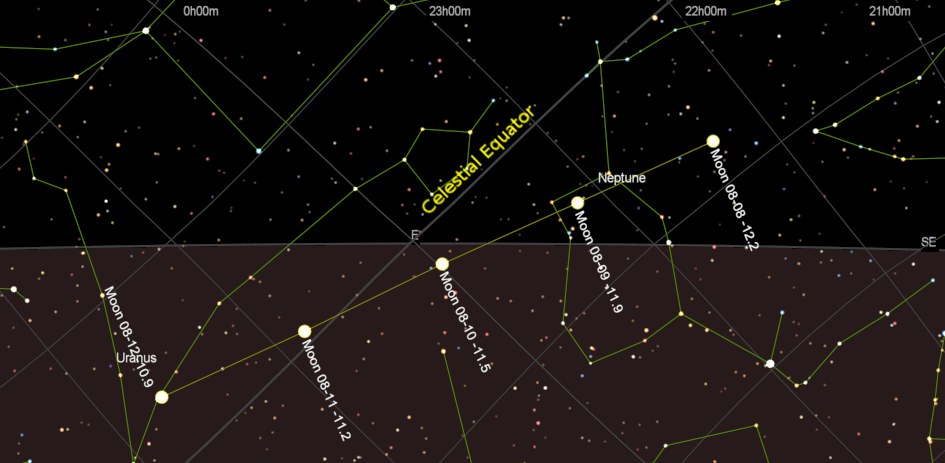
Harvest Moon Effect for this week. Note how shallow the path of the Moon is in relation to the eastern horizon. I’ve made the earth transparent so we can see the Moon below the horizon. As the Earth rotates the Moon will rise in a direction parallel to the celestial equator. In contrast the Moon’s path around March is steeper than average, so the interval in consecutive lunar rise times is much longer than the 50 minute average. Created using Cartes du Ciel (Sky Charts).
06/08/2017 – Ephemeris – The late heavy bombardment of the inner planets
Ephemeris for Thursday, June 8th. Today the Sun will be up for 15 hours and 28 minutes, setting at 9:25, and it will rise tomorrow at 5:57. The Moon, 1 day before full, will set at 6:22 tomorrow morning.
The Moon and many bodies of the inner solar system have many craters which bear witness to many meteorite hits. In studying lunar samples brought back by the Apollo astronauts, from Russian lunar sample return missions and meteorites found on Earth that came from the Moon planetary scientists found that many of their ages correspond to a narrow range of dates of 3.8 to 4.1 billion years ago. Radioisotope dating of rocks would date them to the last time they were molten. This lead to the hypothesis that about a half billion years after the planets were formed, the inner solar system bodies were pelted with millions of asteroids in what is known as the late heavy bombardment. The reason is not completely understood, but one hypothesis is that the outer planets migrated destabilizing the asteroid belt causing the solar system to be a shooting gallery.
The times given are for the Traverse City/Interlochen area of Michigan. They may be different for your location.
Addendum
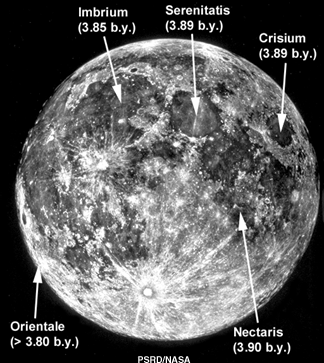
Lunar seas and their ages. Credit NASA.
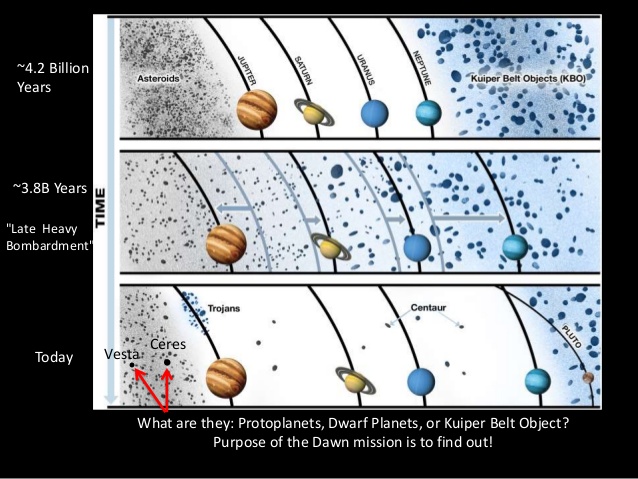
How the migration of the outer planets caused the Late Heavy Bombardment. Credit James Green, Director Planetary Science, NASA.
06/05/2017 – Ephemeris – Why Venus is low in the eastern sky
Ephemeris for Monday, June 5th. Today the Sun will be up for 15 hours and 25 minutes, setting at 9:23, and it will rise tomorrow at 5:58. The Moon, half way from first quarter to full, will set at 4:40 tomorrow morning.
Saturday the planet Venus was at greatest western elongation from the Sun, That is it is the farthest west it will appear from the Sun. It’s still not very high in our sky. However for those in the southern hemisphere Venus will appear very high in the east. There is a rule about this: Planets which are east of the Sun, like Mars is now are easiest seen on spring evenings. Planets which are west of the Sun, like Venus is now are easiest seen on autumn mornings. Since the southern hemisphere has the opposite seasons as the north, this is their autumn, and morning planets are easiest seen. This is especially true for Mercury, which is even closer to the Sun than Venus. Generally it’s only seen when it appears on spring evenings and autumn mornings.
The times given are for the Traverse City/Interlochen area of Michigan. They may be different for your location.
Addendum
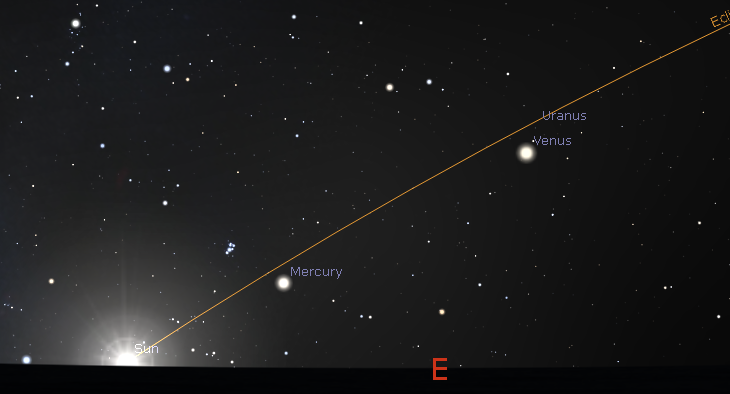
Venus’ low morning appearance is due to the fact that on spring mornings the ecliptic (red line path of the Sun in the sky and nearly that of the planets) lies low to the horizon. Created using Stellarium.
04/14/2014 – Ephemeris – Why does Easter occur on a different Sunday every year?
The answer is astronomical!
Ephemeris for Good Friday, Friday, April 14th. The Sun will rise at 6:59. It’ll be up for 13 hours and 26 minutes, setting at 8:26. The Moon, 3 days past full, will rise at 11:48 this evening.
Easter will be celebrated by western and eastern christian churches this Sunday. Easter is a movable feast in that it falls on a different date each year following the first full moon of spring. It’s an attempt to follow the Jewish Passover, which starts on the 15th of the month of Nisan. Being a lunar calendar the 15th the generally the night of the full moon. And since the Last Supper was a Seder, the Christian church wanted to follow Passover as closely as possible using the Roman solar based calendar where the year was 365.25 days long. Passover started at sunset this past Monday night. The western churches eventually adopted the Gregorian calendar to keep in sync with the seasons. The Eastern churches did not, however Easter is late enough this year so they both fall on the same date.
The times given are for the Traverse City/Interlochen area of Michigan. They may be different for your location.
Addendum
The seasonal, or officially the Tropical Year, from vernal equinox to vernal equinox is approximately 365.24220 days long, about 11 1/2 minutes shorter than the Julian (after Julius Caesar) Calendar year. The Julian Calendar kept up with the year by having three 365 ordinary years and one leap year of 366 days. It over corrects. To make the calculation for Easter easier in the various dioceses of the far-flung church, the vernal equinox, the day the Sun crosses the celestial equator, heading northward was defined as March 21st. The actual vernal equinox was falling behind the Julian Calendar by 0.8 days every century.
By 1582 the Roman Catholic Church under Pope Gregory XIII decided to correct the problem. By then the real vernal equinox occurred on March 11th. Easter is supposed to be a spring feast, and using March 21st as the vernal equinox would eventually push Easter into summer. The Pope instituted a commission to look into the problem. This commission headed by Christophorus Clavius* came up with what we know as the Gregorian Calendar. First, eliminate 10 days from the calendar. This was done in October 1582 between October 4th and 15th. Then to keep the calendar in sync with the actual year it was decreed that leap years would continued for years divisible by 4; except that century years, those divisible by 100 be ordinary years, except those by also divisible by 400. Thus the year 1900 was an ordinary year, but the year 2000 was a leap year, and the year 2100 will be an ordinary year. Adoption of this as a civil calendar took 400 years to be universal.
The Greek Orthodox and other eastern churches kept the Julian Calendar, so on occasion their Easter is sometimes celebrated in May. The Jewish Calendar is, as I alluded to in the program transcript, a lunar calendar. It has a relationship to the Julian Calendar in that 19 Julian Years equals 235 lunar months almost exactly. This is called the Metonic Cycle. Those 235 months equal 12 lunar years of 12 and 13 months. So without correction Passover too will slowly head into summer in millennia to come.
* Clavius was honored by having a large, rather spectacular crater on the Moon named for him. Search these posts for Clavius to find it.
03.14/2017 – Ephemeris – It’s Pi Day!
Ephemeris for Pi Day 3.14, Tuesday, March 14th. The Sun will rise at 7:56. It’ll be up for 11 hours and 51 minutes, setting at 7:47. The Moon, 2 days past full, will rise at 10:04 this evening.
Welcome to Pi Day. I had some NASA inspired links posted on this blog this past Sunday for your enjoyment. Also simply do an Internet search for Pi Day and lots of fun information and activities will be listed. I remember an exercise in high school calculating pi with an inscribed polygon in a circle of ever increasing numbers of sides. Somewhere in there I messed up and came out with an answer that didn’t quite get there. This was in the years B.C. that is Before Calculators. Speaking of round things, Jupiter will rise this evening followed by the Moon and the star Spica in the east. They will all be up by 10:30. Jupiter is not yet an evening planet, since it is not up by sunset. It’s still seen in the morning sky.
Times are for the Traverse City/Interlochen area of Michigan. They may be different for your location.
Addenda
Had I known in the tenth grade this strategy to calculate pi, I could have saved myself a lot of grief. Simply google calculate pi with toothpicks. One of the hits was this from Science Friday: https://sciencefriday.com/articles/estimate-pi-by-dropping-sticks/*. Basically it’s by dropping lots of toothpicks on a piece of paper with parallel lines spaced the length of the toothpicks apart. The total number of toothpicks dropped times two divided by the number of toothpicks that cross a line will approximate pi. The more drops, the closer to pi one gets.
- In the formula in the link, if the length of the toothpicks equals the distance between the lines, those terms drop out of the formula.
Grouping of Jupiter, the Moon and the star Spica
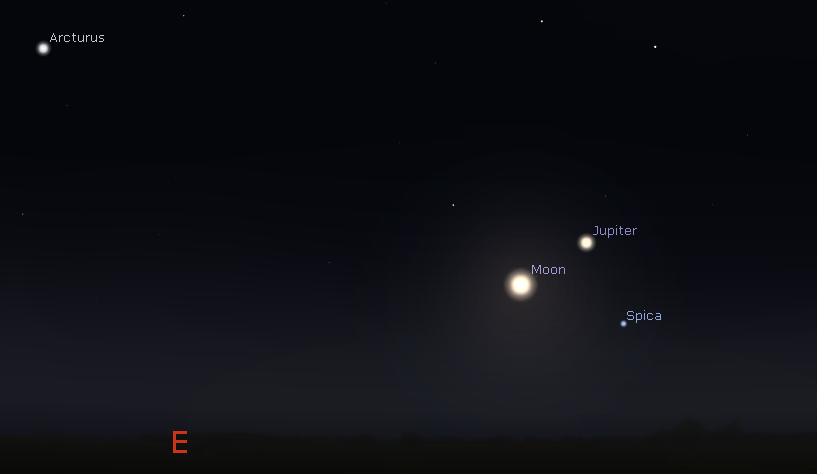
Jupiter, the Moon and the star Spica at 11 p.m. March 14, 2016. Since the Moon moves eastward about its diameter an hour. So observers east or west of here will see the Moon in a different position in relation to these other two bodies. Created using Stellarium.
03/13/2017 – Ephemeris – More thoughts about yesterday’s time change
Ephemeris for Monday, March 13th. The Sun will rise at 7:58. It’ll be up for 11 hours and 48 minutes, setting at 7:46. The Moon, 1 day past full, will rise at 9:03 this evening.
We are now plunged back into dark mornings like we were two month’s ago thanks to the start of Daylight Saving Time. However we are only a week from the vernal equinox, the first day of spring here in the northern hemisphere. However some of my blog followers down under will experience the start of autumn on that day. For us in the next three months the sunrise time will back down 2 hours, and will rise around 6 a.m. Our sunset times will advance a bit less than that, an hour and 45 minutes. The lopsidedness is a consequence of both the Earth’s axial tilt and its slightly elliptical orbit. We are moving somewhat away from the Sun now and are slowing down a bit. It’s all kind of hard to explain, but makes perfect sense… eventually.
Times are for the Traverse City/Interlochen area of Michigan. They may be different for your location.
Addendum
Well, I’m going to try to explain it now.
If one visits most observatories, there will be a clock, usually in the dome that doesn’t seem to read the correct time. We have one in Northwestern Michigan College’s Rogers Observatory’s dome. It only agrees with the time on your watch for an instant on October 16th. It’s called a sidereal clock and it measures Earth’s rotation with respect to the stars, and it gains approximately 4 minutes a day compared to our normal clocks which are geared to the Sun.
The Earth and all the planets orbit the Sun in a counterclockwise direction when seen from the north. Also the Earth and most of the planets spin also in a counterclockwise direction. The exceptions are Venus and Uranus. Most large satellites like our Moon also orbit their planets in a counterclockwise direction. From the surface of the Earth these bodies appear to generally move eastward, while the celestial sphere mirror reflects our eastward rotation by appearing to move east to west.
The Sun appears to move about one degree a day eastward. (360° / 365 days = 1° approximately). The Earth rotates through 15° an hour (360°/24 hours = 15° and 60 minutes in an hour / 15 = 4 minutes to rotate a degree). So on average and approximately after the Earth rotates back to the same point with regard to the stars, it has to rotate and extra degree to catch up to the Sun, which takes 4 more minutes, which is why the solar day is 4 minutes longer than a sidereal day. (Well, 3 minutes 55.9084 seconds if you want to get picky about it!)
Of course it’s not that simple. It never is that simple. This would all work out if the Earth orbited the Sun in a uniform circle and the Earth had no axial tilt. The Earth’s tilt is also called obliquity. The Sun would appear to move uniformly over the Earth’s equator. That Sun, called the mean Sun is what we base our solar time on, not the real Sun. However the Earth’s orbit is elliptical, with the Earth moving fastest at its perihelion or closest point to the Sun, around January 3rd, and slowest at aphelion or farthest point around July 4th. Also the Earth’s axial tilt is 23 ½ °, and is only on the equator two days a year March 20th and September 23rd.
Ever see this funny figure 8 in the Pacific Ocean on old globes?
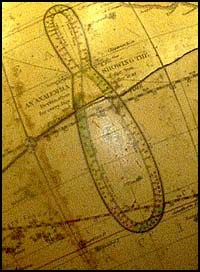
Illustration 1. An Analemma graphically demonstrating the actual Sun’s relation to the mean Sun during the year.
Both eccentricity and obliquity work together to produce the analemma as seen in the diagram below. This figure 8 can actually be photographed in the sky by exposing the same frame of film at regular intervals, or stacking images of the same area of the sky over a year at the same time of day. There are plenty of examples using an Internet search engine to search for analemma images. It is one way to illustrate the equation of time, which is the correction one must make to a sundial reading to get to the correct local mean solar time. To that one must add or subtract one’s offset from the time zone’s time meridian. See Friday’s post.
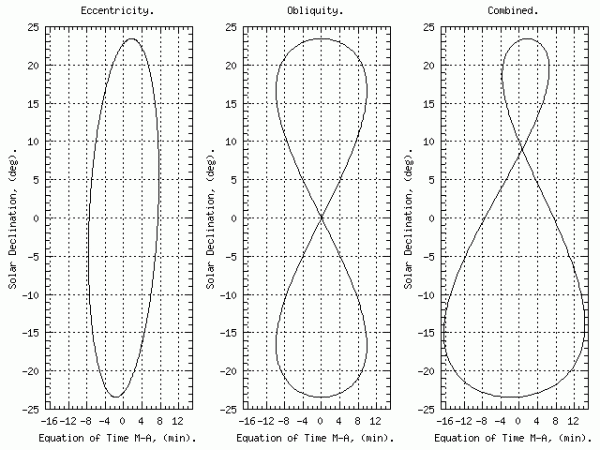
Illustration 2. How eccentricity of the Earth’s orbit and obliquity combine to affect the analemma. The effects add at the bottom near the winter solstice and subtract near the summer solstice.
The above diagram was taken from Ethan Siegel’s Starts with a Bang blog: http://scienceblogs.com/startswithabang/2010/12/17/celebrate-this-winter-solstice/ which also explains it.
The equation of time can be found in tabular form for easy sundial correction, or in a linear graphical form as seen below.
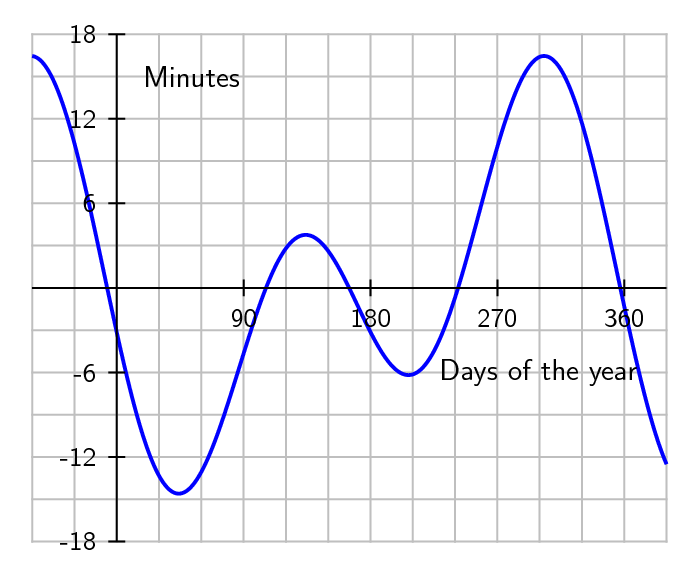
Illustration 3. Linear representation of the equation of time
Actually the biggest effect on the equation of time, is especially near the solstices is the Earth’s obliquity (axial tilt). Below we see how the Sun’s declination affects how fast it appears time wise.
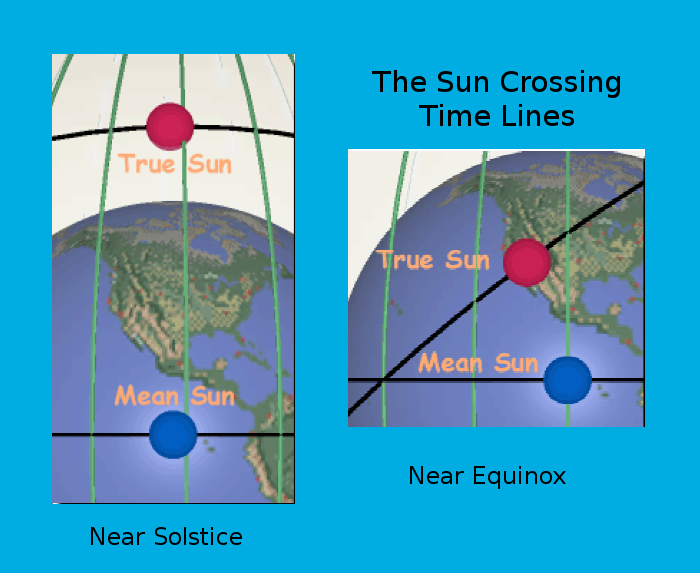
Illustration 4. How the Sun’s declination affects how rapidly it appears to cross time lines (meridians).
Declination of celestial objects is the same as latitude on the Earth. A star whose declination is the same value as one’s latitude will cross at the zenith once a day. In illustration 4 note that the near the solstices the time lines (meridians) are closer together, so the Sun will pass them faster than when near the equinoxes where the time lines are farther apart and the Sun is moving somewhat diagonally, taking longer to cross the time lines. In time only east-west motion counts.
Looking at Illustration 2, I’ve added arrows at the top (northern) and bottom (southern) extremities of each analemma source to give some idea of the Sun’s apparent speed at the solstices. At the bottom, near the December solstice the eccentricity speed of the Sun adds to the obliquity speed increasing the effects at that part of the analemma lobe, making it bigger. At the June solstice end of things eccentricity speed is in the opposite direction, slowing the Sun down.
So what? This affects the dates of the earliest and latest sunrises and sunsets. Here are those dates and time values for us here in northern Michigan (specifically the Interlochen/Traverse City area):
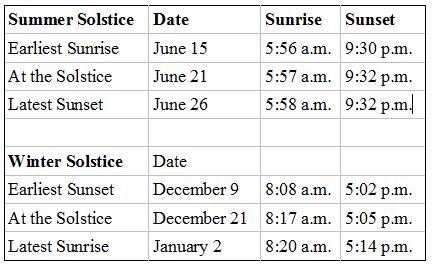
Table of Earliest and Latest Sunrises and Sunsets during the year for Interlochen/Traverse City area of Michigan.
All this may make little difference to our modern lives, governed by the atomic clocks in Paris and Fort Collins, Colorado, divorced as they are from the Earth’s actual rotation and the Sun except for the inclusion of the occasional leap second, like we had last December 31st. To folks like me who are amateur astronomers and have (or had in my case) a day job, it would’ve been nice to have, on the summer solstice, astronomical evening twilight end before midnight.
I hope this helped rather than confused you. What do you think? drop me a comment.
03/10/2017 – Ephemeris – Daylight Saving Time starts Sunday
Ephemeris for Friday, March 10th. The Sun will rise at 7:03. It’ll be up for 11 hours and 39 minutes, setting at 6:42. The Moon, 2 days before full, will set at 6:38 tomorrow morning.
Daylight saving time will begin this Sunday at 2 a.m. That means “spring forward”, setting our clocks ahead an hour. Did you know that we spend more time under daylight time than standard time. Standard time only lasts about 4 months and one week. The rest of the time, nearly 8 months is spent under daylight time. According to theory, anyway, one’s time meridian should run in the middle of its time zone. Right now our standard time meridian of 75 degrees west longitude runs through Philadelphia, 5 hours west of the prime meridian of Greenwich. Come Sunday our time meridian will be 60 degrees west longitude, in the Atlantic at our latitude, and further to the north just touches the eastern tip of Nova Scotia. In relation to the actual Sun we will be an hour and 43 minutes behind it, which is why sundials don’t tell the correct time around here.
Times are for the Traverse City/Interlochen area of Michigan. They may be different for your location.
Addendum
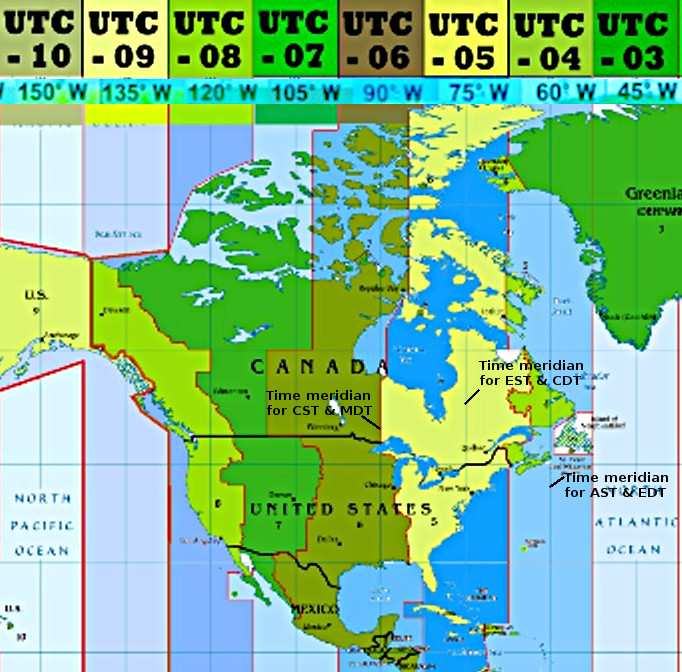
Time zones with their meridians for North America.
11/24/2016 – Ephemeris – The little constellation that used to start the seasonal year
Ephemeris for Thanksgiving Day, Thursday, November 24th. The Sun will rise at 7:52. It’ll be up for 9 hours and 14 minutes, setting at 5:06. The Moon, 3 days past last quarter, will rise at 3:54 tomorrow morning.
From antiquity, the first constellation of the Zodiac has been Aries the ram. That’s the constellation the Sun entered on the first day of spring, or the vernal equinox. Well that was a couple of thousand years ago. Currently the vernal equinox point is in western Pisces. This is due to the wobbling of the Earth’s axis called precession. The spinning Earth like and top or gyroscope wobbles when force is applied to it. In this case the Sun and Moon. One wobble takes 26,000 years to complete. Anyway, Aries is a small constellation of four stars in a bent line, below the triangular constellation of Triangulum, which is itself below Andromeda. It’s a bit west or right of the Pleiades or Seven Sisters star cluster.
Times are for the Traverse City/Interlochen area of Michigan. They may be different for your location.
Addendum
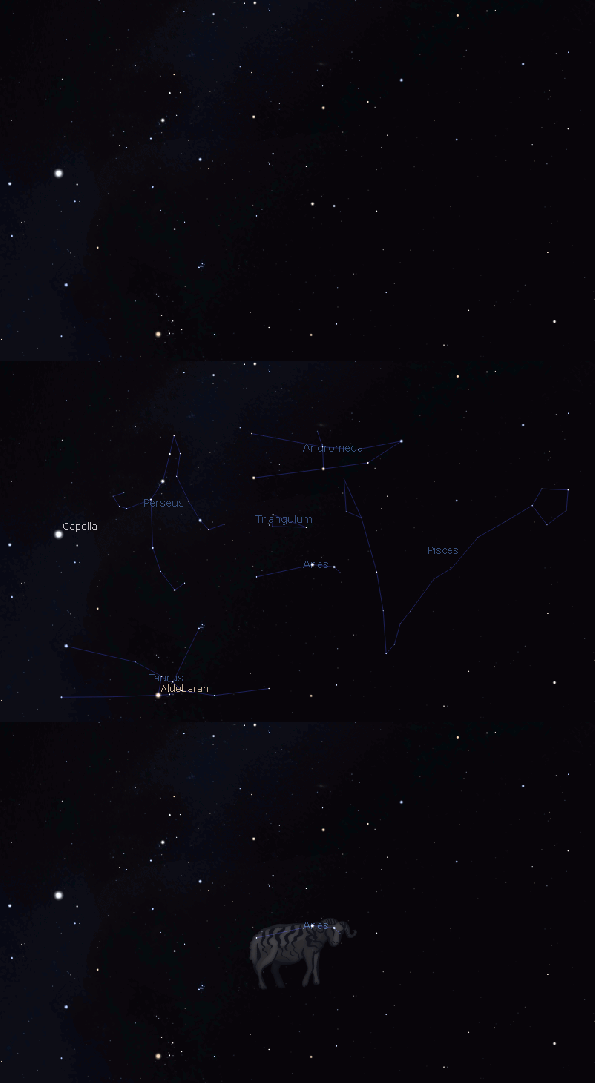
Aries the ram animated finder chart for 9 p.m. November 24, 2016. Created using Stellarium and GIMP.
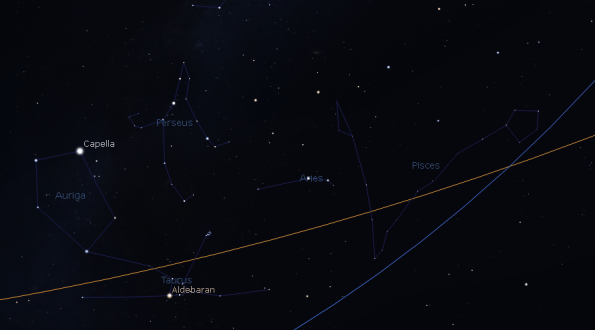
The vernal equinox today, where the blue line, the celestial equator and the orange line, the ecliptic or path of the Sun cross. The Sun is where these lines cross on the first day of spring (March 20th around here). Note that the vernal equinox is now in western Pisces. Created using Stellarium.
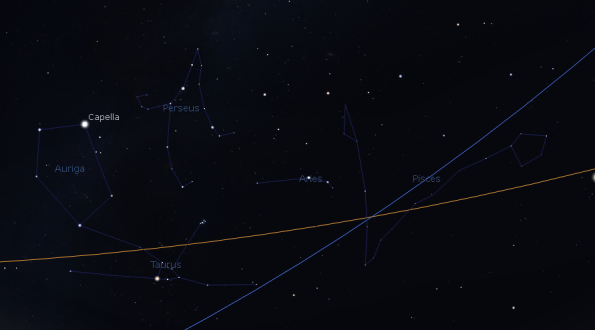
The vernal equinox back in AD 100, where the blue line, the celestial equator and the orange line, the ecliptic or path of the Sun cross. The Sun is where these lines cross on the first day of spring. Note that the vernal equinox was at the east edge of Pisces. Created using Stellarium.
09/12/2016 – Ephemeris – Mercury passes inferior conjunction with the Sun today
Ephemeris for Monday, September 12th. The Sun will rise at 7:18. It’ll be up for 12 hours and 39 minutes, setting at 7:58. The Moon, 3 days past first quarter, will set at 3:34 tomorrow morning.
Today the Planet Mercury will pass inferior conjunction, that is move between the Earth and the Sun. Unlike last inferior conjunction, when it passed directly in front of the Sun on May 9th. This time it will pass below the Sun. The term inferior means it is between the Earth and the Sun. A superior conjunction is when Mercury passes the back side of the Sun. Mercury will be moving into the morning side of the sky, and toward the end of the month it will be much easier to spot than it was last month when it was low in the west. On autumn mornings the ecliptic, the path of the Sun and planets, sticks up, close to vertical, while in the evenings it lies close to the horizon, which is also why Venus sets so soon after the Sun now.
Times are for the Traverse City/Interlochen area of Michigan. They may be different for your location.
Addendum
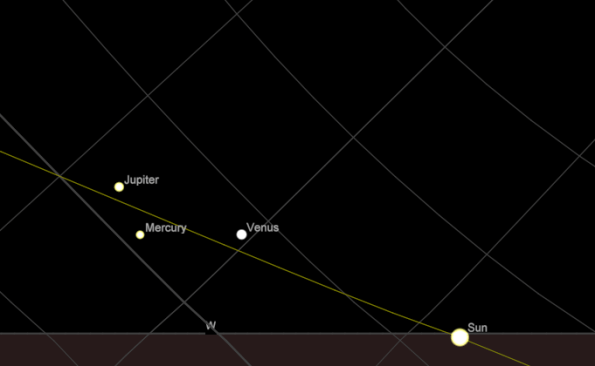
Mercury last August 16 at greatest eastern elongation. Note how low Mercury is to the horizon at sunset. Created using Cartes du Ciel (Sky Charts).
Note in the charts above and below the line passing through the Sun, and the one the planets hang around is the ecliptic, the projection of the Earth’s orbit on the celestial sphere. The grid line running through the west compass point at the horizon is the celestial equator. I’m allowing us to see below the horizon. As planets rise, move across the sky and set they will appear to move parallel to the celestial equator.
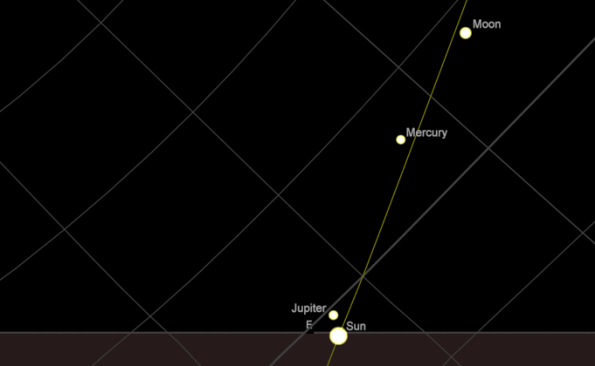
Mercury this coming September 28 at greatest western elongation. Note how high Mercury is to the horizon at sunrise. Created using Cartes du Ciel (Sky Charts).
Note too that Mercury appears farther from the Sun on August 16th than at September 28th. And it is. On August 16th Mercury appears 27.4 degrees from the Sun. On September 28th, it’s only 17.8 degrees. That’s a big advantage for observers in the southern hemisphere. The best times to see an eastern elongation of Mercury is on winter and spring evenings, and the best times to see a western elongation of Mercury is on summer and autumn mornings. Since the seasons are reversed from the northern hemisphere to the southern hemisphere. Our not so good August 16th elongation of Mercury was a really good one for folks south of the equator. We’ll return the favor September 28th. But the best southern hemisphere greatest elongations are always greater in the separation of Mercury from the Sun than northern ones because Mercury has a markedly elliptical orbit.
06/27/2016 – Ephemeris – Astronomical twilight lasts till after midnight… Bummer!
Ephemeris for Monday, June 27th. Today the Sun will be up for 15 hours and 33 minutes, setting at 9:32, and it will rise tomorrow at 5:59. The Moon, at last quarter today, will rise at 1:57 tomorrow morning.
Here we are a week into summer and we find that the latest sunset was already last night. That means that the last vestiges of twilight* don’t end until just after midnight. It wouldn’t be so bad if the Sun was in the south at noon instead of 1:43 in the afternoon, due to being in the extreme western part of the eastern time zone and the imposition of daylight time. For latitudes north of 48 ½ degrees, twilight currently doesn’t end. That latitude will move northward as the Sun heads south. As it is now we in the Grand Traverse region are currently getting only 4 ½ hours of darkness Moon willing. And it won’t for the next few days at least. Our darkness situation will start to get better in about a month from now.
Times are for the Traverse City/Interlochen area of Michigan. They may be different for your location.
*Astronomical twilight begins and ends when the Sun is 18° below the horizon.
 Bob Moler's Ephemeris Blog