Archive
06/22/2015 – Ephemeris – The summer full moon and the winter Sun trade places
Ephemeris for Monday, June 22nd. Today the Sun will be up for 15 hours and 34 minutes, setting at 9:32. The Moon, 2 days before first quarter, will set at 1:04 tomorrow morning. Tomorrow the Sun will rise at 5:57.
Summer’s here, and it’s a few days before the latest sunset and latest end of twilight. It might be instructive to check out the height of the moon over the next two weeks or so. The moon is heading south in front of the Sun. The Sun besides its apparent westward motion during the day caused by the Earth’s rotation also moves about twice its diameter each day eastward against the stars caused by the earth’s motion in its orbit of the Sun. Around July 1st, the moon will be about where the Sun will be next winter solstice, 4 days before Christmas. Actually it will be about 8 moon widths above where the Sun will be because its orbit is tilted a bit to the Earth’s. But it will serve as an illustration of the seasonal difference.
Times are for the Traverse City/Interlochen area of Michigan. They may be different for your location.
Addendum
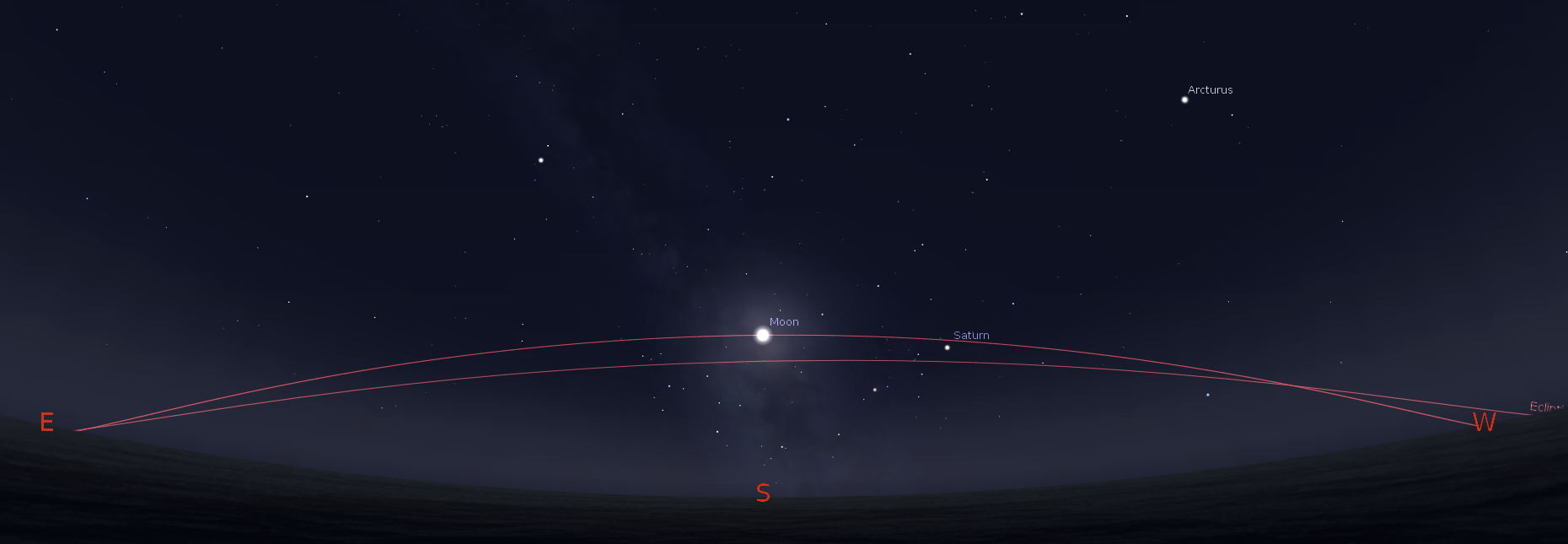
The full moon nearest the summer solstice. The full moon appears near where the sun would appear low in the south at the winter solstice. The bottom red line is the ecliptic, the path of the Sun. Created using Stellarium.
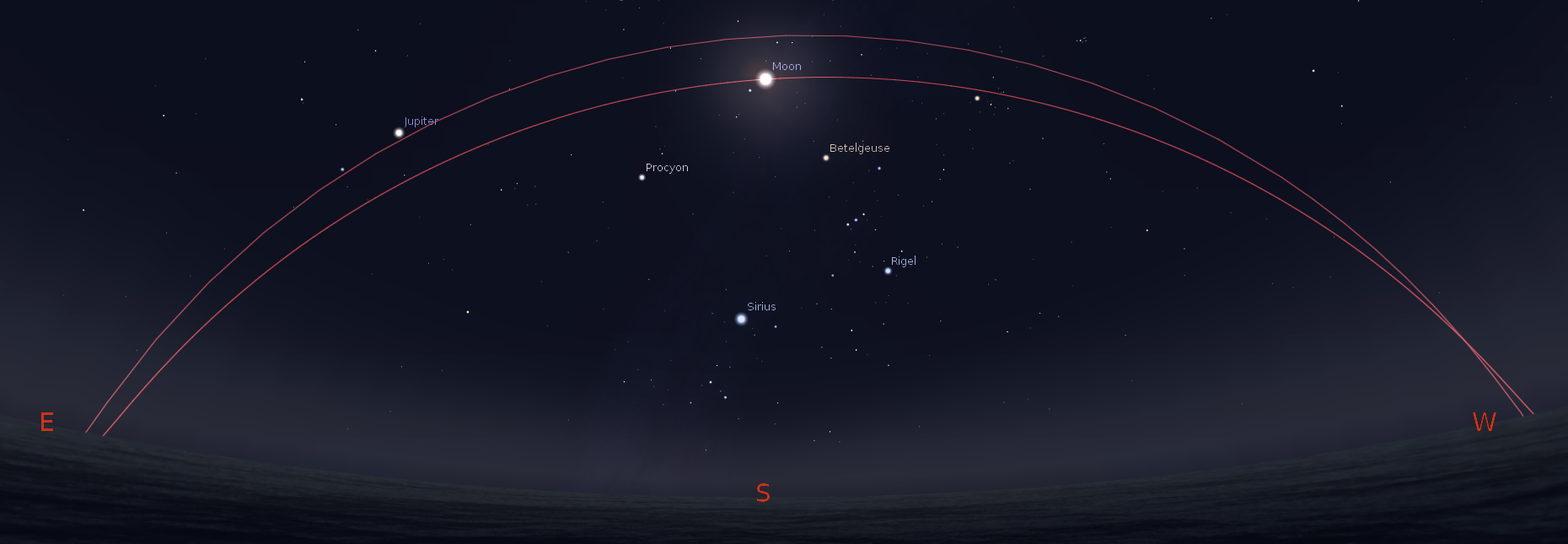
The full moon nearest the winter solstice. The full moon appears near where the sun would appear high in the south at the summer solstice. The top red line is the ecliptic, the path of the Sun. Created using Stellarium.
The Moon’s orbit has a slight tilt of a bit more than 5 degrees from the ecliptic, or plane of the Earth’s orbit of the sun. The crossing point is called a node. In the bottom image the node near the western horizon is called the descending node due to the fact that the Moon is heading south of the ecliptic. When the Sun and Moon are near the same node the Moon will be new and we have a chance for a solar eclipse. When at opposite nodes, a lunar eclipse. The nodes slowly slide westward slowly one revolution in about 18.6 years, which causes eclipse seasons, about 6 months apart to occur a bit earlier each year.
06/15/2015 – Ephemeris – The earliest sunrise
Ephemeris for Monday, June 15th. Today the Sun will be up for 15 hours and 33 minutes, setting at 9:30. The Moon, 1 day before new, will rise at 6:19 tomorrow morning. Tomorrow the Sun will rise at 5:56.
This is the day of the earliest sunrise. We are still six days from the summer solstice, that day the Sun stays up the longest. And 11 days from the latest sunset. I could be off a day since I don’t calculate sunrise and sunset times to the second. I use the standard formula for these computations, which, among other things assumes that the horizon is the sea horizon. If you’re standing on the bluffs overlooking Lake Michigan, sunset would be slightly later than one seen down on the shore, and for the Sleeping Bear Dunes or Empire Bluff, your sunset would be 2 minutes later that Traverse City or Interlochen anyway because that’s west of them. At the latitude of 45 degrees the rise and set times are 1 minute later for each 12 and a half miles west you are.
Times are for the Traverse City/Interlochen area of Michigan. They may be different for your location.
Addendum
The discussion turned from sunrises to sunsets. Well, sunsets are a bigger deal this side of the state. I suppose that if I lived in Alpena or Rogers City, I’d be more interested in sunrises. The timing difference for the rising and setting of celestial objects depends on the longitude one is versus the longitude of the position for which it is calculated, as long as one stays at roughly the same latitude. The times for this program are for a position roughly half way between Interlochen and Traverse City. Full disclosure: It’s the Moler homestead. Back, when I started this program in 1975, it was an era I call BC. Before Computers, well before personal computers. I used the rising and setting tables from the Royal Canadian Astronomical Society’s Observer’s Handbook for the year in question, adjusting for longitude. I climbed op on my rooftop to verify the times several times a year. That was back when my house wasn’t surrounded by trees.
In the sky east or west, what we call longitude on the Earth is marked not in degrees, but in hours, minutes and seconds. Since 360 degrees or Earth’s rotation equals 24 hours, one hour equals 15 degrees, and each degree equals 4 minutes. In Traverse City, near 45 degrees north latitude, The longitude lines are closer than at the equator. They are 71% that of the equatorial separation. Working it out, each minute of rotation equates to 12.31 miles. The 12 1/2 miles is close enough for radio, and besides I had calculated it a looooong time ago and was pulling it off the top of my head. I recalculated it just now.
Any change time in the rising and setting of objects for persons north or south of the standard position depends on the object’s declination (latitude in the sky) north of south of the celestial equator, so the calculation isn’t as simple.
06/04/2015 – Ephemeris – Venus’ greatest eastern elongation from the Sun is Saturday
Ephemeris for Thursday, June 4th. Today the Sun will be up for 15 hours and 24 minutes, setting at 9:23. The Moon, 2 days past full, will rise at 11:06 this evening and tomorrow the Sun will rise at 5:58.
On Saturday Venus will reach its greatest eastern elongation or separation from the Sun of 45.4 degrees angle. It’s phase should be that of exactly half illuminated by the sun. The problem is that the date it is exactly half illuminated can vary from 1 to 4 days from the greatest elongation. Of course this is something that has to be seen in a telescope. Try to catch Venus in bright twilight so its bright glare is minimized. I find that a moon filter fitted to the eyepiece gets rid of the glare nicely. After that time Venus will to begin to move toward the Earth, then curve around in its orbit to pass between the Earth and the Sun. As it does so it will increase its apparent size and its phase will become a crescent.
Times are for the Traverse City/Interlochen area of Michigan. They may be different for your location.
Addendum
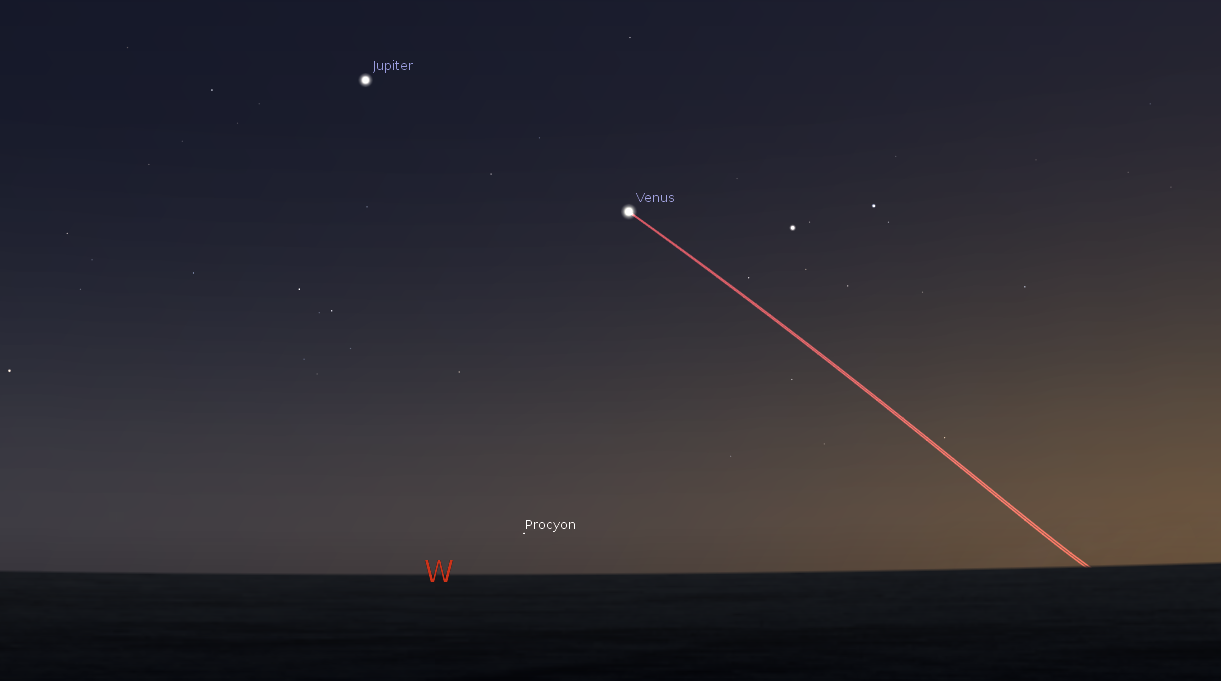
Venus at elongation with a plot of its orbit as seen from Earth at 10:30 p.m. June 6, 2015. Note that the orbit appears at a line. It is this time of year that the Earth passes through the plane of Venus’ orbit. Back in 2012 this occurred when Venus was at inferior conjunction on June 5th. It passed in front of the Sun in the rare transit of Venus. Created using Stellarium.
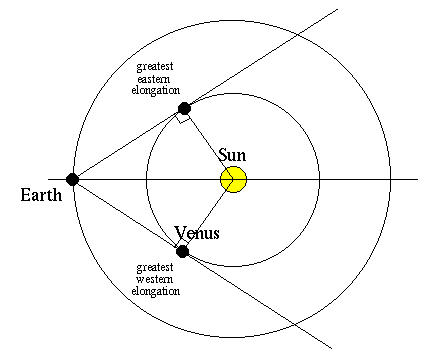
Diagram showing the geometry of a greatest elongation. Note that the sight line is perpendicular to the Venus-Sun line. So the phase should be exactly at dichotomy (half illuminated). Additional lines added to an uncredited diagram.
04/28/2015 – Ephemeris – Why do the stars of winter disappear so fast?
Ephemeris for Tuesday, April 28th. Today the Sun will be up for 14 hours and 6 minutes, setting at 8:43. The Moon, 3 days past first quarter, will set at 4:32 tomorrow morning. Tomorrow the Sun will rise at 6:36.
At 9:30 p.m. the winter constellation of Orion is above the western horizon, but barely visible in the bright twilight. The sun is moving eastward and northward, setting at about 1 minute and a quarter later each night. That minute and a quarter is due to the Sun’s northward motion north. The Sun’s eastward motion, which is actually the Earth’s orbital motion around the sun, makes the stars set approximately 4 minutes earlier each night. That’s because our time is kept based on the Sun, not the stars. What happens is that the winter stars seem to disappear rather rapidly. We lose the bright stars and constellations of winter which are replaced by the sparser constellations of spring.
Times are for the Traverse City/Interlochen area of Michigan. They may be different for your location.
03/23/2015 – Ephemeris – Olbers’ Paradox or why it’s dark at night
Ephemeris for Monday, March 23rd. The Sun will rise at 7:40. It’ll be up for 12 hours and 17 minutes, setting at 7:58. The Moon, 3 days past new, will set at 12:12 tomorrow morning.
Why is it dark at night? It seems like a dumb question but it isn’t, or wasn’t when the question was first asked by Henrich Wilhelm Olbers who lived from 1768 to 1840. The dark sky problem is called Olbers’ Paradox. If the universe was uniformly filled with stars and infinite in size all the stars would overlap giving a bright sky, day or night. The fact that it doesn’t tells us something about the universe. Stars are not uniformly scattered throughout the universe, they are bound up into galaxies, also the more distant stars in their galaxies are red shifted, losing energy. Also if the universe is really infinite, parts of it are receding faster than the speed of light, so we can’t see them. Receding faster than light, how can that be? Though matter cannot move faster than light, space can expand faster than light.
Times are for the Traverse City/Interlochen area of Michigan. They may be different for your location.
Addendum
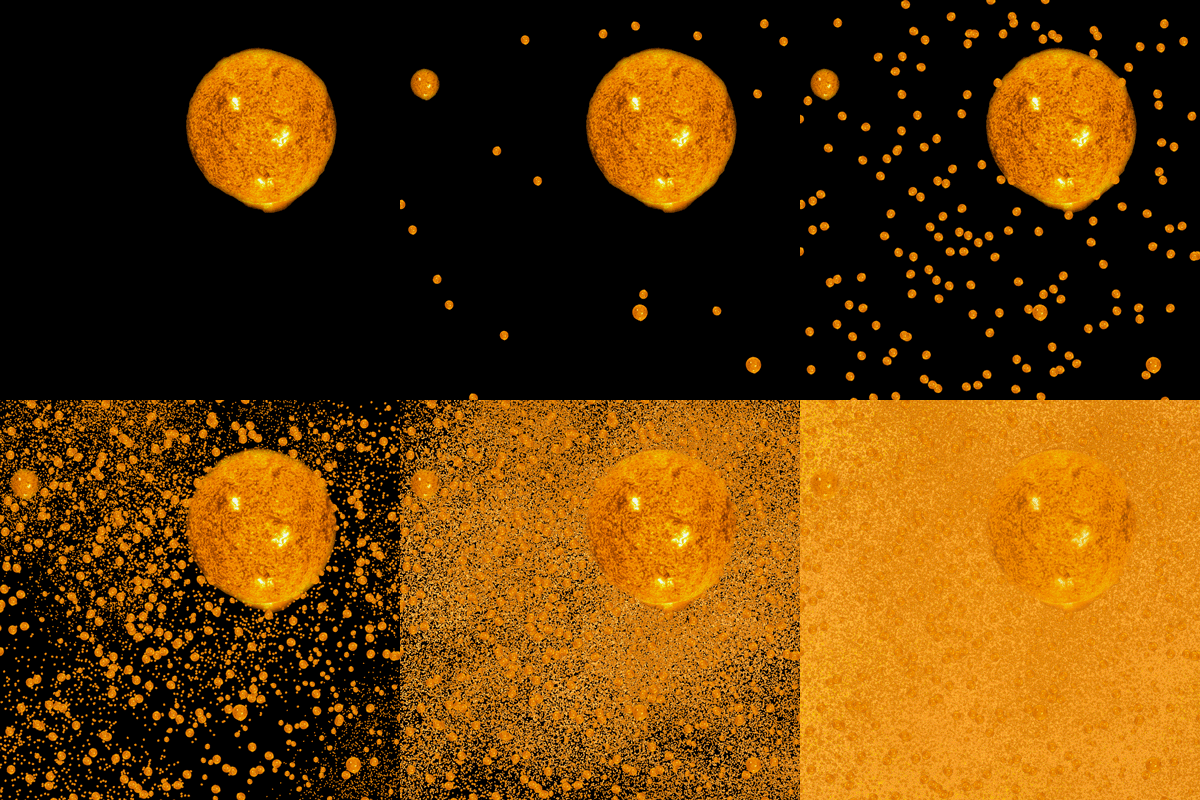
“Olbers’ Paradox – All Points.” Credit: Kmarinas86, Licensed under CC BY-SA 3.0 via Wikimedia Commons
More questions about the length of daylight hours
This is the result of a question I got about why the daylight hours change the way they do during the year. My answer is posted here as “How come hours of daylight changes very slowly around the solstice, but very rapidly around the equinoxes?”
My correspondent has a few more questions. I’ll boil them down.
I pretty much understand why daylight changes rapidly at the equinoxes and slowly at the solstices based upon your map showing the ecliptic and how the steepest part is at the equinoxes. Also, the figure eight drawing makes sense. But why does the curve of the ecliptic seem to linger for a time at the solstices before plunging? Does it have to do with the speed of the Earth in its orbit?
The analemma, as seen below, is the result of two phenomena. First, the tilt of the Earth’s axis which would on itself make a figure 8 with equally sized lobes, with crossing point at the equinoxes. Second, the Earth’s orbit of the Sun is a slight ellipse, meaning for our purposes here that the Earth moves its fastest near perihelion when the Earth is nearest the Sun, around January 4th. and slowest at aphelion, when the Earth is farthest from the Sun, around July 4th. That makes the bottom lobe larger because the Sun is by reflection moving faster eastward in the sky. The apparent slowness that the questioner perceives is an illusion because the Sun appears to be moving in a more directly eastward, and changed the actual time of local solar noon. Wikipedia has a detailed discussion of the analemma.
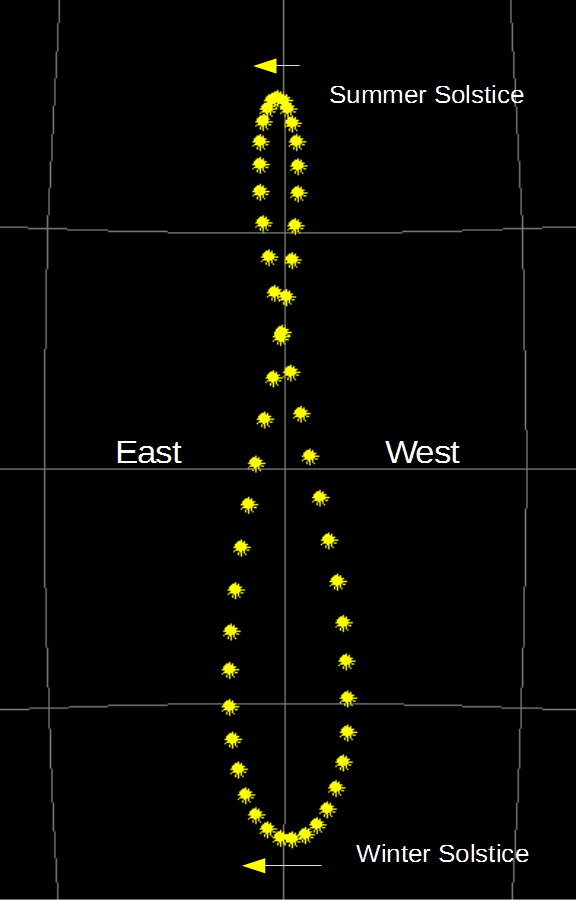
This figure 8 is called an analemma. One can find it on old globes in the Pacific Ocean. Explanation below. Created using my LookingUp program.
I had stated in the prior post that daylight hours would be 12 hours at the equinoxes and also all the time at the equator. So here’s the other question.
At the equator, day length does change over the course of the year, doesn’t it? At the equinoxes it would be 12 hours long, but at the summer solstice up north it would sink towards the south by 23 degrees and at the summer solstice in the south it would sink towards the north by the same amount.
Other than getting cooperation from someone who either lives on or has visited the equator, I generated a calendar of sunrise and sunset times for the equator, specifically for 0º longitude and 0º latitude. A link to it is here. Also read the explanation on that calendar page.
The answer is No, the daylight hours at the equator doesn’t change over the year. The one minute variance has to do with the Analemma.
How come hours of daylight changes very slowly around the solstice, but very rapidly around the equinoxes?
This question came in as a an off topic comment to my post yesterday 01/09/2015. It deserves a good answer. So here goes.
Day to day change in daylight hours occur when the Sun appears to move south or north. For us in the northern hemisphere the daylight hours get shorter when the Sun appears to move south, and longer when the Sun appears to move north. If we spread out the sky in a Mercator projection, like they do the earth or one of those satellite tracking maps, it would look like the image below.
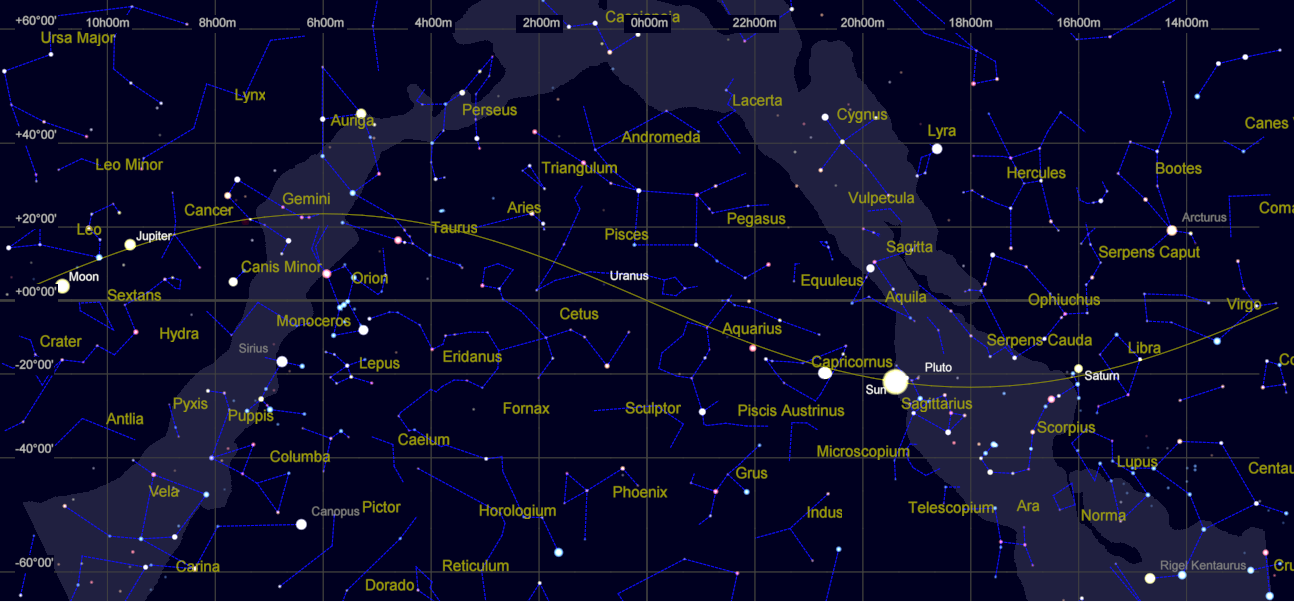
Mercator projection of the heavens from declinations +60 to -60 degrees declination, centered on the vernal equinox. The center horizontal white line is the celestial equator, and the yellow sinusoidal line is the ecliptic, the apparent path of the sun. Note the planets and Moon also stick close to that line. The date of the image is January 9, 2015. Venus and Mercury are on top of each other and unlabeled under the ‘a’ in Capricornus. Created using Cartes du Ceil (Sky Charts). Click image to enlarge.
Note that the steepest part of the ecliptic occurs at the equinoxes, the vernal or March equinox in the center and the autumnal or September equinox at the left and right edges. That’s where the sun’s motion north or south is the greatest, so the daily change in daylight hours is the greatest. Near the solstices at 6 and 18 hours* the Sun isn’t changing its north-south motion very much, so the daylight hours aren’t changing much from day to day. If you were watching the sky at local solar noon, you’d think that at the solstice the sun would stop its motion and stand still before heading back. That’s what the word solstice means: sun-standstill. The variation is daylight hours also depends on your location. At the equator, it doesn’t change at all. Of course at the other extreme, at the poles, there’s 6 months of daylight and 6 months of night.
* The east-west direction in the heavens is like longitude on the Earth but it’s called right ascension and is measured in hours where 15 degrees equals one hours. Astronomers use clocks to keep track of it. Declination is the same as latitude on the Earth. In astronomy longitude and latitude were already in use for ecliptic based coordinates.
So what causes the wavy path in the sky? Lets check out the earth from the sun’s point of view, so to speak.
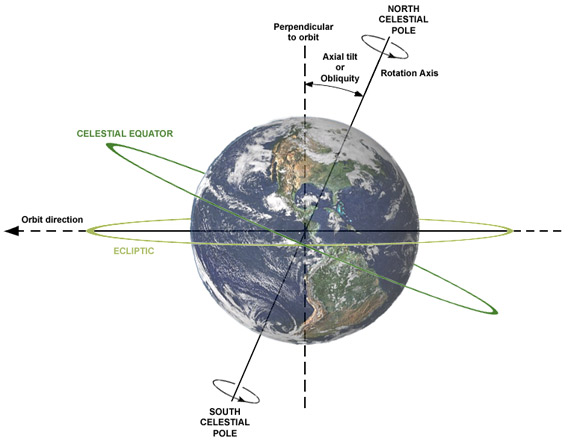
Earth’s axial tilt. The horizontal line is the plane of the Earth’s orbit and what we see projected on the sky as the ecliptic. The tilt of the Earth’s axis to the plane of its orbit by 23 1/2 degrees, gives us the seasons and why the celestial equator and ecliptic cross at a 23 1/2 degree angle. Credit Dennis Nilsson.
Both the celestial equator and the ecliptic are great circles in the sky. They intersect at an angle of 23 1/2 degrees at the equinox points.
Lets take a look at the difference in daylight hours at three times in the year, the equinox and the two solstices for Traverse City, MI whose latitude is just shy of 45° north. The following three images were generated in stereographic projection, which exaggerates the distance of things near the horizon and diminishes the distance of things in the center, the zenith. So actually the speed of the sun is unchanging across the sky.
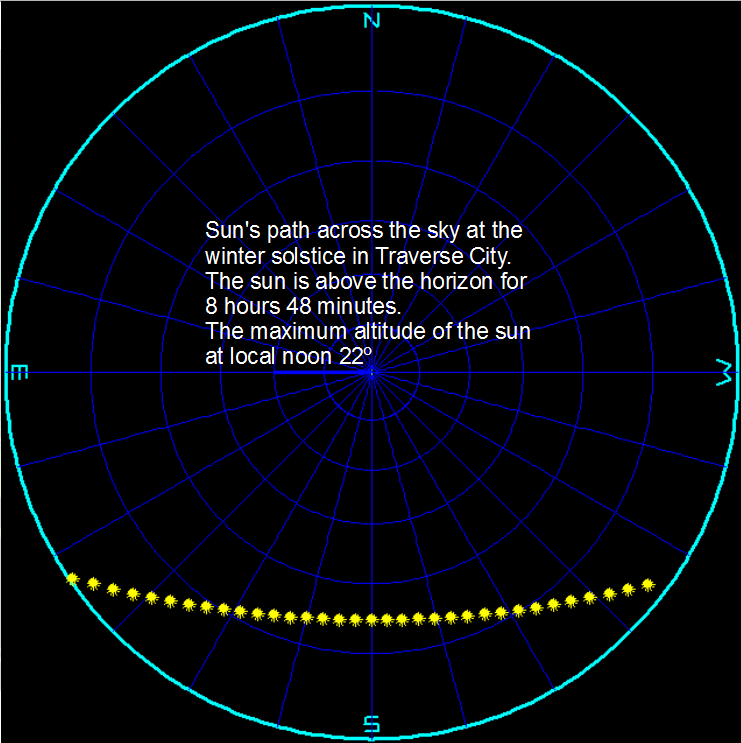
The sun’s daily path through the sky from horizon to horizon on the first day of winter, the winter solstice. Credit My LookingUp program.
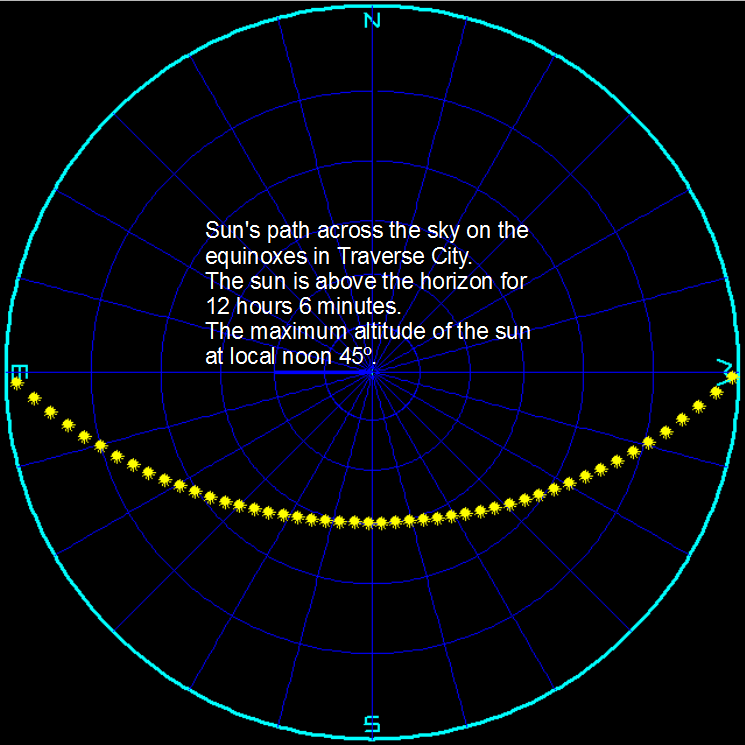
The sun’s daily path through the sky from horizon to horizon on an equinox the first day of spring or autumn. Credit My LookingUp program.
Note that at the equinox the sun rises due east and sets due west.
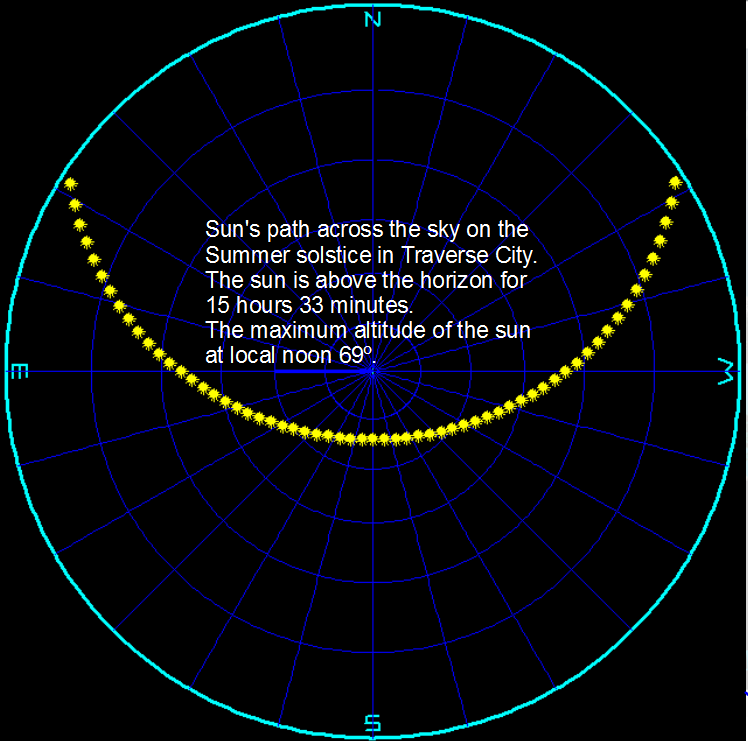
The sun’s daily path through the sky from horizon to horizon on the first day of summer, the summer solstice. Credit My LookingUp program.
One more diagram to illustrate the change in the sun’s north-south position in the sky.
This figure 8 is called an analemma. One can find it on old globes in the Pacific Ocean. Created using my LookingUp program.
This is the Sun plotted for mean solar noon over one year at 7 day intervals. One can see the rapid motion in the north-south position of the sun around the equinoxes versus the solstices. The more rapid the north-south motion of the Sun the greater the change in day-to-day daylight hours. The line with “East West” on it is the celestial equator. Check out my December 2, 2014 post on why it’s a figure 8.
12/02/2014 – Ephemeris – The unequal dates of latest sunrise and earliest sunset
Ephemeris for Tuesday, December 2nd. The sun will rise at 8:00. It’ll be up for 9 hours and 3 minutes, setting at 5:03. The moon, 3 days past first quarter, will set at 4:41 tomorrow morning.
This evening’s sunset is just a minute from the earliest sunset of the year. The Earliest sunset will actually be on the 9th. However the latest sunrise won’t occur until January 2nd. The reason combines the effects of the tilt of the earth’s axis and the fact that the Earth is only a month from perihelion, its closest to the Sun. Both these effects cause the sun to appear to move faster eastward than average, so the Earth has to rotate a bit farther each day to catch up with the Sun. This makes the sunrise and setting events later than one would expect, so they don’t occur together on the shortest day of the year, the 21st this year. Our sunrise this morning is still 19 minutes earlier than the latest sunrise on January 2nd, 2015.
Times are for the Traverse City/Interlochen area of Michigan. They may be different for your location.
Addendum
This figure 8 is called an analemma. One can find it on old globes in the Pacific Ocean. Explanation below. Created using my LookingUp program for Traverse City, MI near +45° latitude.
The analemma is a graphical representation of a daily value called the Equation of Time. It’s best known use is in corrections to sundial time. The vertical axis is the sun’s declination or north-south position. It is highest at summer solstice and lowest at winter solstice. It is the result of two effects: the tilt of the Earth’s axis to the plane of the Earth’s orbit around the Sun, and the change in the Earth’s velocity around the Sun as the Earth moves from perihelion, its closest to the Sun in early January to aphelion, its most distant in July.
If the Earth’s orbit were circular, and it orbited the Sun at the same speed. The analemma would be skinner and the north and south lobes would be of equal size. Since we’re closer to the Sun in the winter, we move faster than average around the Sun, so it appears to move faster eastward. That combines with the faster appearing movement of the sun crossing the closer hour lines at higher and lower declinations. In the diagram above note that the vertical hour lines are slightly closer together at the bottom and the top, so the Sun, moving eastward each day crosses them quicker. Near the winter solstice the two effects work together making sunrise and sunset trending to be later than normal. For the summer solstice the eastward speed of the sun is slower than normal, because we’re farther from the Sun. This works against the effect of the earth’s tilt but cannot completely negate it, making the top of the loop smaller than the one at the bottom. The arrows show the speed and direction of the Sun at the solstices.
To see real analemmas search for analemma images on the Internet. It takes a year to photograph one.
11/21/2014 – Ephemeris – The Hyades a very important star cluster
Ephemeris for Friday, November 21st. The sun will rise at 7:47. It’ll be up for 9 hours and 22 minutes, setting at 5:09. The moon, 1 day before new, will rise at 7:42 tomorrow morning.
The face of the constellation Taurus the bull looks like the letter V sideways above the rising Orion the Hunter in the east at 9 p.m. The bright star at the tip of a letter V of stars is Aldebaran. Look with binoculars at the letter V shape and you will see the stars of the Hyades star cluster The Hyades is the closest star cluster to us, at about 151 light years. And is important for that reason. Before satellites like Hipparcos. The Hyades were the only star cluster to be directly measured by a technique called parallax, using the radius of the earth’s orbit as one side of a surveyors enormous triangle. Its many stars at the same distance were used to determine distances of star clusters even farther away. Additional techniques based on the distance of the Hyades allow us to measure distances to the galaxies.
Times are for the Traverse City/Interlochen area of Michigan. They may be different for your location.
Addendum
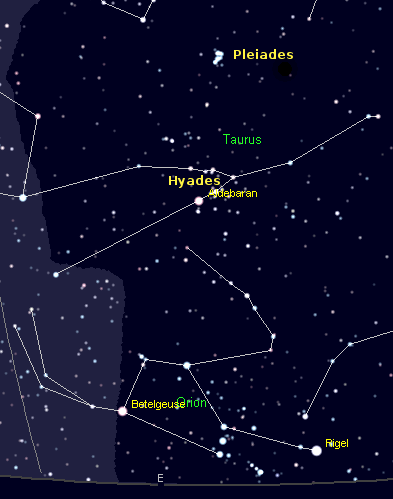
Orion and the Hyades.
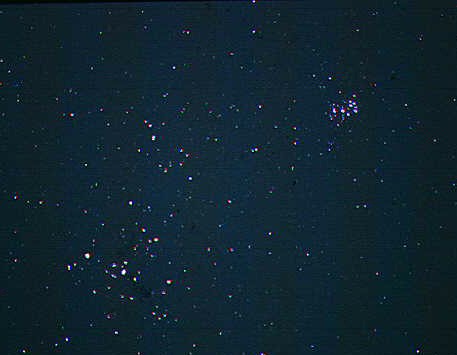
The Hyades (lower left) and the Pleiades (upper right). My photograph from many years ago.
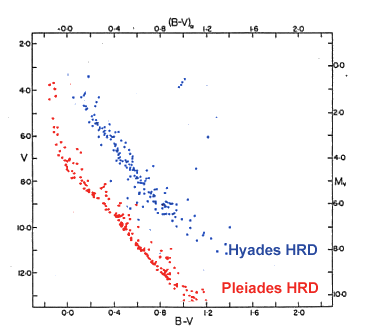
H-R diagram showing the Hyades and Pleiades. Credit: European Southern Observatory.
The Hertzsprung-Russell diagram or H-R diagram plots stars by brightness on the vertical axis versus surface temperature on the horizontal axis, hot to the left to cool on the right. The plot of stars for open or galactic star clusters, where the stars are burning hydrogen in their cores lie on a diagonal line called the main sequence. When matching the plots of two star clusters based on apparent magnitude the main sequence plot for the more distant star cluster will be dimmer by a certain magnitude difference. Since the brightness of and light source diminishes by the inverse square of the distance. The difference in brightness equates to a difference in distance.
For more information on the H-R diagram check out the Wikipedia article. It’s more than about distance.
11/20/2014 – Ephemeris – Constellation rotation from rise to set
Ephemeris for Thursday, November 20th. The sun will rise at 7:45. It’ll be up for 9 hours and 24 minutes, setting at 5:10. The moon, 2 days before new, will rise at 6:38 tomorrow morning.
At 9 p.m., if it’s clear tonight look to the east to see the bright winter constellation Orion the hunter mostly risen over the eastern horizon as Robert Frost told in his poem Star-Splitter. Orion’s throwing a leg up over the horizon, climbing into the sky. The three stars of Orion’s belt are nearly vertical as the mighty hunter rises. When in the spring he sets those stars will be horizontal. The same is true on the two namesake stars of the twins of Gemini Castor and Pollux to Orion’s left rising in then east-northeast. They rise vertically aligned and set horizontally. It’s due to our latitude and the fact that these stars are near the equator of the sky. At the poles the stars don’t change attitude, and don’t rise or set. Here they flip about 90 degrees, and at the equator they do a 180. Interesting.
Times are for the Traverse City/Interlochen area of Michigan. They may be different for your location.
Addendum
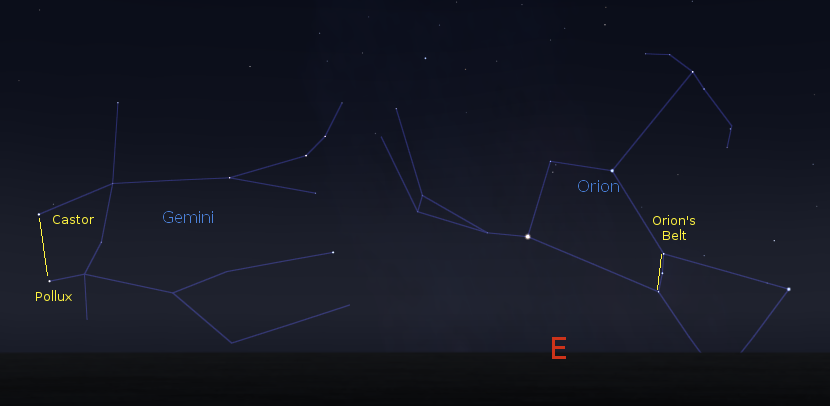
Orion rising at 9 p.m. on November 20, 2014. Note that Orion’s Belt stars and Gemini’s namesake stars are nearly vertically aligned. Created using Stellarium.
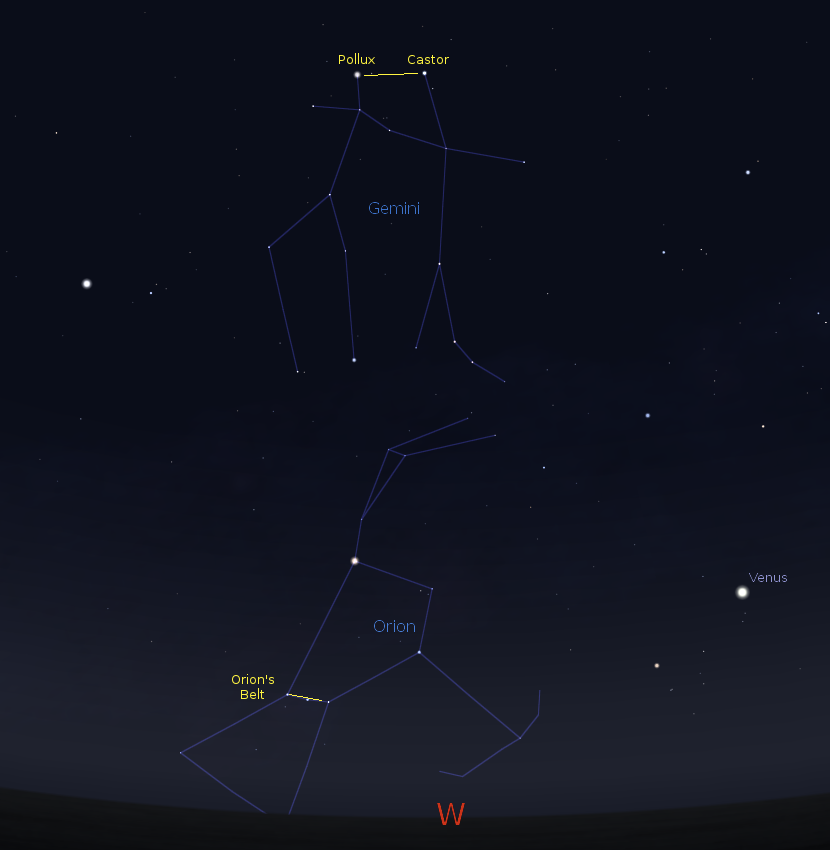
Orion setting near the end of twilight in April 2015. Note that Orion’s Belt stars and Gemini’s namesake stars are now nearly horizontally aligned. Created using Stellarium.
 Bob Moler's Ephemeris Blog