Archive
01/01/2018 – Ephemeris – The difference between the winter full moon and the summer one
Happy New Year, this is Bob Moler with Ephemeris for New Years Day, Monday, January 1st. 2018. The Sun will rise at 8:19. It’ll be up for 8 hours and 53 minutes, setting at 5:13. The Moon, at full today, will rise at 5:11 this evening.
The exact time that the Moon will be fill, at least to the nearest minute is 9:24 tonight. Ever notice the placement of the full moon in the sky between winter and summer? The Full moon near the winter solstice moves very high at midnight, while the full moon near the summer solstice is seen quite low in the south. For the Moon to be full, it most be nearly opposite the Sun in the sky, so we see it fully illuminated as the Sun does. The Moon’s orbit is close to the Sun’s apparent path in the sky, the ecliptic, which is the projection of the Earth’s orbit of the Sun. So the Moon now is near where the Sun will be 6 months from now in late June, high in the sky. Next full moon we will see a lunar eclipse.
The times given are for the Traverse City/Interlochen area of Michigan. They may be different for your location.
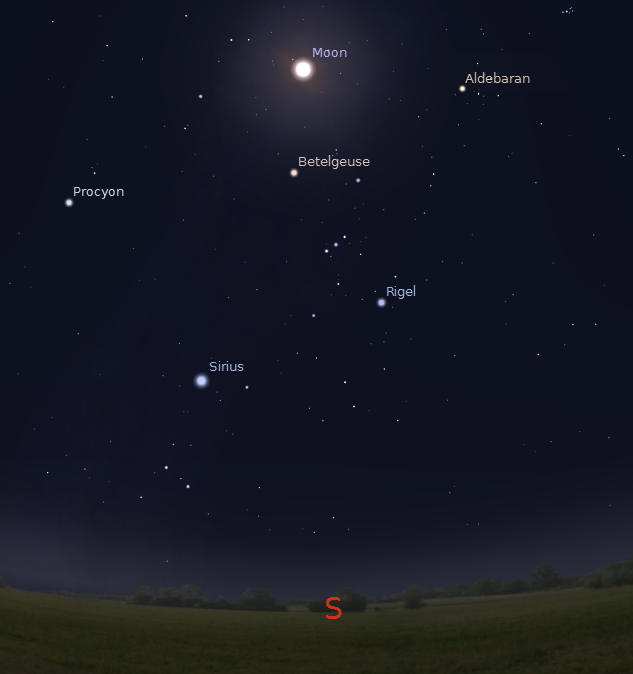
The winter full moon at its highest. Created using Stellarium.
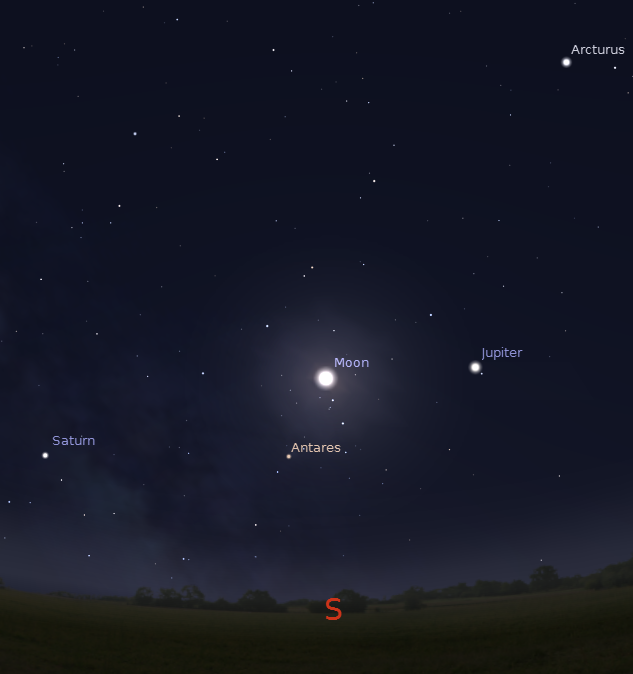
The summer full moon at its lowest. Created using Stellarium.
12/26/2017 – Ephemeris – Help for that Christmas telescope
Ephemeris for Tuesday, December 26th. The Sun will rise at 8:18. It’ll be up for 8 hours and 49 minutes, setting at 5:08. The Moon, at first quarter today, will set at 1:34 tomorrow morning.
Get a telescope for Christmas? Or is there one lurking in a closet or attic? Tonight’s a good time to get it out, if it’s clear, because there’s a first quarter Moon out. I consider the Moon round the first quarter to provide the finest viewing. To get started, most astronomical telescopes have a small finder scope attached. Daytime is the best time to align them on a distant object. To find anything, even the Moon, use the lowest power eyepiece. In most scopes that’s a 20 to 25 millimeter eyepiece. Eyepieces with lower numbers are higher power. Most amateur astronomers use their lowest magnification 90% of the time. The bright planets right now are in the morning sky, and only Jupiter is worth looking at. It’s easy to find because it’s the brightest star-like object, and in the southeast before 7:30 a.m. To help you further, on January 5th, at Northwestern Michigan College’s Rogers Observatory the Grand Traverse Astronomical Society will host its annual Telescope Clinic for telescopes new and old.
The times given are for the Traverse City/Interlochen area of Michigan. They may be different for your location.
Addendum
Here’s a handout we make available at these telescope clinics:
Telescope Basics
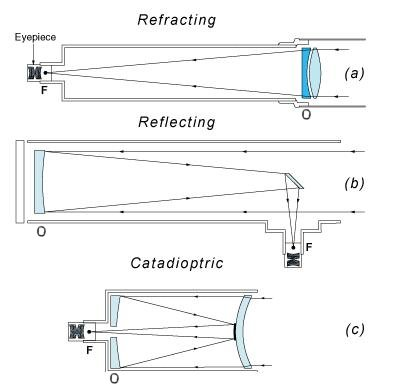
Telescope Types
There are two basic telescope types: The refractor or refracting telescope and reflector or reflecting telescope. The reflecting type shown is a Newtonian telescope, is the simplest and most inexpensive reflector. The Catadioptric (Mirror-Lens) telescope uses a corrector plate in front of the telescope. The one shown is a type called a Maksutov-Cassegrain. The more popular type is the Schmidt-Cassegrain which uses a thin, nearly flat corrector plate. The Cassegrain design uses a convex secondary mirror the sends the light back through a hole in the Primary mirror (O) to an eyepiece.
Refracting telescopes get expensive in a hurry as the diameter of the objective (O) lens increases due to the requirements of at least 4 lens surfaces of the at least two lenses that make it up. The reason for it is to correct for color fringes that would result around bright objects seen through it (chromatic aberration), and the optical quality of the glass required. Reflectors primary mirror have a single surface and the glass simply supports it. The corrector plates of the catadioptric telescopes don’t create chromatic aberration because they don’t bend light much. Telescopes are rated by the diameter of their objectives (O). One could purchase an 11 inch Newtonian telescope for less than $1,000, An 11” Schmidt-Cassegrain for $2,500, or an 11” refractor for the cost of a Lexus.
The reason astronomers go for wider telescopes (greater aperture) is two-fold: To gather more light to better see faint objects, and to increase resolving power, the ability of the telescope to see fine detail and be able to use higher magnification. We’ll see the rules when we talk about eyepieces.
Telescope Mounts
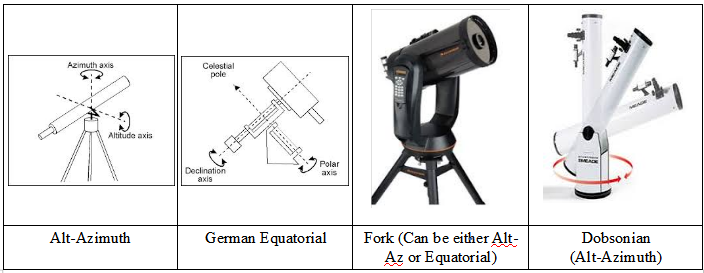 There are four basic mounts. Equatorial mounts have to be aligned to the earth’s axis in order to work properly to follow objects in the sky. Alt-Azimuth mounts are the simplest and easiest to set up, but all but the most sophisticated cannot be made to track objects in the sky as the Earth rotates. A relatively new addition to mounts is the computerized “Go To” feature allows the telescope to find objects itself when the mount is properly aligned to the sky. Telescopes with Dobsonian mounts have the largest aperture for the buck. Cheap telescopes tend to have cheap mounts that are hard to use and wobbly, especially the ones with German equatorial mounts. An alt-azimuth mount would be steadier and a whole lot easier to use in this case.
Finder Telescopes
The telescope eyepiece covers so little area of the sky to make finding anything virtually impossible. So all telescopes have small finder scopes attached of 6 to 10 power, or 1 power devices that put a finder circle or red dot on the sky when you look through them. A newer finder idea is a mount for a green laser that projects a beam in the atmosphere toward the object to be located. The author prefers a finder with an aperture of at least 50mm to be able to see most of the dim objects he’s looking for. In the main telescope, use the lowest power eyepiece because it has the widest field of view.
Eyepieces
Magnifying power or magnification is not a telescope property. The eyepiece is essentially a magnifying glass to view the real image that the objective lens or mirror produces at the focal plane (F) in the telescope type diagram on the first page. The focal length of the objective lens or mirror or the effective focal length of the mirrors of the catadioptric telescope divided by the focal length of the eyepiece gives the magnification of that particular combination of telescope and eyepiece. The focal length of the eyepiece is marked on the eyepiece. The telescope focal length may or may not be stamped or marked on the telescope, if not, check the owner’s manual for that quantity.
A telescope will generally come with one or two eyepieces, The lowest power eyepiece will generally be a 25mm eyepiece of some kind. Eyepieces come in 2 standard barrel sizes, 1 ¼ inch and 2 inch. There are some old telescopes that only accept sub 1 inch eyepieces. You may have to hunt to see if any of those size eyepieces are still around. The cheaper the telescope the crummier the eyepiece. Decent eyepieces start at around $35 and go up from there. The best way to tell which eyepiece fits your needs is to ask an astronomer what eyepiece he or she is using at a star party.
About magnification. The highest usable magnification in a telescope is calculated as the aperture in millimeters times 2.4 or aperture in inches times 60. After that the image becomes fuzzy and dim. It’s due to the wave nature of light. I halve those values in his experience. I’d rather have small crisp images than big fuzzy ones devoid of contrast.
A handy accessory to have is a Barlow lens, a negative lens in a tube, that the eyepiece is slipped in before inserting the pair in the eyepiece holder. It will double the power of the eyepiece. So with two eyepieces and a Barlow four separate magnifications are available. The author would rather us a lower power eyepiece with a Barlow than a high power eyepiece of the same power. In that same vein a good low power wide-angle eyepiece is generally the first extra eyepiece astronomers purchase. More expensive ones can be like viewing the universe in IMAX. Here is a truism: Amateur astronomers use their telescope’s lowest power 90% of the time.
Solar filters that fit over the front of the telescope and finder is a fine addition to any telescope and allow viewing of our star close up. Some old telescopes have a solar filter that fits in an eyepiece. For your visual health take the filter and beat it to death with a hammer, and throw it away. There are also filters that can filter out some of the light pollution for dim nebulae. There are filters also to bring out detail in planets.
Above all, have fun! If you have any questions ask that friendly amateur astronomer over there, standing by his or her telescope at the next star party.
12/21/2017 – Ephemeris – Winter begins this morning
Ephemeris for Thursday, December 21st. The Sun will rise at 8:16. It’ll be up for 8 hours and 48 minutes, setting at 5:05. The Moon, 3 days past new, will set at 8:23 this evening.
The thermometer and snowfall tell us that winter ought to be here. Well it will be at 11:29 this morning. At that point the Sun will be directly over the Tropic of Capricorn at 23 ½ degrees south latitude. Odd name because 2,000 years ago the Sun was in indeed entering Capricornus. Now it’s entering in Sagittarius, right above the spout of the teapot asterism we know so well in summer. From then on the Sun will be climbing up the sky each noon until June 21st next year when summer will start. To which I say Go Sun Go! The Sun will barely make it to 22 degrees above the southern horizon at local noon in Interlochen and be out for only 8 hours and 48 minutes. If it stayed that low all year we’d be in a deep freeze possibly colder than Antarctica.
The times given are for the Traverse City/Interlochen area of Michigan. They may be different for your location.
Addendum
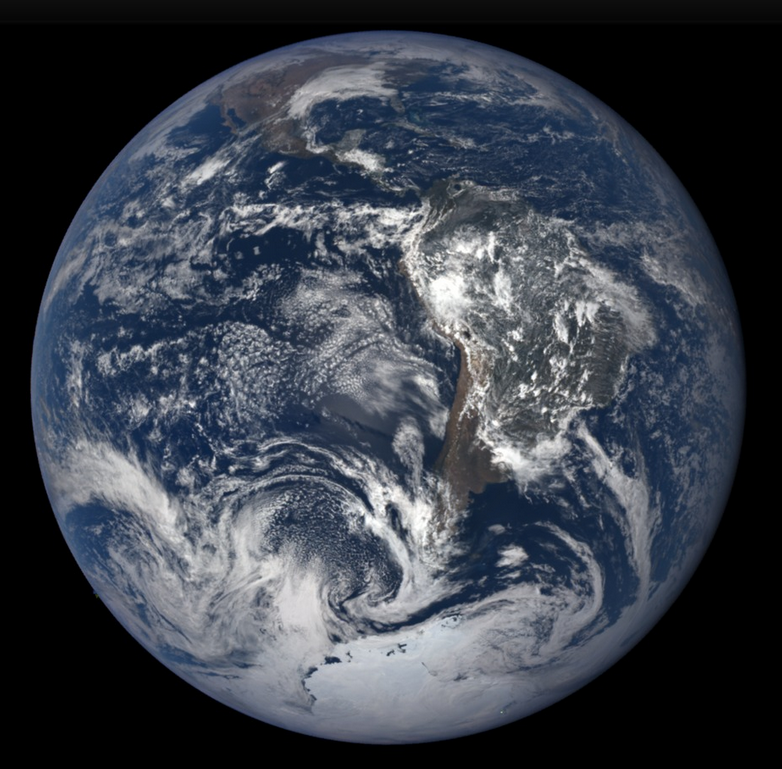
DSCOVR satellite’s Earth Polychromatic Camera image of the Earth at 18:09 UTC (1:09 p.m.) December 19, 2017. We’re way up at the top just under the clouds at the top. It was actually partly cloudy that day. The DSCOVR satellite was in a halo orbit about the Earth-Sun L1 point, 934,498 miles (1,503,929 km) toward the Sun from Earth.
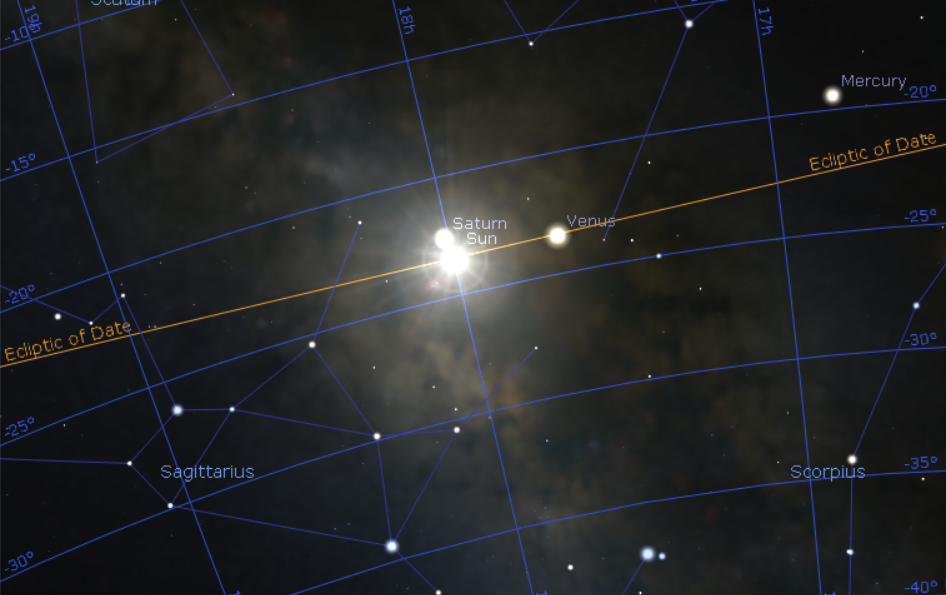
The Sun is shown against the celestial sphere at the moment of the December solstice. Saturn will be in conjunction later in the day, heading to the right along the ecliptic, which is the path of the Sun. Venus will pass the Sun, heading to the left on January 9th. The grid lines are right ascension in hours (h) and declination in degrees. The solstice occurs when the Sun crosses the 18 hour line. Note the Teapot asterism that is part of Sagittarius. Created using Stellarium.
12/19/2017 – Ephemeris – Were celestial events in 7 BC interpreted as the Star of Bethlehem?
Ephemeris for Tuesday, December 19th. The Sun will rise at 8:15. It’ll be up for 8 hours and 49 minutes, setting at 5:04. The Moon, 1 day past new, will set at 6:34 this evening.
This year we have no bright evening Christmas star. But what about the one described in the Bible, in the gospel of Luke? We will look today at the first of two events that may have been recorded as the Star of Bethlehem. In 7 BC there was a rare event over 6 months when three times the planet Jupiter passed Saturn against the stars of the constellation Pisces. Could the Persian astrologer priests called Magi, have read into the event enough significance to start the journey to Jerusalem in search of the new born King of the Jews? It was the scribe’s readings that then sent them to Bethlehem. It is thought that Pisces was associated with the Hebrews, Jupiter with the Messiah or world ruler, and Saturn with the peoples of Palestine.
The times given are for the Traverse City/Interlochen area of Michigan. They may be different for your location.
Addendum
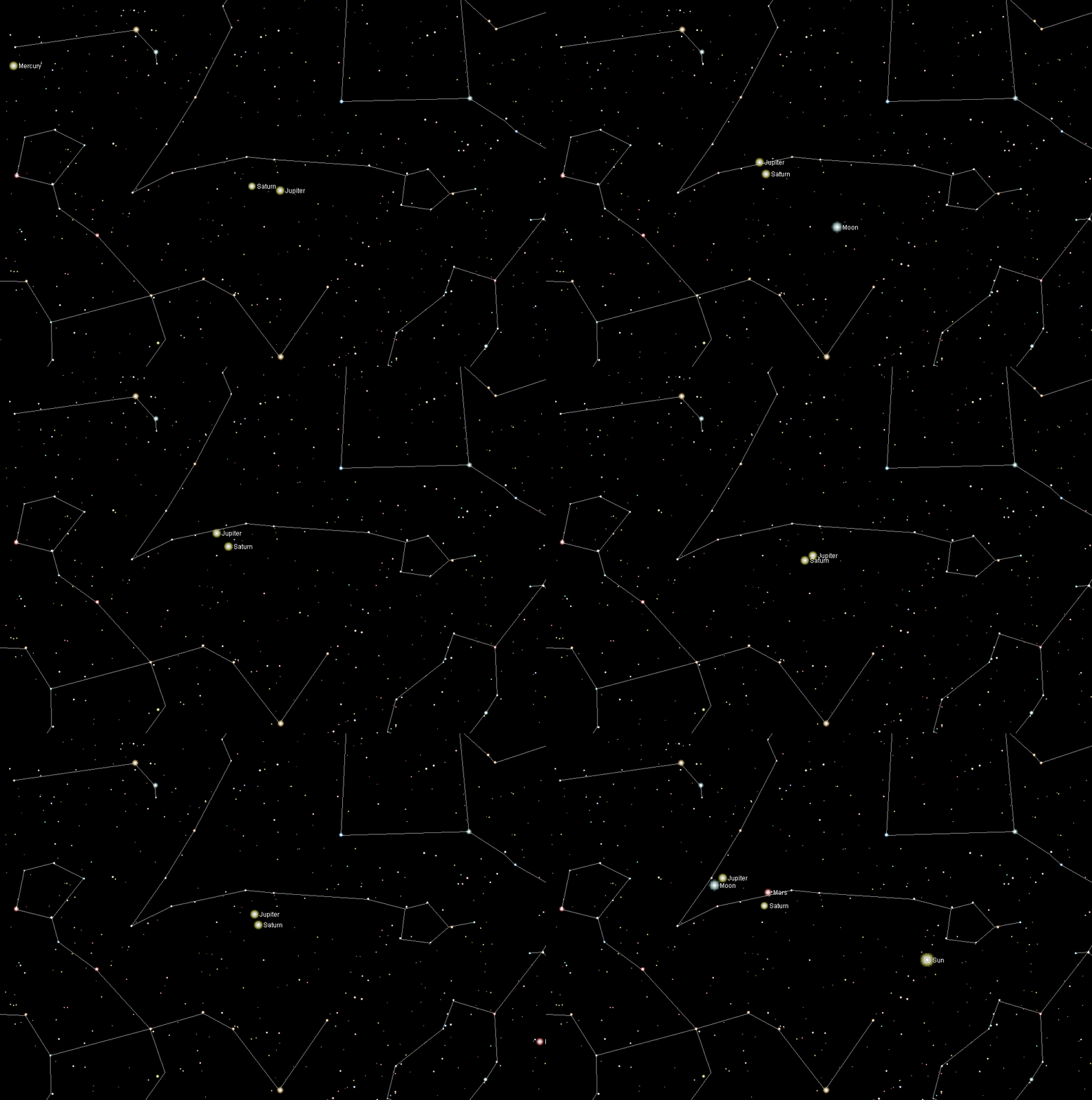
The Jupiter-Saturn triple conjunction of 7 BC. Click on the image to enlarge. Created using Cartes du Ciel.
The animation above shows the planets at 5 day intervals in 7 and a bit in 6 BC. The normal or posigrade motion is toward the east or left. When an outer planet approaches its opposition from the Sun, it seems to slow and reverse direction and head westward for a time, which is retrograde motion. After a time it reverses and heads back eastward again. That’s why the planets seem to see-saw back and forth. Jupiter passes Saturn every 20 years. The next time will be in 2020. On my Wednesday planet charts Jupiter is seen sneaking up on Saturn week by week. In order to have three conjunctions instead of one, the planets need to be near opposition from the Sun when they pass. The last time that happened was in 1980, but it wasn’t against Pisces. Triple conjunctions against a particular zodiacal constellation are much rarer.
The dates for key events in the animation above are:
- First Conjunction May 29, 7 BC
- Planets are Stationary July 6, and begin retrograde motion
- Second Conjunction October 11
- Planets are Stationary November 1 and resume posigrade motion
- Third Conjunction on December 8
- Mars joins February 26, 6 BC
Retrograde motion was difficult to explain when one thinks that the Earth is the center of the Universe and stationary, while the planets supposedly orbited in perfect uniform circular motion around it. It’s easy when the Earth is a moving planet like the rest. When an outer (superior) planet is at opposition from the Sun. The Earth is between the Sun and planet and moving faster. So we’re passing the outer planet. When you are in a car passing another, the car being passed seems to move backward with respect to your car. Since the planets orbits are like a race track, we get to lap the outer planets at regular intervals.
12/14/2017 – Ephemeris – The Moon wanders over to Jupiter this morning
Dec 14. This is Bob Moler with Ephemeris for Thursday, December 14th. The Sun will rise at 8:11. It’ll be up for 8 hours and 50 minutes, setting at 5:02. The Moon, half way from last quarter to new, will rise at 5:26 tomorrow morning.
This morning the planet Jupiter will appear right below the crescent Moon. Jupiter is hard to miss, even without the Moon to point it out. It is with the rare exception of Mars when being its closest to the Earth the second brightest of the planets, after Venus. Speaking of Mars, which is to the upper right of Jupiter and has a reddish hue, if you’re going to send anything to Mars, next spring is the time to do it. Flight times to Mars are 6 to 7 months. The midpoint of the flight is when Mars is closest to the Earth, which next year is July 31st. NASA’s Insight Lander, grounded in 2016 due to an instrument failure has to wait 26 months for the next launch opportunity in May of next year.
The times given are for the Traverse City/Interlochen area of Michigan. They may be different for your location.
Addendum
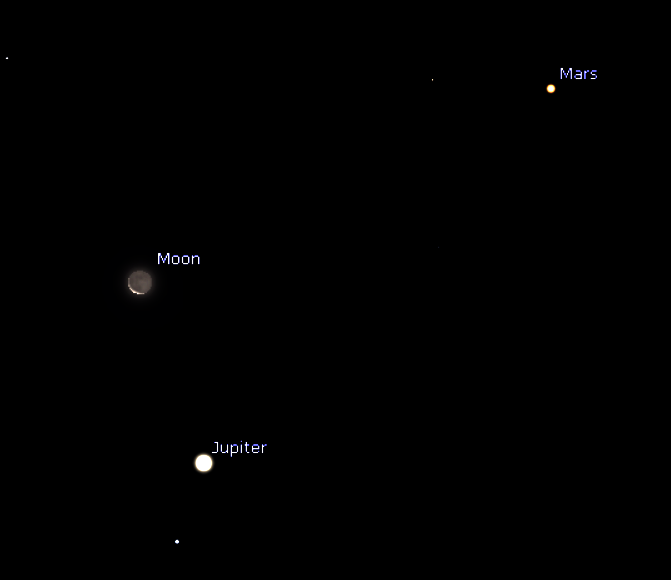
The Moon, Jupiter and Mars this morning, December 14, 2017. Earth shine should be visible as shown, though not as prominent. Created using Stellarium.
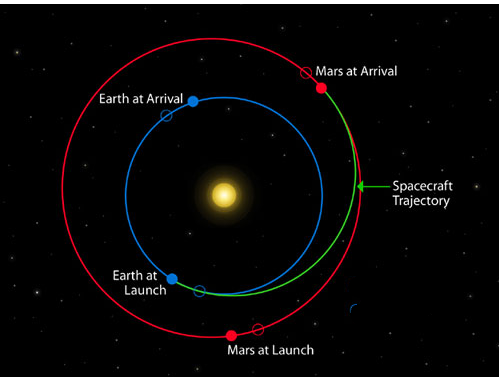
A Hohmann lowest energy transfer orbit to Mars. This diagram is for the Mars Exploration Rovers Spirit and Opportunity launched in 2003, arrived in 2004. Solid planets, Spirit launch and arrival. Ghost planets, Opportunity launch and arrival. Credit NASA/JPL.
What’s a Hohmann transfer orbit? NASA explains.
12/08/2017 – Ephemeris – The earliest sunset of the year is tomorrow night
Ephemeris for Friday, December 8th. The Sun will rise at 8:06. It’ll be up for 8 hours and 55 minutes, setting at 5:02. The Moon, 2 days before last quarter, will rise at 11:04 this evening.
In thirteen days we will have the shortest day in terms of daylight hours. But the change isn’t uniformly distributed in the morning and evening. Tomorrow evening we will have the earliest sunset. Sunset times have been within the same minute for the last few days and will continue for the next few. The latest sunrise will occur on January second. The reason is that the Sun is traveling faster eastward than average, so the Earth’s rotation takes a little longer each day to catch up with it. Near the solstice the Sun is at a higher latitude, where the longitude lines are closer together, also the Earth is nearing its closest to the Sun, so moves faster its orbit adding to the effect. The effect exists in June but isn’t as noticeable.
The times given are for the Traverse City/Interlochen area of Michigan. They may be different for your location.
Addendum
I had more complete thoughts about earliest and latest sunrises and sunsets earlier this year: https://bobmoler.wordpress.com/2017/03/13/03132017-ephemeris-more-thoughts-about-yesterdays-time-change/. Check the addendum.
12/05/2017 – Ephemeris – A flat Earth, come on, really?
Ephemeris for Tuesday, December 5th. The Sun will rise at 8:03. It’ll be up for 8 hours and 58 minutes, setting at 5:02. The Moon, 2 days past full, will rise at 7:35 this evening.
Last Friday night I gave a talk to the Grand Traverse Astronomical Society about the world view of mostly ancient peoples. They uniformly believed in a flat Earth. This includes the world of the Bible. The Greek geographer Eratosthenes calculated the circumference of the Earth way back in the third century BC. A flat Earth would normally be the conclusion of a person who never went more than a few hundred miles from home, especially in an east-west direction. However if one went north or south, the stars would slowly change. Head south and new stars would appear above the southern horizon, and in the north, stars that would never set would now set. Polaris would drop lower in the North. The round Earth is the simplest explanation.
The times given are for the Traverse City/Interlochen area of Michigan. They may be different for your location.
Addendum
Here’s an extension from my notes:
Those who profess to believe in a flat Earth tend to be Christian and believe that the Bible is literally true even to the physical description of the world found in its pages. Therefore the basis for the flat Earth is the Bible.
While there are those who have always believed in a flat earth, Eratosthenes pretty much put killed that notion in the 3rd century BC when he found that there was a 7.2 degree difference in the altitude of the Sun at local noon on the summer solstice between Syene and Alexandria in Egypt. The distance between the two cities was about 800 km, and 7.2 degrees is 1/50th that of a circle, so the Earth would have been 50 X 800 or 40,000 kilometers or 25,000 miles* in circumference. This of course meant that the Earth was round! The units he used were stadia, whose exact length has been in doubt.
Flat earth theories started to proliferate in the mid-19th century when most of the Earth’s coastlines had at least been mapped, though the polar regions had yet to be breached.
Zetetic Astronomy. Earth not a globe! An experimental inquiry… by Samuel Birly Rowbotham, 1865
Zetetic Cosmology: Conclusive evidence that the world is not a rotating-revolving-globe, but a stationary flat pane circle, second edition, by “Rectangle”, 1899. Rectangle is a pseudonym of T. Winship
These can be found on Archive.org.
The latest reincarnation of the Flat Earth Society was started in 2013. Their web page and wiki is here: https://www.tfes.org/.

The Flat Earth by Trekky0623 at English Wikipedia, placed in the Public Domain.
Features:
- North Pole in the center.
- The firmament rotates around it.
- There is no South Pole.
- There are impassable mountains in Antarctica at the end of the Earth.
- Wouldn’t the Sun be always up for everybody?
- Apparently, the Sun orbits over the flat Earth in circles between the Tropic of Cancer and Tropic of Capricorn to produce the seasons.
- The Sun is 3000 miles away and is only about 30 miles in diameter.
- It shines like a spotlight over the earth.
- The moon is somewhat lower than the sun and can cause solar eclipses.
- The flat Earth’s shadow cannot cause a lunar eclipse, since the Moon is on the same side of the Earth as the Sun. The eclipse is caused by a “shadow object” that we can’t see that comes between the Sun and the Moon.
It boggles my mind how anyone in this day and age, who travels a lot cannot believe that the Earth is a spheroid. Maybe no one looks up anymore. Perhaps I’m just an oddball astronomer who like to look up and see the stars shift as I move south or north. In fact I plan on it when I travel.
* corrected this value from the original post
11/28/2017 – Ephemeris – Though it appears bright, the Moon is pretty dirty
Ephemeris for Tuesday, November 28th. The Sun will rise at 7:56. It’ll be up for 9 hours and 8 minutes, setting at 5:04. The Moon, 2 days past first quarter, will set at 2:44 tomorrow morning.
The Moon tonight is a waxing gibbous phase, and each night until it’s full it will get brighter and brighter, drowning out the fainter stars. The Moon is almost too bright to comfortably view in a telescope. One can get a moon filter for the eyepiece, or wear sunglasses or opt for higher magnification. It is after all daytime on the Moon and it’s essentially the same distance from the Sun as we are. A saving grace is that the Moon isn’t white. It’s a dirty gray, reflecting on average only 13.6 percent of the light it gets from the Sun. Just think how bright it would appear if it were 100% reflective, over 7 times brighter than it appears now. The face of the Moon hasn’t appeared to change at all since before we landed there 48 years ago.
The times given are for the Traverse City/Interlochen area of Michigan. They may be different for your location.
Addendum
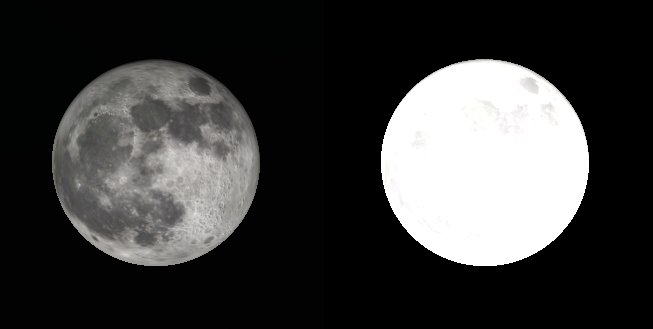
Moon albedo comparison. Actually about 50% vs. 100%. The Moon is less reflectant than that.. Sunday’s super moon image created via Stellarium.
11/23/2017 – Ephemeris – Mercury is at it’s greatest eastern elongation tonight
Ephemeris for Thanksgiving Day, Thursday, November 23rd. The Sun will rise at 7:49. It’ll be up for 9 hours and 17 minutes, setting at 5:07. The Moon, 3 days before first quarter, will set at 9:33 this evening.
Mercury is going to reach its greatest elongation or apparent separation from the Sun this evening. It will be 22 degrees east of the Sun. Because Mercury is the closest planet to the Sun, it is never seen far from it. And because it has the most eccentric orbit of all the planets its greatest elongations are between 17 and 27 degrees from the Sun. Other than that the best times of the year to see Mercury are late winter and early spring evenings and late summer and early autumn mornings. Being an autumn evening means that Mercury is almost too low to spot after sunset. The southern hemisphere is in spring, so Mercury tonight will be much easier seen. Also their best view is when Mercury is farther from the Sun.
The times given are for the Traverse City/Interlochen area of Michigan. They may be different for your location.
Addendum
There are rather clinical charts. The horizontal line through the W (western compass point) is the horizon. Grid marks are 10 degrees apart.
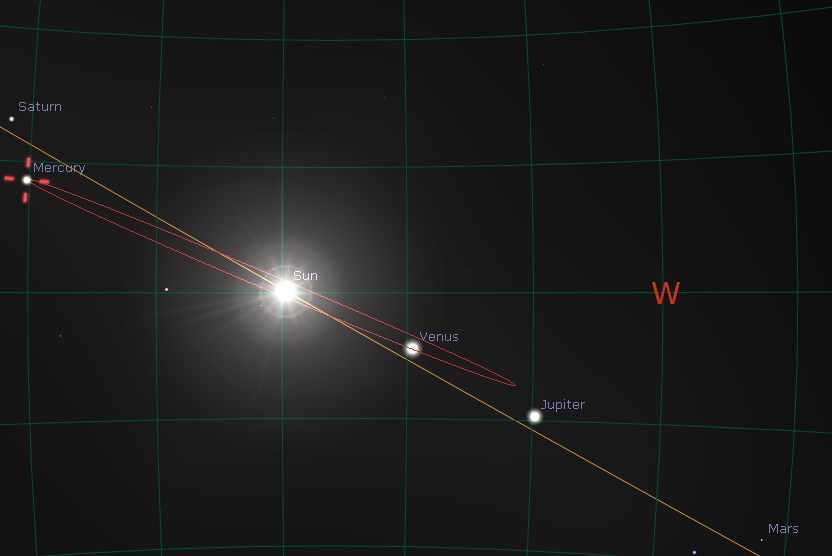
Diagram showing the poor placement of Mercury at greatest eastern elongation tonight in autumn from 45 degrees north latitude. Mercury is about 8.5 degrees altitude at sunset. The orange line is the ecliptic, the path pf the Sun on the celestial sphere. Created using Stellarium.
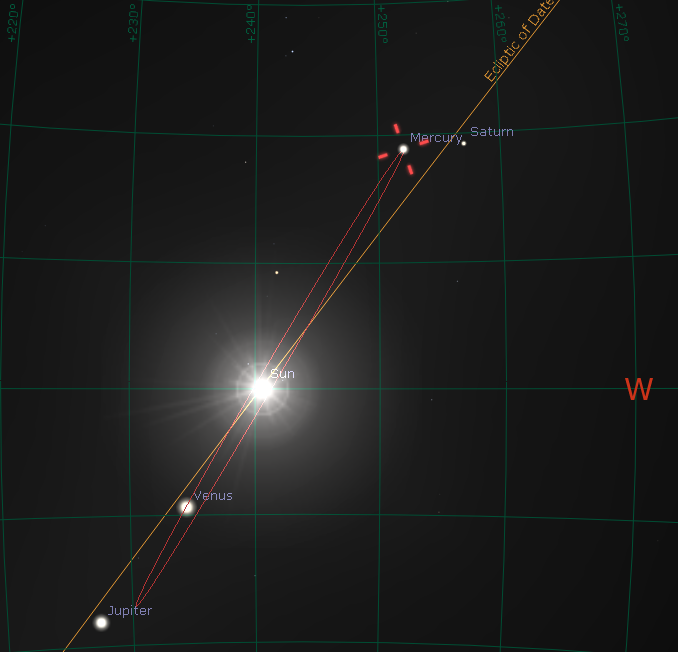
Diagram showing the great placement of Mercury at greatest eastern elongation tonight in southern hemisphere spring from 45 degrees south latitude. Mercury is nearly 19 degrees altitude at sunset. The orange line is the ecliptic, the path pf the Sun on the celestial sphere. Created using Stellarium.
08/28/2017 – Ephemeris – Polaris the North Star
Ephemeris for Monday, August 28th. The Sun will rise at 7:00. It’ll be up for 13 hours and 25 minutes, setting at 8:25. The Moon, 1 day before first quarter, will set at 12:19 tomorrow morning.
The bright star Polaris is a very important star. It is also known as the North Star and the Pole Star. Its unique position is nearly directly at the zenith at the Earth’s north pole, making it a very important navigational star. It’s about 40 minutes of arc, or about one and a third Moon diameters away from the extension of the Earth’s axis into the sky. As a rule of thumb, it’s angular altitude above the northern horizon is approximately one’s latitude, and it stands about at the due north compass point. Polaris is found using the Big Dipper, using the two stars at the front of the dipper bowl to point to it. It’s located at the tip of the handle of the very dim Little Dipper, which this time of year in the evening appears to standing on its handle.
The times given are for the Traverse City/Interlochen area of Michigan. They may be different for your location.
Addendum
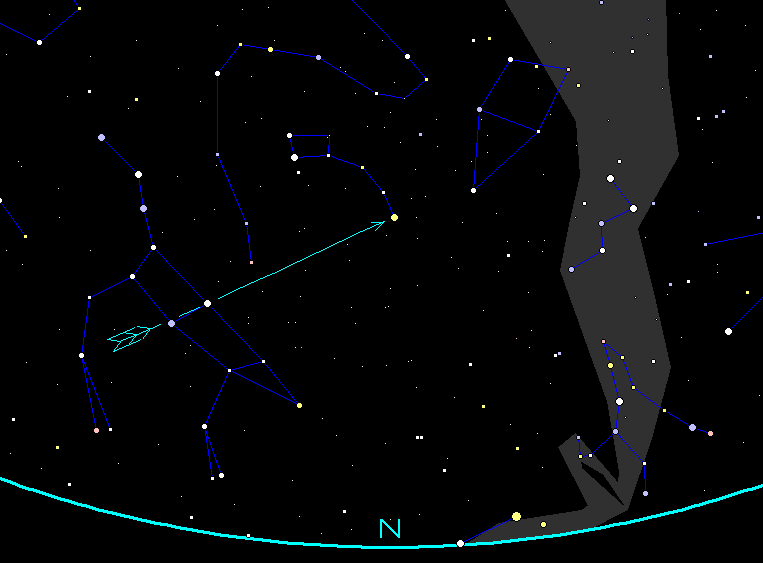
Polaris finder chart for 10 p.m., August 28th. Created using my LookingUp program
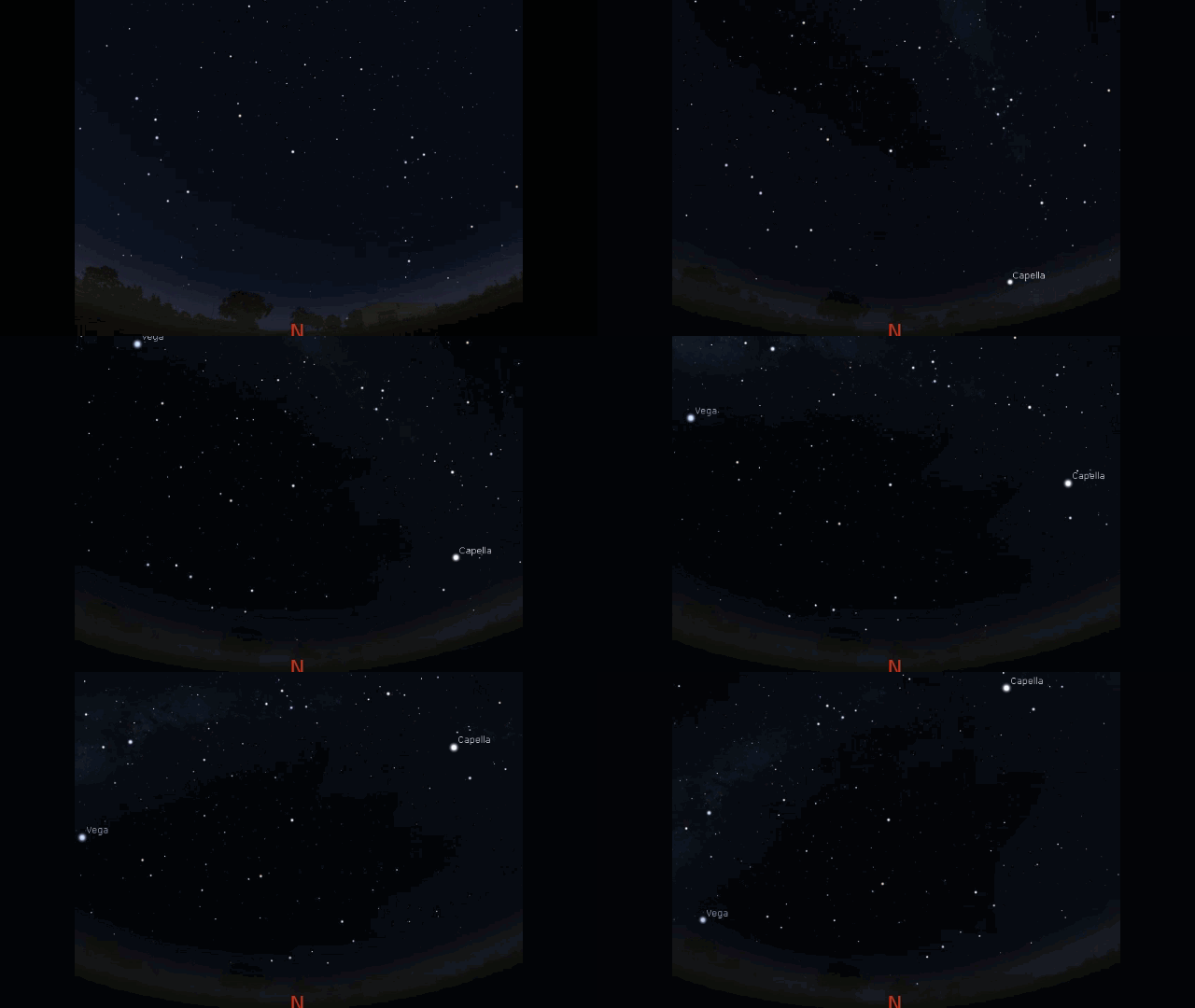
Animation of the rotation of the sky around Polaris on the night of August 28/29, 2017. Created using Stellarium and Filmora.
I’ve left the constellation lines off. The Big Dipper is seen easily as is Cassiopeia’s “W” opposite it around the stationary Polaris.
 Bob Moler's Ephemeris Blog