Archive
How come hours of daylight changes very slowly around the solstice, but very rapidly around the equinoxes?
This question came in as a an off topic comment to my post yesterday 01/09/2015. It deserves a good answer. So here goes.
Day to day change in daylight hours occur when the Sun appears to move south or north. For us in the northern hemisphere the daylight hours get shorter when the Sun appears to move south, and longer when the Sun appears to move north. If we spread out the sky in a Mercator projection, like they do the earth or one of those satellite tracking maps, it would look like the image below.
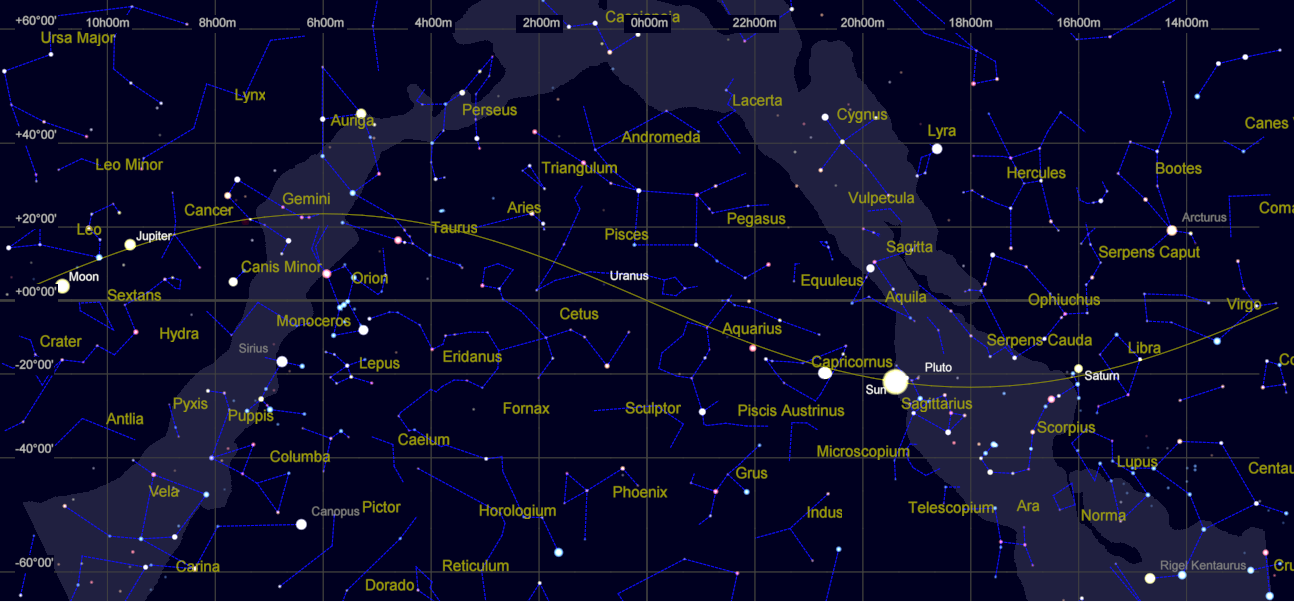
Mercator projection of the heavens from declinations +60 to -60 degrees declination, centered on the vernal equinox. The center horizontal white line is the celestial equator, and the yellow sinusoidal line is the ecliptic, the apparent path of the sun. Note the planets and Moon also stick close to that line. The date of the image is January 9, 2015. Venus and Mercury are on top of each other and unlabeled under the ‘a’ in Capricornus. Created using Cartes du Ceil (Sky Charts). Click image to enlarge.
Note that the steepest part of the ecliptic occurs at the equinoxes, the vernal or March equinox in the center and the autumnal or September equinox at the left and right edges. That’s where the sun’s motion north or south is the greatest, so the daily change in daylight hours is the greatest. Near the solstices at 6 and 18 hours* the Sun isn’t changing its north-south motion very much, so the daylight hours aren’t changing much from day to day. If you were watching the sky at local solar noon, you’d think that at the solstice the sun would stop its motion and stand still before heading back. That’s what the word solstice means: sun-standstill. The variation is daylight hours also depends on your location. At the equator, it doesn’t change at all. Of course at the other extreme, at the poles, there’s 6 months of daylight and 6 months of night.
* The east-west direction in the heavens is like longitude on the Earth but it’s called right ascension and is measured in hours where 15 degrees equals one hours. Astronomers use clocks to keep track of it. Declination is the same as latitude on the Earth. In astronomy longitude and latitude were already in use for ecliptic based coordinates.
So what causes the wavy path in the sky? Lets check out the earth from the sun’s point of view, so to speak.
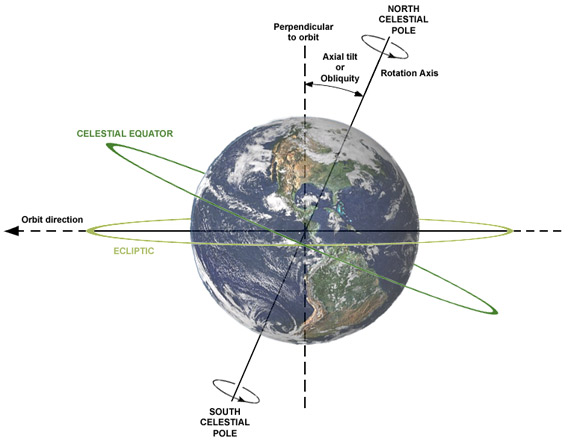
Earth’s axial tilt. The horizontal line is the plane of the Earth’s orbit and what we see projected on the sky as the ecliptic. The tilt of the Earth’s axis to the plane of its orbit by 23 1/2 degrees, gives us the seasons and why the celestial equator and ecliptic cross at a 23 1/2 degree angle. Credit Dennis Nilsson.
Both the celestial equator and the ecliptic are great circles in the sky. They intersect at an angle of 23 1/2 degrees at the equinox points.
Lets take a look at the difference in daylight hours at three times in the year, the equinox and the two solstices for Traverse City, MI whose latitude is just shy of 45° north. The following three images were generated in stereographic projection, which exaggerates the distance of things near the horizon and diminishes the distance of things in the center, the zenith. So actually the speed of the sun is unchanging across the sky.
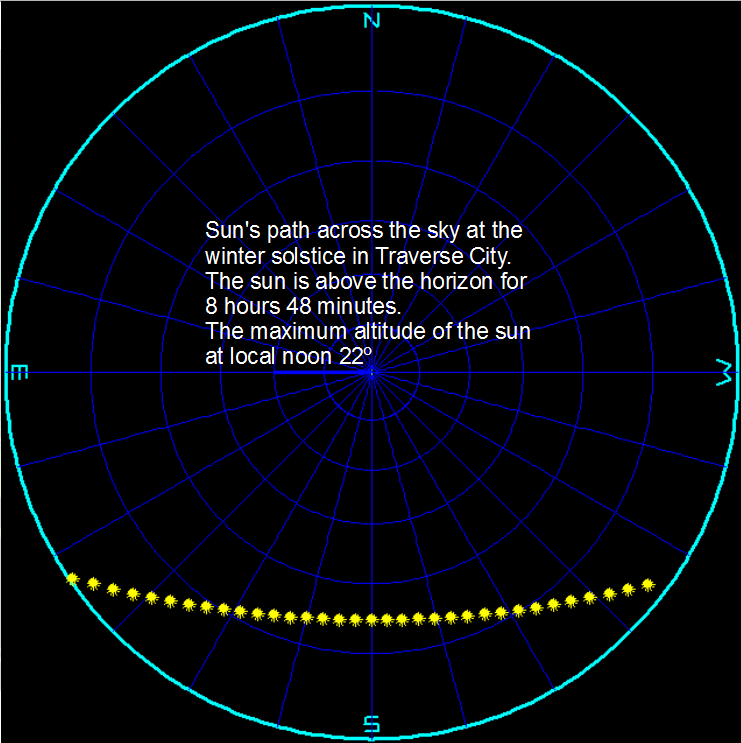
The sun’s daily path through the sky from horizon to horizon on the first day of winter, the winter solstice. Credit My LookingUp program.
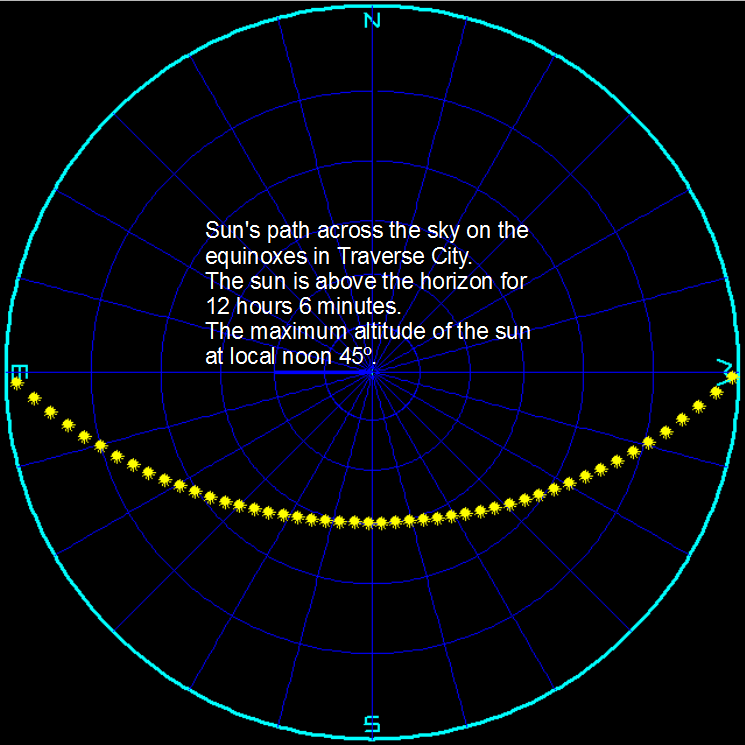
The sun’s daily path through the sky from horizon to horizon on an equinox the first day of spring or autumn. Credit My LookingUp program.
Note that at the equinox the sun rises due east and sets due west.
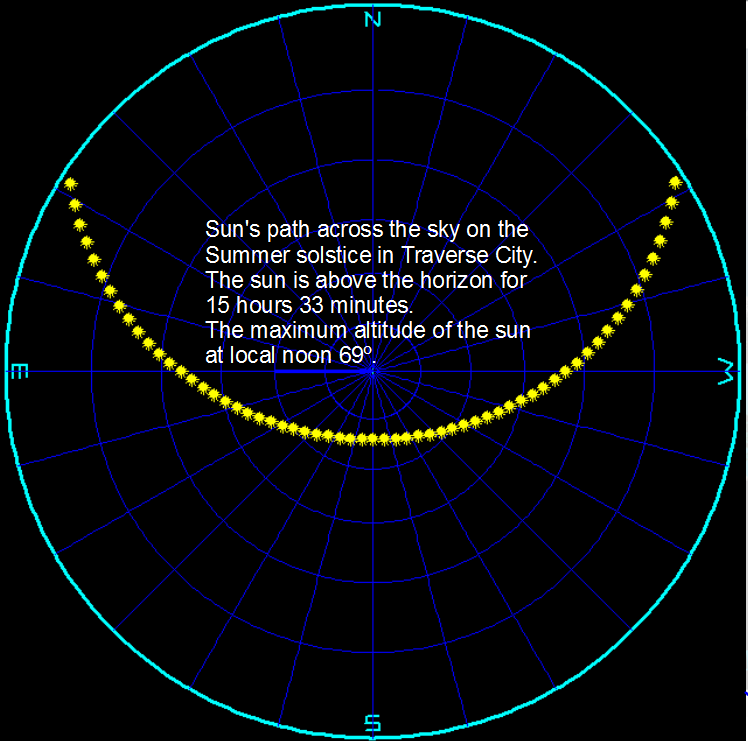
The sun’s daily path through the sky from horizon to horizon on the first day of summer, the summer solstice. Credit My LookingUp program.
One more diagram to illustrate the change in the sun’s north-south position in the sky.
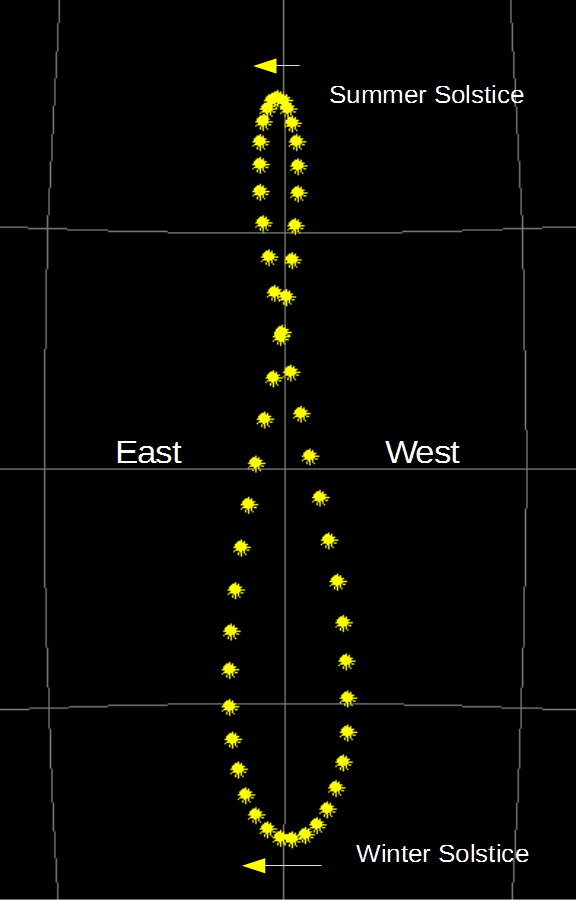
This figure 8 is called an analemma. One can find it on old globes in the Pacific Ocean. Created using my LookingUp program.
This is the Sun plotted for mean solar noon over one year at 7 day intervals. One can see the rapid motion in the north-south position of the sun around the equinoxes versus the solstices. The more rapid the north-south motion of the Sun the greater the change in day-to-day daylight hours. The line with “East West” on it is the celestial equator. Check out my December 2, 2014 post on why it’s a figure 8.
12/02/2014 – Ephemeris – The unequal dates of latest sunrise and earliest sunset
Ephemeris for Tuesday, December 2nd. The sun will rise at 8:00. It’ll be up for 9 hours and 3 minutes, setting at 5:03. The moon, 3 days past first quarter, will set at 4:41 tomorrow morning.
This evening’s sunset is just a minute from the earliest sunset of the year. The Earliest sunset will actually be on the 9th. However the latest sunrise won’t occur until January 2nd. The reason combines the effects of the tilt of the earth’s axis and the fact that the Earth is only a month from perihelion, its closest to the Sun. Both these effects cause the sun to appear to move faster eastward than average, so the Earth has to rotate a bit farther each day to catch up with the Sun. This makes the sunrise and setting events later than one would expect, so they don’t occur together on the shortest day of the year, the 21st this year. Our sunrise this morning is still 19 minutes earlier than the latest sunrise on January 2nd, 2015.
Times are for the Traverse City/Interlochen area of Michigan. They may be different for your location.
Addendum
This figure 8 is called an analemma. One can find it on old globes in the Pacific Ocean. Explanation below. Created using my LookingUp program for Traverse City, MI near +45° latitude.
The analemma is a graphical representation of a daily value called the Equation of Time. It’s best known use is in corrections to sundial time. The vertical axis is the sun’s declination or north-south position. It is highest at summer solstice and lowest at winter solstice. It is the result of two effects: the tilt of the Earth’s axis to the plane of the Earth’s orbit around the Sun, and the change in the Earth’s velocity around the Sun as the Earth moves from perihelion, its closest to the Sun in early January to aphelion, its most distant in July.
If the Earth’s orbit were circular, and it orbited the Sun at the same speed. The analemma would be skinner and the north and south lobes would be of equal size. Since we’re closer to the Sun in the winter, we move faster than average around the Sun, so it appears to move faster eastward. That combines with the faster appearing movement of the sun crossing the closer hour lines at higher and lower declinations. In the diagram above note that the vertical hour lines are slightly closer together at the bottom and the top, so the Sun, moving eastward each day crosses them quicker. Near the winter solstice the two effects work together making sunrise and sunset trending to be later than normal. For the summer solstice the eastward speed of the sun is slower than normal, because we’re farther from the Sun. This works against the effect of the earth’s tilt but cannot completely negate it, making the top of the loop smaller than the one at the bottom. The arrows show the speed and direction of the Sun at the solstices.
To see real analemmas search for analemma images on the Internet. It takes a year to photograph one.
11/21/2014 – Ephemeris – The Hyades a very important star cluster
Ephemeris for Friday, November 21st. The sun will rise at 7:47. It’ll be up for 9 hours and 22 minutes, setting at 5:09. The moon, 1 day before new, will rise at 7:42 tomorrow morning.
The face of the constellation Taurus the bull looks like the letter V sideways above the rising Orion the Hunter in the east at 9 p.m. The bright star at the tip of a letter V of stars is Aldebaran. Look with binoculars at the letter V shape and you will see the stars of the Hyades star cluster The Hyades is the closest star cluster to us, at about 151 light years. And is important for that reason. Before satellites like Hipparcos. The Hyades were the only star cluster to be directly measured by a technique called parallax, using the radius of the earth’s orbit as one side of a surveyors enormous triangle. Its many stars at the same distance were used to determine distances of star clusters even farther away. Additional techniques based on the distance of the Hyades allow us to measure distances to the galaxies.
Times are for the Traverse City/Interlochen area of Michigan. They may be different for your location.
Addendum
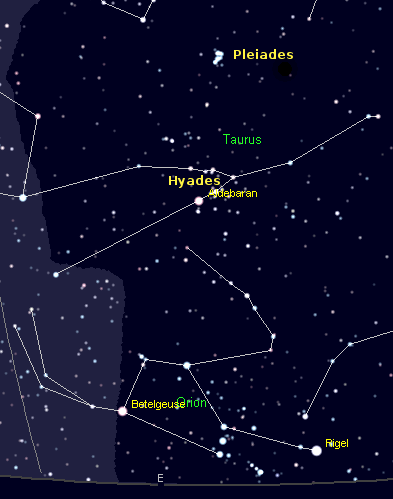
Orion and the Hyades.
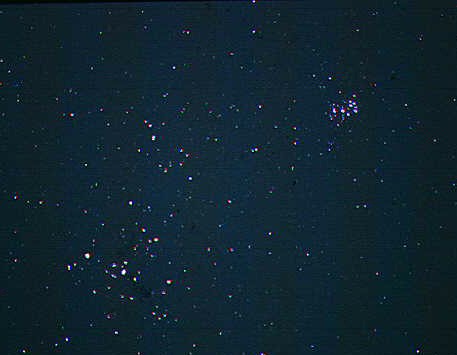
The Hyades (lower left) and the Pleiades (upper right). My photograph from many years ago.
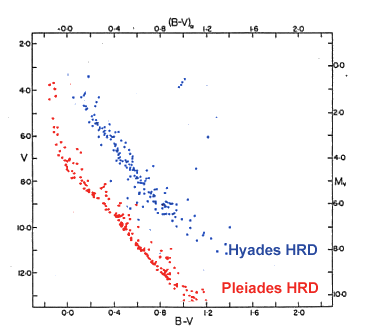
H-R diagram showing the Hyades and Pleiades. Credit: European Southern Observatory.
The Hertzsprung-Russell diagram or H-R diagram plots stars by brightness on the vertical axis versus surface temperature on the horizontal axis, hot to the left to cool on the right. The plot of stars for open or galactic star clusters, where the stars are burning hydrogen in their cores lie on a diagonal line called the main sequence. When matching the plots of two star clusters based on apparent magnitude the main sequence plot for the more distant star cluster will be dimmer by a certain magnitude difference. Since the brightness of and light source diminishes by the inverse square of the distance. The difference in brightness equates to a difference in distance.
For more information on the H-R diagram check out the Wikipedia article. It’s more than about distance.
11/20/2014 – Ephemeris – Constellation rotation from rise to set
Ephemeris for Thursday, November 20th. The sun will rise at 7:45. It’ll be up for 9 hours and 24 minutes, setting at 5:10. The moon, 2 days before new, will rise at 6:38 tomorrow morning.
At 9 p.m., if it’s clear tonight look to the east to see the bright winter constellation Orion the hunter mostly risen over the eastern horizon as Robert Frost told in his poem Star-Splitter. Orion’s throwing a leg up over the horizon, climbing into the sky. The three stars of Orion’s belt are nearly vertical as the mighty hunter rises. When in the spring he sets those stars will be horizontal. The same is true on the two namesake stars of the twins of Gemini Castor and Pollux to Orion’s left rising in then east-northeast. They rise vertically aligned and set horizontally. It’s due to our latitude and the fact that these stars are near the equator of the sky. At the poles the stars don’t change attitude, and don’t rise or set. Here they flip about 90 degrees, and at the equator they do a 180. Interesting.
Times are for the Traverse City/Interlochen area of Michigan. They may be different for your location.
Addendum
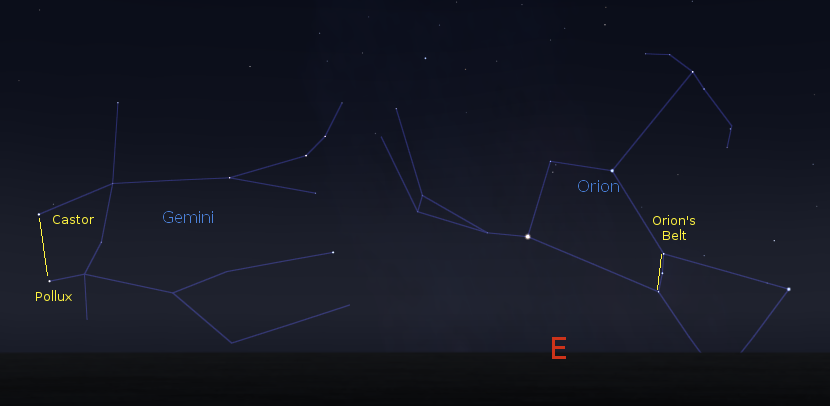
Orion rising at 9 p.m. on November 20, 2014. Note that Orion’s Belt stars and Gemini’s namesake stars are nearly vertically aligned. Created using Stellarium.
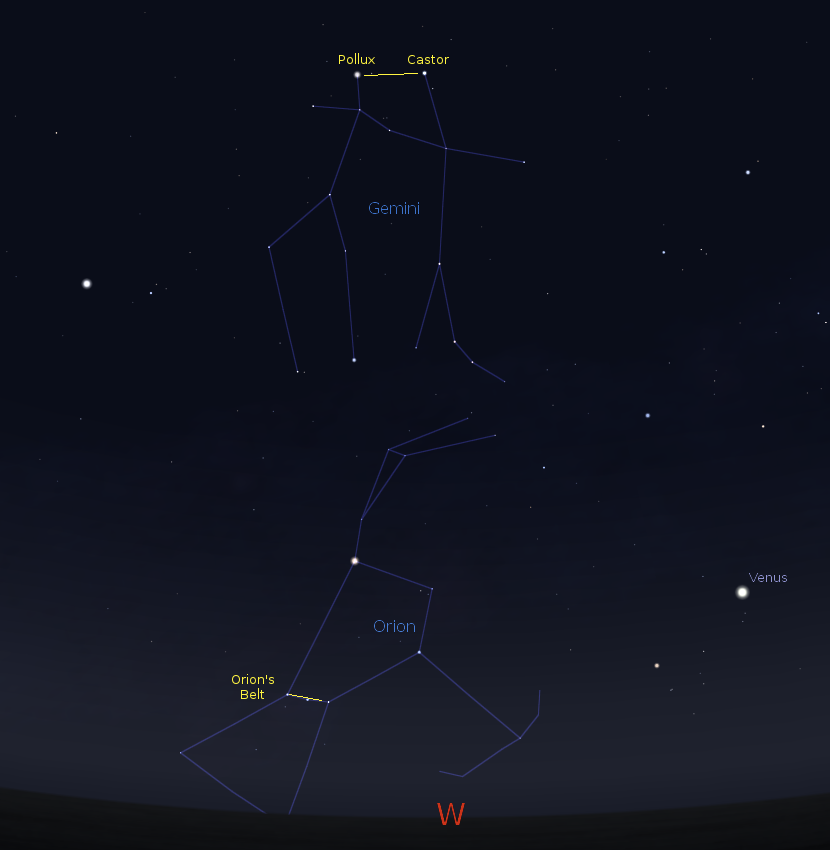
Orion setting near the end of twilight in April 2015. Note that Orion’s Belt stars and Gemini’s namesake stars are now nearly horizontally aligned. Created using Stellarium.
11/07/2014 – Ephemeris – GTAS meeting tonight and Star Party
Ephemeris for Friday, November 7th. The sun will rise at 7:28. It’ll be up for 9 hours and 55 minutes, setting at 5:23. The moon, 1 day past full, will rise at 6:15 this evening.
Tonight the Grand Traverse Astronomical Society will hold their monthly meeting at he Northwestern Michigan College’s Rogers Observatory at 8 p.m. featuring yours truly presenting the Hitchhikers Guide to the Solar System. I have found, what NASA and other space agencies have found, that once orbiting the Sun in the solar system. One can go anywhere in the solar system with a minimum of energy, if one has the time. We’ll start by looking at orbits about the Earth and how they can be changed. We’ll look at escape velocity and those seemingly strange Lagrangian points, plus stealing energy from the planets. At 9 p.m. there will be a star party featuring the Moon and some of the brighter deep sky objects. The observatory is located on Birmley road.
Times are for the Traverse City/Interlochen area of Michigan. They may be different for your location.
Addendum
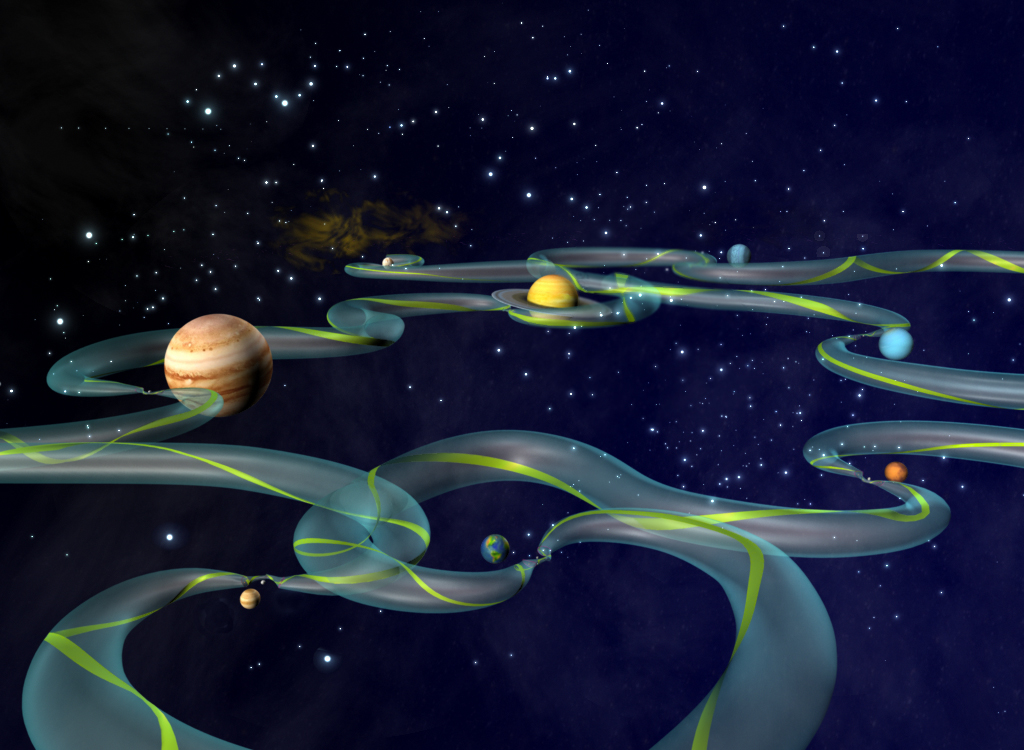
Artist’s concept of interplanetary superhighway or Interplanetary Transport Network. Credit: NASA/JPL.
07/10/2014 – Ephemeris – Why is the bright Moon so low in summer and so high in winter?
Ephemeris for Thursday, July 10th. Today the sun will be up for 15 hours and 20 minutes, setting at 9:28. The moon, 2 days before full, will set at 5:22 tomorrow morning. Tomorrow the sun will rise at 6:08.
If you watch the moon for the next few nights, you won’t have to strain your neck because the moon at its highest will be less than 30 degrees above the southern horizon for us in northern Michigan. That’s because the moon closely follows the path of the sun in the sky, called the ecliptic, with a deviation of only 5 degrees maximum. Tonight it’s a couple of degrees north of the ecliptic. Tonight it’s located about where the sun was back last November or will be next November. In winter you’d swear that the full moon at its greatest height was practically overhead. It’s another effect of the Earth’s axial tilt of 23 ½ degrees. Our moon is odd in it doesn’t orbit the Earth’s equator like most large moons do for their planets.
Times are for the Traverse City/Interlochen area of Michigan. They may be different for your location.
Addendum
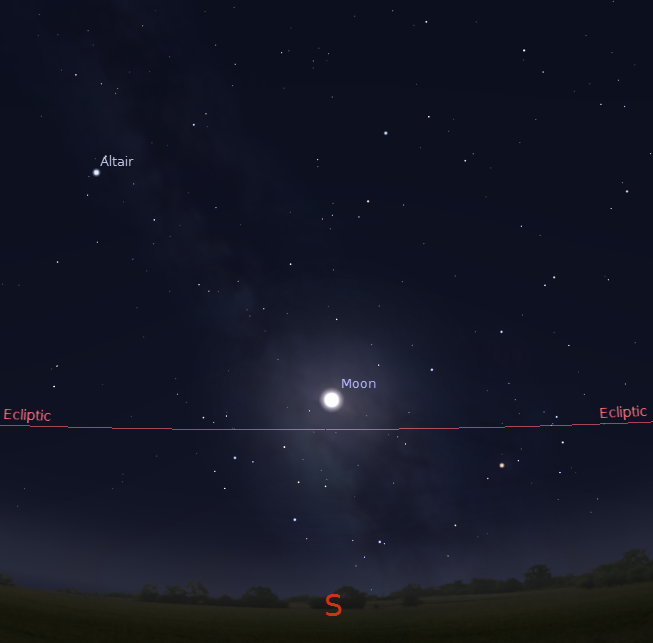
The full Moon on July, 12, 2014. Created using Stellarium.
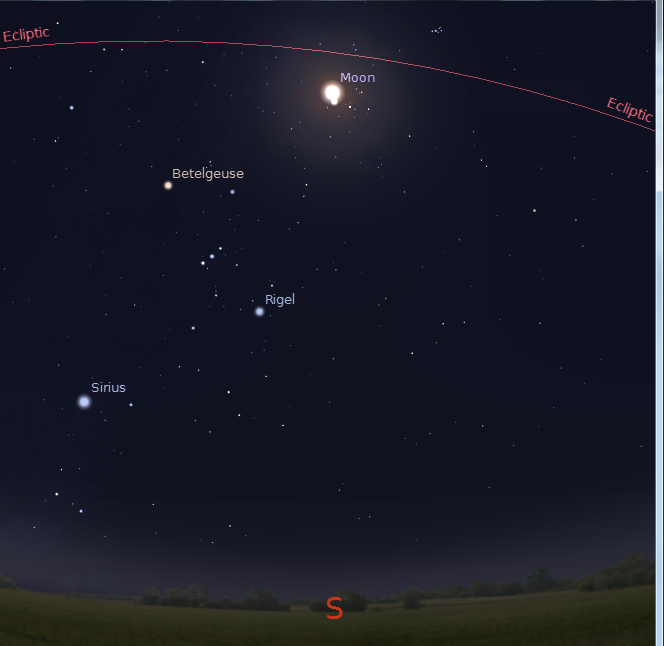
The full Moon on December 6, 2014. Created using Stellarium.
06/16/2014 – Ephemeris – Dates of the earliest sunrise and latest sunset
Ephemeris for Monday, June 16th. Today the sun will be up for 15 hours and 33 minutes, setting at 9:29. The moon, half way from full to last quarter, will rise at 12:11 tomorrow morning. Tomorrow the sun will rise at 5:56.
Yesterday saw the earliest sunrise for the year. My sunrise times will start to show a change on Thursday. The day-to-day change in sunrise times are now a few seconds. The summer solstice, or longest day will be this Saturday, and the latest sunset won’t occur until next week Thursday. The reason these dates don’t coincide has to do with the tilt of the earth’s axis and the earth’s slightly elliptical path around the sun. Actually the disparity between these dates is more pronounced at the winter solstice when the Earth is closer to the sun and moving faster. Yup, the sun is farther away now than it was in December. Actually we’re moving slower now, so summer lasts a few days longer than winter.
Times are for the Traverse City/Interlochen area of Michigan. They may be different for your location.
06/12/2014 – Ephemeris – Jupiter is making up for lost time and is heading rapidly eastward
Ephemeris for Thursday, June 12th. Today the sun will be up for 15 hours and 31 minutes, setting at 9:28. The moon, 1 day before full, will set at 6:38 tomorrow morning. Tomorrow the sun will rise at 5:56.
The planet Jupiter which is the brilliant star-like object in the west is starting to pick up its eastward motion in the stars. Several months ago as the earth was passing Jupiter when it was rising in the east at sunset, it had stopped its eastward motion against the stars and headed westward. This retrograde motion was due to Earth in essence passing the slower moving Jupiter. Now that it’s on the other side of the sun Jupiter is making up for lost time because it and Earth are now moving in opposite directions. This I see in the week to week setting times of Jupiter. Stars rise and set 4 minutes earlier each night. For Jupiter its down to three minutes, meaning it’s moving eastward. When we see it again in December it will have blown past Cancer to Leo, but it will later backtrack into Cancer.
Times are for the Traverse City/Interlochen area of Michigan. They may be different for your location.
Addendum
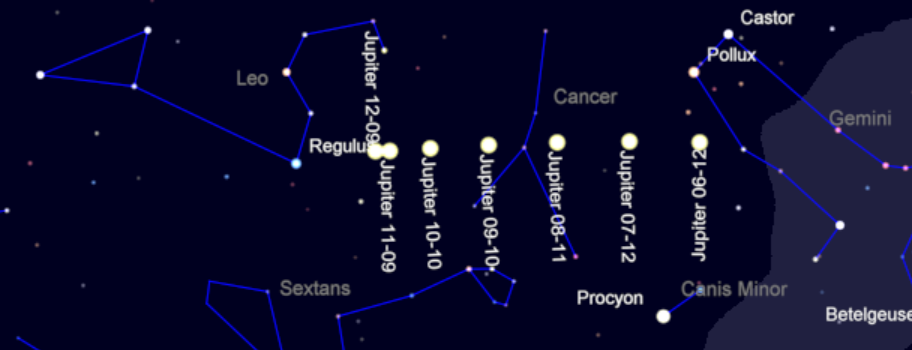
Jupiter’s apparent motion over the next 180 days. Note by December Jupiter will slow and will begin its retrograde loop as the Earth catches up with it again. Created using Cartes du Ciel (Sky Charts).
03/29/2013 – Ephemeris – How we know this Sunday is Easter
Ephemeris for Good Friday, Friday, March 29th. The sun will rise at 7:28. It’ll be up for 12 hours and 38 minutes, setting at 8:06. The moon, 2 days past full, will rise at 11:14 this evening.
Wednesday was the day of the Paschal full moon, the full moon after the first day of spring, which is defined by Christian churches as March 21st. For the date of Easter the actual full moon isn’t used, but a rather complicated formula is used to find the new moon. There’s a complicated correction to then find the date of the full moon, which 2 days ago. This year that formula works out correctly. It can be a day off either way. The next Sunday then is Easter. Orthodox churches use the Julian calendar and a different formula but they’ll celebrate Easter on May 5th. The formula was set up to approximate the Jewish lunar calendar. It works out close this year because Passover started at sunset last Sunday night.
Times are for the Traverse City/Interlochen area of Michigan. They may be different for your location.
03/26/2013 – Ephemeris – The universe is slightly older than we thought
Ephemeris for Tuesday, March 26th. The sun will rise at 7:34. It’ll be up for 12 hours and 28 minutes, setting at 8:02. The moon, 1 day before full, will set at 7:20 tomorrow morning.
Last week NASA and the European Space Agency announced the findings from the Planck satellite. Along with a sharper map of the Cosmic Microwave Background, created at the moment the Universe became transparent some 380,000 years after the Big Bang, Planck data revealed a slightly older universe of 13.82 billion years. This is with the error thought to be in the last measurement. So it’s a refinement. Also the universe appears to be expanding at a slightly lower rate that had been. Of the three main constituents of the universe, ordinary matter out of which you, me and the stars are made of is 4.9 percent, dark matter that holds galaxy clusters together is at 26 percent, while dark energy is at 68.3 percent, a decrease for it.
Times are for the Traverse City/Interlochen area of Michigan. They may be different for your location.
Addendum
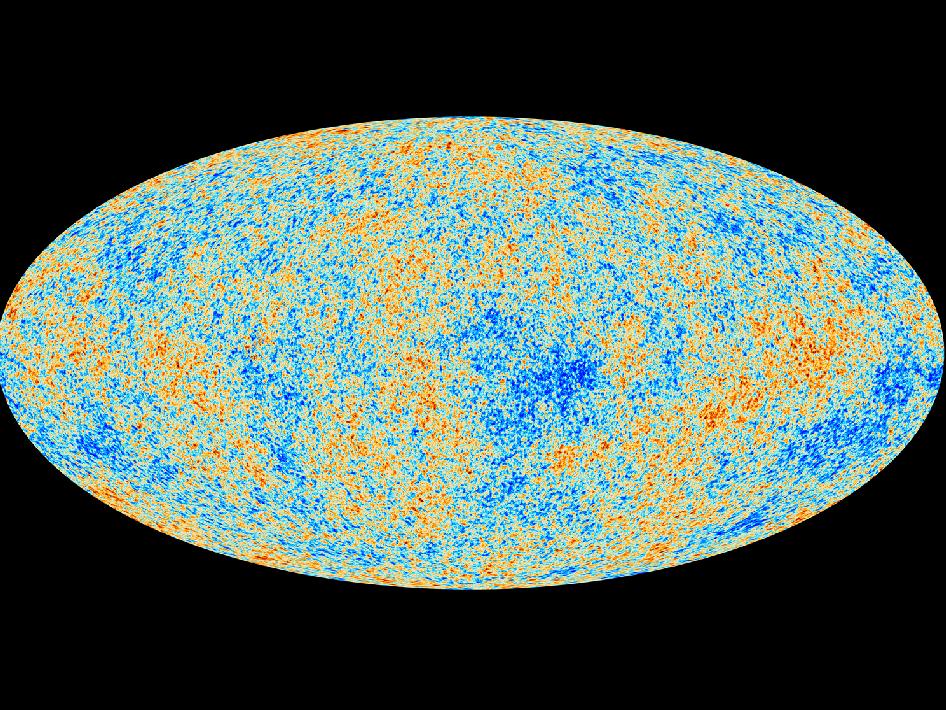
The Cosmic Microwave Background as determined by the Planck satellite. Image credit: ESA and the Planck Collaboration.
 Bob Moler's Ephemeris Blog