Archive
Ephemeris: 11/20/2025 – Venus is disappearing from the morning sky
This is Ephemeris for Thursday, November 20th. Today the Sun will be up for 9 hours and 23 minutes, setting at 5:09, and it will rise tomorrow at 7:48. The Moon is new today, and won’t be visible.
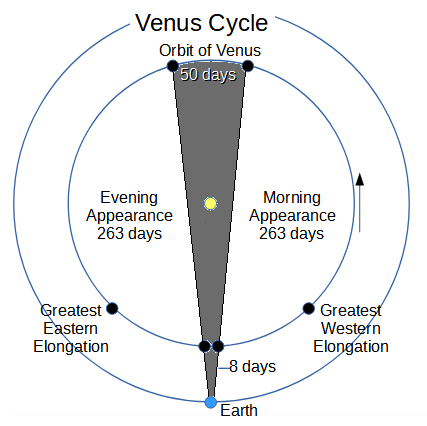
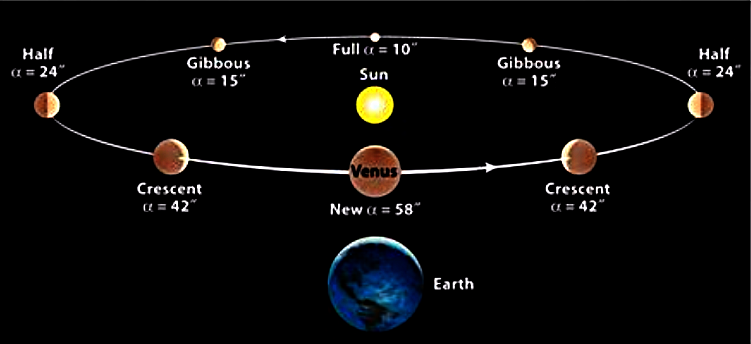
Yesterday I mentioned that Venus is getting very difficult to spot in the morning sky, rising at about 7:00 AM. It’s moving around behind the Sun, what’s called superior conjunction, so it moves slower than it would when it moves toward inferior conjunction meaning it moves between the Earth and the Sun. It’s closer to the Earth so it appears to move faster. Then it’s only gone for maybe 8 to 10 days, transitioning from the evening sky to the morning sky. However, at superior conjunction which will occur on January 6, it will disappear for 50 days or actually longer. The ancient Mayans calculated that around superior conjunction Venus would disappear for about 50 days. We at a higher latitude would see a longer disappearance, losing it until sometime in late February or early March.
The astronomical event times given in this blog are for the Traverse City/Interlochen area of Michigan (Lat 44.7° N, Long 85.7° W; EDT, UT – 4 hours) unless stated otherwise. Times will be different for other locations.
Addendum
Ephemeris: 10/27/2025 – Most of the mass in the universe is unseen
This is Ephemeris for Monday, October 27th. Today the Sun will be up for 10 hours and 23 minutes, setting at 6:38, and it will rise tomorrow at 8:15. The Moon, 2 days before first quarter, will set at 10:31 this evening.
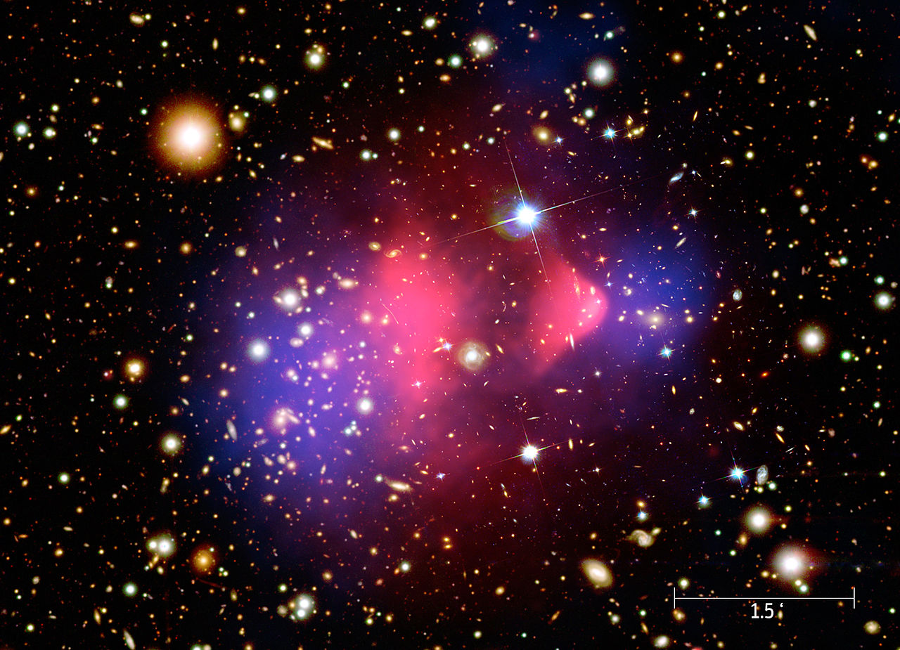
There is much more matter in the universe than we can see with our telescopes. This began to be apparent back in the 1930s when Fritz Zwicky discovered that galaxies in clusters were moving too rapidly. They should be flying apart, but they were not. Later, Vera Rubin found that stars moved around the center of galaxies at pretty much uniform speeds. One would expect stars farther from the center of a galaxy to move slower. So there must be some matter out there creating gravity by its mass that was invisible. This became what we call dark matter. No one knows exactly what it is, though there have been several hypotheses put forth. It can be detected by its warping of space-time, due to its mass, to distort the shapes of the galaxies beyond it.
The astronomical event times given in this blog are for the Traverse City/Interlochen area of Michigan (Lat 44.7° N, Long 85.7° W; EDT, UT – 4 hours) unless stated otherwise. Times will be different for other locations.
Addendum
Ephemeris: 09/25/2025 – Today is Equilux day
This is Ephemeris for Thursday, September 25th. Today the Sun will be up for 12 hours to the minute, setting at 7:33, and it will rise tomorrow at 7:35. The Moon, halfway from new to first quarter, will set at 8:50 this evening.
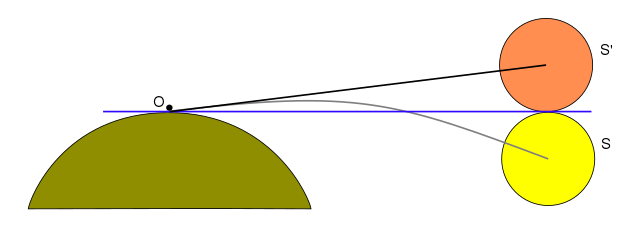
Today is Equilux day it’s the day we have exactly 12 hours of sunshine, and 12 hours of night. But isn’t that what we had three days ago on the equinox? That’s what equinox means. But, it only works on the equinox if the Earth didn’t have an atmosphere, and we decided that sunrise and sunset was when the middle of the sun crosses the horizon. The actual definition of sunrise and sunset is when the top of the Sun hits the horizon. So it rises a little earlier and so it’s a little bit later than it does geometrically. Also, the Earth has an atmosphere which causes the Sun to be higher in the sky when it’s closer to the horizon, which prolongs daylight. Check the weather app on your smartphone for your own personal sunrise and sunset times.
The astronomical event times given in this blog are for the Traverse City/Interlochen area of Michigan (Lat 44.7° N, Long 85.7° W; EDT, UT – 4 hours) unless stated otherwise. Times will be different for other locations.
Addendum
Ephemeris: 09/08/2025 – Previewing the Harvest Moon Effect
This is Ephemeris for Monday, September 8th. Today the Sun will be up for 12 hours and 52 minutes, setting at 8:05, and it will rise tomorrow at 7:14. The Moon, 1 day past full, will rise at 8:30 this evening.
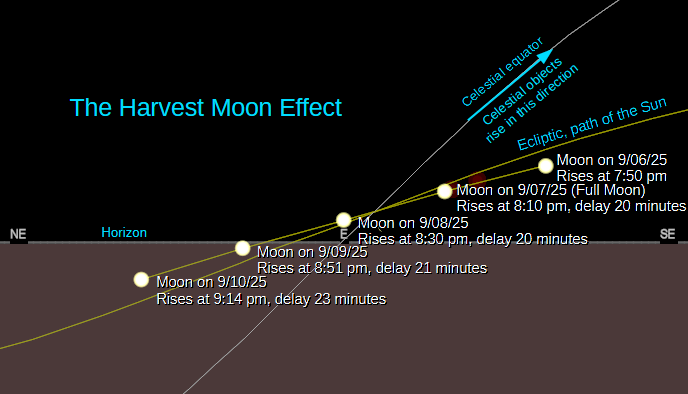
Last night’s full moon was not the Harvest Moon. We normally expect the Harvest Moon to come in September, but this year it does not because it is not the closest full moon to the autumnal equinox. The full moon of October 6th, this year, is the nearest full moon to the autumnal equinox. So it this month’s full moon is called the Corn Moon. But the effects of this full moon are the same as the Harvest Moon, in that the Moon rises only slightly later each evening for about a week or so. The Moon tonight will rise only 20 minutes later than it rose last night. The average day-to-day interval of moon rising is about 50 minutes. This earlier rising time had the effect of extending twilight which helped early farmers with an extra hour to gather in their crops.
The astronomical event times given in this blog are for the Traverse City/Interlochen area of Michigan (Lat 44.7° N, Long 85.7° W; EDT, UT – 4 hours) unless stated otherwise. Times will be different for other locations.
Addendum
Ephemeris: 09/04/2025 – Venus, the Morning Star
This is Ephemeris for Thursday, September 4th. Today the Sun will be up for 13 hours and 4 minutes, setting at 8:13, and it will rise tomorrow at 7:10. The Moon, 3 days before full, will set at 4:19 tomorrow morning.
Venus graces our morning sky as the Morning Star. It is seen, this year, along with the planet Jupiter. They are the two brightest planets. The Greek and others of that part of the world, early on, thought the evening and morning appearances of Venus were two different planets. The Mayans of Pre-Columbian Central America were meticulous observers of Venus, as is seen in one of their surviving books, the Dresden Codex. A Venus cycle lasts 584 days, from first appearance in the morning sky, its heliacal rising, through its morning appearance, disappearance behind the Sun, through its evening appearance and disappearance to the next heliacal rising. Astronomers call that it’s synodic period. Five synodic periods equal almost exactly 8 years.
Addendum
Ephemeris: 08/29/2025 – Late August crescent Moon stays low in the western sky
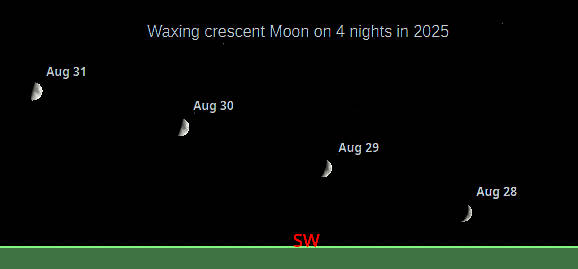
This is Ephemeris for Friday, August 29th. Today the Sun will be up for 13 hours and 22 minutes, setting at 8:24, and it will rise tomorrow at 7:03. The Moon, 2 days before first quarter, will set at 10:48 this evening.
There’s an interesting feature that I’ve noticed about the Moon this time of year. When there’s a waxing crescent Moon in the evening, in late summer to early autumn, it’s seen pretty low in the southwestern sky after sunset. Tonight it’ll be two days before first quarter so it’ll be a fat crescent. However, when it’s seen after sunset, it will be very low in the southwestern sky. Contrast that for early risers, at this time of year the waning crescent Moon moves at a steep angle to the horizon, as do the planets now in the east. And of course the opposite is true for late winter and early spring moons. By the way, the Harvest Moon is in early October this year. The Harvest Moon is the nearest full moon to the autumnal equinox.
The astronomical event times given in this blog are for the Traverse City/Interlochen area of Michigan (Lat 44.7° N, Long 85.7° W; EDT, UT – 4 hours) unless stated otherwise. Times will be different for other locations.
Addendum
Ephemeris: 08/08/2025 – Mercury’s strange rotation
This is Ephemeris for Friday, August 8th. Today the Sun will be up for 14 hours and 21 minutes, setting at 8:58, and it will rise tomorrow at 6:38. The Moon, 1 day before full, will set at 6:42 tomorrow morning.
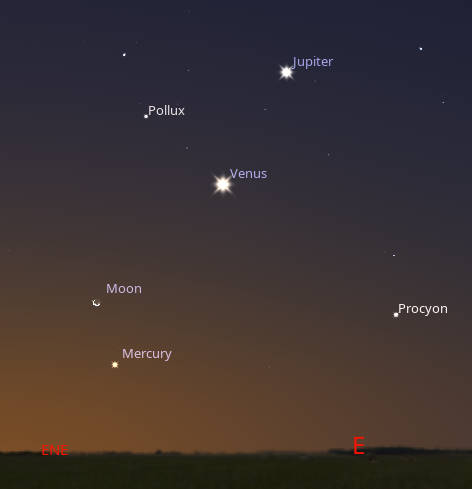
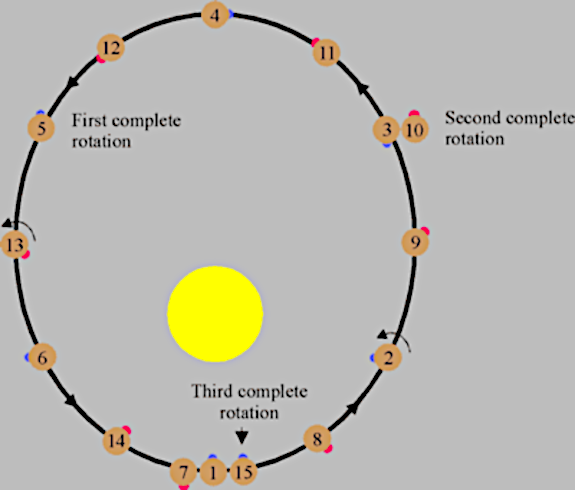
The planet Mercury is the closest planet to the Sun, and for a long time was thought to have synchronous rotation. That is it rotated in the same 88 days it took to orbit the Sun. However, in 1965 using radar from the Arecibo Observatory in Puerto Rico, astronomers learned that the rotation was exactly 2/3 of that 88 days. An interesting relationship of the sidereal rotation of 59 days against the stars, 2/3 of the Mercury’s year. Earth’s solar day, noon to noon is 3 minutes 56 seconds longer than the sidereal day. Mercury’s solar day turns out to be exactly 2 Mercurian years long.
The astronomical event times given in this blog are for the Traverse City/Interlochen area of Michigan (Lat 44.7° N, Long 85.7° W; EDT, UT – 4 hours) unless stated otherwise. Times will be different for other locations.
Addendum
Ephemeris: 08/07/2025 – Does the Moon rotate?
This is Ephemeris for Thursday, August 7th. Today the Sun will be up for 14 hours and 23 minutes, setting at 9:00, and it will rise tomorrow at 6:37. The Moon, 2 days before full, will set at 5:26 tomorrow morning.
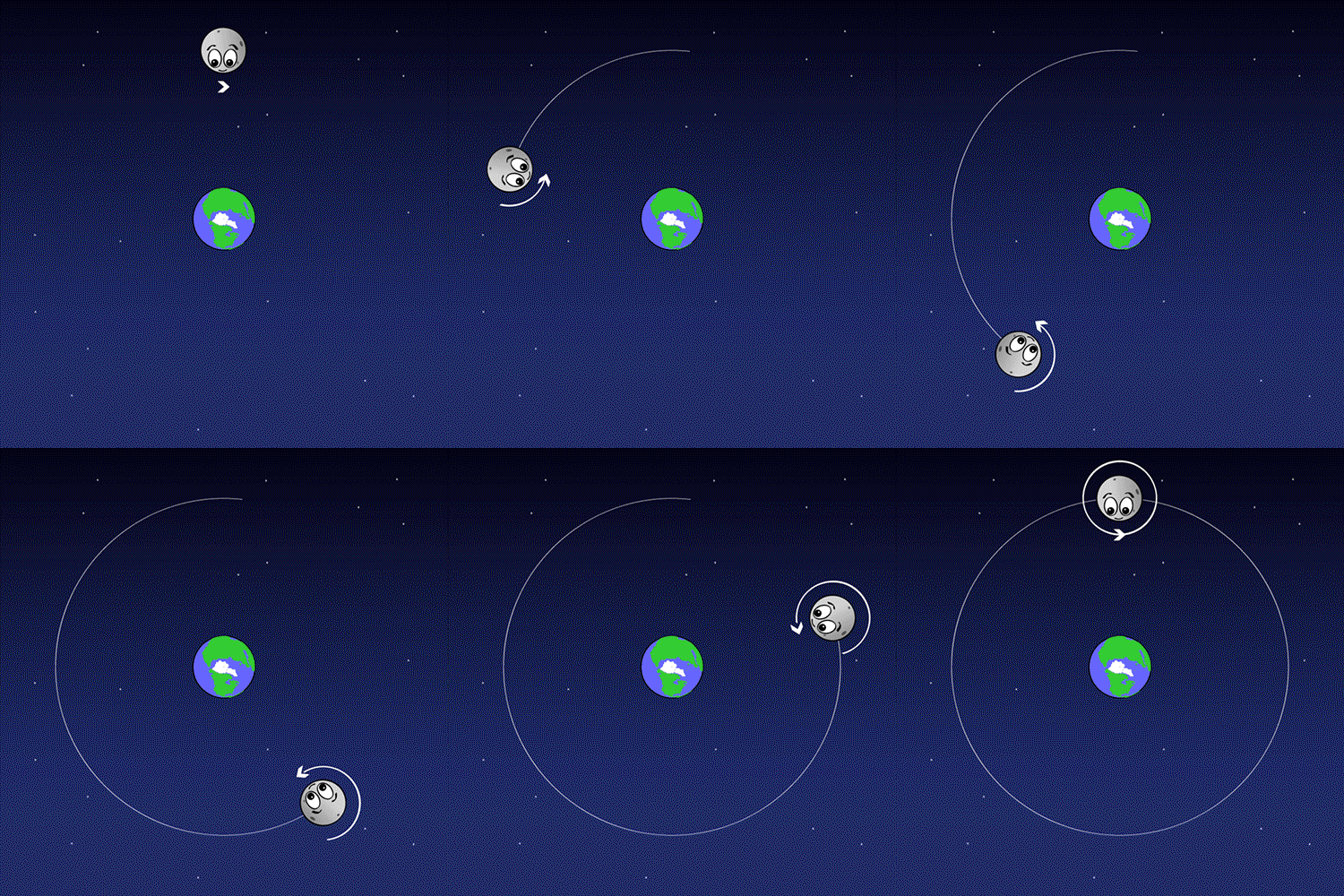
The moon exhibits the same face to the Earth throughout the month. That doesn’t mean the Moon doesn’t rotate. It means that the moon rotates in the same time it takes to orbit the Earth. This is called synchronous rotation. It is also known as tidal locking, caused by the difference in the gravitational attraction across the body of the Moon from the near side to the far side. The same thing happens with the Earth and is best seen by the ocean tides on the part of the Earth facing and away from the Moon. The reason the Earth is not tidally locked is that it is much more massive. But the Moon is slowing down the Earth’s rotation. But by doing that, it is moving further away, so it will never totally lock the Earth’s rotation with it.
The astronomical event times given in this blog are for the Traverse City/Interlochen area of Michigan (Lat 44.7° N, Long 85.7° W; EDT, UT – 4 hours) unless stated otherwise. Times will be different for other locations.
Addendum
Ephemeris: 07/22/2025 – It’s Pi Approximation Day!*
* I’d want to call it “Pi Fractured Fraction Day.”
This is Ephemeris for Pi Approximation Day, Tuesday, July 22nd. Today the Sun will be up for 15 hours exactly, setting at 9:19, and it will rise tomorrow at 6:19. The Moon, 2 days before new, will rise at 4:27 tomorrow morning.
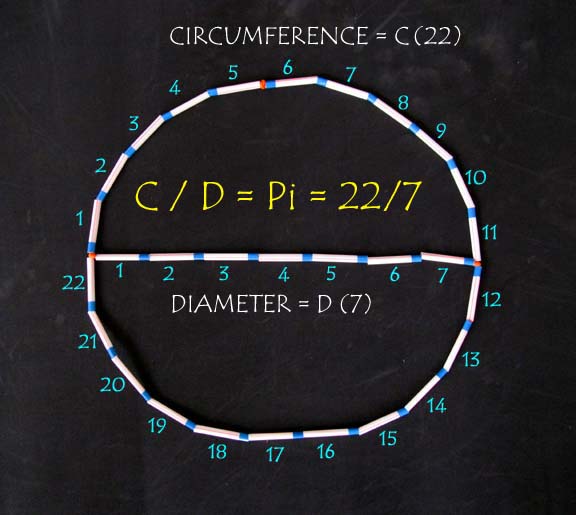
So why is July 22nd Pi Approximation Day? Pi being the Greek letter that represents, mathematically, the ratio of a circle’s diameter to its circumference. Well, we had Pi Day on March 14th or 3.14. Today represents the fractional way of getting to Pi, twenty-two sevenths for July 22nd. In Europe, it’s 22/7, rather how we in America write the date 7/22. I’ve never approximated pi that way. It’s one of those dreaded fractions I learned about in grade school, and to boot it’s an improper fraction. The Bible has a thing for the numbers 7, 40 and a thousand. Also, pi being equal to three. In First Kings, chapter 7, verse 23 it talks about a vessel with a diameter of 10 cubits and a circumference of 30 cubits. A very rough approximation.
The astronomical event times given in this blog are for the Traverse City/Interlochen area of Michigan (Lat 44.7° N, Long 85.7° W; EDT, UT – 4 hours) unless stated otherwise. Times will be different for other locations.
Addendum
Ephemeris: 07/07/2025 – Old and new explanations of the Moon’s appearance
This is Ephemeris for Monday, July 7th. Today the Sun will be up for 15 hours and 24 minutes, setting at 9:30, and it will rise tomorrow at 6:05. The Moon, 3 days before full, will set at 3:30 tomorrow morning.
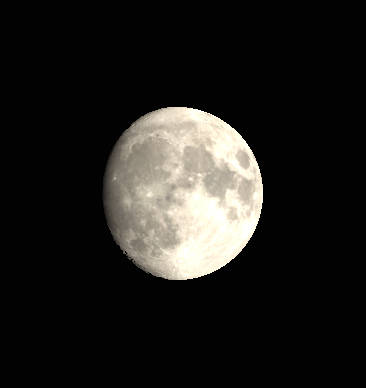
The Moon’s changing appearance over the month may seem to be mysterious at first glance. Maybe because one may think that the objects in the sky are somehow different from the familiar objects we see around us on the Earth. In ancient times, especially the Greeks thought that everything in the heavens was perfect and spotless. They explained the definite markings we see as the man-in-the-moon as a reflection of the Earth by a spotless Moon. The Moon’s phases are simply light and shadow on a ball in the sunlight. Sometime, when the Moon appears in the daytime, take a small ball, like a golf ball and hold it up to the Moon, while the ball is also in sunlight, and the small ball will exhibit the same phase as the Moon.
See 10/12/18
The astronomical event times given in this blog are for the Traverse City/Interlochen area of Michigan (Lat 44.7° N, Long 85.7° W; EDT, UT – 4 hours) unless stated otherwise. Times will be different for other locations.
Addendum

 Bob Moler's Ephemeris Blog