Archive
Ephemeris: 02/13/2026 – The real cause of a planet’s retrograde motion
This is Ephemeris for Friday, February 13th. Today the Sun will be up for 10 hours and 22 minutes, setting at 6:08, and it will rise tomorrow at 7:44. The Moon, halfway from last quarter to new, will rise at 6:30 tomorrow morning.
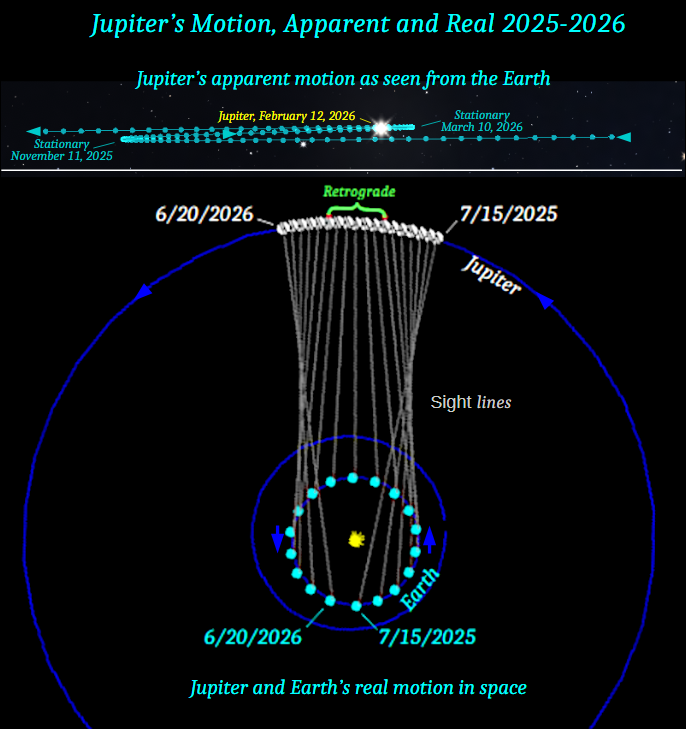
So what is the real reason that Jupiter is currently moving westward for a while in retrograde motion? Retrograde motion occurs in outer planets because the Earth is actually passing them. A simple analogy would be, if you were in a car that was passing another, the car you are passing would seem to move backwards compared to you. And that is exactly what’s happening. The Earth moves faster than the outer planets. Since the solar system is like a racetrack, and we get to lap these outer planets repeatedly when they are closest to us. For the inner planet it’s opposite. They go retrograde or backwards when they are passing us. This is a much simpler answer than all these circles upon circles the ancients invented.
The astronomical event times given in this blog are for the Traverse City/Interlochen area of Michigan (Lat 44.7° N, Long 85.7° W; EST, UT – 5 hours) unless stated otherwise. Times will be different for other locations.
Addendum
Ephemeris: 02/12/2026 – Why do planets stop and move backward for a time? Part 1
This is Ephemeris for Darwin Day, Thursday, February 12th. Today the Sun will be up for 10 hours and 19 minutes, setting at 6:07, and it will rise tomorrow at 7:45. The Moon, 3 days past last quarter, will rise at 5:49 tomorrow morning.
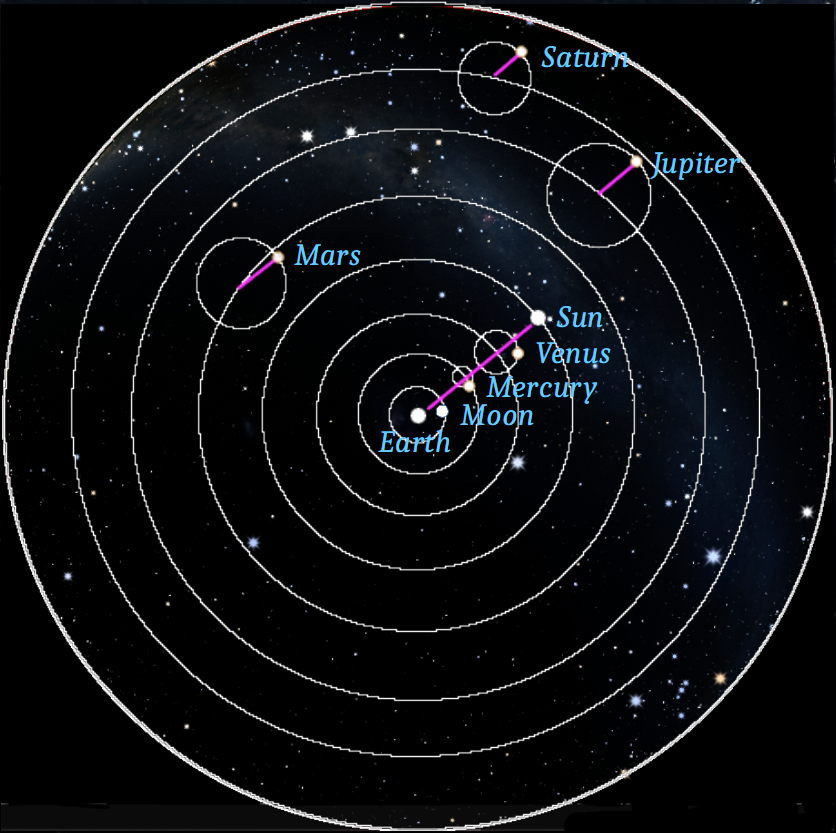
For the last month or so I’ve been talking about Jupiter in its retrograde or westward motion against the stars of Gemini. This motion isn’t due to just Jupiter itself. Jupiter orbits smoothly around the sun in one direction, in a little less than 12 years. The ancients thought that the earth was stationary, and everything in the sky orbited the earth. They thought that the planets orbited the earth in the same time that the planet orbits the sun, however every year and depending on where the planet was in the sky it would stop, reverse itself for a while and then resume its eastward motion through the sky. They thought that the planet moved on a small circle called an epicycle that rode on the larger circle called the deferent.
The astronomical event times given in this blog are for the Traverse City/Interlochen area of Michigan (Lat 44.7° N, Long 85.7° W; EST, UT – 5 hours) unless stated otherwise. Times will be different for other locations.
Addendum
Tomorrow, we’ll find out what’s really going on.
Ephemeris: 01/05/2026 – We just passed perihelion… Can’t you feel the warmth?
This is Ephemeris for Monday, January 5th. Today the Sun will be up for 8 hours and 57 minutes, setting at 5:16, and it will rise tomorrow at 8:19. The Moon, 2 days past full, will rise at 8:10 this evening.
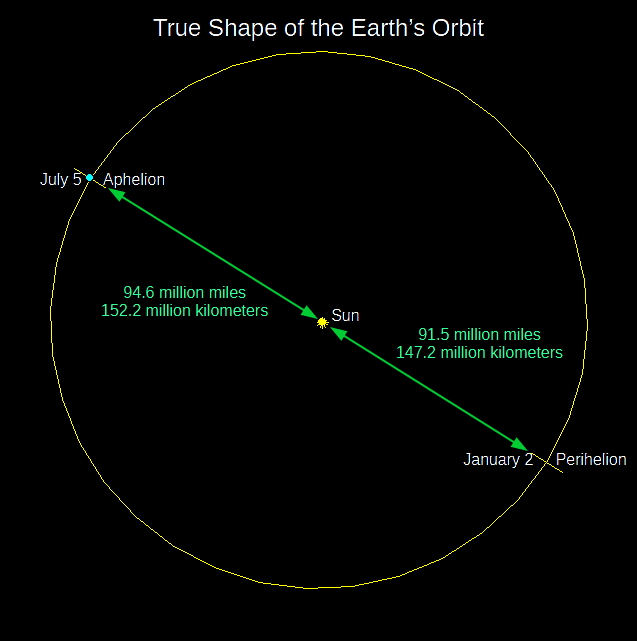
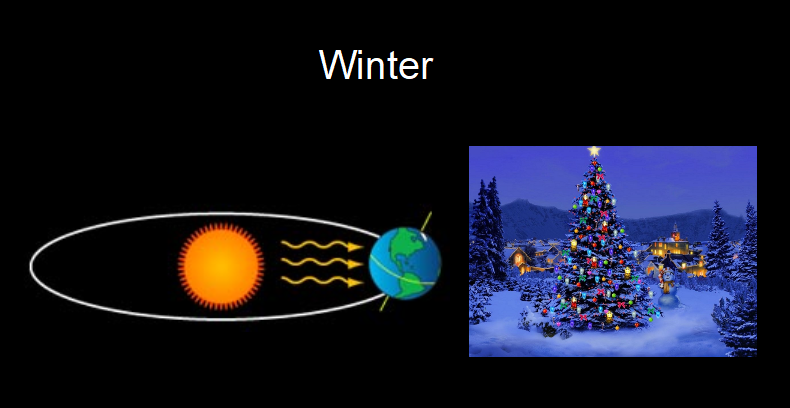
While we were busy with other matters, several astronomical events happened over the weekend. First, on Friday we had our latest sunrise, so our lengthening days are beginning to show up in the morning now. On Saturday the Earth passed perihelion, that is its closest point in its orbit to the Sun. That doesn’t make things any warmer, but it does make winter the shortest season by about four days shorter than summer. Not that you could tell in Northern Michigan. The distance of the Earth from the Sun is still hanging around 91.4 million miles. The earth is moving faster so we move through winter quicker. Also, there was a meteor shower, the Quadrantids, which peaked on Saturday, but was pretty much wiped out by the full moon.
The astronomical event times given in this blog are for the Traverse City/Interlochen area of Michigan (Lat 44.7° N, Long 85.7° W; EST, UT – 5 hours) unless stated otherwise. Times will be different for other locations.
Addendum
Ephemeris: 12/26/2025 – Conjunctions, eclipses, transits and occultations, oh my!
This is Ephemeris for Friday, December 26th. Today the Sun will be up for 8 hours and 49 minutes, setting at 5:08, and it will rise tomorrow at 8:19. The Moon, 1 day before first quarter, will set at 12:13 tomorrow morning.
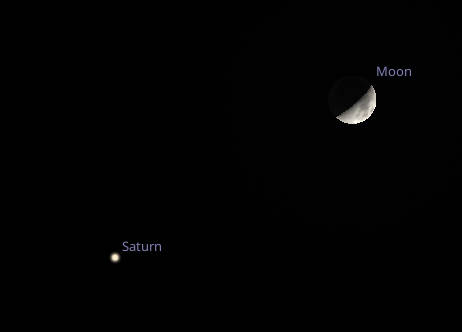
Tonight the Moon will pass north of the planet Saturn. That will mean in that location in the southwestern sky, the planet will appear just below and left of the Moon. When two solar system objects appear to pass each other, it’s called a conjunction. To astronomers, it’s no big deal unless one passes directly in front of the other. If a smaller appearing one crosses the disc of a larger one, it’s called a transit, If one is completely hidden by another it’s an occultation. Occultations and transits of Jupiter and its satellites are common. Also, Jupiter’s satellites are eclipsed by passing through the planet’s shadow. We are in a period now when Jupiter’s moons occult and eclipse each other occasionally.
The astronomical event times given in this blog are for the Traverse City/Interlochen area of Michigan (Lat 44.7° N, Long 85.7° W; EST, UT – 5 hours) unless stated otherwise. Times will be different for other locations.
Addendum
Ephemeris: 12/19/2025 – Winter begins Sunday
This is Ephemeris for Friday, December 19th. Today the Sun will be up for 8 hours and 48 minutes, setting at 5:04, and it will rise tomorrow at 8:16. The Moon is new today, and won’t be visible.
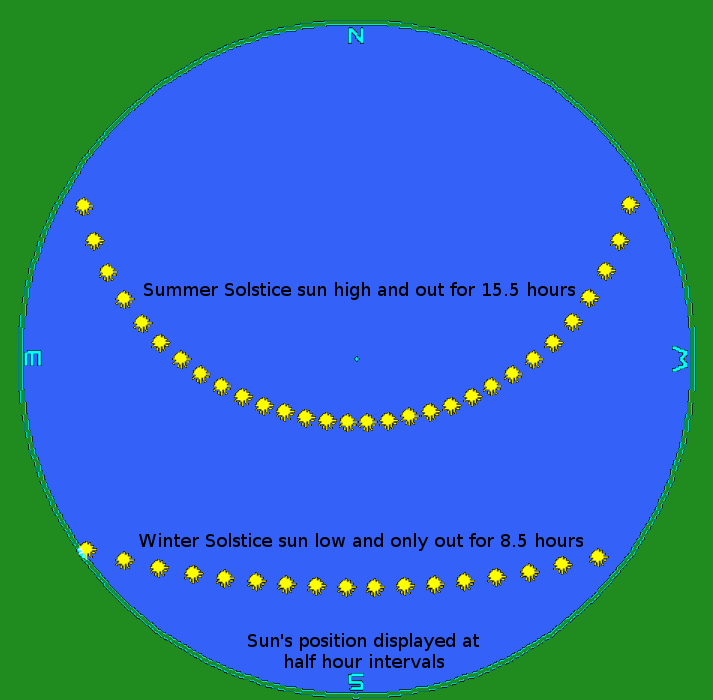
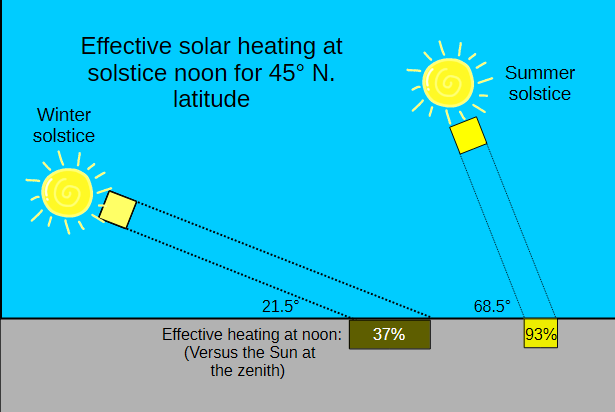
The thermometer and snowfall tell us that winter ought to be here. Well, it will be at 10:03 Sunday morning. At that point, the winter solstice, the Sun will be directly over the Tropic of Capricorn at 23 ½ degrees south latitude. It’s an odd name because 2,000 years ago the Sun was in indeed entering Capricornus. Now it will be entering Sagittarius, right above the spout of the teapot asterism we know so well in summer. From then on the Sun will be climbing up the sky each noon until June 21st next year when summer will start. To which I say: Go Sun Go! The Sun will almost make it up to 22 degrees above the southern horizon at local noon, which is 12:40 pm, in Interlochen and be out for only 8 hours and 48 minutes. If it stayed that low all year, we’d be in a deep freeze, possibly colder than Antarctica.
The astronomical event times given in this blog are for the Traverse City/Interlochen area of Michigan (Lat 44.7° N, Long 85.7° W; EST, UT – 5 hours) unless stated otherwise. Times will be different for other locations.
Addendum
Ephemeris: 11/20/2025 – Venus is disappearing from the morning sky
This is Ephemeris for Thursday, November 20th. Today the Sun will be up for 9 hours and 23 minutes, setting at 5:09, and it will rise tomorrow at 7:48. The Moon is new today, and won’t be visible.
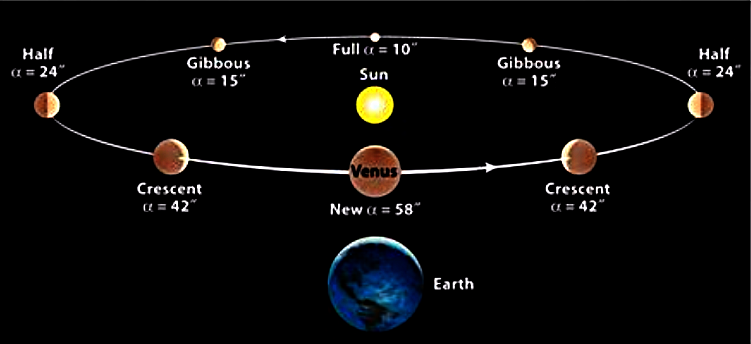
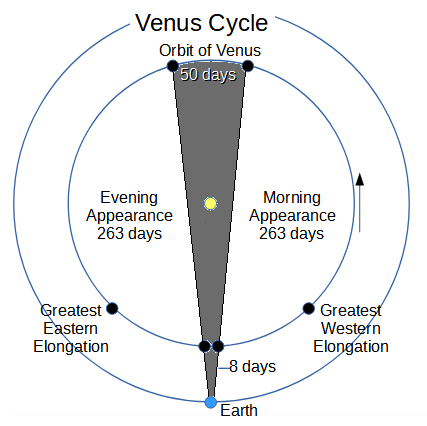
Yesterday I mentioned that Venus is getting very difficult to spot in the morning sky, rising at about 7:00 AM. It’s moving around behind the Sun, what’s called superior conjunction, so it moves slower than it would when it moves toward inferior conjunction meaning it moves between the Earth and the Sun. It’s closer to the Earth so it appears to move faster. Then it’s only gone for maybe 8 to 10 days, transitioning from the evening sky to the morning sky. However, at superior conjunction which will occur on January 6, it will disappear for 50 days or actually longer. The ancient Mayans calculated that around superior conjunction Venus would disappear for about 50 days. We at a higher latitude would see a longer disappearance, losing it until sometime in late February or early March.
The astronomical event times given in this blog are for the Traverse City/Interlochen area of Michigan (Lat 44.7° N, Long 85.7° W; EDT, UT – 4 hours) unless stated otherwise. Times will be different for other locations.
Addendum
Ephemeris: 10/27/2025 – Most of the mass in the universe is unseen
This is Ephemeris for Monday, October 27th. Today the Sun will be up for 10 hours and 23 minutes, setting at 6:38, and it will rise tomorrow at 8:15. The Moon, 2 days before first quarter, will set at 10:31 this evening.
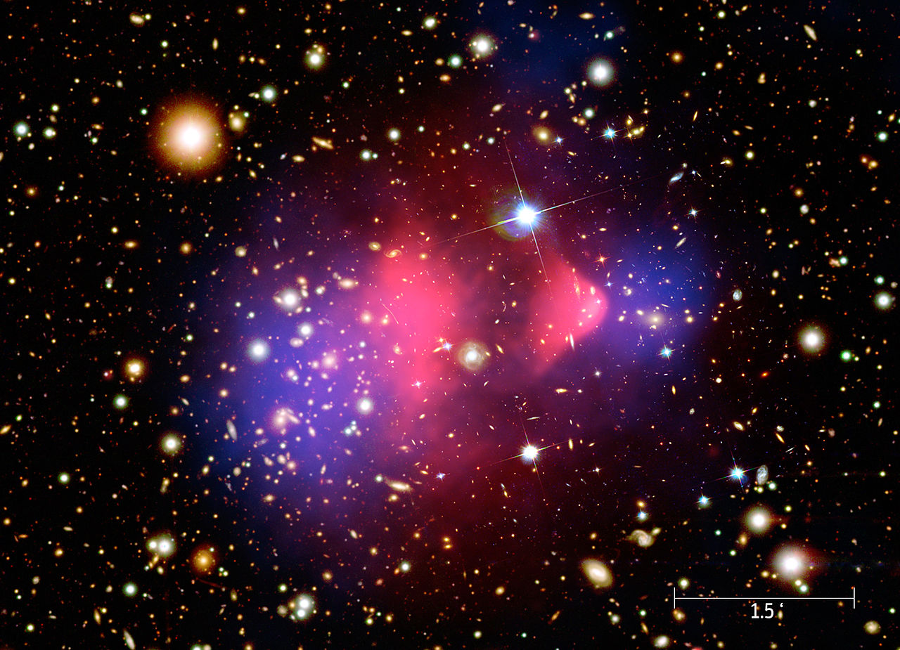
There is much more matter in the universe than we can see with our telescopes. This began to be apparent back in the 1930s when Fritz Zwicky discovered that galaxies in clusters were moving too rapidly. They should be flying apart, but they were not. Later, Vera Rubin found that stars moved around the center of galaxies at pretty much uniform speeds. One would expect stars farther from the center of a galaxy to move slower. So there must be some matter out there creating gravity by its mass that was invisible. This became what we call dark matter. No one knows exactly what it is, though there have been several hypotheses put forth. It can be detected by its warping of space-time, due to its mass, to distort the shapes of the galaxies beyond it.
The astronomical event times given in this blog are for the Traverse City/Interlochen area of Michigan (Lat 44.7° N, Long 85.7° W; EDT, UT – 4 hours) unless stated otherwise. Times will be different for other locations.
Addendum
Ephemeris: 09/25/2025 – Today is Equilux day
This is Ephemeris for Thursday, September 25th. Today the Sun will be up for 12 hours to the minute, setting at 7:33, and it will rise tomorrow at 7:35. The Moon, halfway from new to first quarter, will set at 8:50 this evening.
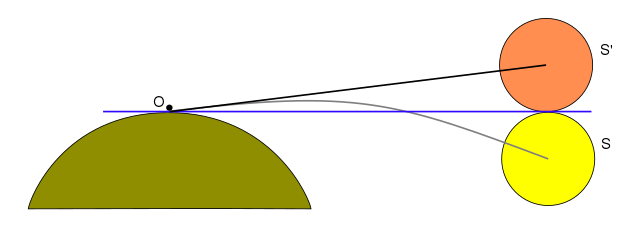
Today is Equilux day it’s the day we have exactly 12 hours of sunshine, and 12 hours of night. But isn’t that what we had three days ago on the equinox? That’s what equinox means. But, it only works on the equinox if the Earth didn’t have an atmosphere, and we decided that sunrise and sunset was when the middle of the sun crosses the horizon. The actual definition of sunrise and sunset is when the top of the Sun hits the horizon. So it rises a little earlier and so it’s a little bit later than it does geometrically. Also, the Earth has an atmosphere which causes the Sun to be higher in the sky when it’s closer to the horizon, which prolongs daylight. Check the weather app on your smartphone for your own personal sunrise and sunset times.
The astronomical event times given in this blog are for the Traverse City/Interlochen area of Michigan (Lat 44.7° N, Long 85.7° W; EDT, UT – 4 hours) unless stated otherwise. Times will be different for other locations.
Addendum
Ephemeris: 09/08/2025 – Previewing the Harvest Moon Effect
This is Ephemeris for Monday, September 8th. Today the Sun will be up for 12 hours and 52 minutes, setting at 8:05, and it will rise tomorrow at 7:14. The Moon, 1 day past full, will rise at 8:30 this evening.
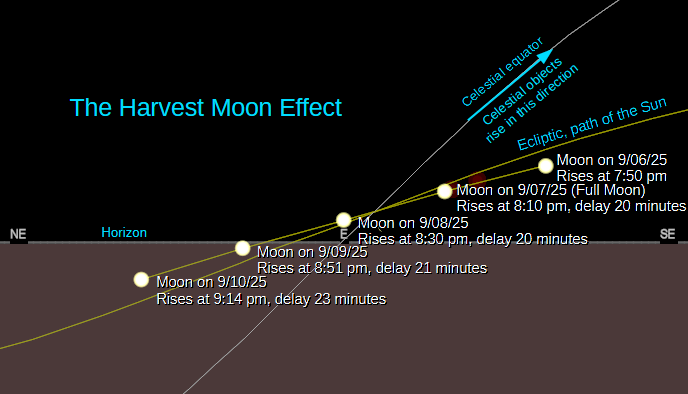
Last night’s full moon was not the Harvest Moon. We normally expect the Harvest Moon to come in September, but this year it does not because it is not the closest full moon to the autumnal equinox. The full moon of October 6th, this year, is the nearest full moon to the autumnal equinox. So it this month’s full moon is called the Corn Moon. But the effects of this full moon are the same as the Harvest Moon, in that the Moon rises only slightly later each evening for about a week or so. The Moon tonight will rise only 20 minutes later than it rose last night. The average day-to-day interval of moon rising is about 50 minutes. This earlier rising time had the effect of extending twilight which helped early farmers with an extra hour to gather in their crops.
The astronomical event times given in this blog are for the Traverse City/Interlochen area of Michigan (Lat 44.7° N, Long 85.7° W; EDT, UT – 4 hours) unless stated otherwise. Times will be different for other locations.
Addendum
Ephemeris: 09/04/2025 – Venus, the Morning Star
This is Ephemeris for Thursday, September 4th. Today the Sun will be up for 13 hours and 4 minutes, setting at 8:13, and it will rise tomorrow at 7:10. The Moon, 3 days before full, will set at 4:19 tomorrow morning.
Venus graces our morning sky as the Morning Star. It is seen, this year, along with the planet Jupiter. They are the two brightest planets. The Greek and others of that part of the world, early on, thought the evening and morning appearances of Venus were two different planets. The Mayans of Pre-Columbian Central America were meticulous observers of Venus, as is seen in one of their surviving books, the Dresden Codex. A Venus cycle lasts 584 days, from first appearance in the morning sky, its heliacal rising, through its morning appearance, disappearance behind the Sun, through its evening appearance and disappearance to the next heliacal rising. Astronomers call that it’s synodic period. Five synodic periods equal almost exactly 8 years.
Addendum