Archive
Ephemeris: 08/29/2025 – Late August crescent Moon stays low in the western sky
This is Ephemeris for Friday, August 29th. Today the Sun will be up for 13 hours and 22 minutes, setting at 8:24, and it will rise tomorrow at 7:03. The Moon, 2 days before first quarter, will set at 10:48 this evening.
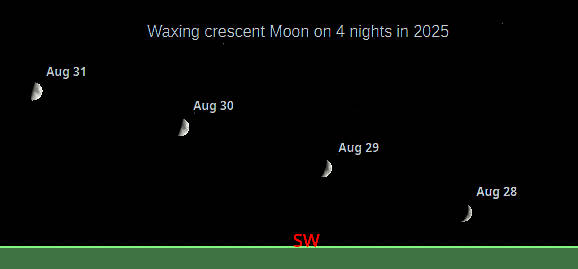
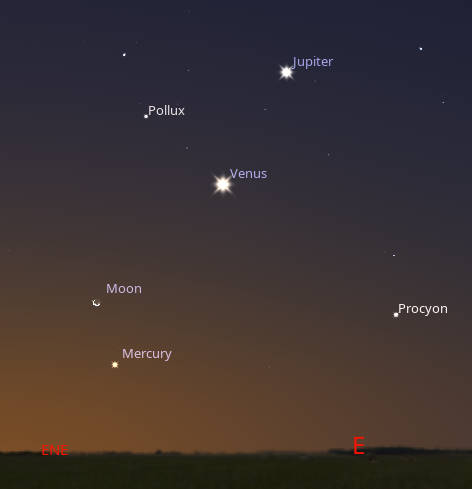
There’s an interesting feature that I’ve noticed about the Moon this time of year. When there’s a waxing crescent Moon in the evening, in late summer to early autumn, it’s seen pretty low in the southwestern sky after sunset. Tonight it’ll be two days before first quarter so it’ll be a fat crescent. However, when it’s seen after sunset, it will be very low in the southwestern sky. Contrast that for early risers, at this time of year the waning crescent Moon moves at a steep angle to the horizon, as do the planets now in the east. And of course the opposite is true for late winter and early spring moons. By the way, the Harvest Moon is in early October this year. The Harvest Moon is the nearest full moon to the autumnal equinox.
The astronomical event times given in this blog are for the Traverse City/Interlochen area of Michigan (Lat 44.7° N, Long 85.7° W; EDT, UT – 4 hours) unless stated otherwise. Times will be different for other locations.
Addendum
Ephemeris: 08/08/2025 – Mercury’s strange rotation
This is Ephemeris for Friday, August 8th. Today the Sun will be up for 14 hours and 21 minutes, setting at 8:58, and it will rise tomorrow at 6:38. The Moon, 1 day before full, will set at 6:42 tomorrow morning.
The planet Mercury is the closest planet to the Sun, and for a long time was thought to have synchronous rotation. That is it rotated in the same 88 days it took to orbit the Sun. However, in 1965 using radar from the Arecibo Observatory in Puerto Rico, astronomers learned that the rotation was exactly 2/3 of that 88 days. An interesting relationship of the sidereal rotation of 59 days against the stars, 2/3 of the Mercury’s year. Earth’s solar day, noon to noon is 3 minutes 56 seconds longer than the sidereal day. Mercury’s solar day turns out to be exactly 2 Mercurian years long.
The astronomical event times given in this blog are for the Traverse City/Interlochen area of Michigan (Lat 44.7° N, Long 85.7° W; EDT, UT – 4 hours) unless stated otherwise. Times will be different for other locations.
Addendum
Ephemeris: 08/07/2025 – Does the Moon rotate?
This is Ephemeris for Thursday, August 7th. Today the Sun will be up for 14 hours and 23 minutes, setting at 9:00, and it will rise tomorrow at 6:37. The Moon, 2 days before full, will set at 5:26 tomorrow morning.
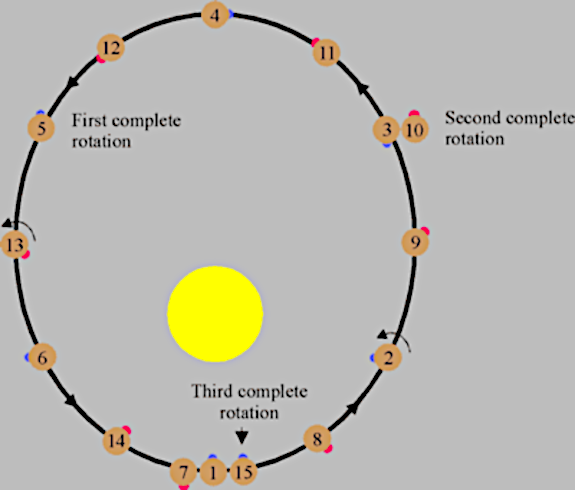
The moon exhibits the same face to the Earth throughout the month. That doesn’t mean the Moon doesn’t rotate. It means that the moon rotates in the same time it takes to orbit the Earth. This is called synchronous rotation. It is also known as tidal locking, caused by the difference in the gravitational attraction across the body of the Moon from the near side to the far side. The same thing happens with the Earth and is best seen by the ocean tides on the part of the Earth facing and away from the Moon. The reason the Earth is not tidally locked is that it is much more massive. But the Moon is slowing down the Earth’s rotation. But by doing that, it is moving further away, so it will never totally lock the Earth’s rotation with it.
The astronomical event times given in this blog are for the Traverse City/Interlochen area of Michigan (Lat 44.7° N, Long 85.7° W; EDT, UT – 4 hours) unless stated otherwise. Times will be different for other locations.
Addendum
Ephemeris: 07/22/2025 – It’s Pi Approximation Day!*
* I’d want to call it “Pi Fractured Fraction Day.”
This is Ephemeris for Pi Approximation Day, Tuesday, July 22nd. Today the Sun will be up for 15 hours exactly, setting at 9:19, and it will rise tomorrow at 6:19. The Moon, 2 days before new, will rise at 4:27 tomorrow morning.
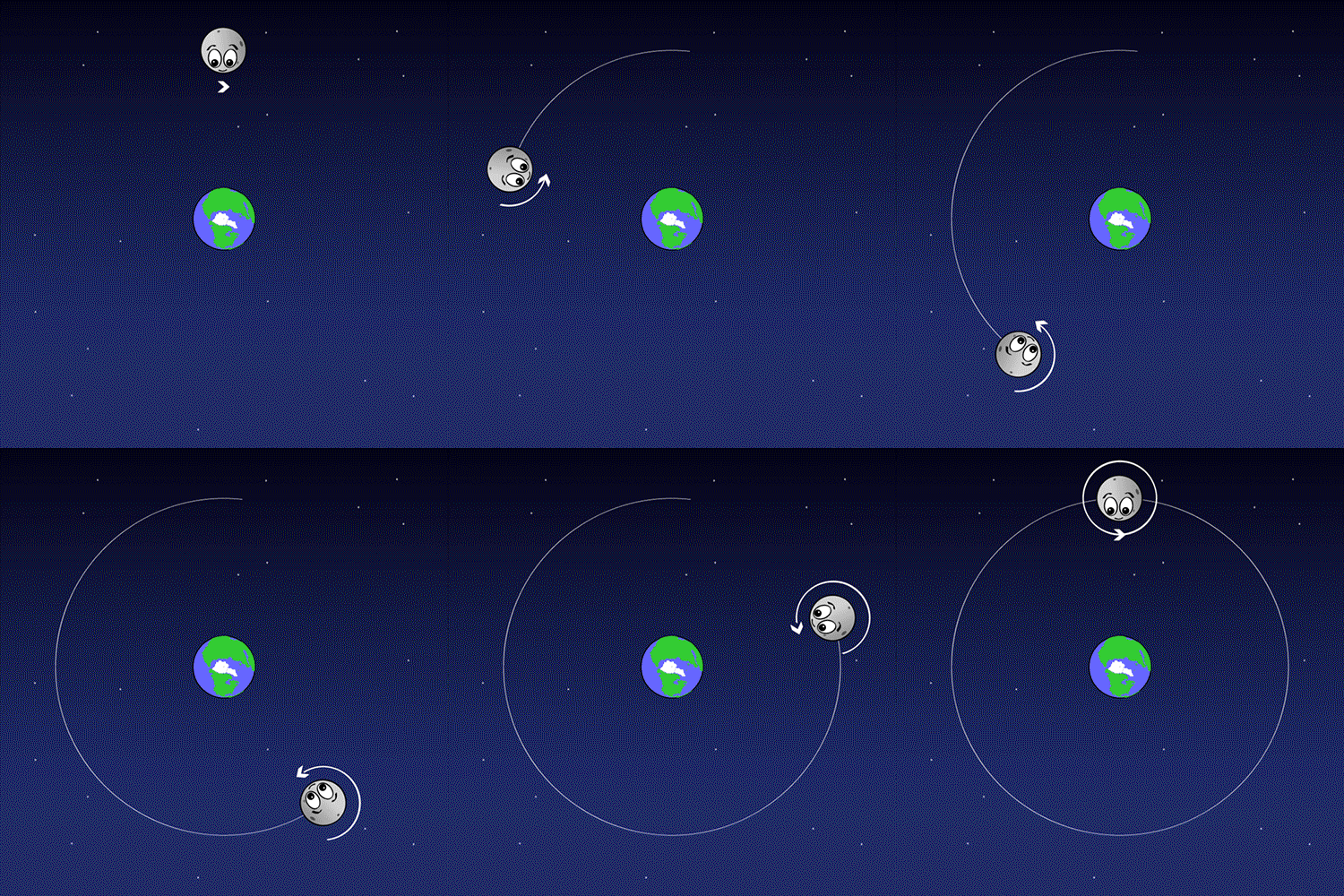
So why is July 22nd Pi Approximation Day? Pi being the Greek letter that represents, mathematically, the ratio of a circle’s diameter to its circumference. Well, we had Pi Day on March 14th or 3.14. Today represents the fractional way of getting to Pi, twenty-two sevenths for July 22nd. In Europe, it’s 22/7, rather how we in America write the date 7/22. I’ve never approximated pi that way. It’s one of those dreaded fractions I learned about in grade school, and to boot it’s an improper fraction. The Bible has a thing for the numbers 7, 40 and a thousand. Also, pi being equal to three. In First Kings, chapter 7, verse 23 it talks about a vessel with a diameter of 10 cubits and a circumference of 30 cubits. A very rough approximation.
The astronomical event times given in this blog are for the Traverse City/Interlochen area of Michigan (Lat 44.7° N, Long 85.7° W; EDT, UT – 4 hours) unless stated otherwise. Times will be different for other locations.
Addendum
Ephemeris: 07/07/2025 – Old and new explanations of the Moon’s appearance
This is Ephemeris for Monday, July 7th. Today the Sun will be up for 15 hours and 24 minutes, setting at 9:30, and it will rise tomorrow at 6:05. The Moon, 3 days before full, will set at 3:30 tomorrow morning.
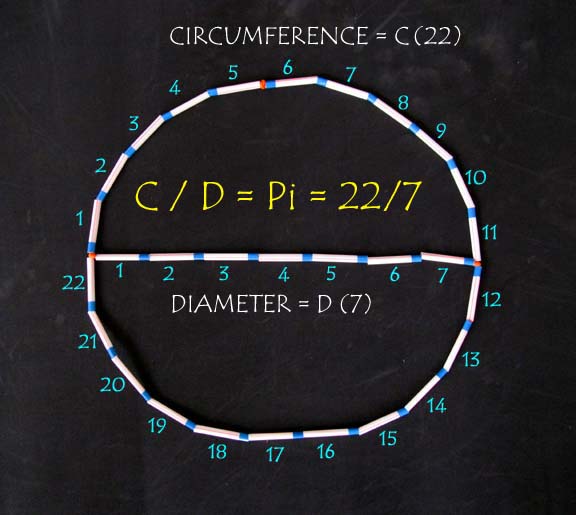
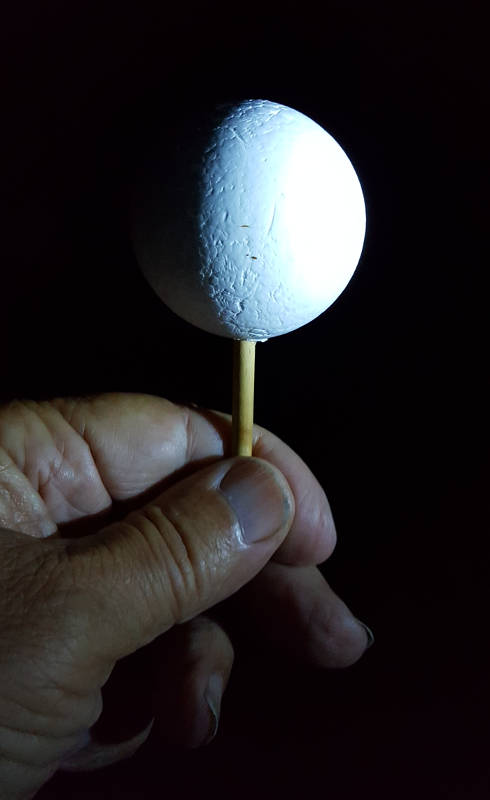
The Moon’s changing appearance over the month may seem to be mysterious at first glance. Maybe because one may think that the objects in the sky are somehow different from the familiar objects we see around us on the Earth. In ancient times, especially the Greeks thought that everything in the heavens was perfect and spotless. They explained the definite markings we see as the man-in-the-moon as a reflection of the Earth by a spotless Moon. The Moon’s phases are simply light and shadow on a ball in the sunlight. Sometime, when the Moon appears in the daytime, take a small ball, like a golf ball and hold it up to the Moon, while the ball is also in sunlight, and the small ball will exhibit the same phase as the Moon.
See 10/12/18
The astronomical event times given in this blog are for the Traverse City/Interlochen area of Michigan (Lat 44.7° N, Long 85.7° W; EDT, UT – 4 hours) unless stated otherwise. Times will be different for other locations.
Addendum
Ephemeris: 05/26/2025 – About globular star clusters
This is Ephemeris for Memorial Day, Monday, May 26th. Today the Sun will be up for 15 hours and 12 minutes, setting at 9:16, and it will rise tomorrow at 6:03. The Moon is new today, and won’t be visible.
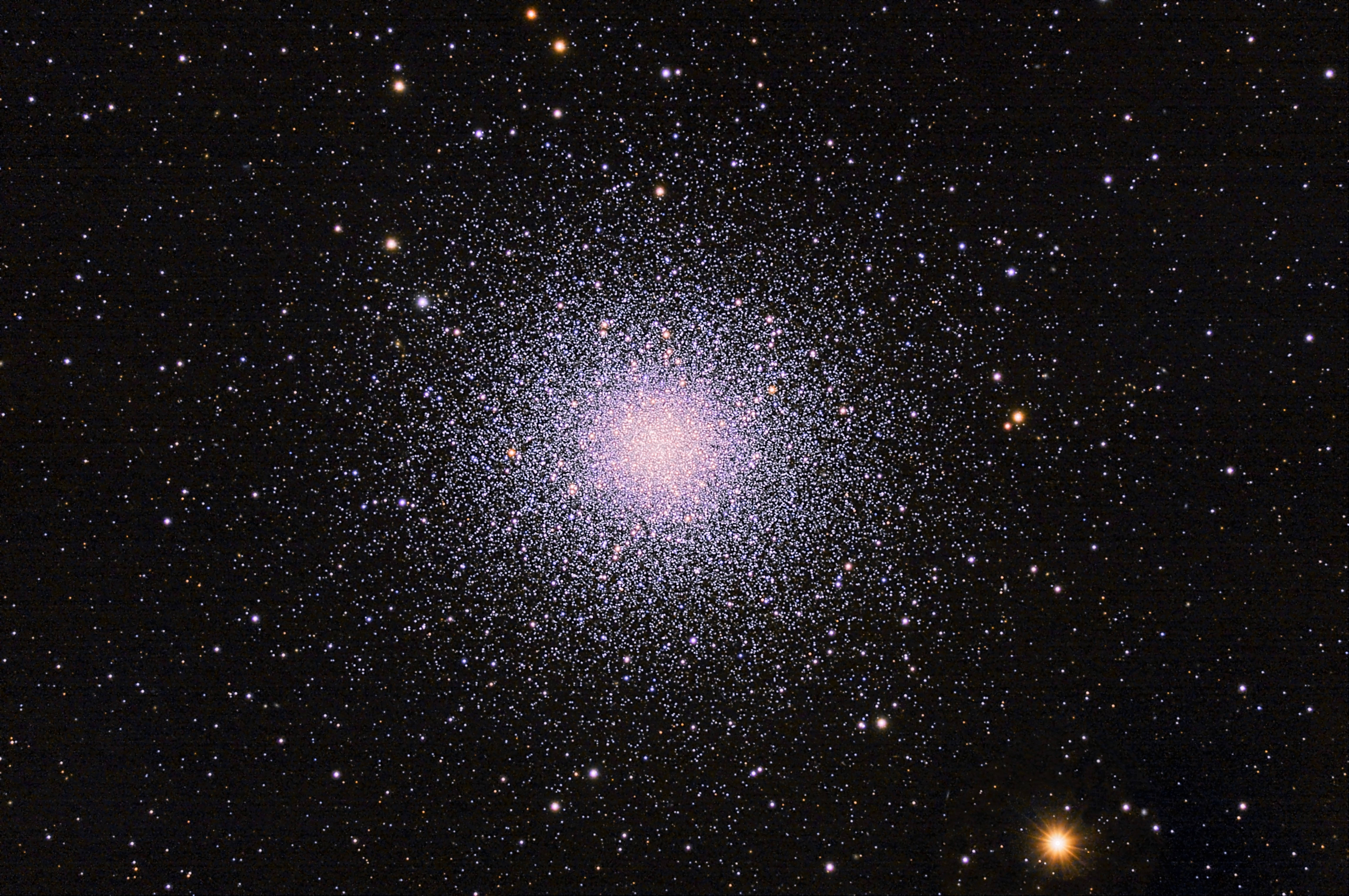
The constellation Hercules, out in the evening sky now, contains the brightest globular star cluster in the northern sky. A globular star cluster, about 25 thousand light years away. It’s an ancient assemblage of hundreds of thousands to millions of stars in a big ball. About 150 of these star clusters, that we know of, exist in the Milky Way. They form a spherical distribution around the Milky Way concentrated towards the center. The ages of these clusters runs to over 10 billion years. It is thought that they formed first out of the gas of the Milky Way and so did not participate in the collapse of the gas into the disk of the Milky Way we know today from which later stars were formed. We see them in other galaxies.
The astronomical event times given in this blog are for the Traverse City/Interlochen area of Michigan (Lat 44.7° N, Long 85.7° W; EDT, UT – 4 hours) unless stated otherwise. Times will be different for other locations.
Addendum
Ephemeris: 05/13/2025 – Arcturus, extragalactic visitor?
This is Ephemeris for Tuesday, May 13th. Today the Sun will be up for 14 hours and 45 minutes, setting at 9:02, and it will rise tomorrow at 6:15. The Moon, 1 day past full, will rise at 10:39 this evening.
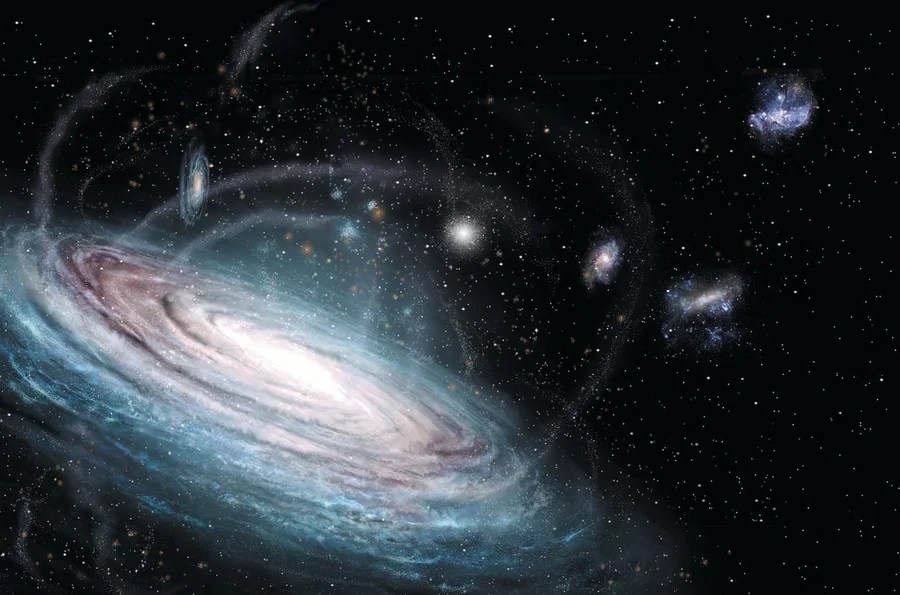
The bright orange star high in the southeast at 10 PM is Arcturus. Remember: Follow the arc of the handle of the Big Dipper to find Arcturus. It is an interesting star in many respects. Arcturus is somewhat more massive than the Sun and a bit older. It is starting its red giant phase having run out of hydrogen in its core and starting to use helium as its heat source, transmuting it into carbon and other elements. It has a very high velocity with respect to the Sun of about 100 kilometers per second. Arcturus is thought to be, by some astronomers, part of the remnants of a dwarf galaxy that collided with the Milky Way, and has now been assimilated. So Arcturus isn’t from around here.
-The astronomical event times given in this blog are for the Traverse City/Interlochen area of Michigan (Lat 44.7° N, Long 85.7° W; EDT, UT – 4 hours) unless stated otherwise. Times will be different for other locations.
Addendum
Ephemeris: 05/12/2025 – Artificial Intelligence, promise and caution

This is Ephemeris for Monday, May 12th. Today the Sun will be up for 14 hours and 43 minutes, setting at 9:01, and it will rise tomorrow at 6:16. The Moon, at full today, will rise at 9:34 this evening.
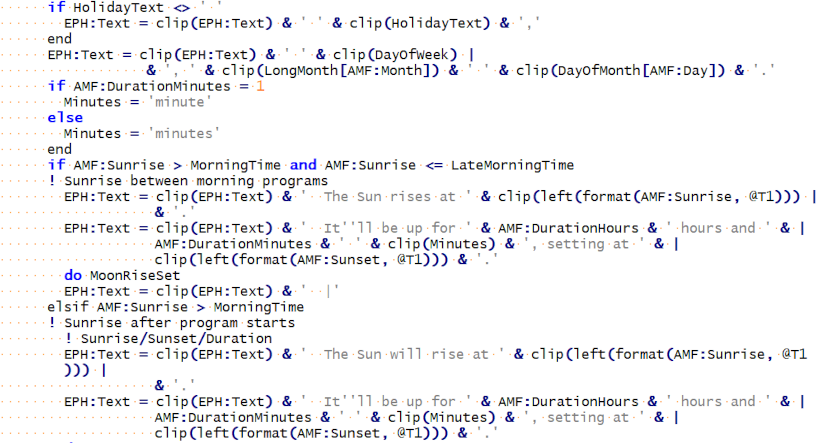
The text for the part of this program up to now was generated by a computer. It’s not AI. It’s generated by a program I wrote from data I created by another program that I also wrote, which is why it’s nearly the same every day. AI or artificial intelligence systems are trained rather than programmed. They learn their information more like how organic creatures learn, than computers do. And in talking to an AI one gets the feeling that there is almost a person there. It’s not like talking to the automated answering system of most businesses, where whatever the system is running, does not have a large vocabulary or under really understand anything. AI is powerful… and scary. AI can lie, they call it hallucinate, and can cheat. There’s great potential… and great danger.
The astronomical event times given in this blog are for the Traverse City/Interlochen area of Michigan (Lat 44.7° N, Long 85.7° W; EDT, UT – 4 hours) unless stated otherwise. Times will be different for other locations.
Addendum
Ephemeris: 05/09/2025 – AI and me
This is Ephemeris for Friday, May 9th. Today the Sun will be up for 14 hours and 36 minutes, setting at 8:57, and it will rise tomorrow at 6:20. The Moon, 3 days before full, will set at 5:08 tomorrow morning.
Continuing my look at Artificial Intelligence or AI. AI appears to be just about everywhere nowadays: on computers, software applications, and even on smartphones. The brains of AI are somewhere out on the Internet not on your phone or computer. I’ve gotten into it just recently. The first time was just this last February when I wanted a picture of a groundhog seeing its shadow for Groundhog’s day from my blog, which illustrated my day after Groundhog’s Day program here on Ephemeris. I use AI for research. Besides giving a synopsis of what it finds on the Internet. The one I use also gives a link to the original data, which has more information. I don’t rely on the synopsis it presents. And I would never have an AI write an Ephemeris episode. You could probably tell by its much better grammar.
The astronomical event times given in this blog are for the Traverse City/Interlochen area of Michigan (Lat 44.7° N, Long 85.7° W; EDT, UT – 4 hours) unless stated otherwise. Times will be different for other locations.
Addendum
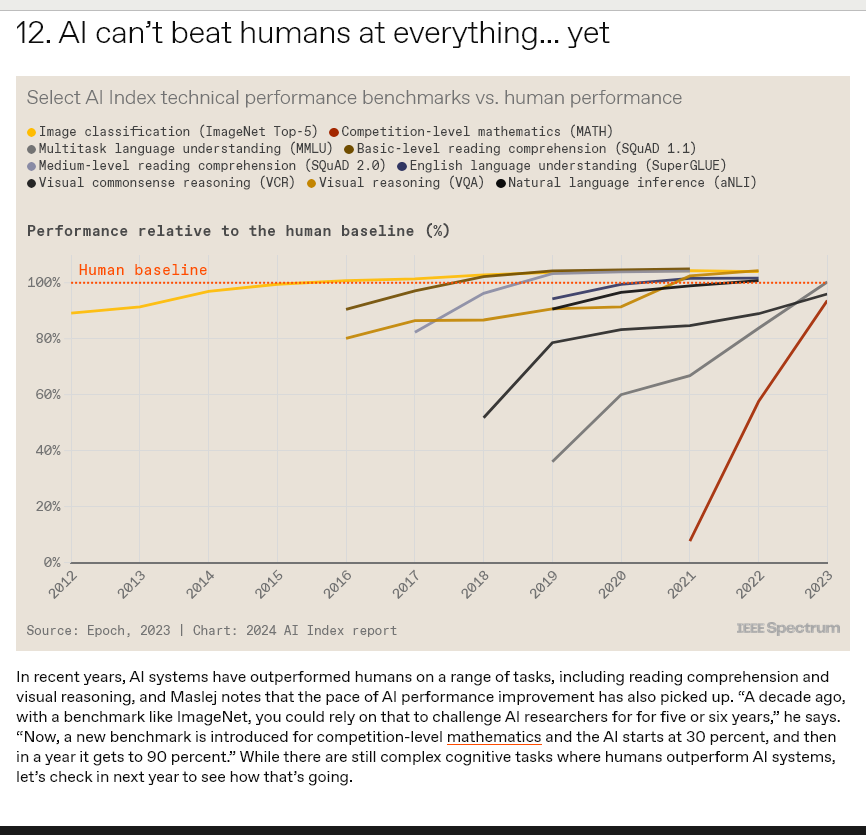
Ephemeris: 05/08/2025 – AI, a different way to compute
This is Bob Moler with Ephemeris for Thursday, May 8th. Today the Sun will be up for 14 hours and 33 minutes, setting at 8:56, and it will rise tomorrow at 6:21. The Moon, halfway from first quarter to full, will set at 4:51 tomorrow morning.
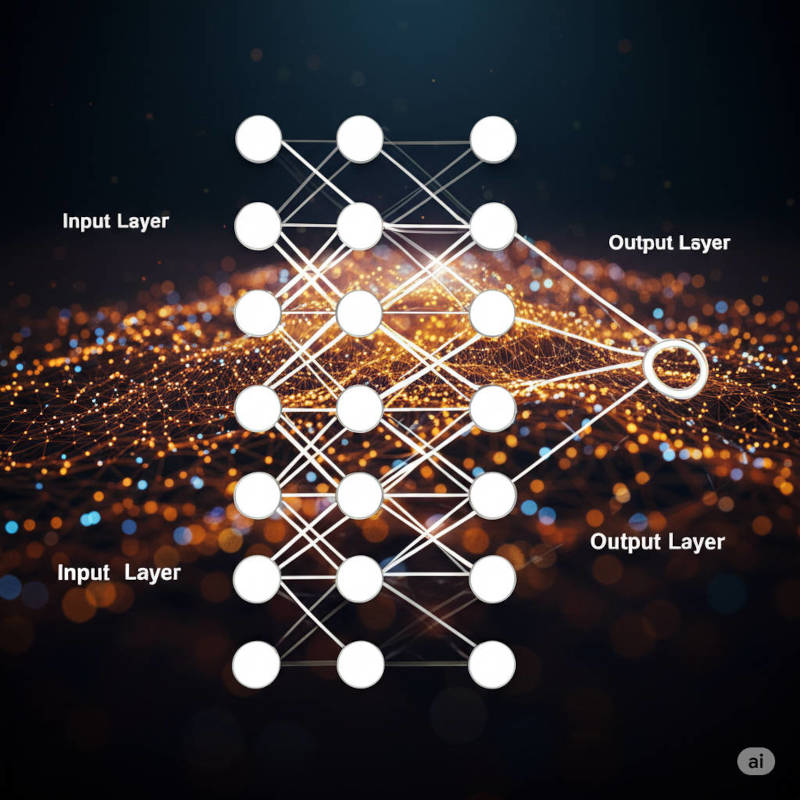
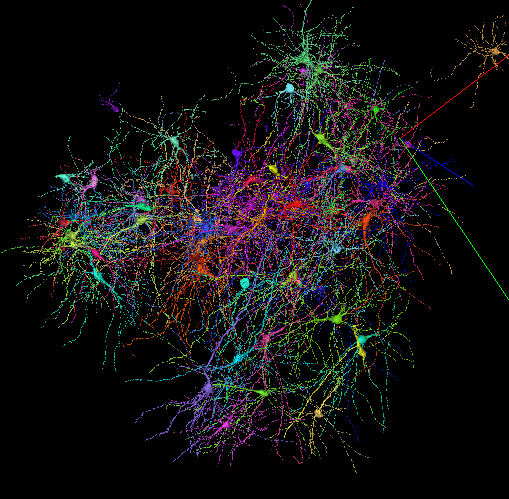
This week we’re investigating artificial intelligence or AI. My software experience in my career with computers is that of financial software for banks including ATMs and various other machines that have to do with banking, so AI or anything scientific was completely out of my realm. So I’m kind of looking at this like is an interested layman with some knowledge of computers. AI uses neural networks which is something that most computers don’t have. It can be simulated digitally, although I understand that they have chips that actually are neural network components. Neural networks are how the human brain functions with neurons and synapses. How they’ve gotten it to work, I have no idea.
The astronomical event times given in this blog are for the Traverse City/Interlochen area of Michigan (Lat 44.7° N, Long 85.7° W; EDT, UT – 4 hours) unless stated otherwise. Times will be different for other locations.
Addendum