Archive
Ephemeris: 08/15/2024 – What’s the matter with dark matter?
This is Bob Moler with Ephemeris for Thursday, August 15th. Today the Sun will be up for 14 hours and 1 minute, setting at 8:47, and it will rise tomorrow at 6:47. The Moon, 3 days past first quarter, will set at 2:23 tomorrow morning.
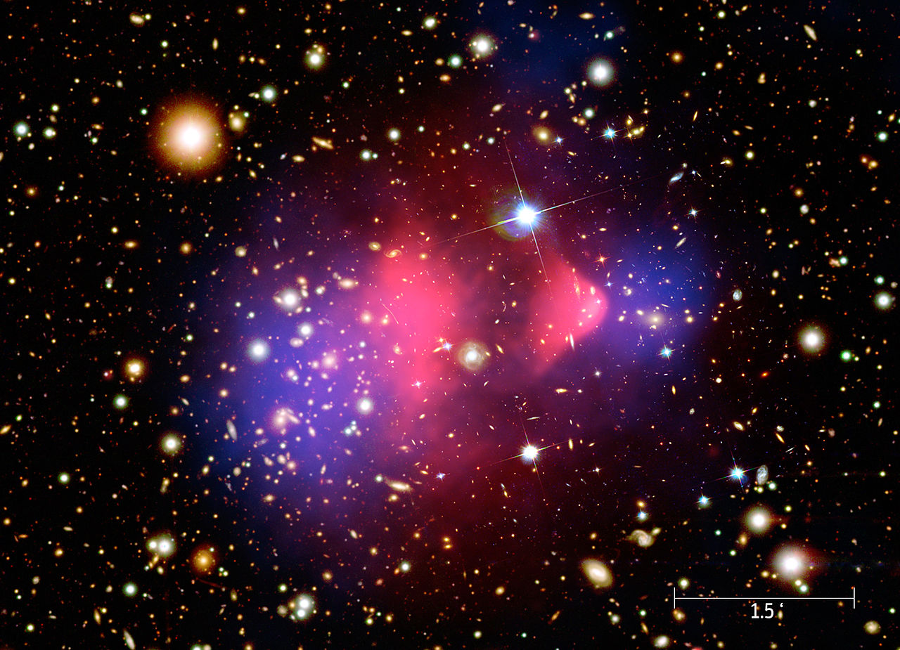
Over the past century astronomers have come to the realization that we are seeing only about 5% of the mass and energy of the universe. Galaxies in clusters seemed to move too fast to not escape, dissipating the cluster, yet after billions of years they still exist. Also, the stars in galaxies revolve about their centers much faster than expected revealing missing mass. So astronomers have come up with the idea that either there is missing matter that we can’t see, what’s called dark matter or there is something wrong with Newton’s and Einstein’s theories of gravity. Astronomers have come up with up two possible types of dark matter, which they humorously dub WIMPs and MACHOs. More about them tomorrow.
The astronomical event times given are for the Traverse City/Interlochen area of Michigan (EDT, UT–4 hours). Times will be different for other locations.
Addendum
Ephemeris: 07/22/2024 – Happy Pi Approximation Day
This is Bob Moler with Ephemeris for Pi Approximation Day*, Monday, July 22nd. Today the Sun will be up for 15 hours exactly, setting at 9:19, and it will rise tomorrow at 6:19. The Moon, 1 day past full, will rise at 10:37 this evening.
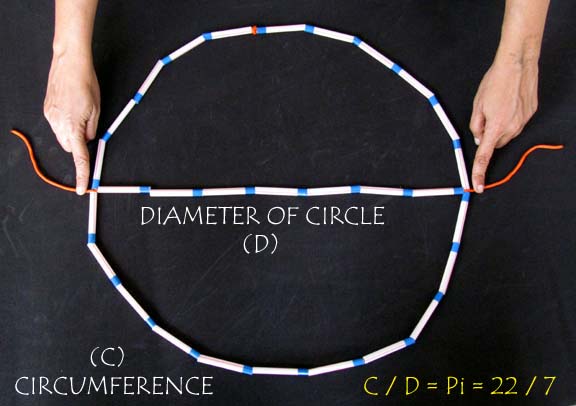
The first Pi day of the year for mathematics junkies was March 14th utilizing the three most significant digits of the mathematical value π, the ratio of the circumference of a circle to its diameter, written as 3.14. Today is the second version of π written as the fraction 22/7. We don’t write our date that way, we write it as 7/22. In other parts of the world it is written as 22/7. So whichever way you slice it, it’s a pi day and in Northern Michigan I would imagine it’s a cherry pi. In the sky today the planet Mercury is at its greatest elongation or separation east of the Sun in the western sky. It is preceding the Sun heading southward against the stars and is not easily visible after sunset.
The astronomical event times given are for the Traverse City/Interlochen area of Michigan (EDT, UT–4 hours). They may be different for your location.
* In the radio program I called it Pi Day #2. I have since found out that today has a special name.
Addendum
Ephemeris: 07/11/2024 – Low energy routes to get to the Moon
This is Ephemeris for Thursday, July 11th. Today the Sun will be up for 15 hours and 19 minutes, setting at 9:27, and it will rise tomorrow at 6:09. The Moon, 2 days before first quarter, will set at 12:26 tomorrow morning.
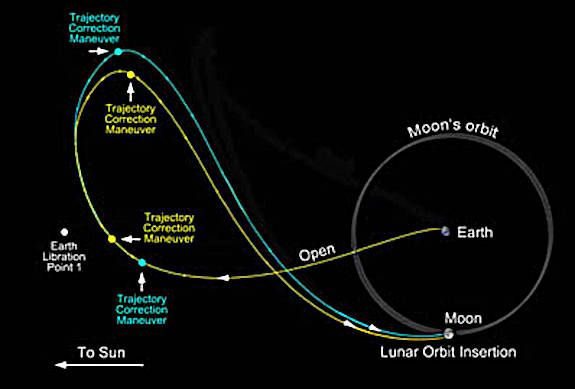
Back in the Apollo days when we sent people to the Moon, the trip out was only three days. The latest generation of unmanned probes to the Moon sent by the United States and other countries can take days, weeks, or even months to reach the Moon, so what’s going on? These are robot probes, needing little power. Humans however are high maintenance. Even when they’re doing nothing they are breathing, eating, and using resources. So when humans are aboard you have got to get there fast. Also, many of these probes are CubeSats, no bigger than a breadbox*. They must get into orbit of the Moon with very little thrust other than that of the rocket that launched them. They can go out as far as a million miles away before falling back to the Moon.
The astronomical event times given are for the Traverse City/Interlochen area of Michigan (EDT, UT–4 hours). They may be different for your location.
* OK, I’m an old guy, the modern size comparison would be a microwave.
Addendum
Ephemeris: 06/25/2024 – Three kinds of novas
This is Ephemeris for Tuesday, June 25th. Today the Sun will be up for 15 hours and 33 minutes, setting at 9:32, and it will rise tomorrow at 5:58. The Moon, 3 days before last quarter, will rise at 12:35 tomorrow morning.
As I mentioned yesterday we’re expecting a nova or bright star that we expect to appear sometime this year, maybe in September according to some astronomers. A nova is a rapid brightening of a star due to some cataclysmic event happening to it. There are three kinds that we actually know of. A nova, which is what we’re expecting; a supernova, an explosion maybe a million times greater; and the recently discovered kilonova when two neutron stars collide, which is a thousand or so times brighter than an ordinary nova. A nova and one kind of supernova (Type 1) involve a binary star system which contains a white dwarf star near the end of its life close enough to a larger star to siphon off material. At some point enough has built up and an explosion occurs.
The astronomical event times given are for the Traverse City/Interlochen area of Michigan (EDT, UT–4 hours). They may be different for your location.
Addendum
The second type of Supernova is caused when a supermassive star’s core collapses when it’s made of iron and tries to fuse it into heaver elements. That process takes energy rather than producing it. Oops! The star collapses on itself, and… Kablooey!
Nova in a binary system
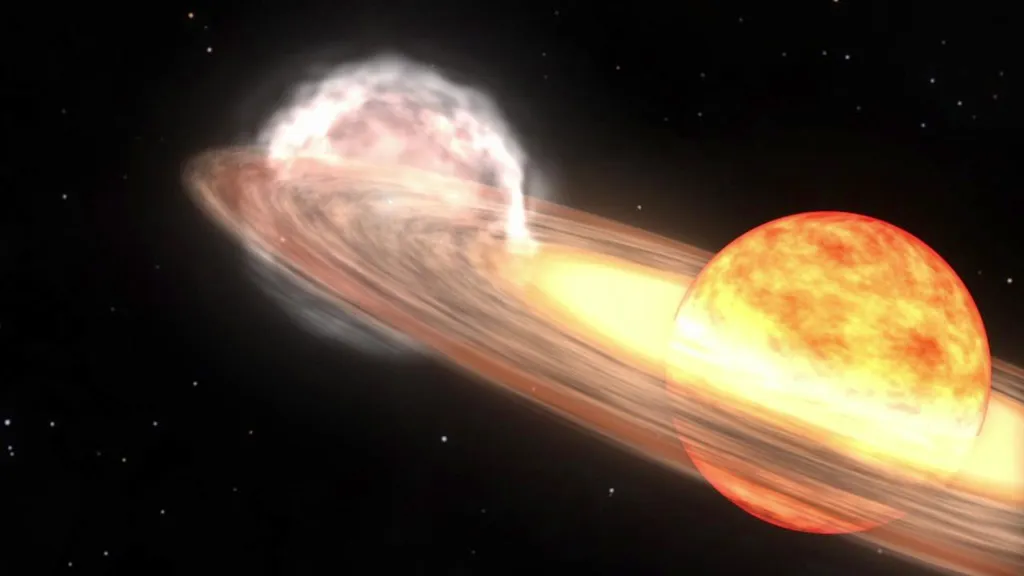
A red giant star and white dwarf orbit each other in this animation of a nova similar to T Coronae Borealis. The red giant is a large sphere in shades of red, orange, and white, with the side facing the white dwarf the lightest shades. The white dwarf is hidden in a bright glow of white and yellows, which represent an accretion disk around the star. A stream of material, shown as a diffuse cloud of red, flows from the red giant to the white dwarf. When the red giant moves behind the white dwarf, a nova explosion on the white dwarf ignites, creating a ball of ejected nova material shown in pale orange. After the fog of material clears, a small white spot remains, indicating that the white dwarf has survived the explosion. NASA/Goddard Space Flight Center.
Ephemeris: 05/24/2024 – The twilight zone
This is Ephemeris for Friday, May 24th. Today the Sun will be up for 15 hours and 9 minutes, setting at 9:14, and it will rise tomorrow at 6:04. The Moon, 1 day past full, will rise at 11:06 this evening.
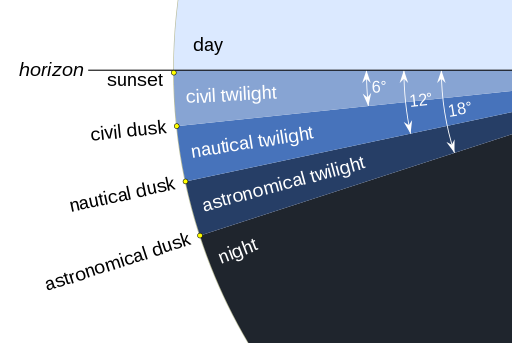
Let’s take a look at twilight, despite the fact it doesn’t end until 1132 PM. Of course the bright Moon will rise before then. By the 12th of June astronomical twilight will end at midnight and a couple of days before the summer solstice it will have extended itself to 12:05 AM. The Moon tonight will rise in the middle of astronomical twilight so we’ll get about 1/2 hour or so of semi dark sky viewing from about 10:37 PM to moonrise at 11:07. There are three intervals of twilight. Civil twilight which is the period between sunset and when the Sun is 6° below the horizon. Nautical twilight extends to when the Sun is 12° below the horizon, and astronomical twilight which ends when the Sun is 18° below the horizon.
The astronomical event times given are for the Traverse City/Interlochen area of Michigan (EDT, UT–4 hours). They may be different for your location
Addendum
Ephemeris: 05/23/2024 – My observations of the Earth as a globe
This is Bob Moler with Ephemeris for Thursday, May 23rd. Today the Sun will be up for 15 hours and 7 minutes, setting at 9:13, and it will rise tomorrow at 6:05. The Moon, at full today, will rise at 9:58 this evening.
As far as I can remember back in time I’ve always thought that the Earth was a globe. To me that the Earth is flat is nonsensical. And I’ve looked to the sky as confirmation that the Earth was indeed a globe. During my first trip to a southern state I saw it for myself. From our vantage point here in Michigan the constellation of Scorpius the scorpion just scrapes the southern horizon at its highest. When traveling down to Kentucky it was higher in the sky, so that was my first proof that the Earth is round. I’ve since gone to Hawaii and even using the programs I wrote and use for the times for Ephemeris, based on the Earth as a globe, I was able to predict when and where to see the Southern Cross. It was right there as calculated by my program.
The astronomical event times given are for the Traverse City/Interlochen area of Michigan (EDT, UT–4 hours). They may be different for your location.
Addendum
Ephemeris: 03/15/2024 – The Ides of March
This is Ephemeris for Ides of March, Friday, March 15th. Today the Sun will be up for 11 hours and 55 minutes, setting at 7:49, and it will rise tomorrow at 7:52. The Moon, 2 days before first quarter, will set at 3:01 tomorrow morning.
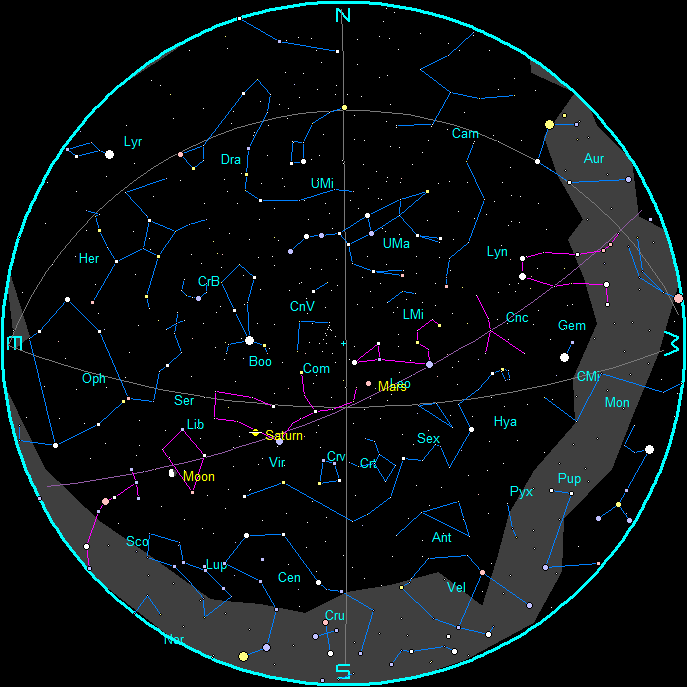
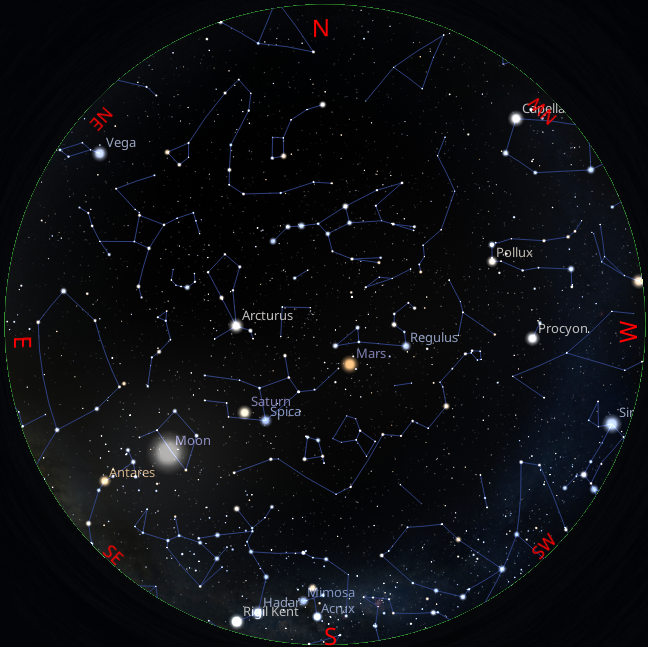
Our calendar is derived from the Roman calendar. The Ides is the only named day ion the Roman calendar that we’re familiar with today, the Ides of March. On this day in 44 BCE Roman Emperor Julius Caesar was assassinated. The Ides of a month is the 13th of the month except for March, May, July, and October when it’s the 15th. The Roman calendar has two other named days. The 1st of the month is called Kalend, from which we get our word calendar. The other day is Nones which is the 5th day of the month except for March, May, July, and October when it’s on the 7th. The other days are countdown days to those dates so tomorrow will be the 17th day before the Kalend of April. The countdown is to 1 not 0, if you’re counting.
My source: https://www.slideserve.com/jonah/roman-calendar
The astronomical event times given are for the Traverse City/Interlochen area of Michigan (EDT, UT–4 hours). They may be different for your location.
Addendum

This being a leap year, I will spend more time on these programs talking about the calendar. As you may know, we no longer use the Julian calendar for our normal calendar keeping functions. We use the Gregorian Calendar which is a modification of the Julian Calendar that was first made in the year 1582 CE. As we get closer to Easter I will delve into the Gregorian Calendar because it has everything to do with the date of Easter.
Ephemeris: 02/27/2024 – Thursday is the Intercalary Day
This is Bob Moler with Ephemeris for Tuesday, February 27th. Today the Sun will be up for 11 hours and 2 minutes, setting at 6:27, and it will rise tomorrow at 7:22. The Moon, 3 days past full, will rise at 9:47 this evening.
Thursday we’re going to have one of those special days that only occur once every 4 years making this a leap year. It’s the intercalary day that compensates for that fact that the Earth takes 365 and a bit short of a quarter day to orbit the sun. That orbit is a year, and those quarter days are accumulated and added as the last day of February in years divisible by 4. The Gregorian reform makes a slight adjustment to most century years, making century years not divisible by 400 ordinary years to keep the calendar in sync with the seasons. The Romans, from who we’ve gotten our calendar considered the month of February as unlucky, and so they shortened it most years to 28 days. Enjoy your extra day Thursday.
The astronomical event times given are for the Traverse City/Interlochen area of Michigan (EST, UT –5 hours). They may be different for your location.
Addendum


No calendar is perfect. The average year of the Julian Calendar is 11 minutes and 14 seconds longer than the actual seasonal year which it is trying to model. By the time of the papacy of Pope Gregory XIII from 1572 to 1585 CE the error in the Julian calendar versus the actual seasons had grown to 10 days since the Julian Calendar was established 16 centuries before. The reason the Church was concerned was that Easter was slowly advancing toward summer, and Easter is a more important feast than Christmas, but is related to the Jewish Feast of Passover. I’ll discuss the formula for determining Easter as we get closer to it. However, the Gregorian calendar reform came in two parts: Ten days were dropped from the calendar between October 4th and 15th in the year 1582 and after that the every four year leap day rule, that is years evenly divided by 4, was modified so that on century years, that is years ending in 00, but not divisible by 400, became ordinary years, that is no leap days, this will keep the calendar in sync with the seasons for several millennia. This calendar reform occurring after the Reformation meant that only the Catholic countries adopted it. It took almost until the present day for everyone to adopt it. For ecclesiastical purposes the Orthodox Churches still used the Julian Calendar.
Ephemeris: 02/26/2024 – The angle of the rising and setting planets from the Sun vary with the seasons
This is Bob Moler with Ephemeris for Monday, February 26th. Today the Sun will be up for 10 hours and 59 minutes, setting at 6:25, and it will rise tomorrow at 7:24. The Moon, 2 days past full, will rise at 8:44 this evening.
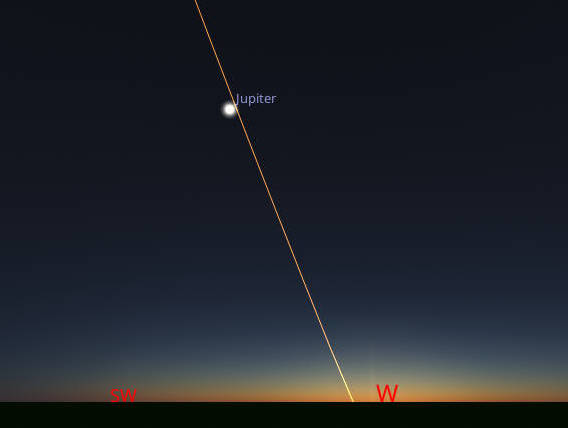
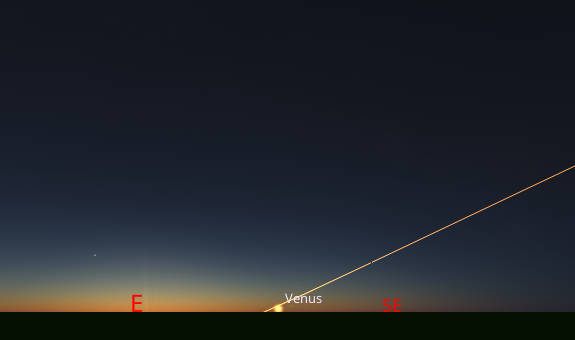
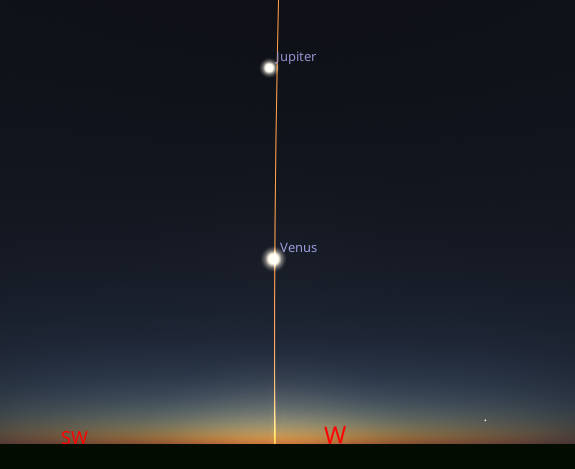
In late winter and early spring dark skies return within a few days after the full Moon. Indeed, this is the first day after the full moon, which was on Saturday morning, that we have dark skies. Well for 40 minutes before the Moon rises. This is because the ecliptic which is the Sun’s path in the sky is as close to vertical as it can get for us. It shows planets near the Sun and the area of the full moon as steeply inclined to the horizon as possible. Twelve years ago this month when my wife and I were on a Hawaiian cruise, I was aboard ship looking at the sky after sunset and was amazed to see Jupiter and Venus* vertically aligned in the west. It was because we were located around the Tropic of Cancer and near the equinox, so the ecliptic was actually vertical after sunset. It was quite a jolt to see that. So this time of year we can see planets close to the sun at sunset and the moon to go away after full rapidly.
The astronomical event times given are for the Traverse City/Interlochen area of Michigan (EST, UT –5 hours). They may be different for your location.
* On the broadcast I said Jupiter and Saturn, relying on my memory. As can be seen below, it was Jupiter and Venus.
Addendum
Ephemeris: 01/26/2024 – In astronomy “dark” means we can’t see it
This is Ephemeris for Friday, January 26th. Today the Sun will be up for 9 hours and 33 minutes, setting at 5:42, and it will rise tomorrow at 8:07. The Moon, 1 day past full, will rise at 6:37 this evening.
What does the word “dark” mean? In astronomy the word dark means something we cannot see. In ages before 1959 we could not see the backside of the moon, so people got to calling it the dark side of the Moon. All changed in 1959 when a Soviet spacecraft went around behind the moon it took photographs of it. The two contenders for dark things in astronomy are now dark matter and dark energy. Dark matter is something that has a gravitational effect on the galaxies that it surrounds, but we can’t see it. Also, the expansion of the universe appears to be accelerating, where we would expect it to be decelerating because of gravitational forces of all the galaxies in it. We call that cause dark energy. And we don’t know what either is.
The astronomical event times given are for the Traverse City/Interlochen area of Michigan (EST, UT –5 hours). They may be different for your location.
Addendum
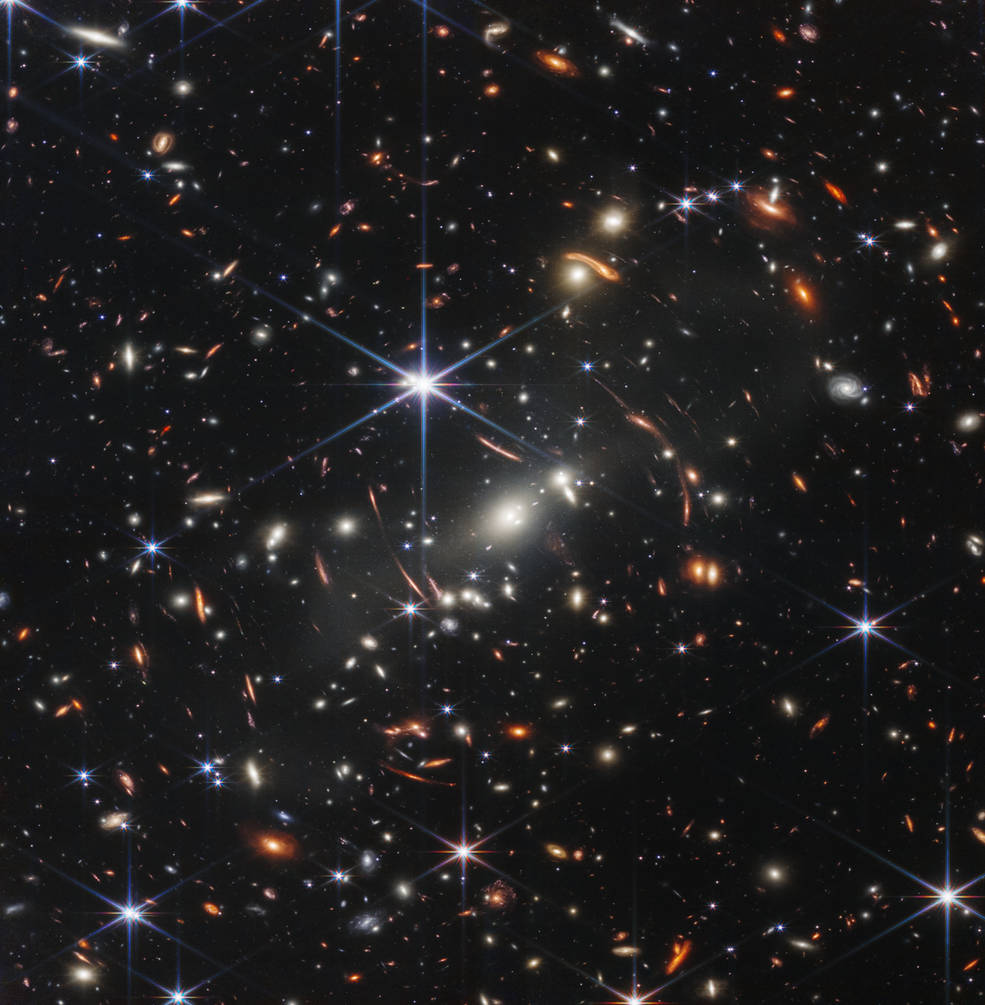
Two possible causes of Dark Matter are in the running, WIMPs, and of course MACHOs. WIMPs are Weakly Interacting Massive Particles, while MACHOs are the bit more tortured acronym Massive Astrophysical Compact Halo Objects. Whatever they are they don’t interact much with themselves or ordinary matter, neither emitting light or any other radiation, or block it. However, they have mass and warp spacetime, distorting the shape of galaxies seen behind them. They also make galaxies seem to be more massive than their starlight would make them appear, and other effects.
 Bob Moler's Ephemeris Blog