Archive
08/22/11 – Ephemeris – The constellation Sagittarius
Monday, August 22nd. The sun rises at 6:52. It’ll be up for 13 hours and 44 minutes, setting at 8:36. The moon, 1 day past last quarter, will rise at 12:50 tomorrow morning.
The Milky Way runs from north to south through the heavens at 11 p.m. You’ll notice that the Milky Way is brighter and broader just above the horizon in the south. In that glow in the south is a star pattern that looks like a stout little teapot, with a the Milky way like steam rising from the spout, which faces the west. This pattern of stars is the major part of the constellation called Sagittarius. According to Greek mythology Sagittarius is a centaur with a bow and arrow poised to shoot Scorpius the scorpion to the right. This centaur is called Chiron, the most learned of the breed, centaurs usually being a rowdy bunch. The center of the pinwheel of our galaxy lies hidden beyond the stars above the spout of the teapot.
* Times are for the Traverse City/Interlochen area of Michigan. They may be different for your location.
Addendum
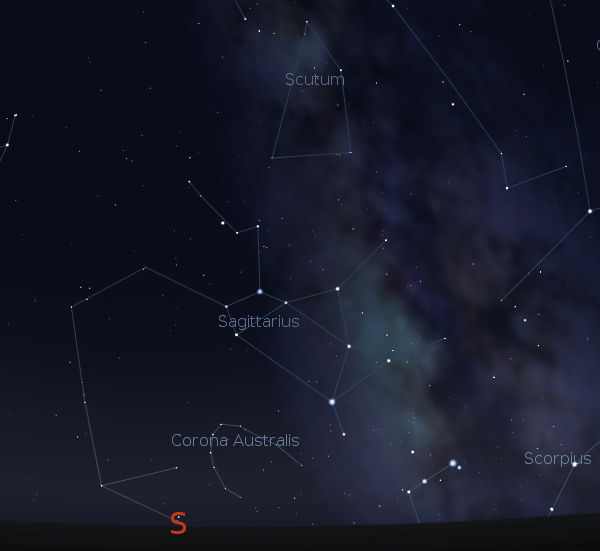
The constellations Sagittarius and Scutum. Created using Stellarium.
08/02/11 – Ephemeris – The constellation of Aquila the eagle
Note: this is a repeat due to Internet problems for the July 25th program with one alteration.
Tuesday, August 2nd. The sun rises at 6:29. It’ll be up for 14 hours and 37 minutes, setting at 9:06. The moon, 3 days past new, will set at 10:19 this evening.
The southernmost star in the Summer Triangle of three bright stars is Altair, high in the south southeast in the evening. It’s in the head of the constellation Aquila the Eagle. Altair is flanked by two stars, the eagle’s shoulders, and farther out are the wing tips. Other stars to the lower right are in its body and a last three in its tail. Near the tail binoculars will show a fuzzy spot that telescopes show as a compact star cluster, sometimes called the Wild Duck Cluster for its nearly triangular shape. Aquila is flying northeastward through the Milky Way, where it is split in two by a cloud of gas and dust, the edges of which can be seen in binoculars. According to mythology the Trojan boy Ganymede was taken to heaven at the behest of the god Zeus by this eagle.
* Times are for the Traverse City/Interlochen area of Michigan. They may be different for your location.
Addendum
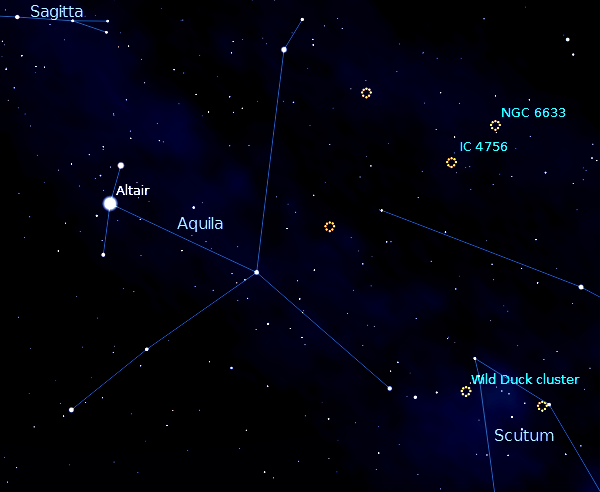
Finder chart for M11, the Wild Duck Cluster, Created using Stellarium.
06/28/11 – Ephemeris – The constellation Lyra the harp
Tuesday, June 28th. Today the sun will be up for 15 hours and 32 minutes, setting at 9:31. The moon, 3 days before new, will rise at 4:19 tomorrow morning. Tomorrow the sun will rise at 6:00.
High in the east at 11 p.m. can be found a bright star just above a small, narrow, but very distinctive parallelogram of stars. They are the stars of the constellation Lyra the harp. The bright star is Vega, one of the twenty one brightest stars, called first magnitude stars. Vega is actually the 5th brightest night time star. The harp, according to Greek mythology, was invented by the god Hermes. The form of the harp in the sky, is as he had invented it: by stretching strings across a tortoise shell. Hermes gave it to his half-brother Apollo, who in turn gave it to the great musician Orpheus. In binoculars, near Vega, two stars appear together. They barely appear to the unaided eye as one star, called Epsilon Lyrae.
* Times are for the Traverse City/Interlochen area of Michigan. They may be different for your location.
Addendum
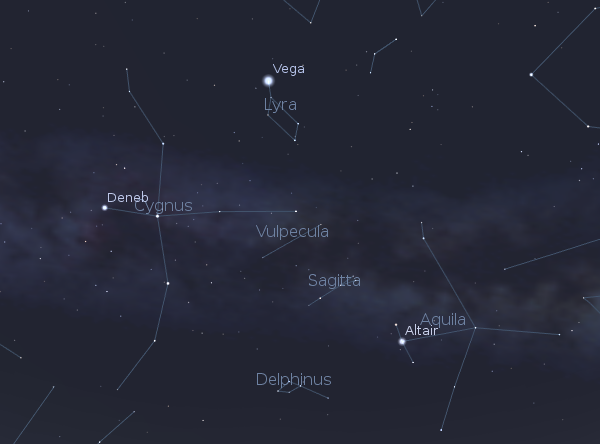
The constellations Lyra, Cygnus and Aquila. Created using Stellarium.
Lyra has some interesting treats for the telescope.
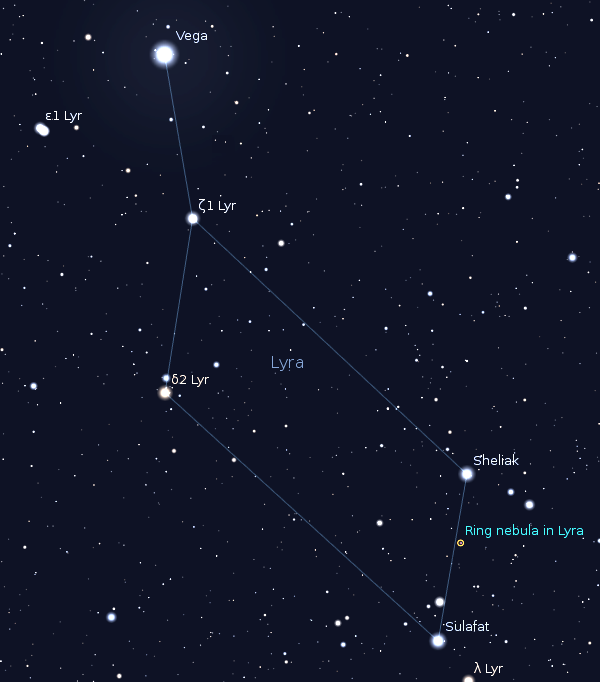
Lyra in Binoculars. Created using Stellarium.
Epsilon (ε) Lyrae, near Vega is easier to split than this image. In good telescopes each of its stars is again split into two stars. Amateur astronomers call it the Double-Double Star. Not mentioned in the program is the Ring Nebula. It isn’t visible in small finder telescopes, but if you have a telescope point the finder directly between the stars Sheliak and Sulafat, and the ghostly ring of the Ring Nebula will be near in the telescope.
06/23/11 – Ephemeris – The constellation Hercules
Thursday, June 23rd. Today the sun will be up for 15 hours and 33 minutes, setting at 9:31. The moon, at last quarter today, will rise at 1:30 tomorrow morning. Tomorrow the sun will rise at 5:58.
The greatest Greek hero of all, Hercules, gets a dim group of stars on the border between the spring and summer stars. At 11 p.m. Hercules is high in the southeastern sky. It is located above and right of the bright star, Vega, also in the east. Hercules’ central feature is a keystone shaped box of stars, called the Keystone, which represents the old boy’s shorts. From each top corner extend lines of stars that are his legs, from the bottom stars, the rest of his torso and arms extend. So in one final indignity he’s upside down in our sky. Just below and right of the topmost star of the keystone is what looks like a fuzzy star in binoculars or small telescope. It is the Great Hercules Globular Star Cluster, home to a million stars.
* Times are for the Traverse City/Interlochen area of Michigan. They may be different for your location.
Addendum
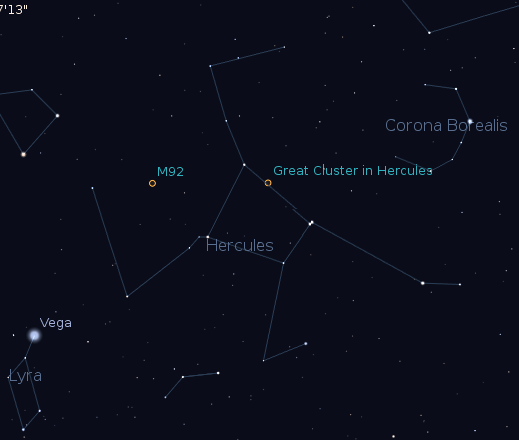
The constellation Hercules and his neighbors. Created with Stellarium.
05/30/11 – Ephemeris – The constellation Corona Borealis
Memorial Day, Monday, May 30th. Today the sun will be up for 15 hours and 16 minutes, setting at 9:18. The moon, 2 days before new, will rise at 4:56 tomorrow morning. Tomorrow the sun will rise at 6:01.
High in the southeast east at 10:30 this evening can be seen a small nearly circular constellation of Corona Borealis, the Northern Crown. It is just below Boötes, the kite shaped constellation off the handle of the Big Dipper. According to Greek myth the crown was given by the gods to the princess Ariadne, daughter of King Minos of Crete. The crown is more like a tiara with the bright star Gemma also known as Alphecca at the front. While stars suggest that the crown is diamond studded, however the meaning of Gemma, a blossom suggests that Corona Borealis is a floral crown. Corona’s most famous star isn’t even visible to the unaided eye. It is R Coronae Borealis, a variable star, which appears to be surrounded by a dust cloud.
* Times are for the Traverse City/Interlochen area of Michigan. They may be different for your location.
Addendum

Corona Borealis with Boötes at 10:30 p.m. on May 30th. Created with Stellarium.
05/23/11 – Ephemeris – The constellation Boötes
Monday, May 23rd. Today the sun will be up for 15 hours and 5 minutes, setting at 9:11. The moon, 1 day before last quarter, will rise at 1:59 tomorrow morning. Tomorrow the sun will rise at 6:06.
Appearing high in the eastern sky at 10 p.m. tonight is the kite shaped constellation of Boötes the herdsman. The bright star Arcturus is at the bottom of the kite, pointed to by the arc of the handle of the Big Dipper, overhead. In one story Boötes represents a young hunter named Arcas, son of Callisto, a beautiful young lady who had the misfortune of being loved by Zeus the chief Greek god. Zeus’ wife Hera, found out about it, and since she couldn’t punish Zeus, turned Callisto into an ugly bear. Arcas, unaware of why his mother disappeared in his youth was about to kill the bear when Zeus intervened and placed them both in the sky. Now Arcas as Boötes chases the Great Bear forever around the pole of the sky each night.
* Times are for the Traverse City/Interlochen area of Michigan. They may be different for your location.
Addendum
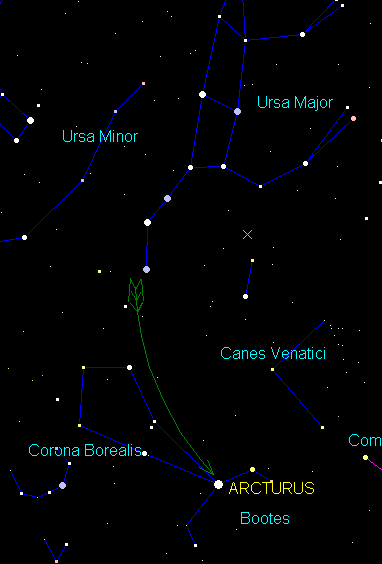
Bootes and the Big Dipper
05/19/11 – Ephemeris – The bright star Spica
Thursday, May 19th. Today the sun will be up for 14 hours and 57 minutes, setting at 9:07. The moon, 2 days past full, will rise at 11:47 this evening. Tomorrow the sun will rise at 6:09.
The large constellation of Virgo the reclining maiden is midway up the sky in the south when it gets dark. Virgo contains mostly faint stars in a large area of sky left of and below Leo the lion, but it has a few bright stars. Virgo’s brightest star Spica, can be found from the handle of the Big Dipper, overhead, following the arc to the star Arcturus, and straightening to a spike to Spica, the 16th brightest night time star. The planet Saturn is above and right of it. Spica is supposed to be a stalk of wheat held in Virgo’s hands. The star and Virgo itself were symbols of a bountiful harvest. The sun used to be in Virgo at the end of summer. In Egypt it was the goddess Isis, and at least one ancient temple was oriented to Spica’s setting point.
* Times are for the Traverse City/Interlochen area of Michigan. They may be different for your location.
Addendum
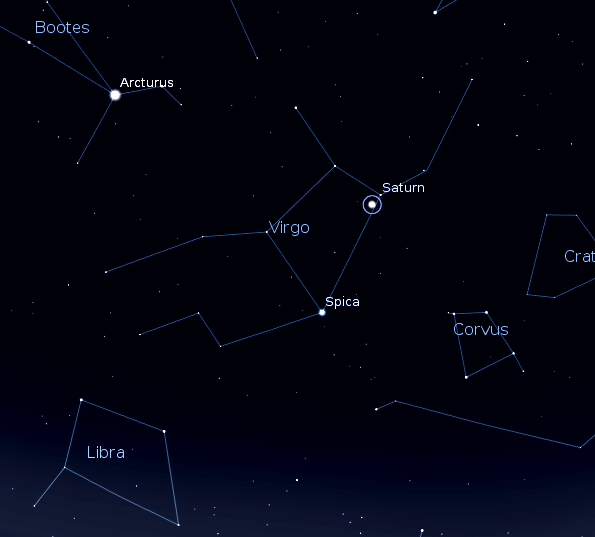
Virgo and Spica in the evening this month
05/03/11 – Ephemeris – The constellation Virgo
Tuesday, May 3rd. The sun rises at 6:30. It’ll be up for 14 hours and 19 minutes, setting at 8:49. The moon is new today, and won’t be visible.
Tonight in the sky: to the left of the constellation of Leo the lion, which lies in the south southwest at 10 p.m. is the next constellation of the zodiac: Virgo the maiden, seen in the south southeast. Virgo is a large constellation of a reclining woman holding a stalk of wheat. The bright star in the center of the constellation, Spica, is the head of that spike of wheat; and as such ruled over the harvest in two of Virgo’s guises as the goddesses Persephone and Ceres. The planet Saturn is also in Virgo this year to the right of Spica. Virgo is also identified as Astraea the goddess of justice. The constellation of Libra, the scales, is found just east of her an hour later, only being half risen at 10 p.m. Early Christians saw Virgo as the Virgin Mary.
* Times are for the Traverse City/Interlochen area of Michigan. They may be different for your location.
Addendum
Virgo at 10;30 p.m. May 3, 2011
04/28/11 – Ephemeris – Some ancient ideas about Leo the lion
Thursday, April 28th. The sun rises at 6:37. It’ll be up for 14 hours and 5 minutes, setting at 8:43. The moon, 4 days past last quarter, will rise at 4:38 tomorrow morning.
The constellation Leo the lion is now high in the south at 10 pm. It’s directly below the Big Dipper at the zenith. Leo is marked by two sets of easily recognizable stars. The front of him is a backward question mark of stars, also known as the Sickle that mark his head and mane, along with the front part of his body. Regulus is the star at the bottom of that backwards question mark. It’s the Little King Star. The hind end of him is a triangle of stars ending with another bright star, but not as bright as Regulus. It’s Denebola which means Lion’s tail. It is thought when the sun was in this constellation long ago that the lions were driven by the heat to quench their thirst in the Nile river. Ancients physicians thought medicines were poison when the sun was here too.
* Times are for the Traverse City/Interlochen area of Michigan. They may be different for your location.
Addendum
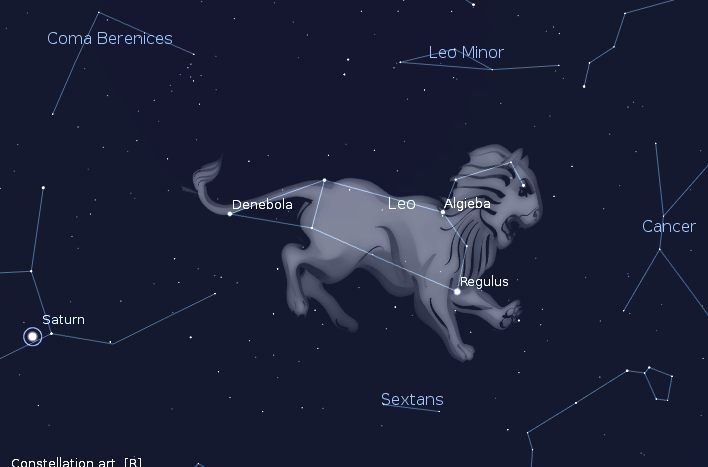
Leo, April 28 2011, 10 p.m. Created using Stellarium.
04/25/11 – Ephemeris – The constellation of Corvus the crow
Monday, April 25th. The sun rises at 6:42. It’ll be up for 13 hours and 57 minutes, setting at 8:39. The moon, 1 day past last quarter, will rise at 3:32 tomorrow morning.
The small constellation of Corvus the crow is located low in the south southeast at 10 this evening. It’s made of 5 dim stars, but the pattern is a distinctive distorted box with two stars at the upper left marking that corner. To the right is a fainter constellation of a thick stemmed goblet called Crater. Both appear above the long constellation of Hydra the water snake who is slithering just above the southern horizon.. In Greek mythology Corvus, then white, was the god Apollo’s pet. Apollo once bid Corvus to take a cup and fetch him some water. Corvus however dallied and waited for an unripe fig to ripen. Corvus grabbed a snake and returned with a story as to how the snake had delayed him. The angry Apollo turned the crow and all crows to this day black.
* Times are for the Traverse City/Interlochen area of Michigan. They may be different for your location.
Addendum
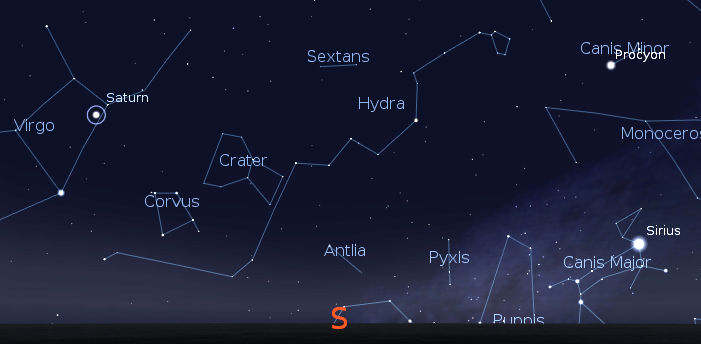
Corvus, Crater and Hydra via Stellarium for April 25, 2011 near 10 p.m.
 Bob Moler's Ephemeris Blog