Archive
09/11/2012 – Ephemeris – The constellation Sagittarius the archer
Ephemeris for Tuesday, September 11th. The sun will rise at 7:17. It’ll be up for 12 hours and 42 minutes, setting at 7:59. The moon, 3 days past last quarter, will rise at 3:28 tomorrow morning.
Low in the south at 10 p.m. lies the constellation of Sagittarius. The name means archer, but this isn’t just any old fellow with a bow and arrow. It’s a centaur with a bow and arrow. These half man half horse creatures were a rowdy bunch; kind of the ancient Greek counterpart of a motorcycle gang. The one exception is this centaur, Chiron by name. He was highly educated, and learned medicine from the great physician Aesculapius, whom we see in the sky to the upper right as the constellation Ophiuchus. His drawn bow and arrow can also be seen in the stars here, pointing to Scorpius the scorpion’s heart. If it’s hard seeing a Centaur here don’t be disappointed. To most of us the constellation looks like a stout little teapot.
Times are for the Traverse City/Interlochen area of Michigan. They may be different for your location.
Addendum
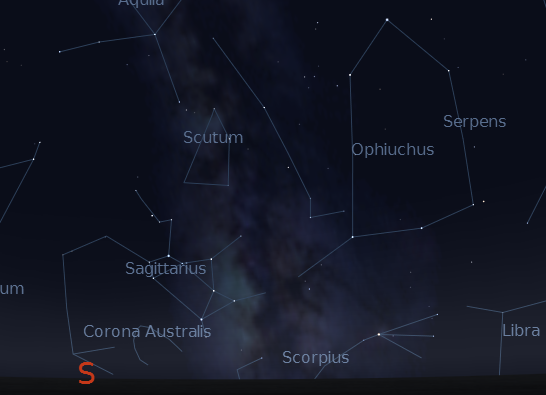
Sagittarius and the Milky Way September 11, 2012 10 p.m. Created using Stellarium.
09/06/2012 – Ephemeris – Cassiopeia the queen
Ephemeris for Thursday, September 6th. The sun will rise at 7:11. It’ll be up for 12 hours and 57 minutes, setting at 8:08. The moon, 2 days before last quarter, will rise at 11:01 this evening.
The constellation Cassiopeia looks like the letter W in the northeastern sky at 10 p.m. My mother taught it to me as my grandfather taught her as the Flying W. Cassiopeia represents a queen of Ethiopia in a grand story that has had at least a couple of movies made as the Clash of the Titans. A dim star above the middle star makes the constellation in to a crooked backed chair. Cassiopeia is circumpolar in Michigan since it is near the north pole of the sky. It revolves around and around the pole star Polaris. In late autumn it’s overhead, in the spring its low in the northwest and in early summer it’s scraping the northern horizon.
Times are for the Traverse City/Interlochen area of Michigan. They may be different for your location.
Addendum
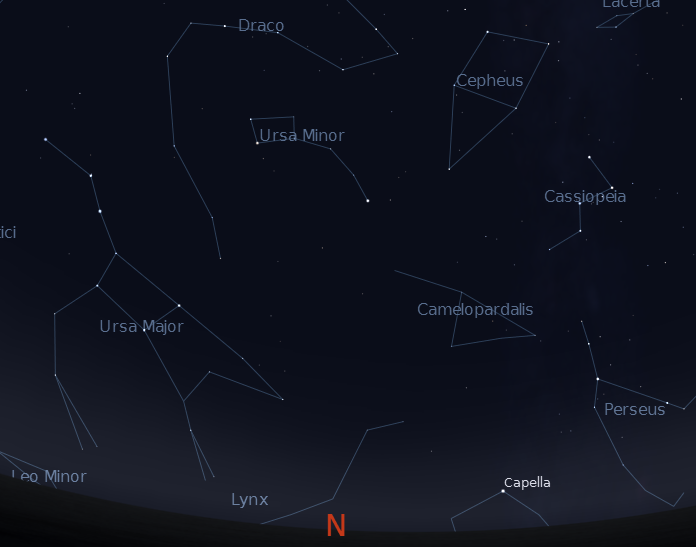
Cassiopeia and the other circumpolar constellations. Created using Stellarium.
07/27/2012 – Ephemeris – I’ll be giving a presentation at the Eyaawing Museum & Culture Center in Peshawbestown tomorrow
Ephemeris for Friday, July 27th. The sun rises at 6:24. It’ll be up for 14 hours and 49 minutes, setting at 9:13. The moon, 1 day past first quarter, will set at 1:41 tomorrow morning.
Tomorrow yours truly will be giving a presentation Stars and Stories of the Summer Night Skies This will be a talk illustrated by a fantastic planetarium type program called Stellarium which is actually free from the Internet. There won’t be a planetarium dome however. I’ll be exploring the stars and constellations visible in the summer sky and how various cultures saw them and some of the wonderful stories of those who counted on the heavens to be their calendar in order to plant their crops and prepare for winter.. There’s the Greek constellations I tend to talk about on these programs, and others, especially those of the local Indian peoples. The presentation is at 1 p.m. at the Eyaawing Museum and Cultural Center in Peshawbestown.
Times are for the Traverse City/Interlochen area of Michigan. They may be different for your location.
07/19/2012 – Ephemeris – The constellation Cygnus the swan
Ephemeris for Thursday, July 19th. Today the sun will be up for 15 hours and 5 minutes, setting at 9:21. The moon is new today, and won’t be visible. | Tomorrow the sun will rise at 6:16.
High in the east northeast as it gets dark flies the constellation of Cygnus the swan. This constellation is also known as the Northern Cross. The cross is seen lying on its side with the bright star Deneb at the head of the cross to the left. The rest of the cross is delineated in the stars to the right. As a swan, Deneb is the tail, the stars of the crosspiece of the cross are the leading edges of wings as Cygnus flies south through the Milky Way. There are faint stars that also define the tips and trailing edges of its wings. It is a very good portrayal of a flying swan, like the mute swans we see on the wing. In Greek mythology this was the disguise of the god Zeus who seduced the young lady Leda and fathered the immortal of the Gemini twins Pollux.
Times are for the Traverse City/Interlochen area of Michigan. They may be different for your location.
Addendum
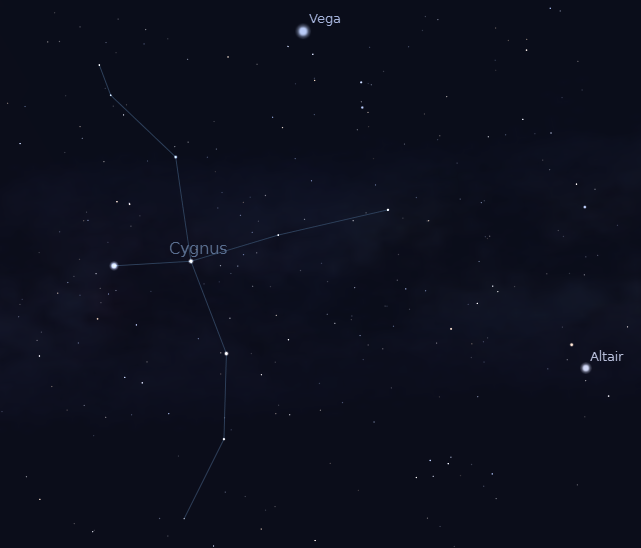
Cygnus and the stars of the Summer Triangle at 11 p.m. on July 19th. Created using Stellarium.
07/17/2012 – Ephemeris – Scorpius and Orion
Ephemeris for Tuesday, July 17th. Today the sun will be up for 15 hours and 9 minutes, setting at 9:22. The moon, 2 days before new, will rise at 5:50 tomorrow morning. Tomorrow the sun will rise at 6:14.
Crawling just above the southern horizon at 11 p.m. is the zodiacal constellation of Scorpius the scorpion. His heart is the red giant star Antares. Its facing the west or right with a short arc of three stars as its head. His body and tail drop to the left and scrape the horizon before curving up to the critter’s poisonous stinger of two stars. One story of the scorpion concerns Orion the hunter the great winter constellation. In that story Orion was supposedly killed by the sting of a scorpion. Therefore Orion and Scorpius are never seen in the sky at the same time. That is certainly true around here and for the Greeks, whose legend it is. However if one travels far enough south that is no longer true.
Times are for the Traverse City/Interlochen area of Michigan. They may be different for your location.
Addendum
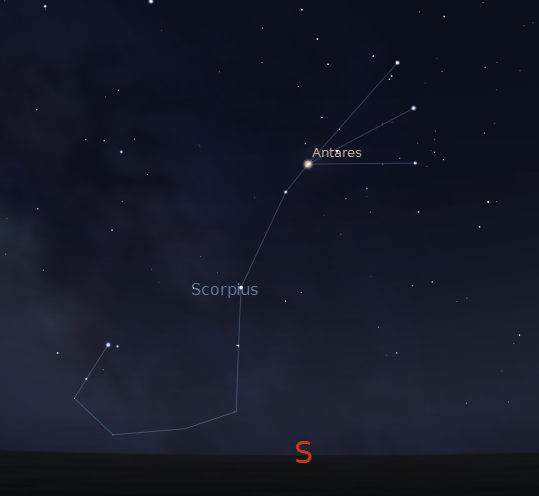
The constellation Scorpius at 10:30 p.m. on July 17, 2012. Created using Stellarium.
07/12/2012 – Ephemeris – The constellation Lyra the harp
Thursday, July 12th. Today the sun will be up for 15 hours and 17 minutes, setting at 9:26. The moon, 2 days past last quarter, will rise at 1:50 tomorrow morning. Tomorrow the sun will rise at 6:10.
High in the east at 11 p.m. can be found a bright star called Vega just above a small, narrow, but very distinctive parallelogram of stars. They are the stars of the constellation Lyra the harp. Vega, the 5th brightest night time star, is one of the twenty one brightest stars, called first magnitude stars. The harp, according to Greek mythology, was invented by the god Hermes. The form of the harp in the sky, is as he had invented it: by stretching strings across a tortoise shell. Hermes gave it to his half-brother Apollo, who in turn gave it to the great musician Orpheus. In binoculars, near Vega, two stars appear together. They barely appear to the unaided eye as a single star, designated Epsilon Lyrae.
Times are for the Traverse City/Interlochen area of Michigan. They may be different for your location.
Addendum
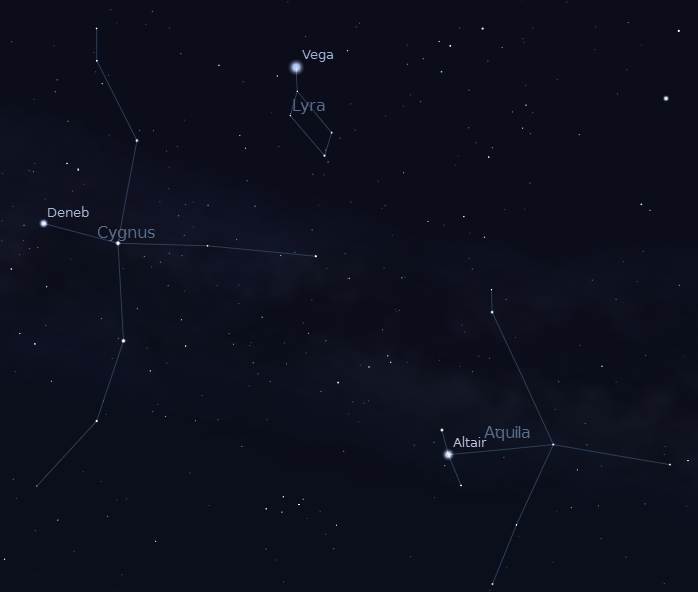
Summer Triangle and the constellation Lyra at 07-12-12 at 11 p.m. Created using Stellarium.
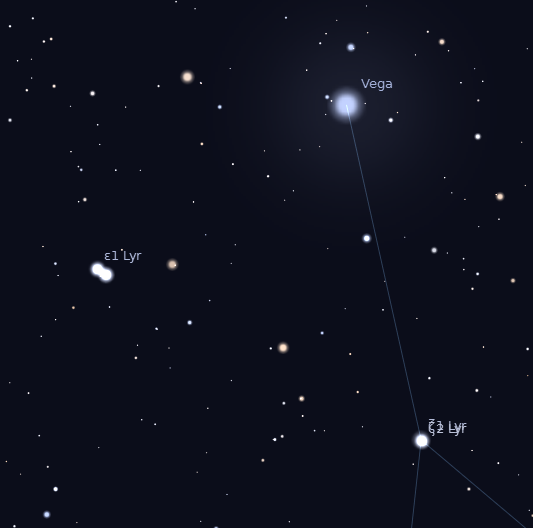
Closeup on Vega and Epsilon Lyrae. Created using Stellarium.
ε1 Lyrae is one of the stars of Epsilon Lyrae. The pair can be split better than this image with binoculars. Looking at the two with a good telescope and over 100 power can split each component into two more stars. We amateur astronomers call it the “Double-Double Star” Note too that Zeta (ζ) Lyrae is also a double star that can be split with a low power telescope.
07/10/2012 – Ephemeris – The constellation of Ophiuchus
Ephemeris for Tuesday, July 10th. Today the sun will be up for 15 hours and 20 minutes, setting at 9:27. The moon, at last quarter today, will rise at 12:50 tomorrow morning. Tomorrow the sun will rise at 6:08.
The red star Antares shines in the south at 11 p.m. In the area of sky above it lies a large constellation of faint stars called Ophiuchus, the serpent bearer. Ophiuchus represent the legendary physician Aesculapius. The constellation shape is like a large bell, which reminds me of the head, shoulders and arms of a fellow that’s holding the snake like a weight lifter struggling to pull up a heavy barbell. Serpens, the constellation of the serpent is in the sky in two sections. The front end lies to the right as Serpens Caput, and wends its way up towards Corona Borealis, the Northern Crown. Serpens Cauda, the tail rises to the left of Ophiuchus. It’s a rewarding sight, and not that hard to spot.
Times are for the Traverse City/Interlochen area of Michigan. They may be different for your location.
Addendum
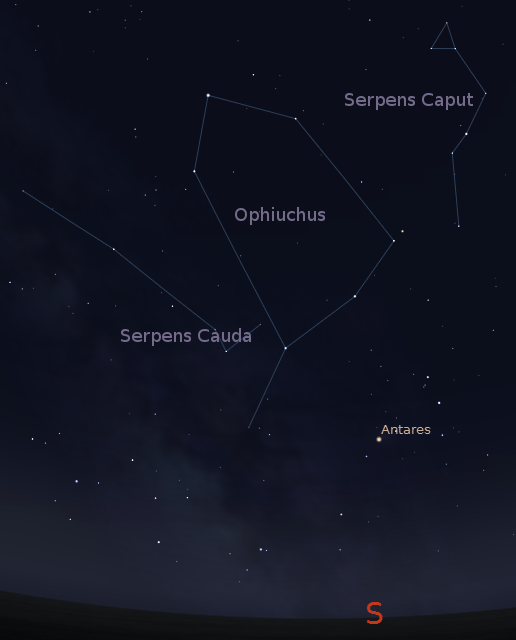
Ophiuchus and Serpens July 10, 2012 at 11 p.m.. Created using Stellarium.
06/08/2012 – Ephemeris – The constellation of Hercules
Ephemeris for Friday, June 8th. Today the sun will be up for 15 hours and 28 minutes, setting at 9:26. The moon, 3 days before last quarter, will rise at 12:38 tomorrow morning. Tomorrow the sun will rise at 5:57.
High in the east is the dim and reasonably large constellation of Hercules. Here is the greatest of the Greek heroes, dim and upside down even, while the comparative nobody Orion gets a great constellation to his name in the winter. Anyway, Hercules can be spotted by the distinctive keystone shape of stars that mark the old boy’s kilt. Stars connected to the four corners show his body and limbs. Check a constellation book for where all the stars lead to. On the west side of the keystone can be spotted with binoculars a fuzzy star. Investigations with larger and larger telescopes will reveal a huge assembly of stars called a globular star cluster. There’s perhaps a million stars there. The finest in the northern heavens.
Times are for the Traverse City/Interlochen area of Michigan. They may be different for your location.
Addendum
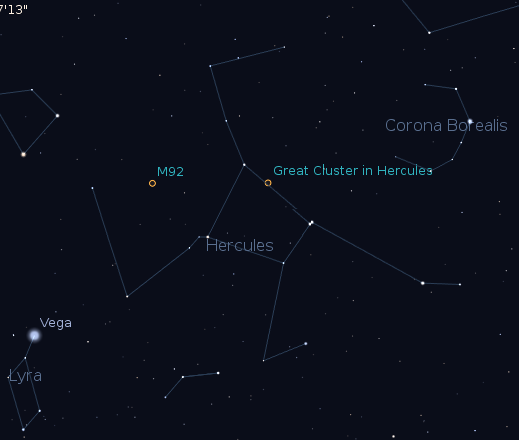
The constellation Hercules and his neighbors. Created with Stellarium.
M92 is also a globular star cluster but more distant. The Great Globular Cluster in Hercules is also designated M13.
06/07/2012 – Ephemeris – The constellation of Corona Borealis
Ephemeris for Thursday, June 7th. Today the sun will be up for 15 hours and 27 minutes, setting at 9:25. The moon, 3 days past full, will rise at 12:07 tomorrow morning. Tomorrow the sun will rise at 5:57.
High in the southeast at 10:30 p.m. can be found a rather small arc of stars just east of the kite shaped constellation of Boötes with the bright star Arcturus at the bottom. It’s called Corona Borealis, the Northern Crown. There is a Southern Crown, Corona Australis, just below the Teapot of Sagittarius, a late summer constellation, which barely rises above the horizon here. This semi-circle of stars was to the Greeks the crown bestowed to Princess Ariadne daughter of King Minos of Crete after she had helped the Greek Theseus escape from the Labyrinth of the Minotaur. To the Native Americans around here it was the sweat lodge, and to the Australian Aborigines it was the boomerang whenever it rose over their northern horizon.
Times are for the Traverse City/Interlochen area of Michigan. They may be different for your location.
Addendum

Corona Borealis with Boötes at 10:30 p.m. Created with Stellarium.
04/19/2012 – Ephemeris – Stories of Leo the lion
Ephemeris for Thursday, April 19th. The sun rises at 6:50. It’ll be up for 13 hours and 42 minutes, setting at 8:32. The moon, 2 days before new, will rise at 6:13 tomorrow morning.
The constellation of Leo the lion is seen in the south at 10 p.m. Mars lies on its underside just left of Leo’s brightest star Regulus. Regulus lies at the bottom of a backwards question mark of stars that are his head and mane. To the left beyond Mars is a triangle of stars that are his haunches. As the lion is the kink of beasts it is fitting that its brightest star Regulus means “Little King Star”. It was thought in ancient Egypt that the heat of summer, when the sun was in Leo drove the lions to drink the waters of the Nile. The lion was also the symbol of the Israelite tribe of Judah, from Jacob’s prophesy in Genesis, and may have played a part in the origin of the Star of Bethlehem. One Egyptian philosopher thought the sun was in Leo at the creation of the world.
* Times are for the Traverse City/Interlochen area of Michigan. They may be different for your location.
Addendum
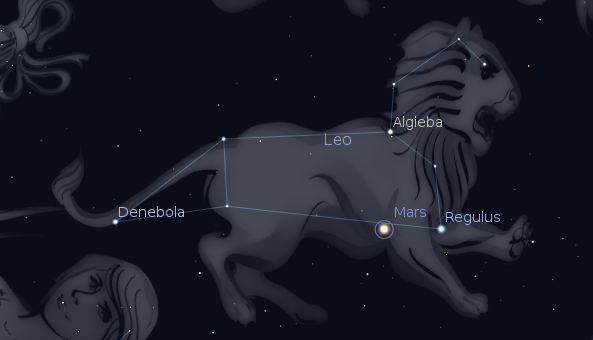
Leo and Mars at 10 p.m. on April 19, 2012 Created using Stellarium.

