Archive
05/19/2022 – Ephemeris – Spring constellations: Virgo
This is Ephemeris for Thursday, May 19th. Today the Sun will be up for 14 hours and 58 minutes, setting at 9:08, and it will rise tomorrow at 6:09. The Moon, halfway from full to last quarter, will rise at 1:40 tomorrow morning.
Tonight at 11 p.m. in the south is the constellation and member of the zodiac: Virgo the virgin. Virgo is a large constellation of a reclining woman holding a stalk of wheat. Spica, the bluest of the first magnitude stars, is the head of that spike of wheat; and as such it ruled over the harvest in two of Virgo’s guises as the goddesses Persephone and Ceres. Virgo is also identified as Astraea the goddess of justice. The constellation of Libra, the scales, which she is associated with, is found just east of her low in the southeast. Early Christians who sought to de-paganize the heavens saw Virgo as the Virgin Mary. Virgo is the host to a great cluster of galaxies seen far beyond its stars, which belong to our galaxy.
The astronomical event times given are for the Traverse City/Interlochen area of Michigan (EDT, UT – 4 hours). They may be different for your location.
Addendum
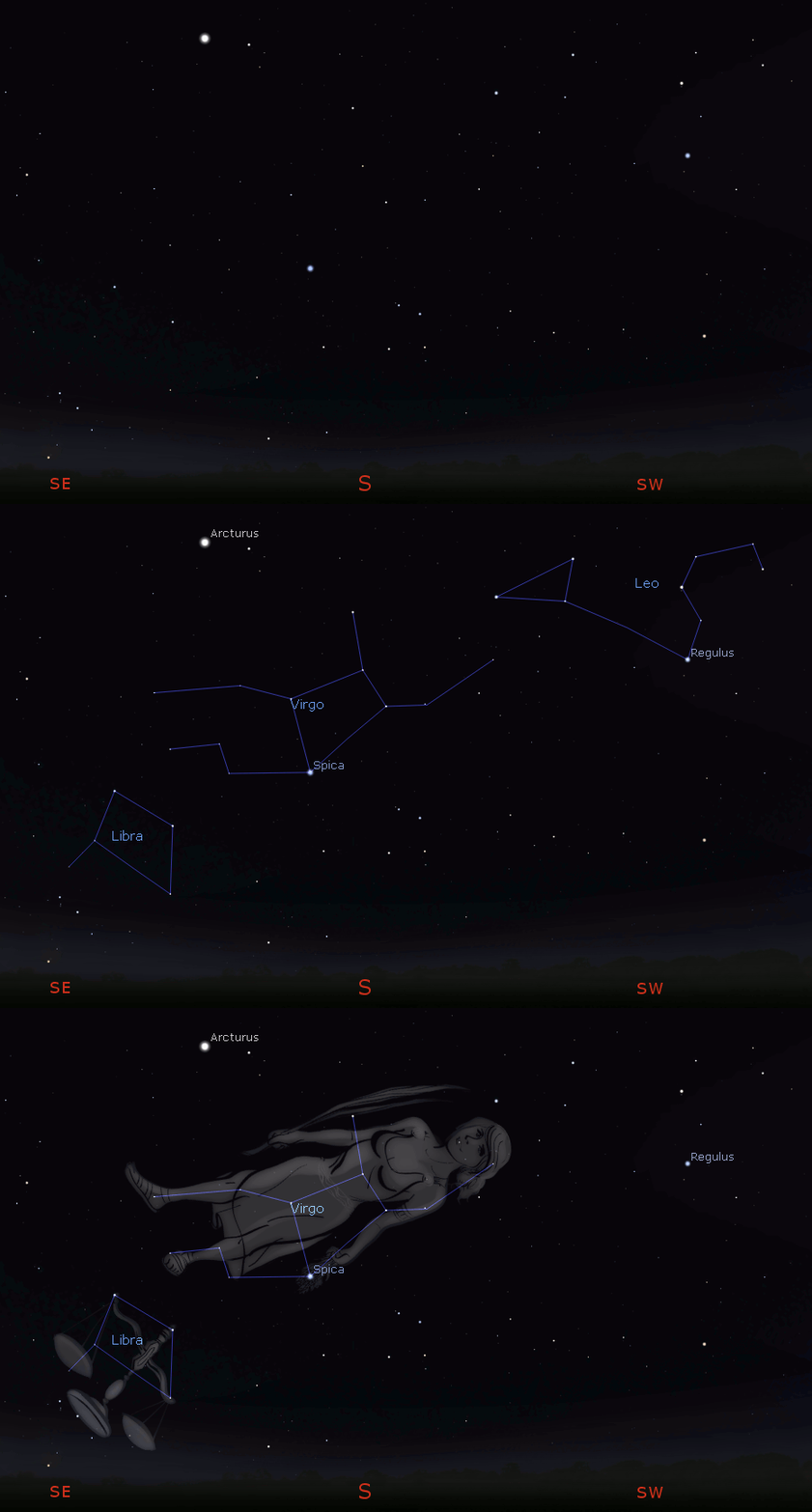
Virgo finder animation with Libra added for 11 p.m. tonight, May 19th. Created using Stellarium and GIMP.
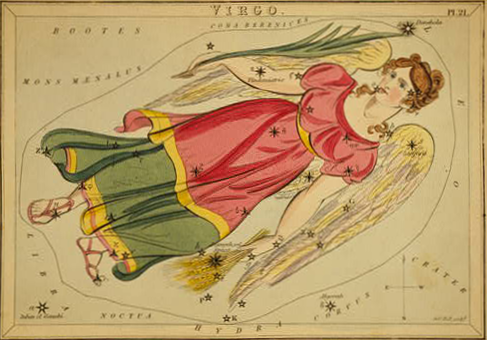
Virgo as depicted in Urania’s Mirror, a set of constellation cards published in London c.1825. From the Library of Congress. H/T Wikipedia.
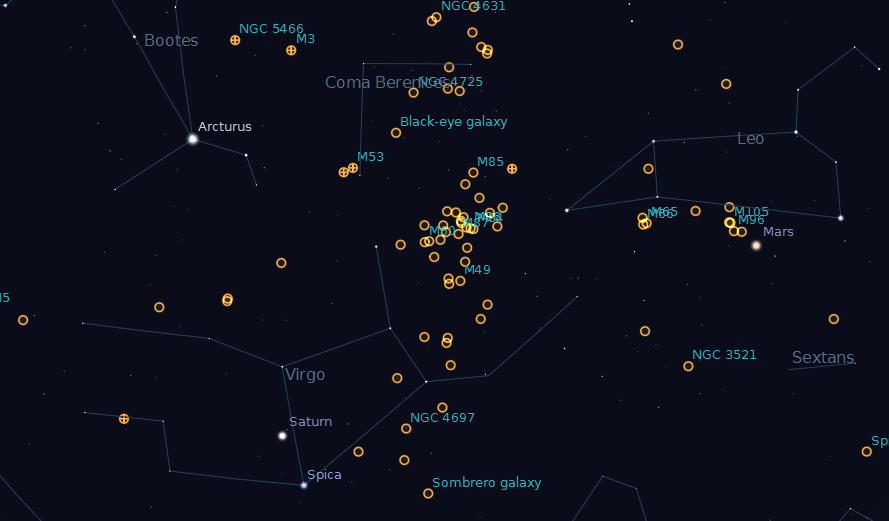
Brighter members of the Virgo Cluster. Created using Stellarium. Open circles are galaxies, circles with crosses are globular star clusters, outlying members of our Milky Way galaxy.
05/03/2022 – Ephemeris – Regulus, the “Little King Star”
This is Bob Moler with Ephemeris for Tuesday, May 3rd. Today the Sun will be up for 14 hours and 20 minutes, setting at 8:50, and it will rise tomorrow at 6:28. The Moon, 3 days past new, will set at 12:05 tomorrow morning.
Fairly high in the south-southwest at 10 p.m. is a pattern of stars that’s in the shape of a backward question mark. This informal star group or asterism is also called the sickle. It is the head and mane of the official zodiacal constellation of Leo the lion. To the left is a triangle of stars is his hind end. The bright star at the bottom of the question mark, or end of the sickle’s handle is Regulus, the “Little King Star”, alluding to the lion’s status as the king of the jungle. Regulus is about 79 light years away and is a 4 star system that exists as two star pairs. The bright star Regulus itself and a companion too close to be imaged directly in telescopes, and a nearby pair of dim stars make up the system. The Moon often passes in front of Regulus, since it’s close to the ecliptic. These occultations, as they are called, will occur monthly for a year and a half starting July
The astronomical event times given are for the Traverse City/Interlochen area of Michigan (EDT, UT – 4 hours). They may be different for your location.
Addendum

Animated finder chart for Leo and Regulus for early May at 10 pm or an hour after sunset. The orange line that appears is the ecliptic, the path of the Sun in the sky. The path of the Moon is tilted by about 5 degrees to that path. The paths cross at points called nodes. The nodes move slowly westward in an 18.6-year cycle called the regression of the nodes. Occultations of Regulus by the Moon occur during two periods in that cycle. The next period where occultations of Regulus will occur monthly from July 2025 to January 2027. Created using Stellarium and GIMP.
Occultations are like solar eclipses in that they can only be seen from a limited area. That area will shift southward during that period. Of the 21 occultations in that period, only 2 will be visible from the United States: February 3rd, and April 26th 2026.
04/28/2022 – Ephemeris – The story of Arcas and Callisto
This is Bob Moler with Ephemeris for Thursday, April 28th. Today the Sun will be up for 14 hours and 6 minutes, setting at 8:44, and it will rise tomorrow at 6:35. The Moon, 2 days before new, will rise at 6:16 tomorrow morning.
Appearing in the eastern sky at 10 p.m. tonight is the kite shaped constellation of Boötes the herdsman. The bright star Arcturus is at the bottom of the kite which is horizontal to the left, pointed to by the arc of the handle of the Big Dipper, higher in the east. The Big Dipper is the hind end of the constellation Ursa Major, the Great Bear. In one story, Boötes represents a young hunter named Arcas, son of Callisto, a beautiful young woman who had the misfortune of being loved by god Zeus. Zeus’ wife, Hera, found out about the affair, and since she couldn’t punish Zeus, turned the poor woman into a bear. Arcas, many years later, unaware of why his mother disappeared, was about to kill the bear when Zeus intervened and placed them both in the sky, where he continues to chase her across the sky nightly.
The astronomical event times given are for the Traverse City/Interlochen area of Michigan (EDT, UT – 4 hours). They may be different for your location.
Addendum
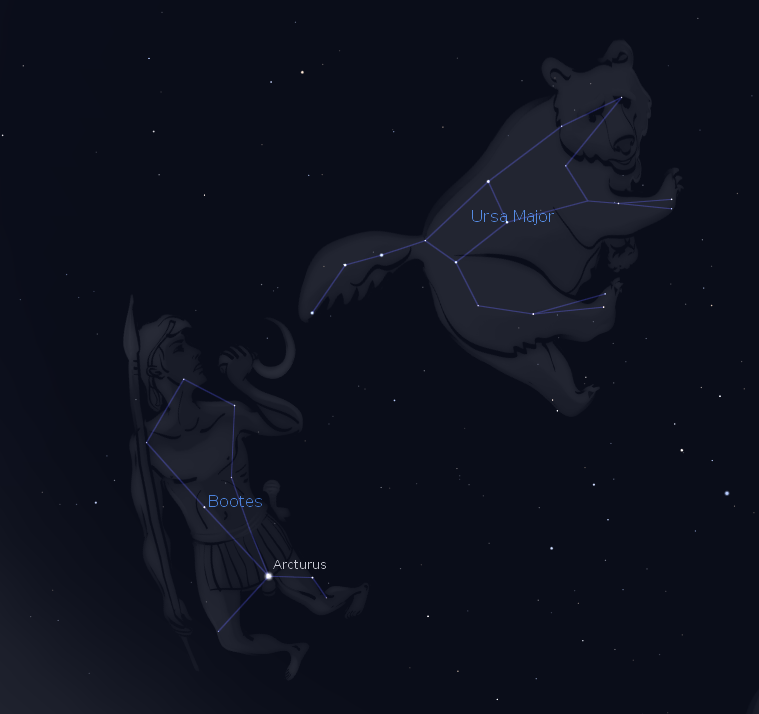
Boötes and Ursa Major aka Arcas chasing Callisto around the pole of the sky. Created using Stellarium.
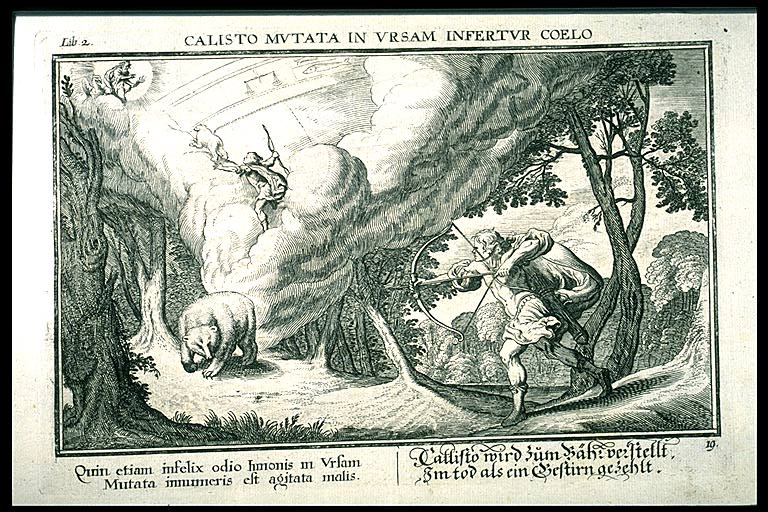
Arcas about to slay the bear by the 17th century artist Baur. Source: University of Virginia Electronic Text Center
04/19/2022 – Ephemeris – A constellation memorializing a real person
This is Ephemeris for Tuesday, April 19th. Today the Sun will be up for 13 hours and 41 minutes, setting at 8:32, and it will rise tomorrow at 6:49. The Moon, 3 days past full, will rise at 12:37 tomorrow morning.
High in the southeast at 10 p.m. is a tiny and faint constellation of Coma Berenices, or Berenice’s Hair. In it are lots of faint stars arrayed to look like several strands of hair to the naked eye. The whole group will fit in the field of a pair of binoculars, which will also show many more stars. The story behind it was that Berenice was a real Queen of Egypt, whose husband was away at war. This was in the days when the Greeks ruled Egypt after Alexander conquered it. She offered her golden tresses to the gods for the king’s safe return. The hair, was placed in a temple. However, the offering disappeared when the king returned. Ever since then, the constellation of Coma Berenices has been seen to commemorate the queen’s sacrifice.
The astronomical event times given are for the Traverse City/Interlochen area of Michigan (EDT, UT – 4 hours). They may be different for your location.
Addendum
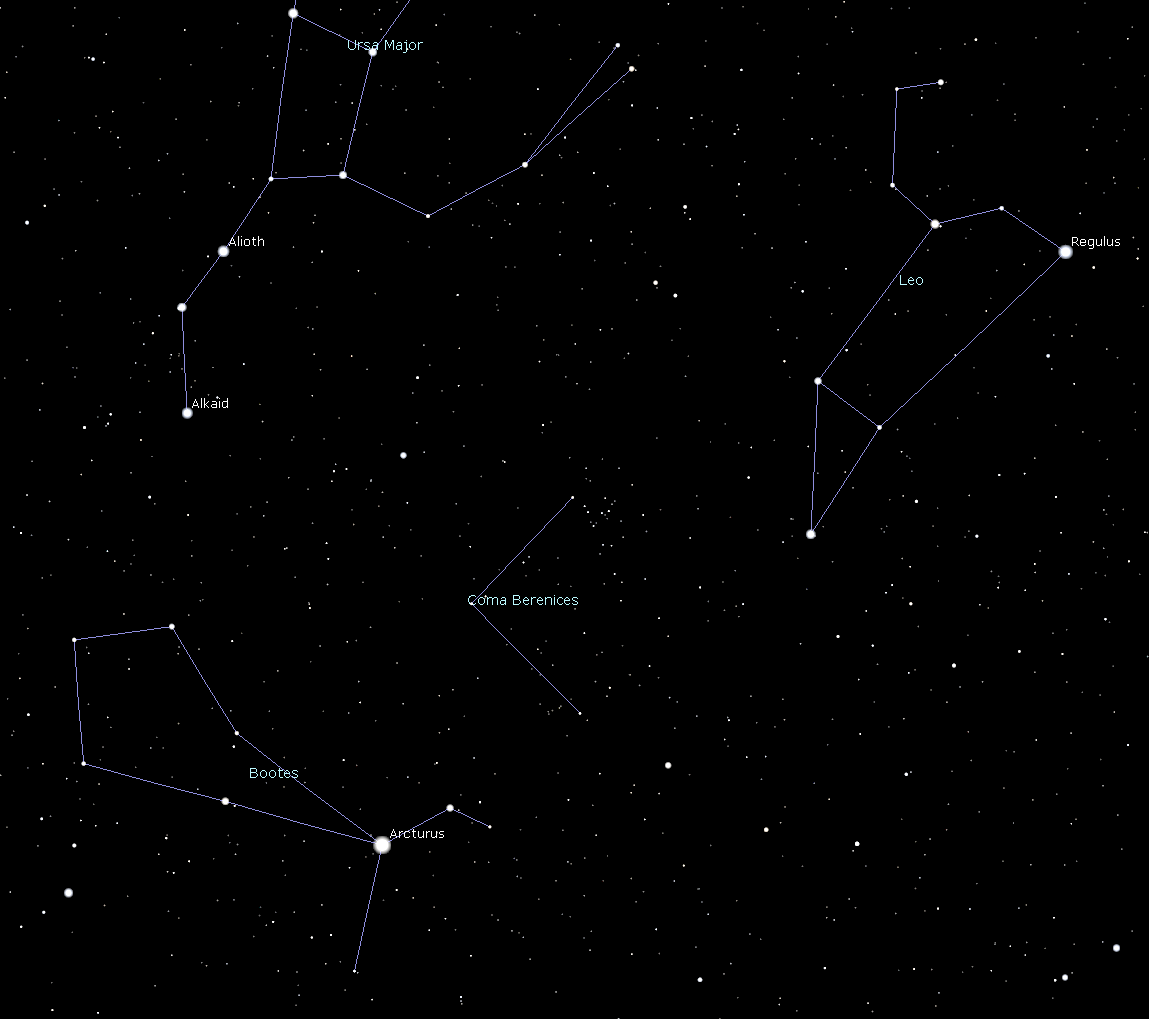
Coma Berenices and neighboring constellations at 10 p.m. in mid-April. Note that only the upper right star of the upside down L shape actually belongs to the cluster. Click on the image to enlarge it. Created using Stellarium.
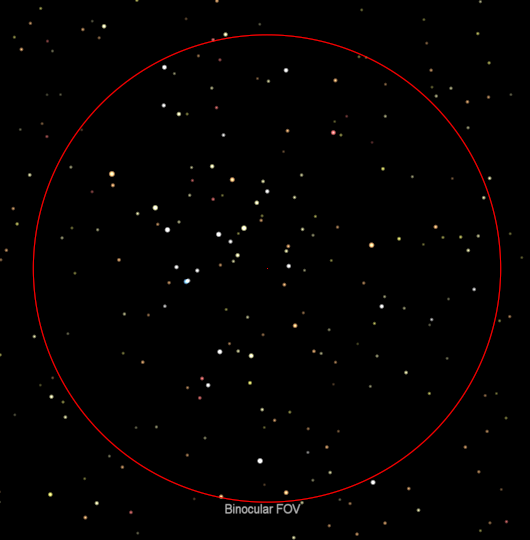
Approximate 7 power binocular field of view (FOV) of the Coma Berenices Cluster. Created using Cartes du Ciel (Sky Charts).
03/28/2022 – Ephemeris – Finding the Great Bear
This is Ephemeris for Monday, March 28th. Today the Sun will be up for 12 hours and 34 minutes, setting at 8:05, and it will rise tomorrow at 7:29. The Moon, 3 days past last quarter, will rise at 6:47 tomorrow morning.
The Big Dipper is now reaching for the zenith in the northeast at 10 p.m. The seven bright stars are second to Orion in the west as the seven brightest stars in a constellation. If you looked up a list of constellations, you’d find that the Big Dipper isn’t there. Ursa Major or the Great Bear is the constellation of which the Big Dipper is a part. The seven bright stars of the dipper are the rump and long tail of this constellation. The rest of the bear, including his head and legs, are delineated by dimmer stars. An anatomical problem is its long tail, which was drawn in by the ancients of the old world. Their explanation was that a god had grabbed the bear’s stubby tail, whirled the bear around his head, and threw it into the sky, thus stretching its tail.
The astronomical event times given are for the Traverse City/Interlochen area of Michigan (EDT, UT – 4 hours). They may be different for your location.
Addendum
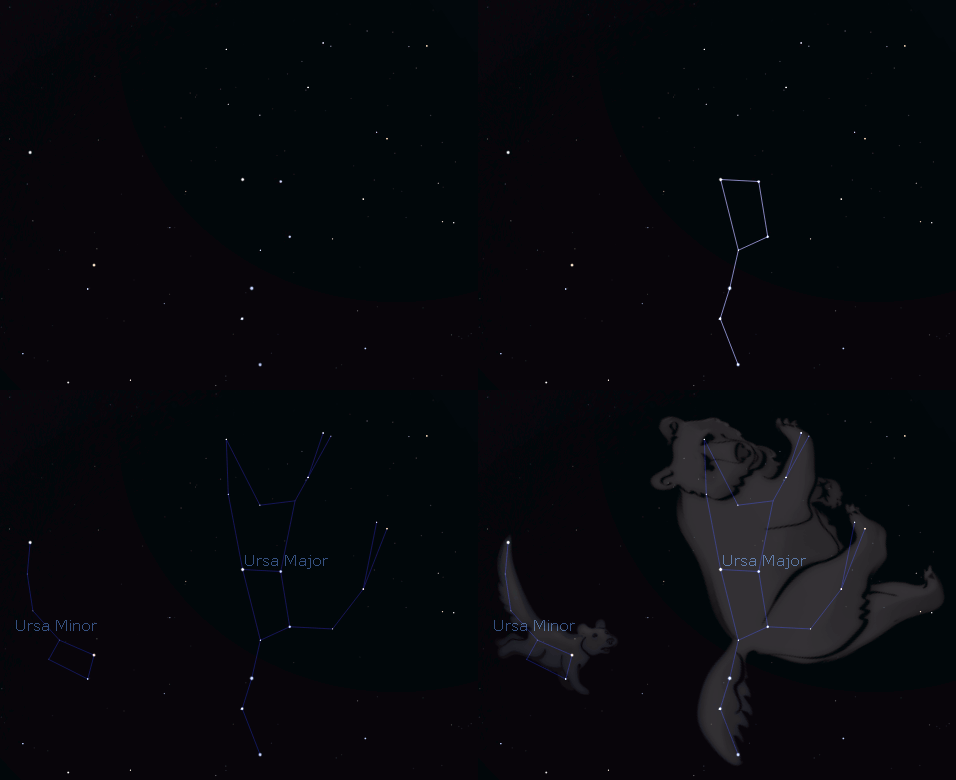
The Great Bear (Ursa Major) finder animation. It shows the stars only, then the Big Dipper, Then the lines of the constellations Ursa Major and Ursa Minor (Lesser Bear and Little Dipper) as a bonus, and finally the constellation artwork. The orientation is for about 9:30 pm on the latter days of March. We are looking high in the northeast. In Northern Michigan, the bear’s front paw is near the zenith at that time. Created using Stellarium and GIMP.
03/21/2022 – Ephemeris – Finding the celestial lion
This is Ephemeris for Monday, March 21st. Today the Sun will be up for 12 hours and 12 minutes, setting at 7:56, and it will rise tomorrow at 7:42. The Moon, 3 days past full, will rise at 12:15 tomorrow morning.
At 10 p.m. the spring constellation of Leo the lion will be fairly high in the southeast. It can be found by locating the Big Dipper high in the northeast and imagining that a hole were drilled in the bowl to let the water leak out. It would drip on the back of this giant cat. The Lion is standing or lying facing westward. His head and mane are seen in the stars as a backwards question mark. This group of stars is also called the Sickle. The bright star Regulus is at the bottom, the dot at the bottom of the question mark. A triangle of stars, to the left of Regulus, is the lion’s haunches. Leo contains some nice galaxies visible in moderate sized telescopes. The stars in Leo’s part of the sky are fewer than those in the winter sky.
The astronomical event times given are for the Traverse City/Interlochen area of Michigan (EDT, UT – 4 hours). They may be different for your location.
Addendum
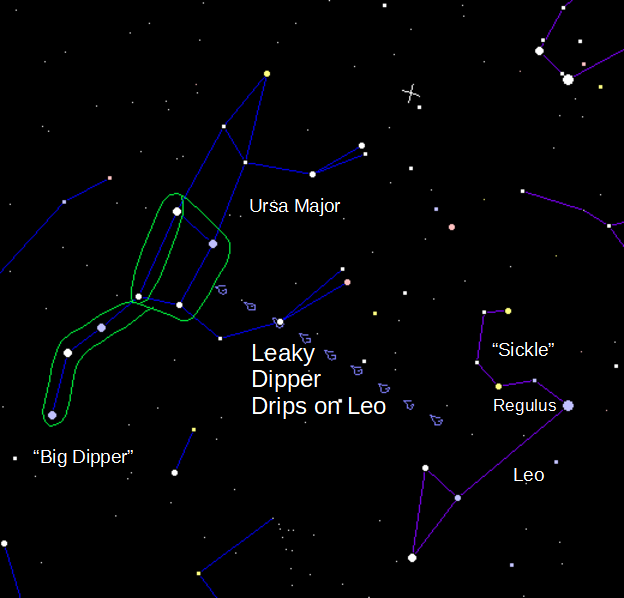
Leaky Big Dipper drips on Leo. The positions in the sky are for 10 pm local time, or about 2 hours after sunset. The little distorted cross at the top of the image marks the zenith. Look high in the east and southeast to see these stars. Created using my LookingUp program, GIMP and LibreOffice.
03/07/2022 – Ephemeris – The Fisher announces the beginning of the Maple sugaring season
This is Ephemeris for Monday, March 7th. Today the Sun will be up for 11 hours and 28 minutes, setting at 6:38, and it will rise tomorrow at 7:07. The Moon, 3 days before first quarter, will set at 12:19 tomorrow morning.
March is a month of transitions. The stars of the winter skies, that is Orion and his merry band of bright stars, move to the west as those of spring rise in the east. The Big Dipper is ascending in the northeastern sky, after lying low in the north during the long dark evenings in the heart of winter. The dipper is the hind end of the Great Bear, officially Ursa Major. The Anishinaabe peoples of the Great Lakes region saw the Big Dipper as the hind end and tail of a magical creature called Fisher, or in their language Ojiig, who brought summer to the Earth. Its position in the sky around the pole announces the seasons. The Fisher’s ascension high into the northeastern sky signals this month’s maple sugaring season.
The astronomical event times given are for the Traverse City/Interlochen area of Michigan (EST, UT – 5 hours). They may be different for your location.
Addendum
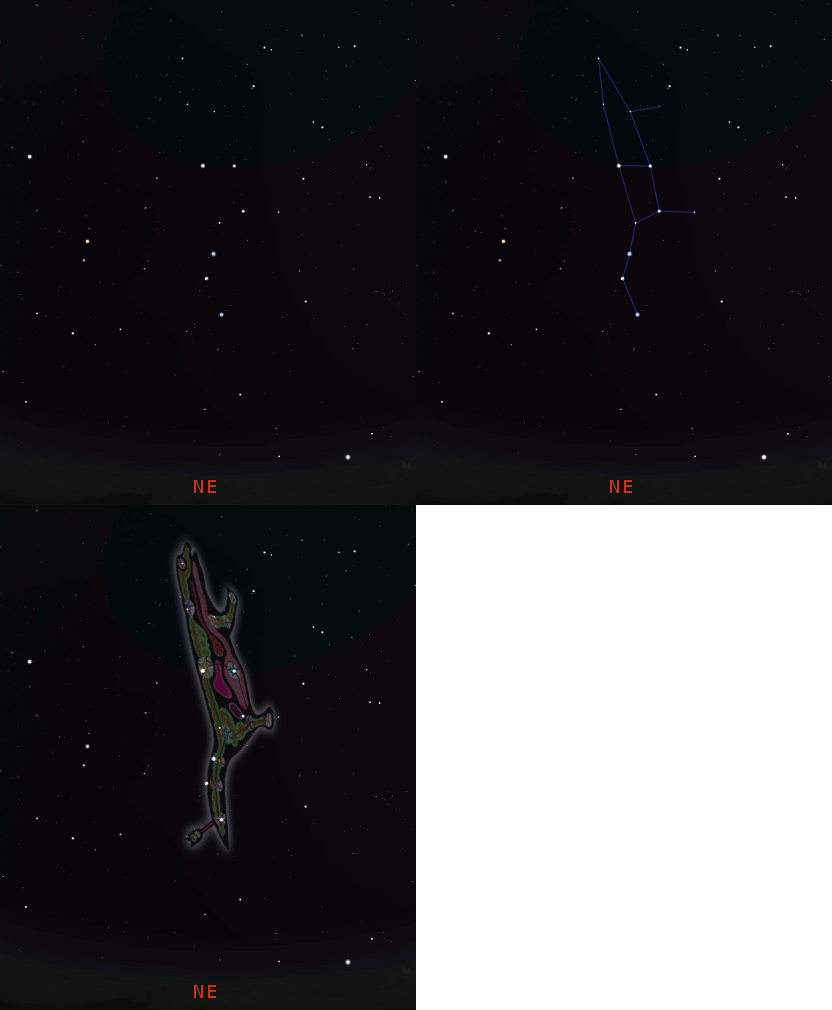
The Fisher announcing maple sugaring season – animation. Star positions for about 2 hours after sunset, near 45 degrees north latitude, for a week into March. Created using Stellarium and GIMP.
For the story of how the Fisher brought summer to the earth, and why he’s got an arrow sticking into his tail, click here.
03/03/2022 – Ephemeris – Finding Cancer the crab
This is Ephemeris for Thursday, March 3rd. Today the Sun will be up for 11 hours and 16 minutes, setting at 6:33, and it will rise tomorrow at 7:15. The Moon, 1 day past new, will set at 7:46 this evening.
The constellation of Cancer the crab is made of dim stars, which are generally connected, in constellation charts, with lines that make either the letter K or an upside down Y, which lie directly between the star pair Castor and Pollux in Gemini and Regulus in Leo. In the center of the constellation is, what to the naked-eye is a fuzzy spot called Praesepe, or the manger. The two nearby stars, one to the northeast, and one to the southeast are Asellus Borealis, and Asellus Australis, the northern and southern donkey colts feeding out of the manger. Viewing that fuzzy spot with a pair of binoculars will reveal that it’s not fuzzy at all. It resolves into a cluster of stars, which astronomers, over the years, have called the Beehive cluster. Back in the first and second century CE, the Sun entered Cancer to begin the season of summer. It’s now just a transitional constellation between the winter and spring evening skies.
The astronomical event times given are for the Traverse City/Interlochen area of Michigan (EST, UT – 5 hours). They may be different for your location.
Addendum
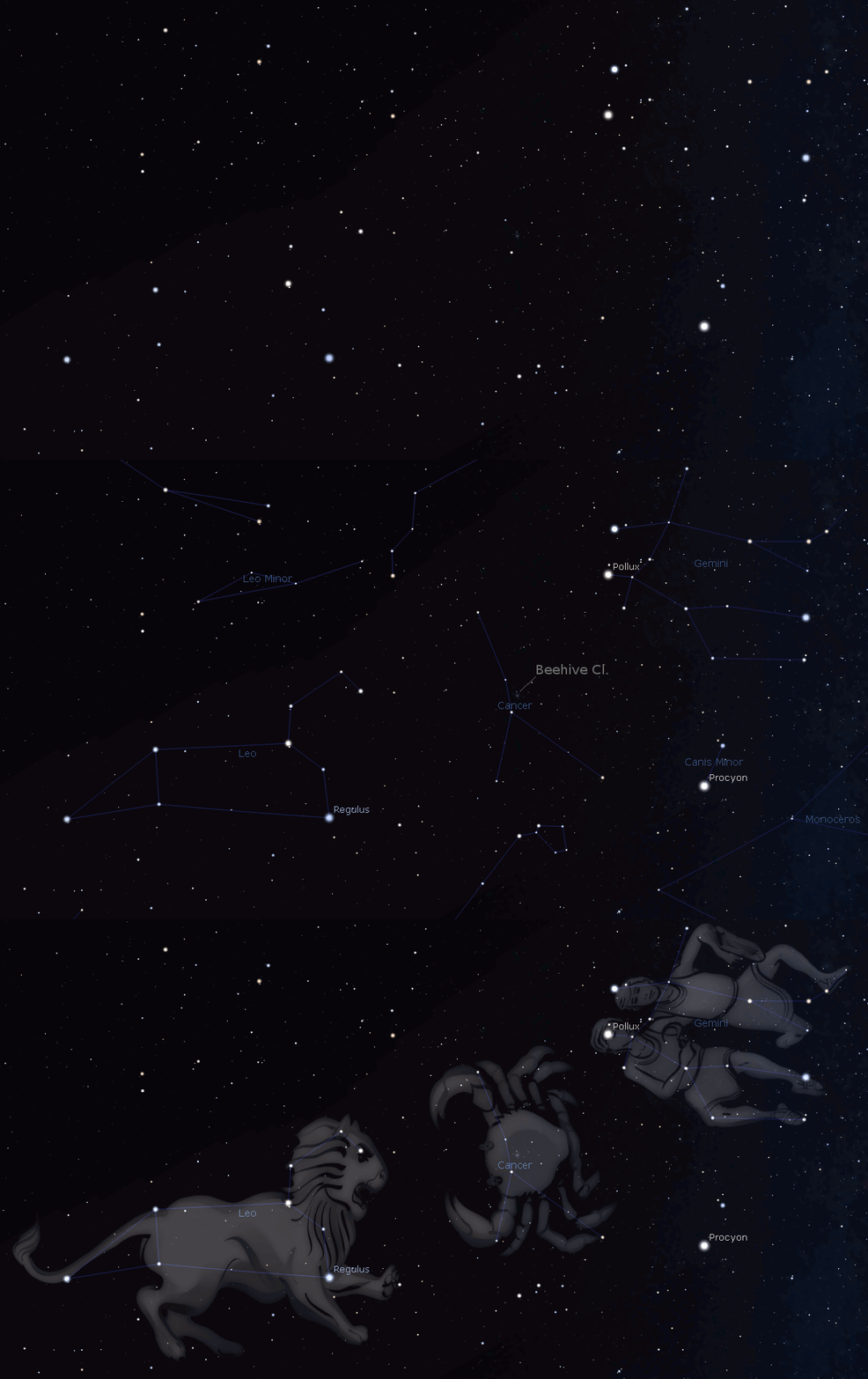
Cancer, the crab finder chart. Note the beehive cluster, also known to amateur astronomers as M44, along with other catalog names. Prior to the invention of the telescope this cluster was known as Praesepe which means “Manger”. Click on the image to enlarge it. Created using Stellarium and GIMP.
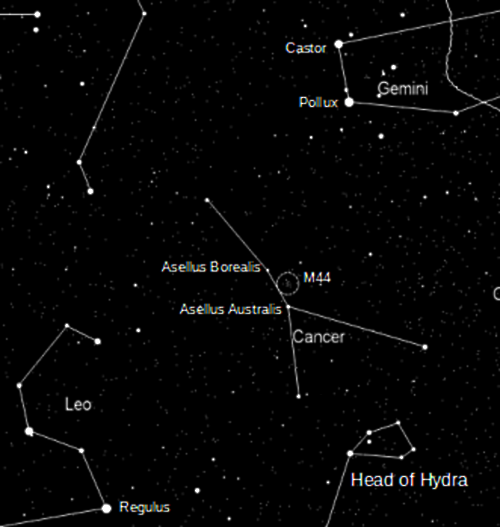
A closer look at Cancer, noting the donkey stars Asellus Borealis and Australis feeding at the manger, Praesepe or M44, aka: the Beehive Cluster. Created using Cartes du Ciel (Sky Charts) and LibreOffice for captions. Adapted from a chart I created for the March 2022 issue of the GTAS newsletter, the Stellar Sentinel.
02/24/2022 – Ephemeris – The celestial unicorn
This is Ephemeris for Thursday, February 24th. Today the Sun will be up for 10 hours and 55 minutes, setting at 6:23, and it will rise tomorrow at 7:27. The Moon, 1 day past last quarter, will rise at 3:57 tomorrow morning.
Among all the constellations in the sky of animals real and mythical, there is also a unicorn. It’s called Monoceros, and inhabits the south-southeastern sky at 8 p.m. mostly bounded by Orion on the right, Canis Major, the great dog below and Canis Minor, the little dog to the left and above. Unfortunately for observers without a telescope, Monoceros, is devoid of any but the faintest stars. Maybe that’s why no one sees unicorns anymore. It has many faint stars because the Milky Way runs through it. To the telescopic observer and astrophotographer it is a feast of faint nebulae or clouds of gas and dust, the birthplace of stars, including the red rose of the Rosette Nebula* (NGC 2237), and Hagrid’s Dragon Cluster (NGC 2301), which sounds suspiciously like it was recently, and unofficially, named. Monoceros also contains a beautiful telescopic triple star system, Beta (β) Monocerotis.
The astronomical event times given are for the Traverse City/Interlochen area of Michigan (EST, UT – 5 hours). They may be different for your location.
* The Rosette nebula surrounds the star cluster NGC 2244. This sparse star cluster is visible visually in telescopes. I’ve never been able to spot the nebula in a telescope, but it shows up, faintly, in my wide angle photographs of the area.
Addendum
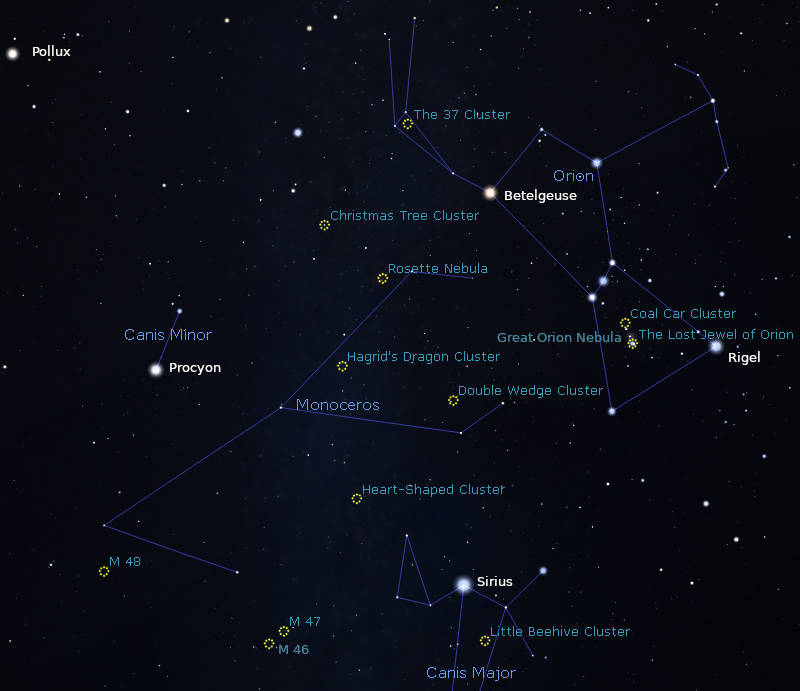
Deep Sky Objects in and around Monoceros. Deep Sky Objects are telescopic objects that lie beyond the solar system. Click on the image to enlarge. Created using Stellarium.
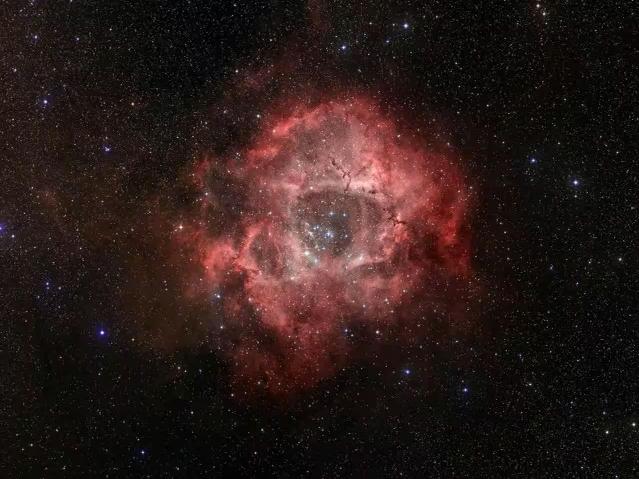
Rosette Nebula in the infrared from the Spitzer Space Telescope. Credit: NASA/JPL/Caltech
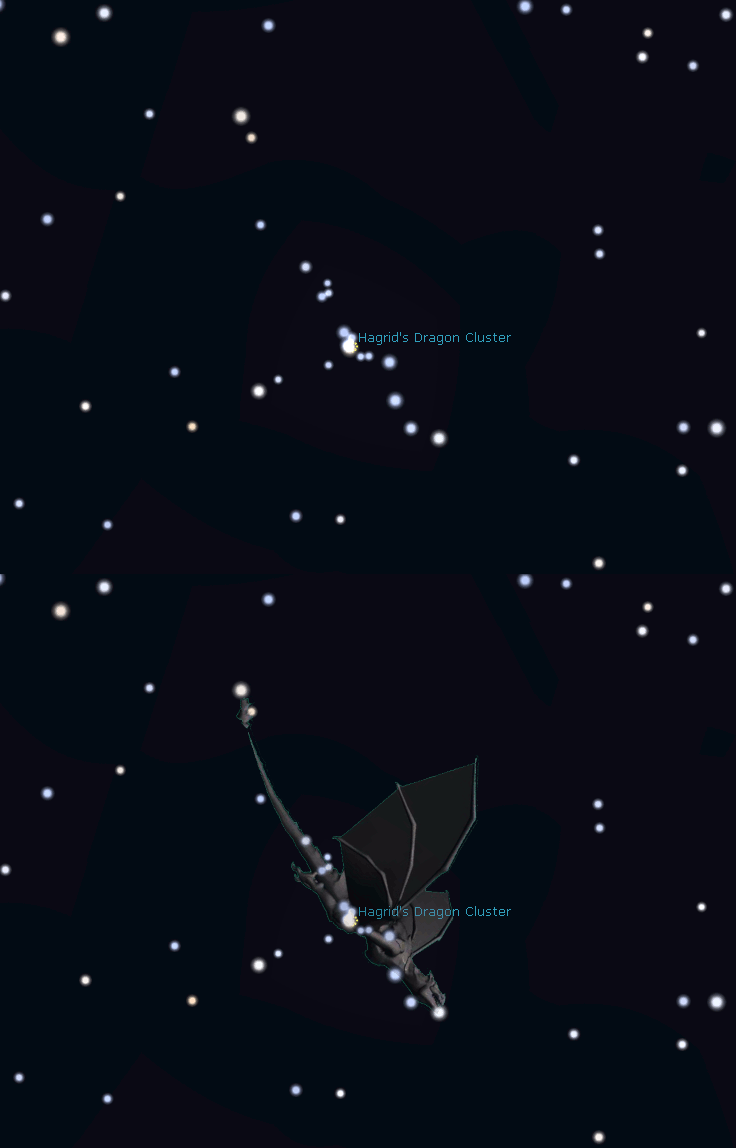
The brighter stars of NGC 2301 (Hagrid’s Dragon Cluster, AKA Great Bird Cluster and Copeland’s Golden Worm). It’s also in two other catalogs: Cr 119 and Mel 54. Created using Stellarium and GIMP. The dragon image is from “Dragon Flying Cycle” on YouTube by Simon Hussey.
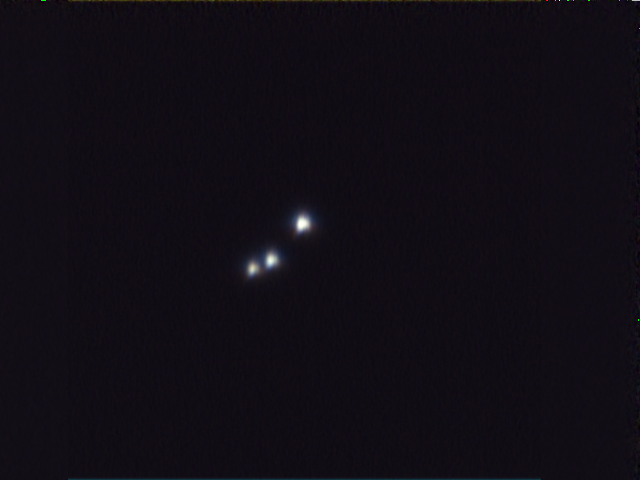
Telescopic Beta Monocerotis. William Hershel, discoverer of Uranus, said that it was “One of the most beautiful sights in the heavens.” Credit: F. Ringwald, Fresno State.
02/18/2022 – Ephemeris – Sirius, the brightest nighttime star
This is Ephemeris for Friday, February 18th. Today the Sun will be up for 10 hours and 37 minutes, setting at 6:15, and it will rise tomorrow at 7:36. The Moon, 2 days past full, will rise at 8:32 this evening.
In the evening, the great constellation of Orion the hunter can be seen in the south. Its large rectangle of bright stars is easily visible, even with a full moon. The three stars in a straight line, his belt, tilt downward to the left to a very bright star merrily twinkling lower in the sky. This star is called Sirius, also known as the Dog Star because it’s in the heart of Orion’s larger hunting dog, Canis Major. It is an arc light white star as seen in binoculars or telescope. It is the brightest star in the night sky, and a neighboring star, just twice the distance of the closest star to the Sun at 8.6 light years. It’s name, Sirius, has nothing to do with a dog, but is from the Greek meaning scorching for its brightness or sparkling, due to its intense twinkling.
The astronomical event times given are for the Traverse City/Interlochen area of Michigan (EST, UT – 5 hours). They may be different for your location.
Addendum
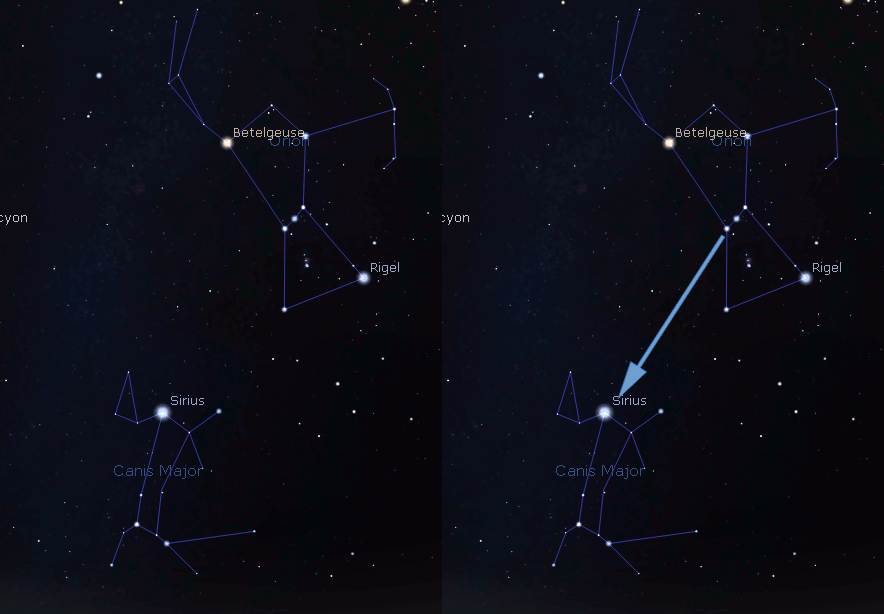
In the southern sky, Orion’s belt points to Sirius. Created using Stellarium, Libreoffice and GIMP.
 Bob Moler's Ephemeris Blog