Archive
10/28/2021 – Ephemeris – The spookiest star in the sky
This is Ephemeris for Thursday, October 28th. Today the Sun will be up for 10 hours and 21 minutes, setting at 6:36, and it will rise tomorrow at 8:17. The Moon, at last quarter today, will rise at 12:31 tomorrow morning.
We are getting down to the spookiest time of the year, with Halloween on Sunday, so it’s time to talk about the spookiest star in the sky, Algol the Ghoul or Demon Star. It’s in the constellation of Perseus the hero, now rising in the northeastern sky. The constellation itself looks like the Greek letter pi, or like the cartoon Roadrunner with its long legs. Algol is the second brightest star in the constellation, near the Roadrunner’s leading foot. That’s where the eye of the severed head of Medusa, that Perseus is carrying. It’s still winking, once every 2 days and 21 hours*. Tonight it will be in the deepest part of its wink at 8:43 pm. It will take about three hours to recover its usual brightness. I recall that the ancient Chinese weren’t fond of that star either.
The astronomical event times given are for the Traverse City/Interlochen area of Michigan (EDT, UT – 4 hours). They may be different for your location.
* More specifically, 2 days, 20 hours, 49 minutes on average and altered by Earth’s changing distance from the star due to its orbit of the Sun.
Addendum
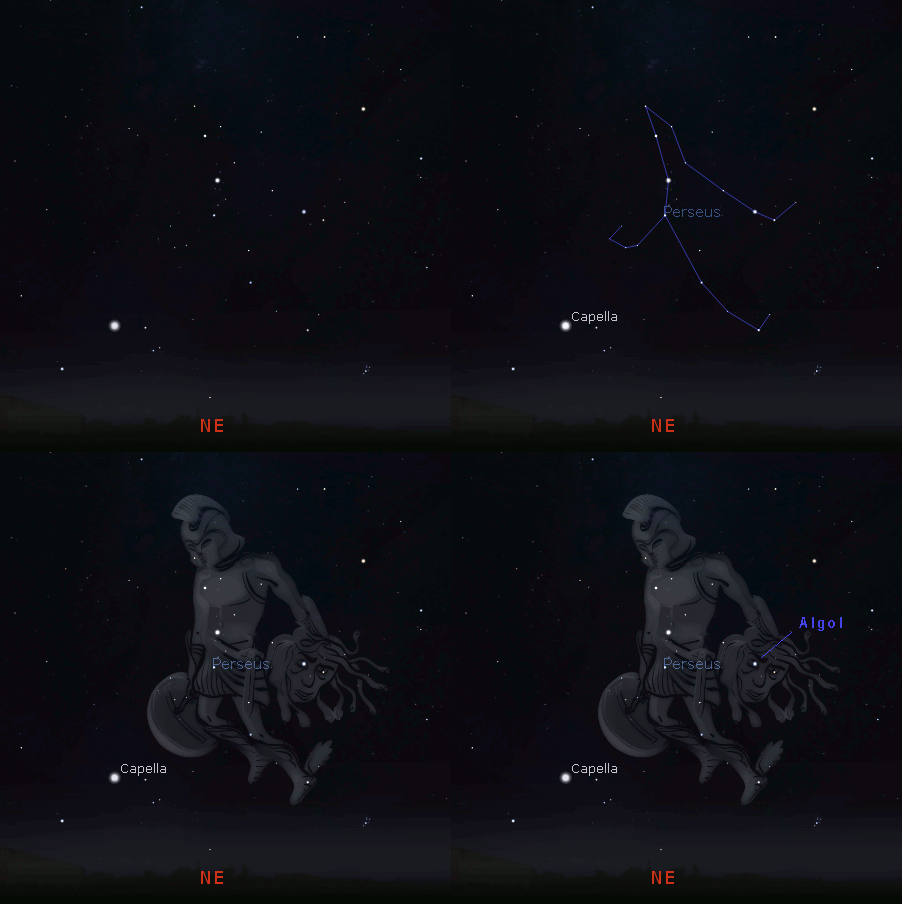
Algol Finder Animation for around 8 pm in the later part of October and early November (7 pm after the EST time change on the first Sunday in November). Created using Stellarium and GIMP.
Algol is an eclipsing binary star, where one star eclipses the other.
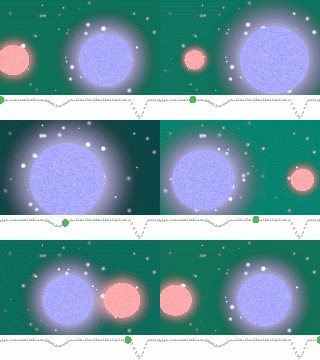
Animation of an eclipsing binary star like Algol. Credit: Wikimedia Commons h/t Earth and Sky
10/26/2021 – Ephemeris – The bright star Capella is slowly ascending in the northeastern sky
This is Ephemeris for Tuesday, October 26th. Today the Sun will be up for 10 hours and 26 minutes, setting at 6:39, and it will rise tomorrow at 8:14. The Moon, 2 days before last quarter, will rise at 10:29 this evening.
The bright star that’s been hanging out fairly low in the northeastern sky in the evening lately is Capella, sometimes called the Goat Star. It’s at the top of a rather oddly shaped pentagon of stars that make up the constellation Auriga, the charioteer. A small, thin triangle of stars to Capella’s right is called the Kids*. Her kids. I’m not sure what a fellow is doing holding 4 goats while driving a chariot. Maybe that’s how he ended up in the sky. Capella itself consists of two yellow giant stars, about the same temperature as the Sun, but much larger. Capella is circumpolar for most of northern Michigan, meaning it never sets. It gets pretty low in the north on summer evenings.
The astronomical event times given are for the Traverse City/Interlochen area of Michigan (EDT, UT – 4 hours). They may be different for your location.
* I’ve always known them as the Kids. Stellarium calls them the Goatlings.
Addendum
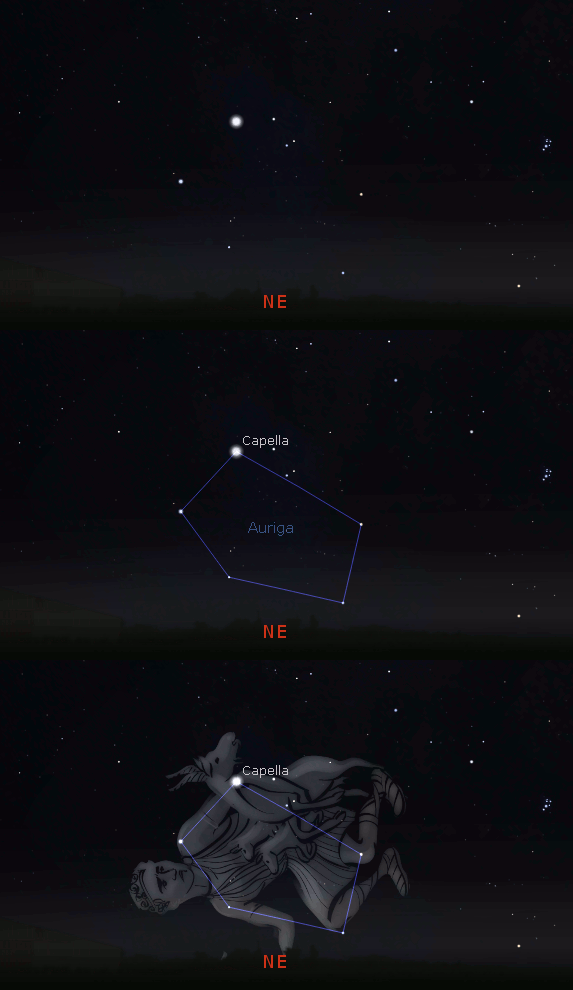
Capella and Auriga, low in the northeastern sky. I left the Kids unannotated, but they are easy to find near Capella. An animation created using Stellarium and GIMP.
10/07/2021 – Ephemeris – The loneliest star in the sky
This is Bob Moler with Ephemeris for Thursday, October 7th. Today the Sun will be up for 11 hours and 23 minutes, setting at 7:11, and it will rise tomorrow at 7:49. The Moon, 1 day past new, will set at 8:06 this evening.
There’s a bright star that appears for only seven and a half hours on autumn nights. It’s appearance, low in the south-southeast at 9 p.m., is a clear indication of the autumn season. The star’s name is Fomalhaut, which means fish’s mouth. That’s fitting because it’s in the constellation of Piscis Austrinus, the southern fish. At our latitude it’s kind of the fish that got away, because Fomalhaut appears to be quite alone low in the sky. The dimness of the constellation’s other stars and location close to the horizon make the other stars hard to spot. The Earth’s thick atmosphere near the horizon reduces their brightness by a factor of two or more, so Fomalhaut, one of the brightest stars in the sky, keeps a lonely vigil in the south.
The astronomical event times given are for the Traverse City/Interlochen area of Michigan (EDT, UT-4 hours). They may be different for your location.
Addendum
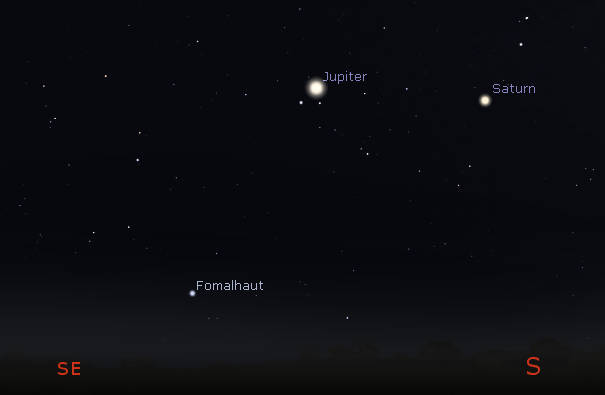
Fomalhaut at 9 pm, October 7, 2021. This year it has two bright planets relatively nearby, By they’re just passing through, albeit slowly. Normally the closest first magnitude star to Fomalhaut is Altair, the southernmost of the Summer Triangle stars. Created using Stellarium.
09/28/2021 – Ephemeris – Andromeda, a damsel in distress
This is Bob Moler with Ephemeris for Tuesday, September 28th. Today the Sun will be up for 11 hours and 50 minutes, setting at 7:28, and it will rise tomorrow at 7:38. The Moon, at last quarter today, will rise at 11:46 this evening.
In the east at 9 this evening can be found a large square of stars, the Great Square of Pegasus the flying horse. The square is standing on one corner. What looks like its hind legs stretching to the left from the left corner star is another constellation, Andromeda the chained princess. She is seen in the sky as two diverging curved strings of stars that curve upward. She was doomed due to her mother, Queen Cassiopeia’s boasting, which angered the god Poseidon. She was rescued by the hero Perseus, a nearby constellation, riding his steed Pegasus. Andromeda’s claim to astronomical fame is the large galaxy seen with the naked-eye just above the upper line of stars. The Great Andromeda Galaxy is two and a half million light years away.
The astronomical event times given are for the Traverse City/Interlochen area of Michigan (EDT, UT-4 hours). They may be different for your location.
Addendum
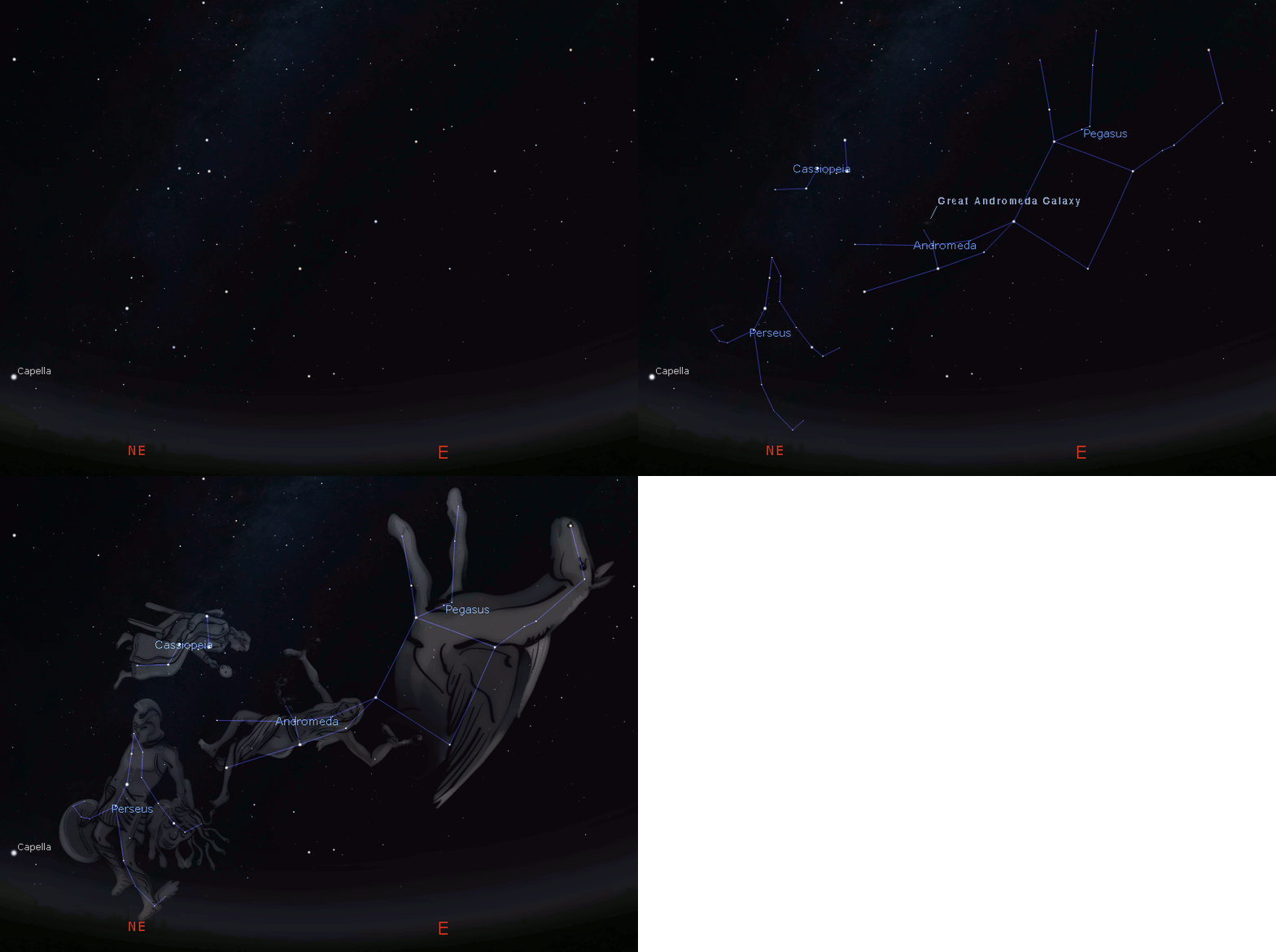
Andromeda finder animation surrounded by the other constellations in her story, except the monster, which will rise later. Click on the image to enlarge it. Created using Stellarium and GIMP.
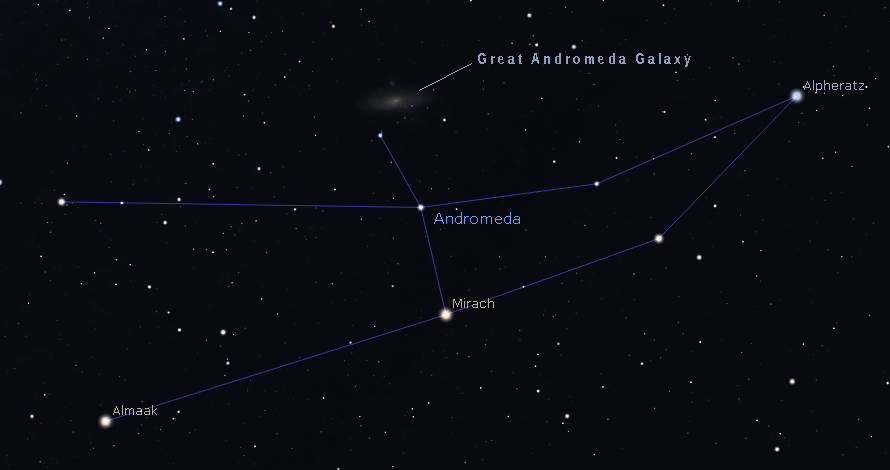
Great Andromeda Galaxy finder chart. This image shows the galaxy almost to its fullest extent. In the finder animation above, the galaxy looks pretty much as it would to the naked eye. Click on the image to enlarge it. Created using Stellarium.
Astronomers often refer to this galaxy as M 31 for short. It was the 31st entry in Charles Messier’s catalog of objects that could be confused as being comets by comet hunters like himself. It was added in 1764. He didn’t care what these fuzzy objects were, just that they didn’t move against the background stars. Actually, M 31 is in the background. The stars are in the foreground, in our Milky Way Galaxy.
09/24/2021 – Ephemeris – Capricornus, home this season to Jupiter and Saturn
This is Bob Moler with Ephemeris for Friday, September 24th. Today the Sun will be up for 12 hours and 3 minutes, setting at 7:35, and it will rise tomorrow at 7:33. The Moon, halfway from full to last quarter, will rise at 9:26 this evening.
Nearly 2000 years ago the southernmost of the constellations of the zodiac was Capricornus the water goat. That’s why the latitude on the Earth where the Sun is overhead on the winter solstice is called the Tropic of Capricorn. Not anymore, Sagittarius, one constellation west, has that honor today*. Capricornus is large, but made up of dim stars. To me, it looks like a 45 degree isosceles triangle, long side up, but which all the sides are sagging. The constellation is found low in the south at 10 to 11 p.m. The image that is supposed to be represented by the stars is that of a goat whose hind quarters are replaced by a fish’s tail, not a mermaid but a mer-goat. This autumn, Jupiter is at the left end of Capricornus, with Saturn on the right.
The astronomical event times given are for the Traverse City/Interlochen area of Michigan (EDT, UT-4 hours). They may be different for your location.
The reason for the shift is lunisolar precession, which I talked about yesterday.
Addendum
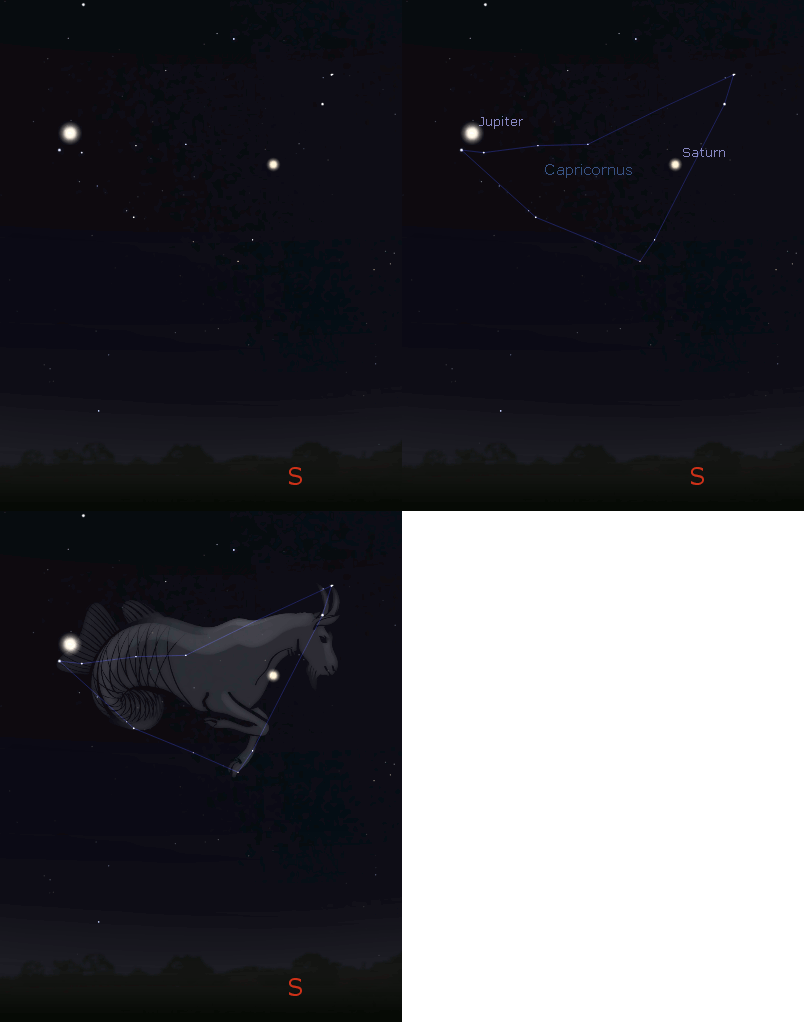
Capricornus w/Jupiter & Saturn finder animation for 10 pm, September 24, 2021. Created using Stellarium and GIMP.
09/09/2021 – Ephemeris – The constellation of Cassiopeia the Queen
This is Ephemeris for Thursday, September 9th. Today the Sun will be up for 12 hours and 49 minutes, setting at 8:04, and it will rise tomorrow at 7:16. The Moon, 3 days past new, will set at 9:40 this evening.
Tonight, check out the crescent Moon, with Venus below left of it. Cassiopeia is a constellation shaped like the letter W seen in the northeast these evenings. In Greek mythology, she was the queen of Ethiopia. She was very beautiful and very boastful of that fact. She even compared her beauty with that of the sea nymphs, daughters of the sea god Poseidon. Papa was not amused. So Cassiopeia’s daughter, the Princess Andromeda, was made to suffer for it. Poseidon sent a sea monster, Cetus, to ravage the coastal cities of the country. The only way to stop it was to sacrifice Andromeda to the monster. Andromeda and Cetus are constellations we’ll meet in the coming weeks. We’ve already met Pegasus, the flying horse, rising in the east. And we are yet to meet the hero, Perseus.
The astronomical event times given are for the Traverse City/Interlochen area of Michigan (EDT, UT – 4 hr). They may be different for your location.
Addendum
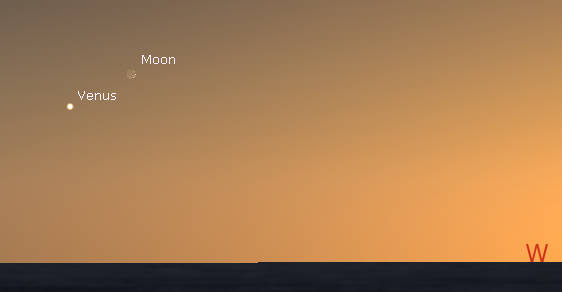
Venus and the Moon in evening twilight, about a half hour after sunset tonight, September 9, 2021. Created using Stellarium.
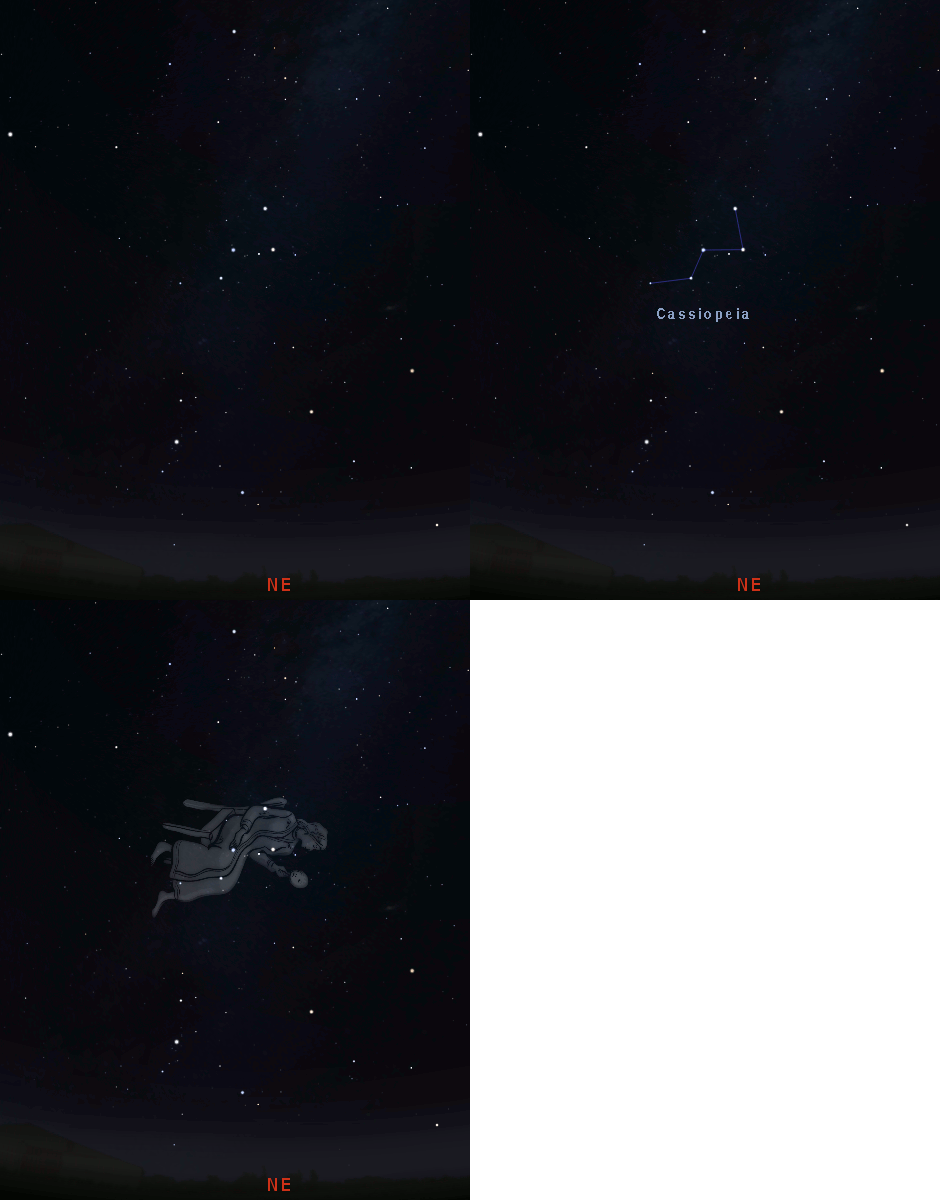
Cassiopeia finder animation looking northeast in mid-September, an hour and a half after sunset. Created using Stellarium.
09/07/2021 – Ephemeris – The constellation of Cepheus the king
This is Bob Moler with Ephemeris for Tuesday, September 7th. Today the Sun will be up for 12 hours and 55 minutes, setting at 8:07, and it will rise tomorrow at 7:13. The Moon, 1 day past new, will set at 8:53 this evening.
There’s a faint constellation in the northeast above the W shaped constellation of Cassiopeia. It’s a nearly upside down church steeple of a constellation called Cepheus the king, and husband of queen Cassiopeia. Cepheus’ claim to modern astronomical fame is that one of its stars, Delta (δ) Cephei, is the archetype for the important Cepheid variable stars. Delta is the bottom most of a trio of stars at the right corner of the constellation. In the early 20th century, Henrietta Leavitt discovered that Cepheids in the nearby galaxy the Large Magellanic Cloud varied in brightness with a period that was related to their average brightness. This meant that Cepheids could be used as standard candles to measure the great distances to other galaxies.
The astronomical event times given are for the Traverse City/Interlochen area of Michigan (EDT, UT – 4 hr). They may be different for your location.
Addendum
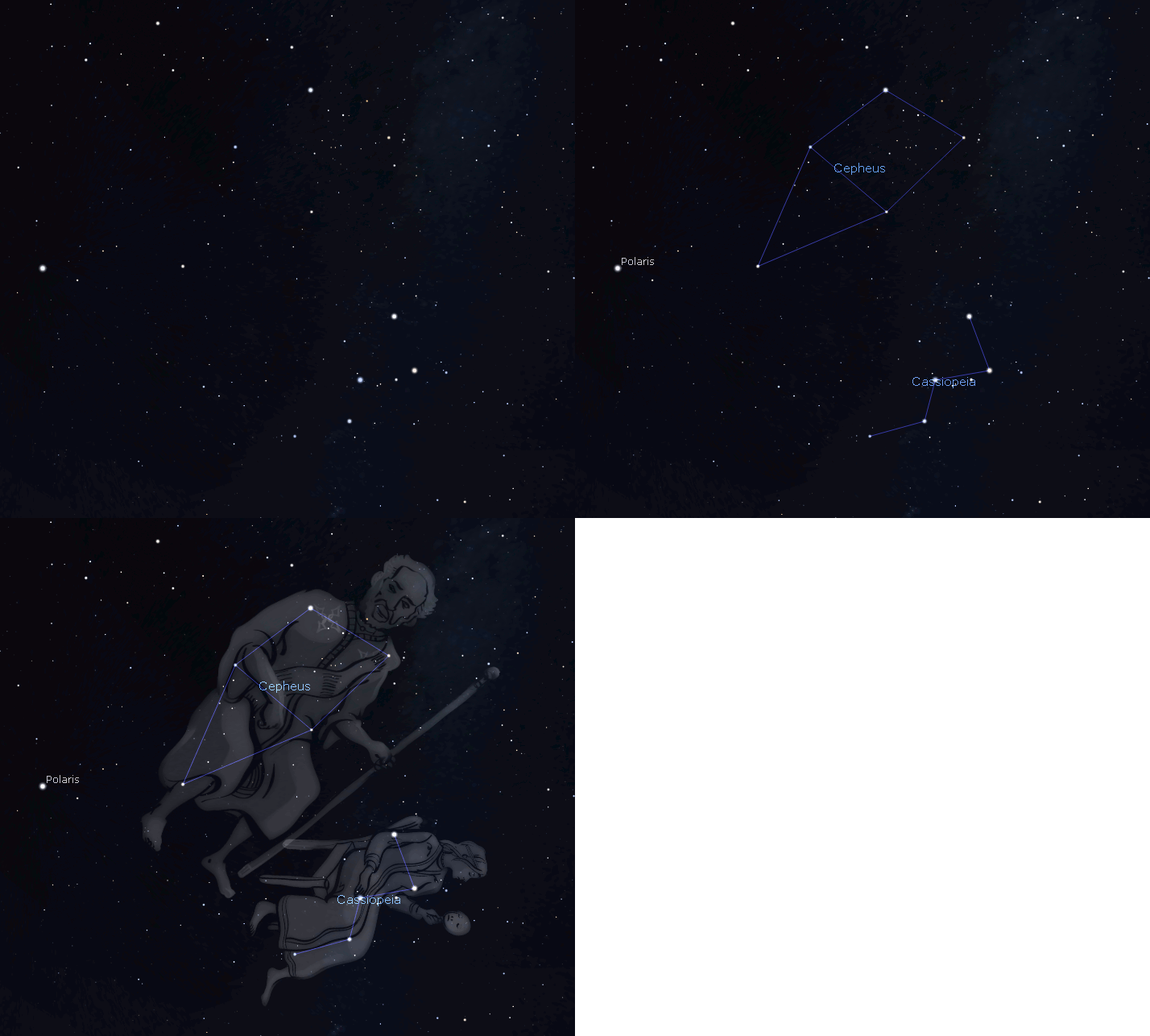
Cassiopeia and Cepheus finder animation looking in the northeast at 9-10 pm or about an hour after sunset. Created using Stellarium and GIMP.
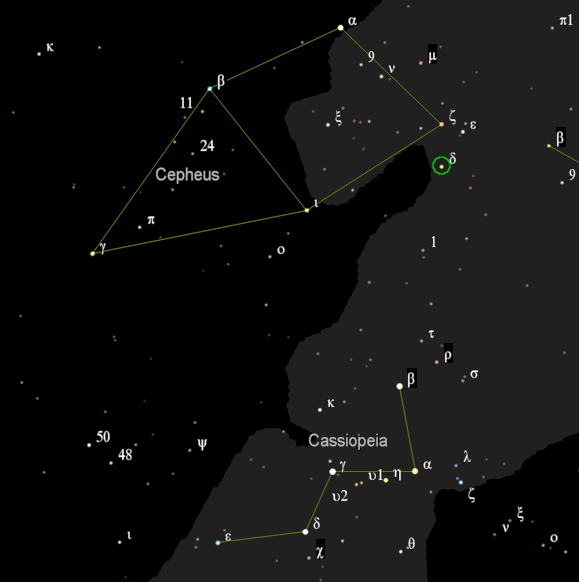
Delta Cephei finder for September at 9-10 pm, looking northeast. Created using Cartes du Ciel (Sky Chart).
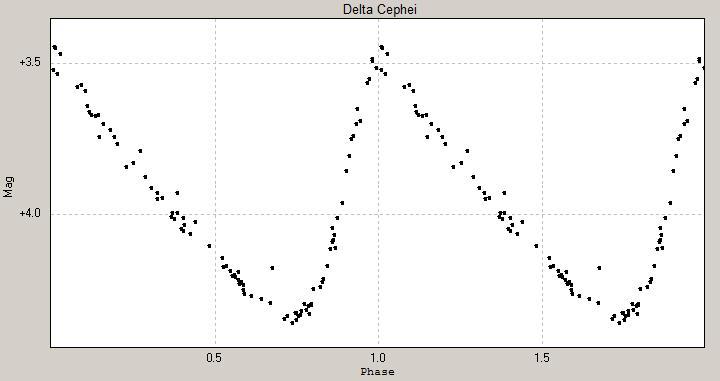
Light Curve of Delta Cephei. The pulsation period is 5.367 days. Note the Magnitude vertical axis, the lower the magnitude the brighter the star is. Blame that on the Greek astronomer Hipparchus, 2nd century BC. It’s like golf scores, the lower the score, the better the golfer. Credit: Thomas K Vbg – Own work, CC BY-SA 3.0, https://commons.wikimedia.org/w/index.php?curid=13887639.
09/02/2021 – Ephemeris – Finding the Little Dipper
This is Bob Moler with Ephemeris for Thursday, September 2nd. Today the Sun will be up for 13 hours and 10 minutes, setting at 8:17, and it will rise tomorrow at 7:07. The Moon, 3 days past last quarter, will rise at 2:55 tomorrow morning.
10 p.m. is the best time now to spot the Little Dipper. It is difficult to spot, being much smaller and dimmer than the Big Dipper. However, it is the Big Dipper that points to it, by the two stars at the front of the bowl which point to the North Star, Polaris, the star that doesn’t appear to move. That star is the tip of the handle of the Little Dipper. The handle is seen as a curve of stars upward and to the left to a small box of stars that is its bowl. The two brighter stars at the front of the bowl are called the Guard Stars because in the past they were thought to be guardians of the pole. The Little Dipper is not an official constellation, but is Ursa Minor the lesser bear. To the Anishinaabe native peoples of this area, it represents Maang the loon.
The astronomical event times given are for the Traverse City/Interlochen area of Michigan (EDT, UT – 4 hr). They may be different for your location.
Addendum
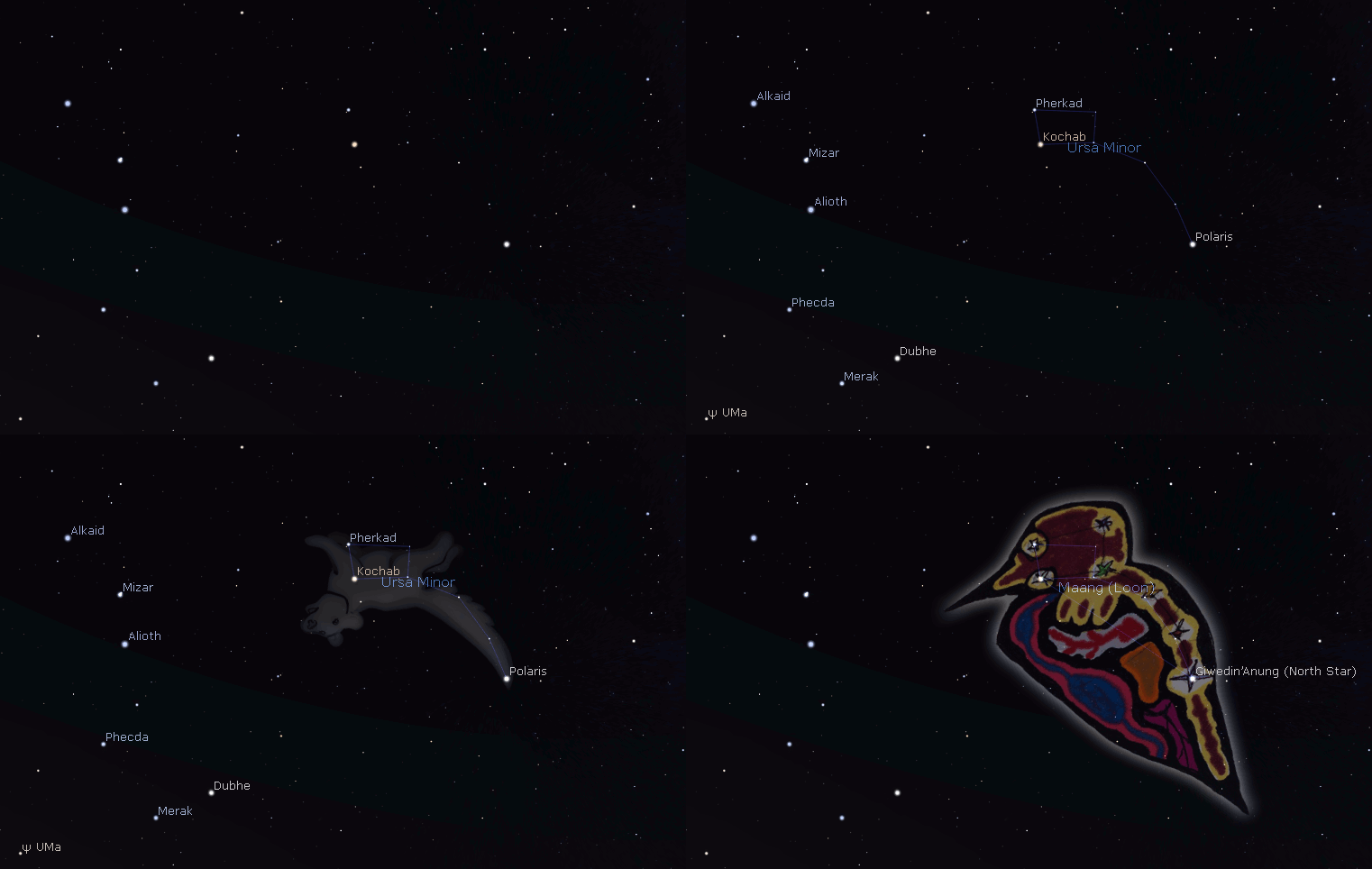
Little Dipper finder animation. The Little Dipper is also Ursa Major and the Loon. Polaris is the Pole Star and North Star. The Guard Stars are Kochab and Pherkad. Except for the named stars, the Little Dipper stars are quite faint and require moonless skies away from the city to spot. Created using Stellarium and GIMP.
08/30/2021 – Ephemeris – “W”
This is Bob Moler with Ephemeris for Monday, August 30th. Today the Sun will be up for 13 hours and 19 minutes, setting at 8:22, and it will rise tomorrow at 7:04. The Moon, at last quarter today, will rise at 12:26 tomorrow morning.
Rising higher each evening in the northeastern sky is a group of stars that make the pattern of the letter W. It is the constellation of Cassiopeia the queen. It is one of the more recognizable star patterns. From our latitude here in Northern Michigan, it is circumpolar, meaning that it never sets. Though, the best time to see it is in the autumn and winter, when it’s highest in the sky. It is opposite the Big Dipper from Polaris, the north star. In fact, a line drawn from any of the handle stars of the Big Dipper through Polaris will reach Cassiopeia. So as the Big Dipper descends in the northwestern sky now, Cassiopeia ascends in the northeast. They change places in winter and spring as the Big Dipper ascends in the northeast.
The astronomical event times given are for the Traverse City/Interlochen area of Michigan (EDT, UT – 4 hr). They may be different for your location.
Addendum
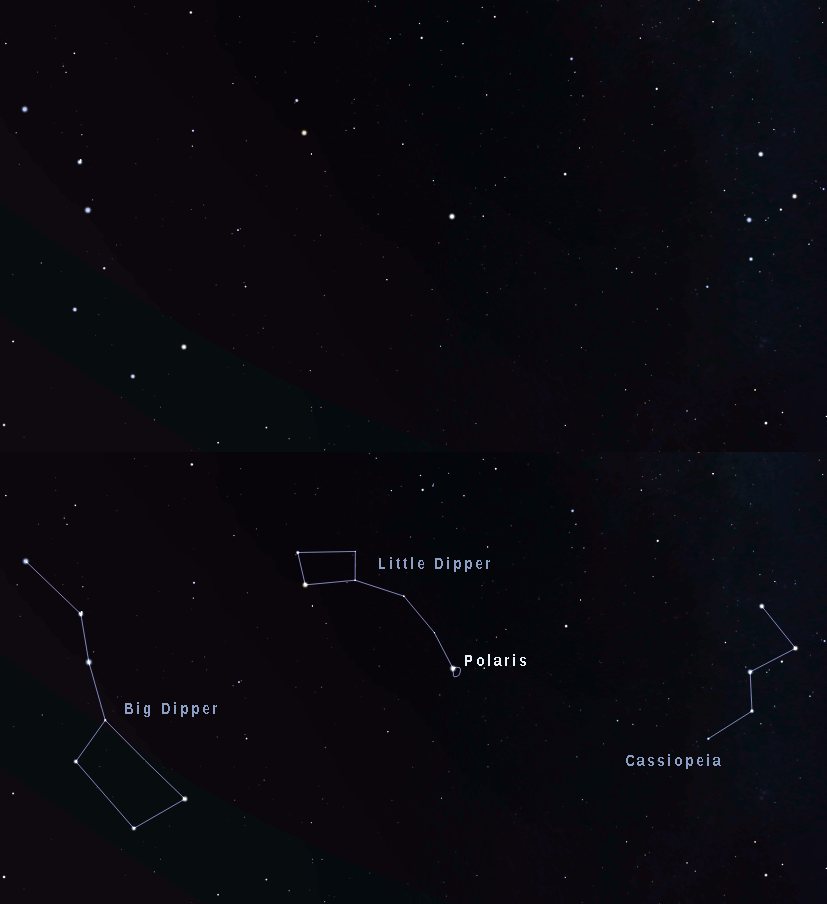
Animation showing the juxtaposition of Cassiopeia and the Big Dipper from Polaris, the North Star. Click on the image to enlarge it. Created using Stellarium and GIMP.
08/27/2021 – Ephemeris – As Labor Day approaches, so do the autumn constellations
This is Bob Moler with Ephemeris for Friday, August 27th. Today the Sun will be up for 13 hours and 28 minutes, setting at 8:27, and it will rise tomorrow at 7:00. The Moon, 3 days before last quarter, will rise at 11:01 this evening.
Rising in the east at as it gets dark around 9:30 p.m. we can preview one of the great autumn constellations: Pegasus the flying horse of Greek myth. Its most visible feature is a large square of four stars, now standing on one corner. This feature, called the Great Square of Pegasus, represents the front part of the horse’s body. The horse is quite aerobatic because it is seen flying upside down. Remembering that fact, the neck and head is a bent line of stars extending from the right corner star of the square. Its front legs can be seen in a gallop extending to the upper right from the top star of the square. From the left star extend, not hind legs but the constellation of Andromeda, an important constellation in its own right. The Anishinaabe peoples native to this region saw a right side up Moose (Mooz) in the stars here.
The astronomical event times given are for the Traverse City/Interlochen area of Michigan (EDT, UT – 4 hr). They may be different for your location.
Addendum
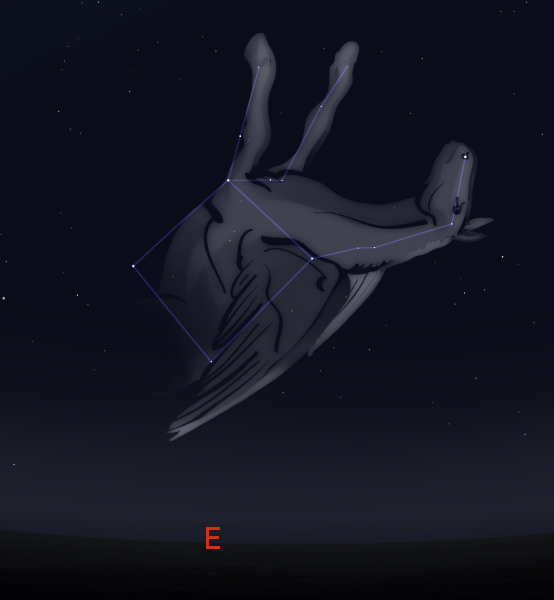
Pegasus image in the stars at 10 pm. Created using Stellarium. Drawing by Johan Meuris.
 Bob Moler's Ephemeris Blog