Archive
06/07/2021 – Ephemeris – The Little Dipper, aka Ursa Minor
This is Ephemeris for Monday, June 7th. Today the Sun will be up for 15 hours and 28 minutes, setting at 9:26, and it will rise tomorrow at 5:57. The Moon, 3 days before new, will rise at 4:54 tomorrow morning.
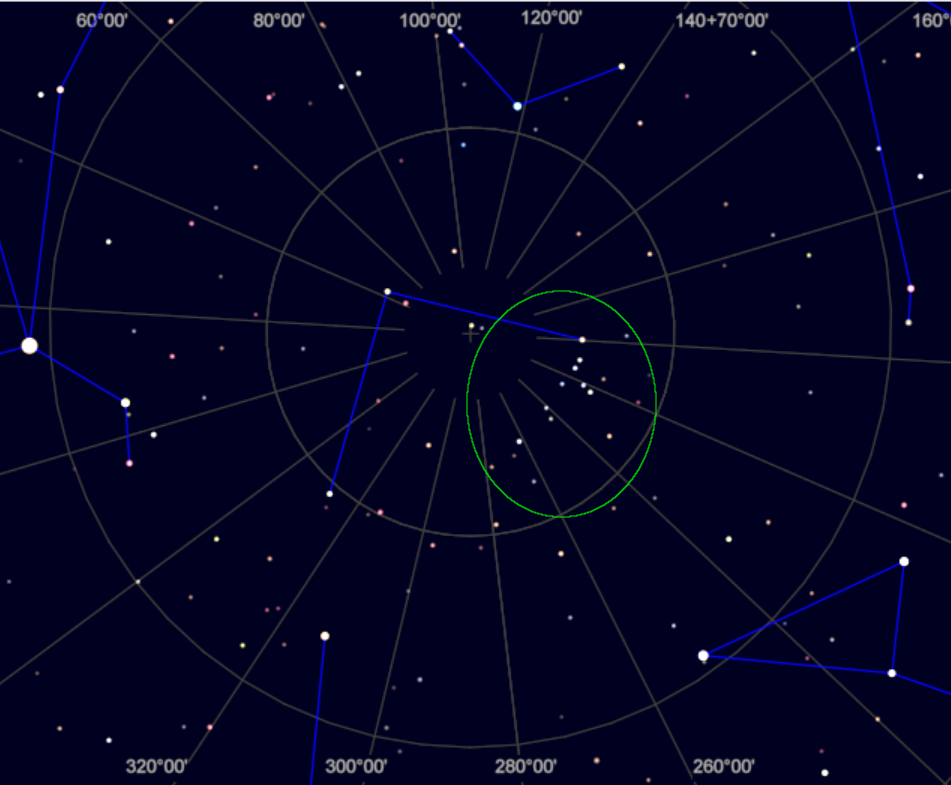
One of the constellations I don’t talk about much, except in passing is Ursa Minor, the Little Bear, better known as the Little Dipper. As a dipper goes, its handle is bent the wrong way. Anyway, this time of year in the evening, it’s standing on the tip of it’s handle the North Star Polaris. Polaris is pointed to by the front two stars of the Big Dipper. As dippers go they pour their contents into each other. The second and third-brightest stars of the Little Dipper are at the front of the bowl, and are Kochab and Pherkad, the Guard Stars, that is Guardians of the Pole. To the Anishinaabe native peoples of our area the Little Dipper is Maang, the Loon.
The astronomical event times given are for the Traverse City/Interlochen area of Michigan. They may be different for your location.
Addendum

Little Dipper finder animation with bonus frame with Draco the dragon. Click on the image to enlarge. Created using Stellarium. Animation and star names added with GIMP.
06/03/2021 – Ephemeris – Arcturus in the Bible.
This is Ephemeris for Thursday, June 3rd. Today the Sun will be up for 15 hours and 23 minutes, setting at 9:23, and it will rise tomorrow at 5:58. The Moon, 1 day past last quarter, will rise at 3:30 tomorrow morning.
Arcturus is a bright orangish star that’s high in the south at 11 pm. It’s also found by following the arc of the handle of the Big Dipper, which is the ridiculous tail of Ursa Major the Great Bear. It was considered the “Guardian of the Bear”, It is in the base of the kite shaped constellation of Boötes, the herdsman or the Bear Chaser. The latter story I recounted earlier this year. The name from the Greek has been confused with the bear itself. Thus, in the King James version of the Bible Arcturus, not the Bear, meaning the Great Bear, is mentioned in the 38th chapter of Job. This has been corrected in the newer versions I’ve seen. Arcturus has a rich history in literature, mostly by being confused with the Great Bear.
The astronomical event times given are for the Traverse City/Interlochen area of Michigan. They may be different for your location.
Addendum
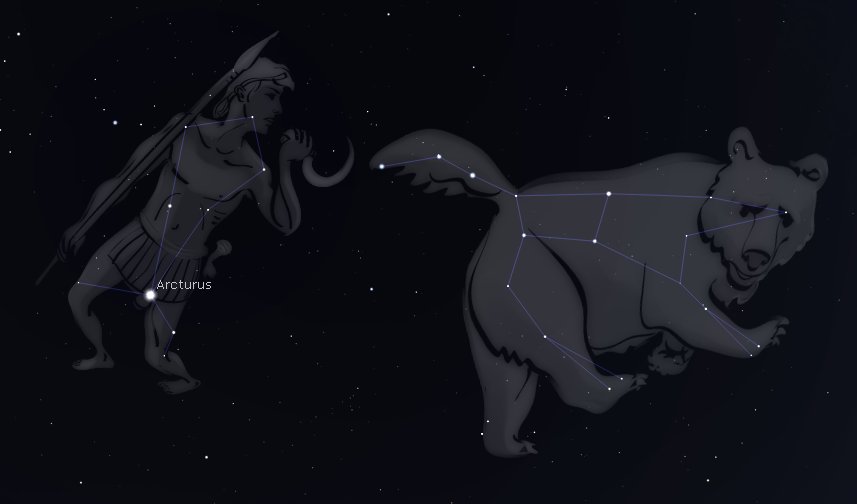
Arcturus, Boötes and Ursa Major can be seen by looking overhead while facing the west-southwest at 11 pm in early June. Created using Stellarium. Lines and figures not included.
Biblical translations
King James Version of Job 38:31-32
31 Canst thou bind the sweet influences of Pleiades,
   or loose the bands of Orion?

32 Canst thou bring forth Mazzaroth in his season?
   or canst thou guide Arcturus with his sons?
New International Version of Job 38:31-32
31
“Can you bind the chains of the Pleiades?
Can you loosen Orion’s belt?
32
Can you bring forth the constellations in their seasons
or lead out the Bear with its cubs?
No one is sure what a Mazzaroth is.
05/31/2021 – Ephemeris – Hercules the constellation
This is Bob Moler with Ephemeris for Memorial Day, Monday, May 31st. Today the Sun will be up for 15 hours and 19 minutes, setting at 9:20, and it will rise tomorrow at 6:00. The Moon, 2 days before last quarter, will rise at 2:23 tomorrow morning.
Orion, the hard luck mythological Greek hunter gets a splashy constellation in the winter sky, but the greatest hero of all, Hercules, gets a dim group of stars on the border between the spring and summer stars. At 11 p.m. Hercules is fairly high in the east. It is located above and a bit right of the bright star, Vega east-northeast. Hercules’ central feature is a keystone shaped box of stars, called the Keystone laying on its side, which represents the old boy’s shorts. From each left corner stars extend lines of stars that are his legs, from the right stars, the rest of his torso and arms extend. So in one final indignity he’s upside down in our sky. For those with a telescope, Hercules contains the beautiful globular star cluster Messier 13.
The astronomical event times given are for the Traverse City/Interlochen area of Michigan. They may be different for your location.
Addendum

Hercules can be found in the east among the line of constellations at around 11 pm in late May or early June between the bright stars Arcturus and Vega. Created using Stellarium and GIMP.
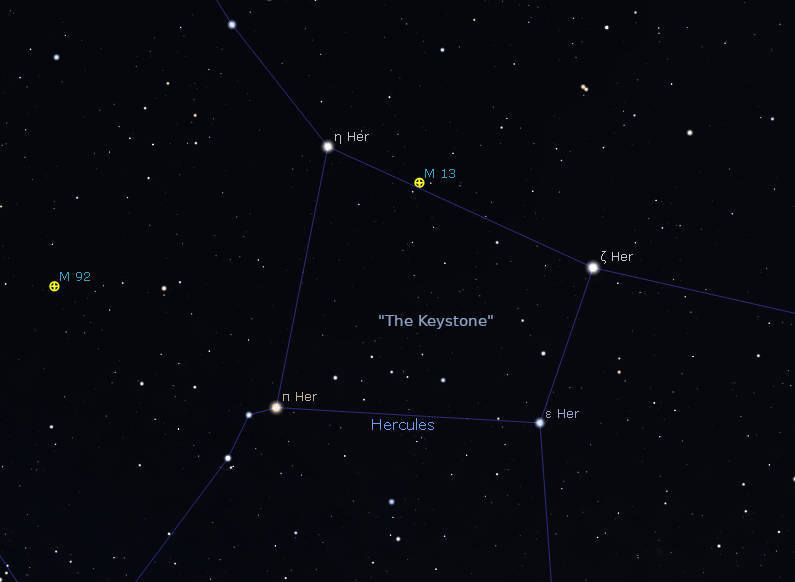
M 13 is found on the western side of the Keystone. In this orientation when Hercules is in the east, it is the top side. Created using Stellarium with an annotation.

M 13, the Great Globular Star Cluster in Hercules. Credit: Scott Anttila.
M 13 is the brightest and finest globular star cluster in the northern hemisphere of the sky. It’s at a distance of 25 thousand light years. Some amateur astronomers can spot M 13 with the naked eye. It is a fuzzy spot in binoculars. I can barely resolve some of its stars in an 8-inch (200 mm) telescope. It’s a wonderful sight in anything bigger! The slightly dimmer M 92 is also slightly farther away at nearly 27 thousand light years.
Click on any of the images above to enlarge them.
05/28/2021 – Ephemeris – The Northern Crown
This is Bob Moler with Ephemeris for Friday, May 28th. Today the Sun will be up for 15 hours and 15 minutes, setting at 9:18, and it will rise tomorrow at 6:01. The Moon, 2 days past full, will rise at 12:19 tomorrow morning.
High in the east-southeast at 11 this evening can be seen a small nearly circular constellation of Corona Borealis, the Northern Crown. It is just below Boötes, the kite shaped constellation off the handle of the Big Dipper. According to Greek myth the crown was given by the gods to the princess Ariadne, daughter of King Minos of Crete. The crown is more like a tiara with the bright star Alphecca at the front. To the Anishinaabe people, who are natives of our region, it is the Sweat Lodge. Part of what we call Hercules next to it is the Exhausted Bather, who is lying on the ground after the ceremony. The seven stones that are heated for the Sweat Lodge are the Pleiades, now too close to the Sun to be seen.
The astronomical event times given are for the Traverse City/Interlochen area of Michigan. They may be different for your location.
Addendum

05/11/2021 – Ephemeris – The Big Dipper as seen by many peoples
This is Ephemeris for Tuesday, May 11th. Today the Sun will be up for 14 hours and 41 minutes, setting at 9 pm, and it will rise tomorrow at 6:17 am. The Moon is new today, and won’t be visible.
The Big Dipper is overhead, actually north of overhead this evening when it gets dark for us in Michigan, it’s seven stars shining brightly. The Big Dipper is not an actual constellation, recognized internationally. It’s part, the hind part, of Ursa Major, the great bear. The Big Dipper is an asterism or informal constellation. It is a distinctly North American constellation. For fugitive slaves, fleeing the southern states in the days before the Civil War, the Drinking Gourd, as they called it, showed the direction north to freedom. In England the dipper stars become the Plough (plow), or Charles’ Wain (Charlemagne’s Wagon). In France, known for culinary delights it was the saucepan, or the cleaver. Many cultures saw what was familiar to them in these seven bright stars.
The astronomical event times given are for the Traverse City/Interlochen area of Michigan. They may be different for your location.
Addendum
05/10/2021 – Ephemeris – The story of the constellations Boötes and Ursa Major
This is Bob Moler with Ephemeris for Monday, May 10th. Today the Sun will be up for 14 hours and 38 minutes, setting at 8:58, and it will rise tomorrow at 6:18. The Moon, 1 day before new, will rise at 6:25 tomorrow morning.
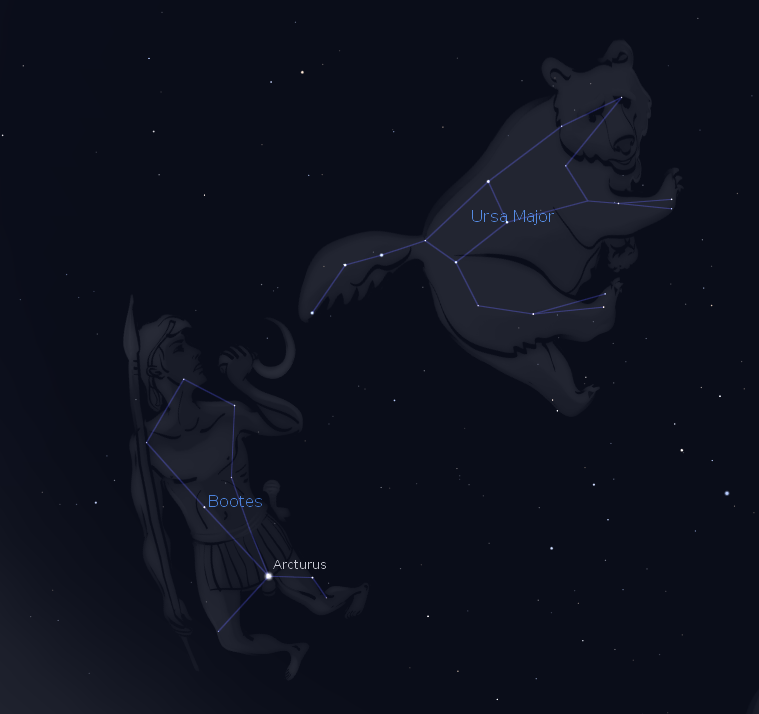
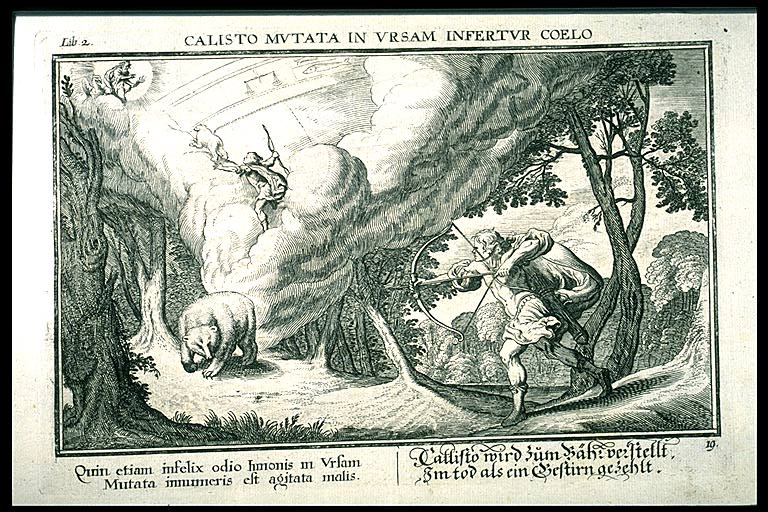
Seen in the east at 10 p.m. tonight is the kite shaped constellation of Boötes the herdsman. The bright star Arcturus is at the bottom of the kite to the right. It is pointed to by the arc of the handle of the Big Dipper, higher in the east. Boötes represents a young hunter named Arcas, son of Callisto, a beautiful young lady who had the misfortune of being loved by Zeus the chief of the Greek gods. Zeus’ wife Hera, found out about it, and since she couldn’t punish Zeus, turned the poor woman into a bear. Arcas, many years later, unaware of the events surrounding his mother’s disappearance was about to kill the bear when Zeus intervened and placed them both in the sky to save her, as Arcas still pursues her across the sky nightly.
The astronomical event times given are for the Traverse City/Interlochen area of Michigan. They may be different for your location.
Addendum
05/06/2021 – Ephemeris – Corvus, Crater, Hydra and Apollo
This is Ephemeris for Thursday, May 6th. Today the Sun will be up for 14 hours and 28 minutes, setting at 8:54, and it will rise tomorrow at 6:24. The Moon, 3 days past last quarter, will rise at 5:04 tomorrow morning.
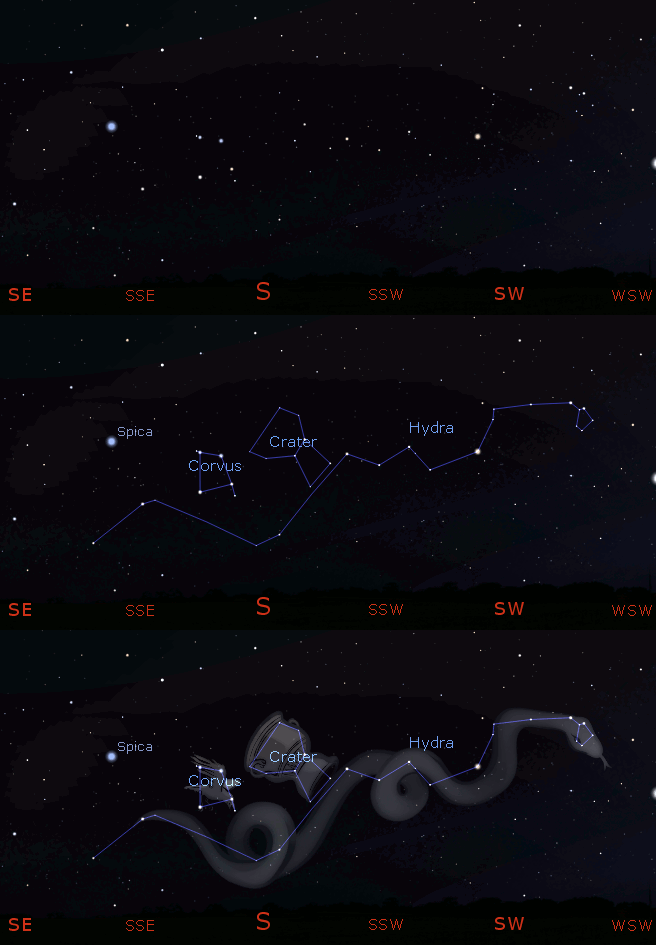
The small constellation of Corvus the crow is located low in the south at 10:30 this evening. It’s made of 5 dim stars, but the pattern is a distinctive but distorted box with two stars at the upper left marking that corner. To the right is a fainter constellation of a thick stemmed goblet called Crater. Both appear above the long constellation of Hydra the water snake who is slithering just above the southern horizon. In Greek mythology Corvus, then white, was the god Apollo’s pet. Apollo once bid Corvus to take a cup and fetch him some water. Corvus however dallied and waited for a green fig to ripen. He grabbed a snake and returned with a story as to how the snake had delayed him. The angry Apollo turned the crow and all crows to this day black.
The astronomical event times given are for the Traverse City/Interlochen area of Michigan. They may be different for your location.
Addendum
05/03/2021 – Ephemeris – The constellation of Virgo
This is Ephemeris for Monday, May 3rd. Today the Sun will be up for 14 hours and 21 minutes, setting at 8:50, and it will rise tomorrow at 6:28. The Moon, at last quarter today, will rise at 3:52 tomorrow morning.
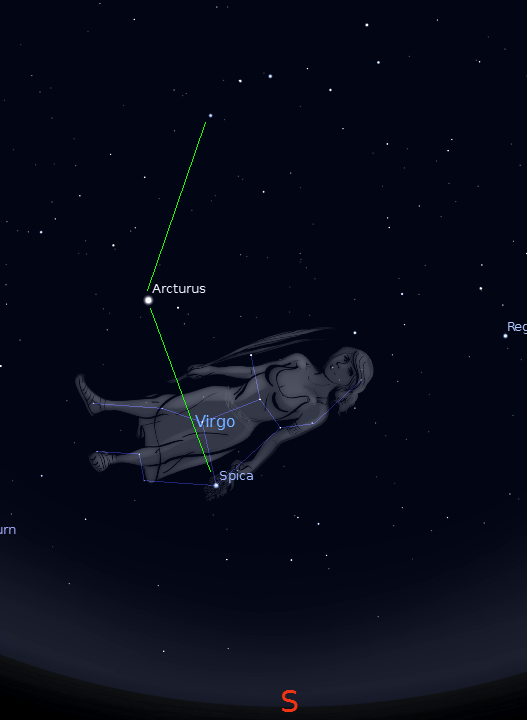
Tonight in the sky: to the southeast is the bright star Spica. Another way to find the star is to find the Big Dipper high overhead and follow the arc of the handle to the bright star Arcturus, and straighten the arc to a spike to meet Spica. It is in the constellation and member of the zodiac: Virgo the virgin. Virgo is a large constellation of a reclining woman holding a stalk of wheat. The bright star in the center of the constellation, Spica, is the head of that spike of wheat; and as such it ruled over the harvest in two of Virgo’s guises as the goddesses Persephone and Ceres. Ceres is now a dwarf planet and the root of the word cereal. Virgo is also identified as Astraea the goddess of justice. The constellation of Libra, the scales of justice, lies at her feet.
The astronomical event times given are for the Traverse City/Interlochen area of Michigan. They may be different for your location.
Addendum
04/29/2021 – Ephemeris – A star cluster that seems out of place
This is Bob Moler with Ephemeris for Thursday, April 29th. Today the Sun will be up for 14 hours and 10 minutes, setting at 8:45, and it will rise tomorrow at 6:33. The Moon, 3 days past full, will rise at 12:25 tomorrow morning.
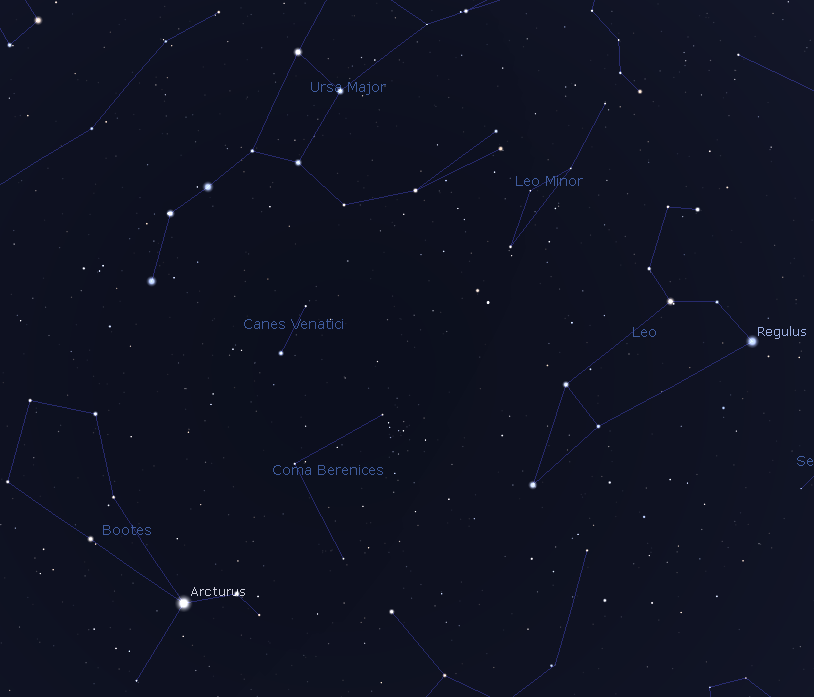
Looking to the southeast these nights one can find the dim constellation of Coma Berenices, or Berenice’s hair. It’s located near the bottom of a triangle between Leo, Boötes the Big Dipper. It’s best seen on a moonless night as a sprinkling of faint stars that look like strands of hair. It is a star cluster some 271 light years away, the second-closest star cluster to the Earth, after the Hyades that marks the face of Taurus the bull, at about 160 light years. Coma Berenices is located at an odd spot for an open or galactic star cluster. It’s as far from the milky band as you can get. Most galactic star clusters are close or in that band. However, due to its closeness Coma Berenices is north of the solar system, as we both orbit the center of the Milky Way.
The astronomical event times given are for the Traverse City/Interlochen area of Michigan. They may be different for your location.
Addendum
04/13/2021 – Ephemeris – Hydra slithers across the southern sky
This is Bob Moler with Ephemeris for Tuesday, April 13th. Today the Sun will be up for 13 hours and 24 minutes, setting at 8:25, and it will rise tomorrow at 6:59. The Moon, 2 days past new, will set at 10:08 this evening.
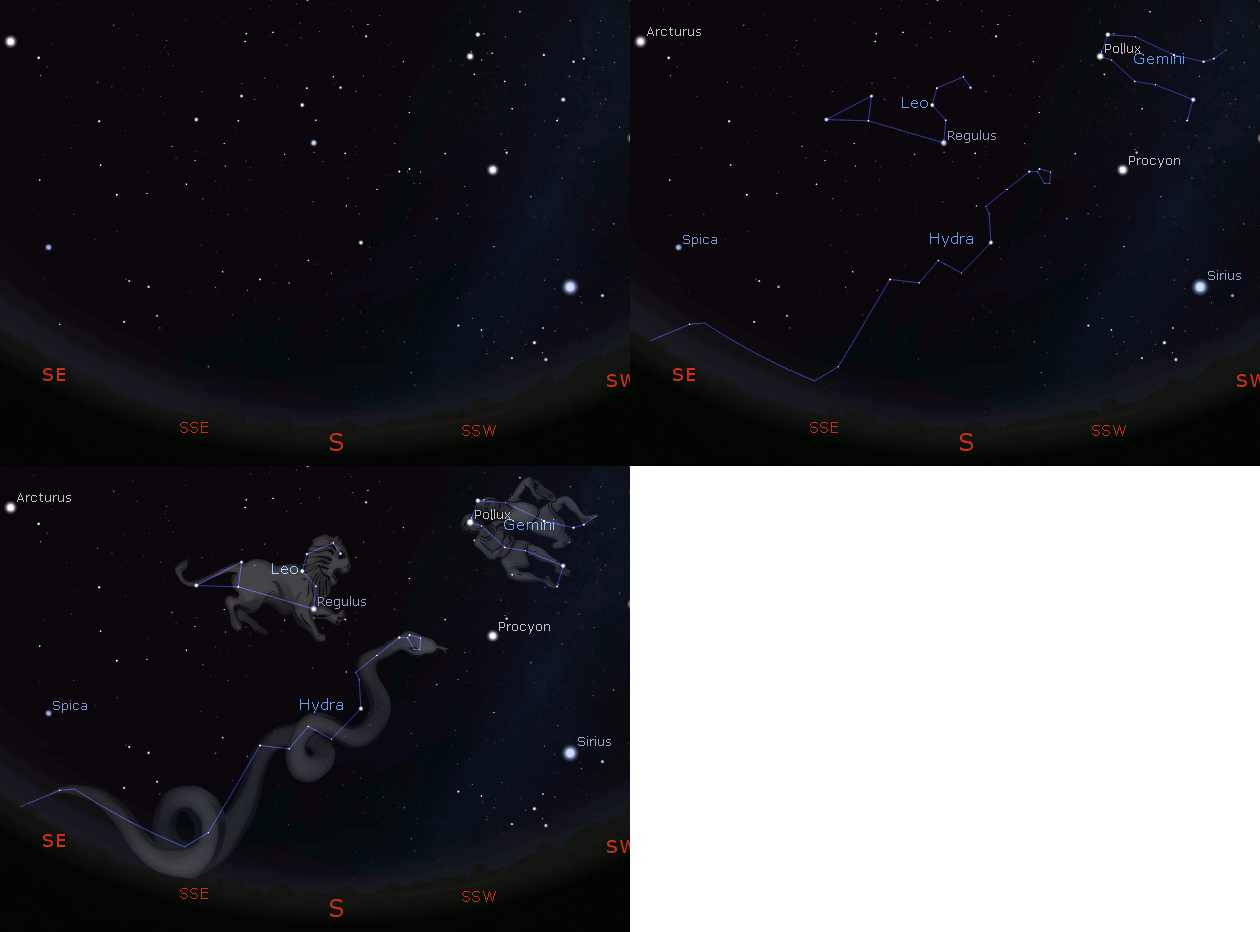
In the southern evening sky can be found the constellation of Hydra the water snake. Unlike the monster of the same name this Hydra has but one head, which is its most distinctive part. At 10 p.m. look midway up the sky in the south-southwest. The head of Hydra is located below a line from the constellation Leo the Lion in the south and Gemini high in the west-southwest. Its head is directly below Cancer the crab in the southwest. Hydra’s head is a small but distinctive group of 6 stars that make a loop and the snake’s slightly drooping head. The rest of Hydra wends its way to the southeastern horizon, and eventually ends near the late spring constellation of Libra the scales. Over the next few hours Hydra will be seen slithering across the southern sky.
The astronomical event times given are for the Traverse City/Interlochen area of Michigan. They may be different for your location.
Addendum
 Bob Moler's Ephemeris Blog