Archive
02/08/2018 – Ephemeris – The wonderfully named stars of Orion
Ephemeris for Thursday, February 8th. The Sun will rise at 7:53. It’ll be up for 10 hours and 8 minutes, setting at 6:01. The Moon, 1 day past last quarter, will rise at 3:09 tomorrow morning.
The constellation of Orion the hunter is visible in the south at 9 p.m. The stars of Orion are interesting in themselves. Starting at the top left of the seven bright stars of Orion’s torso is Betelgeuse the bright red star, whose name means something like “Armpit of the Giant”. The star in Orion’s other shoulder is Bellatrix the “Amazon Star”. Below are the three stars of Orion’s belt, from left to right; Alnitak, Alnilam and Mintaka. Their names mean “Girdle”, “Belt of Pearls”, and “Belt” respectively. Down to Orion’s knees we look on the left to the star Saiph pronounced ‘safe’ which means “Sword”, though it is some ways from the stars of Orion’s sword. Finally there’s the bright blue-white star Rigel whose name means “Left Leg of the Giant”.
The times given are for the Traverse City/Interlochen area of Michigan. They may be different for your location.
Addendum
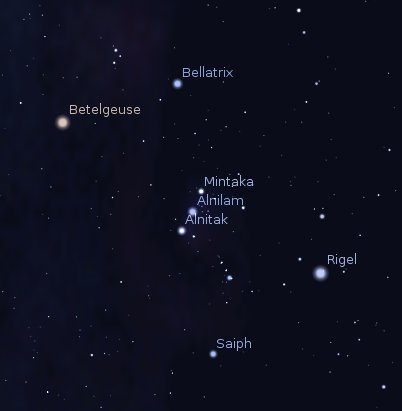
The named stars of Orion. Created using Stellarium.
Betelgeuse, pronounced Beetlejuice is the name of a 1988 movie, where Betelgeuse (spelled properly) is a particularly mischievous demon. Don’t say his name three times, or he’ll come and ‘help’ you. Oops, I did. It is a red giant star near the end of its life.
Bellatrix, is now known to most of us now as the first name as the first name of Bellatrix Lestrange from J. K. Rowling’s Harry Potter book and movie series. Other members of the Black family have astronomical names, such as Regulus (Leo) Black, and Sirius (Canis Major) Black.
The names of the belt stars were taught to me by Evelyn Grebel of the Grand Rapids Public Museum in the late 1950s. She was one of the founders of the Grand Rapids Amateur Astronomical Association. The names Alnitak, Alnilam and Mintaka have stuck with me ever since. It was through her that I was able to worm my way into working at the museum’s new then unnamed planetarium. I also remember being in her office with her, listening to the radio as Alan Shepard made his historic suborbital flight on May 5th, 1961.
Rigel is a hot blue-white star, and will probably become a red giant star like Betelgeuse. There is another bright star named Rigel, but most don’t know it. It’s Rigel Kentaurus, the leg of the centaur of Centaurus. It’s better known as Alpha Centauri, a catalog designation, and the nearest star to the solar system.
02/06/2018 – Ephemeris – Monoceros the Unicorn
Ephemeris for Tuesday, February 6th. The Sun will rise at 7:55. It’ll be up for 10 hours and 2 minutes, setting at 5:58. The Moon, 1 day before last quarter, will rise at 1:09 tomorrow morning.
Among all the constellations in the sky of animals real and mythical, there is also a unicorn. It’s called Monoceros, and inhabits the southeastern sky at 9 p.m. bounded by Orion on the right, Canis Major, the great dog below and Canis Minor, the little dog to the left. Unfortunately for observers without optical aid Monoceros, though large, is devoid of any but the faintest stars. Maybe that’s why no one sees unicorns anymore. It has many faint stars because the Milky Way runs through it. To the telescope it is a feast of faint nebulae or clouds of gas and dust, the birth place of stars, including the red rose of the Rosette Nebula, and the strange and tiny Hubble’s Variable Nebula. It also contains beautiful telescopic triple star system, Beta (β) Monocerotis.
The times given are for the Traverse City/Interlochen area of Michigan. They may be different for your location.
Addendum
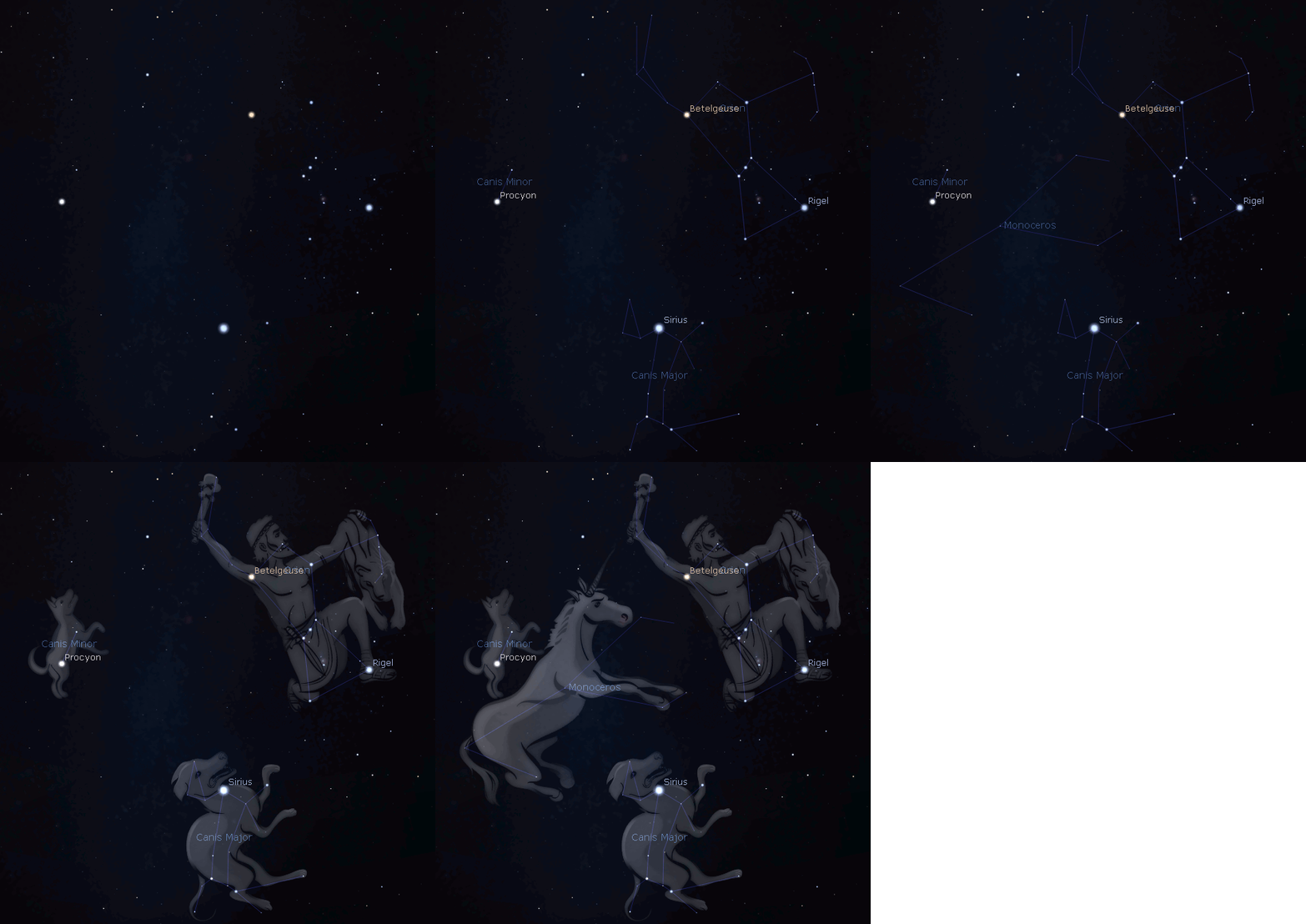
Monoceros finder chart animation. Created using Stellarium and GIMP.
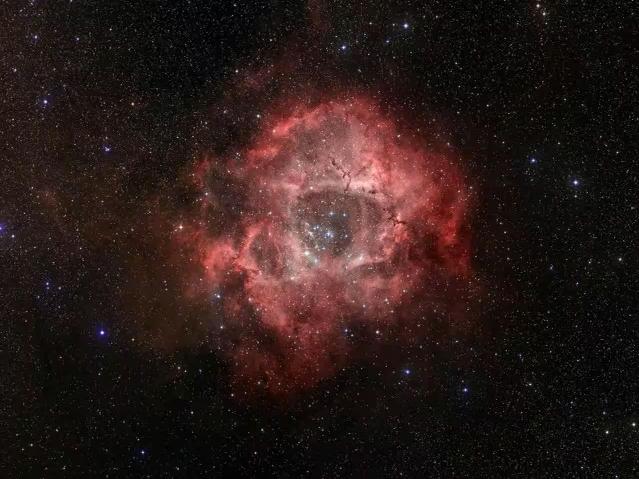
Rosette Nebula in the infrared from the Spitzer Space Telescope. Credit: NASA/JPL/Caltech
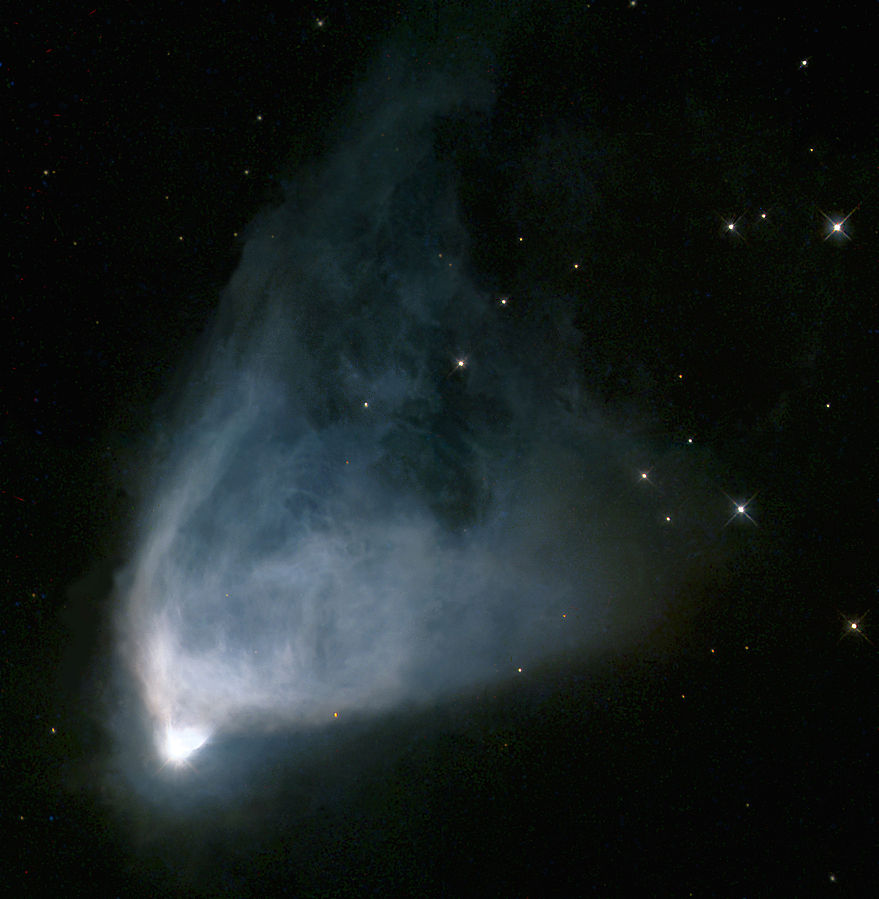
Hubble’s Variable Nebula photographed appropriately enough by the Hubble Space Telescope. Credit: NASA/ESA and The Hubble Heritage Team (AURA/STScI).
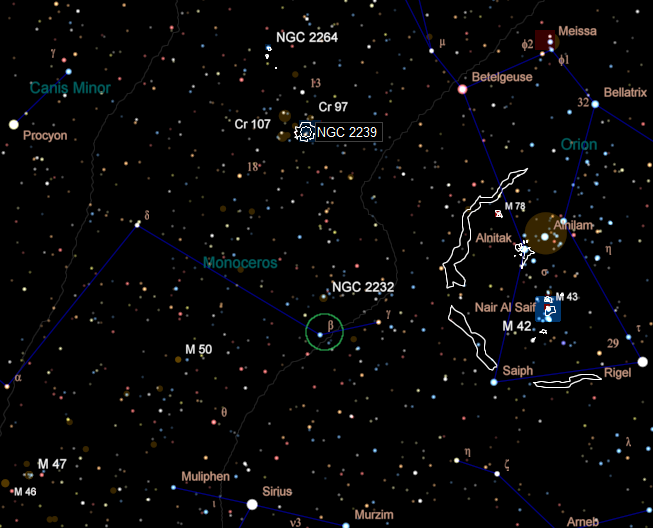
Looking at some faint objects in Monoceros. NGC 2239 is the star cluster in the center of the Rosette Nebula. The nebula itself is extremely faint. It shows in photographs, but I’ve never seen it visually. The green circle shows Beta Monocerotis, the triple star. All these stars are extremely blue-white hot. Created using Cartes du Ciel (Sky Charts).
Also in the chart above is the semicircular Barnard’s Loop, a supernova remnant a great long exposure photography target.
02/05/2018 – Ephemeris – The rabbit that got away
Ephemeris for Monday, February 5th. The Sun will rise at 7:57. It’ll be up for 10 hours even, setting at 5:57. The Moon, 2 days before last quarter, will rise at 12:06 tomorrow morning.
Orion, the central winter constellation is seen in the south at 9 p.m. He is a hunter, but he’s preoccupied with the charge of Taurus the bull from the upper right. At Orion’s feet, and unnoticed by him is the small constellation of Lepus the hare. It’s very hard to see a rabbit in its dim stars: however, I do see a rabbit’s head ears and shoulders. A misshapen box is the head and face of this critter facing to the left. His ears extend upwards from the upper right star of the box, and the bend forward a bit. Two stars to the right of the box and a bit farther apart hint at the front part of the body. Some see a whole rabbit facing the other way. In Lepus telescopes can find M79, a distant globular star cluster, one of the few in the winter sky.
The times given are for the Traverse City/Interlochen area of Michigan. They may be different for your location.
Addendum
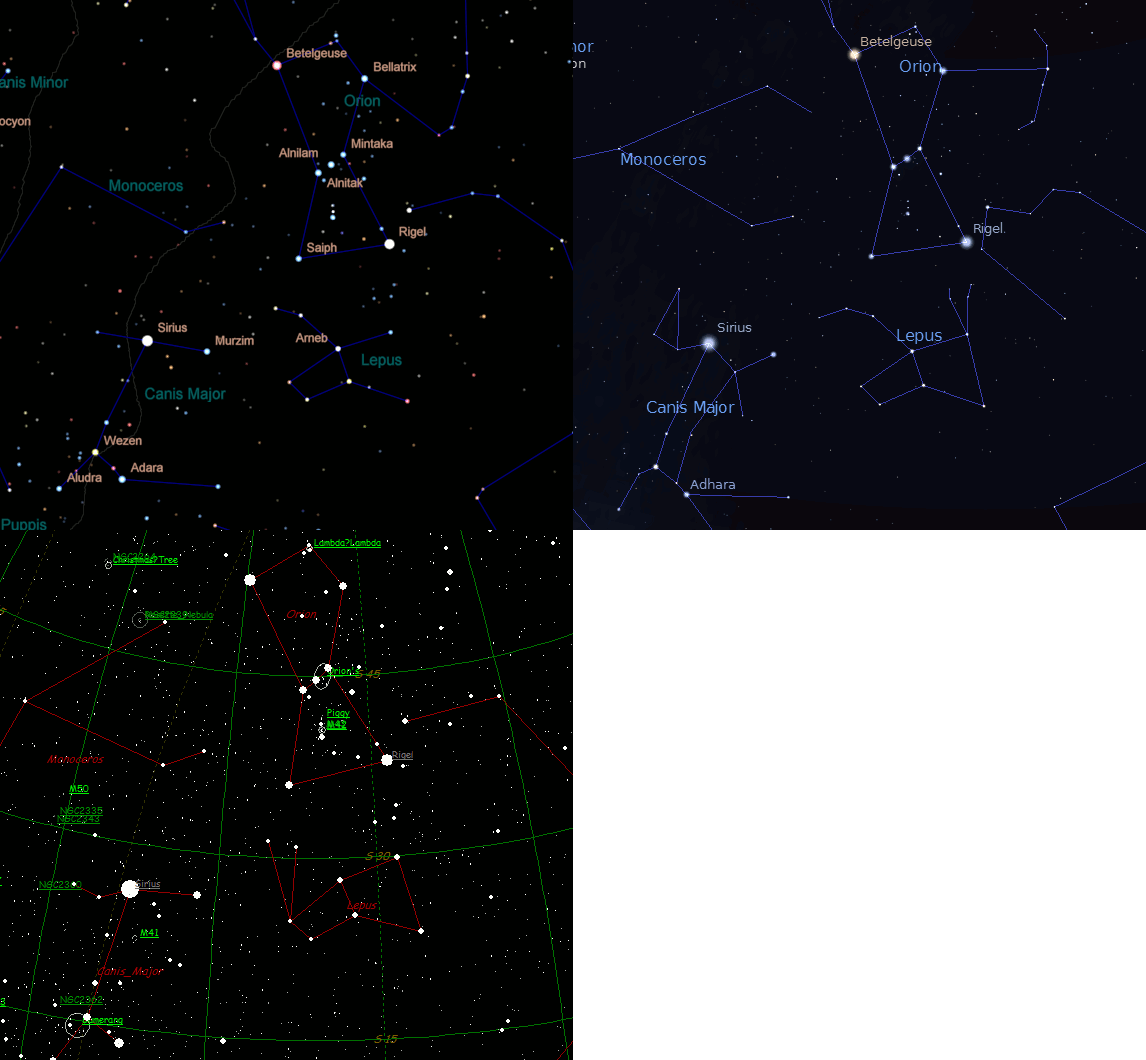
Pick your favorite Lepus outline. Cartes du Ciel, Stellarium, or Hallo Northern SKY (with grid lines).
01/19/2018 – Ephemeris – Orion’s large hunting dog
Ephemeris for Friday, January 19th. The Sun will rise at 8:14. It’ll be up for 9 hours and 19 minutes, setting at 5:33. The Moon, 3 days past new, will set at 8:15 this evening.
The brightest star-like object in the evening sky is Sirius, also known as the Dog Star. It also is the brightest night-time star in our skies period. Tonight at 9 p.m. it’s located low in the southeastern sky. The Dog Star name comes from its position at the heart of the constellation Canis Major, the great dog of Orion the hunter, which is seen almost like he’s begging, feet to the right. The three stars of Orion’s belt tilt to the southeast and point to Sirius. The name Sirius means ‘Scorcher’, a reference to its great brilliance and twinkling. To me it has a blue tinge like an arc light in a telescope. Its Egyptian name was Sothis, and its appearance in the dawn skies in late June signaled the flooding of the Nile, and the beginning of the Egyptian agricultural year.
The times given are for the Traverse City/Interlochen area of Michigan. They may be different for your location.
Addendum
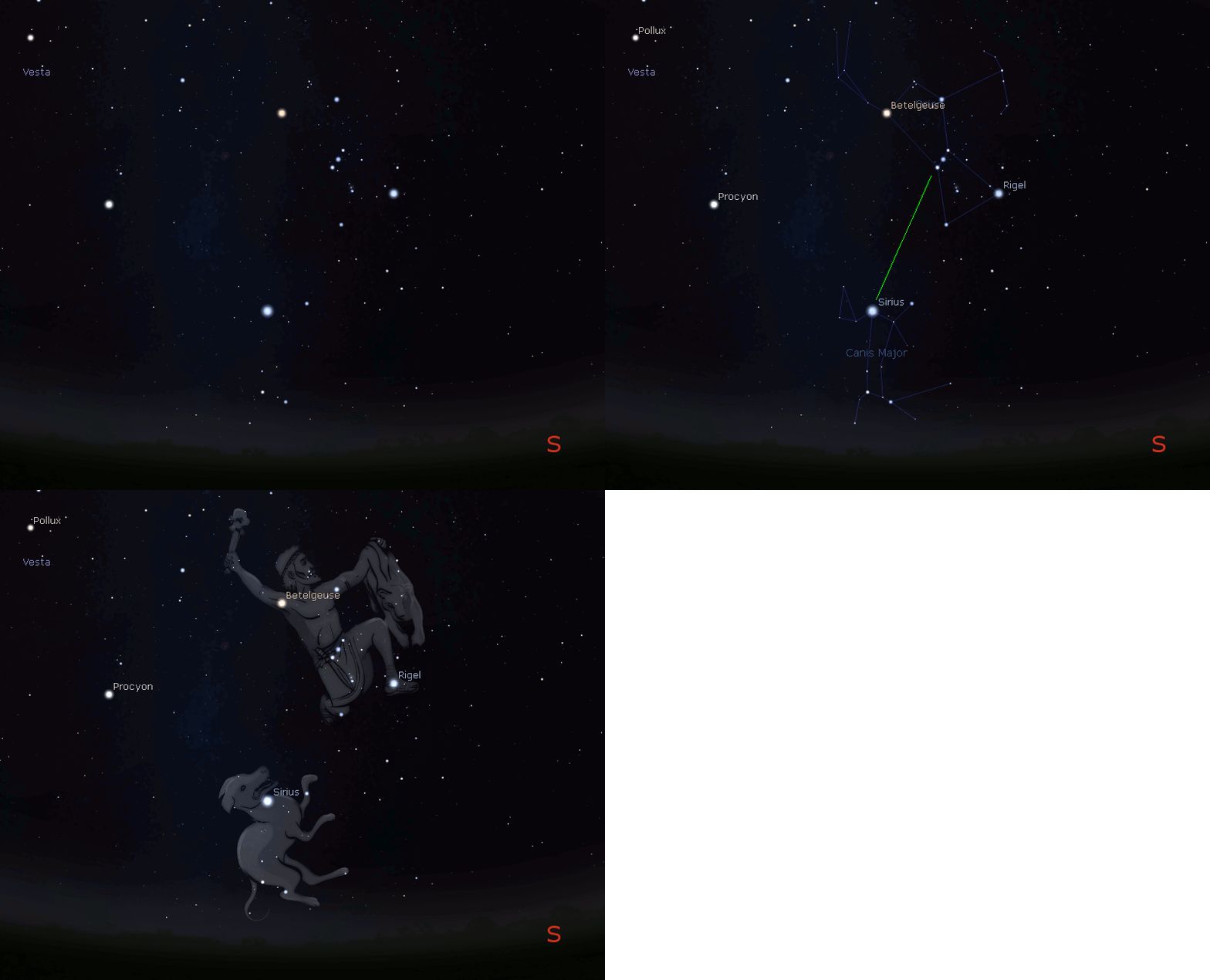
Orion and Canis Major Animation for 9 p.m. tonight. Created using Stellarium and GIMP.
01/18/2018 – Ephemeris – The spectacular Great Orion Nebula
This is Bob Moler with Ephemeris for Thursday, January 18th. The Sun will rise at 8:14. It’ll be up for 9 hours and 17 minutes, setting at 5:32. The Moon, 2 days past new, will set at 7:15 this evening.
The constellation Orion the hunter is the south-southeast at 9 p.m. its upright rectangle of four stars frame his belt of three stars in a straight line and still tilt a bit to the left. Below the belt is what appear to the unaided eye as three more stars arranged vertically, his sword. Binoculars aimed at the middle stars of the sword will find a glowing haze around those stars. That is the Great Orion Nebula. It is the birth place of stars, and is even illuminated by a clutch of four hot young stars. One of the discoveries of the Hubble space telescope are what appear, and are tiny cocoons of gas and dust in which stars condense and form. They are called Proplyds, which are short for protoplanetary disks. In each one is the red center, a young star just beginning to shine.
The times given are for the Traverse City/Interlochen area of Michigan. They may be different for your location.
Addendum
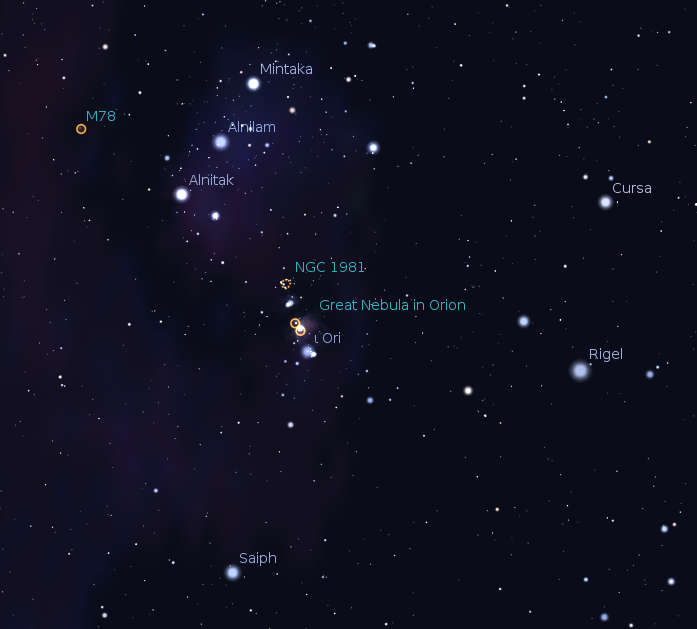
The lower part of Orion with the Great Orion Nebula. Created using Stellarium.
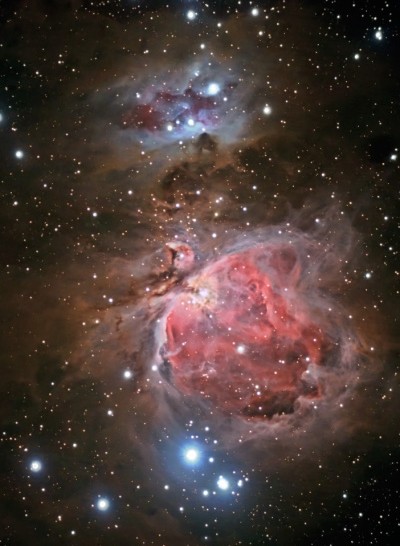
The Great Orion Nebula (M42) long exposure photograph by Scott Anttila. Includes all the sword stars.
A new video just posted by NASA
01/16/2018 – Ephemeris – More thoughts about Orion and the Wintermaker
Ephemeris for Tuesday, January 16th. The Sun will rise at 8:15. It’ll be up for 9 hours and 13 minutes, setting at 5:29. The Moon is new today, and won’t be visible.
We come back to the central constellation of the winter sky Orion the hunter, now in the southeast at 9 p.m. with his three stars of his belt in a straight line, with his upper shoulder stars above and knees below. In one Greek story he was killed by the sting of a scorpion so the gods made sure the rising of the constellation Scorpius would chase him out of the sky to the west. To the Greeks he was a hapless hero. Orion is mentioned in the Bible in the book of Job. The name for Orion in Hebrew is Kesil, meaning “Fool”. To the native peoples around the Great Lakes, the stars here are those of the Wintermaker, who stretches his arms from Aldebaran in Taurus to Procyon in Canis Minor. When he is in the evening sky it is indeed winter.
The times given are for the Traverse City/Interlochen area of Michigan. They may be different for your location.
Addendum
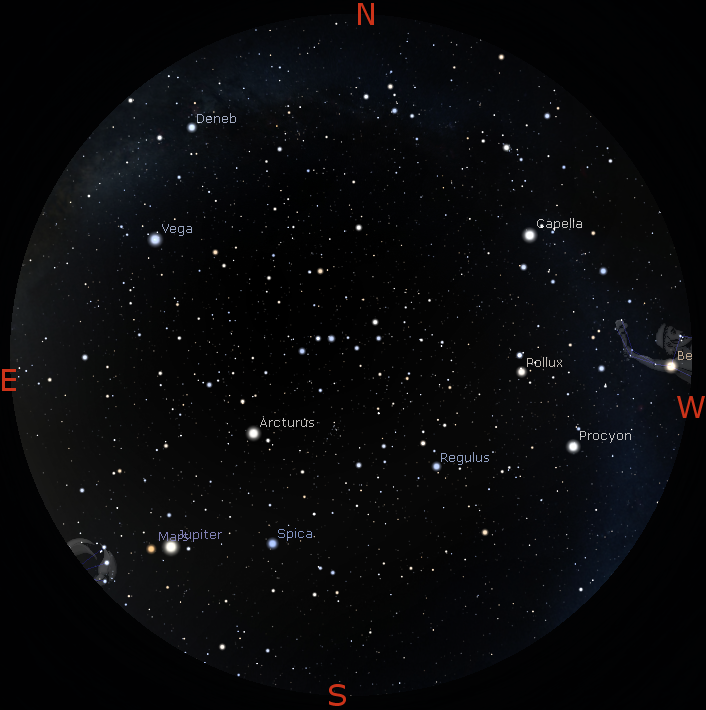
When the scorpion (Scorpius) crawls over the southeastern horizon, Orion takes a powder to the west. This is about 5 a.m. in mid January. Created using Stellarium.
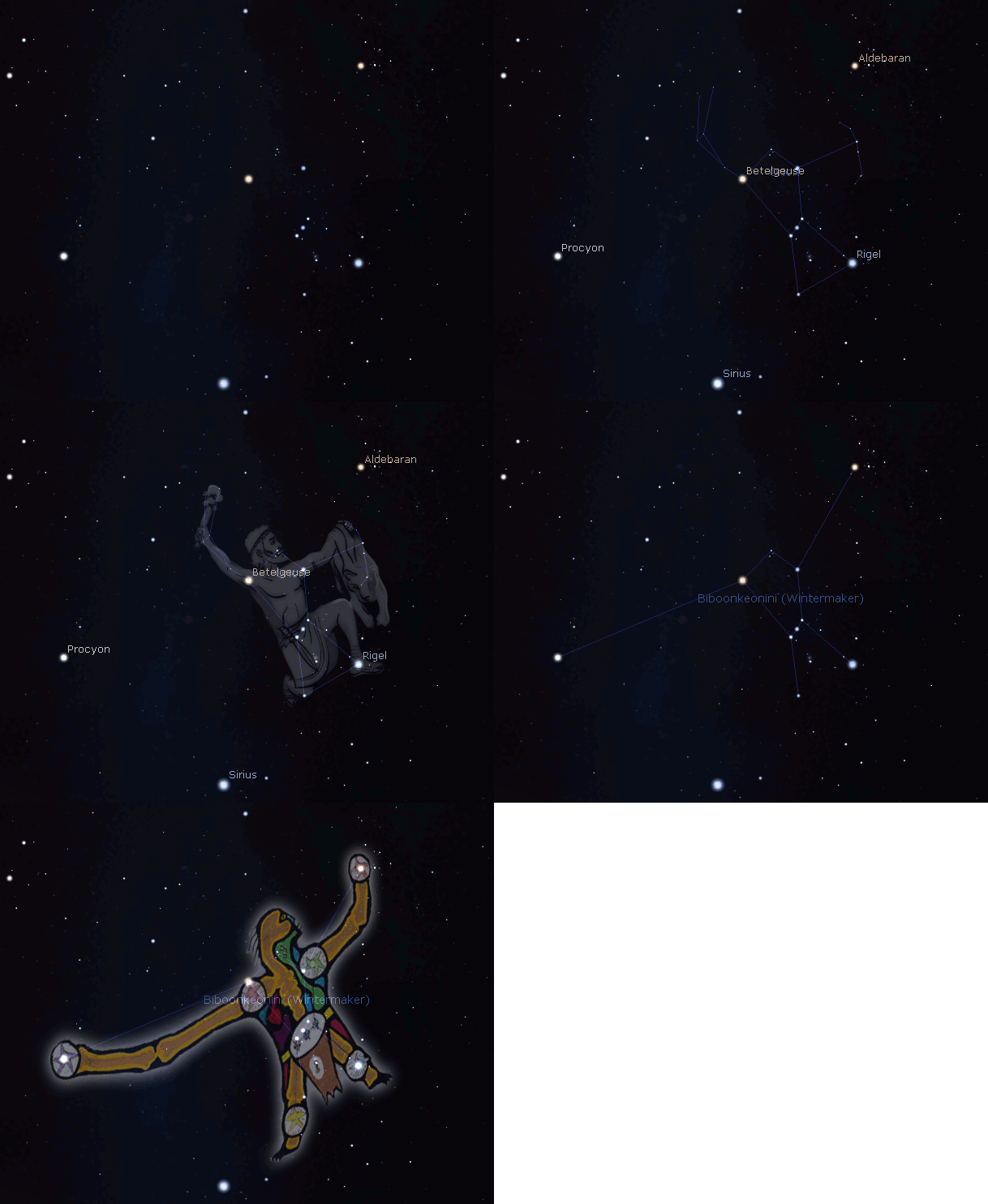
Orion-Wintermaker finder animation for 9 p.m., January 16. Created using Stellarium and GIMP.
01/15/2018 – Ephemeris – A river in the sky
Ephemeris for Martin Luther King Day, Monday, January 15th. The Sun will rise at 8:16. It’ll be up for 9 hours and 11 minutes, setting at 5:28. The Moon, 1 day before new, will rise at 7:49 tomorrow morning.
There is a long and sinuous constellation that’s part of the winter sky. It is Eridanus, which depicts a river. The river starts near the lower right corner of Orion, near the bright star Rigel and flows to the right then down near the southern horizon, then it meanders below the horizon. One has to travel to the far southern United States or even farther south to see the southern terminus of the river, the bright star Achernar. Writers over the ages have seen here the Nile and the earth circling river Ocean of the flat earth days. One of its stars is close to us and famous. It’s Omicron 2 Eridani a triple star system and the fictional home to Mr. Spock and other Vulcans of the Star Trek franchise. No real planet has been found there. Yet.
The times given are for the Traverse City/Interlochen area of Michigan. They may be different for your location.
Addendum
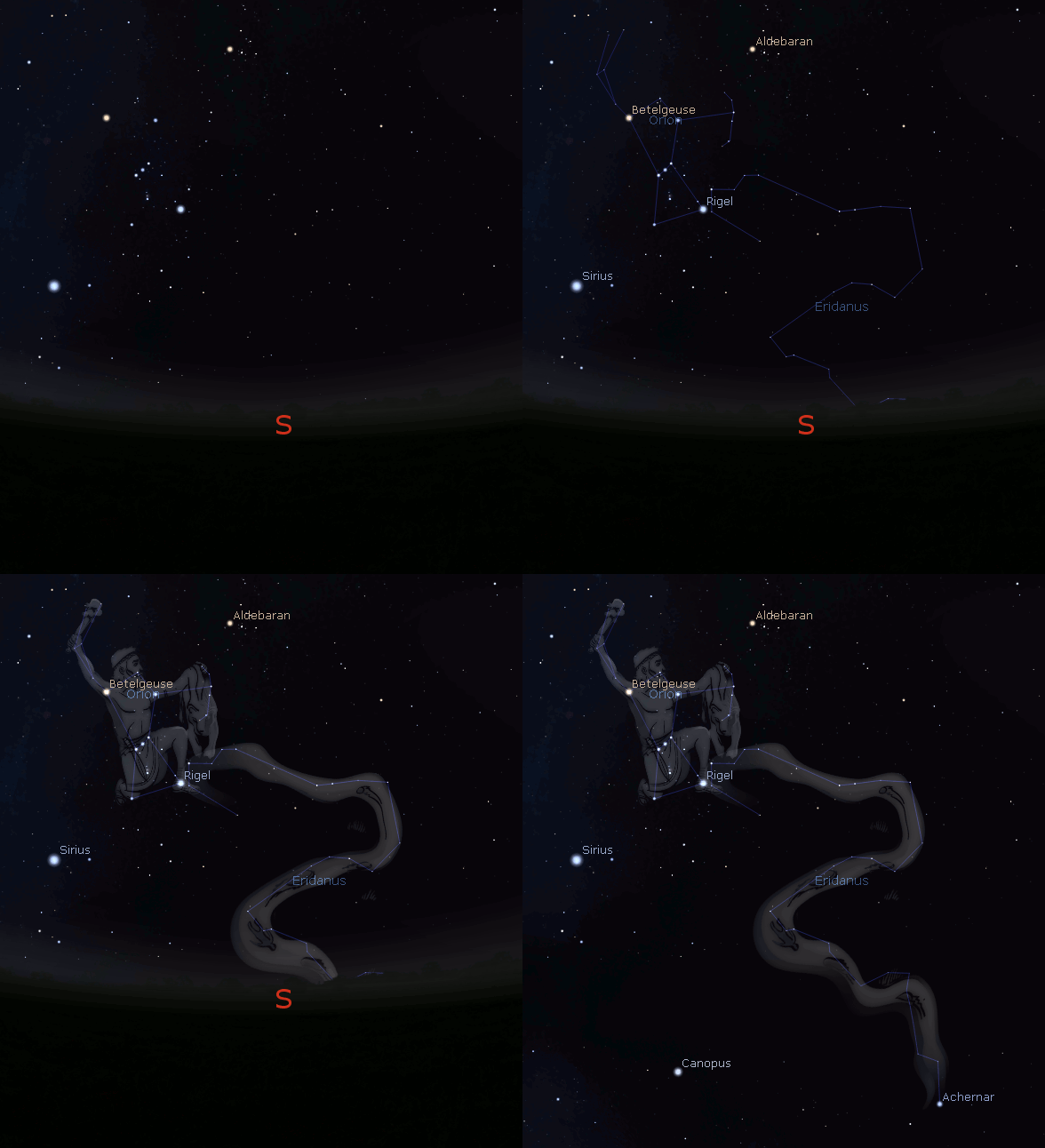
An animation of the constellation Eridanus which is a river that flows from Rigel in Orion to the star Achernar below our southern horizon at latitude 45 degrees north. Create using Stellarium and GIMP.
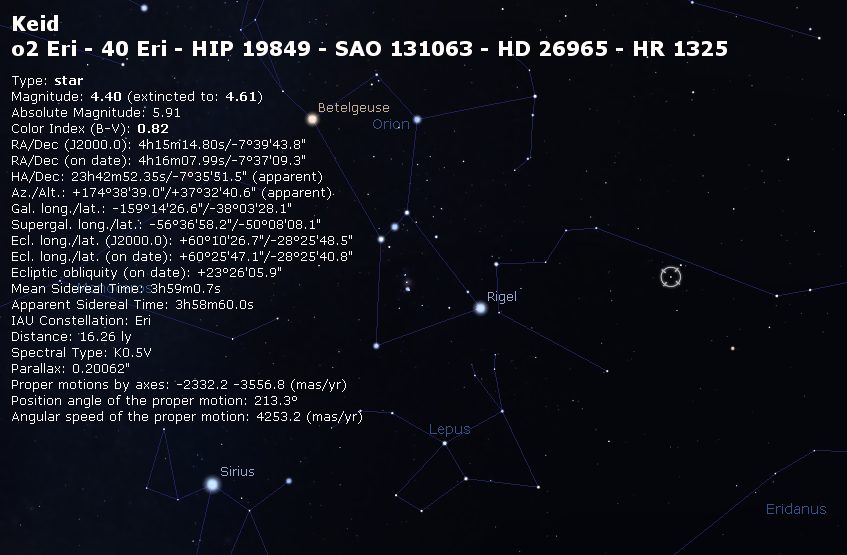
Keid, Omicron 2 Eridani, fictional home of Mr. Spock. Created using Stellarium.
01/12/2018 – Ephemeris – A look at Gemini the very unusual twins
Ephemeris for Friday, January 12th. The Sun will rise at 8:18. It’ll be up for 9 hours and 6 minutes, setting at 5:24. The Moon, half way from last quarter to new, will rise at 5:16 tomorrow morning.
The constellation Gemini, the Twins is visible half way up the sky in the east at 9 p.m. The namesake stars of the two lads will be on the upper left edge of the constellation, nearly vertically aligned. Castor is above, while Pollux, a slightly brighter star is below it. Lines of stars from Castor and Pollux to the right delineate the lads. In Greek mythology Castor and Pollux were twins, and half brothers, Castor was fathered by a mere mortal, while Pollux was fathered by Zeus in the famous Leda and the swan affair. The brothers, however were inseparable, and when Castor was killed during the quest for the Golden Fleece, Pollux pleaded with Zeus to let him die also. Zeus granted his wish, so they both appear in the sky together forever.
The times given are for the Traverse City/Interlochen area of Michigan. They may be different for your location.
Addendum
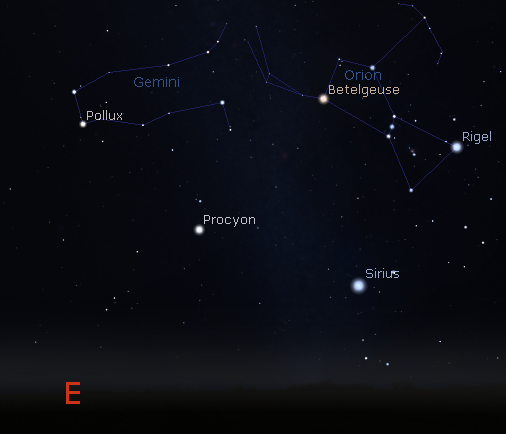
Gemini as it should appear at 9 p.m., January 12, 2018. Created using Stellarium.
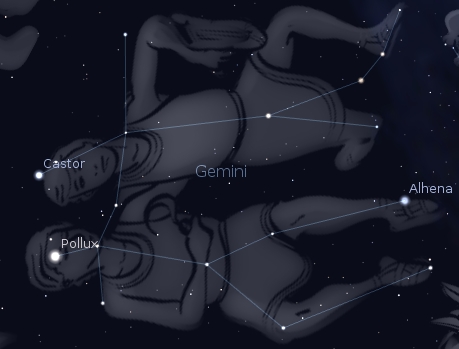
Gemini with Castor and Pollux. A closeup with a different way to link the stars with constellation art. Created with Stellarium.
01/08/2018 – Ephemeris – The Pleiades in Greek myth
Ephemeris for Monday, January 8th. The Sun will rise at 8:19. It’ll be up for 9 hours and 1 minute, setting at 5:20. The Moon, at last quarter today, will rise at 1:17 tomorrow morning.
The large and bright constellation of Orion is now in the southeast at 9 p.m. It is seen as an upright rectangle of bright stars, with a belt of three stars in the center. Orion is a minor character in Greek mythology. Orion was the son of Neptune, and was a hunter. He had an ill-fated romance with Merope, whose father King Oenopion, had him blinded. After having his sight restored, Orion became a companion of Diana goddess of the hunt and they wanted to marry. Apollo, Diana’s brother disapproved of Orion also and was able to trick Diana into accidentally killing Orion with an arrow. The heart-broken Diana then placed Orion in the sky with his hunting dogs, were we see him to this day.
The times given are for the Traverse City/Interlochen area of Michigan. They may be different for your location.
Addendum
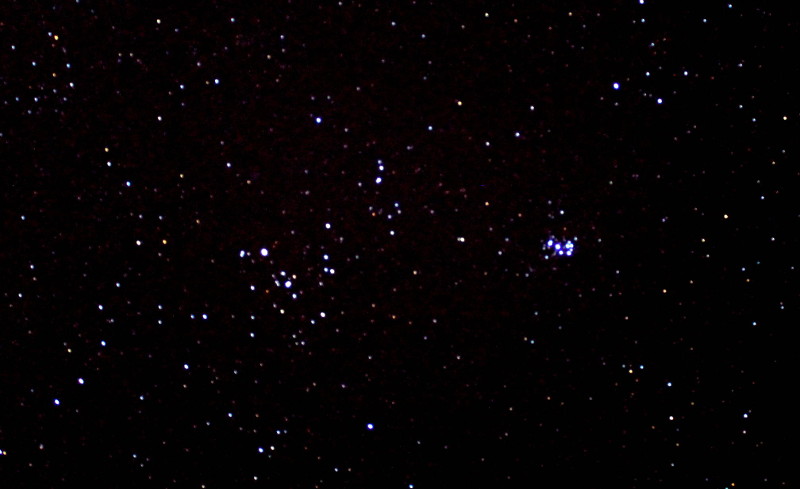
The Pleiades (right) and the Hyades (left) in this photograph I took January 4, 2016.
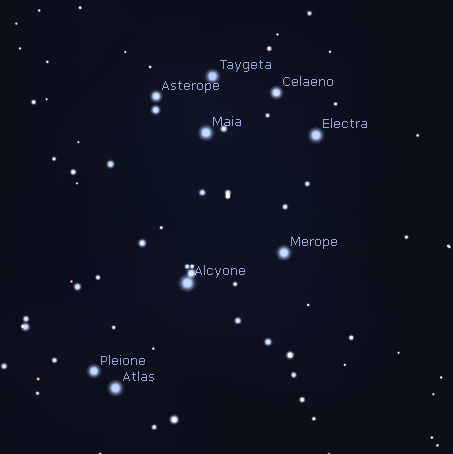
The named stars of the Pleiades. This is also showing more stars than can be seen with the naked eye. This is the number of stars that can be seen in binoculars, which is the best way to observe them. Most telescopes are offer too much magnification to fit all the stars in. A thirty power wide-angle eyepiece can just fit all the stars in. Created using Stellarium.
12/18/2017 – Ephemeris – The little dog shall lead
Ephemeris for Monday, December 18th. The Sun will rise at 8:14. It’ll be up for 8 hours and 49 minutes, setting at 5:03. The Moon is new today, and won’t be visible.
The constellation Orion has two hunting dogs. At 9 p.m. we’ll see one of them, the lesser dog, Canis Minor whose bright star Procyon is low in the East. Just two stars mark the constellation. Is it a dachshund or maybe a hot dog? The name Procyon means “Before the dog”, an odd title. It means that though east of Sirius, the bright dog star in Orion’s large dog, Canis Major, it rises before Sirius, due to its more northerly position in the sky. At 9 Sirius is just rising in the east-southeast. In many ways Procyon is nearly a twin of Sirius. It shines with the same white color, although a bit cooler, and has a white dwarf companion like Sirius. It’s a bit farther away than Sirius’ 8.6 light years. Procyon is at a distance of 11.46 light years.
The times given are for the Traverse City/Interlochen area of Michigan. They may be different for your location.
Addendum
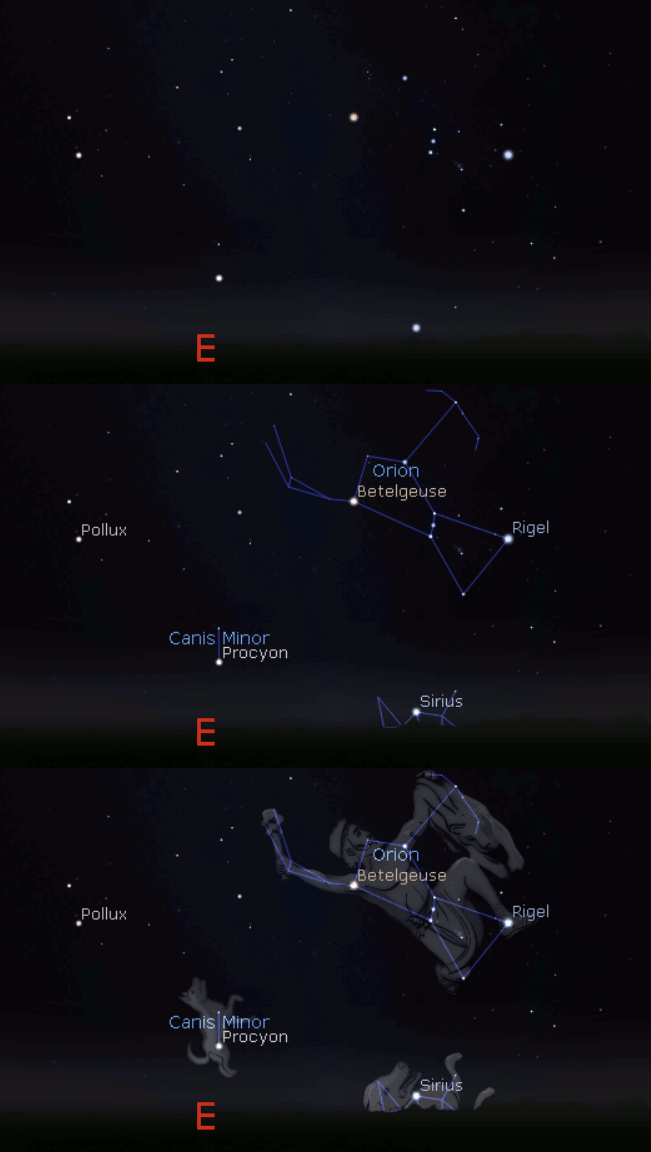
Stars and constellations in the east at 9 p.m., about 4 hours after sunset, on December 18th. This only works for locations above 30 degrees north latitude. Created using Stellarium.
 Bob Moler's Ephemeris Blog