Archive
02/20/2017 – Ephemeris – The spring constellations are rising
Ephemeris for President’s Day, Monday, February 20th. The Sun will rise at 7:34. It’ll be up for 10 hours and 44 minutes, setting at 6:18. The Moon, 2 days past last quarter, will rise at 3:59 tomorrow morning.
With spring only a month away, lets turn our eyes eastward in the evening to the rising spring stars. In contrast to the brilliant stars of the winter skies still holding forth in the south, and running along the Milky Way overhead and to the northwest, the stars to the east are rather sparse and dull. The only exception is the Big Dipper to the northeast. The one bright star in the east is Regulus, whose rank as a first magnitude star is dead last in brightness. It is in the heart of the constellation of Leo the lion, and as such has gained a great amount of fame. Regulus is at the base of a backward question mark of stars that is informally known a the Sickle. It is also the characteristic head and mane of a male lion. A triangle of stars to the lower left are his back end ending with Leo’s second brightest star Denebola, literally “Lion’s Tail”.
Times are for the Traverse City/Interlochen area of Michigan. They may be different for your location.
Addendum
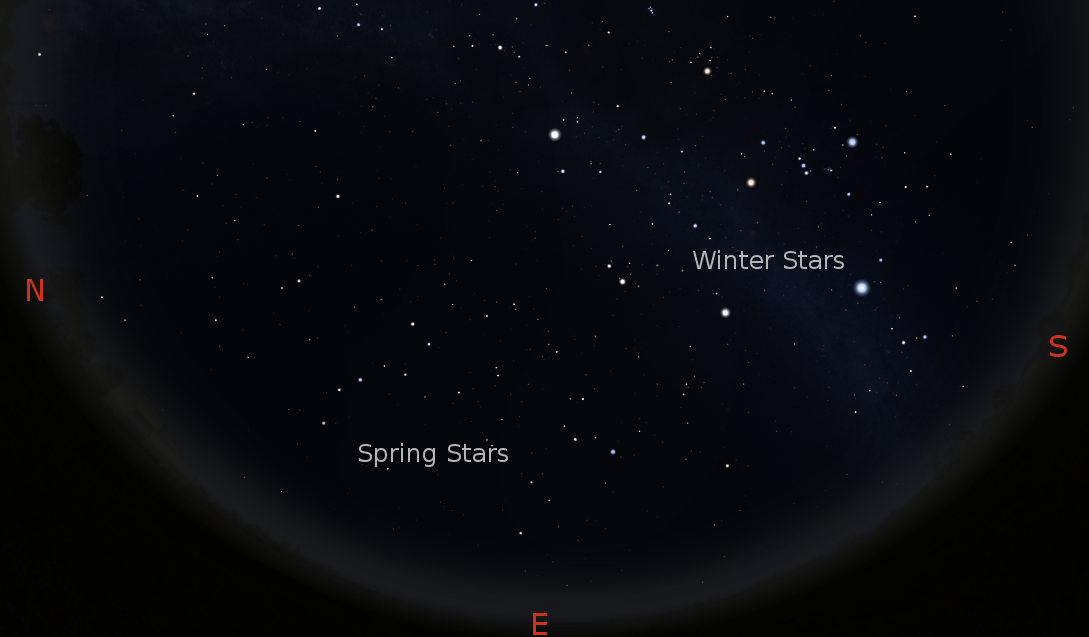
Comparison of winter stars vs. spring stars. Created using Stellarium.
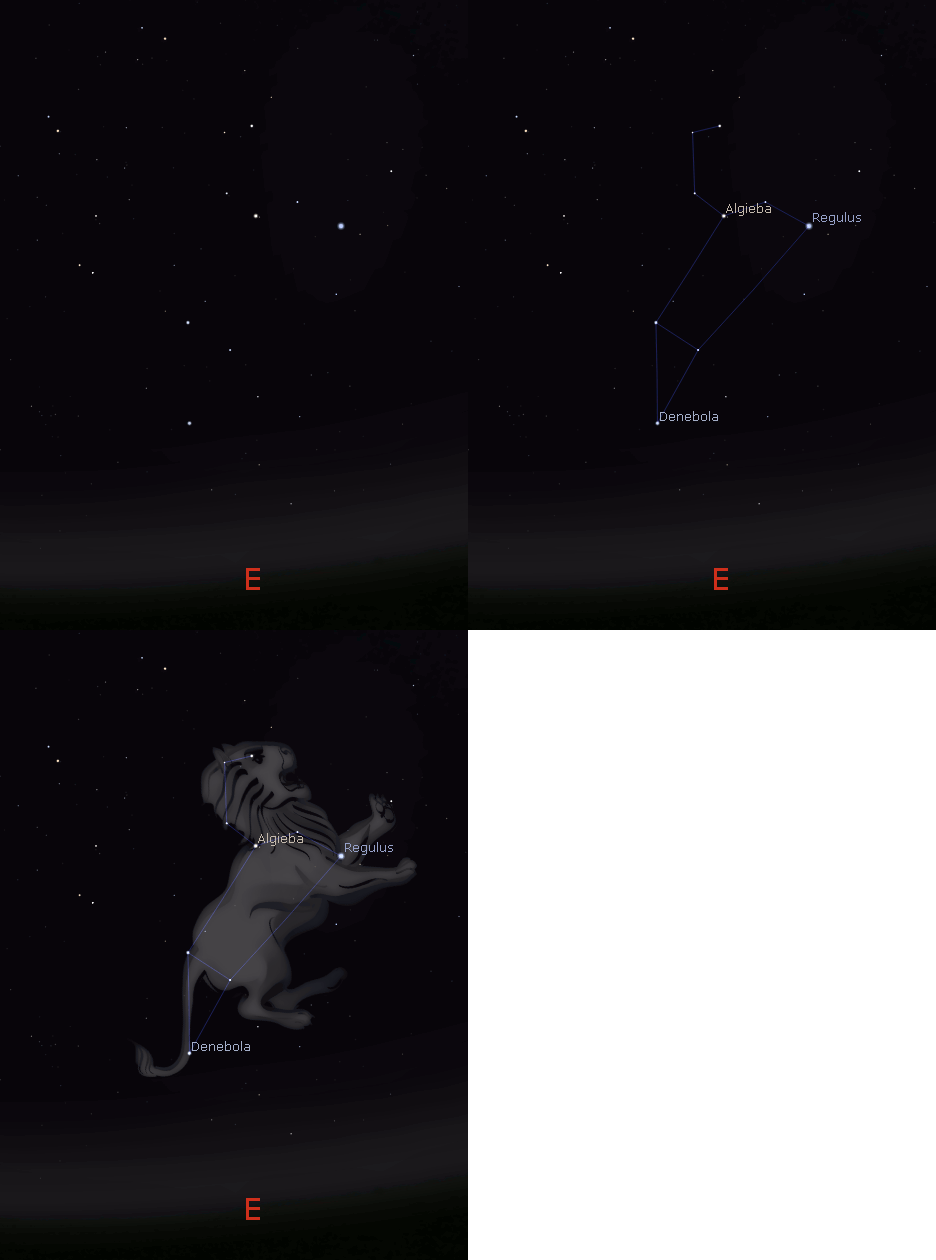
The constellation Leo animation. Created using Stellarium and GIMP.
02/17/2017 – Ephemeris – The stars of the Belt of Orion
Ephemeris for Friday, February 17th. The Sun will rise at 7:39. It’ll be up for 10 hours and 35 minutes, setting at 6:14. The Moon, 1 day before last quarter, will rise at 1:15 tomorrow morning.
Let’s take a closer look at the central constellation of the winter sky, the giant hunter Orion. His most remarkable feature in his Belt of three stars in a straight line. It’s the brightest, straightest and most equidistant line of stars I know of. It points down and left to the brightest star Sirius the dog star and up to the right of Aldebaran the angry bloodshot eye in Taurus the bull. The star names as taught to me by Grand Rapids Public Museum curator Evelyn Grebel in my youth in the 1950s was from left to right Alnitak, Alnilam and Mintaka. All the names reference a belt or girdle. Alnitak lights up a faint cloud that can sometimes be glimpsed with binoculars called the Flame Nebula, Just below it and invisible except in photographs is the Horsehead Nebula.
Times are for the Traverse City/Interlochen area of Michigan. They may be different for your location.
Addendum
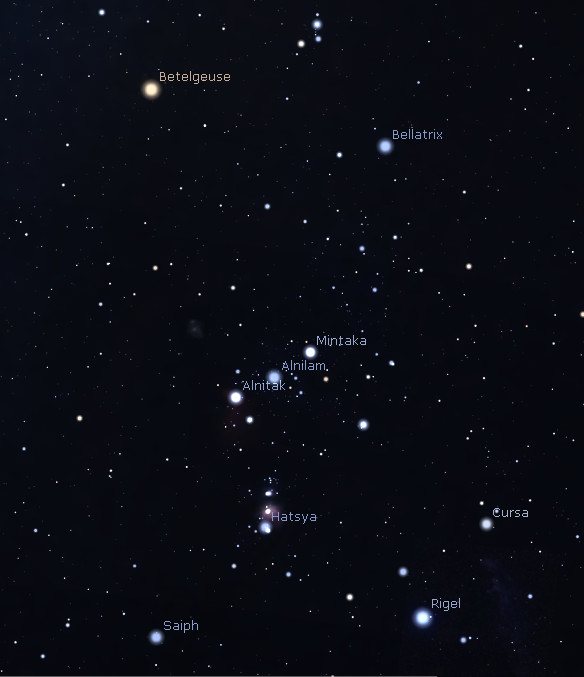
Orion’s named stars including the belt stars. Created using Stellarium.
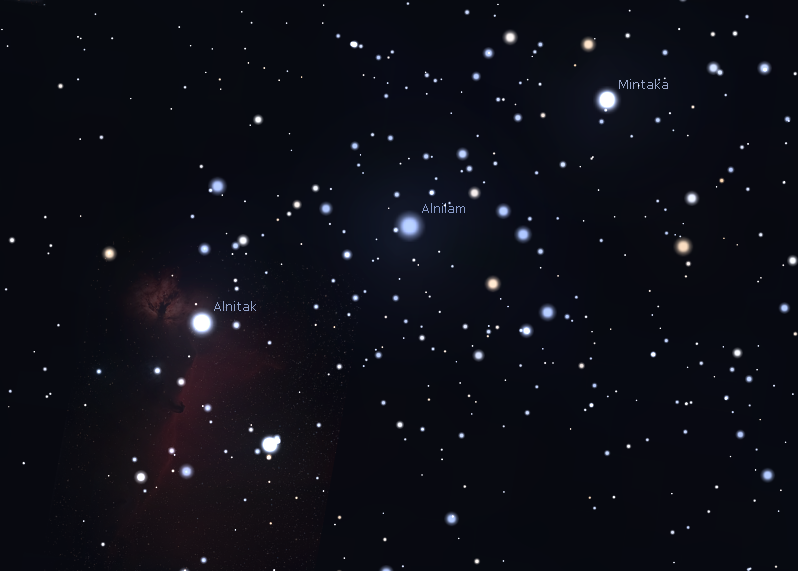
Orion’s belt stars showing the nebulae illuminated by Alnitak. The Flame Nebula above left of it and the Horsehead Nebula below. At this scale the horse’s head figure appears as a dark bump into the left edge of the red glow.
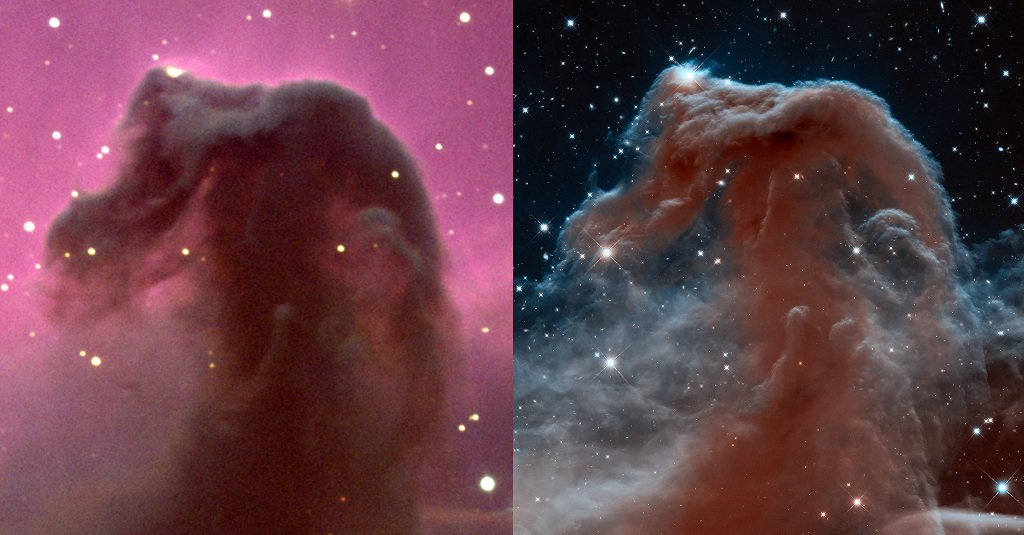
The Horsehead Nebula: On the left in visible light from the National Optical Astronomy Observatory, while the image on the right is from the Hubble Space Telescope’s near infrared camera. Infrared light penetrated dust and gas better than visible light. This image is rotated about 90 degrees counterclockwise from the above image.
02/16/2017 – Ephemeris – The Winter Circle
Ephemeris for Thursday, February 16th. The Sun will rise at 7:40. It’ll be up for 10 hours and 32 minutes, setting at 6:12. The Moon, 2 days before last quarter, will rise at 12:17 tomorrow morning.
The winter skies are blessed with more first magnitude stars than any other season. These are the twenty-one brightest stars in the sky. Six of these stars lie in a large circle centered on the seventh. This circle is up all evening now that we are in the heart of winter. Starting high overhead is Capella in Auriga the charioteer. Moving clockwise, we come to Aldebaran in the face of Taurus the Bull. Then down to Orion’s knee we find Rigel. Down and left is the brightest star of all Sirius the Dog Star in Canis Major Orion’s large hunting dog, lowest of these stars in the south. Moving up and left there is Procyon in Canis Minor, Then above it is Pollux in Gemini the twins. All are centered on Betelgeuse in Orion.
Times are for the Traverse City/Interlochen area of Michigan. They may be different for your location.
Addendum
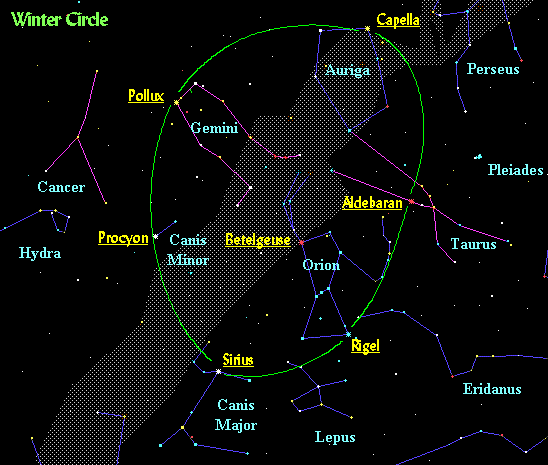
The Winter Circle of 1st magnitude stars. Created using my LookingUp program.
01/30/2017 – Ephemeris – Can you really see a unicorn?
Ephemeris for Monday, January 30th. The Sun will rise at 8:03. It’ll be up for 9 hours and 45 minutes, setting at 5:49. The Moon, 3 days past new, will set at 8:58 this evening.
Among all the constellations in the sky of animals real and mythical, there is also a unicorn. It’s called Monoceros, and inhabits the southern sky at 9 p.m. bounded by Orion on the right, Canis Major, the great dog below and Canis Minor, the little dog to the left. Unfortunately for observers without optical aid Monoceros, though large, is devoid of any but the faintest stars. Maybe that’s why no one sees unicorns anymore. It has many faint stars because the Milky Way runs through it. To the telescope it is a feast of faint nebulae or clouds of gas and dust, the birth place of stars, including the red rose of the Rosette Nebula, and the strange and tiny Hubble’s Variable Nebula. It contains no bright stars, but a wealth of wonders below naked eye visibility.
Times are for the Traverse City/Interlochen area of Michigan. They may be different for your location.
Addendum
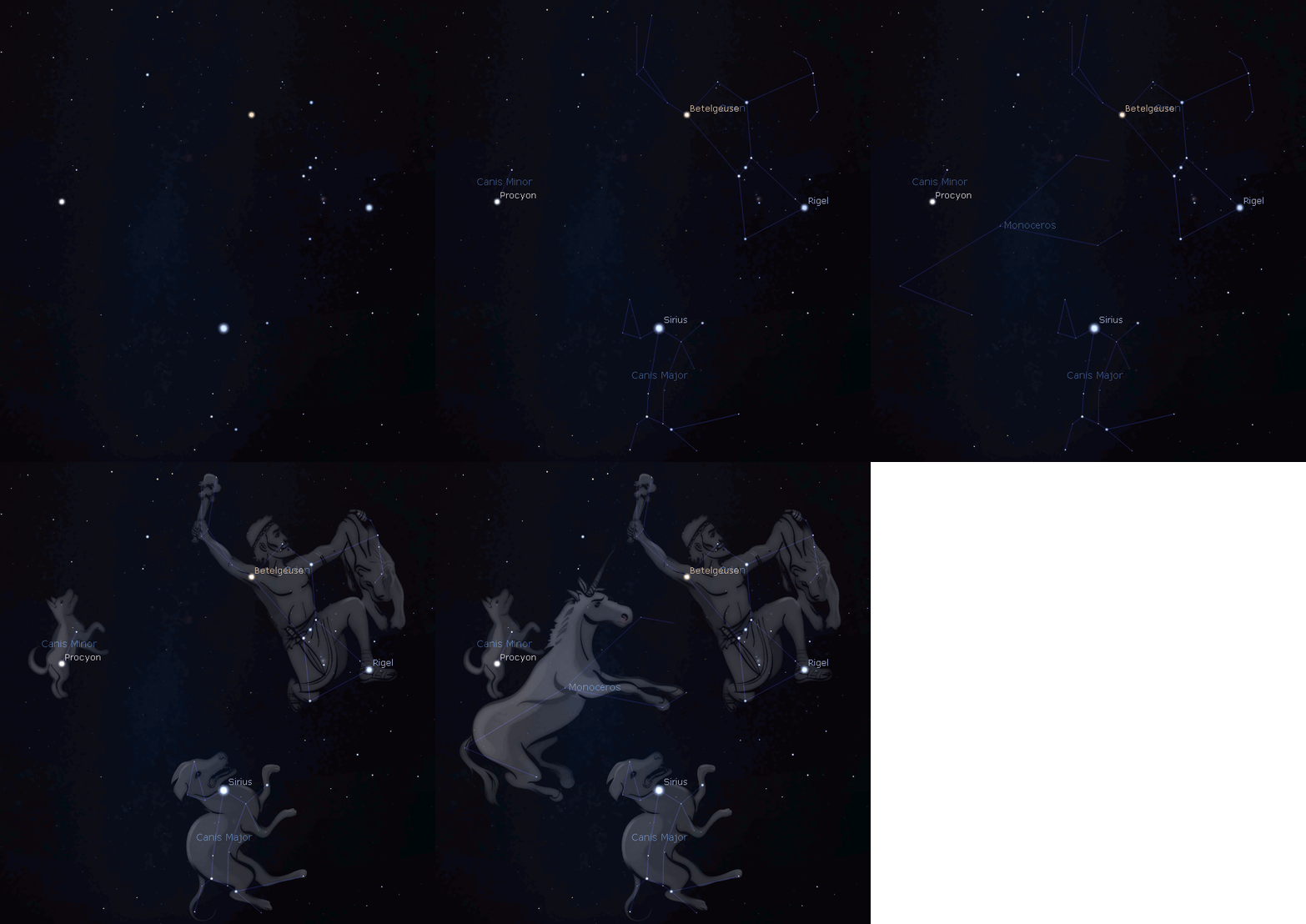
Monoceros finder chart animation. Created using Stellarium and GIMP.
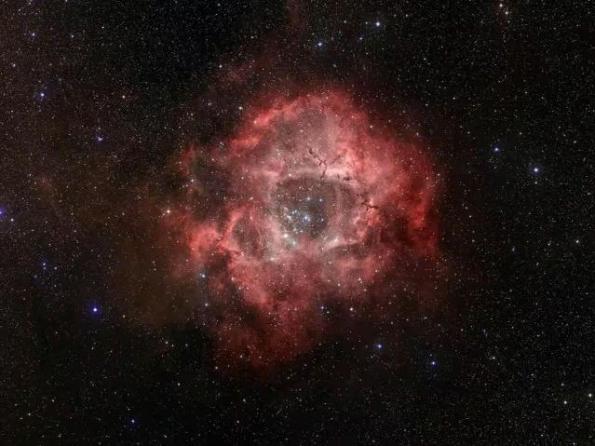
Rosette Nebula in the infrared from the Spitzer Space Telescope. Credit: NASA/JPL/Caltech.
I’ve never seen it visually through a telescope. However the inner star cluster, NGC 2244 is visible. The nebula is NGC 2239.
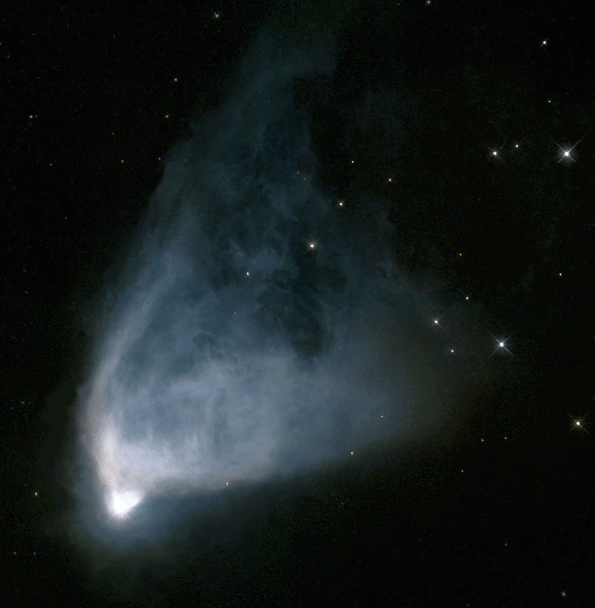
Hubble’s Variable Nebula NGC 2261 photographed appropriately enough by the Hubble Space Telescope. Credit: NASA/ESA and The Hubble Heritage Team (AURA/STScI).

Another nebula: The Cone Nebula, NGC 2264, as seen with the Hubble Space Telescope. Kind of looks like eggs in an eagle’s nest Credit ESA/Hubble.
The mentioned NGC objects can be found with a good star atlas or the free program Cartes du Ciel via the link on the right.
01/27/2017 – Ephemeris – The celestial twins
Ephemeris for Friday, January 27th. The Sun will rise at 8:06. It’ll be up for 9 hours and 38 minutes, setting at 5:44. The Moon is new today, and won’t be visible.
The constellation Gemini, the Twins is visible high in the southeast at 9 p.m. The namesake stars of the two lads, will be high on the upper left edge of the constellation, nearly vertically aligned. Castor is above, while Pollux, a slightly brighter star is below it. Lines of stars from Castor and Pollux to the lower right delineate the lads. In Greek mythology Castor and Pollux were twins, and half brothers, Castor was fathered by a mere mortal, while Pollux was fathered by Zeus in the famous Leda and the swan affair. The brothers, however were inseparable, and when Castor was killed during the quest for the Golden Fleece, Pollux pleaded with Zeus to let him die also. Zeus granted his wish, so both appear in the sky together forever.
Times are for the Traverse City/Interlochen area of Michigan. They may be different for your location.
Addendum
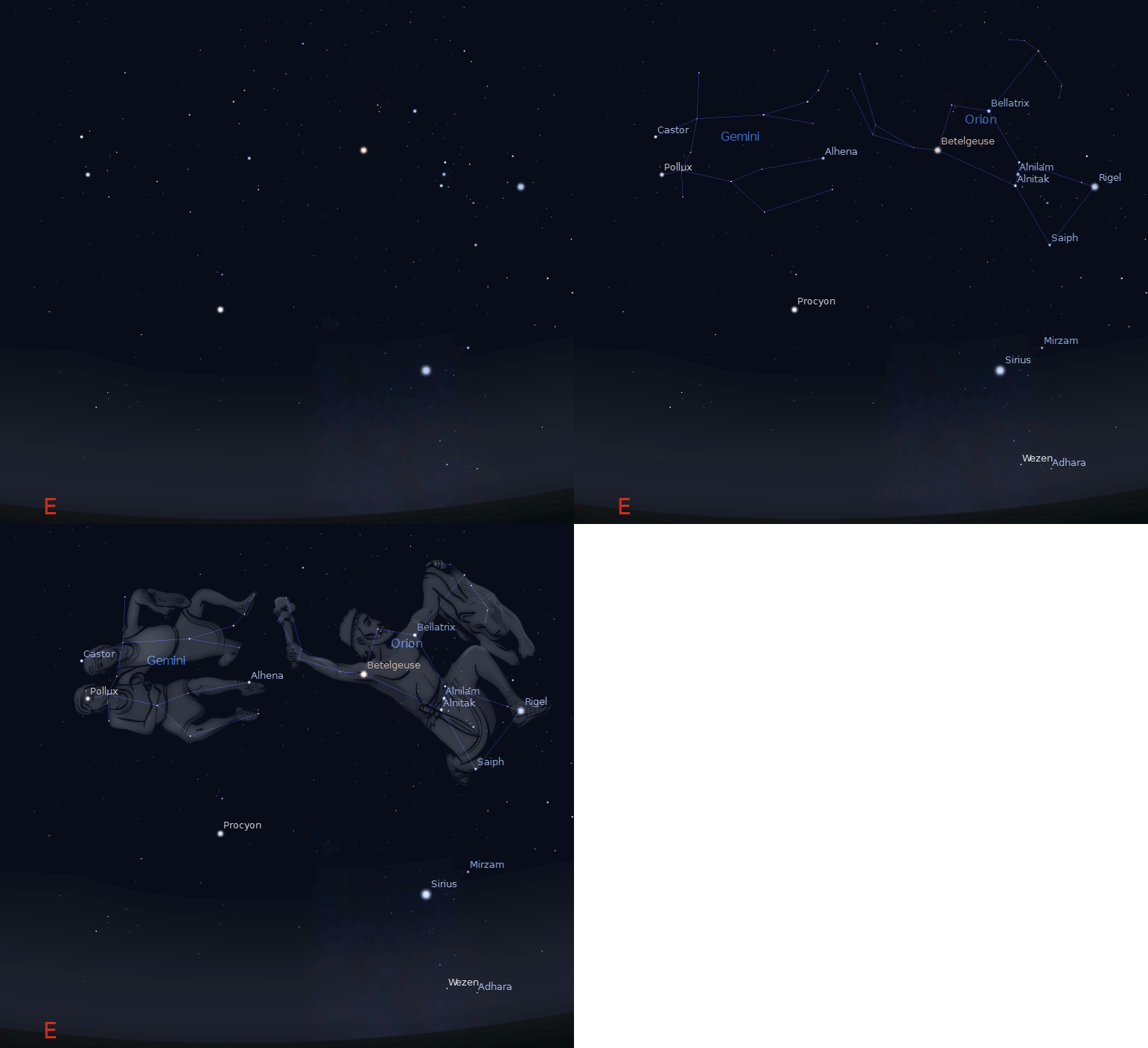
Gemini revealed by animation. Created using Stellarium and GIMP.
01/26/2017 – Ephemeris – Is it a dachshund or a hot dog?
Ephemeris for Thursday, January 26th. The Sun will rise at 8:07. It’ll be up for 9 hours and 36 minutes, setting at 5:43. The Moon, 1 day before new, will rise at 7:40 tomorrow morning.
The constellation Orion has two hunting dogs. We’ve seen Canis Major the greater dog at Orion’s feet with Sirius in its heart. The lesser dog, Canis Minor is level with Betelgeuse in Orion’s shoulder and off to the left. Just two stars mark it. Is it a dachshund or is it a hot dog? You decide. It’s brighter star’s name is Procyon which means “Before the dog”, an odd title. It means that though east of Sirius, it rises before Sirius, due to its more northerly position in the sky. In many ways Procyon is nearly a twin of Sirius. It shines with the same white color, although a bit cooler, and has a white dwarf companion like Sirius. It’s a bit farther away than Sirius’ 8 light years. Procyon is 11 and a half light years away. Procyon, Betelgeuse and Sirius make the winter triangle.
Times are for the Traverse City/Interlochen area of Michigan. They may be different for your location.
Addendum
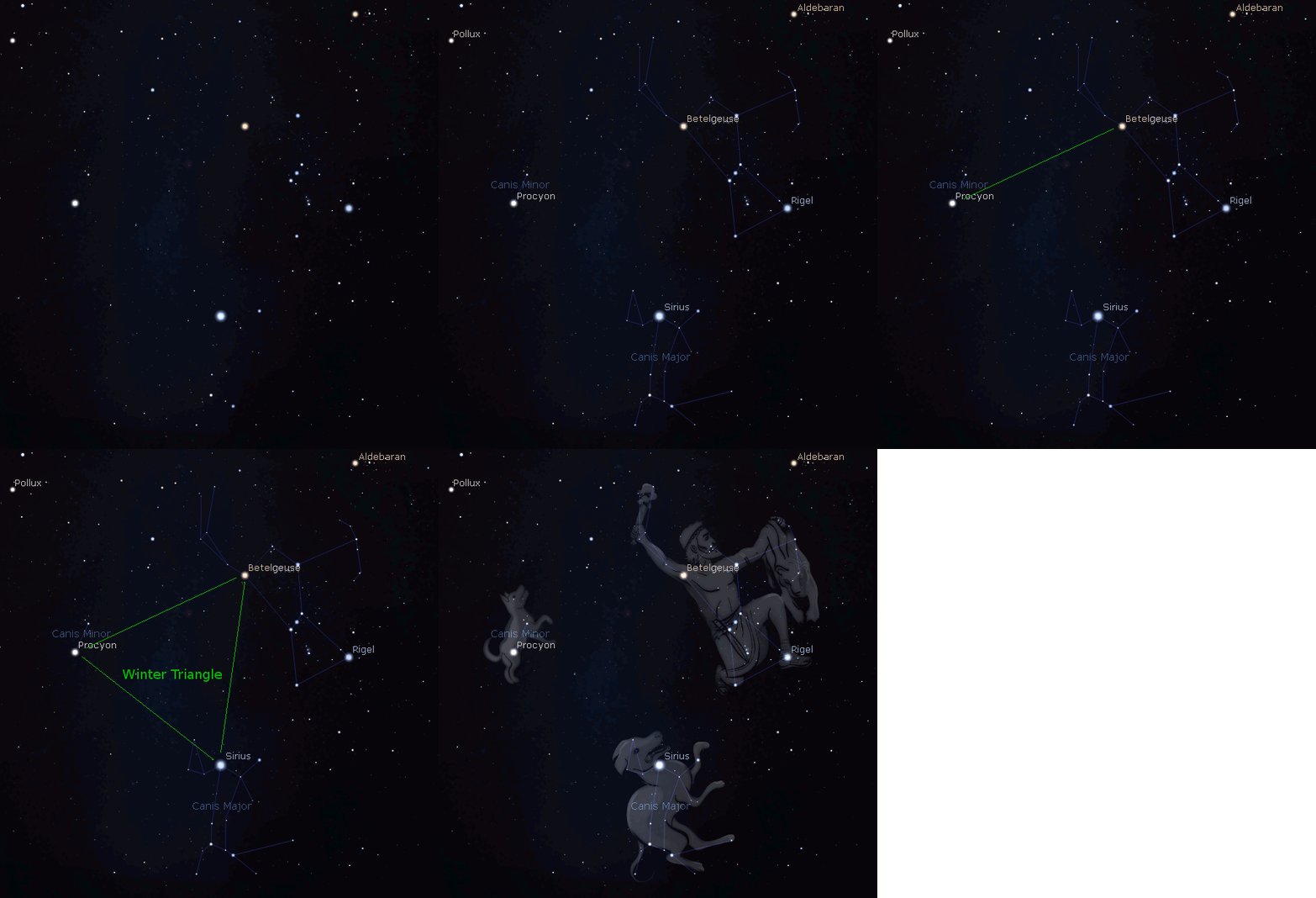
Procyon and Orion’s hunting dogs animation also showing the Winter Triangle asterism*. Created using Stellarium and GIMP.
* Asterism – an informal constellation like the Big Dipper, the Northern Cross, or the Summer Triangle. Not one of the 88 official constellations.
01/23/2017 – Ephemeris – The rabbit that got away
Ephemeris for Monday, January 23rd. The Sun will rise at 8:10. It’ll be up for 9 hours and 29 minutes, setting at 5:39. The Moon, half way from last quarter to new, will rise at 5:17 tomorrow morning.
Orion, the central winter constellation is seen in the south-southeast at 9 p.m. He is a hunter, but is preoccupied in defending himself from the charge of Taurus the bull to the upper right. At Orion’s feet, and unnoticed by him is the small constellation of Lepus the hare. It’s very hard to see a whole rabbit in its eight dim stars: however, I do see a rabbit’s head, ears and shoulders. A misshapen box is the head and face of this critter facing to the left. His ears extend upwards from the upper right star of the box, and the bend forward a bit. Two stars to the right of the box and a bit farther apart show the front part of the body. The free computer program at Stellarium.org shows a whole rabbit facing the opposite direction.
Times are for the Traverse City/Interlochen area of Michigan. They may be different for your location.
Addendum

An animation showing the stars, constellations and artwork of Lepus, Orion and Taurus. Created using Stellarium and GIMP.
01/20/2017 – Ephemeris – Orion’s greater hunting dog
Ephemeris for Friday, January 20th. The Sun will rise at 8:12. It’ll be up for 9 hours and 22 minutes, setting at 5:35. The Moon, 1 day past last quarter, will rise at 2:29 tomorrow morning.
The great winter constellation or star group Orion the Hunter, is located in the south-southeastern sky at 9 p.m. His elongated rectangle of a torso is almost vertical. In the center of the rectangle are three stars in a line that make his belt. As a hunter, especially one of old, he has two hunting dogs. The larger, Canis Major can be found by following the three belt stars of Orion down and to the left. There lies the brilliant star called Sirius, also known as the Dog Star. It’s in the heart of a stick figure dog low in the southeast facing Orion that appears to be begging. I’ll have more to say about Sirius in the future, but there’s a fine star cluster, called M41, at the 5 o’clock position from Sirius easily visible in binoculars or a small telescope.
Times are for the Traverse City/Interlochen area of Michigan. They may be different for your location.
Addendum
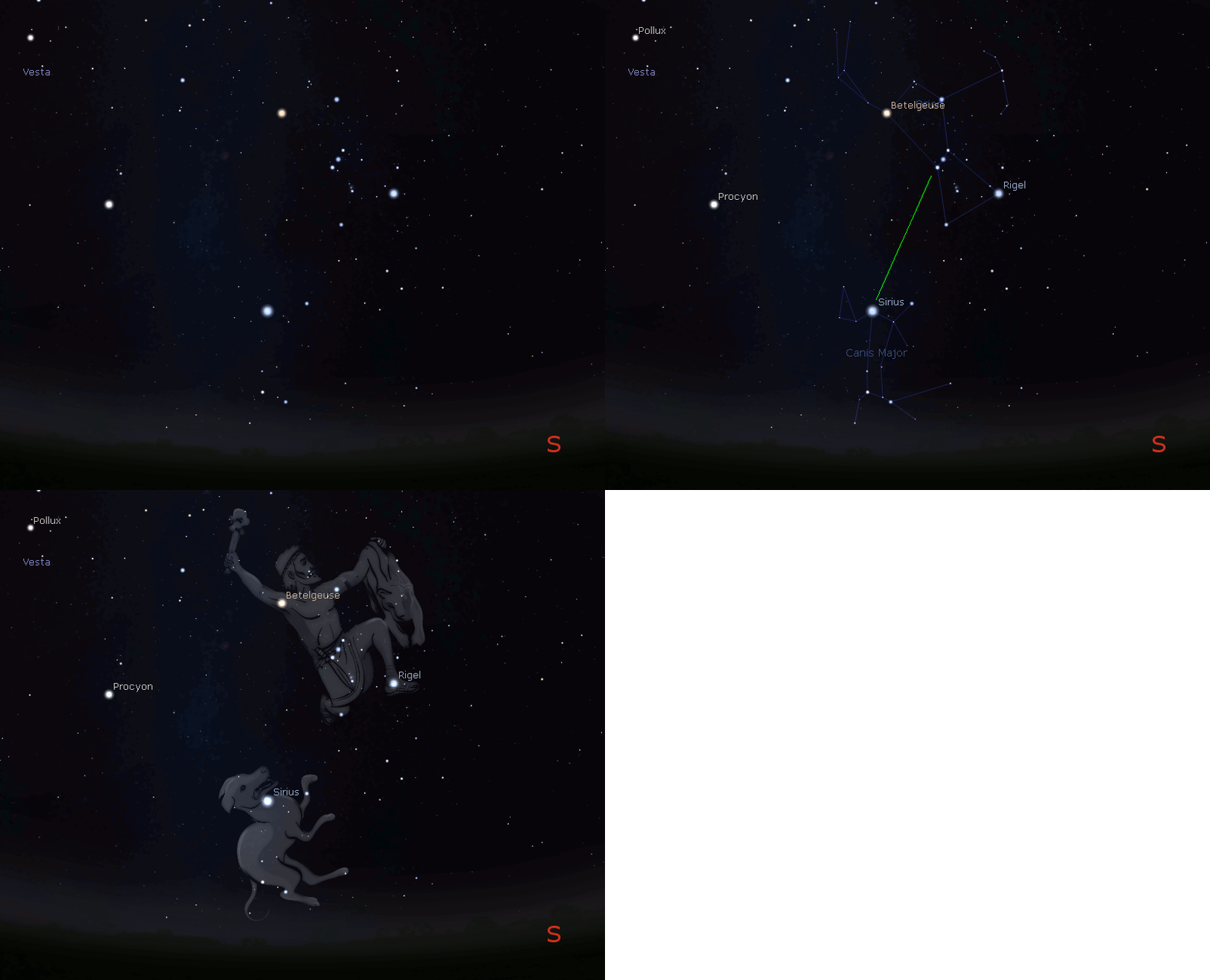
Orion and Canis Major Animation for 9 p.m. January 20, 2017. Click on image to enlarge. Created using Stellarium and GIMP.
01/17/2017 – Ephemeris – Denial is not a river in the sky
Ephemeris for Tuesday, January 17th. The Sun will rise at 8:14. It’ll be up for 9 hours and 16 minutes, setting at 5:31. The Moon, 2 days before last quarter, will rise at 11:32 this evening.
One of the more obscure constellations around is Eridanus, which depicts a river. At 9 p.m. the river starts near the lower right corner of Orion, near the bright star Rigel and flows to the right then zigzags down to the left, then down to the right near the southern horizon, then it heads south below the horizon. One has to travel to the far south to see the southern terminus of the river, the bright star Achernar. Writers over the ages have seen here the Nile and the world circling river Ocean of the flat Earth days. Achernar was recently discovered to be the flattest star known, due to its rapid spin. The dimensions of Achernar have been determined to be twice as wide across its equator than from pole to pole. It’s 139 light years away.
Times are for the Traverse City/Interlochen area of Michigan. They may be different for your location.
Addendum
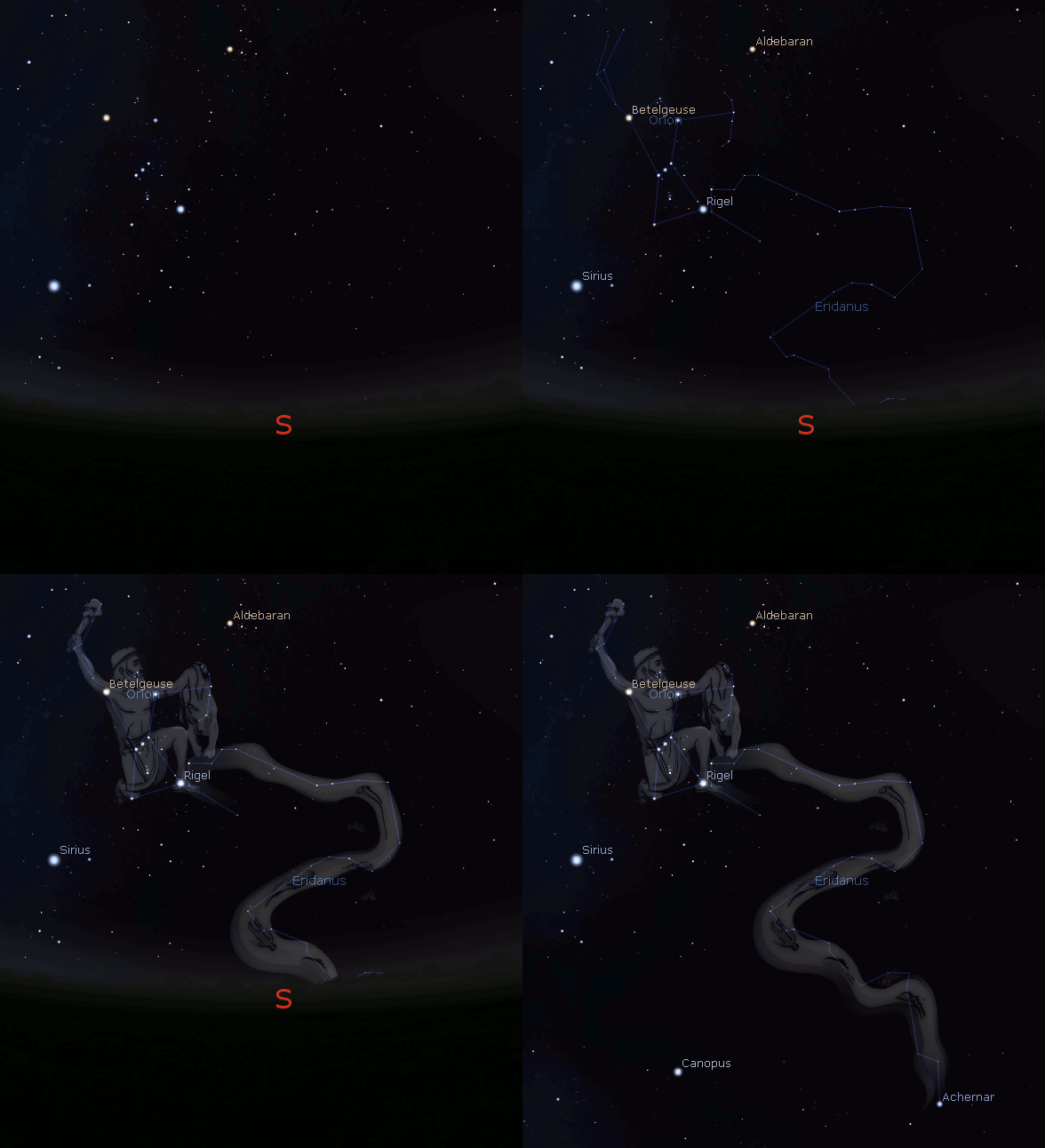
An animation of the constellation Eridanus which is a river that flows from Rigel in Orion to the star Achernar below our southern horizon at latitude 45 degrees north. Create using Stellarium and GIMP.
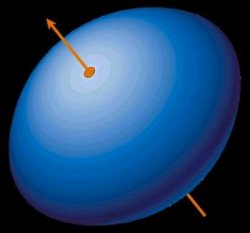
A model of Achernar by the European Southern Observatory (ESO).
01/09/2017 – Ephemeris – Betelgeuse the bright red star in Orion
Ephemeris for Monday, January 9th. The Sun will rise at 8:18. It’ll be up for 9 hours and 3 minutes, setting at 5:21. The Moon, 3 days before full, will set at 6:06 tomorrow morning.
The bright red star in constellation Orion’s shoulder is Betelgeuse, 643 light years away give or take 146 light years. Betelgeuse is a shortened form of an Arabic phrase that means “Armpit of the central one”. Orion is seen in the south in the evening. Even at its great distance it’s the star whose surface is easiest seen, after the sun of course. That’s because it’s so big. Possibly larger around than the orbit of Jupiter, though that’s hard to determine. Recent telescopic observations of Betelgeuse have shown shells of gas surrounding the star. A star like Betelgeuse is so bloated that it can be described as a red-hot vacuum, thus its edge or limb is much darker than its center. The sun has limb darkening too, but it is much less noticeable.
Times are for the Traverse City/Interlochen area of Michigan. They may be different for your location.
Addendum
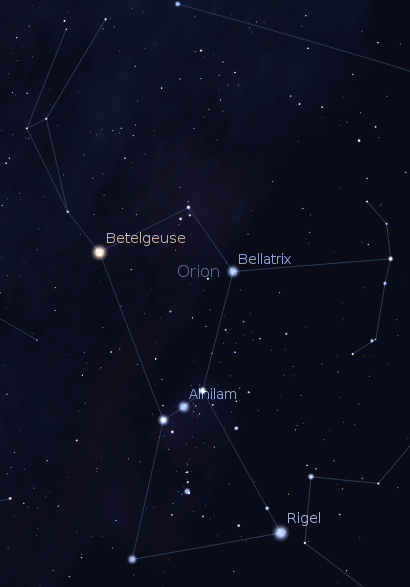
Orion upright and due south. Created using Stellarium.
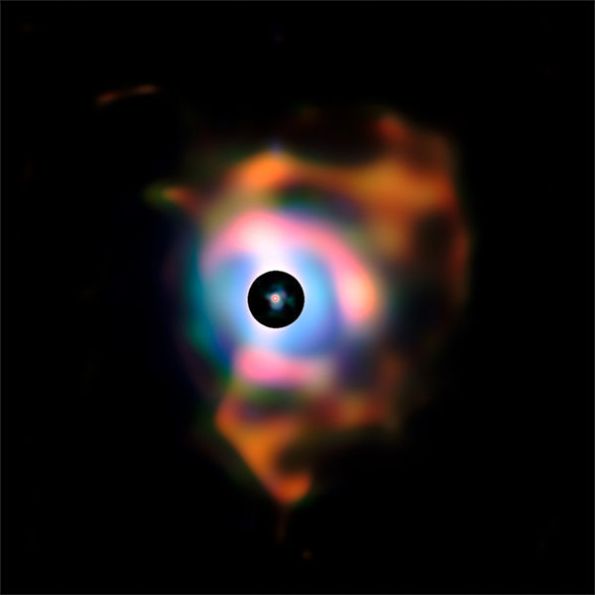
Betelgeuse and its nebula. From European Southern Observatory’s Very Large Telescope.
Betelgeuse is a single star like the Sun there is evidence that Betelgeuse may have eaten its companion star 100,000 years ago, yum! http://phys.org/news/2016-12-famous-red-star-betelgeuse-faster.html
 Bob Moler's Ephemeris Blog