Archive
12/27/2016 – Ephemeris – The stars of Orion
Ephemeris for Tuesday, December 27th. The Sun will rise at 8:19. It’ll be up for 8 hours and 49 minutes, setting at 5:09. The Moon, 2 days before new, will rise at 7:26 tomorrow morning.
The large and bright constellation of Orion the hunter is in the southeast at 9 p.m., with the bright star Sirius below it near the horizon. The equally spaced line of three stars of Orion’s belt are nearly vertical and point down to Sirius, also known as the Dog Star in Canis Major, Orion’s greater dog. The whole of its constellation stars aren’t up at 9 p.m., but they will all clear the horizon by 10 p.m. Those three belt stars are in the center of an elongated rectangle of stars At the top left of Orion’s shoulder stars is the red giant star Betelgeuse. The right shoulder star is Bellatrix. Both Bellatrix and Sirius along with the names of other stars and constellations should be familiar to fans of the Harry Potter novels and movies, as members of the house of Black. The knee stars at the bottom of the rectangle are, from left to right Saiph and the brilliant blue giant star Rigel. Between his belt and knees are stars of his sword.
Times are for the Traverse City/Interlochen area of Michigan. They may be different for your location.
Addendum
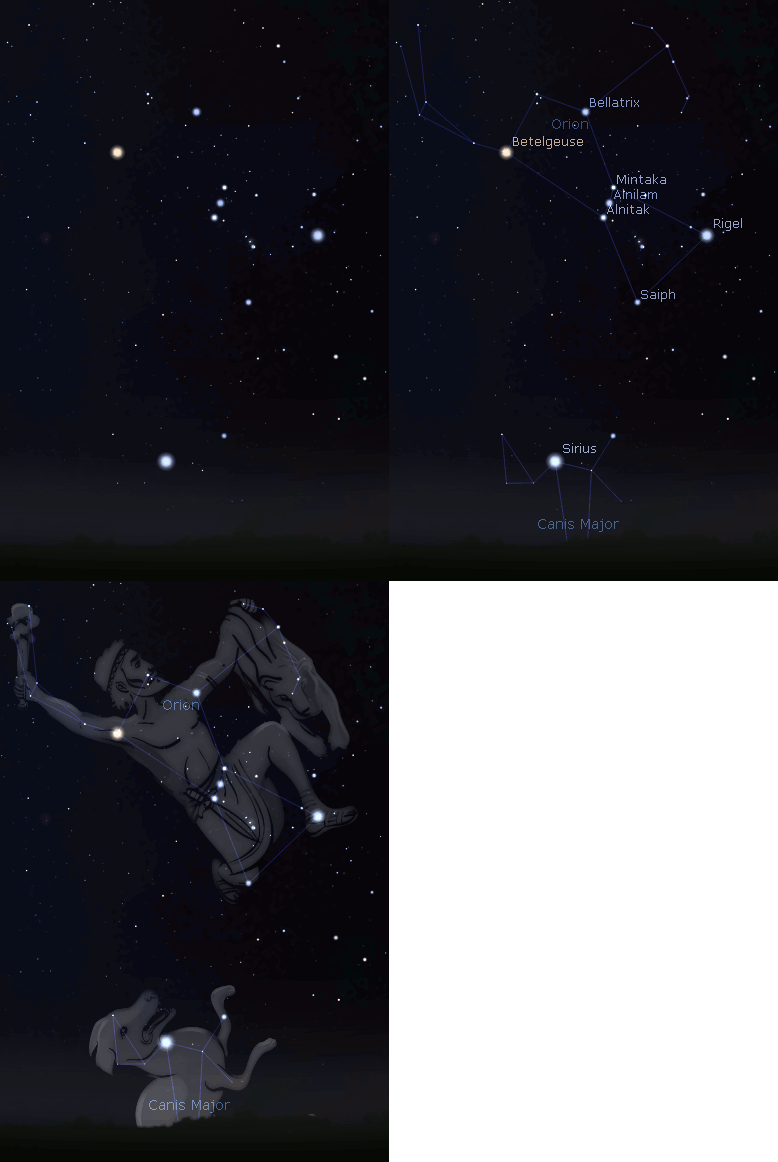
Orion, star names, and constellation art animation position for 9 p.m. December 27. Created using Stellarium and GIMP. Artist: Johan Meuris.
In the image above I’ve added the belt star names, though they are generally covered in a program of their own.
12/26/2016 – Ephemeris – Orion takes its place as the central winter constellation
Ephemeris for Monday, December 26th. The Sun will rise at 8:19. It’ll be up for 8 hours and 49 minutes, setting at 5:08. The Moon, 3 days before new, will rise at 6:33 tomorrow morning.
The great constellation of Orion the hunter has claimed his rightful position as the central winter constellation. It’s the most famous constellation of all. Think the Big Dipper is a big deal? They can’t even see it from the large population centers of Australia. Parts of Orion can be seen from every part of the Earth from pole to pole. Orion’s distinctive feature is his belt of three bright stars in a row. This tilted belt is in the center of a large rectangle of bright stars. The upper left star is Betelgeuse a red giant star. The lower right star is Rigel a blue giant star. Orion was an unlucky fellow of Greek myth. One wonders why he gets this splashy constellation in Winter while Hercules gets a dim upside down constellation in the spring sky.
Times are for the Traverse City/Interlochen area of Michigan. They may be different for your location.
Addendum
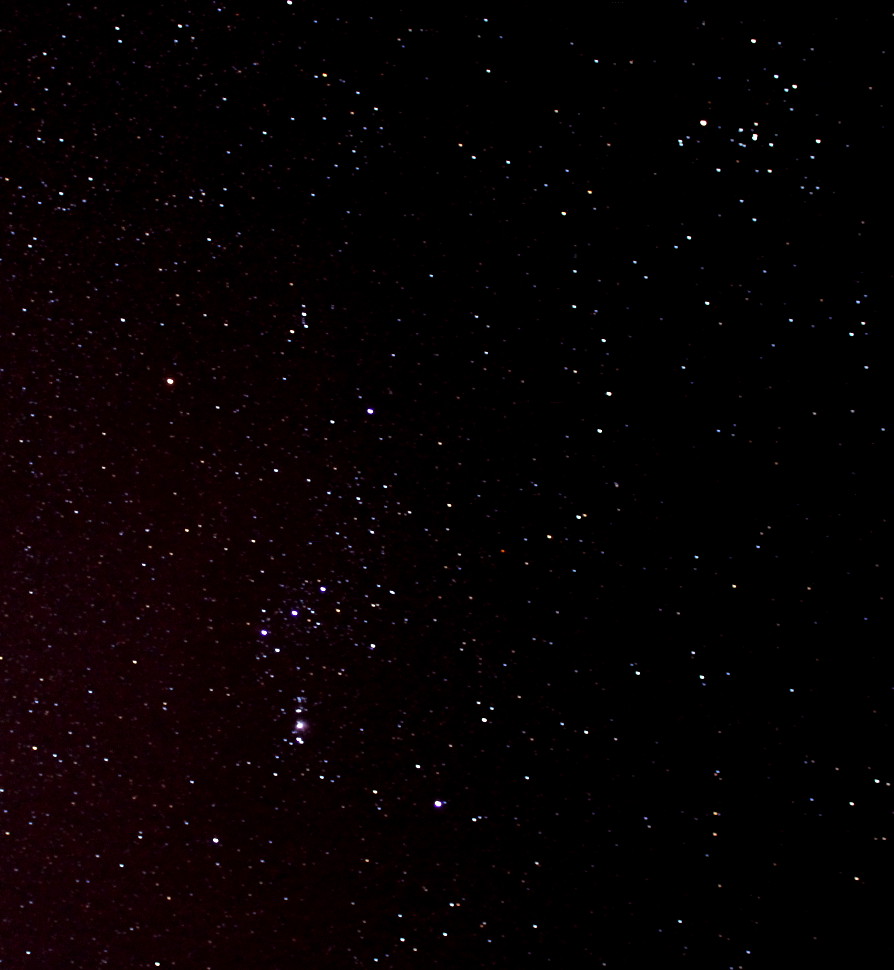
Orion and the head of Taurus photograph by myself January 4, 2016 at 11:30 p.m. It’s a stack of unguided 20 second exposures.
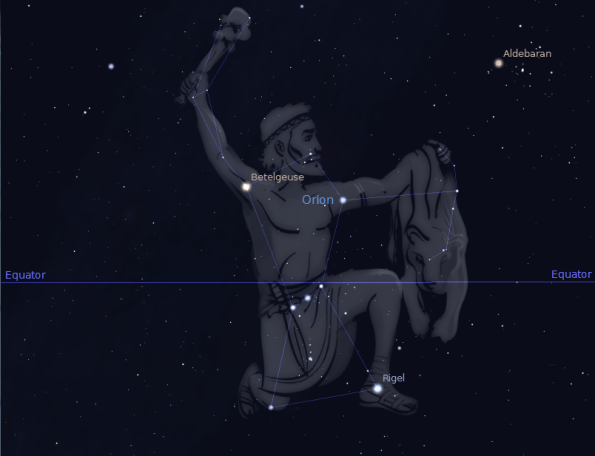
Orion from mid latitudes north of the equator. Orion would be upside down if viewed south of the equator. Created using Stellarium.
The Ephemeris radio programs are very short (59 seconds) so I will visit Orion several times during the winter to explore its mythology and deep sky wonders within, or search past posts for Orion.
12/19/2016 – Ephemeris – OK kids, do I have to turn this chariot around
Ephemeris for Monday, December 19th. The Sun will rise at 8:16. It’ll be up for 8 hours and 48 minutes, setting at 5:04. The Moon, 1 day before last quarter, will rise at 11:44 this evening.
The constellation Auriga the charioteer is half way up the sky in the east at 8 p.m. It is a pentagon of stars, with the brilliant star Capella at one of its corners. Capella represents a she goat he’s carrying. A narrow triangle of stars nearby Capella are her kids, an informal constellation or asterism. Within and near that pentagon, binoculars and telescopes will find several star clusters, groups of hundreds of stars born in the clump we still see them in. These star clusters will appear as fuzzy spots in binoculars. One called M38 is near the center of the pentagon. Another, M36 is below it. Still another star cluster, M37, is farther below still. The M designations come from Charles Messier who two centuries ago ran into them while looking for comets.
Times are for the Traverse City/Interlochen area of Michigan. They may be different for your location.
Addendum
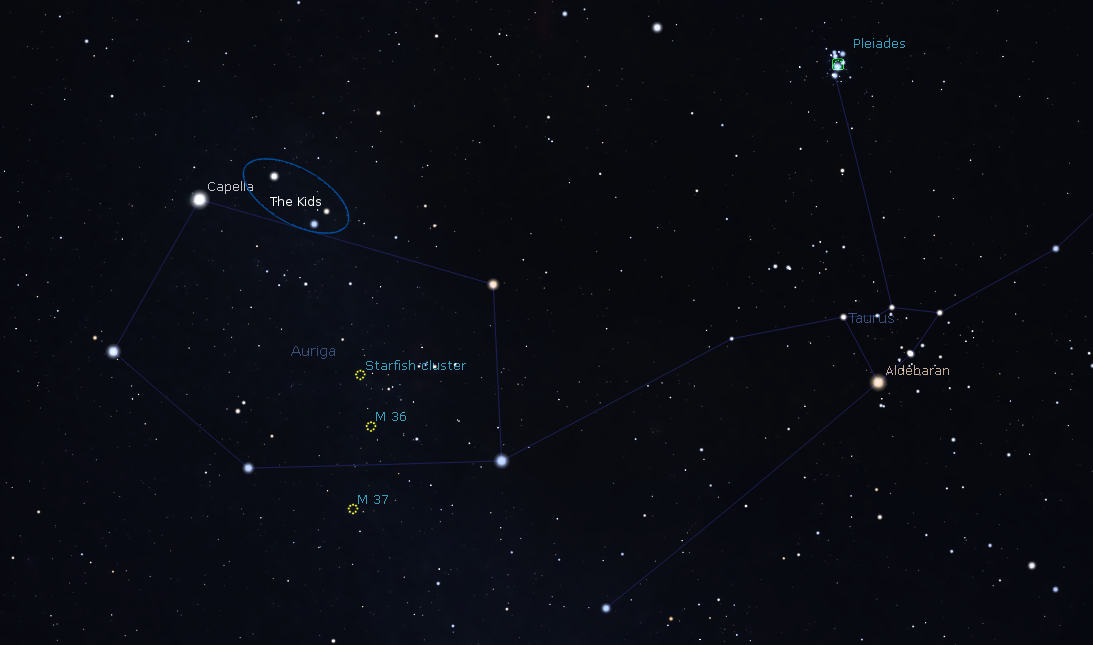
Auriga the charioteer with Capella and the Kids at 8 p.m. December 19, 2016. The object named the Starfish Cluster is M38. To the right is Taurus the bull with the Hyades, his face and above the Pleiades in his shoulder. Created using Stellarium and edited with GIMP. Click on the image to enlarge.
12/16/2016 – Ephemeris – The Pleiades in the mythology of many cultures
Ephemeris for Friday, December 16th. The Sun will rise at 8:14. It’ll be up for 8 hours and 48 minutes, setting at 5:03. The Moon, 3 days past full, will rise at 8:28 this evening.
Let’s look at how some other cultures saw the Pleiades. To the Anishinabek native peoples around here the Pleiades is the “Hole in the Sky” or the seven stones that are heated for the sweat lodge ceremony. To the Kiowa* these were sister stars that had been whisked into the sky from the top of Devils Tower in Wyoming where they were threatened by a huge bear. In Norse mythology these were the goddess Freya’s hens. The name we know them by has rather misty origins. Some think the Greek name is from the mother of the seven sisters, Pleione. The Greek word for sail is similar to Pleiades, and some suggested that the appearance of the Pleiades in the morning sky signaled the best sailing weather in the Mediterranean region.
Times are for the Traverse City/Interlochen area of Michigan. They may be different for your location.
* I originally reported it as Lakota on the program, and earlier as the Sioux.
Addendum
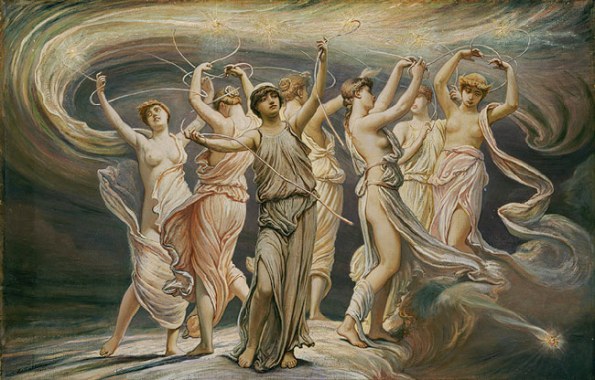
The Greek Pleiades a painting by Elihu Vedder in the Metropolitan Museum of Art, New York City. Public Domain.

Seven maidens being attacked by a giant bear, having fled to the top of Devil’s Tower in Wyoming. Painting by Herbert Collins, www.nps.gov/deto
12/15/2015 – Ephemeris – The Seven Sisters of the Pleiades
Ephemeris for Thursday, December 15th. The Sun will rise at 8:13. It’ll be up for 8 hours and 49 minutes, setting at 5:02. The Moon, 2 days past full, will rise at 7:21 this evening.
While I’ve mentioned the Pleiades with regard to its neighboring stars and constellations several times this autumn I haven’t looked at this beautiful star cluster itself. The Pleiades appears as a group of six or seven stars visible to the naked eye, of over a hundred stars, and is also known as the Seven Sisters. Some also mistake it for the Little Dipper, due to the little bowl shape in the center of the cluster. I call it the “tiny dipper”. The real Little Dipper is now hanging off Polaris in the north. There are a lot of stories about the Pleiades from many different cultures. From the Greek and Roman cultures we get our best known stories of them, that the seven sisters were the daughters of the god Atlas and Pleione. The 9 brightest stars bear the names of the sisters and their parents.
Times are for the Traverse City/Interlochen area of Michigan. They may be different for your location.
Addendum
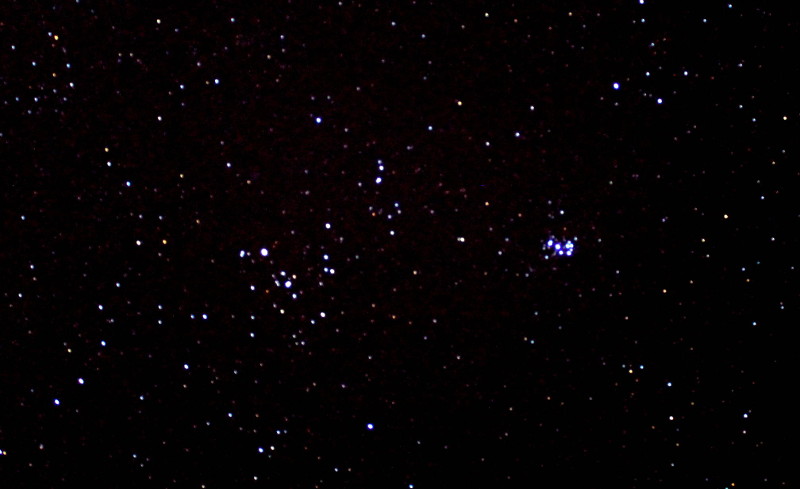
The Pleiades (right) and the Hyades, the face of Taurus the bull (left) in this photograph I took 11:23 p.m. January 4, 2016.
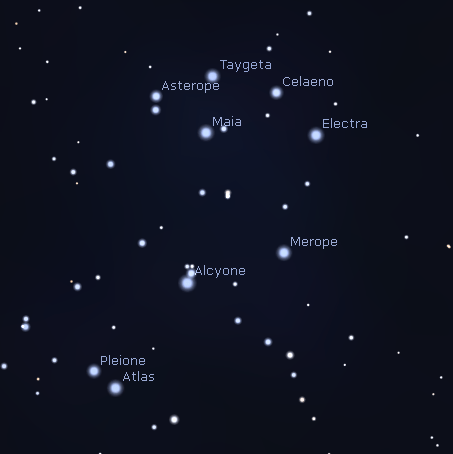
The named stars of the Pleiades. This is also showing more stars than can be seen with the naked eye. This is the number of stars that can be seen in binoculars, which is the best way to observe them. Most telescopes offer too much magnification to fit all the stars in. A thirty power wide angle eyepiece can just fit all the stars in. Created using Stellarium. Note that this view is the orientation of the cluster at 8p.m. tonight.
12/06/2016 – Ephemeris – Capella the northernmost first magnitude star
Ephemeris for Tuesday, December 6th. The Sun will rise at 8:05. It’ll be up for 8 hours and 56 minutes, setting at 5:02. The Moon, 1 day before first quarter, will set at 12:08 tomorrow morning.
A bright star called Capella has slowly been rising in the northeastern sky in the evenings for the past few months. At 8 p.m. now it is low in the east-northeast to the upper left of Orion, rising in the east. This winter Capella will be overhead, the highest of winter’s seven brilliant first magnitude stars. Capella never quite sets for anyone north of Ludington. Due to its brightness, and being the closest first magnitude star to the pole, Capella appears to move slowly as the earth rotates, and spends summer and autumn evenings close to the horizon, and has, in years past, elicited a few phone calls and other queries about that ‘bright object in the northeast’. Capella belongs to the pentagonal constellation of Auriga the charioteer.
Times are for the Traverse City/Interlochen area of Michigan. They may be different for your location.
Addendum
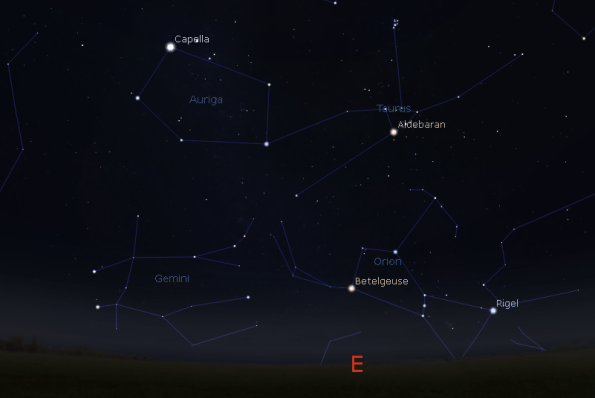
The star Capella with the other stars and constellations of Winter rising in the east. Created using Stellarium.
11/28/2016 – Ephemeris – The Hyades the star cluster in the face of Taurus the bull
Ephemeris for Monday, November 28th. The Sun will rise at 7:57. It’ll be up for 9 hours and 7 minutes, setting at 5:04. The Moon, 1 day before new, will rise at 7:45 tomorrow morning.
Rising in the east now is the bright star Aldebaran an orange star that’s at one end of the sideways letter V of stars that is the head of Taurus the bull. Above it is the jewel-like Pleiades or Seven Sisters star cluster. There’s more to Taurus, like it’s freakishly long horns and front part of its body. But you can say you’ve seem Taurus, if you can spot his face. That V of stars is actually a star cluster called the Hyades, and in Greek Myth were the half-sisters of the Pleiades, also fathered by the god Atlas. Both the Hyades and Pleiades are being pursued by Orion, which as Robert Frost put it is throwing a leg over the eastern horizon at 8 to 9 pm. He isn’t the only one following the Pleiades, the name Aldebaran means “The Follower”.
Times are for the Traverse City/Interlochen area of Michigan. They may be different for your location.
Addendum
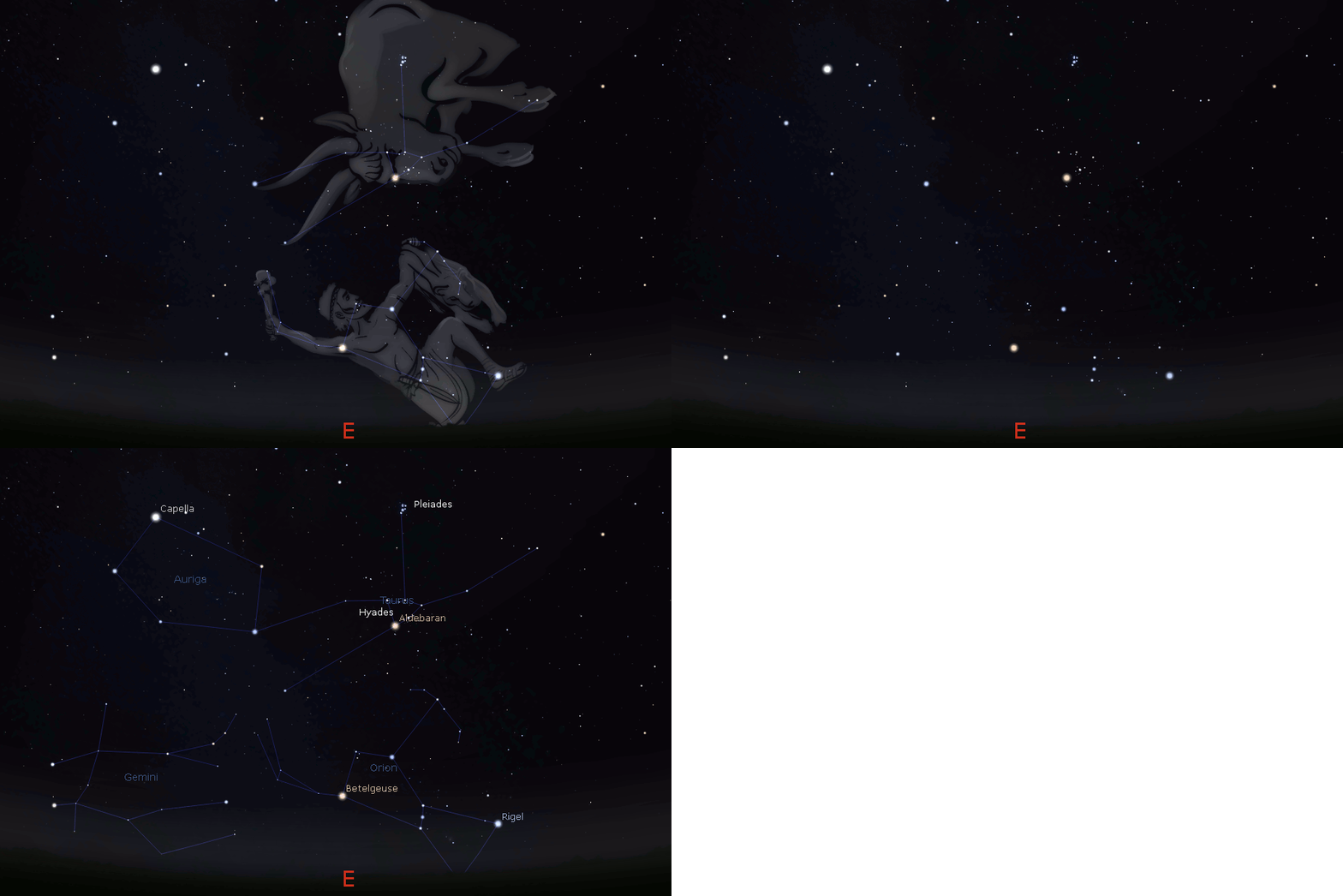
An animation showing the Hyades, Taurus, Orion and the Pleiades. Created using Stellarium and GIMP. Click on image to enlarge.
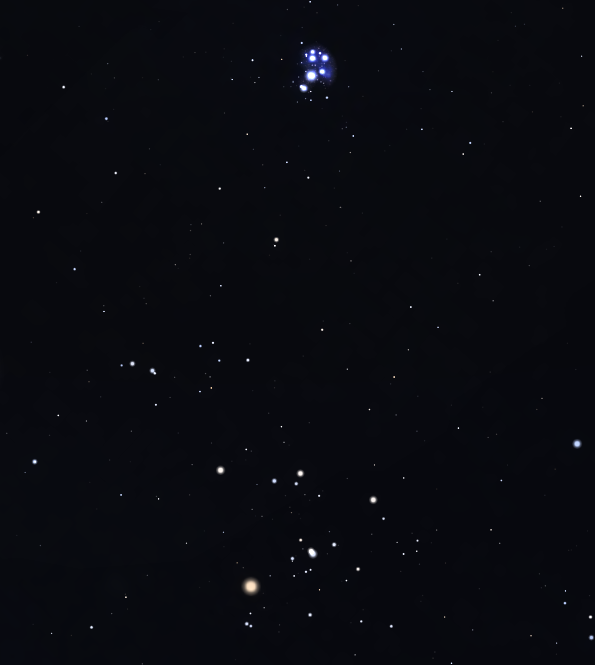
Closeup of the Hyades and the Pleiades. Created using Stellarium.
11/24/2016 – Ephemeris – The little constellation that used to start the seasonal year
Ephemeris for Thanksgiving Day, Thursday, November 24th. The Sun will rise at 7:52. It’ll be up for 9 hours and 14 minutes, setting at 5:06. The Moon, 3 days past last quarter, will rise at 3:54 tomorrow morning.
From antiquity, the first constellation of the Zodiac has been Aries the ram. That’s the constellation the Sun entered on the first day of spring, or the vernal equinox. Well that was a couple of thousand years ago. Currently the vernal equinox point is in western Pisces. This is due to the wobbling of the Earth’s axis called precession. The spinning Earth like and top or gyroscope wobbles when force is applied to it. In this case the Sun and Moon. One wobble takes 26,000 years to complete. Anyway, Aries is a small constellation of four stars in a bent line, below the triangular constellation of Triangulum, which is itself below Andromeda. It’s a bit west or right of the Pleiades or Seven Sisters star cluster.
Times are for the Traverse City/Interlochen area of Michigan. They may be different for your location.
Addendum
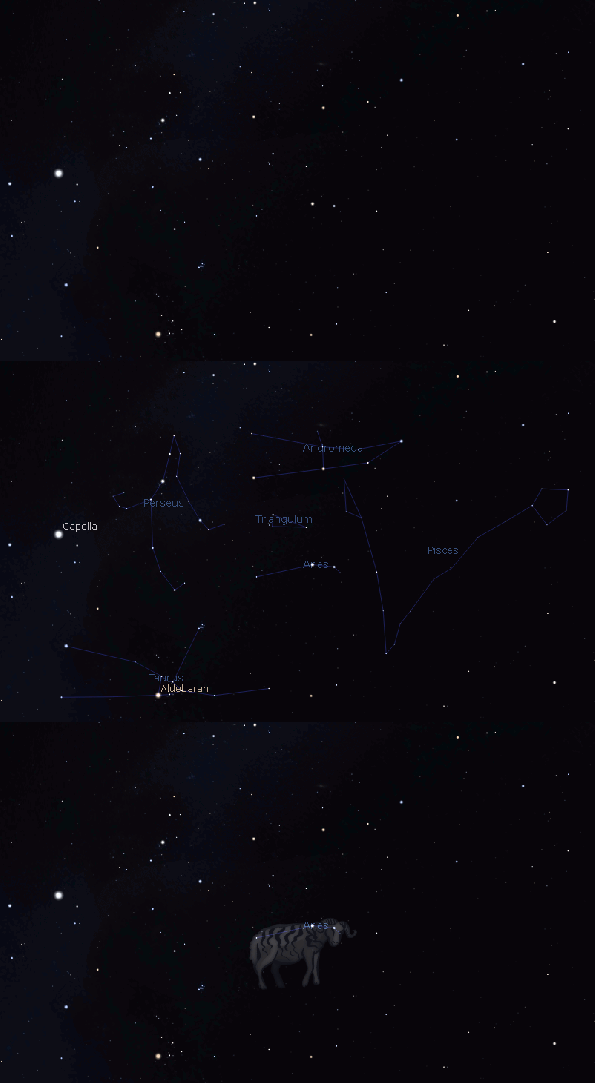
Aries the ram animated finder chart for 9 p.m. November 24, 2016. Created using Stellarium and GIMP.
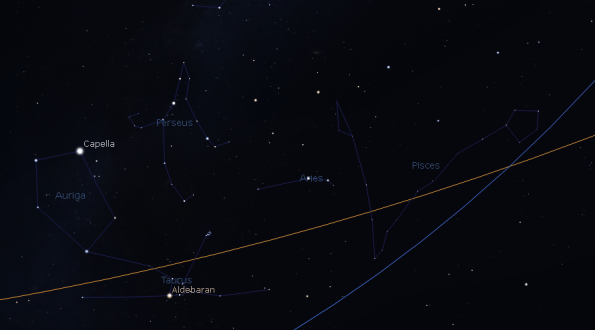
The vernal equinox today, where the blue line, the celestial equator and the orange line, the ecliptic or path of the Sun cross. The Sun is where these lines cross on the first day of spring (March 20th around here). Note that the vernal equinox is now in western Pisces. Created using Stellarium.
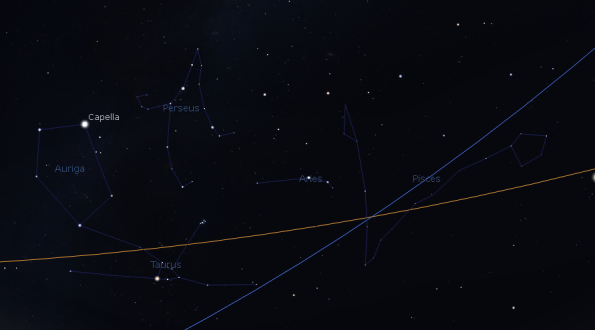
The vernal equinox back in AD 100, where the blue line, the celestial equator and the orange line, the ecliptic or path of the Sun cross. The Sun is where these lines cross on the first day of spring. Note that the vernal equinox was at the east edge of Pisces. Created using Stellarium.
1122/2016 – Cepheus the king and its one really important star
Ephemeris for Tuesday, November 22nd. The Sun will rise at 7:49. It’ll be up for 9 hours and 18 minutes, setting at 5:08. The Moon, 1 day past last quarter, will rise at 1:56 tomorrow morning. | There’s a faint constellation in the north above Polaris. It’s a nearly upside down church steeple of a constellation called Cepheus the king, and husband of queen Cassiopeia the W shaped constellation right of it. Cepheus’ claim to astronomical fame is that one of its stars, Delta (δ) Cephei, is the archetype for the important Cepheid variable stars. Delta is in a trio of stars at the top corner of the constellation, and the one on the right. In the early 20th century Henrietta Leavitt discovered that Cepheids in the nearby galaxy the Large Magellanic Cloud varied in brightness with a period that was related to their average brightness. This meant that Cepheids could be used as standard candles to measure great distances to other galaxies.
Times are for the Traverse City/Interlochen area of Michigan. They may be different for your location.
Addendum
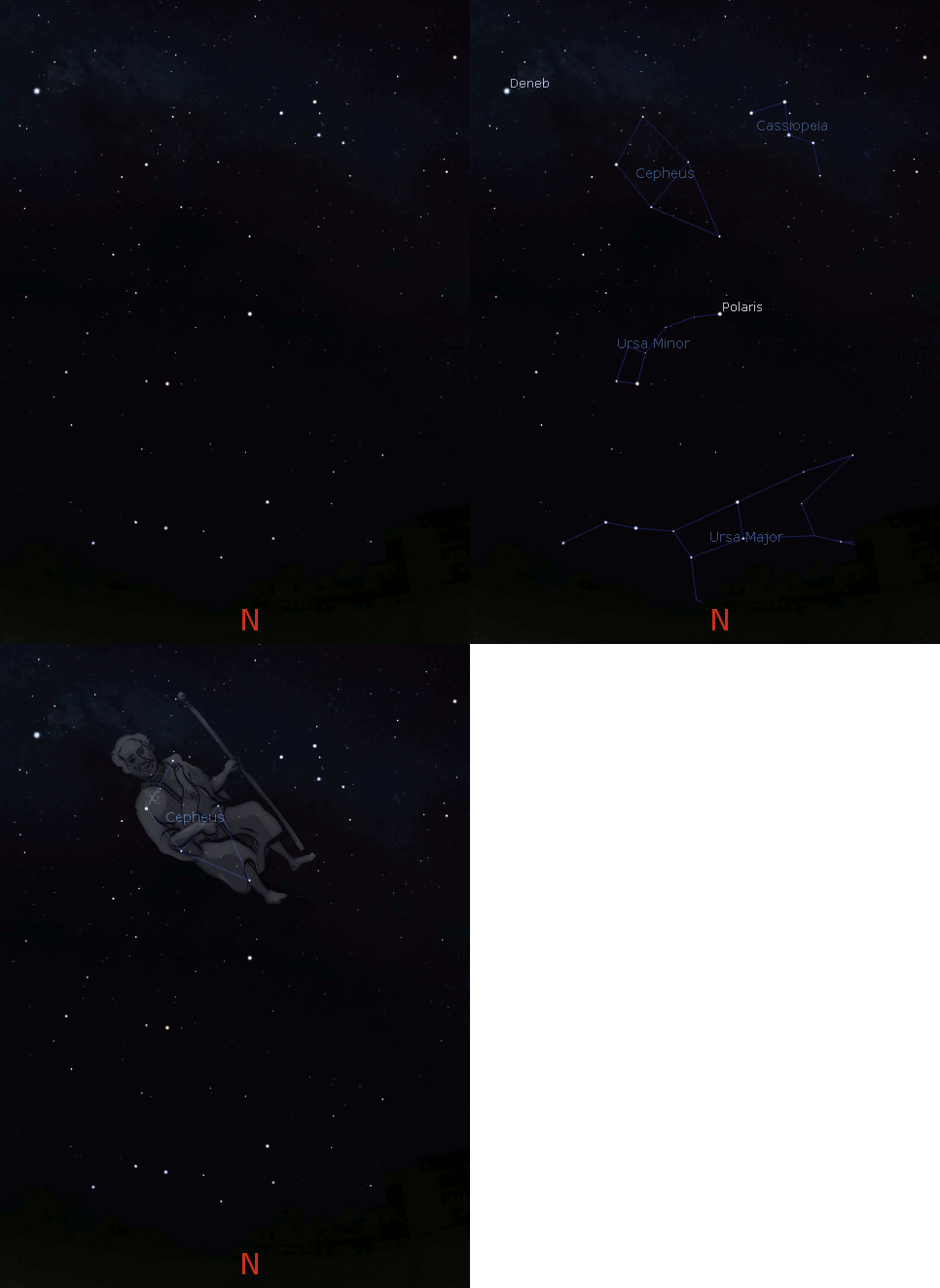
Cepheus animated finder chart for 8 p.m. November 22, 2016. Created using Stellarium and GIMP.
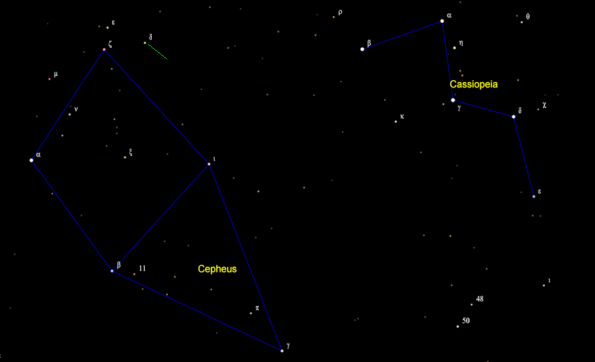
Delta Cephei finder chart. This is the same orientation as the chart above, but created using Cartes du Ciel (Sky Charts). A green line points to Delta (δ) Cephei.
A word about star designations in the chart above. In general only the brightest stars have proper names. And those usually come from antiquity, and most of those are Arabic. Star designations which are Greek lower case letters come from Johann Bayer’s Uranometria star atlas from 1603. He designated the stars by order of brightness. In constellations with a lot of stars he moved to the Latin alphabet after running out of Greek letters. These were, of course, naked eye stars; the atlas being produced a few years before the invention of the telescope. Stars with numbers are Flamsteed designations from John Flamsteed’s 1725 star catalog. He numbered his stars from west to east in a particular constellation, but only those stars that could be seen from Great Britain. A single star can have many catalog designations. For instance the bright star Vega in Lyra the harp is Alpha (α) Lyrae, Bayer designation; 3 Lyrae, Flamsteed designation; HD 172167, Henry Draper catalog; BD +38 3238, Bonner Durchmusterung, a German catalog; HIP 91262, Hipparcos catalog, and so on.
11/21/2016 – Ephemeris – The two fishies of Pisces
Ephemeris for Monday, November 21st. The Sun will rise at 7:48. It’ll be up for 9 hours and 20 minutes, setting at 5:08. The Moon, at last quarter today, will rise at 12:54 tomorrow morning.
High in the south-southeast at 9 p.m. are the four bright stars of the Great Square of Pegasus, the upside down flying horse. Lying along the left and bottom sides of the great square is the constellation of Pisces the fish, one of the 12 constellations of the Zodiac that lie along the path of the sun, moon and planets. Even though the constellation is called the fish, the fish themselves are not represented in the stars. What can be traced in the stars is the rope, that’s tied to their tails, anchored at the extreme southeastern part of the constellation that is seen in the stars. The right or western end of Pisces is the asterism, or informal constellation, of the Circlet. It’s the loop of 5 stars, the rope around the tail of one of the two fish.
Times are for the Traverse City/Interlochen area of Michigan. They may be different for your location.
Addendum
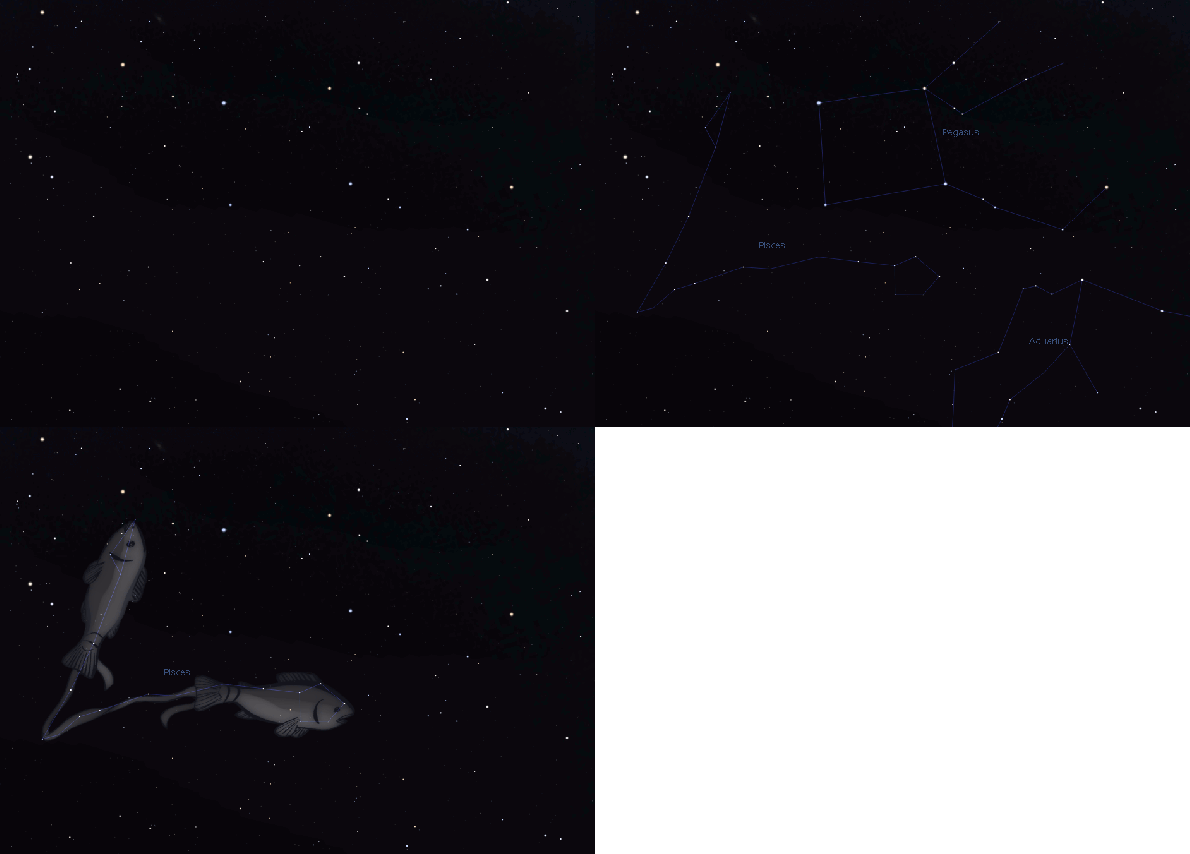
An animation of the constellation of Pisces the fish, showing first the stars, then the constellation outline including those of Pegasus, and Aquarius, then an artist rendering. Created using Stellarium and GIMP.
I don’t care what the artists think, I still think the circlet is a loop around the western fish’s tail.
 Bob Moler's Ephemeris Blog