Archive
08/29/2016 – Ephemeris – The celestial teapot
Ephemeris for Monday, August 29th. The Sun will rise at 7:02. It’ll be up for 13 hours and 21 minutes, setting at 8:23. The Moon, 3 days before new, will rise at 5:11 tomorrow morning.
If the ancient Greeks had teapots the constellation we call Sagittarius might have been Teapotius or something. It’s low in the south at 11 p.m. with the Milky Way rising like steam from its spout. Sagittarius is supposed to be a centaur with a bow and arrow. However to us the dearth of centaurs around outside of Harry Potter books, and there being lots of teapots around, and that great children’s song which perfectly describes the Sagittarius teapot. So the teapot is an asterism, like the Big Dipper, not one of the official constellations. A pair of binoculars is all you need to spot many fuzzy objects in and around Sagittarius. Pay special attention to that steam of the Milky way above the teapot’s spout for many fuzzy objects.
Times are for the Traverse City/Interlochen area of Michigan. They may be different for your location.
Addendum
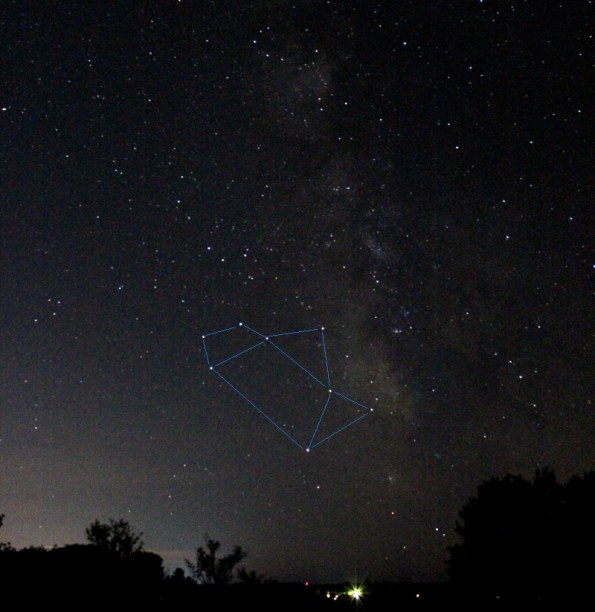
Sagittarius star field showing the Teapot. Credit Bob Moler.
08/25/2016 – Ephemeris – Sagittarius, a very strange archer
Ephemeris for Thursday, August 25th. The Sun rises at 6:57. It’ll be up for 13 hours and 33 minutes, setting at 8:31. The Moon, 1 day past last quarter, will rise at 1:18 tomorrow morning.
Low in the south at 11 p.m. lies the constellation of Sagittarius. The name means archer, but this isn’t just any old fellow with a bow and arrow. It’s a centaur with a bow and arrow. These half man half horse creatures were a rowdy bunch; kind of the ancient Greek counterpart of a motorcycle gang. The one exception is this centaur, Chiron by name. He was highly educated, and learned medicine from the great physician Aesculapius, whom we see in the sky to the upper right as the constellation Ophiuchus. His drawn bow and arrow can also be seen in the stars here, pointing to Scorpius the scorpion’s heart. If it’s hard seeing a Centaur here don’t be disappointed. To most of us the constellation looks like a stout little teapot.
Times are for the Traverse City/Interlochen area of Michigan. They may be different for your location.
Addendum
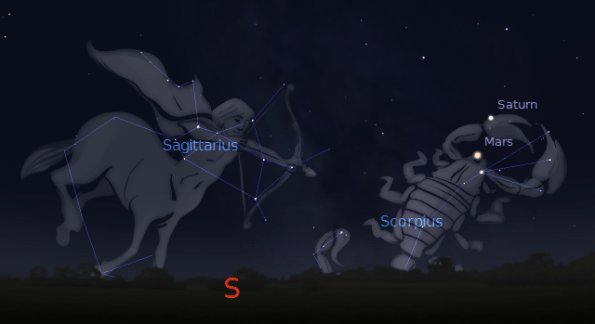
Sagittarius taking aim at Scorpius with Mars and Saturn at 10 p,m. August 25, 2016. Created using Stellarium.
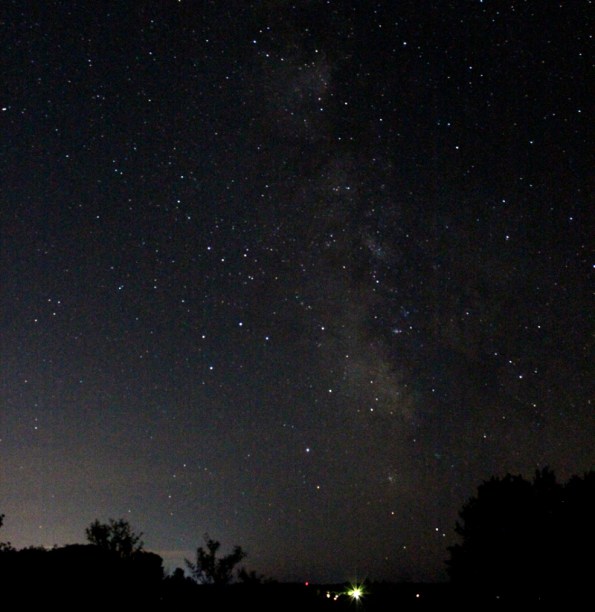
Actual Sagittarius star field where the Teapot is easily seen. Credit Bob Moler.
“I’m a little teapot short and stout…” Children’s song.
Ephemeris Extra – Sightseeing around the Summer Triangle
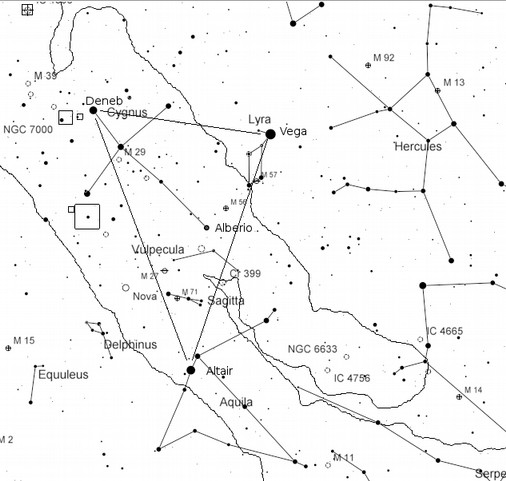
The Summer Triangle and some Deep-Sky treasures within and nearby. Created using Cartes du Ciel (Sky Charts).
Published in the Grand Traverse Astronomical Society’s August 2016 Stellar Sentinel Extras section, updated from an article first published in 1998
One of the signs that summer is here is the appearance of the Summer Triangle in the evening sky. Three of the brightest stars of summer are arranged in a large beautiful triangle. The Summer Triangle isn’t an official constellation. It is an informal one, which is called an asterism. The Big Dipper is another famous asterism.
Each of the triangle stars belongs to its own separate constellation. At the top of our chart is Deneb, the dimmest of the three in our sky at magnitude +1.25. However it is actually the brightest of the three. It suffers only due to its distance of 2,600 light years. Its absolute magnitude, its magnitude if it were 10 parsecs or 32.6 light years away, is -8.4, as bright as the quarter moon. Deneb is situated at the tail of the Cygnus the swan. The word Deneb means tail. It’s actually part of a longer Arabic phrase the means “Tail of the Hen”.
Brightest from our point of view is Vega in Lyra the harp. Vega means either “Falling Eagle” or “Falling Vulture”. Vega is close to the sun, at 25 light years. It’s apparent magnitude is +0.03, with an absolute magnitude of +0.5.
Closest of the three is Altair in Aquila the eagle which is only 16.7 light years away, at magnitude +0.77 with an absolute magnitude of +2.2. It spins rapidly, once in 8.9 hours, creating a decidedly oblate shape with an equatorial radius of 2 times the Suns radius and a polar radius of 1.6 times.
The area in and around the Summer Triangle is a wonderful hunting ground for a telescope. They include binary stars and deep sky objects.
Alberio, the star at the beak of Cygnus the swan is a beautiful maize and blue pair, which I have dubbed the “U of M Star” (University of Michigan’s Maize and Blue) at the public viewing nights. Sorry State fans, I don’t know of a green and white binary. It’s a wide pair, but requires more than a pair of binoculars.
Another neat binary star is Epsilon Lyrae, just to the left of Vega. It shows as a wide pair of equally bright stars in binoculars. A telescope reveals, upon close inspection, that each is again a bin ary. Epsilon Lyrae is the famous double-double star, And splitting them is a good test of telescope and atmospheric seeing.
Just about centered between the two stars at the south end o f the parallelogram of Lyra can be found one of the really special faint wonders of the sky. It is M57, 57th object of Charles Messier’s list of objects that look like comets but aren’t. It is better known as the Ring Nebula. It is one of a class of objects known as planetary nebulae. Planetary nebulae have nothing to with planets, but many of them look like Uranus or Neptune, being faint small greenish or bluish in color. Anyway, the ring, and all planetaries are the result of the SlimStar™ plan of rapid mass loss. It is something small stars like the Sun do when out of fuel and are in the final collapse to white dwarfhood. The outer layers of the star are pushed out to form many wonderful shapes. The Ring Nebula apparently is a torus about half a light year in diameter and about 2,300 light years away. Though small and bright in telescopes, it is invisible in finder telescopes. See the Hubble image of it on page E-4.
Another planetary is M27, also known as the Dumbbell Nebula is located just north of the tip star of Sagitta the arrow. This is a tough one to find, and like M57 is invisible in finders. The Dumbbell is large, but with a low surface brightness. The two glowing lobes of gas first visible give the object its name. Much finer detail is visible to the careful observer. It’s distance is thought to be about 1,360 light years, which makes its diameter nearly 3 light years.
The greatest globular star cluster in this area is M13 the Great Hercules Globular Star Cluster which is located along the western edge of the ‘Keystone’ part of Hercules. The fuzzy blob that is visible in binoculars and small telescopes begins to resolve itself into stars in telescopes of 6 inch diameter and larger. M13 contains upwards of a million stars packed in a diameter of 168 light years and is located some 22,200 light years away. Globulars are ancient clusters that trace there origins to the formation of the Milky Way. Other globulars in this area are M92, also in Hercules, M56 in Lyra, M14 in Ophiuchus, the serpent bearer, M15 in Pegasus, and perhaps M71 in Sagitta the arrow. M71 may be a sparse globular or very compact galactic cluster.
Galactic or open clusters here are M11, off the tail of Aquila the eagle, M39 and M29 in Cygnus. M11, which is actually in Scutum the shield is among the finest of its type. It takes a telescope of 6 inches diameter to completely resolve it. M11 is also called the Wild Duck Cluster, perhaps due to its vaguely triangular appearance.
The Summer Triangle provides a wealth of objects to view and study, Some are among the finest of all the heavens.
08/02/2016 – Ephemeris – The Scorpion has visitors this year
Ephemeris for Tuesday, August 2nd. The Sun rises at 6:30. It’ll be up for 14 hours and 35 minutes, setting at 9:06. The Moon is new today, and won’t be visible.
There’s a large constellation located low in the south as it gets dark about 10:30 tonight It’s Scorpius the scorpion. Its brightest star is Antares in its heart, a red giant star whose name means “Rival of Mars”. From Antares to the right is a star then a vertical arc of three stars that is its head. The Scorpion’s tail is a line of stars running down to the left of Antares swooping near the horizon before coming back up and ending in a pair of stars that portray his poisonous stinger. This year the planet Saturn appears almost directly above Antares. Tonight Mars is right of Antares. On the 23rd of this month Mars will pass just above
Antares, between it and Saturn, making line of three bright objects. Mars is currently brighter than Antares.
Times are for the Traverse City/Interlochen area of Michigan. They may be different for your location.
Addendum
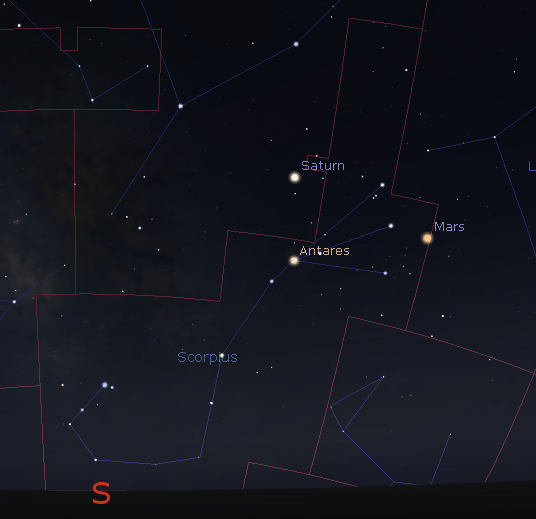
Scorpius with Mars and Saturn at 10:30 p.m. August 2, 2016. Created using Stellarium.
The red lines are the official constellation boundaries by the International Astronomical Union. From the look of some of the boundaries, astronomers apparently gerrymander as well as our politicians.
For those unfamiliar with gerrymandering put “gerrymander” in your favorite search engine or Wikipedia.
07/29/2016 – Ephemeris – Aquila the Eagle, third constellation of the Summer Triangle
Ephemeris for Friday, July 29th. The Sun rises at 6:26. It’ll be up for 14 hours and 45 minutes, setting at 9:11. The Moon, 3 days past last quarter, will rise at 3:20 tomorrow morning.
Aquila the eagle is a constellation that lies in the Milky Way. It’s in the southeastern sky as it gets dark. Its brightest star, Altair is one of the stars of the Summer Triangle, a group of three bright stars seen now in the eastern sky in the evening. Altair, in the head of the eagle, is flanked by two slightly dimmer stars, the shoulders of the eagle. The eagle is flying northeastward through the Milky Way. Its wings are seen in the wing tip stars. A curved group of stars to the lower right of Altair is its tail. Within Aquila the Milky Way shows many dark clouds as part of the Great Rift that splits it here. The other summer bird is Cygnus the swan, which I talked about Tuesday, above and left of Aquila, flying in the opposite direction.
Times are for the Traverse City/Interlochen area of Michigan. They may be different for your location.
Addendum
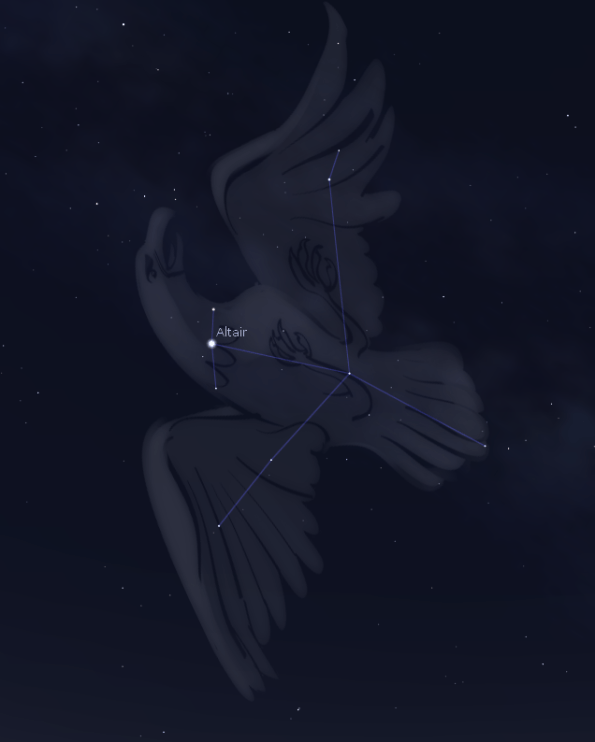
Aquila the Eagle in the southeastern sky. Created using Stellarium.
074/26/2016 – Ephemeris – The flying swan and Northern Cross
Ephemeris for Tuesday, July 26th. The Sun rises at 6:22. It’ll be up for 14 hours and 52 minutes, setting at 9:15. The Moon, at last quarter today, will rise at 1:09 tomorrow morning.
Fairly high in the east at 11 p.m. Is the constellation of Cygnus the swan, flying south through the Milky Way. It is also called the Northern Cross. At the left, the tail of the swan or the head of the cross is the bright star Deneb, one of the stars of the Summer Triangle. The next star right is Sadr the intersection of the body and the wings of the swan seen in flight, or the intersection of the two pieces of the cross. There are two or three stars farther to the right that delineate the swan’s long neck or upright of the cross, that ends with the star Alberio in the beak of the swan or foot of the cross. It takes a telescope, but Alberio splits into a beautiful blue and gold binary star.
Times are for the Traverse City/Interlochen area of Michigan. They may be different for your location.
Addendum
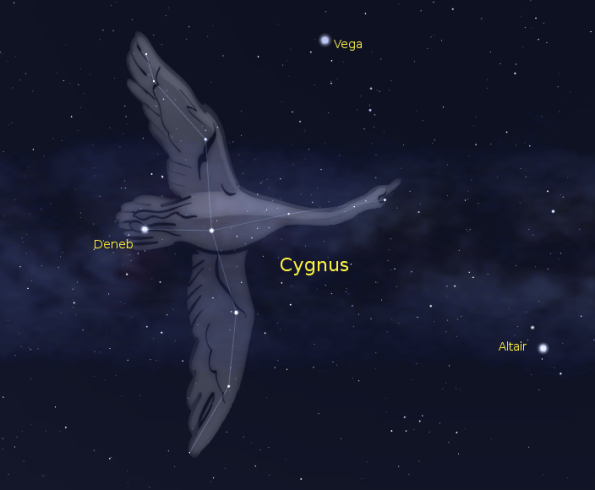
Cygnus the Swan Created using Stellarium.
07/25/2016 – Ephemeris – Hermes’ Harp
Ephemeris for Monday, July 25th. The Sun rises at 6:21. It’ll be up for 14 hours and 54 minutes, setting at 9:16. The Moon, 1 day before last quarter, will rise at 12:34 tomorrow morning.
High up in the eastern sky at 11 p.m. can be found a bright star just north of a small, narrow, but very distinctive parallelogram of stars. They are the stars of the constellation Lyra the harp. The bright star is Vega, one of the twenty-one brightest stars, first magnitude stars. Vega is actually the 5th brightest night-time star. The harp, according to Greek mythology, was invented by the Greek god Hermes. The form of the harp in the sky, is as he had invented it: by stretching strings across a tortoise shell. Hermes gave it to his half-brother Apollo, who in turn gave it to the great musician Orpheus. In binoculars, near Vega, two stars appear together. They barely appear to the unaided eye as one star, called Epsilon Lyrae.
Times are for the Traverse City/Interlochen area of Michigan. They may be different for your location.
Addendum
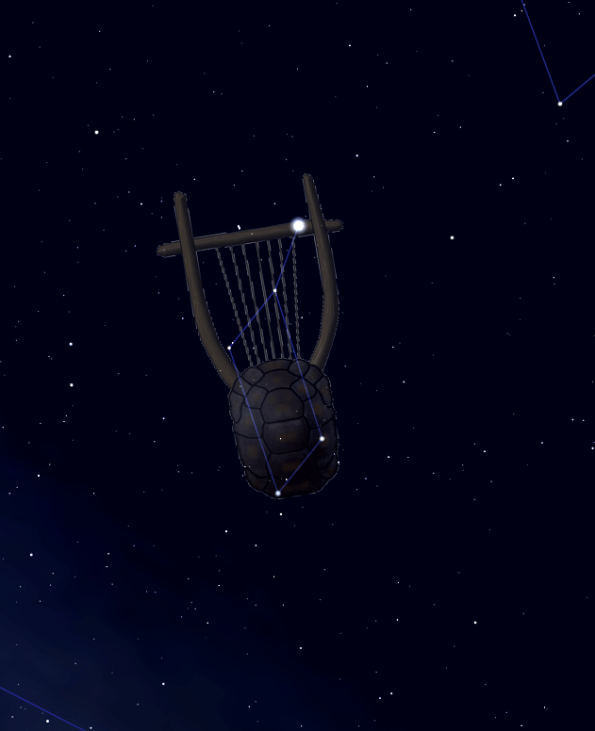
Lyra as a tortoise shell harp. Created using Stellarium and free clip art.
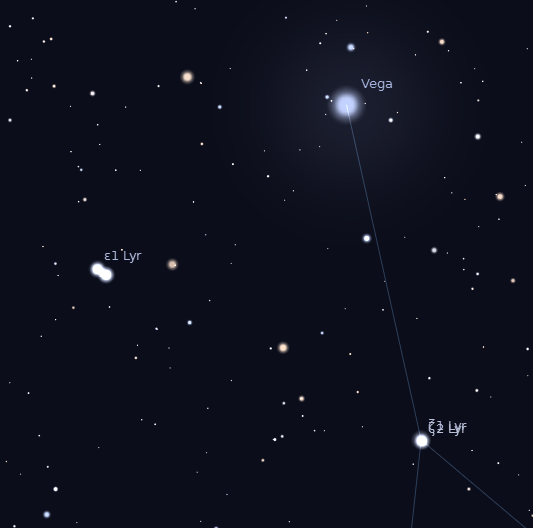
Closeup on Vega and Epsilon Lyrae. Created using Stellarium.
07/07/2016 – Ephemeris – The snake handler in the sky
Ephemeris for Thursday, July 7th. Today the Sun will be up for 15 hours and 24 minutes, setting at 9:30, and it will rise tomorrow at 6:06. The Moon, 3 days past new, will set at 11:31 this evening.
Saturn and the red star Antares shine in the south at 11 p.m. In the area of sky above it lies a large constellation of faint stars called Ophiuchus, the serpent bearer. Ophiuchus represent the legendary physician Aesculapius. The constellation shape is like a large bell, which reminds me of the head, shoulders and arms of a fellow that’s holding the snake-like a weight lifter struggling to pull up a heavy barbell. Serpens, the constellation of the serpent is in the sky in two sections. The front end lies to the right as Serpens Caput, and wends its way up towards Corona Borealis, the Northern Crown. Serpens Cauda, the tail rises to the left of Ophiuchus. It’s a rewarding sight, and not that hard to spot.
Times are for the Traverse City/Interlochen area of Michigan. They may be different for your location.
Addendum
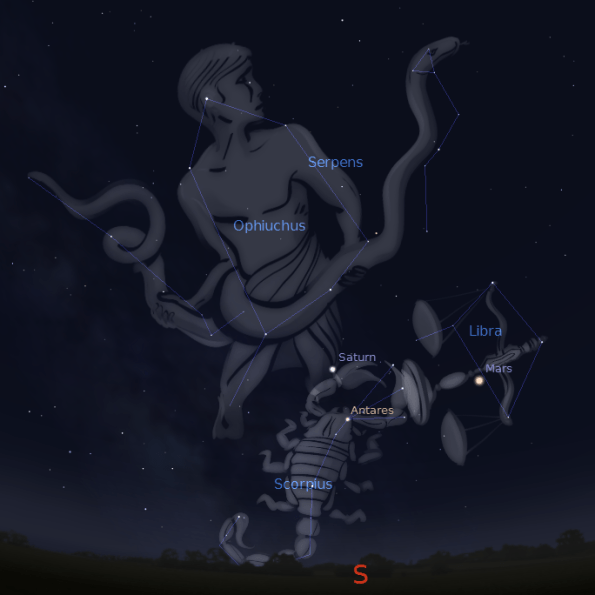
The figure of Ophiuchus with Saturn and Mars nearby at 11 p.m. July 7, 2016. Created using Stellarium.
07/05/2016 – Ephemeris – Poor Hercules
Ephemeris for Tuesday, July 5th. Today the Sun will be up for 15 hours and 26 minutes, setting at 9:30, and it will rise tomorrow at 6:04. The Moon, 1 day past new, will set at 10:17 this evening.
Orion, an obscure Greek hero gets a splashy constellation in the winter sky, but the greatest hero of all, Hercules, gets a dim group of stars on the border between the spring and summer stars. At 11 p.m. Hercules is high and nearly overhead. It’s located above and right of the bright star, Vega, high in the east. Hercules’ central feature is a keystone shaped box of stars, called the Keystone, which represents the old boy’s shorts. From each top corner extend lines of stars that are his legs, from the bottom stars, the rest of his torso and arms extend. So in one final indignity he’s upside down in our sky. Some see him crouched down, club upraised holding the multi-headed Hydra about to throttle it.
Times are for the Traverse City/Interlochen area of Michigan. They may be different for your location.
Addendum
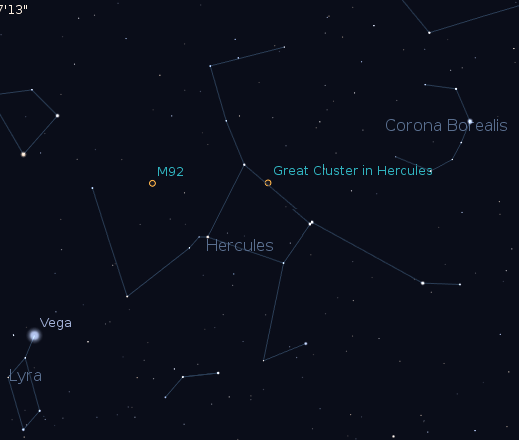
The constellation Hercules and his neighbors. Created with Stellarium.
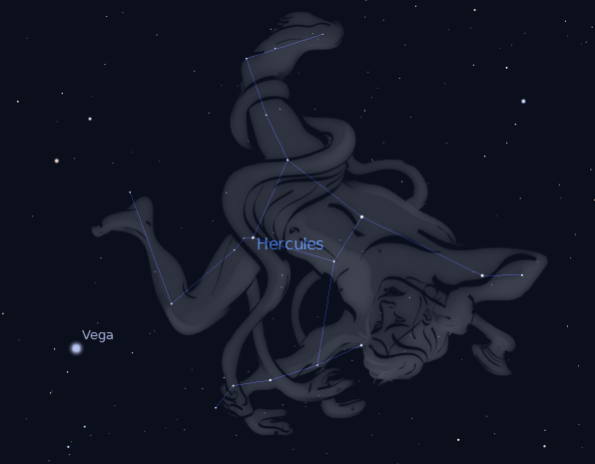
Hercules, visualized by Johan Meuris of the Stellarium development team.
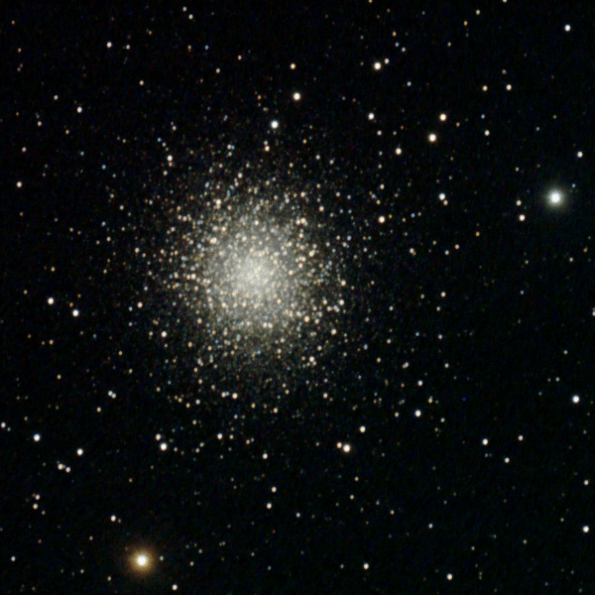
M13, the Great Globular Star Cluster in Hercules. Credit: Scott Anttila.
06/28/2016 – Ephemeris – Corona Borealis, the Northern Crown
Ephemeris for Tuesday, June 28th. Today the Sun will be up for 15 hours and 32 minutes, setting at 9:32, and it will rise tomorrow at 6:00. The Moon, 1 day past last quarter, will rise at 2:31 tomorrow morning.
High in the south at 11 p.m. can be found a small but easily spotted constellation of Corona Borealis, the Northern Crown. It is located just east or left of the kite shaped constellation of Boötes, with its bright star Arcturus at the bottom. The Northern Crown is a three-quarters circle of stars, like a tiara, with a brighter star Alphecca or Gemma at the bottom. Alphecca in Arabic means “Bright star of the broken ring of stars”. Gemma could mean gem or a bud or blossom, so Corona Borealis could represent a floral crown. According to Greek mythology it belonged to Princess Ariadne, daughter of King Minos of Crete who helped Theseus escape from the Labyrinth of the Minotaur, only to be abandoned by him on an island.
Times are for the Traverse City/Interlochen area of Michigan. They may be different for your location.
Addendum
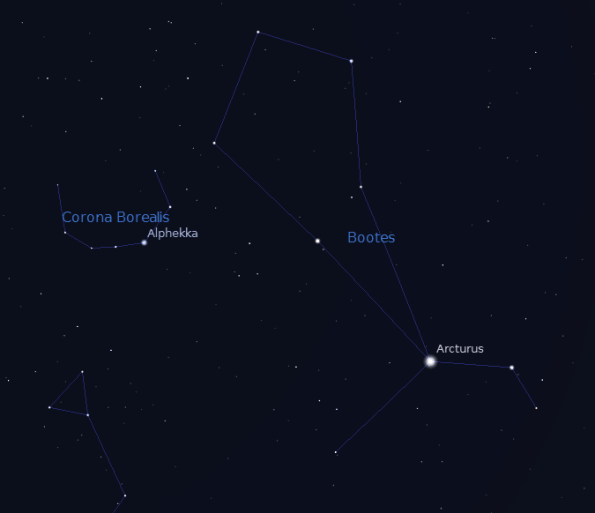
Corona Borealis tonight, June 28, 2016. Alphekka is the alternate spelling, European, of Alphecca. Created using Stellarium.
 Bob Moler's Ephemeris Blog