Archive
The story of the Fisher Star
The Anishinaabe peoples have lived in the Great Lakes area since way before the coming of the Europeans. They are comprised of the Ojibwe, Ottawa, Chippewa and even Algonquin tribes. While some did see a bear in the stars and around the Big Dipper sans tail. Most of the stories concern the Fisher or Fisher Star.
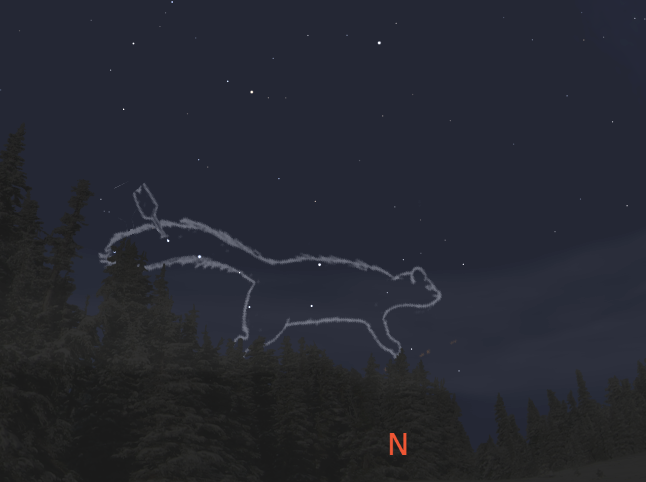
The Fisher Star in Autumn painting the leaves with his tail. Created using Stellarium and other sources.
By the way, the thee stars of the handle of the Big Dipper were hunters that were following the bear. The hunter denoted by the star Mizar at the bend in the handle of the dipper had a dog with him, the star we call Alcor, that make it an intriguing double for folks with good eyesight.
Fisher is supposed to be a weasel-like animal, intelligent, and a great hunter. He lived in a world that was snow covered and cold year round, where food was scarce. Perhaps this story is a cultural remembrance of the last glaciation period. Contrary to his name Fisher didn’t fish.
One day his son came to him with a request to bring summer, for he was cold and hungry. Fisher decided to somehow get to Skyland and tap into its warmth. He brought together his three bravest friends for the journey: Otter, Lynx, and Wolverine. They set out to seek the tallest mountains so they could reach Skyland.
When they had climbed the tallest mountain they found that Skyland was just out of reach. If they could only crack through. Otter tried first. He jumped first and bounced off. He fell back and slid completely down the mountain on his belly. It was so much fun that this is what otters do to this day. The lynx tried. He jumped up and hit his head and was knocked unconscious.
The wolverine was persistent. He jumped time after time and was finally able to chew a hole in the base of Skyland. When it was large enough he scampered through. Fisher was sure the hole wasn’t large enough, and that the inhabitants of Skyland would soon cover it up. So he chewed and chewed, enlarging the hole so the Skyland people couldn’t cover it for more than half the year.
As he was finishing up the hole the Skyland people discovered him. He boasted to them; “I am Fisher, the great hunter, you cannot catch me.” he jumped to the nearest tree and climbed to the top. The sky people shot arrows at him, but he had a special power making him impervious to arrows except for a particular spot on his tail. Kind of an Achilles tail, to mix my legends. Well, after some time the sky people got wise to Fisher’s protections and an arrow found the vulnerable spot in his tail and he fell out of the tree. Before Fisher’s body could fall to the ground the Great Spirit, Gitchee Manitou, caught him and placed him in the night sky to herald the seasons Fisher had created for the earth. In the sky Fisher’s tail is the handle of the Big Dipper. Tiny Alcor signifies the spot where the arrow hit. Every fall as Fisher’s tail passes over the northern horizon the blood in his wound paints the autumn leaves red. In late winter as he rises again in the northeast it is time to begin tapping the maple trees.
Sources: Keepers of the Earth, by Michael Caduto and Joseph Bruchac, and Anishinaabe Star Knowledge by Michael Wassegijig Price. Thanks also to Nodwese Red Bear.
10/09/2012 – Ephemeris – Capricornus the sea-goat
Ephemeris for Tuesday, October 9th. The sun will rise at 7:50. It’ll be up for 11 hours and 16 minutes, setting at 7:07. The moon, 1 day past last quarter, will rise at 2:16 tomorrow morning.
The sky around 9 p.m. when it gets dark is that of summer stars overhead and to the west while the stars of autumn approach from the east. The southern terminus of the Milky Way will reach the horizon in the southwest. The teapot shaped constellation of Sagittarius is tipped as if pouring its contents on the southwestern horizon. To the south is found the next constellation of the Zodiac Capricornus the sea goat. Capricornus doesn’t have as bright a stars as Sagittarius. It looks like the stars trace a sagging triangle. Capricornus used to be the southernmost constellation of the Zodiac in ancient times, but precession, the slow wobbling of the earth’s axis, has shifted Sagittarius to that position now.
Times are for the Traverse City/Interlochen area of Michigan. They may be different for your location.
Addendum
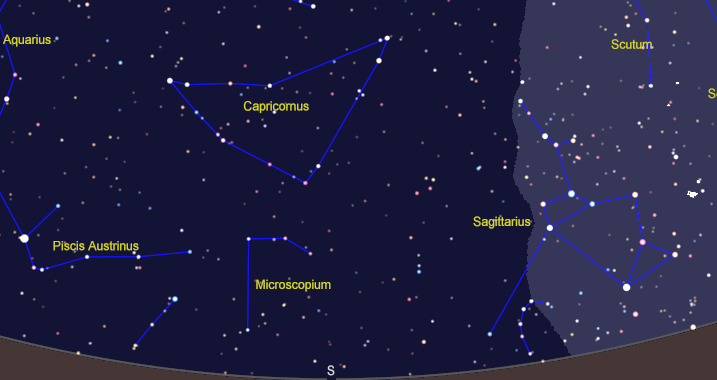
Capricornus the way I see it. Created using Cartes duCiel.
09/27/2012 – Ephemeris – The Fisher in the stars
Ephemeris for Thursday, September 27th. The sun will rise at 7:36. It’ll be up for 11 hours and 53 minutes, setting at 7:29. The moon, 2 days before full, will set at 6:06 tomorrow morning.
The Big Dipper is swooping low in the northwestern sky in the evening now. The Big Dipper is not a constellation but part of the Great Bear for most peoples, and is enshrined by the International Astronomical Union as Ursa Major. To some of the Anishinabek peoples native to our region the stars of the Big Dipper belonged to a small weasel like animal call the Fisher. In a story I can’t relate here Fisher brought summer to the earth, and for his trouble was killed by an arrow to his only vulnerable spot, his tail. The Great Spirit would not let Fisher fall to earth, but placed him in the sky. His rising in the northeast signals the coming of spring, and when his bloody tail brushes the horizon in autumn his blood paints the maple trees red.
Times are for the Traverse City/Interlochen area of Michigan. They may be different for your location.
Addendum
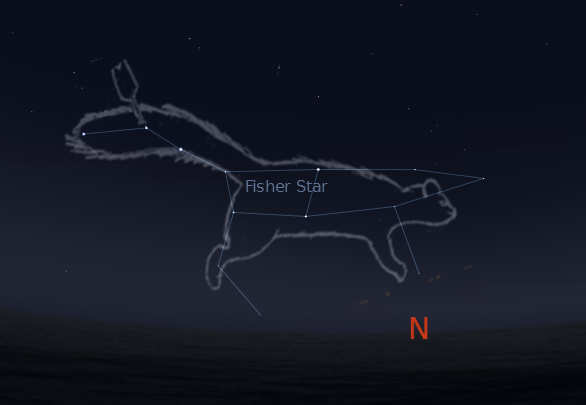
The Fisher heads towards the northern horizon. Created using Stellarium and an unknown artist which I took liberties with.
The Fisher is also known as the Fisher Star (Ojiig’anung). I’ll have my version of the story posted soon.
The Fisher heads towards the northern horizon. Created using Stellarium and an unknown artist which I took liberties with.
09/18/2012 – Ephemeris – The center of the Milky Way
Ephemeris for Tuesday, September 18th. The sun will rise at 7:25. It’ll be up for 12 hours and 21 minutes, setting at 7:46. The moon, 3 days past new, will set at 8:58 this evening.
Look to the south southwest at 10 p.m. At the constellation of Sagittarius, which looks like a teapot. It’s located at the south end of the Milky Way. Just off the spout of the teapot lies, beyond the clouds of stars, gas and dust, at a distance of about 27,000 light years, the center of the Milky Way. The center contains a 4 million sun mass black hole with a bevy of stars orbiting around it like planets orbit the sun. Black holes are so massive that, nothing, not even light can escape their gravity. Lots of energy is released by matter falling in to a black hole. Currently our Milky Way’s black hole is quiet, nothing of note is falling in. However there is a cloud of gas and dust approaching the black hole, so its quiet phase may end next year.
Times are for the Traverse City/Interlochen area of Michigan. They may be different for your location.
Addendum
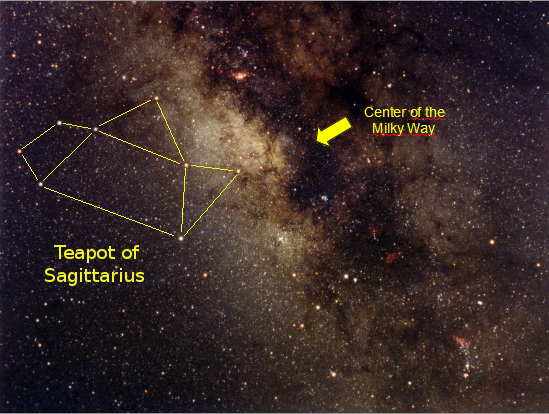
Location of the center of the Milky Way and the Teapot of Sagittarius.
While the actual center of the galaxy cannot be seen in optical wavelengths it is visible in radio, infrared and x-rays. The black hole at the center of the Milky Way is designated Sagittarius A* (pronounced Sagittarius A Star). Check it out in Wikipedia and other sources.
09/17/2012 – Ephemeris – Cygnus and the search for exo-planets
Ephemeris for Monday, September 17th. The sun will rise at 7:24. It’ll be up for 12 hours and 24 minutes, setting at 7:48. The moon, 2 days past new, will set at 8:21 this evening.
Nearly overhead at 10 p..m. is the constellation Cygnus the swan. The bright star Deneb is at the tail of this flying swan with its wings outstretched, flying south through the Milky Way. Cygnus is located at a point in the Milky Way in the direction the sun’s orbiting the center of the Milky Way. That is the approximate direction the Kepler spacecraft is staring. Launched in 2009 the Kepler spacecraft has been slowly drifting away from the earth in a trailing orbit of the sun. It is monitoring over 100,000 stars continuously looking for transits of planets across their stars. So far some 2300 suspects have been found. They have to be confirmed by ground based telescopes before being officially cataloged. So far close in planets to their stars have been discovered.
Addendum
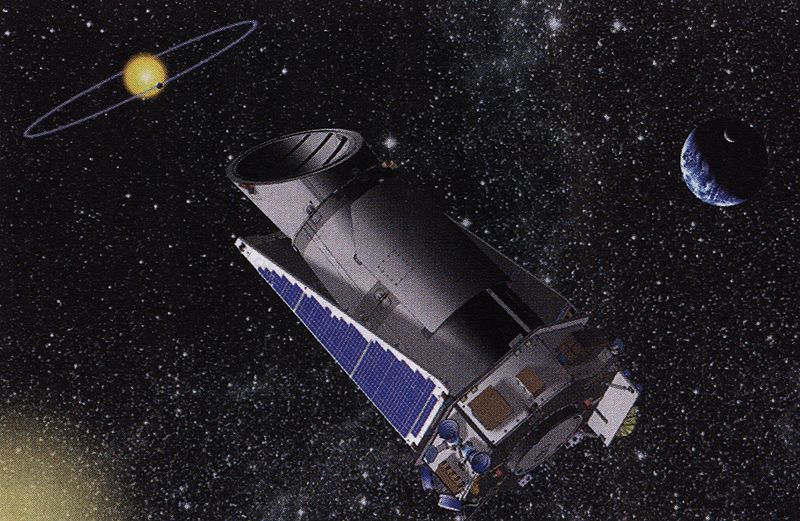
Kepler Spacecraft. Credit NASA.
Click image to enlarge.
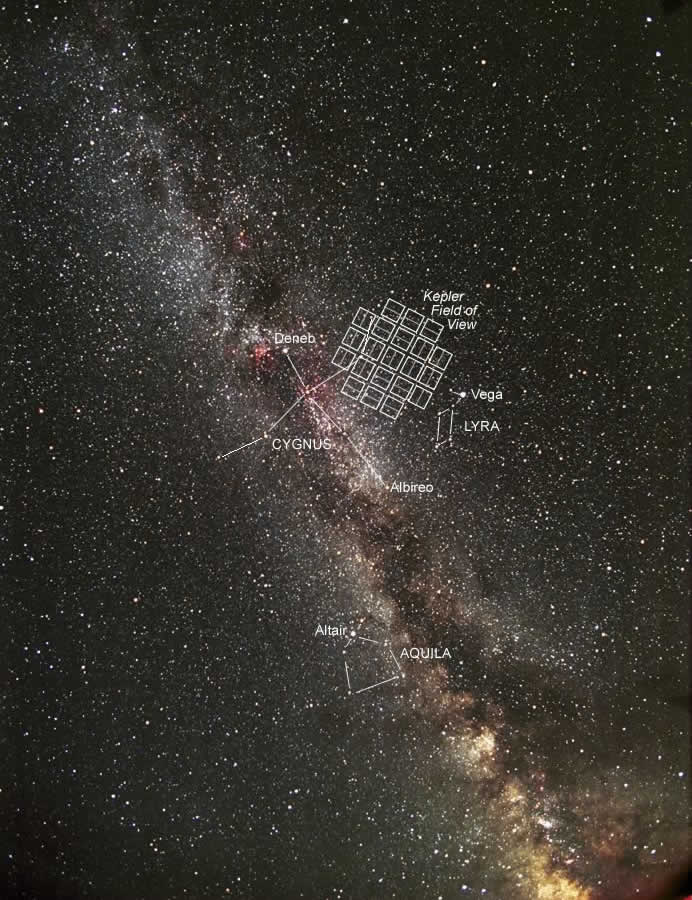
Kepler field of view. Credit C. Roberts, NASA.
Click image to enlarge.
Link to Kepler’s home page: http://kepler.nasa.gov/
09/11/2012 – Ephemeris – The constellation Sagittarius the archer
Ephemeris for Tuesday, September 11th. The sun will rise at 7:17. It’ll be up for 12 hours and 42 minutes, setting at 7:59. The moon, 3 days past last quarter, will rise at 3:28 tomorrow morning.
Low in the south at 10 p.m. lies the constellation of Sagittarius. The name means archer, but this isn’t just any old fellow with a bow and arrow. It’s a centaur with a bow and arrow. These half man half horse creatures were a rowdy bunch; kind of the ancient Greek counterpart of a motorcycle gang. The one exception is this centaur, Chiron by name. He was highly educated, and learned medicine from the great physician Aesculapius, whom we see in the sky to the upper right as the constellation Ophiuchus. His drawn bow and arrow can also be seen in the stars here, pointing to Scorpius the scorpion’s heart. If it’s hard seeing a Centaur here don’t be disappointed. To most of us the constellation looks like a stout little teapot.
Times are for the Traverse City/Interlochen area of Michigan. They may be different for your location.
Addendum
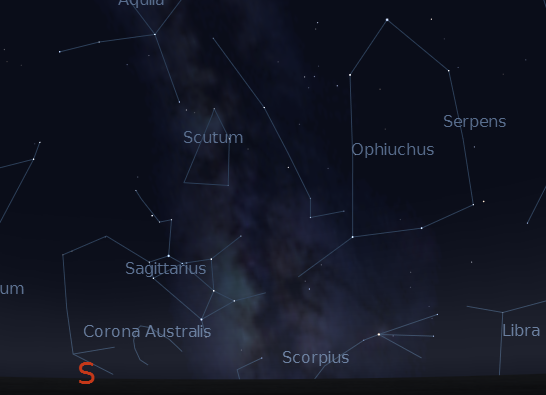
Sagittarius and the Milky Way September 11, 2012 10 p.m. Created using Stellarium.
09/10/2012 – Ephemeris – The constellation Cepheus the king
Ephemeris for Monday, September 10th. The sun will rise at 7:16. It’ll be up for 12 hours and 45 minutes, setting at 8:01. The moon, 2 days past last quarter, will rise at 2:25 tomorrow morning.
The stars of autumn are taking over the eastern evening sky as the equinox approaches. Looking to the northeastern sky at 10 p.m. we find the W shaped constellation of Cassiopeia the queen. It is opposite the pole star Polaris from the Big Dipper. Above Cassiopeia is a dim church steeple shaped constellation of Cepheus the king. The steeple is toppled to the left. It also lies on the line between the bright star Deneb, the northeastern most star of the Summer Triangle and Polaris. Cepheus is a king and the husband of the more notorious Cassiopeia. The Milky Way flows through a corner of Cepheus. One of its stars is Delta Cephei is the first of a type of variable star that have allowed us to measure distances to the galaxies.
Times are for the Traverse City/Interlochen area of Michigan. They may be different for your location.
Addendum
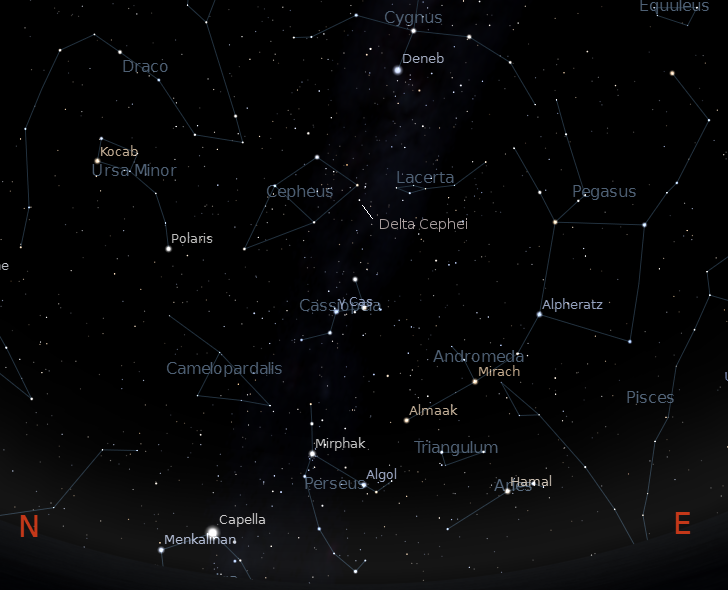
The constellation Cepheus at 10 p.m. September 10th. Created using Stellarium.
Click image to enlarge.
09/06/2012 – Ephemeris – Cassiopeia the queen
Ephemeris for Thursday, September 6th. The sun will rise at 7:11. It’ll be up for 12 hours and 57 minutes, setting at 8:08. The moon, 2 days before last quarter, will rise at 11:01 this evening.
The constellation Cassiopeia looks like the letter W in the northeastern sky at 10 p.m. My mother taught it to me as my grandfather taught her as the Flying W. Cassiopeia represents a queen of Ethiopia in a grand story that has had at least a couple of movies made as the Clash of the Titans. A dim star above the middle star makes the constellation in to a crooked backed chair. Cassiopeia is circumpolar in Michigan since it is near the north pole of the sky. It revolves around and around the pole star Polaris. In late autumn it’s overhead, in the spring its low in the northwest and in early summer it’s scraping the northern horizon.
Times are for the Traverse City/Interlochen area of Michigan. They may be different for your location.
Addendum
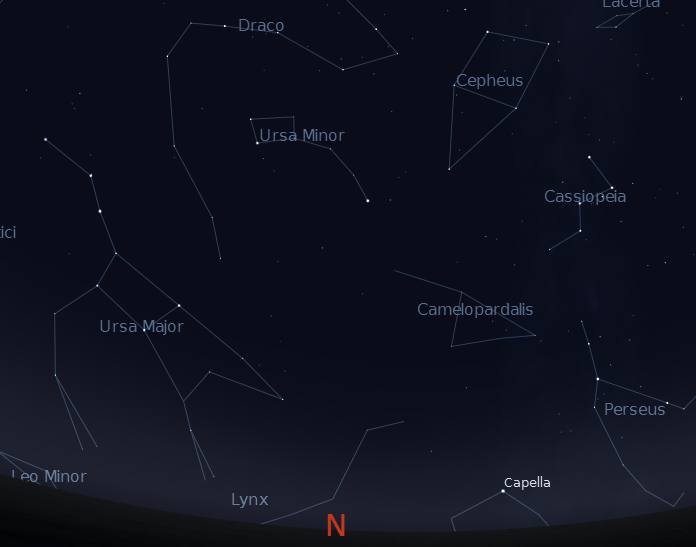
Cassiopeia and the other circumpolar constellations. Created using Stellarium.
09/04/2012 – Ephemeris – The Great Square of Pegasus
Ephemeris for Tuesday, September 4th. The sun will rise at 7:09. It’ll be up for 13 hours and 3 minutes, setting at 8:12. The moon, half way from full to last quarter, will rise at 9:51 this evening.
Rising ever higher in the east at as it gets dark around 9:30 p.m. can be found one of the great autumn constellations: Pegasus the flying horse of Greek myth. Its most visible feature is a large square of four stars, now standing on one corner. This feature, called the Great Square of Pegasus, represents the front part of the horse’s body. The horse is quite aerobatic, because it is seen flying upside down. Remembering that fact, the neck and head is a bent line of stars emanating from the right corner star of the square. Its front legs can be seen in a gallop extending to the upper right from the top star of the square. From the left star extend, not hind legs but the constellation of Andromeda, a fascinating constellation in its own right. We’ll be checking out Andromeda this fall.
Times are for the Traverse City/Interlochen area of Michigan. They may be different for your location.
Addendum
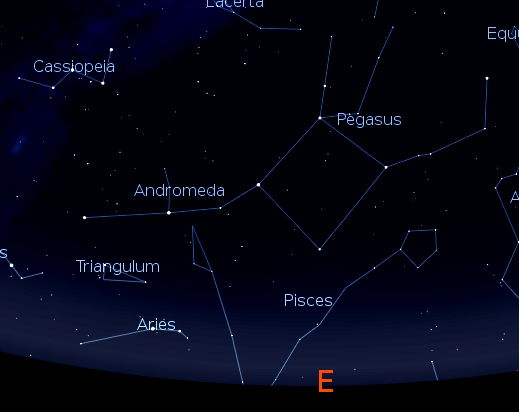
Pegasus at 9 p.m. Chart created using Stellarium.
08/20/2012 – Ephemeris – Celestial Dolphin and Cupid’s dart
Ephemeris for Monday, August 20th. The sun rises at 6:51. It’ll be up for 13 hours and 47 minutes, setting at 8:39. The moon, 3 days past new, will set at 9:48 this evening.
Located below the eastern edge of the Summer Triangle of three of the brightest stars in the sky, which is nearly overhead sky at 10 p.m., is the tiny constellation of Delphinus the dolphin, which is seen high in the south. Delphinus’ 6 stars in a small parallelogram with a tail, really does look like a dolphin leaping out of the water. The parallelogram itself has the name Job’s Coffin. The origin of this asterism or informal constellation is unknown. Of the dolphin itself: the ancient Greeks appreciated this aquatic mammal as we do, and told stories of dolphins rescuing shipwrecked sailors. There’s another tiny constellation to the right of Delphinus, Sagitta the arrow, which represents Cupid’s dart. [Off the tail of Sagitta binoculars will find a cute inverted coat hanger in the stars.]
Times are for the Traverse City/Interlochen area of Michigan. They may be different for your location. Bracketed text was removed from the audio program due to time constraints.
Addendum
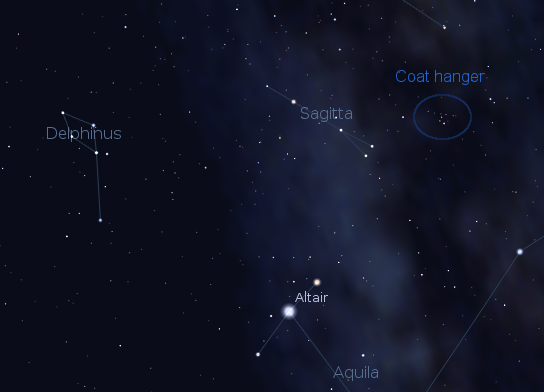
Delphinus, Sagitta and the Coat hanger. Diagram created using Stellarium.
 Bob Moler's Ephemeris Blog