Archive
12/11/2012 – Ephemeris – The Pleiades and Hyades star clusters
Ephemeris for Tuesday, December 11th. The sun will rise at 8:09. It’ll be up for 8 hours and 52 minutes, setting at 5:02. The moon, 2 days before new, will rise at 7:13 tomorrow morning.
At 8 to 9 p.m. The constellation of Taurus the bull rises higher in the east to southeast. Taurus contains two bright clusters of stars. The most famous of these is the Pleiades, also known as the Seven Sisters. The other is a letter V shape that is the face of Taurus, the Hyades. In the Greek mythology they are half-sisters of each other, all fathered by the Titan Atlas. They are apparently fleeing from the giant Orion rising in the east. The Pleiades are the younger of the two star clusters, and there has been some problem in estimating their distance. They could be from 390 to 460 light years away. The distance to Hyades is much better known at 153 light years. It was the star cluster upon which greater distances could be measured.
Times are for the Traverse City/Interlochen area of Michigan. They may be different for your location.
Addendum
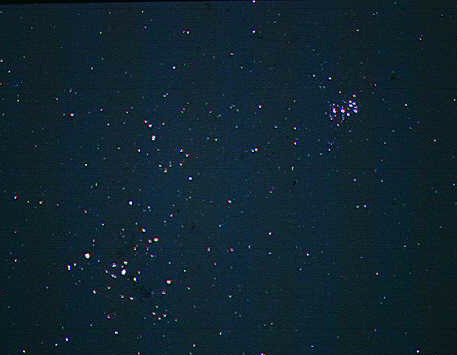
The Hyades (lower left) and the Pleiades (upper right). My photograph from many years ago.
12/06/2012 – Ephemeris – The constellation Taurus the bull
Ephemeris for Thursday, December 6th. The sun will rise at 8:05. It’ll be up for 8 hours and 57 minutes, setting at 5:02. The moon, at last quarter today, will rise at 1:10 tomorrow morning.
Low in the east southeast at 9 p.m. is the constellation of the giant hunter Orion. Above him is Taurus the bull. His face is a letter V shape of stars lying on its side, the star cluster Hyades, with the bright orange-red star Aldebaran at one tip of the V as its angry blood-shot eye, but actually about half way between us and the cluster. Jupiter is complicating this this year, appearing in Taurus. Orion is depicted in the sky facing, with club in one hand and a shield in the other, the approaching and in some depictions charging Taurus. The Pleiades star cluster is in his shoulder. Taurus in Greek mythology was the guise the god Zeus when he carried off the maiden Europa. Europa’s still with him as the intriguing satellite orbiting Zeus’ Roman equivalent the planet Jupiter.
Times are for the Traverse City/Interlochen area of Michigan. They may be different for your location.
Addendum
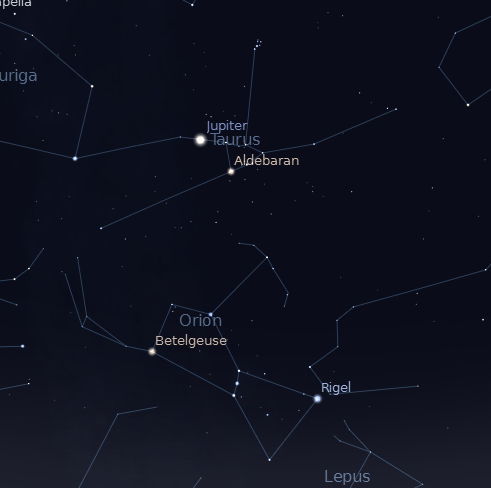
Taurus and Orion in the east at 9 p.m. December 6, 2012. Created using Stellarium.
12/03/2012 – Ephemeris – Orion rising
Ephemeris for Monday, December 3rd. The sun will rise at 8:01. It’ll be up for 9 hours and 1 minute, setting at 5:02. The moon, 3 days before last quarter, will rise at 9:56 this evening.
Off in the southeast at 9 in the evening the great constellation of Orion will be seen now. This is the most famous of all constellations world wide. We think the Big Dipper is a big deal. It’s not even a constellation, being the hind end of the great bear Ursa Major. However it’s invisible if one travels far enough south of the equator. Orion is now a rectangle of stars tilted to the left as he rises. With three stars in a straight line in the center. They are aligned nearly vertically. Orion is a giant hunter. The rectangle depict his shoulders and knees. Among its other bright stars Orion contains two of the brightest. The upper left star is the famous red giant star Betelgeuse. The lower left star is the blue=white super giant Rigel.
Times are for the Traverse City/Interlochen area of Michigan. They may be different for your location.
Addendum
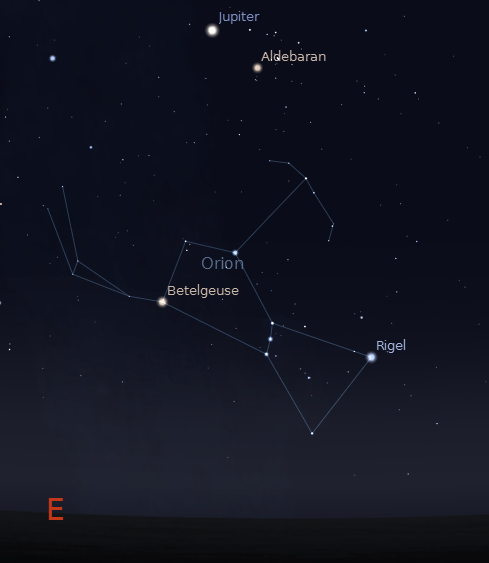
Orion rising at 9 p.m. December 3, 2012. Created using Stellarium.
11/16/2012 – Ephemeris – Capella the winter that doesn’t set (around here)
Ephemeris for Friday, November 16th. The sun will rise at 7:41. It’ll be up for 9 hours and 32 minutes, setting at 5:13. The moon, 3 days past new, will set at 8:11 this evening.
Midway up the sky in the east northeast at 9 p.m. You will find the bright star Capella. It is above and left of the bright planet Jupiter. Capella is located at one corner of a pentagon of stars that is the constellation Auriga the Charioteer. Capella represents a little she goat, while a slim triangle of stars are her kids. That triangle is known as the Kids. Capella is circumpolar for locations north of Ludington, meaning that this winter star doesn’t set, even in summer. Capella is a close binary star of stars with the same color as the sun, but much brighter. They orbit each other in 104 days. It looks like a single star in most telescopes. Spotting it low on the northern horizon at midnight in July is a reminder that winter will come soon enough.
Times are for the Traverse City/Interlochen area of Michigan. They may be different for your location.
Addendum
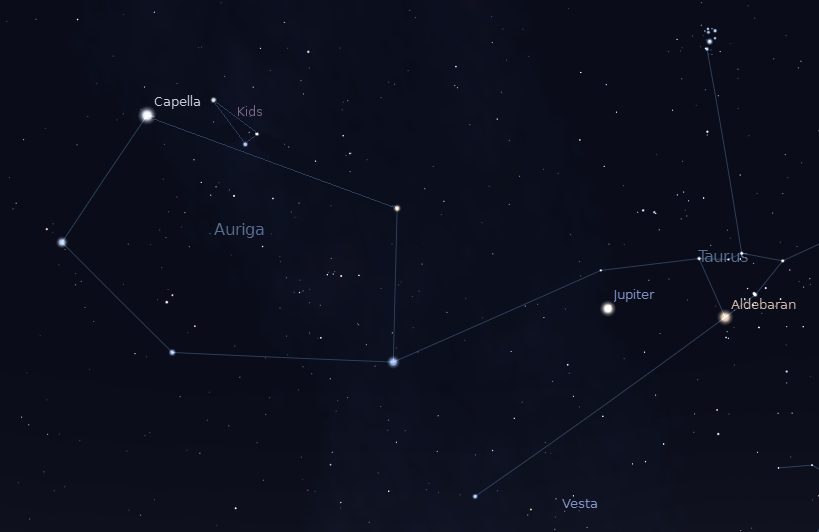
Capella in Auriga with the Kids at 9 p.m. on November 16, 2012. Created using Stellarium.
11/09/2012 – Ephemeris – The constellations of the triangle and the ram
Ephemeris for Friday, November 9th. The sun will rise at 7:31. It’ll be up for 9 hours and 48 minutes, setting at 5:20. The moon, 3 days past last quarter, will rise at 3:29 tomorrow morning.
High in the south at 9 p.m. can be seen the Great Square of Pegasus. From the top left star of the square diverge two curved lines of stars that is Andromeda the chained princess. Just below and left of Andromeda is a slender triangle of stars, none particularly bright. It has a name you can easily see in the stars, Triangulum, the triangle. It has been known from antiquity, and early Christians saw it as the Mitre of Saint Peter or the Trinity. Another small constellation seen below Triangulum is the much better known constellation Aries the ram. It is the first constellation of the Zodiac, where the sun used to to enter on the first day of spring. Aries is a small hockey stick constellation, not that hard to spot.
Times are for the Traverse City/Interlochen area of Michigan. They may be different for your location.
Addendum
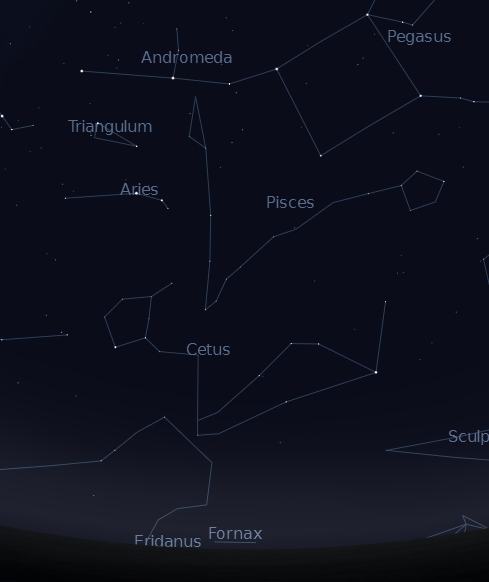
Cetus, Triangulum, Aries and surrounding constellations on November 8, 2012 at 9 p.m. Created using Stellarium.
11/08/2012 – Ephemeris – Is the constellation Cetus a whale of a sea monster?
Ephemeris for Thursday, November 8th. The sun will rise at 7:30. It’ll be up for 9 hours and 51 minutes, setting at 5:21. The moon, 2 days past last quarter, will rise at 2:18 tomorrow morning.
The identity of the constellation Cetus is a bit mixed up. Officially it is a whale, but in the story of the constellations above it, (Cassiopeia, Pegasus, Andromeda, Perseus and Cepheus) it is the monster sent to ravage the Ethiopian coast, and to whom the sacrifice of Andromeda was to stop. Either can be seen in the stars in the southeast at 9 p.m. It is a large constellation of dim stars below and left of the Great Square of Pegasus and Pisces. The whale can be seen diving, its tail of 5 stars in a squished pentagon, is seen to the upper left. If you see the stars differently and put the head of the of the sea monster where the tail of whale is the dreaded Cetus of the story appears. One of its stars is variable and may not be visible. It’s Mira, the wonderful.
Times are for the Traverse City/Interlochen area of Michigan. They may be different for your location.
Addendum
Cetus, Triangulum, Aries and surrounding constellations on November 8, 2012 at 9 p.m. Created using Stellarium.
11/05/2012 – Ephemeris – The zodiacal constellation of Aquarius
Ephemeris for Monday, November 5th. The sun will rise at 7:26. It’ll be up for 9 hours and 59 minutes, setting at 5:25. The moon, 1 day before last quarter, will rise at 11:02 this evening.
One of the constellations of the zodiac is in the south sky at 9 in the evening. It’s the constellation of Aquarius the water bearer. The image that is supposed to be depicted in the stars is that of a hapless fellow spilling a stone jar of water across the sky. Aquarius is fairly hard to spot because it is made of faint stars. One part of him, though, is easy to spot. That is the Water Jar, an asterism or informal constellation. It is a distinctive small nearly equilateral triangle of stars with another star in the center. Stars extending to the right from the water jar are that stream of water. The Water Jar is just below the top of the head of the upside down Pegasus the flying horse. The body of Aquarius is below, a misshapen deflated balloon of stars.
Times are for the Traverse City/Interlochen area of Michigan. They may be different for your location.
Addendum
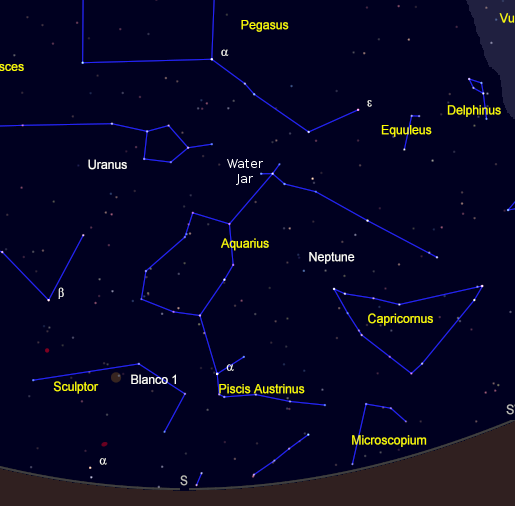
Aquarius and surrounding constellations 9 p.m. November 5, 2012. Created using Cart duCiel (Sky Charts)
10/31/2012 – Epmeneris – The Ghoul Star
Ephemeris for Halloween, Wednesday, October 31st. The sun will rise at 8:19. It’ll be up for 10 hours and 12 minutes, setting at 6:32. The moon, 2 days past full, will rise at 7:37 this evening.
Not all the ghosts and goblins out tonight will be children. One will be out every night, because it’s a star. Its name is Algol, from the Arabic for Ghoul Star or Demon Star. The Chinese had a name for it that meant a mausoleum or more ominously ‘piled up corpses’. It’s the second brightest star in the constellation Perseus the hero, rising in the northeast this evening. The star is located where artists have drawn the severed head of Medusa, whom he had slain. Medusa was so ugly that she turned all who gazed upon her to stone. Algol is her still glittering eye. Astronomers finally found out what was wrong with Algol. It does a slow 6 hour wink every two days 21 hours, because it is two very close stars that eclipse each other in that period.
Times are for the Traverse City/Interlochen area of Michigan. They may be different for your location.
Addendum
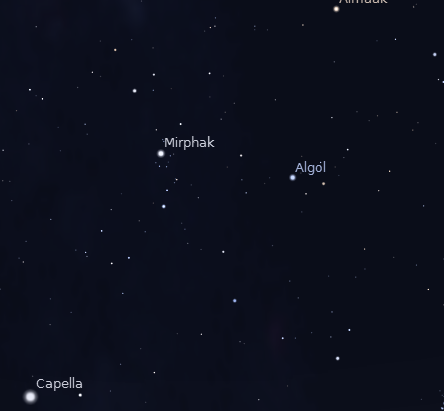
The constellation Perseus in the northeast at 9 p.m. on October 31, 2012. Created using Stellarium.
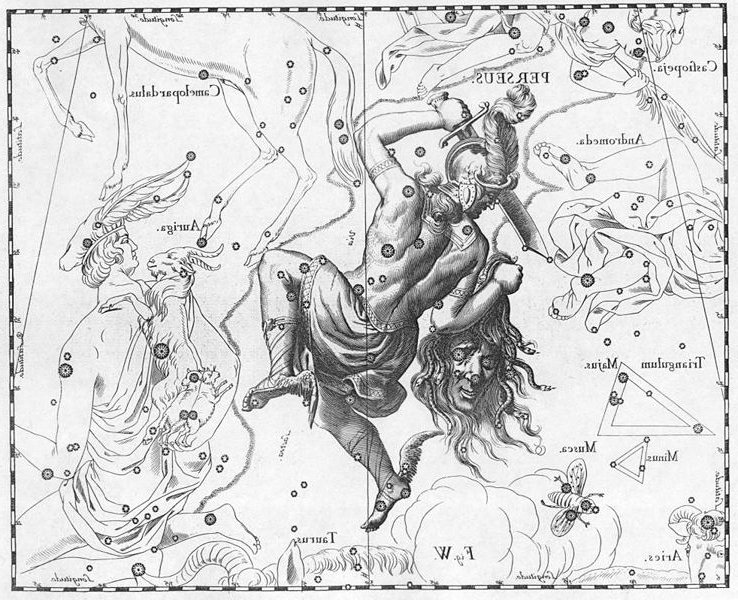
Perseus and the head of Medusa from the 1690 Uranographia by Johannes Hevelius. Image found with the article on Algol in Wikipedia.
Note that this is a mirror image. The star charts in the 17th century were based on celestial globes, which represented the constellations as seen from the outside of the celestial sphere instead of from the inside. I reversed the image to match Perseus as we see him.
10/18/2012 – Ephemeris – Autumn wonders for binoculars or small telescope: The Alpha Persei Association
Ephemeris for Thursday, October 18th. The sun will rise at 8:02. It’ll be up for 10 hours and 49 minutes, setting at 6:52. The moon, half way from new to first quarter, will set at 9:17 this evening.
When is a star cluster not a star cluster? When it’s an association. That is when it has begun to dissipate because the gravitational force of the group cannot hold it together. The central stars of the Big Dipper belong to The Ursa Major Association. Below the W shaped constellation of Cassiopeia in the northeast at 9 or 10 p.m. Is the constellation of Per-seus or Pers-e-us as it is usually pronounced. Its brightest star is Mirfak with a designation of Alpha Persei. There are some stars there to the naked eye, but with binoculars there are a great many stars just below naked eye visibility. This is called the Alpha Persei association. The star groups I’ve talked about this week are just some of the wonders visible in a simple pair of binoculars.
Times are for the Traverse City/Interlochen area of Michigan. They may be different for your location.
Addendum
The constellation Perseus. (Stellarium spells Alpha Persei Mirphak, not Mirfak. Star name spelling can be something variable.)
The constellation Perseus in the northeast at 10 p.m. on October 18, 2012. Created using Stellarium.
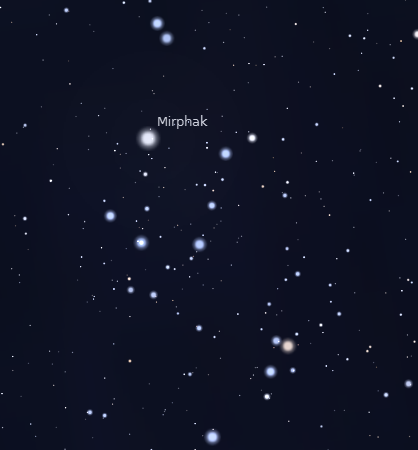
The Alpha Persei Association in a binocular view. Created using Stellarium.
10/12/2012 – Ephemeris – The constellation of Andromeda and its great galaxy
Ephemeris for Friday, October 12th. The sun will rise at 7:54. It’ll be up for 11 hours and 7 minutes, setting at 7:02. The moon, 3 days before new, will rise at 5:42 tomorrow morning.
In the east at 9 this evening can be found a large square of stars, the Great Square of Pegasus the flying horse. The square is standing on one corner. What look like its hind legs stretching to the left from the left corner star is another constellation, Andromeda the chained maiden. She is seen in the sky as two diverging curved strings of stars that curve upward. She was rescued by the hero Perseus, a nearby constellation, riding his steed Pegasus. Andromeda’s claim to astronomical fame is the large galaxy seen with the unaided eye just above the upper line of stars, the Great Andromeda Galaxy, nearly 2 and a half million light years away. To the unaided eye the galaxy appears as a small smudge of light. In binoculars the galaxy is a delicate spindle of light.
Times are for the Traverse City/Interlochen area of Michigan. They may be different for your location.
Addendum
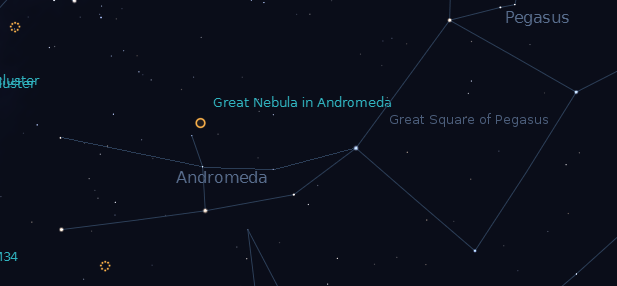
Andromeda at 9 p.m. with the Great Andromeda Galaxy. Created using Stellarium.
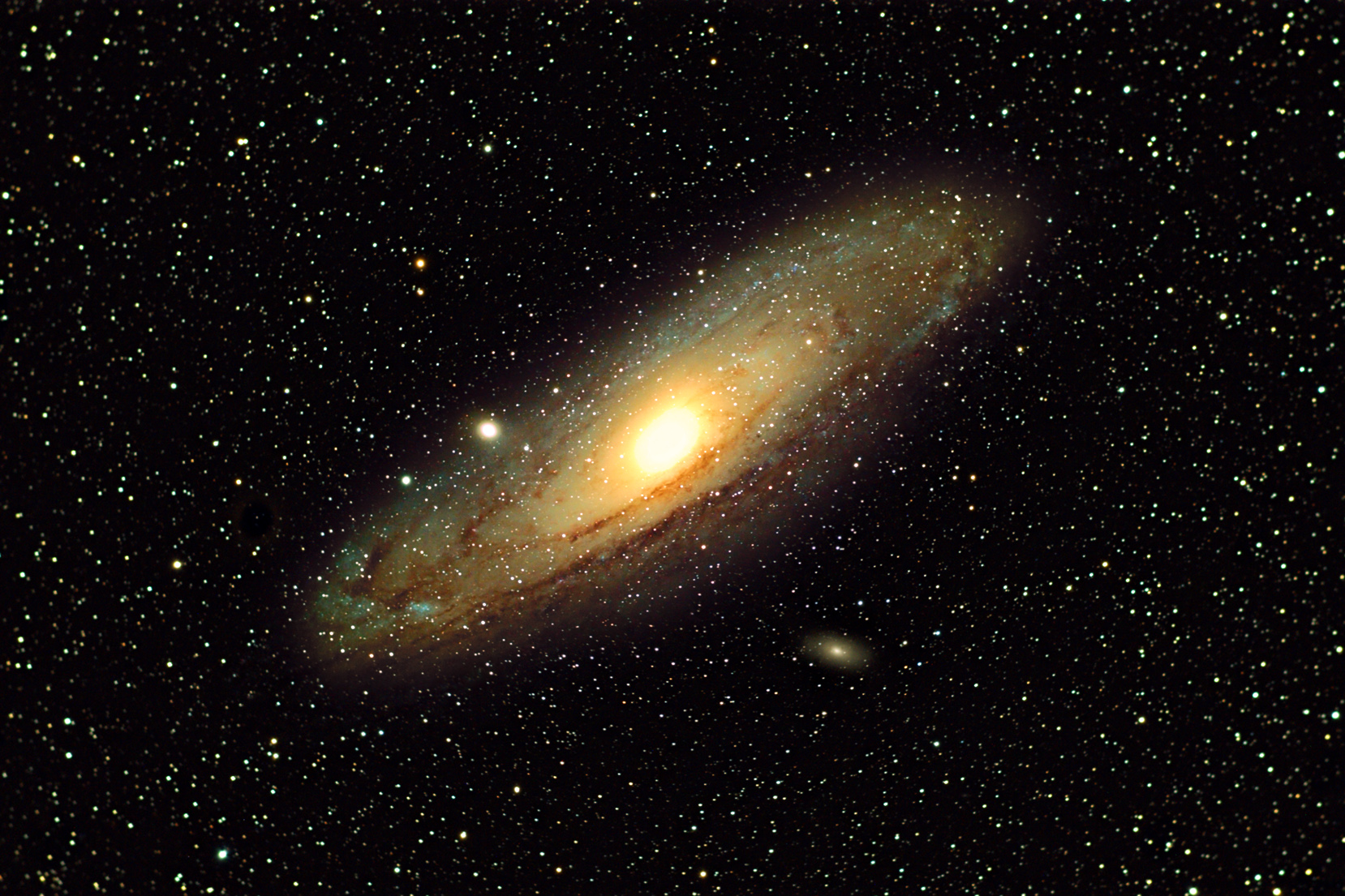
The Great Andromeda Galaxy (M31). Image taken by Scott Anttila.
 Bob Moler's Ephemeris Blog