Archive
Ephemeris: 05/09/2025 – AI and me
This is Ephemeris for Friday, May 9th. Today the Sun will be up for 14 hours and 36 minutes, setting at 8:57, and it will rise tomorrow at 6:20. The Moon, 3 days before full, will set at 5:08 tomorrow morning.
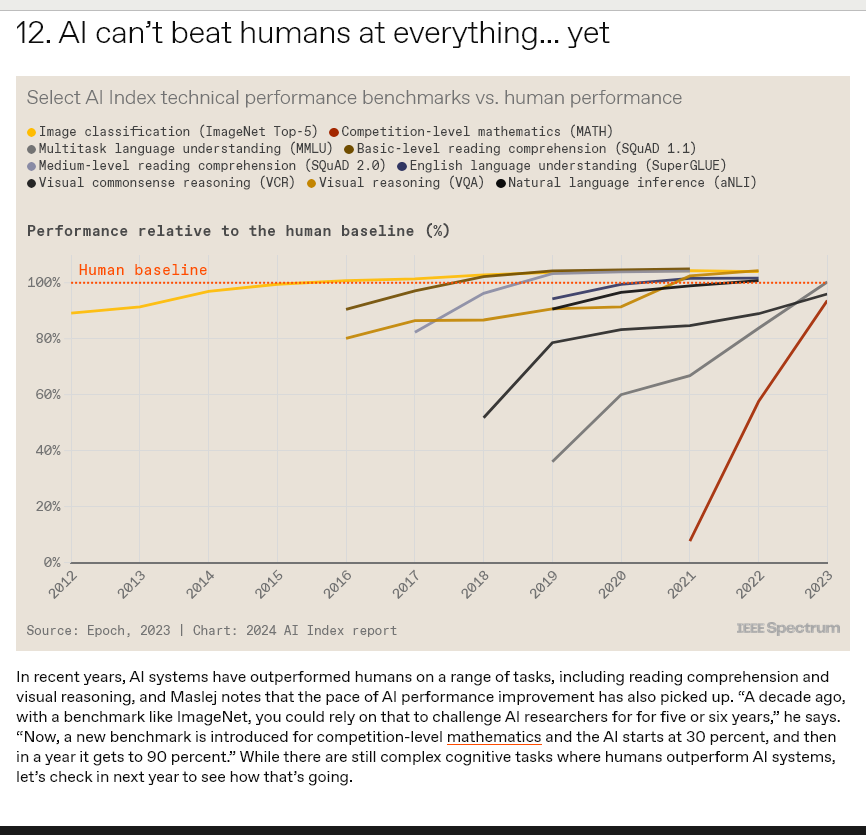
Continuing my look at Artificial Intelligence or AI. AI appears to be just about everywhere nowadays: on computers, software applications, and even on smartphones. The brains of AI are somewhere out on the Internet not on your phone or computer. I’ve gotten into it just recently. The first time was just this last February when I wanted a picture of a groundhog seeing its shadow for Groundhog’s day from my blog, which illustrated my day after Groundhog’s Day program here on Ephemeris. I use AI for research. Besides giving a synopsis of what it finds on the Internet. The one I use also gives a link to the original data, which has more information. I don’t rely on the synopsis it presents. And I would never have an AI write an Ephemeris episode. You could probably tell by its much better grammar.
The astronomical event times given in this blog are for the Traverse City/Interlochen area of Michigan (Lat 44.7° N, Long 85.7° W; EDT, UT – 4 hours) unless stated otherwise. Times will be different for other locations.
Addendum
Ephemeris: 05/08/2025 – AI, a different way to compute
This is Bob Moler with Ephemeris for Thursday, May 8th. Today the Sun will be up for 14 hours and 33 minutes, setting at 8:56, and it will rise tomorrow at 6:21. The Moon, halfway from first quarter to full, will set at 4:51 tomorrow morning.
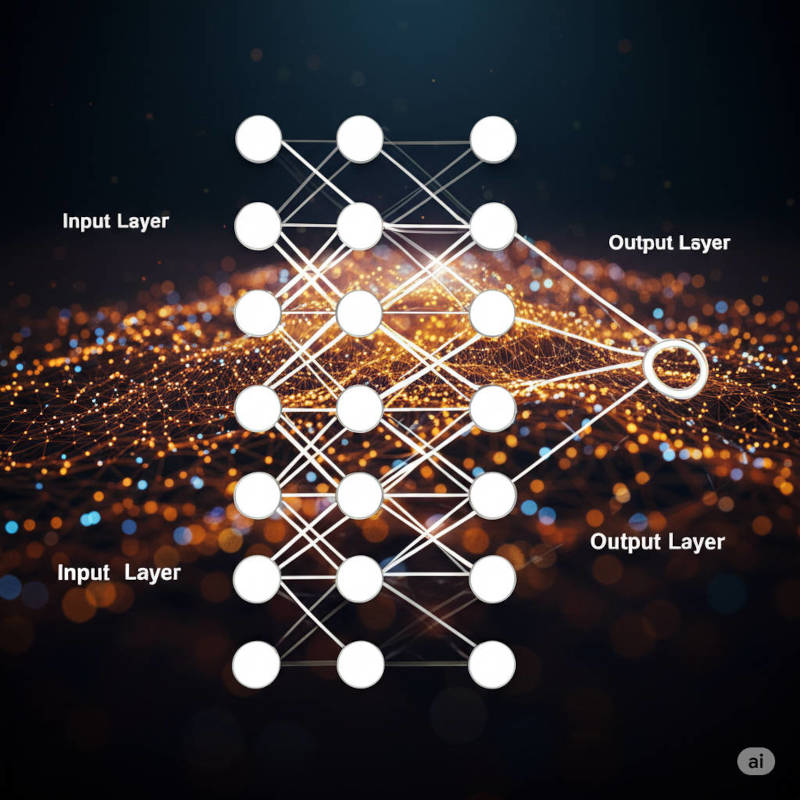
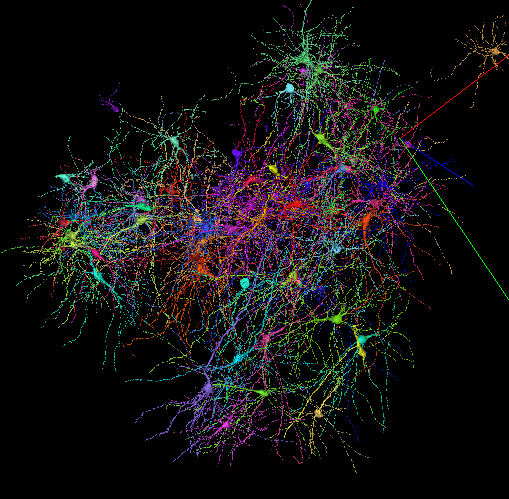
This week we’re investigating artificial intelligence or AI. My software experience in my career with computers is that of financial software for banks including ATMs and various other machines that have to do with banking, so AI or anything scientific was completely out of my realm. So I’m kind of looking at this like is an interested layman with some knowledge of computers. AI uses neural networks which is something that most computers don’t have. It can be simulated digitally, although I understand that they have chips that actually are neural network components. Neural networks are how the human brain functions with neurons and synapses. How they’ve gotten it to work, I have no idea.
The astronomical event times given in this blog are for the Traverse City/Interlochen area of Michigan (Lat 44.7° N, Long 85.7° W; EDT, UT – 4 hours) unless stated otherwise. Times will be different for other locations.
Addendum
Ephemeris: 05/07/2025 – Taking our weekly look at the whereabouts of the naked-eye planets
This is Ephemeris for Wednesday, May 7th. Today the Sun will be up for 14 hours and 31 minutes, setting at 8:55, and it will rise tomorrow at 6:22. The Moon, 3 days past first quarter, will set at 4:36 tomorrow morning.
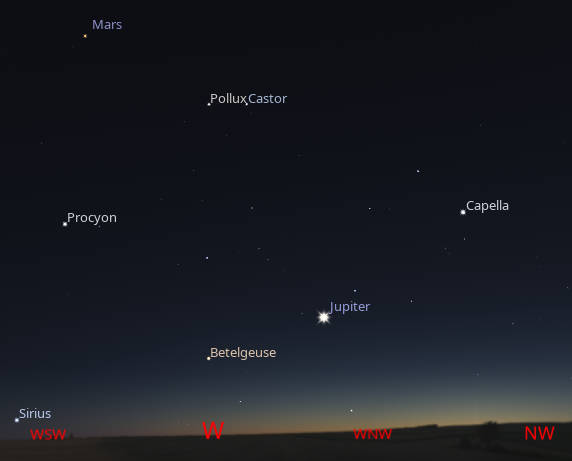
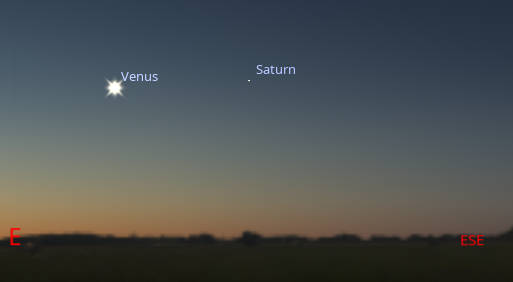
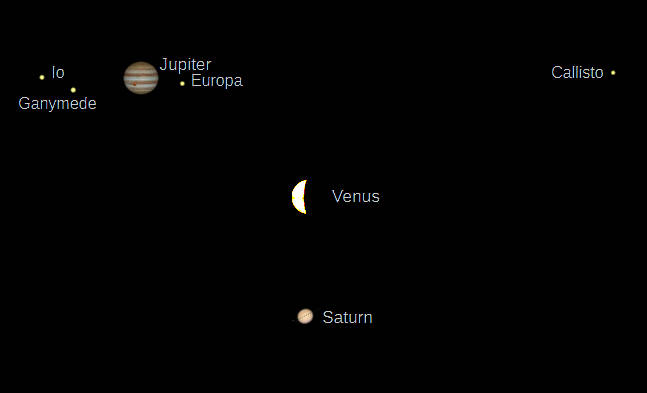
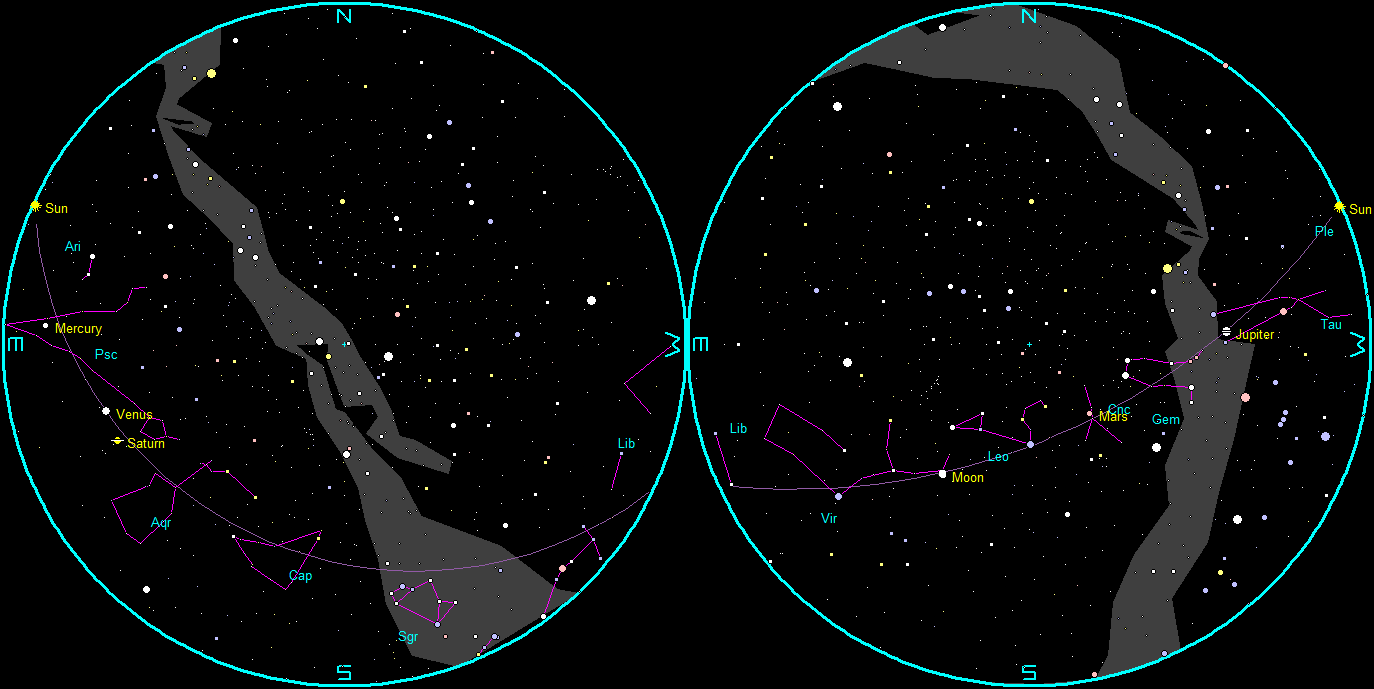
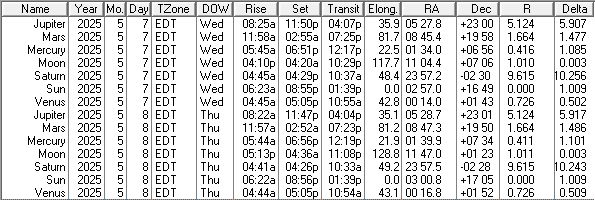
Let’s take our weekly look at the whereabouts of the naked-eye planets. At 10 PM this evening two of the five naked eye planets will be out. Jupiter, is now the brightest evening planet, our substitute evening star if you will. It will be in the low in the west-northwestern sky. The rapidly fading Mars, with its distinctive reddish hue, is in the west-southwest, moving away from the stars Castor and Pollux in Gemini to the lower right of it. By 5:30 AM Venus will be seen very low in the east, as the Morning Star. It will require a low eastern horizon. It should be visible until a bit after 6:30. Saturn is visible close and to its right and a bit above. It will disappear much sooner than Venus.
The astronomical event times given in this blog are for the Traverse City/Interlochen area of Michigan (Lat 44.7° N, Long 85.7° W; EDT, UT – 4 hours) unless stated otherwise. Times will be different for other locations.
Addendum
Ephemeris: 05/05/2025 – Speculating about AI while the Moon is too bright

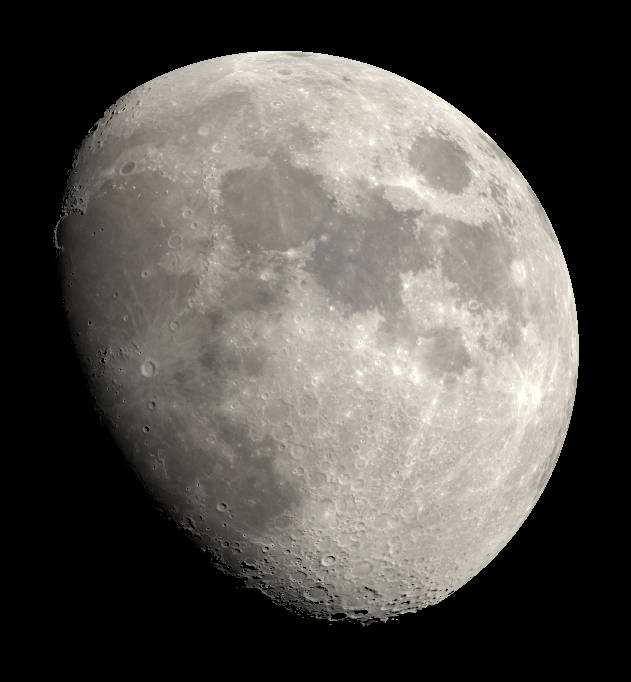
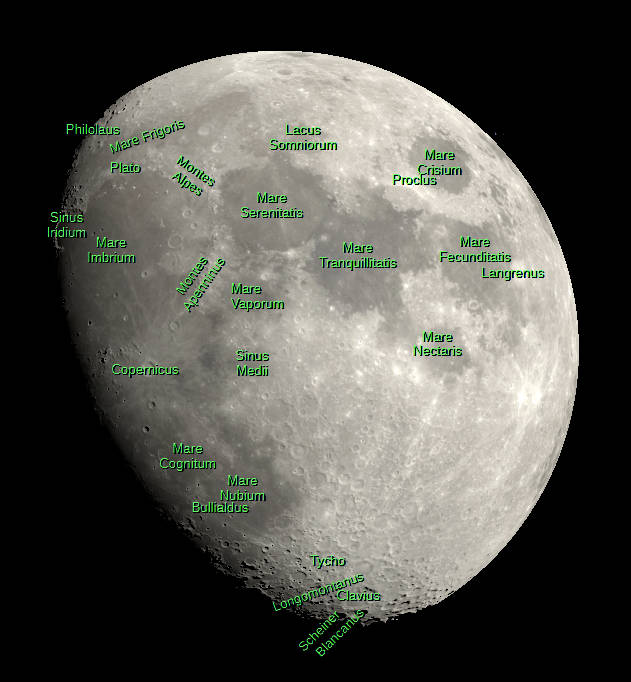
This is Ephemeris for Tuesday, May 6th. Today the Sun will be up for 14 hours and 28 minutes, setting at 8:54, and it will rise tomorrow at 6:23. The Moon, 2 days past first quarter, will set at 4:20 tomorrow morning.
With the Artemis moon program in doubt, NASA’s budget being cut, and scientific programs being eliminated, I’m going to wait until the dust settles a bit before I talk more about it. In the meantime I’d like to digress a bit with a little bit of expertise I’ve gotten from my working life as a systems engineer and computer programmer. I have no expertise in what’s hot now in computers, which is artificial intelligence or AI, but I do have some thoughts about it which I will talk about later on this week and next while the constellations are pretty much wiped out by the Moon’s bright light. AI came upon the scene rather suddenly*, after years of quiet development. All of a sudden just about every smartphone and computer app seems to have an AI component.
The astronomical event times given in this blog are for the Traverse City/Interlochen area of Michigan (Lat 44.7° N, Long 85.7° W; EDT, UT – 4 hours) unless stated otherwise. Times will be different for other locations.
*I’m a bit old, and moving slowly, but the clock seems to tick faster. Just about anything seems to happen faster.
Ephemeris: 05/05/2025 – A brief early morning meteor shower
This is Bob Moler with Ephemeris for Cinco de Mayo, Monday, May 5th. Today the Sun will be up for 14 hours and 26 minutes, setting at 8:53, and it will rise tomorrow at 6:25. The Moon, 1 day past first quarter, will set at 4:03 tomorrow morning.
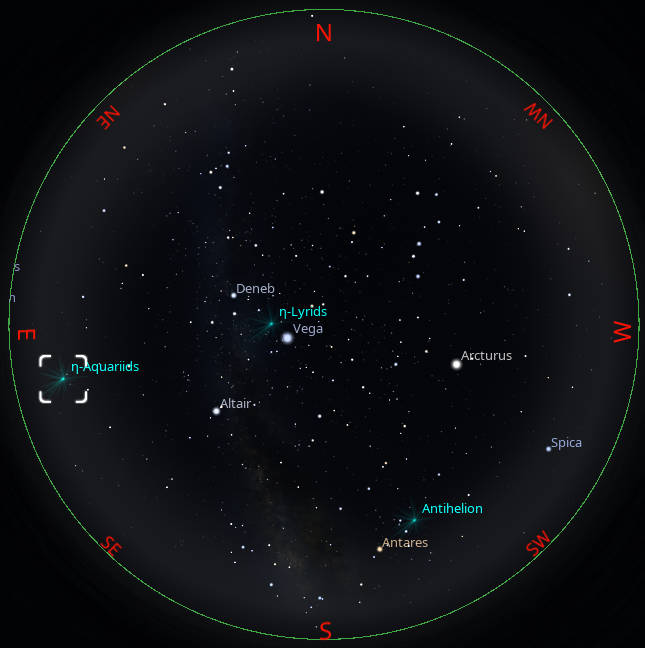
The Earth is now passing through a stream of bits of rock that were shed from Halley’s Comet on its many previous passes through the inner solar system. The Earth gets to pass through this stream twice a year, Once in late October as the stream passes the Earth’s orbit heading in, and in early May as the stream is departing. The peak of this meteor shower, the Eta Aquariids, is this afternoon. Since the meteoroids are coming from nearer the direction of the Sun, there is only a short period when these meteors are visible. Actually less than an hour between moonset at 4:03 AM and nearly 5 AM around here as twilight begins to interfere with the display. The meteors will seem to come from low in the east-southeast, but they will be seen all over the sky.
The astronomical event times given in this blog are for the Traverse City/Interlochen area of Michigan (Lat 44.7° N, Long 85.7° W; EDT, UT – 4 hours) unless stated otherwise. Times will be different for other locations.
Addendum
Ephemeris: 05/02/2025 – GTAS meeting ~ Deep sky wonders for the small telescope
This is Ephemeris for Friday, May 2nd. Today the Sun will be up for 14 hours and 18 minutes, setting at 8:49, and it will rise tomorrow at 6:29. The Moon, 2 days before first quarter, will set at 2:47 tomorrow morning.
The Grand Traverse Astronomical Society will host its May meeting tonight at 9 PM at Northwestern Michigan College’s Joseph H Rogers Observatory. The talk for the evening will be given by Mary Gribbin presenting the program titled Exploring Deep Space Objects with Small Telescopes by Season. Deep Space Objects, better known as Deep Sky Objects or DSOs, are things that reside beyond the solar system which are generally only visible in telescopes, like star clusters, galaxies and nebulae, which are clouds. After the meeting, weather permitting, there will be viewing of the Moon and whatever we can find in the twilight. The observatory is located south of Traverse City on Birmley Rd. The meeting will also be available via Zoom, with instructions for joining the meeting on the society’s website, http://www.gtastro.org.
The astronomical event times given in this blog are for the Traverse City/Interlochen area of Michigan (Lat 44.7° N, Long 85.7° W; EDT, UT – 4 hours) unless stated otherwise. Times will be different for other locations.
Addendum
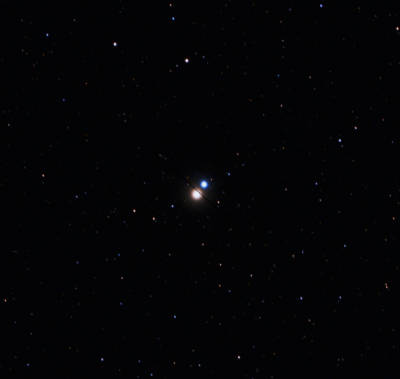
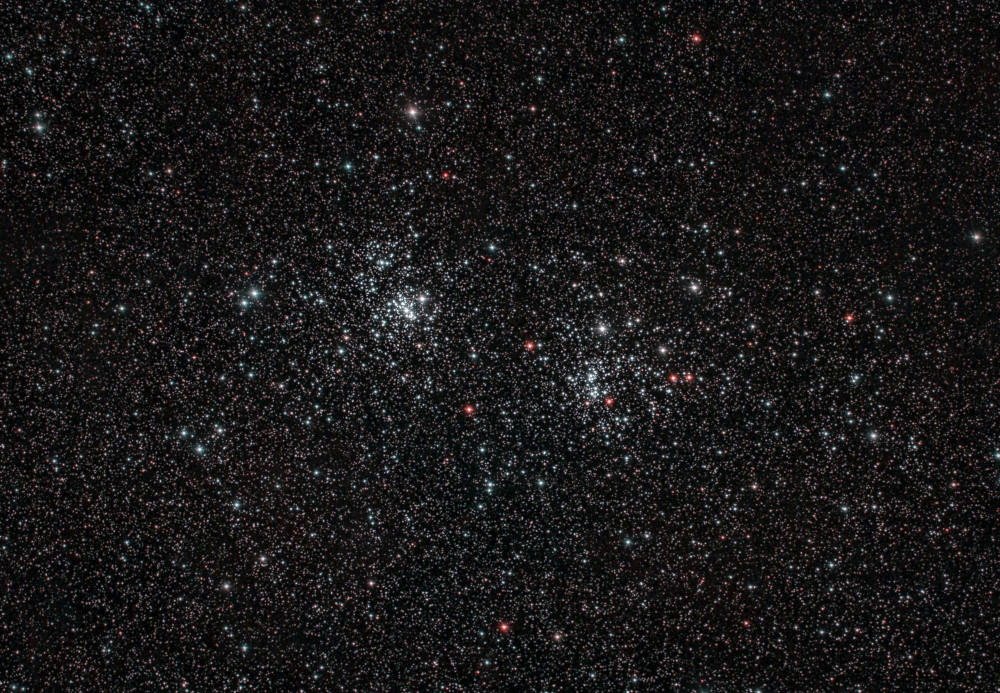
The above are two of the many wonders for owners of a small telescope.
Ephemeris: 05/01/2025 – Previewing May Skies
This is Ephemeris for Thursday, May 1st. Today the Sun will be up for 14 hours and 15 minutes, setting at 8:48, and it will rise tomorrow at 6:30. The Moon, 3 days before first quarter, will set at 2:05 tomorrow morning.
May is here, when the promise made on Groundhog Day is finally fulfilled. Daylight hours in the Interlochen/Traverse City area will increase from 14 hours and 15 minutes today to 15 hours 20 minutes on the 31st. The altitude, or angle, of the Sun above the southern horizon at local noon will ascend from 61 degrees now to 67 degrees at month’s end. The altitude of the Sun in the Straits area will be a degree lower than that, but your daylight hours will be a few minutes longer. Local apparent noon this month, when the Sun passes due south, will be about 1:38 p.m. This is the month of the Eta Aquariid meteor shower which will reach its peak next week Tuesday morning. There will be less than an hour of prime viewing after the Moon sets at 4:03 AM.
The astronomical event times given in this blog are for the Traverse City/Interlochen area of Michigan (Lat 44.7° N, Long 85.7° W; EDT, UT – 4 hours) unless stated otherwise. Times will be different for other locations.
Addendum
May Evening Star Chart
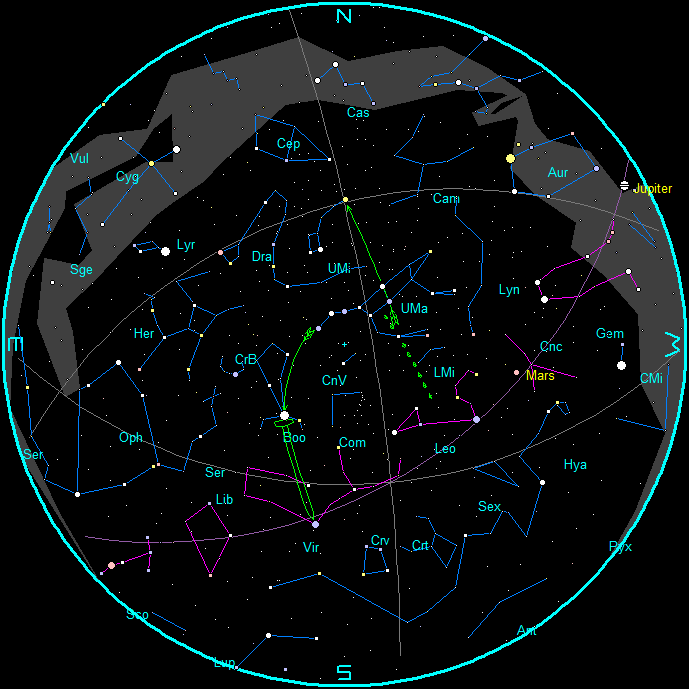
The planets and stars are plotted for the 15th at 11 p.m. EDT in the evening and 4 a.m. on the 16th for the morning chart. These are the chart times. Note that Traverse City is located approximately 45 minutes behind our time meridian, West 75° longitude. (An hour 45 minutes behind our daylight saving time meridian during EDT). To duplicate the star positions on a planisphere you may have to set it to 1 hour 45 minutes earlier than the current time.
Note, the chart times of 11 p.m. and 4 a.m. are for the night of the15/16th. For each week before then add ½ hour (28 minutes if you’re picky). For each week after then, subtract ½ hour or 28 minutes. The planet positions are updated each Wednesday on this blog. For planet positions on dates other than the 15th, check the Wednesday planet posts on this blog for their weekly locations.
May Morning Star Chart
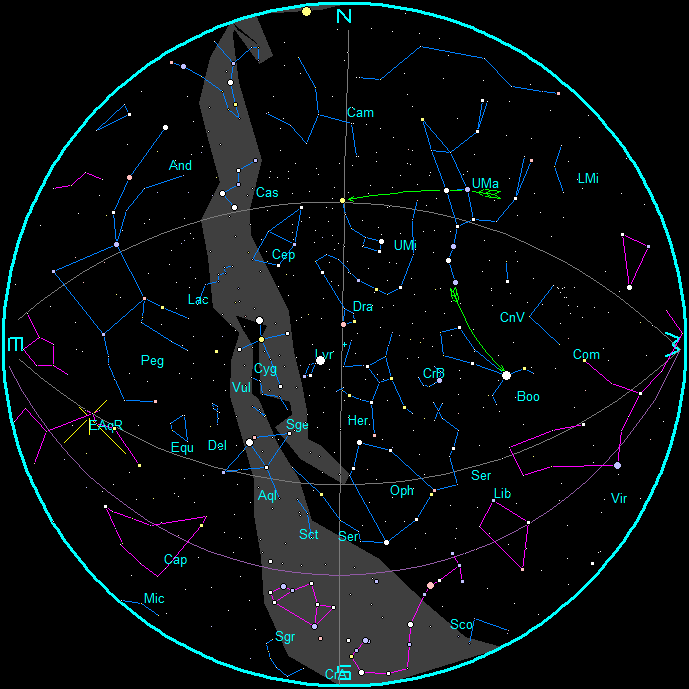
For a list of constellation names to go with the abbreviations, click here.
- Pointer stars at the front of the bowl of the Big Dipper point to Polaris, the North Star.
- Leaky dipper drips on Leo
- Follow the arc of the handle of the Big Dipper to the star Arcturus, and
- Extend like a spike to Spica,
- EaqR is the radiant of the Eta Aquariid meteor shower that peaks on the 5th.
Twilight Limits, Nautical and Astronomical
| EDT | |||||||
| Morning | Twilight | Evening | Twilight | Dark | Night | Moon | |
| Date | Astro. | Nautical | Nautical | Astro. | Start | End | Illum. |
| 2025-05-01 | 4h36m | 5h21m | 22h02m | 22h47m | 1h09m | 4h36m | 0.26 |
| 2025-05-02 | 4h34m | 5h19m | 22h04m | 22h49m | 2h06m | 4h34m | 0.36 |
| 2025-05-03 | 4h32m | 5h17m | 22h06m | 22h51m | 2h48m | 4h32m | 0.46 |
| 2025-05-04 | 4h30m | 5h16m | 22h07m | 22h53m | 3h19m | 4h30m | 0.57 |
| 2025-05-05 | 4h28m | 5h14m | 22h09m | 22h55m | 3h44m | 4h28m | 0.66 |
| 2025-05-06 | 4h26m | 5h12m | 22h10m | 22h57m | 4h03m | 4h26m | 0.75 |
| 2025-05-07 | 4h24m | 5h11m | 22h12m | 22h59m | 4h20m | 4h24m | 0.83 |
| 2025-05-08 | 4h22m | 5h09m | 22h13m | 23h01m | – | – | 0.89 |
| 2025-05-09 | 4h19m | 5h07m | 22h15m | 23h03m | – | – | 0.94 |
| 2025-05-10 | 4h17m | 5h06m | 22h16m | 23h05m | – | – | 0.98 |
| 2025-05-11 | 4h15m | 5h04m | 22h18m | 23h07m | – | – | 1.00 |
| 2025-05-12 | 4h13m | 5h02m | 22h20m | 23h09m | – | – | 1.00 |
| 2025-05-13 | 4h11m | 5h01m | 22h21m | 23h11m | – | – | 0.98 |
| 2025-05-14 | 4h09m | 4h59m | 22h23m | 23h13m | 23h13m | 23h42m | 0.94 |
| 2025-05-15 | 4h07m | 4h58m | 22h24m | 23h15m | 23h15m | – | 0.89 |
| 2025-05-16 | 4h05m | 4h56m | 22h26m | 23h17m | 23h17m | 0h36m | 0.82 |
| 2025-05-17 | 4h04m | 4h55m | 22h27m | 23h19m | 23h19m | 1h21m | 0.74 |
| 2025-05-18 | 4h02m | 4h54m | 22h29m | 23h21m | 23h21m | 1h58m | 0.64 |
| 2025-05-19 | 4h00m | 4h52m | 22h30m | 23h22m | 23h22m | 2h27m | 0.53 |
| 2025-05-20 | 3h58m | 4h51m | 22h31m | 23h24m | 23h24m | 2h51m | 0.42 |
| 2025-05-21 | 3h56m | 4h50m | 22h33m | 23h26m | 23h26m | 3h12m | 0.31 |
| 2025-05-22 | 3h54m | 4h48m | 22h34m | 23h28m | 23h28m | 3h32m | 0.21 |
| 2025-05-23 | 3h53m | 4h47m | 22h36m | 23h30m | 23h30m | 3h52m | 0.12 |
| 2025-05-24 | 3h51m | 4h46m | 22h37m | 23h32m | 23h32m | 3h51m | 0.05 |
| 2025-05-25 | 3h49m | 4h45m | 22h38m | 23h34m | 23h34m | 3h49m | 0.01 |
| 2025-05-26 | 3h48m | 4h44m | 22h40m | 23h36m | 23h36m | 3h48m | 0.00 |
| 2025-05-27 | 3h46m | 4h43m | 22h41m | 23h37m | 23h37m | 3h46m | 0.02 |
| 2025-05-28 | 3h45m | 4h42m | 22h42m | 23h39m | 23h51m | 3h45m | 0.06 |
| 2025-05-29 | 3h43m | 4h41m | 22h43m | 23h41m | – | 3h43m | 0.13 |
| 2025-05-30 | 3h42m | 4h40m | 22h45m | 23h43m | 0h41m | 3h42m | 0.21 |
| 2025-05-31 | 3h41m | 4h39m | 22h46m | 23h44m | 1h18m | 3h41m | 0.31 |
The twilight calendar was generated using Cartes du Ciel (Sky Charts), with some corrections.
See my blog post: Twilight Zone for the definitions of the different periods of twilight here: https://bobmoler.wordpress.com/2018/09/27/.
NASA Calendar of Planetary Events
   Date       Time    Event
May  1  Th            Venus: 40.9° W
     1  Th   2:35 AM  Moon North Dec.: 28.6° N
     2  Fr   8:02 PM  Moon-Pollux: 2.2° N
     3  Sa   7:12 PM  Moon-Mars: 2.2° S
     3  Sa   7:27 PM  Moon-Beehive: 2.6° S
     4  Su   7:59 AM  Mars-Beehive: 0.4° N
     4  Su   9:52 AM  First Quarter
     4  Su  10:07 PM  Eta Aquariid Shower: ZHR = 60
     5  Mo   1:58 PM  Moon-Regulus: 2.2° S
     7  We   7:44 PM  Moon Descending Node
    10  Sa   3:43 AM  Moon-Spica: 0.4° N
    10  Sa   8:49 PM  Moon Apogee: 406200 km
    12  Mo  12:56 PM  Full Moon
    14  We  12:10 AM  Moon-Antares: 0.3° N
    15  Th   2:44 PM  Moon South Dec.: 28.5° S
    17  Sa   8:55 PM  Uranus Conjunction
    20  Tu   7:59 AM  Last Quarter
    22  Th   4:05 AM  Moon Ascending Node
    22  Th   1:51 PM  Moon-Saturn: 2.8° S
    23  Fr   7:52 PM  Moon-Venus: 4° S
    25  Su   9:37 PM  Moon Perigee: 359000 km
    26  Mo  11:02 PM  New Moon
    28  We  12:16 PM  Moon North Dec.: 28.4° N
    30  Fr  12:07 AM  Mercury Superior Conjunction
    30  Fr   5:13 AM  Moon-Pollux: 2.4° N
    31  Sa   4:00 AM  Moon-Beehive: 2.3° S
    31  Sa   9:59 PM  Venus Elongation: 45.9° W
Jun  1  Su            Venus: 45.9° W
Sky Events Calendar by Fred Espenak and Sumit Dutta (NASA’s GSFC),
http://eclipse.gsfc.nasa.gov/SKYCAL/SKYCAL.html.
Sun and Moon Rising and Setting Events
LU              Ephemeris of Sky Events for Interlochen/TC
May, 2025    Local time zone: EDT
+-----------------------------------------------------------------------+
| DATE |  SUN     SUN  DAYLIGHT|   TWILIGHT*    |MOON  RISE OR    ILLUM |
|      |  RISE    SET    HOURS |  END    START  |PHASE SET** TIME FRACTN|
+=======================================================================+
|Thu  1| 06:32a  08:48p  14:15 | 10:00p  05:20a |      Set  02:05a   24%|
|Fri  2| 06:30a  08:49p  14:18 | 10:02p  05:18a |      Set  02:47a   34%|
|Sat  3| 06:29a  08:50p  14:21 | 10:03p  05:16a |      Set  03:19a   44%|
+------+-----------------------+----------------+-----------------------+
|Sun  4| 06:28a  08:51p  14:23 | 10:05p  05:14a |F Qtr Set  03:43a   54%|
|Mon  5| 06:26a  08:53p  14:26 | 10:06p  05:13a |      Set  04:03a   64%|
|Tue  6| 06:25a  08:54p  14:28 | 10:08p  05:11a |      Set  04:20a   73%|
|Wed  7| 06:23a  08:55p  14:31 | 10:10p  05:09a |      Set  04:36a   81%|
|Thu  8| 06:22a  08:56p  14:33 | 10:11p  05:08a |      Set  04:51a   88%|
|Fri  9| 06:21a  08:57p  14:36 | 10:13p  05:06a |      Set  05:08a   94%|
|Sat 10| 06:20a  08:59p  14:38 | 10:14p  05:04a |      Set  05:27a   97%|
+------+-----------------------+----------------+-----------------------+
|Sun 11| 06:18a  09:00p  14:41 | 10:16p  05:03a |      Set  05:50a   99%|
|Mon 12| 06:17a  09:01p  14:43 | 10:17p  05:01a |Full  Rise 09:34p  100%|
|Tue 13| 06:16a  09:02p  14:45 | 10:19p  05:00a |      Rise 10:39p   98%|
|Wed 14| 06:15a  09:03p  14:48 | 10:20p  04:58a |      Rise 11:41p   95%|
|Thu 15| 06:14a  09:04p  14:50 | 10:22p  04:57a |      Rise 12:36a   90%|
|Fri 16| 06:13a  09:05p  14:52 | 10:23p  04:55a |      Rise 01:21a   83%|
|Sat 17| 06:12a  09:06p  14:54 | 10:25p  04:54a |      Rise 01:57a   75%|
+------+-----------------------+----------------+-----------------------+
|Sun 18| 06:11a  09:08p  14:57 | 10:26p  04:52a |      Rise 02:27a   66%|
|Mon 19| 06:10a  09:09p  14:59 | 10:28p  04:51a |      Rise 02:51a   55%|
|Tue 20| 06:09a  09:10p  15:01 | 10:29p  04:50a |L Qtr Rise 03:12a   45%|
|Wed 21| 06:08a  09:11p  15:03 | 10:31p  04:48a |      Rise 03:32a   34%|
|Thu 22| 06:07a  09:12p  15:05 | 10:32p  04:47a |      Rise 03:51a   23%|
|Fri 23| 06:06a  09:13p  15:06 | 10:33p  04:46a |      Rise 04:13a   14%|
|Sat 24| 06:05a  09:14p  15:08 | 10:35p  04:45a |      Rise 04:39a    7%|
+------+-----------------------+----------------+-----------------------+
|Sun 25| 06:04a  09:15p  15:10 | 10:36p  04:44a |      Rise 05:12a    2%|
|Mon 26| 06:04a  09:16p  15:12 | 10:37p  04:42a |New   Set  09:25p    0%|
|Tue 27| 06:03a  09:17p  15:13 | 10:39p  04:41a |      Set  10:44p    1%|
|Wed 28| 06:02a  09:18p  15:15 | 10:40p  04:40a |      Set  11:50p    5%|
|Thu 29| 06:01a  09:19p  15:17 | 10:41p  04:39a |      Set  12:40a   11%|
|Fri 30| 06:01a  09:19p  15:18 | 10:42p  04:38a |      Set  01:17a   19%|
|Sat 31| 06:00a  09:20p  15:20 | 10:43p  04:37a |      Set  01:45a   29%|
+-----------------------------------------------------------------------+
* Nautical Twilight
** Moonrise or moonset, whichever occurs between sunset and sunrise
Created using my LookingUp for DOS app.
Ephemeris: 04/30/2025 – Let’s take our weekly look at the whereabouts of the naked-eye planets
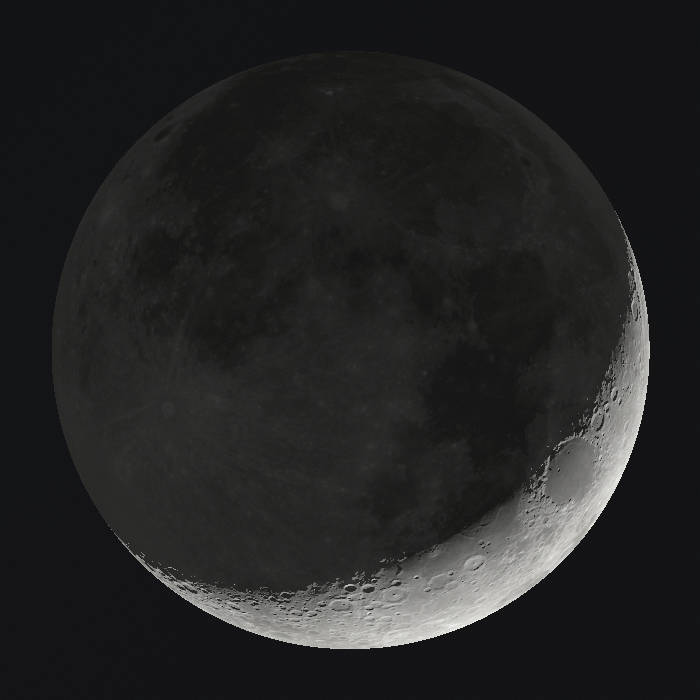
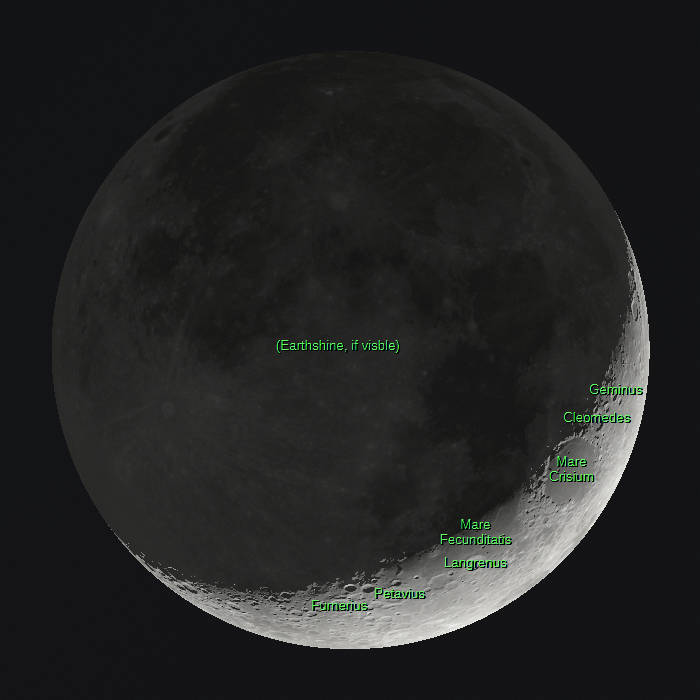
This is Bob Moler with Ephemeris for Wednesday, April 30th. Today the Sun will be up for 14 hours and 13 minutes, setting at 8:46, and it will rise tomorrow at 6:32. The Moon, 3 days past new, will set at 1:08 tomorrow morning.
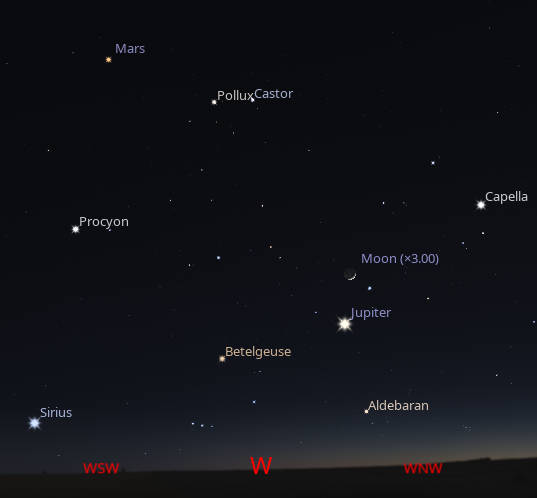
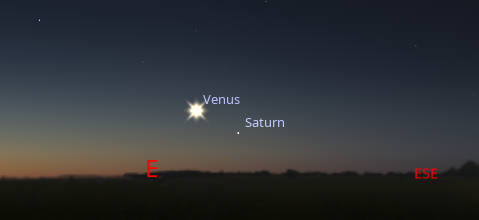
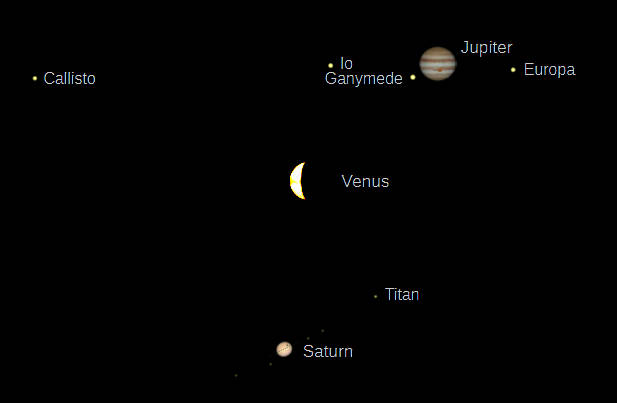
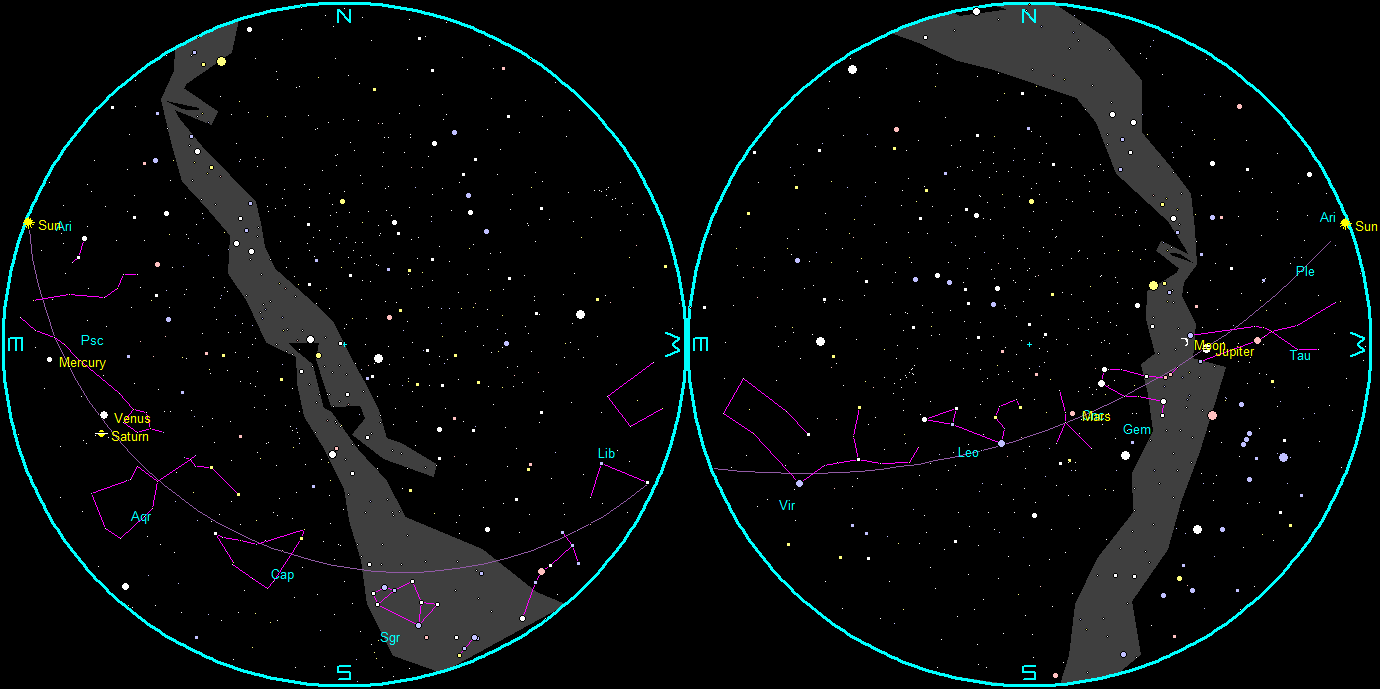
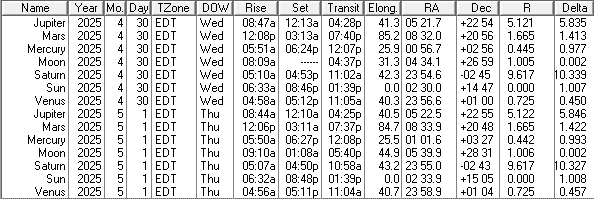
Let’s take our weekly look at the whereabouts of the naked-eye planets. At 9:30 PM this evening two of the five naked eye planets will be out. Jupiter, is now the brightest evening planet, our substitute evening star if you will. It will be in the western sky. Tonight it will be below the crescent Moon. To its lower left, the great constellation of Orion will be beginning to set. The rapidly fading Mars, with its distinctive reddish hue, is high in the southwest, with the stars Castor and Pollux in Gemini to the right of it. By 5:30 AM Venus will be seen very low in the east, as the Morning Star. It will require a low eastern horizon. It should be visible until a bit after 6:30. Saturn is visible close and to its lower right.
The astronomical event times given in this blog are for the Traverse City/Interlochen area of Michigan (Lat 44.7° N, Long 85.7° W; EDT, UT – 4 hours) unless stated otherwise. Times will be different for other locations.
Addendum
Ephemeris: 04/29/2025 – Using the Sun as a telescope
This is Ephemeris for Tuesday, April 29th. Today the Sun will be up for 14 hours and 10 minutes, setting at 8:45, and it will rise tomorrow at 6:33. The Moon, 2 days past new, will set at 11:56 this evening.
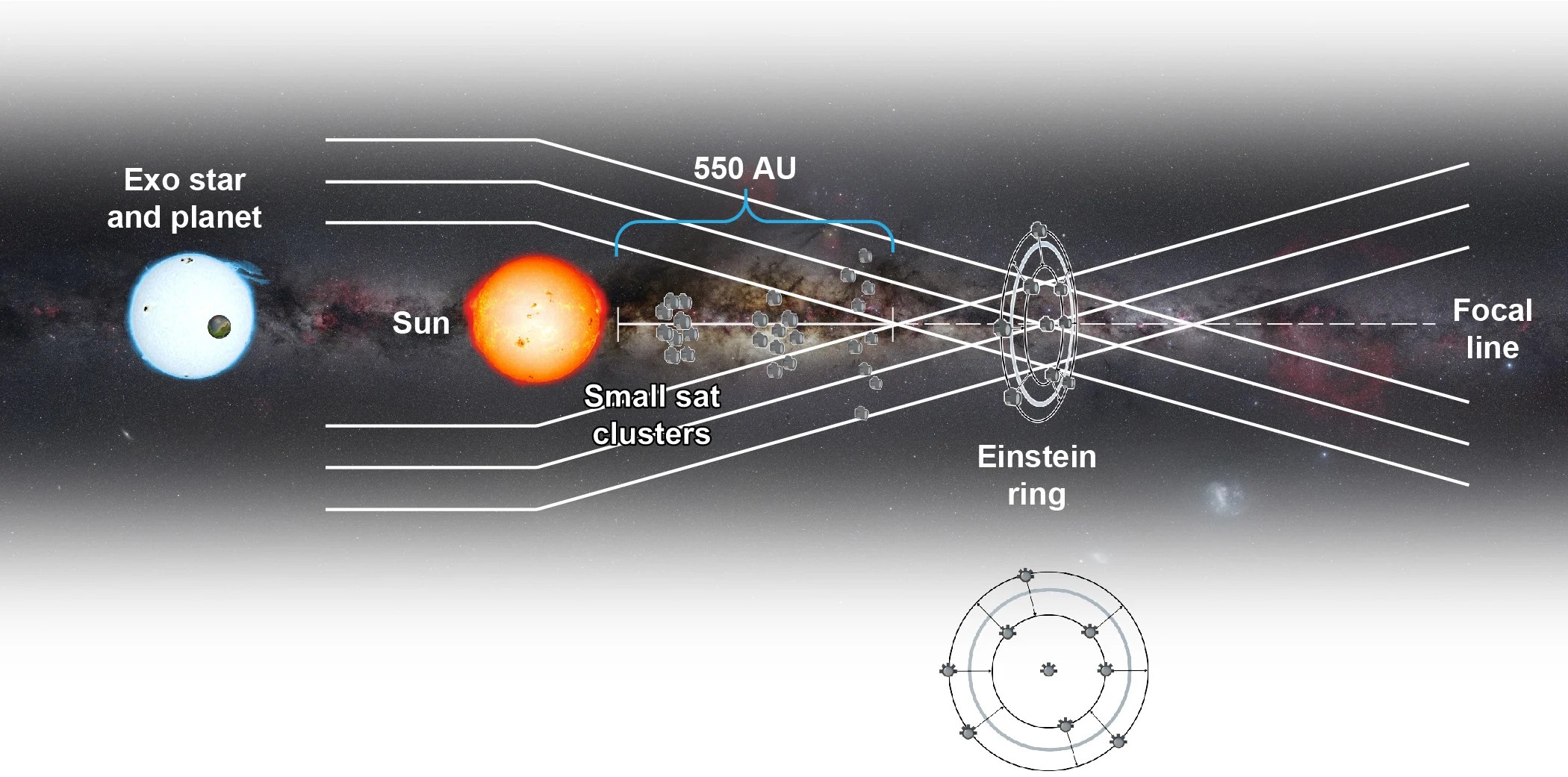
One idea of a telescope I find very fantastic. This is a telescope that uses the Sun and its mass curving spacetime to alter the path of light from a distant object to act like a lens in a telescope. This is called gravitational lensing. The length of this telescope would have to be about 542 times the earth’s distance from the Sun, 542 astronomical units. In the 48 years since Voyager 1 was launched it has achieved only about 1/3 of that distance. What would be the use of this telescope would be to image exoplanets. So far exoplanets, if they are visible at all, don’t even cover a single pixel in even our largest telescopes. The problems are huge, starting with gravitational lenses don’t bend light the same way as optical ones do.
The astronomical event times given in this blog are for the Traverse City/Interlochen area of Michigan (Lat 44.7° N, Long 85.7° W; EDT, UT – 4 hours) unless stated otherwise. Times will be different for other locations.
Addendum
Here are some sources of additional information on this topic:
https://www.universetoday.com/articles/how-can-the-sun-become-a-telescope
https://www.livescience.com/space/the-sun/could-we-turn-the-sun-into-a-gigantic-telescope
https://nasaspacenews.com/2025/04/see-alien-planets-in-4k-the-suns-gravitational-lens-explained/
https://news.stanford.edu/stories/2022/05/gravity-telescope-image-exoplanets
https://www.space.com/sun-gravity-could-help-observe-exoplanets-in-detail
Ephemeris: 04/28/2025 – Venus and Saturn appear together in the morning sky
This is Bob Moler with Ephemeris for Monday, April 28th. Today the Sun will be up for 14 hours and 7 minutes, setting at 8:44, and it will rise tomorrow at 6:35. The Moon, 1 day past new, will set at 10:33 this evening.
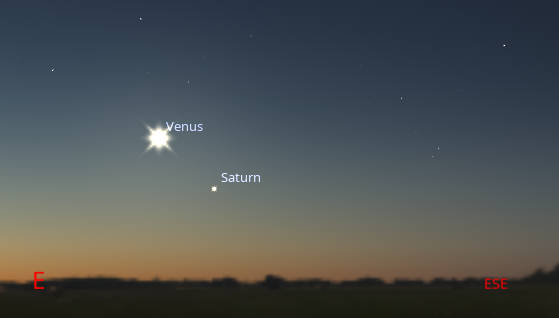
At about 3:30 this afternoon Saturn and Venus will appear closest together. They will be up at that time. However, it’s during the daytime, so they will be invisible. By tomorrow morning Saturn will still be very close to Venus. The ringed planet will appear to the lower right of Venus by about half the width of a fist held in arm’s length. It will be very low in the sky at about 5:30 AM. Saturn is at its dimmest, because in a telescope, especially in twilight those rings would be missing. The rings are nearly edge on and the Sun happens to be shining on the other side of them, so the most that would be seen would be a very thin shadow of the rings across the center of the planet. In coming days Saturn will be moving away from the Sun, while Venus falls back to it.
The astronomical event times given in this blog are for the Traverse City/Interlochen area of Michigan (Lat 44.7° N, Long 85.7° W; EDT, UT – 4 hours) unless stated otherwise. Times will be different for other locations.
Addendum
 Bob Moler's Ephemeris Blog