Archive
07/03/2015 – Ephemeris – Astronomy in the Grand Traverse Region tonight
Ephemeris for Friday, July 3rd. Today the Sun will be up for 15 hours and 29 minutes, setting at 9:31. The Moon, 2 days past full, will rise at 10:33 this evening and tomorrow the Sun will rise at 6:02.
Dr. David Penney will investigate the structure of the Milky Way at this evening’s meeting of the Grand Traverse Astronomical Society at 8 p.m. at Northwestern Michigan College’s Rogers Observatory. The Milky Way is the band of light we see in the sky especially on summer and winter evenings. But it is more than a band of dim stars, it is what we can see of the huge disk of maybe 200 billion stars with an embedded pin wheel structure. Everyone is welcome. Also at 9 p.m. there will be a star party at the observatory. The astronomical objects of the evening will be the planets Venus, Jupiter and Saturn and the Moon later in the evening. The observatory is located south of Traverse City on Birmley Road.
Times are for the Traverse City/Interlochen area of Michigan. They may be different for your location.
Addendum
Dr. Penney has a Ph.D. in Physiology and Biochemistry, and is pretty much retired spending his time between Michigan in the summer and northern Florida in the winter, where he is a member of several astronomy clubs. He gives many talks there also.
07/02/2015 -Ephemeris – A belated preview of July’s skies
Ephemeris for Thursday, July 2nd. Today the Sun will be up for 15 hours and 30 minutes, setting at 9:31. The Moon, 1 day past full, will rise at 9:48 this evening and tomorrow the Sun will rise at 6:02.
Lets preview July’s skies a day late. Sorry, it’s been a busy week.. The sun, having reached its northern solstice, is beginning to slide southward again, at first imperceptibly, then with greater speed. The daylight hours will decrease from 15 hours and 30 minutes Today to 14 hours 44 minutes at month’s end. The daylight hours will be slightly shorter south of Interlochen, and slightly longer to the north. The altitude of the sun at local noon, when the sun is due south will decrease from 68 degrees Now to 63 degrees at month’s end. The sun will be a degree lower in the Straits area. Despite the warmth, the earth will reach its greatest distance from the sun on Monday the 6th. The range of the earth’s distance from the sun is 3 million out of 93 million miles.
Times are for the Traverse City/Interlochen area of Michigan. They may be different for your location.
Addendum
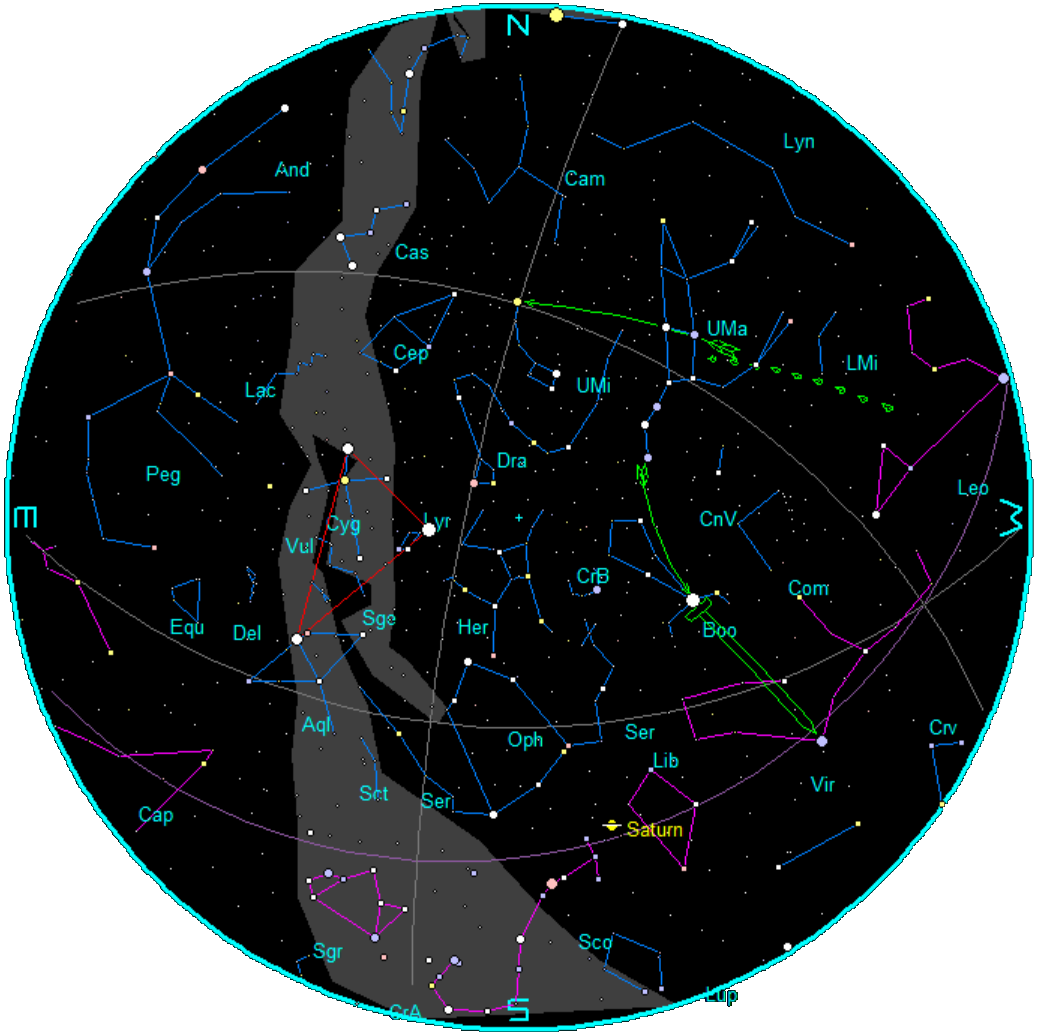
Star Chart for July 2015. Created using my LookingUp program. Click on image to enlarge.
The Moon is not plotted.
The planets and stars are plotted for the 15th at 11 p.m. EDT. That is chart time. Note, Traverse City is located 1 hour 45 minutes behind our time meridian. To duplicate the star positions on a planisphere you may have to set it to 1 hour 45 minutes earlier than the current time.
Evening Astronomical twilight ends at midnight. EDT on July 1st, decreasing to 11:14 p.m. EDT on the 31st.
Morning astronomical twilight starts at 3:32 a.m. EDT on July 1st, and increasing to 4:42 a.m. EDT on the 31st.
Add a half hour to the chart time every week before the 15th and subtract and hour for every week after the 15th.
For a list of constellation names to go with the abbreviations click here.
The green pointer from the Big Dipper is:
- Pointer stars at the front of the bowl of the Big Dipper point to Polaris the North Star.
- Drill a hole in the bowl of the Big Dipper and the water will drip on the back of Leo the Lion.
- Follow the arc of the Big Dipper’s handle to Arcturus
- Continue with a spike to Spica
- The Summer Triangle is shown in red
Calendar of Planetary Events
Credit: Sky Events Calendar by Fred Espenak and Sumit Dutta (NASA’s GSFC)
To generate your own calendar go to http://eclipse.gsfc.nasa.gov/SKYCAL/SKYCAL.html
Times are Eastern Daylight Time on a 24 hour clock. Some additions made to aid clarity.
Conjunctions like the Moon-Jupiter: 4.5° N means Jupiter will appear 4.5° north of the Moon.
 Date       Local   Event
             Time
Jul  01     We    02:48    Moon South Dec.: 18.4° S
     01     We        Venus: 42.4° E
     01     We    22:20    Full Moon
     05     Su    14:54    Moon Perigee: 367100 km
     06     Mo    08:59    Aphelion: 1.0167 AU
     07     Tu    20:07    Moon Descending Node
     08     We    16:24    Last Quarter
     12     Su    13:55    Moon-Aldebaran: 0.9° S
     14     Tu    00:24    Moon North Dec.: 18.4° N
     14     Tu    17:35    Venus-Regulus: 2.3° S
     15     We    21:24    New Moon
     18     Sa    13:34    Moon-Jupiter: 4.5° N
     18     Sa    21:06    Moon-Venus: 0.5° N
     21     Tu    07:02    Moon Apogee: 404800 km
     21     Tu    15:32    Moon Ascending Node
     23     Th    15:18    Mercury Superior Conjunction with the Sun
     24     Fr    00:04    First Quarter
     26     Su    04:43    Moon-Saturn: 2.4° S
     28     Tu    10:23    Delta Aquarid Meteor Shower: ZHR* = 20
     28     Tu    13:34    Moon South Dec.: 18.3° S
     31     Fr    06:43    Full Moon
Aug  01     Sa        Venus: 21.5° E
*ZHR – Zenithal Hourly Rate: Approximate number of meteors per hour when the shower radiant is at the zenith. For more information on this and other meteor showers in 2015 see the International Meteor Organization website calendar section: http://www.imo.net/calendar.
07/01/2015 – Ephemeris – Jupiter, Venus and Saturn grace our evening sky
Ephemeris for Wednesday, July 1st. Today the Sun will be up for 15 hours and 31 minutes, setting at 9:32. The Moon, at full today, will rise at 8:58 this evening and tomorrow the Sun will rise at 6:01.
Lets take a look at the bright planets for this week. Our brilliant evening star Venus and Jupiter are close together in the west by 9:45 p.m. They will set around 11:45 p.m.. Venus’ will slide down to the Sun faster and faster in the coming weeks leaving Jupiter behind for a while. Venus will take a month and a half to slide past the Sun. Jupiter though will take 2 months, so Venus will pass it again around August 4th when both are too close to the horizon and Sun to spot. There’s a third conjunction of these two in October in the morning sky with Mars nearby. Saturn is in the southeast in evening twilight. It will pass due south at 10:53 p.m. and will set at 3:41 a.m. Even small telescopes can see Saturn’s rings.
Times are for the Traverse City/Interlochen area of Michigan. They may be different for your location.
Addendum
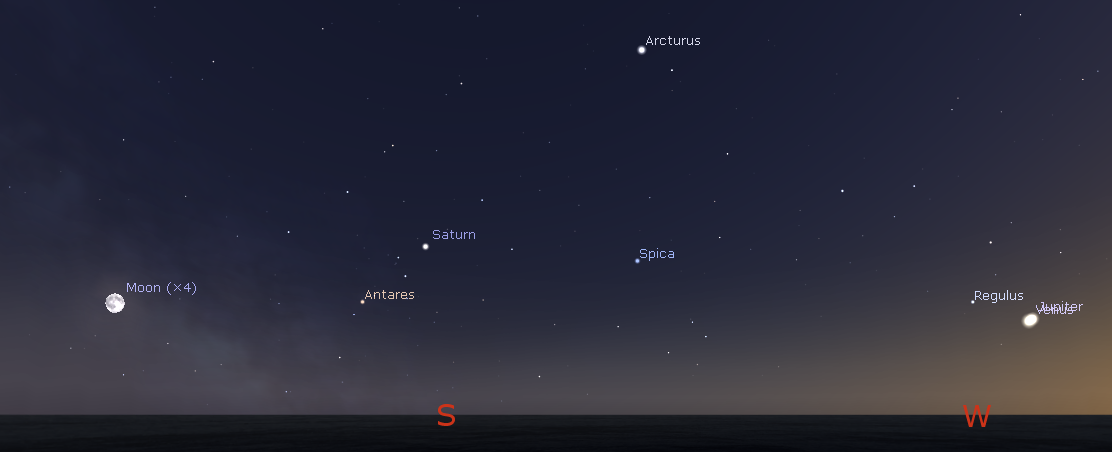
The evening planets and the Moon at 10:30 p.m. July 1, 2015. Though their images overlap Jupiter is above right of Venus. Click on the image to enlarge. Created using Stellarium.
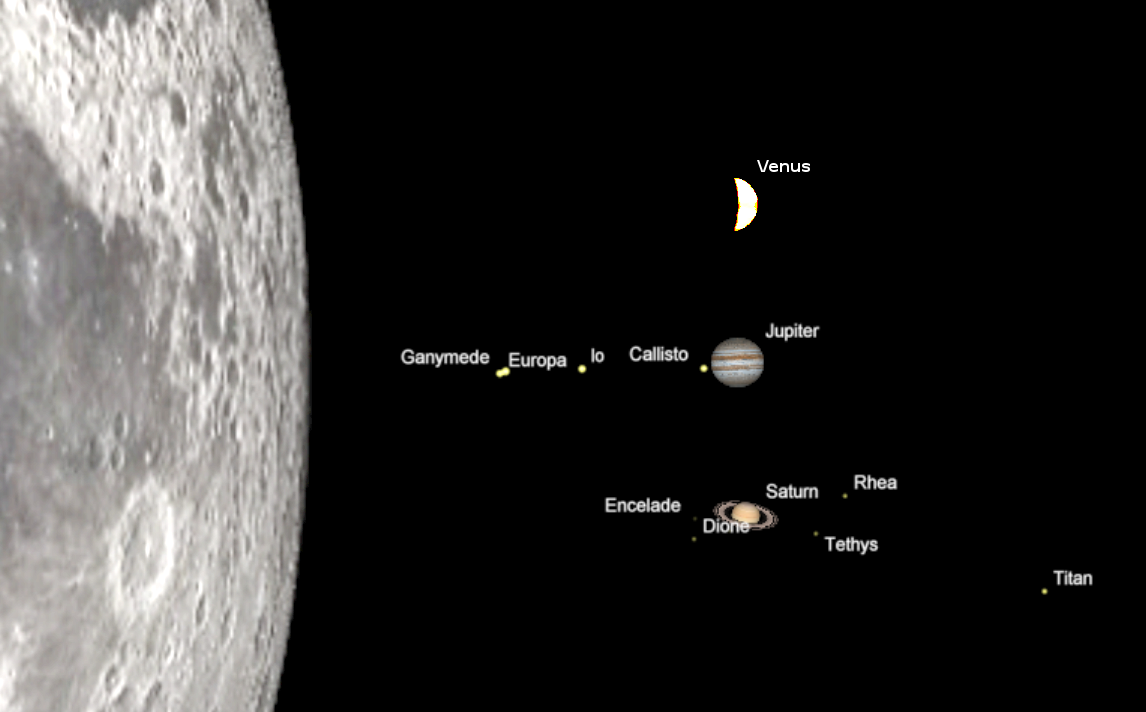
The evening planets and the Moon with their satellites to scale at 10:30 p.m. July 1, 2015. Created using Stellarium.
Mercury is officially in the morning sky now, but it is not a favorable appearance for northern hemisphere observers.
06/30/2015 – Ephemeris – Tonight’s close conjunction of Jupiter and Venus will be visible in the west after sunset
Ephemeris for Tuesday, June 30th. Today the Sun will be up for 15 hours and 31 minutes, setting at 9:32. The Moon, 1 day before full, will set at 5:49 tomorrow morning and tomorrow the Sun will rise at 6:00.
Tonight the planets Venus and Jupiter will appear at their closest in the western sky after sunset. Dimmer Jupiter will appear just above Venus by 20 minutes of arc or two-thirds of the width of the Moon. They can both be seen in the same telescope field using low power. It’s interesting that Jupiter, is over 11 times the diameter of Venus, but because Venus is so much closer to us, it now appears to be the same size as Jupiter, and it will continue to grow. It’s 48 million miles away and closing to 27 million on August 15th when it passes between the Earth and the Sun. Astrologers think a conjunction like this means something, while astronomers like me see two bright planets which happen to be beautifully aligned along our line of sight.
Times are for the Traverse City/Interlochen area of Michigan. They may be different for your location.
Addendum
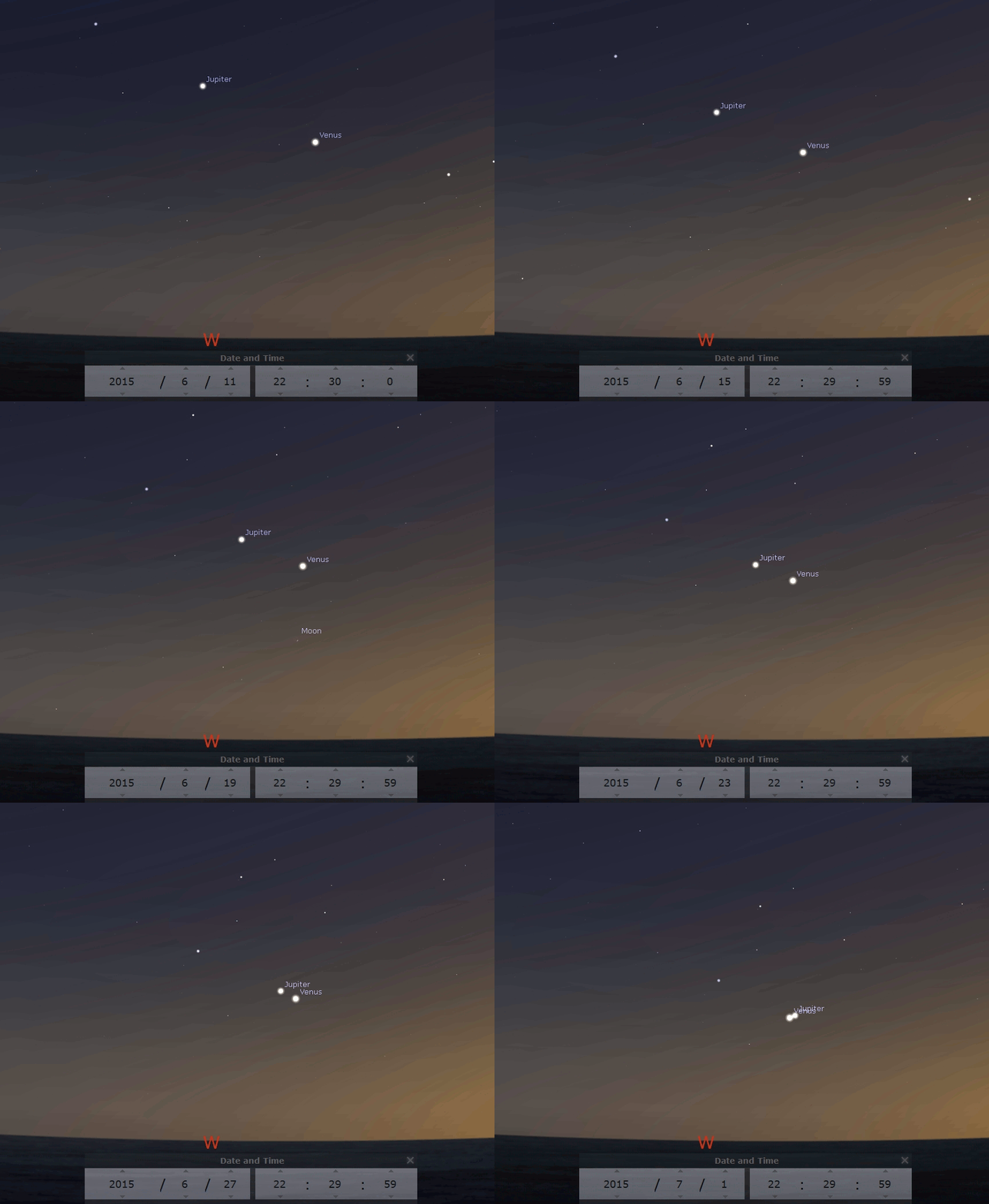
Jupiter-Venus approach animation June 11 to July 1, 2015 at 10:30 p.m. Created using Stellarium and GIMP. Click on image to enlarge.
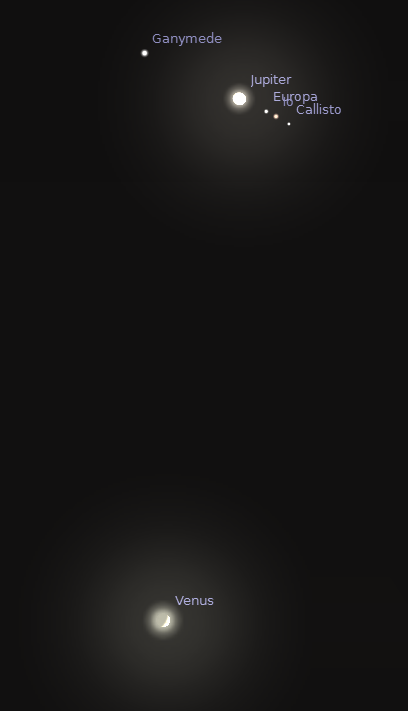
A telescopic view of what we expect the positions of Jupiter and Venus at 10:30 p.m. EDT June 30, 2015 (2:20 UT July 1, 2015). Created using Stellarium.
06/29/2015 – Ephemeris – Did tomorrow’s conjunction between Venus and Jupiter happen before?
Ephemeris for Monday, June 29th. Today the Sun will be up for 15 hours and 32 minutes, setting at 9:32. The Moon, 2 days before full, will set at 4:56 tomorrow morning and tomorrow the Sun will rise at 6:00.
Tonight the planet Jupiter will be a bit more than the width of the Moon away from Venus. Tomorrow that distance will be cut in half as Jupiter will pass directly above Venus. This is a second of two conjunctions that are a near repeat of two conjunctions that some, including myself have speculated as being what the Magi reported as the Star of Bethlehem in 3 and 2 BC. On August 12th 3 BC in the predawn sky Jupiter and Venus were a third of a moon width apart, Then on June 17th 2 BC they were in conjunction again but even closer . Last year we had a close conjunction of the two on August, 18th and the two will be in conjunction, and again tomorrow. Neither are as close as they were in 3 and 2 BC.
Times are for the Traverse City/Interlochen area of Michigan. They may be different for your location.
Addendum
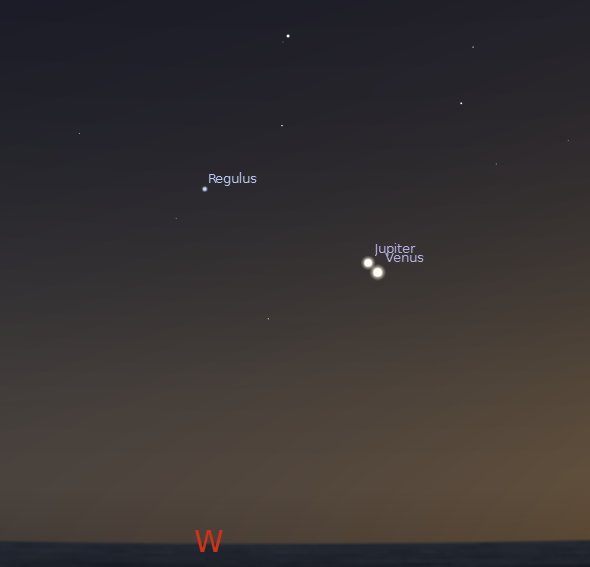
Jupiter and Venus at 10:30 tonight June 29, 2015, one day before their conjunction. Created using Stellarium.
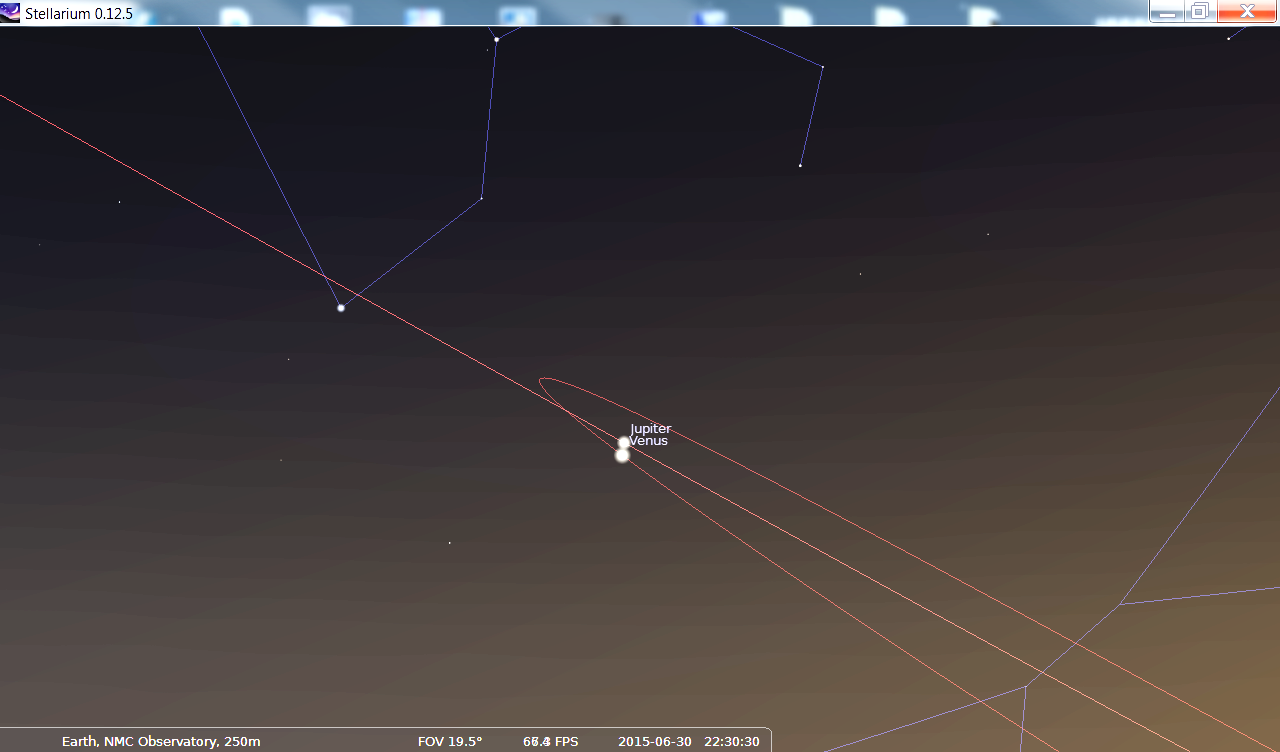
The orbits of Venus and Jupiter for the conjunction of June 30, 2015. The bright star to the upper left is Regulus. Created using Stellarium.
A telescopic view of what we expect the positions of Jupiter and Venus at 10:30 p.m. EDT June 30, 2015 (2:20 UT July 1, 2015). Created using Stellarium.
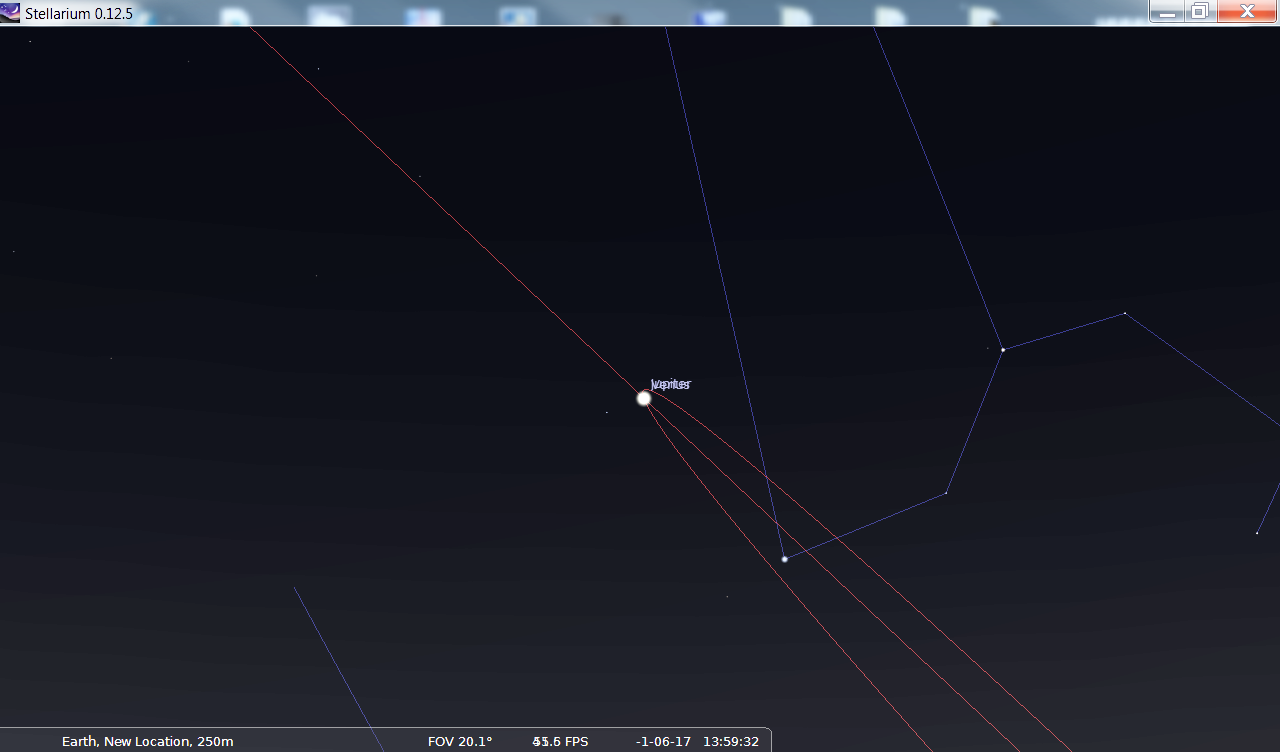
The orbits of Venus and Jupiter for the conjunction of June 17, 2 BC. The bright star to the lower right is Regulus. Created using Stellarium.
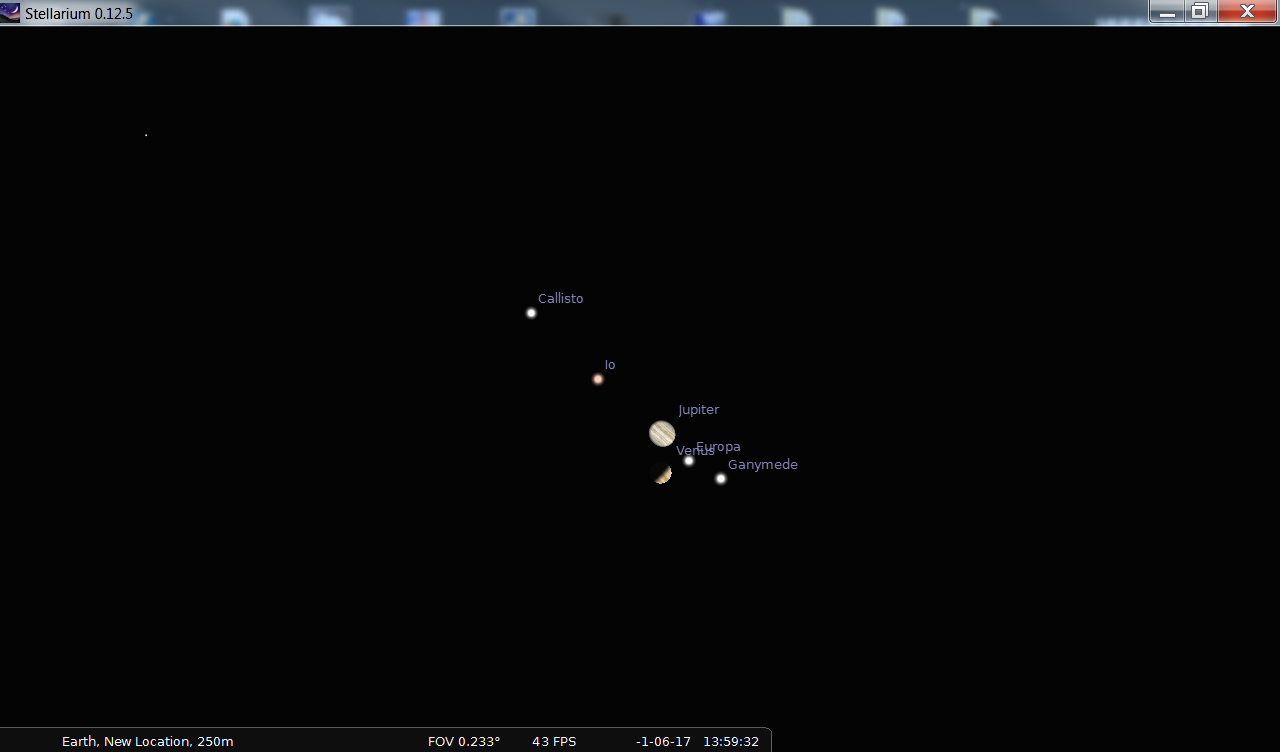
Venus appeared among Jupiter’s moons on August 12, 3 BC. Of course no one had a telescope back then. Created using Stellarium.
I’ve written about the Jupiter-Venus conjunctions of 3 and 2 BC. You can see it here from my Ephemeris website..
06/25/2015 – Ephemeris – Lunar seas and highlands tell the story of the Moon’s history
Ephemeris for Thursday, June 25th. Today the Sun will be up for 15 hours and 34 minutes, setting at 9:32. The Moon, 1 day past first quarter, will set at 2:26 tomorrow morning and tomorrow the Sun will rise at 5:58.
Tuesday I talked about the brightness variation on the Moon, the bright and ancient highlands and the darker areas called seas, but a large asteroid impact areas that welled up magma from the moon’s interior erasing prior craters. The dark seas were created after most cratering had ended, or they’d be heavily cratered too. They seem to have occurred about 4 billion years ago, about 500 million years after the Moon formed. This appeared to be a period when the giant planets came closer to the Sun than they are now, before retreating again. This period is called the late heavy bombardment. Not all astronomers give it credence, but it bears out what we see in planetary systems around other stars.
Times are for the Traverse City/Interlochen area of Michigan. They may be different for your location.
Addendum
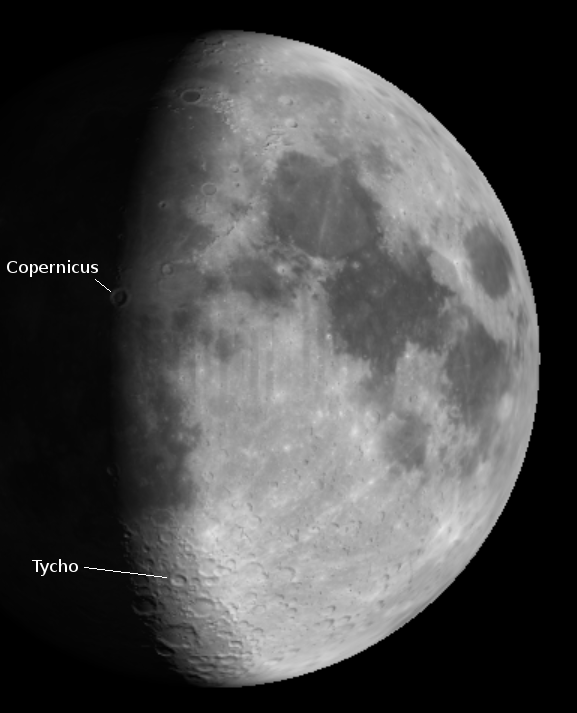
The Moon tonight with pointers to seas near the crater Copernicus and the highlands near the crater Tycho. 10:30 p.m. June 25, 2015. Created using Virtual Moon Atlas.
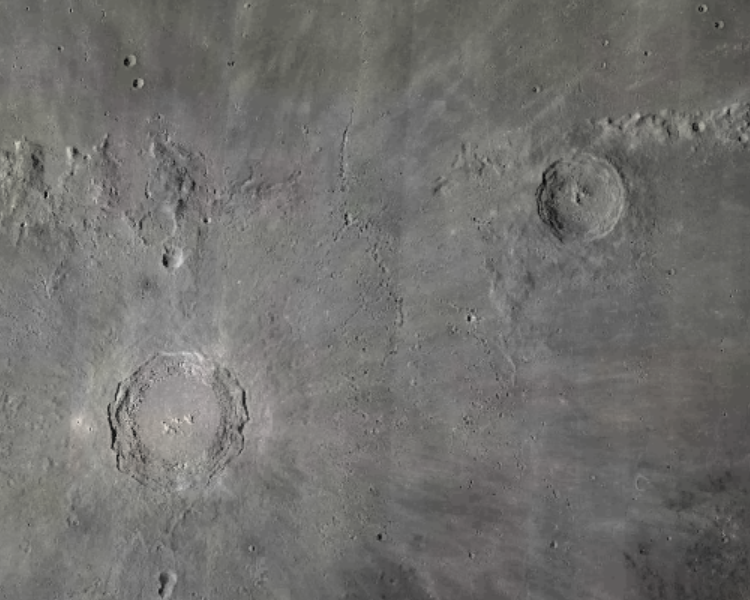
The Lunar seas near the crater Copernicus showing the smooth surface with relatively few craters. Credit: Virtual Moon Atlas with the texture from NASA’s Lunar Reconnaissance Orbiter. The lunar phase was omitted.
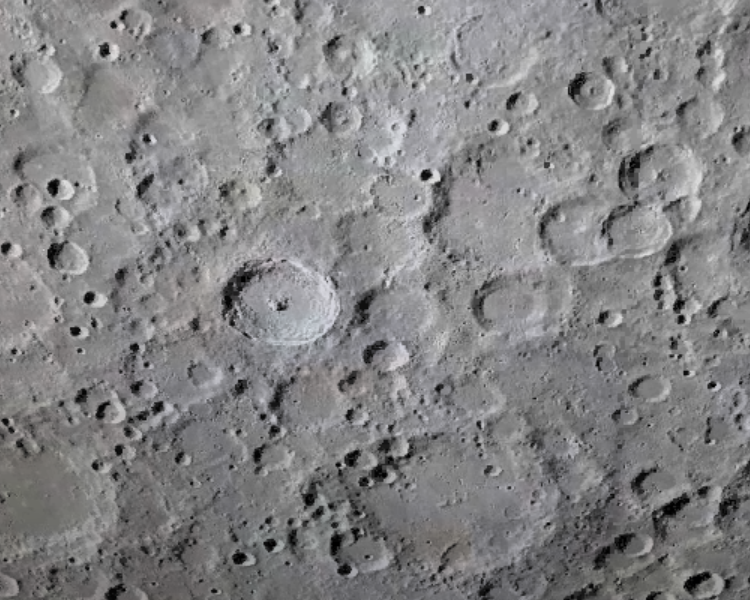
The Lunar highlands near the crater Tycho showing a surface saturated with craters. Credit: Virtual Moon Atlas with the texture from NASA’s Lunar Reconnaissance Orbiter. The lunar phase was omitted. Both images are shown to the same scale.
06/24/2015 – Ephemeris – Jupiter and Venus inch closer while Saturn keeps its distance
Ephemeris for Wednesday, June 24th. Today the Sun will be up for 15 hours and 34 minutes, setting at 9:32. The Moon, at first quarter today, will set at 1:58 tomorrow morning and tomorrow the Sun will rise at 5:58.
Lets take a look at the bright planets for this week. Our brilliant evening star Venus is in the west by 9:45 p.m. It will set around midnight. Venus’ will slide down to the Sun faster and faster in the coming weeks. It will take a bit less than 2 months. Jupiter will appear western sky to the left of and slightly above Venus at about 10 p.m. It will set at 12:09 a.m. It seems to approach Venus, and now appears about 3 and a half degrees away. That’s about three finger widths held at arm’s length. They will cross paths in 6 days, on the 30th. Saturn is in the southeast in evening twilight. It will pass due south at 11:22 p.m. and will set at 4:10 a.m. Even small telescopes can see Saturn’s rings.
Times are for the Traverse City/Interlochen area of Michigan. They may be different for your location.
Addendum
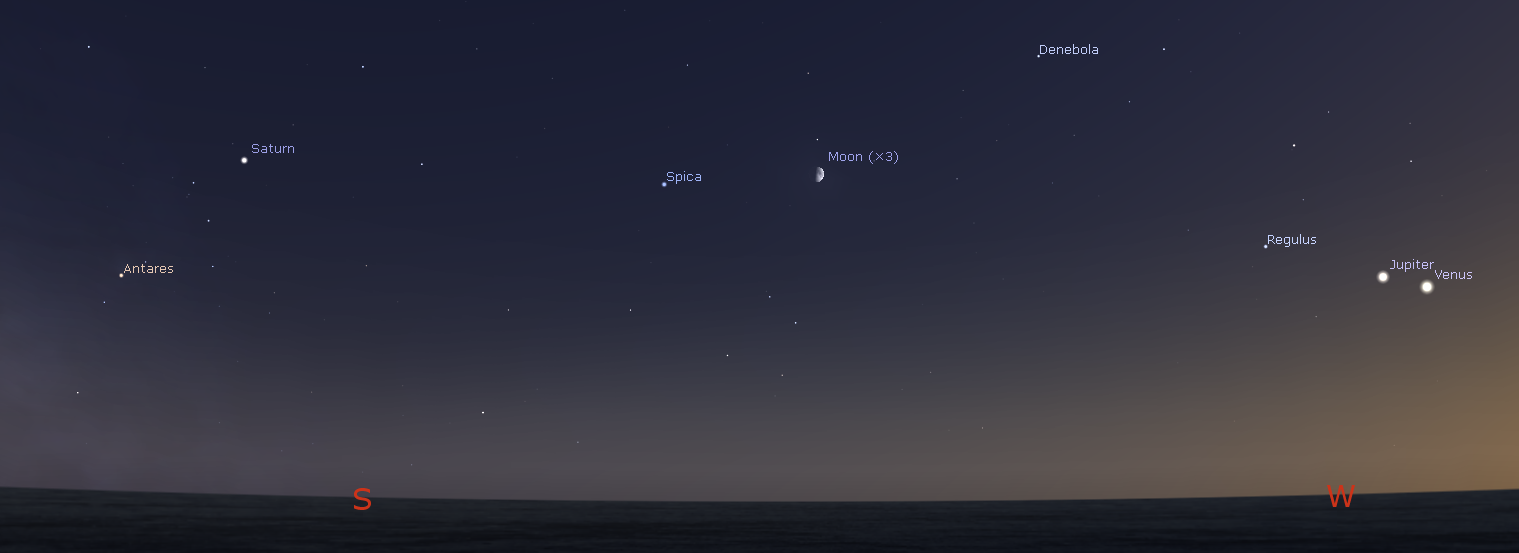
Jupiter and Venus converge in the west while the Moon and Saturn look on. 10:30 p.m., June 24, 2015. Created using Stellarium. Click to enlarge.
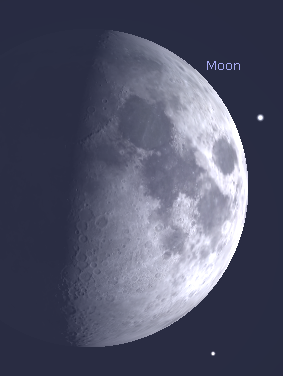
Closeup of the Moon at 10:30 p.m. June 24, 2015. Created using Stellarium.
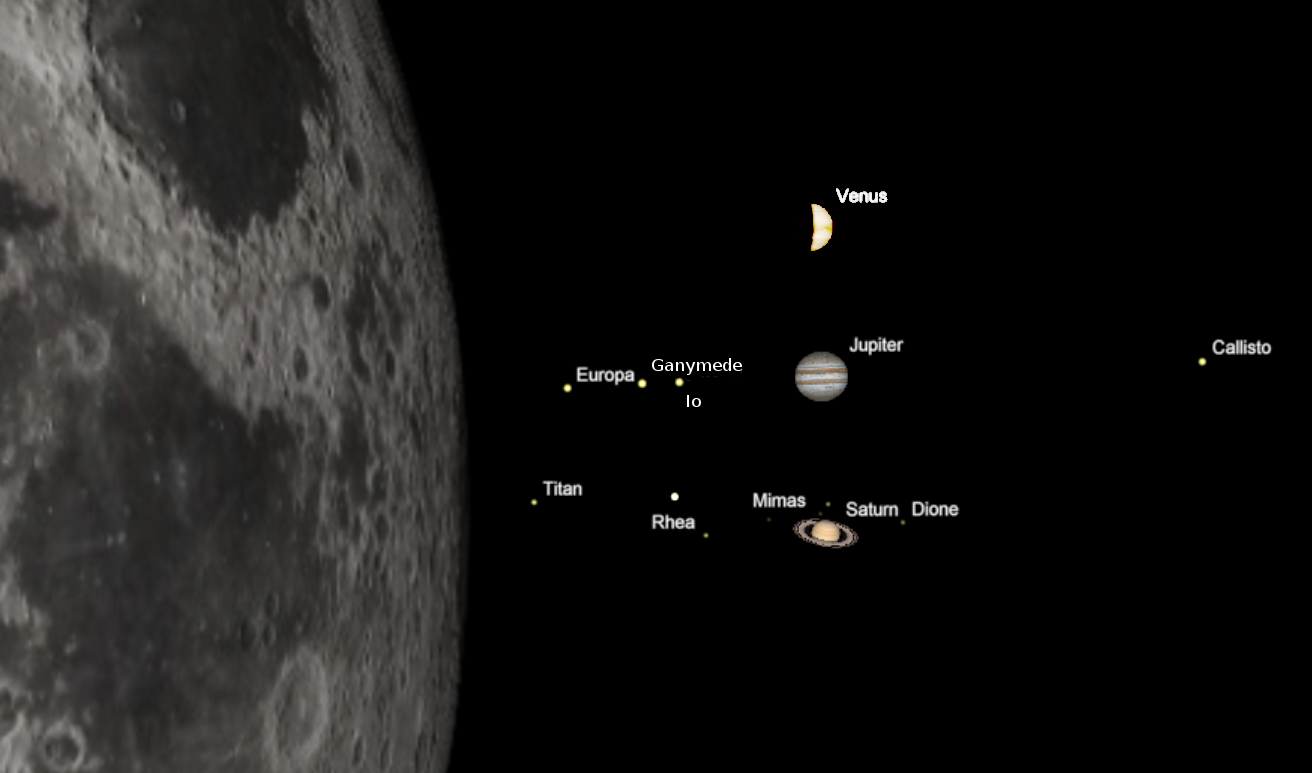
The evening planets and the Moon using the same magnification at 10:30 p.m., June 24, 2015. Created using Cartes du Ciel (Sky Charts). Click on image to enlarge.
Note that over the last few Wednesdays that I’ve portrayed the planets at the same scale that Venus has been getting larger with respect to Jupiter as it approaches the Earth and Jupiter moves away.
Jupiter-Venus approach animation June 11 to July 1, 2015 at 10:30 p.m. Created using Stellarium and GIMP. Click on image to enlarge.
06/19/2015 – Ephemeris – Two events this weekend: one local, one global
Ephemeris for Friday, June 19th. Today the Sun will be up for 15 hours and 34 minutes, setting at 9:31. The Moon, 3 days past new, will set at 11:34 this evening. Tomorrow the Sun will rise at 5:56.
There’s a couple of astronomical events coming up this weekend. On Saturday there will be another Sun ‘n Star Party at the Sleeping Bear Dunes National Lakeshore if weather cooperates. This time the telescopes will be set up at the Pierce Stocking Scenic Drive, Stop 3, the Dunes Overlook from 4 to 6 p.m. and from 9 to 11 p.m. The best place to park is Picnic Mountain, just before the Dunes Overlook. On Sunday a truly global event, the Summer solstice will occur at 12:38 p.m. (16:38 UT), when the Sun will reach its farthest north signaling the start of summer in the northern hemisphere. For folks south of the equator it will be the winter solstice signaling the start of winter for them.
Times are for the Traverse City/Interlochen area of Michigan. They may be different for your location.
Addendum
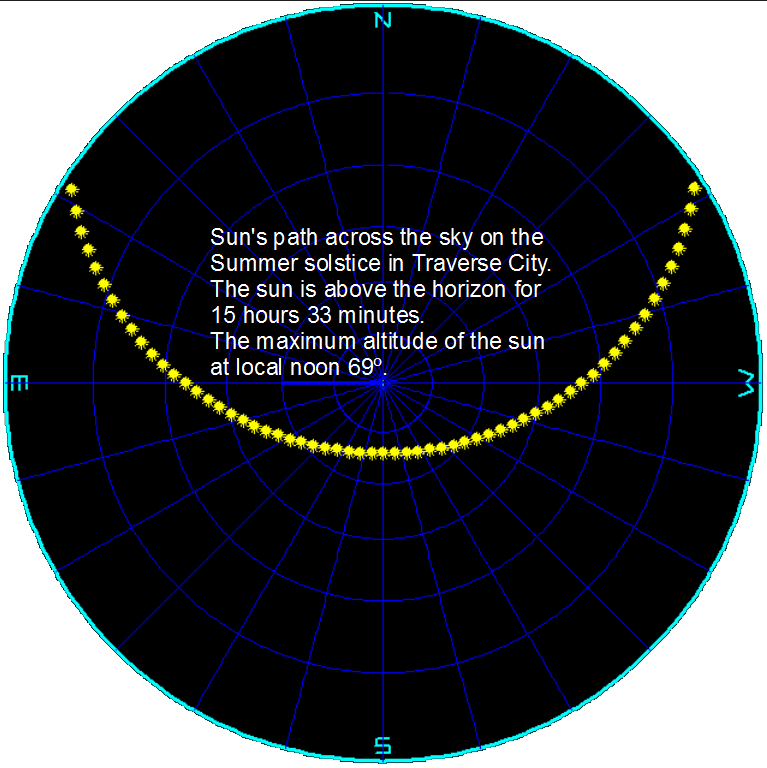
The Sun’s apparent path in the sky on the summer solstice. The cyan circle is the horizon and the Sun is plotted every 15 minutes throughout the day. Created by Bob Moler using LookingUp. This is a slide from his school program on the cause of the seasons.
06/18/2015 – Ephemeris – 26 days to Pluto!
Ephemeris for Thursday, June 18th. Today the Sun will be up for 15 hours and 34 minutes, setting at 9:31. The Moon, 2 days past new, will set at 10:57 this evening. Tomorrow the Sun will rise at 5:56.
I hope everyone’s been following the progress of the New Horizons spacecraft as it nears the Pluto system. It will reach and pass through the Pluto system on July 14th, only 26 days from now after a journey of 9 years. Now, Pluto is more than a dot in the probe’s cameras, which are used to look for possible hazardous rings of debris, more moons and for navigational purposes. New Horizons is aimed for a window less than a hundred miles on a side, and a few minutes in time. All its moves to study Pluto and its moons have been pre-programmed in and actually tested two years ago to make sure everything works. We will not hear from the spacecraft on encounter day, it will be too busy.
Times are for the Traverse City/Interlochen area of Michigan. They may be different for your location.
Addendum
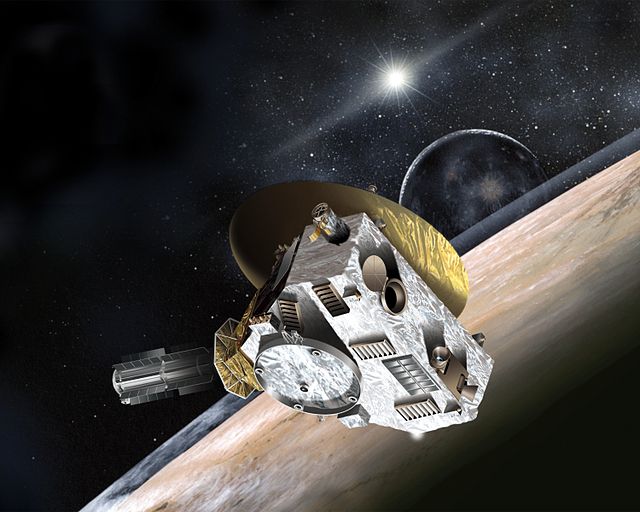
Artist conception of the New Horizons spacecraft at Pluto. Credit: NASA/Johns Hopkins University Applied Physics Laboratory/Southwest Research Institute
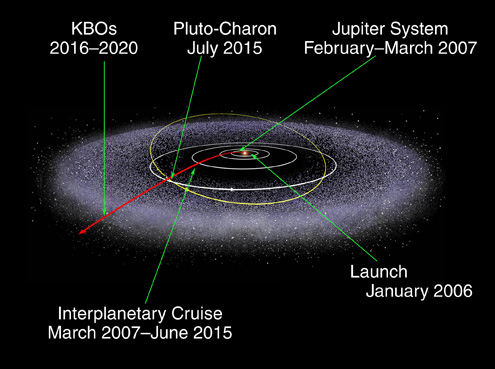
New Horizon’s trajectory through the solar system. Credit: NASA/APL.
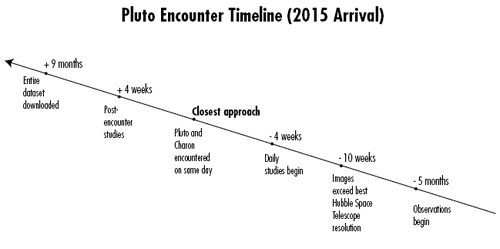
New Horizons Encounter Timeline. Credit: NASA/JHAPL.
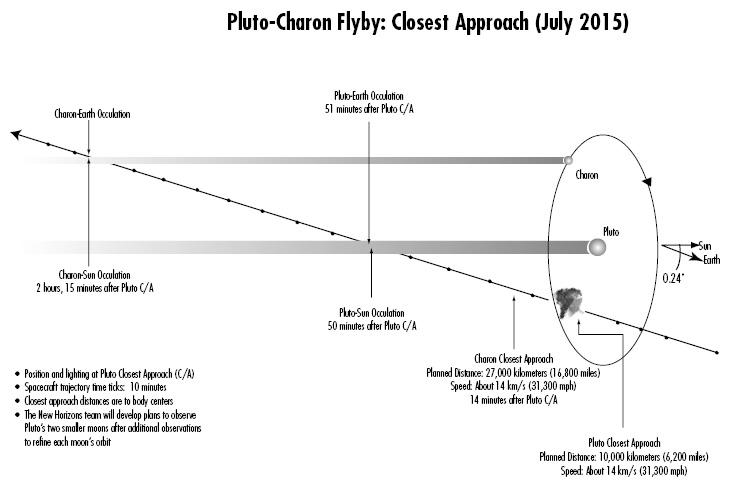
New Horizons at closest approach to Pluto. Credit: NASA/JHAPL.
06/17/2015 – Ephemeris – Jupiter and Venus approach each other while Saturn looks on
Ephemeris for Wednesday, June 17th. Today the Sun will be up for 15 hours and 34 minutes, setting at 9:30. The Moon, 1 day past new, will set at 10:14 this evening. Tomorrow the Sun will rise at 5:56.
Lets take a look at the bright planets for this week. Our brilliant evening star Venus is in the west by 9:45 p.m. It will set at 12:19 a.m. Venus’ will slide down to the Sun faster and faster in the coming weeks. It will take a bit less than 2 months. Jupiter will appear western sky to the left of and slightly above Venus at about 10 p.m. It will set at 12:34 a.m. It seems to approach Venus, and now appears about 8 degrees away. That’s somewhat less than the width of your fist held at arm’s length. They will cross paths in 13 days, on the 30th. Saturn is in the southeast in evening twilight. It will pass due south at 11:51 p.m. and will set at 4:39 a.m. Check out Saturn’s rings in any small telescope.
Times are for the Traverse City/Interlochen area of Michigan. They may be different for your location.
Addendum
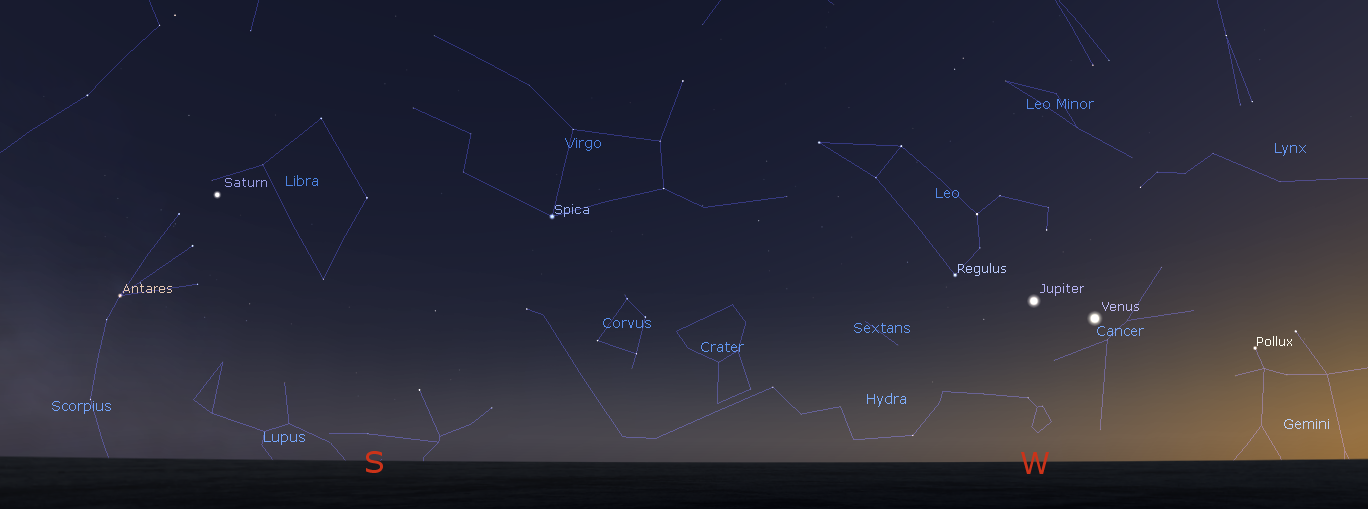
Venus, Jupiter and Saturn with the late spring southern constellations at 10:30 p.m., June 17, 2015. Created using Stellarium. Click on image to enlarge.
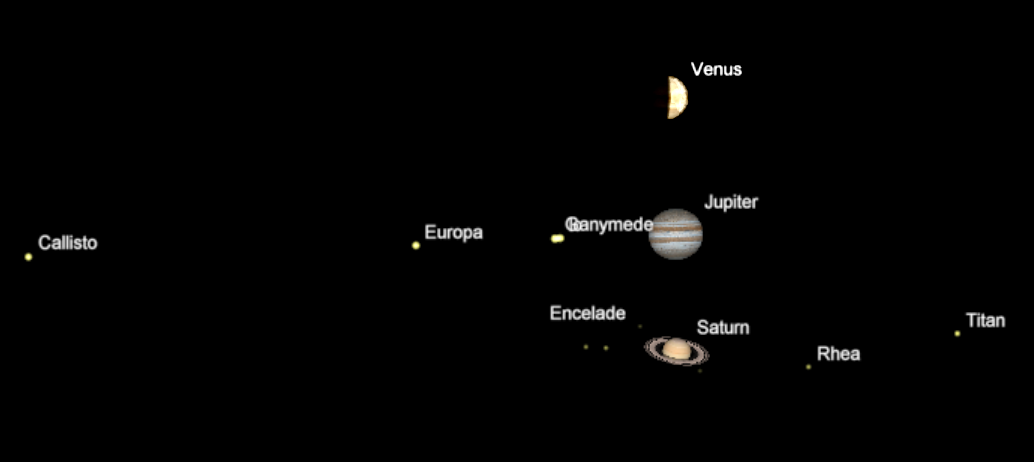
The evening planets using the same magnification at 10:30 p.m., June 17, 2015. Created using Cartes du Ciel (Sky Charts). Click on image to enlarge. Note that Jupiter’s moons Ganymede and Io are so close their labels overlap.

