Archive
Ephemeris: 12/05/2024 – More about Jupiter: it’s very gassy
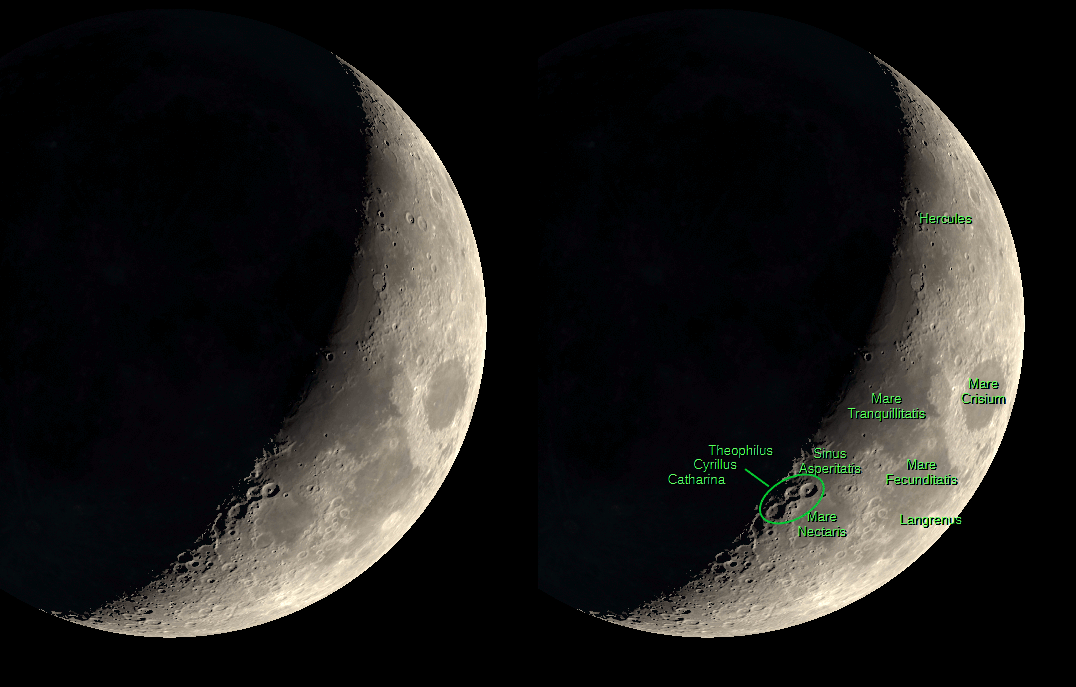
This is Bob Moler with Ephemeris for Thursday, December 5th. Today the Sun will be up for 8 hours and 57 minutes, setting at 5:02, and it will rise tomorrow at 8:05. The Moon, 3 days before first quarter, will set at 9:14 this evening.
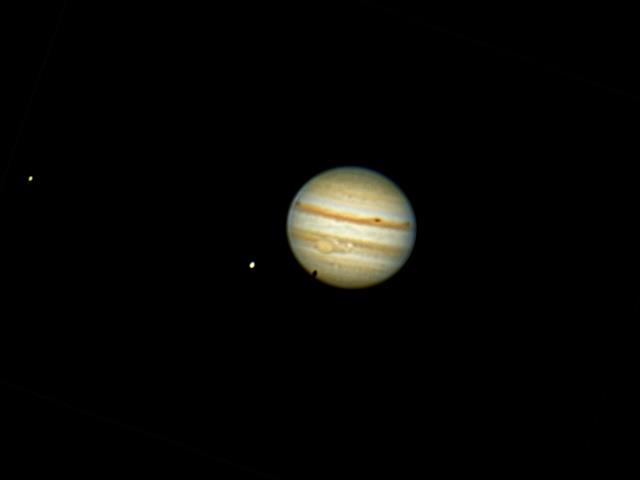
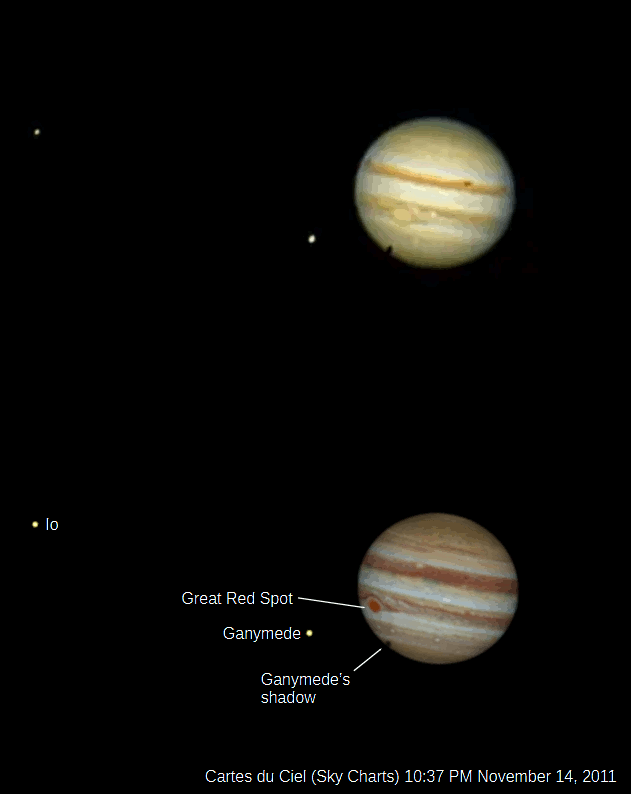
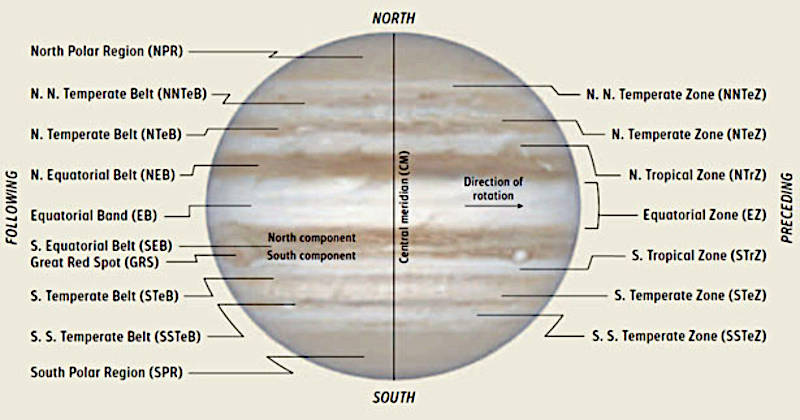
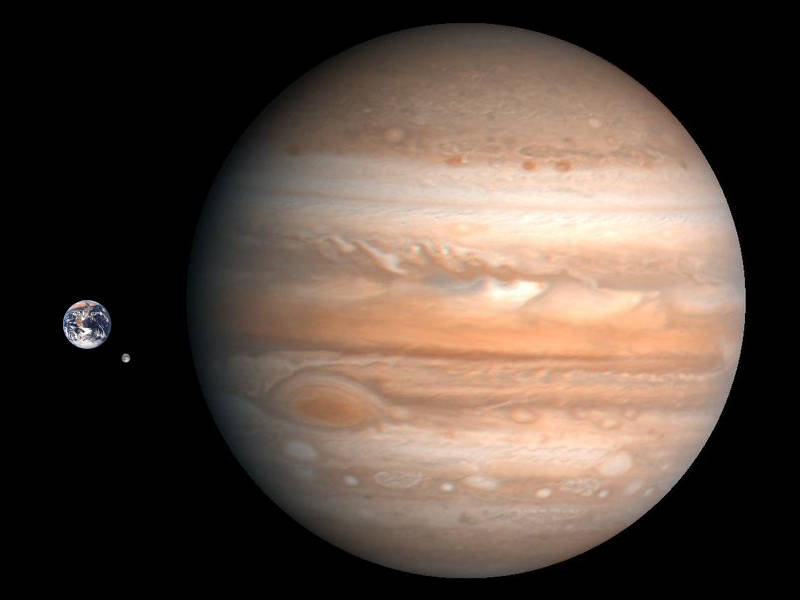
The planet Jupiter rules over the night sky with the Moon after Venus sets. Jupiter, 11 times the diameter of the Earth, has the volume of 1300 earths, however it is only 318 times the mass of the Earth. It is made-up mostly of hydrogen and helium, so it is called a gas giant planet, rather than a terrestrial or rocky planet like the Earth. Jupiter is the best viewable of the planets in a small telescope. It has 2 dark bands across it called belts of darker appearing clouds. The famed Great Red Spot is an anticyclone embedded in the southern of those belts. The spot is not as red anymore. I remember it being brick-red back in the late 1950s and early 60s. Jupiter spins very rapidly, its day lasts only 10 hours.
The astronomical event times given are for the Traverse City/Interlochen area of Michigan (EST, UT – 5 hours). Times will be different for other locations.
Addendum
Ephemeris: 12/04/2024 – Checking where the naked-eye planets are now
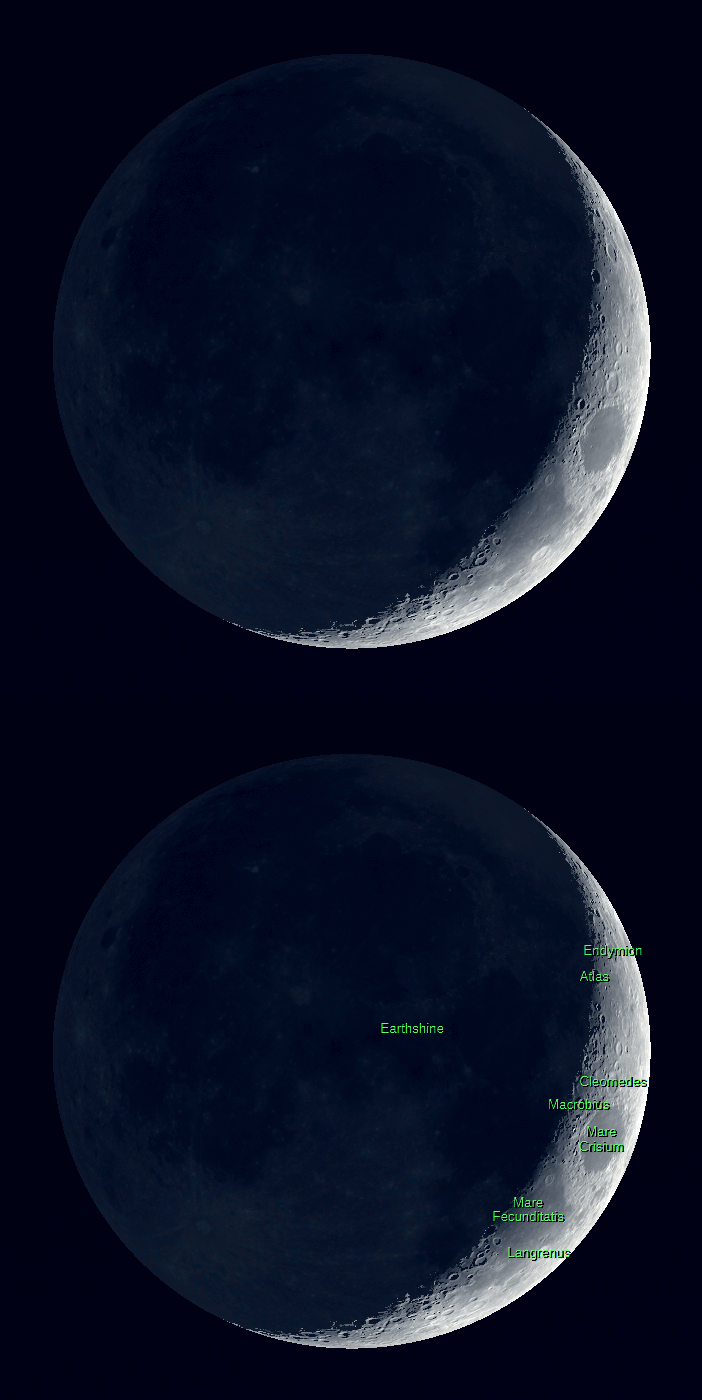
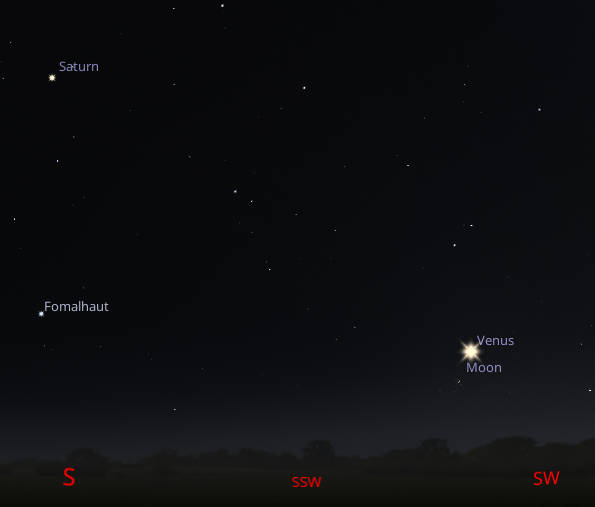
This is Ephemeris for Wednesday, December 4th. Today the Sun will be up for 8 hours and 58 minutes, setting at 5:02, and it will rise tomorrow at 8:04. The Moon, 3 days past new, will set at 7:59 this evening.
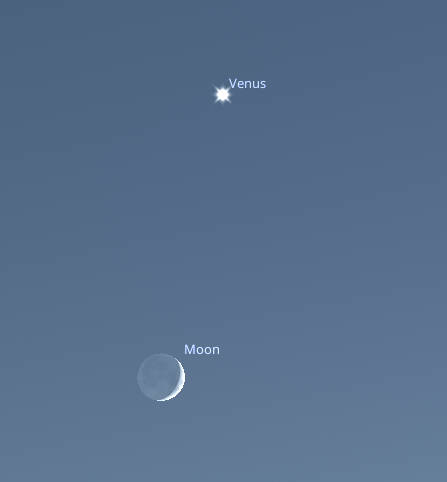
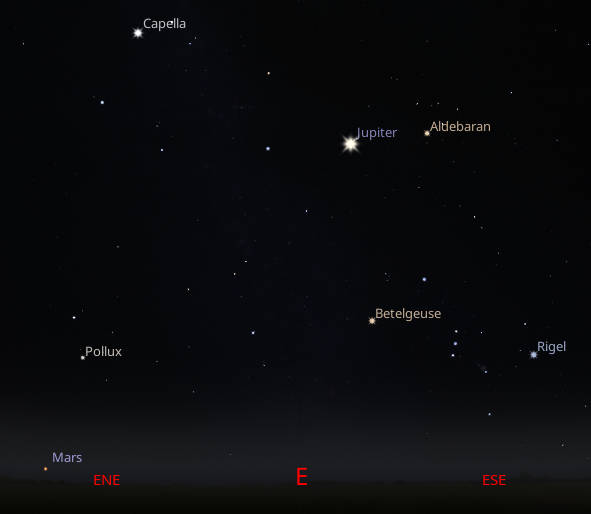
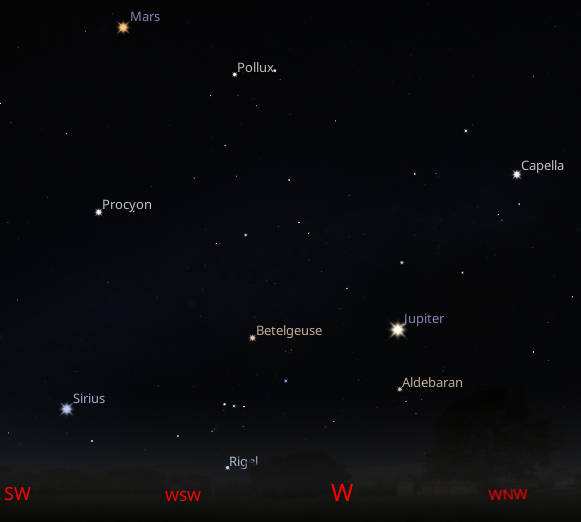
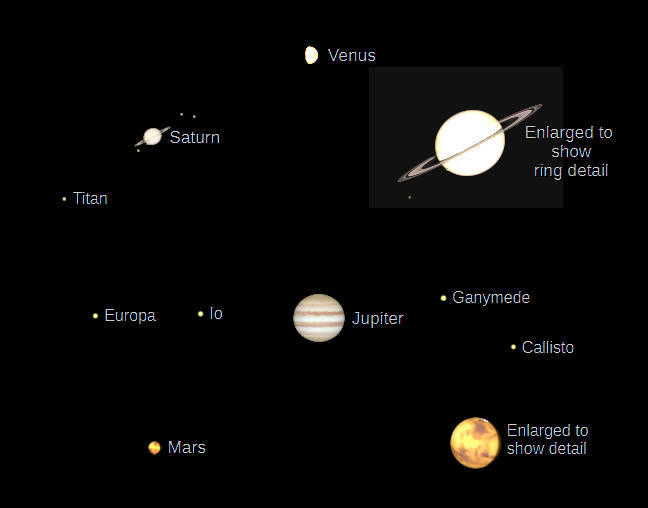
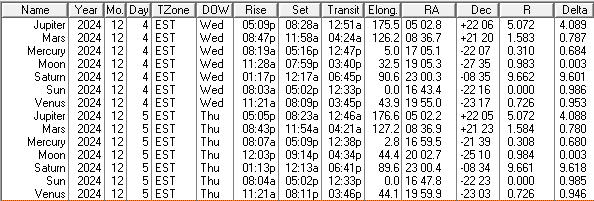
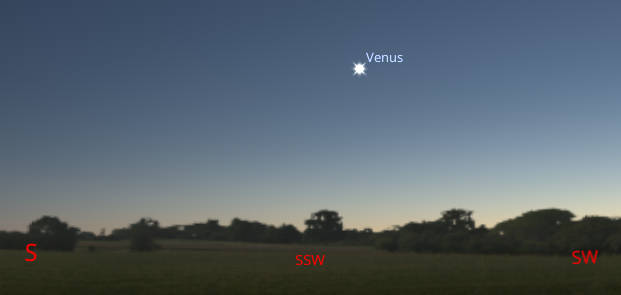
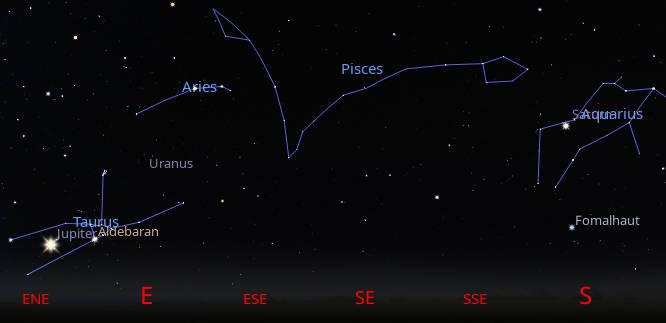
Let’s take our weekly look at the whereabouts of the naked-eye planets. Venus can be spotted low in the south-southwestern sky by 5:30 PM, about 30 minutes after sunset. It appears above the Moon tonight, and will set at 8:09 PM. Saturn will be in the south-southeast at 6 PM. Jupiter will rise at 5:09 PM in the east-northeast, and be a good object for the small telescope about an hour later. Mars, rises tonight at 8:47, Both Mars and Jupiter are considered morning planets, since they are still up at sunrise, though Jupiter will be an evening planet after Saturday. By 6:00 AM tomorrow Jupiter will be in the west, above and right of Orion, while reddish Mars will be high in the southwest. Jupiter and Saturn are great planets to view with a small telescope.
The astronomical event times given are for the Traverse City/Interlochen area of Michigan (EST, UT – 5 hours). Times will be different for other locations.
Addendum
Ephemeris: 12/03/2024 – Jupiter begins to dominate the evening sky
This is Ephemeris for Tuesday, December 3rd. Today the Sun will be up for 9 hours even, setting at 5:02, and it will rise tomorrow at 8:03. The Moon, 2 days past new, will set at 6:48 this evening.
The bright star that’s in the east early in the evenings isn’t a star at all, but the planet Jupiter. This giant planet is moving to be in opposition to the Sun this Saturday, which means that the Earth is directly between Jupiter and the Sun, so it’s the time that it’s closest to us. And so it’s at its largest appearing and brightest. Jupiter is the largest of the planets being about 11 times the Earth’s diameter, its volume would be 11 cubed or about 1,300 times the Earth’s volume. It is the second-brightest planet after Venus. It is also the largest appearing planet in telescopes except for a couple of months around the time when Venus is closest to the Earth. Binoculars will show that Jupiter is not quite star-like, and some of its large satellites can be also seen.
The astronomical event times given are for the Traverse City/Interlochen area of Michigan (EST, UT – 5 hours). Times will be different for other locations.
Addendum
Ephemeris: 12/02/2024 – Orion is rising in the evening
This is Ephemeris for Monday, December 2nd. Today the Sun will be up for 9 hours and 1 minute, setting at 5:03, and it will rise tomorrow at 8:02. The Moon, 1 day past new, will set at 5:47 this evening.
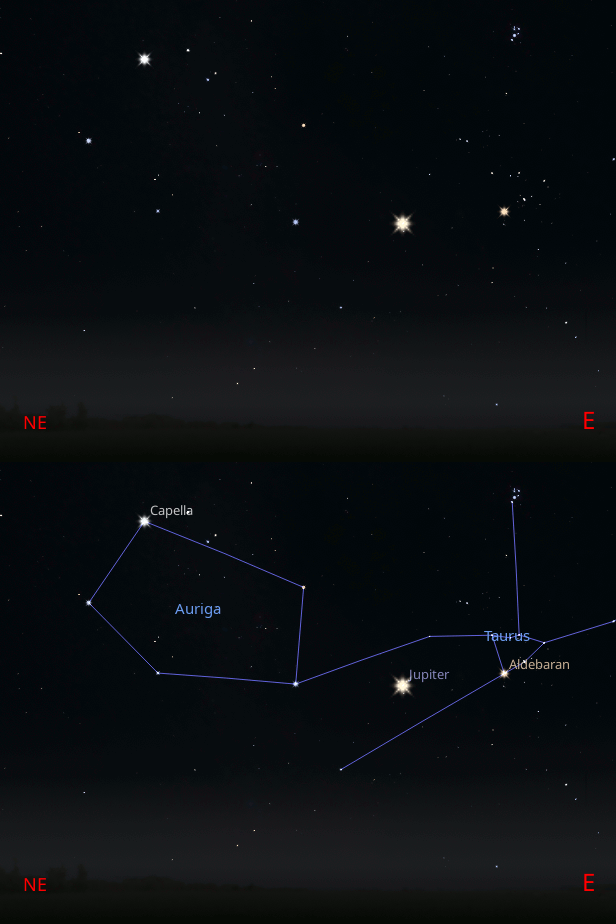
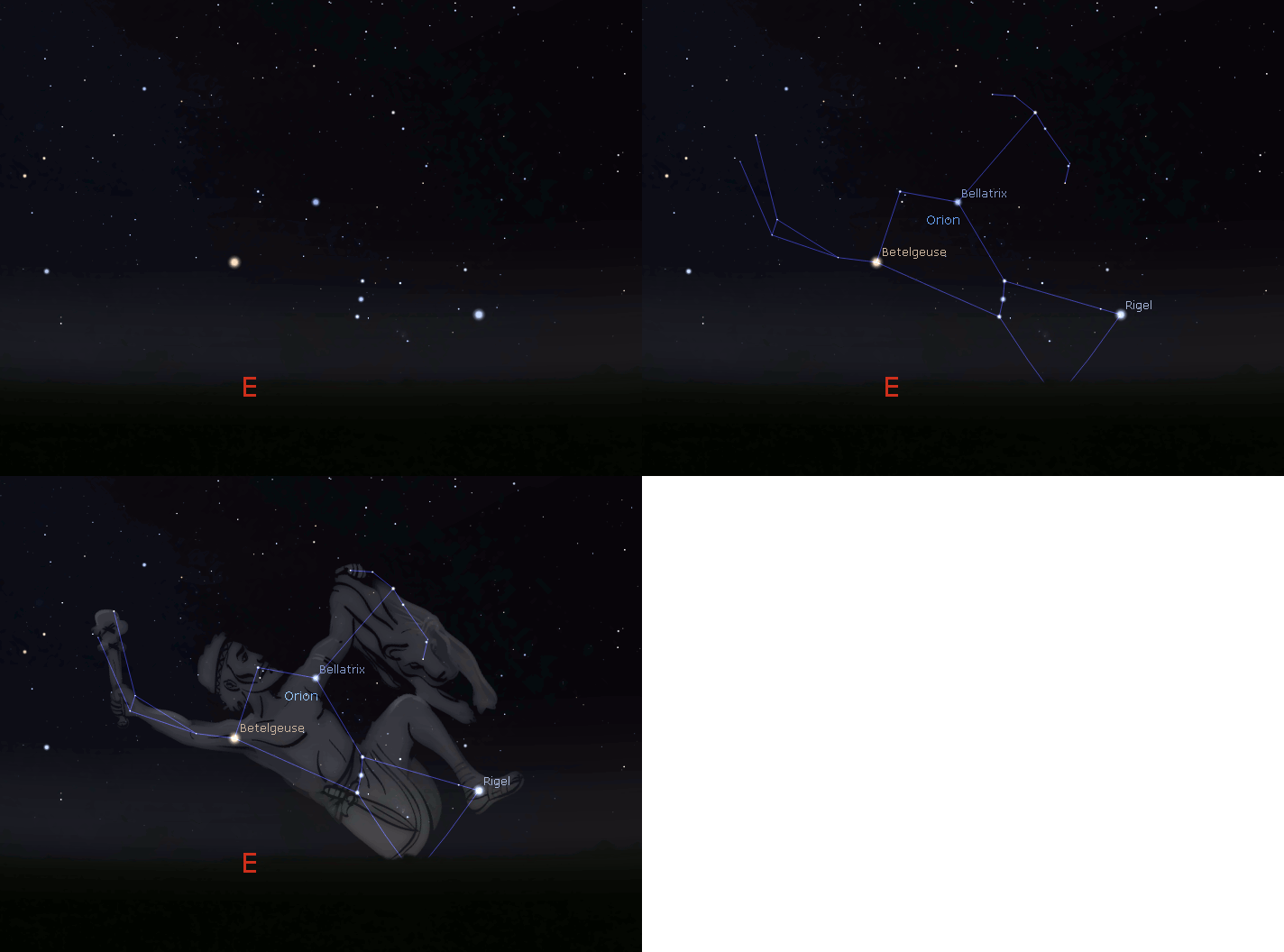
In the east, the central winter constellation Orion the hunter throws a leg over the horizon between 8 and 9 p.m. as Robert Frost told in his poem Star-Splitter. The upright rectangle that is his body on December evenings is tilted to the left as he rises, with a bright red star Betelgeuse at the top left of the rectangle, his shoulder. At the opposite corner is blue-white Rigel, a knee. In the center of the rectangle is a line of three stars nearly vertically aligned as he rises, which represents his belt. The stars of Orion’s belt are how many folks can find him. The Anishinaabek native peoples of this area call him the Wintermaker whose arms are held wide to encompass the winter stars. His rising in the evening heralds the coming of winter.
The astronomical event times given are for the Traverse City/Interlochen area of Michigan (EST, UT – 5 hours). Times will be different for other locations.
Addendum
Ephemeris: 11/29/2024 – Previewing December skies
This is Ephemeris for Native American Heritage Day, Friday, November 29th. Today the Sun will be up for 9 hours and 5 minutes, setting at 5:04, and it will rise tomorrow at 7:59. The Moon, 2 days before new, will rise at 7:39 tomorrow morning.
Let’s look at December skies. We are now in the holiday season and about to celebrate the southernmost travel of the Sun in the sky and its return northward. So there is not much change in sunrise and sunset times. The Sun will stop its travel south, the winter solstice, on the 21st at 4:20 am. It will make that day the shortest day in terms of daylight hours. However, the earliest sunset will occur on the 9th. The Geminid meteor shower will be hampered by the bright Moon when it reaches its peak on the evening of the 13th, near the full moon. This month continues the surprisingly active sunspot cycle that started four years ago and is nearing its peak.
The astronomical event times given are for the Traverse City/Interlochen area of Michigan (EST, UT – 5 hours). Times will be different for other locations.
Addendum (Updated 11/29/2024)
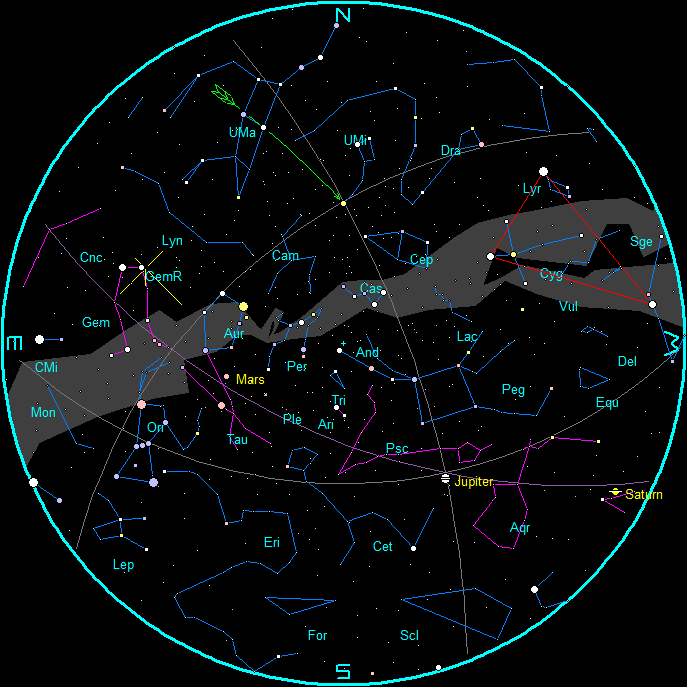
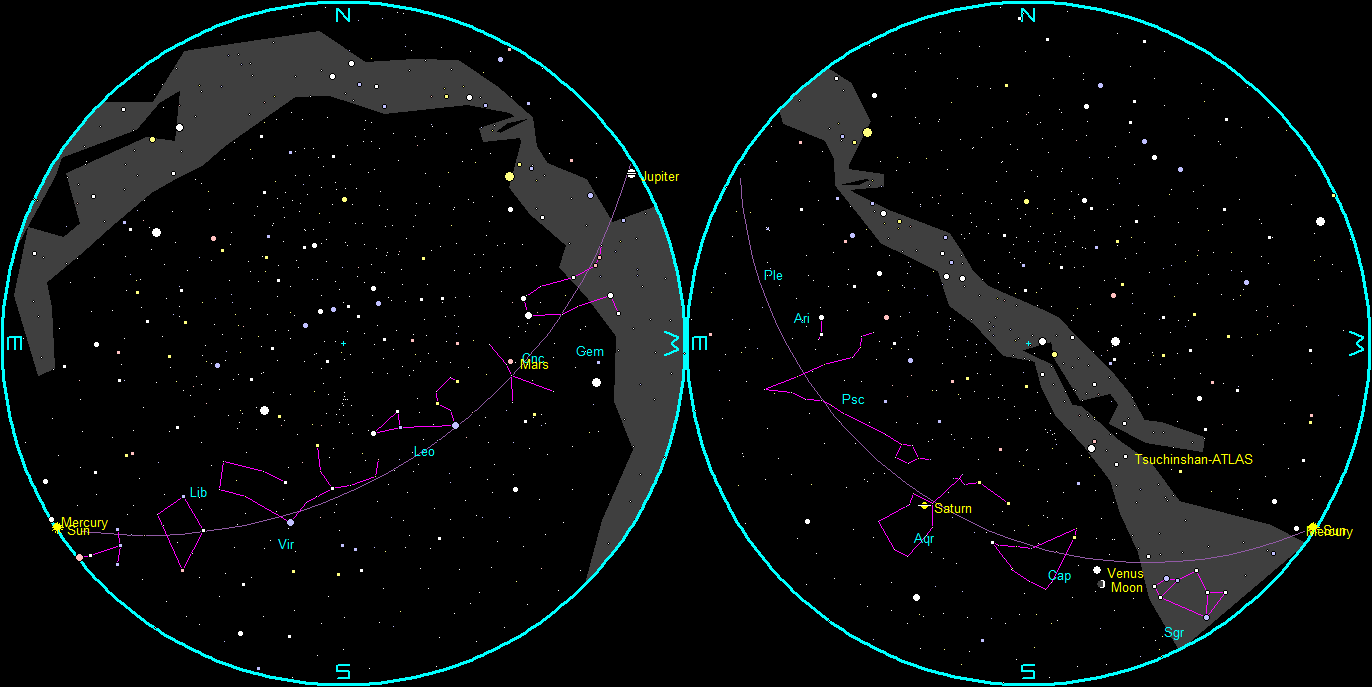
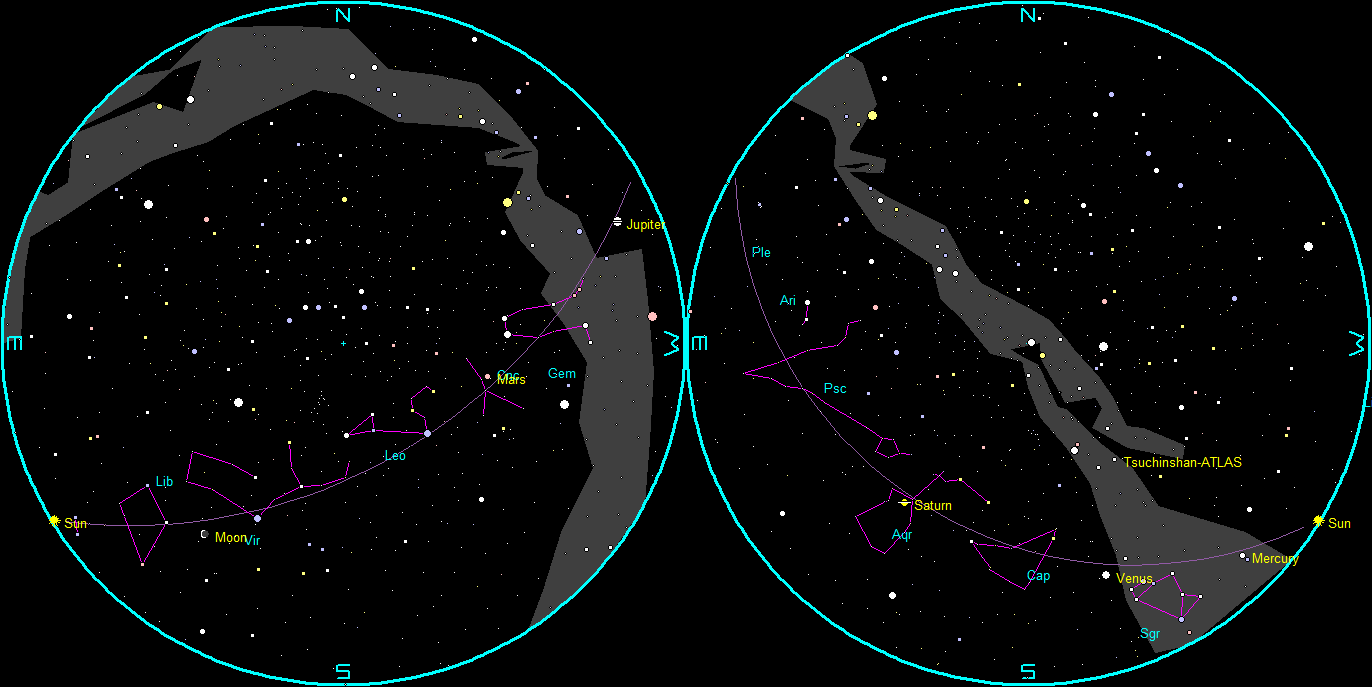
December Evening Star Chart
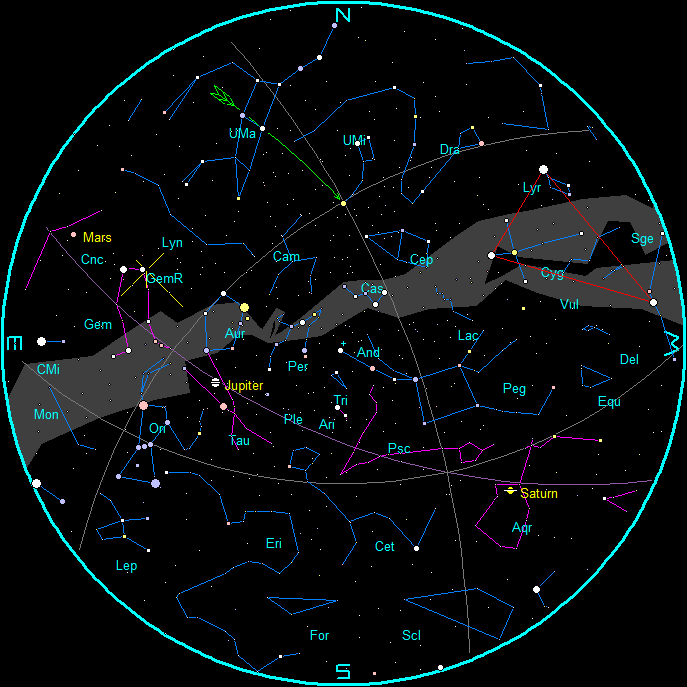
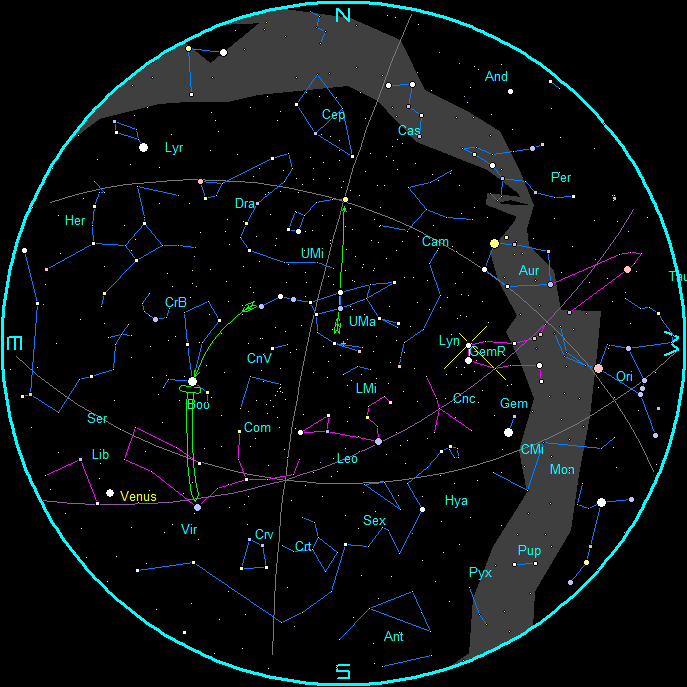
The planets and stars are plotted for the 15th at 9 pm EST in the evening and 6 a.m. for the morning chart. These are the chart times. Note that Traverse City is located approximately 45 minutes behind our time meridian, West 75° longitude. (An hour 45 minutes behind our daylight saving time meridian during EDT).
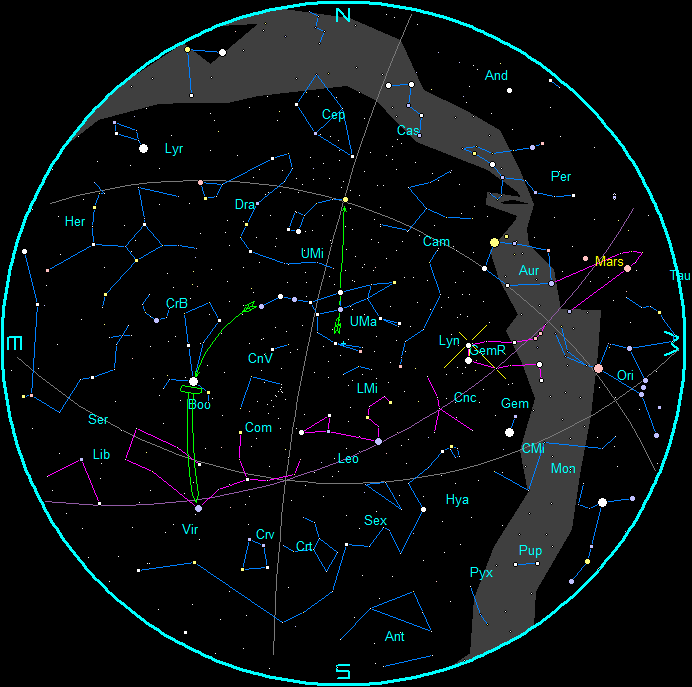
December Morning Star Chart
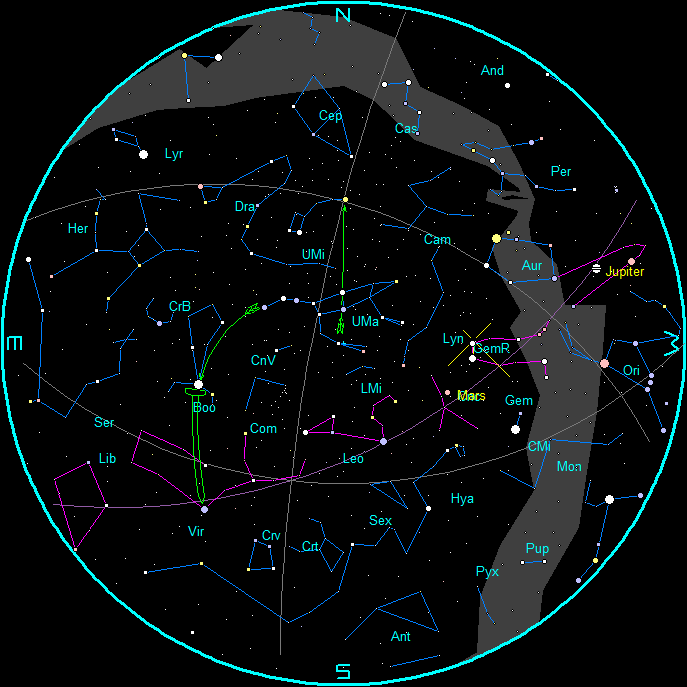
For a list of constellation names to go with the abbreviations, click here.
- Pointer stars at the front of the bowl of the Big Dipper point to Polaris, the North Star.
- The leaky bowl of the Big Dipper drips on Leo.
- Follow the arc of the handle of the Big Dipper to the star Arcturus, then
- Follow the spike to Spica.
- The Summer Triangle is in red.
- GemR on the star charts is the radiant of the Geminid meteor shower, which peaks on the evening of the 13th.
Twilight Limits, Nautical and Astronomical
| EST | |||||||
| Morning | Twilight | Evening | Twilight | Dark | Night | Moon | |
| Date | Astro. | Nautical | Nautical | Astro. | Start | End | Illum. |
| 2024-12-01 | 6h17m | 6h52m | 18h12m | 18h47m | 18h47m | 6h17m | 0.01 |
| 2024-12-02 | 6h18m | 6h53m | 18h12m | 18h47m | 18h47m | 6h18m | 0.04 |
| 2024-12-03 | 6h19m | 6h54m | 18h12m | 18h47m | 18h49m | 6h19m | 0.09 |
| 2024-12-04 | 6h20m | 6h55m | 18h11m | 18h47m | 20h00m | 6h20m | 0.16 |
| 2024-12-05 | 6h21m | 6h56m | 18h11m | 18h47m | 21h15m | 6h21m | 0.24 |
| 2024-12-06 | 6h22m | 6h57m | 18h11m | 18h47m | 22h31m | 6h22m | 0.34 |
| 2024-12-07 | 6h22m | 6h58m | 18h11m | 18h47m | 23h47m | 6h22m | 0.45 |
| 2024-12-08 | 6h23m | 6h59m | 18h11m | 18h47m | – | 6h23m | 0.57 |
| 2024-12-09 | 6h24m | 6h59m | 18h11m | 18h47m | 1h03m | 6h24m | 0.68 |
| 2024-12-10 | 6h25m | 7h00m | 18h11m | 18h47m | 2h20m | 6h25m | 0.78 |
| 2024-12-11 | 6h26m | 7h01m | 18h12m | 18h47m | 3h39m | 6h26m | 0.87 |
| 2024-12-12 | 6h26m | 7h02m | 18h12m | 18h47m | 5h01m | 6h26m | 0.94 |
| 2024-12-13 | 6h27m | 7h02m | 18h12m | 18h47m | 6h24m | 6h27m | 0.98 |
| 2024-12-14 | 6h28m | 7h03m | 18h12m | 18h48m | – | – | 1.00 |
| 2024-12-15 | 6h28m | 7h04m | 18h12m | 18h48m | – | – | 0.99 |
| 2024-12-16 | 6h29m | 7h05m | 18h13m | 18h48m | – | – | 0.96 |
| 2024-12-17 | 6h30m | 7h05m | 18h13m | 18h49m | 18h49m | 19h23m | 0.90 |
| 2024-12-18 | 6h30m | 7h06m | 18h13m | 18h49m | 18h49m | 20h37m | 0.83 |
| 2024-12-19 | 6h31m | 7h06m | 18h14m | 18h49m | 18h49m | 21h48m | 0.75 |
| 2024-12-20 | 6h31m | 7h07m | 18h14m | 18h50m | 18h50m | 22h55m | 0.66 |
| 2024-12-21 | 6h32m | 7h07m | 18h15m | 18h50m | 18h50m | 0h00m | 0.57 |
| 2024-12-22 | 6h32m | 7h08m | 18h15m | 18h51m | 18h51m | – | 0.47 |
| 2024-12-23 | 6h33m | 7h08m | 18h16m | 18h51m | 18h51m | 1h03m | 0.38 |
| 2024-12-24 | 6h33m | 7h09m | 18h17m | 18h52m | 18h52m | 2h06m | 0.29 |
| 2024-12-25 | 6h34m | 7h09m | 18h17m | 18h53m | 18h53m | 3h10m | 0.21 |
| 2024-12-26 | 6h34m | 7h09m | 18h18m | 18h53m | 18h53m | 4h16m | 0.14 |
| 2024-12-27 | 6h34m | 7h10m | 18h18m | 18h54m | 18h54m | 5h24m | 0.08 |
| 2024-12-28 | 6h34m | 7h10m | 18h19m | 18h55m | 18h55m | 6h33m | 0.03 |
| 2024-12-29 | 6h35m | 7h10m | 18h20m | 18h55m | 18h55m | 6h35m | 0.01 |
| 2024-12-30 | 6h35m | 7h10m | 18h21m | 19h00m | 19h00m | 6h35m | 0.00 |
| 2024-12-31 | 6h35m | 7h11m | 18h21m | 19h01m | 19h01m | 6h35m | 0.02 |
Twilight calendar was generated using Cartes du Ciel (Sky Charts).
See my blog post: Twilight Zone for the definitions of the different periods of twilight here: https://bobmoler.wordpress.com/2018/09/27/.
NASA Calendar of Planetary Events
Dec  1  Su            Venus: 43.6° E
     1  Su   1:21 am  New Moon
     2  Mo   5:31 pm  Moon South Dec.: 28.5° S
     3  Tu   7:08 am  Mars-Beehive: 1.6° N
     4  We   5:40 pm  Moon-Venus: 2.4° N
     5  Th   9:11 pm  Mercury Inferior Conj.
     7  Sa   3:19 pm  Jupiter Opposition
     8  Su   3:49 am  Moon-Saturn:  .3° S
     8  Su  10:27 am  First Quarter
     9  Mo   2:36 pm  Moon Ascending Node
    12  Th   8:18 am  Moon Perigee: 365400 km
    13  Fr  12:13 pm  Moon-Pleiades:  .1° S
    13  Fr   8:12 pm  Geminid Shower: ZHR = 120
    15  Su   4:02 am  Full Moon
    15  Su   3:12 pm  Moon North Dec.: 28.4° N
    17  Tu   7:12 am  Moon-Pollux: 2.1° N
    18  We   3:46 am  Moon-Mars: 1° S
    18  We   6:28 am  Moon-Beehive: 2.8° S
    20  Fr  12:37 am  Moon-Regulus: 2.6° S
    21  Sa   4:20 am  Winter Solstice
    22  Su   5:00 am  Ursid Shower: ZHR = 10
    22  Su   5:18 pm  Last Quarter
    22  Su   6:21 pm  Moon Descending Node
    23  Mo   4:39 pm  Mercury-Antares: 6.8° N
    24  Tu   2:25 am  Moon Apogee: 404500 km
    24  Tu   2:28 pm  Moon-Spica:  .2° S
    24  Tu   8:59 pm  Mercury Elongation: 22° W
    28  Sa   9:37 am  Moon-Antares:  .1° N
    30  Mo  12:06 am  Moon South Dec.: 28.4° S
    30  Mo   5:27 pm  New Moon
Jan  1  We            Venus: 47° E
Generated using my LookingUp for DOS program.
Sun and Moon Rising and Setting Events
LU                  Ephemeris of Sky Events for Interlochen/TC
December, 2024    Local time zone: EST
+-----------------------------------------------------------------------+
| DATE |  SUN     SUN  DAYLIGHT|   TWILIGHT*    |MOON  RISE OR    ILLUM |
|      |  RISE    SET    HOURS |  END    START  |PHASE SET** TIME FRACTN|
+=======================================================================+
|Sun  1| 08:00a  05:03p  09:02 | 06:12p  06:51a |New   Set  04:56p    1%|
|Mon  2| 08:01a  05:03p  09:01 | 06:12p  06:52a |      Set  05:47p    3%|
|Tue  3| 08:02a  05:02p  09:00 | 06:12p  06:53a |      Set  06:48p    8%|
|Wed  4| 08:03a  05:02p  08:58 | 06:12p  06:54a |      Set  07:59p   14%|
|Thu  5| 08:04a  05:02p  08:57 | 06:12p  06:54a |      Set  09:14p   23%|
|Fri  6| 08:05a  05:02p  08:56 | 06:12p  06:55a |      Set  10:31p   32%|
|Sat  7| 08:06a  05:02p  08:55 | 06:12p  06:56a |      Set  11:47p   43%|
+------+-----------------------+----------------+-----------------------+
|Sun  8| 08:07a  05:02p  08:54 | 06:12p  06:57a |F Qtr Set  01:03a   54%|
|Mon  9| 08:08a  05:02p  08:53 | 06:12p  06:58a |      Set  02:20a   65%|
|Tue 10| 08:09a  05:02p  08:52 | 06:12p  06:59a |      Set  03:39a   76%|
|Wed 11| 08:10a  05:02p  08:51 | 06:12p  07:00a |      Set  05:00a   85%|
|Thu 12| 08:11a  05:02p  08:51 | 06:12p  07:00a |      Set  06:24a   92%|
|Fri 13| 08:12a  05:02p  08:50 | 06:13p  07:01a |      Set  07:45a   97%|
|Sat 14| 08:12a  05:02p  08:49 | 06:13p  07:02a |      Set  08:57a  100%|
+------+-----------------------+----------------+-----------------------+
|Sun 15| 08:13a  05:02p  08:49 | 06:13p  07:02a |Full  Rise 05:01p   99%|
|Mon 16| 08:14a  05:03p  08:48 | 06:13p  07:03a |      Rise 06:09p   96%|
|Tue 17| 08:14a  05:03p  08:48 | 06:14p  07:04a |      Rise 07:23p   92%|
|Wed 18| 08:15a  05:03p  08:48 | 06:14p  07:04a |      Rise 08:36p   85%|
|Thu 19| 08:16a  05:04p  08:48 | 06:15p  07:05a |      Rise 09:47p   77%|
|Fri 20| 08:16a  05:04p  08:48 | 06:15p  07:05a |      Rise 10:55p   68%|
|Sat 21| 08:17a  05:05p  08:48 | 06:16p  07:06a |      Rise 11:59p   59%|
+------+-----------------------+----------------+-----------------------+
|Sun 22| 08:17a  05:05p  08:48 | 06:16p  07:06a |L Qtr Rise 01:02a   49%|
|Mon 23| 08:18a  05:06p  08:48 | 06:17p  07:07a |      Rise 02:05a   40%|
|Tue 24| 08:18a  05:07p  08:48 | 06:17p  07:07a |      Rise 03:10a   31%|
|Wed 25| 08:18a  05:07p  08:48 | 06:18p  07:08a |      Rise 04:16a   23%|
|Thu 26| 08:19a  05:08p  08:49 | 06:19p  07:08a |      Rise 05:24a   15%|
|Fri 27| 08:19a  05:09p  08:49 | 06:19p  07:08a |      Rise 06:32a    9%|
|Sat 28| 08:19a  05:09p  08:50 | 06:20p  07:09a |      Rise 07:38a    4%|
+------+-----------------------+----------------+-----------------------+
|Sun 29| 08:19a  05:10p  08:50 | 06:21p  07:09a |      Rise 08:36a    1%|
|Mon 30| 08:19a  05:11p  08:51 | 06:21p  07:09a |New   Set  04:37p    0%|
|Tue 31| 08:20a  05:12p  08:52 | 06:22p  07:09a |      Set  05:46p    1%|
+-----------------------------------------------------------------------+
* Nautical Twilight
** Moonrise or moonset, whichever occurs between sunset and sunrise
Generated using my LookingUp for DOS program.
Ephemeris: 11/27/2024 – Checking up on the naked-eye planets this week
This is Ephemeris for Wednesday, November 27th. Today the Sun will be up for 9 hours and 9 minutes, setting at 5:05, and it will rise tomorrow at 7:57. The Moon, 4 days before new, will rise at 5:23 tomorrow morning.
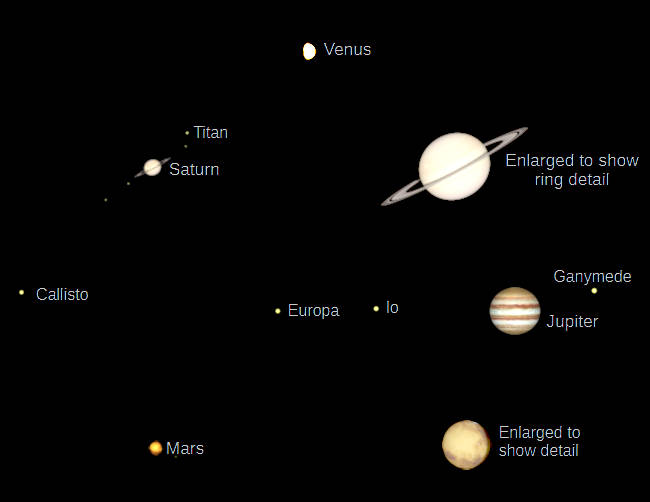
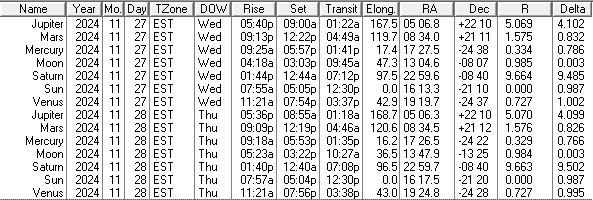
Let’s take our weekly look at the whereabouts of the naked-eye planets. Venus can be spotted low in the south-southwestern sky by 5:30 PM, about 25 minutes after sunset. It will set at 7:52. Saturn will be in the south-southeast at 6 PM. Jupiter will rise at 5:45 PM in the east northeast, and be a good object for the small telescope about an hour later. Mars, rises tonight near 9:16, Both Mars and Jupiter are considered morning planets, since they are still up at sunrise. By 6 AM tomorrow Jupiter will be in the west, above and right of Orion, while reddish Mars will be high in the southwest. Jupiter and Saturn are good planets to view with a small telescope, Mars will appear only a quarter the diameter of Jupiter.
The astronomical event times given are for the Traverse City/Interlochen area of Michigan (EST, UT – 5 hours). Times will be different for other locations.
Addendum
Ephemeris: 11/26/2024 – Finding the celestial charioteer and his goats
This is Ephemeris for Tuesday, November 26th. Today the Sun will be up for 9 hours and 11 minutes, setting at 5:05, and it will rise tomorrow at 7:55. The Moon, 4 days past last quarter, will rise at 4:18 tomorrow morning.
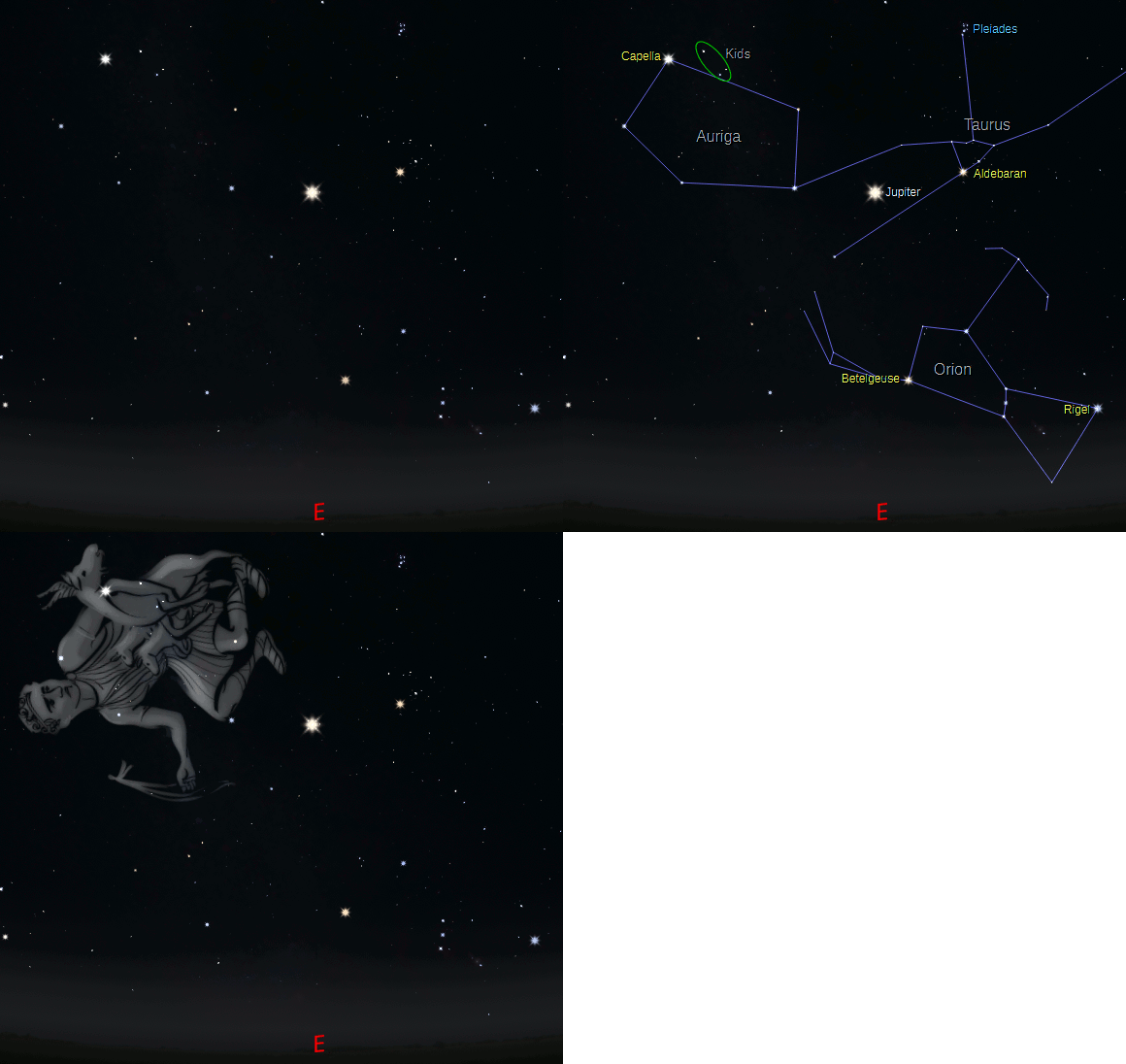
The constellation Auriga the charioteer is halfway up the sky in the east northeast at 9 p.m. It is a pentagon of stars, with the brilliant star Capella at the upper left of its corners. Capella represents a mama goat he’s carrying. A narrow triangle of stars just right of Capella are her kids, that is her baby goats. The Kids is an informal constellation or asterism. The Milky Way runs through Auriga, but it’s not very bright here. We are looking away from the center of the Milky Way to the more sparse outer parts of our galaxy. Within and near that pentagon, one can sweep with binoculars and low power telescopes to find several star clusters, groups of hundreds of stars born in the clump we still see them in. These star clusters will appear as fuzzy spots in binoculars.
The astronomical event times given are for the Traverse City/Interlochen area of Michigan (EST, UT – 5 hours). Times will be different for other locations.
Addendum
Ephemeris: 11/25/2024 – How to find Taurus the bull
This is Ephemeris for Monday, November 25th. Today the Sun will be up for 9 hours and 12 minutes, setting at 5:06, and it will rise tomorrow at 7:54. The Moon, 3 days past last quarter, will rise at 3:15 tomorrow morning.
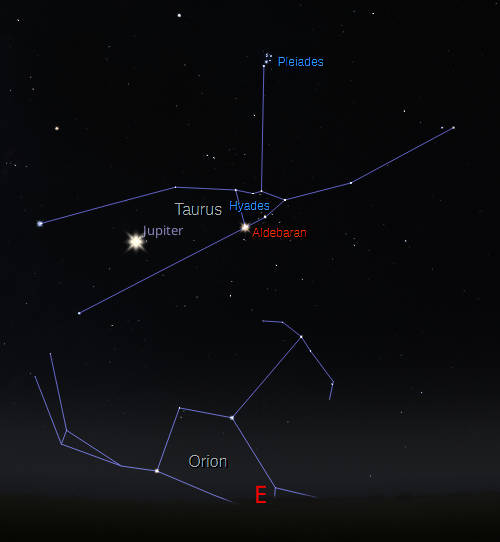
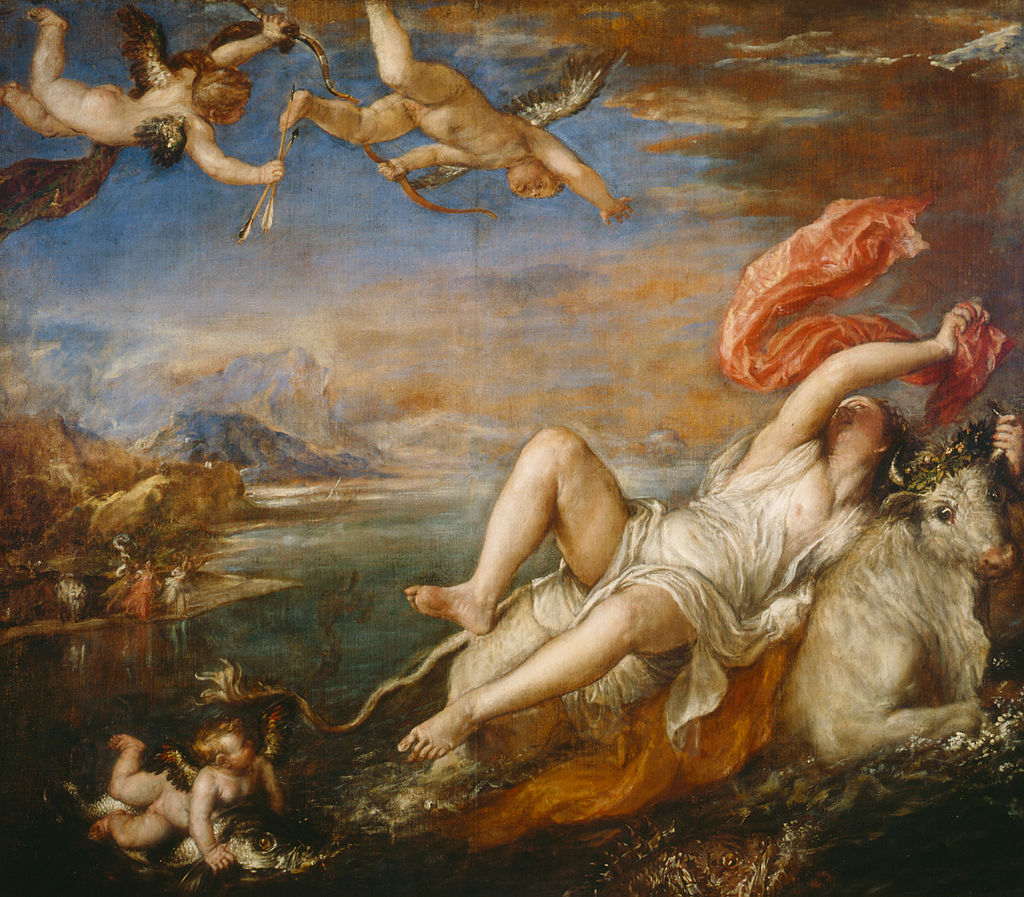
Low in the east at 8 this evening and below the beautiful Pleiades star cluster is Taurus the bull. His face is a letter V shape of stars lying on its side, the star cluster Hyades, with the bright orange-red star Aldebaran at one tip of the V as its angry bloodshot eye. Aldebaran is actually about halfway between us and the cluster. Tonight it is to the right of the brilliant planet Jupiter. The Pleiades star cluster is in his shoulder. Taurus is seen charging downward at that hour, the rising constellation of Orion. Taurus in Greek mythology was the form the god Zeus assumed when he carried off the maiden Europa. Europa’s still with him as a moon orbiting Zeus’ Roman equivalent, the planet Jupiter.
The astronomical event times given are for the Traverse City/Interlochen area of Michigan (EST, UT – 5 hours). Times will be different for other locations.
Addendum
Ephemeris: 11/22/2024 – Finding Aquarius
This is Ephemeris for Friday, November 22nd. Today the Sun will be up for 9 hours and 18 minutes, setting at 5:08, and it will rise tomorrow at 7:50. The Moon, at last quarter today, will rise at 12:04 tomorrow morning.
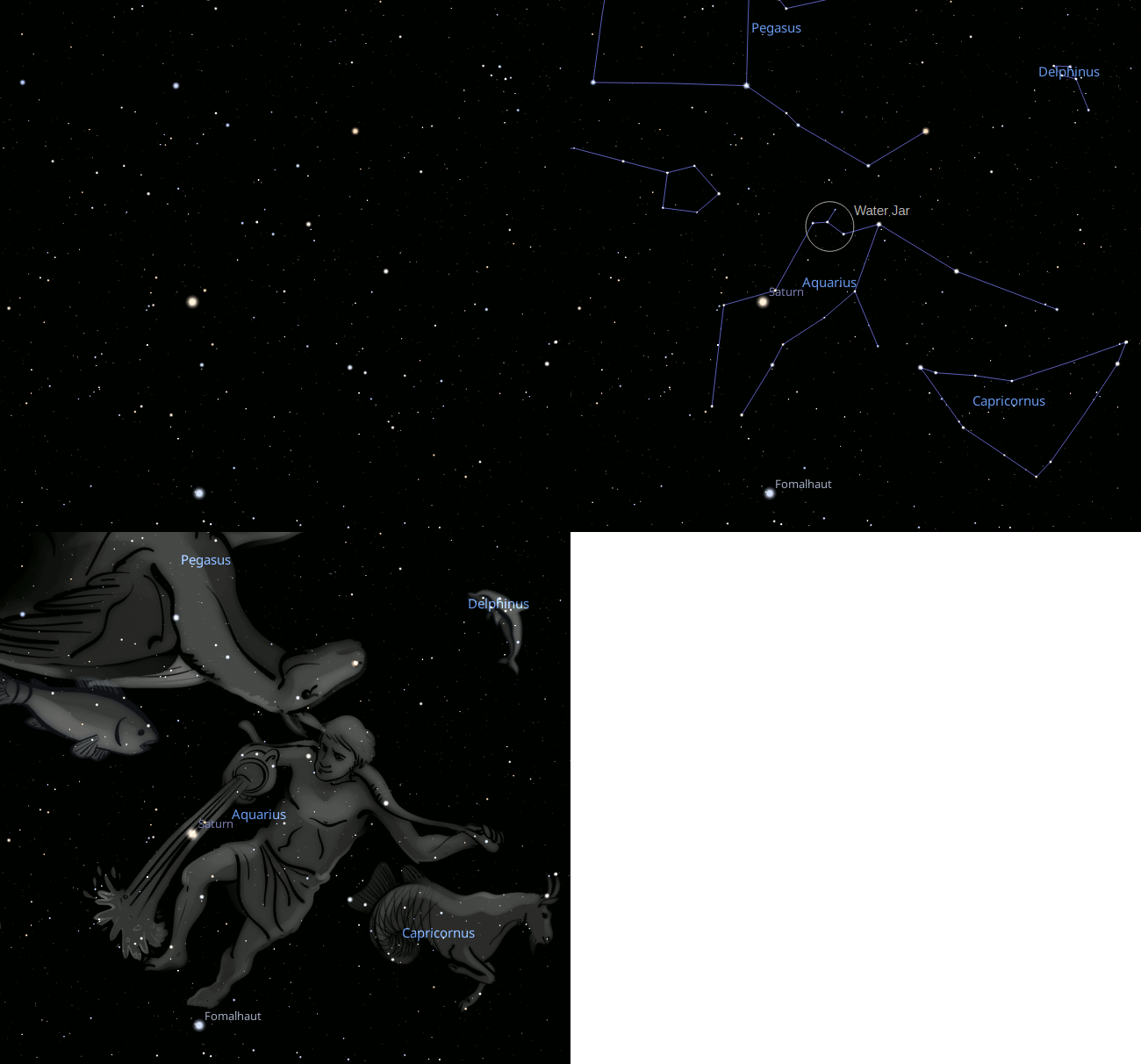
One of the constellations of the zodiac is in the southern sky at 8 in the evening, where Saturn is located this year. It’s the constellation of Aquarius, the water bearer. The image that is supposed to be depicted in the stars is that of a fellow carrying a stone jar of water. Aquarius is fairly hard to spot because it is made of faint stars. One part of him, though, is easier to spot. That is the Water Jar, an asterism or informal constellation. It is a distinctive small nearly equilateral triangle of stars with another star in the center. Aquarius is not a very good water bearer because he’s spilling the water out of his jar. The Water jar is above and to the right of Saturn this year and the water is flowing down a line of stars to the lower left.
The astronomical event times given are for the Traverse City/Interlochen area of Michigan (EST, UT – 5 hours). Times will be different for other locations.
Addendum
Ephemeris: 11/21/2024 – Fomalhaut’s planet that wasn’t
This is Ephemeris for Thursday, November 21st. Today the Sun will be up for 9 hours and 20 minutes, setting at 5:08, and it will rise tomorrow at 7:49. The Moon, 1 day before last quarter, will rise at 10:56 this evening.
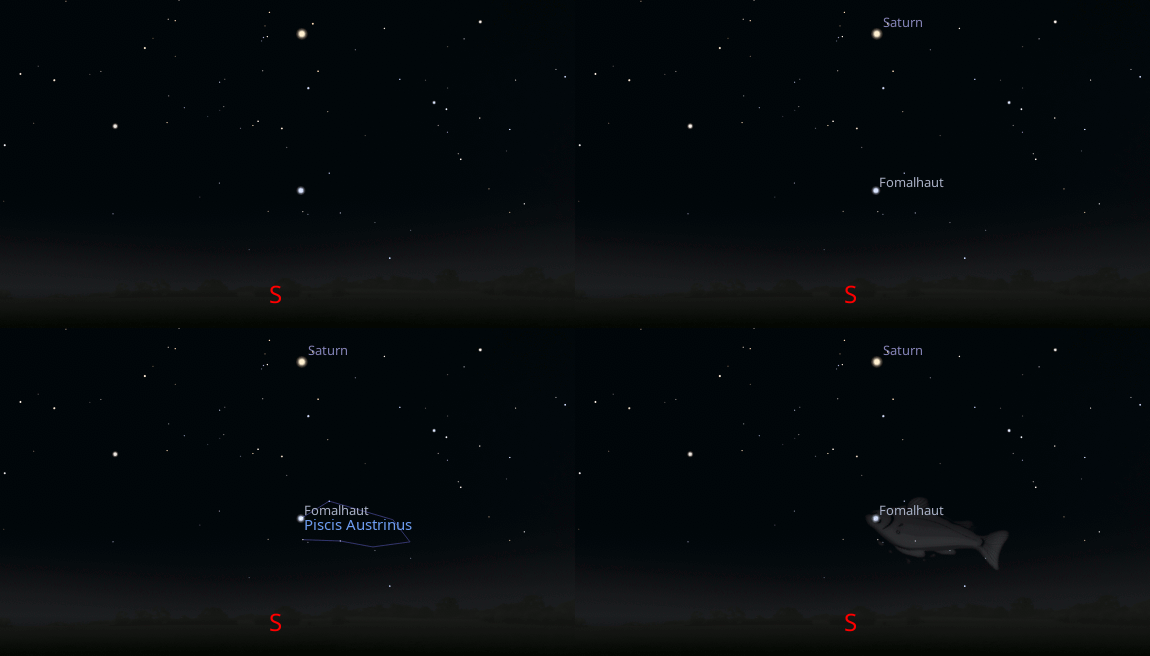
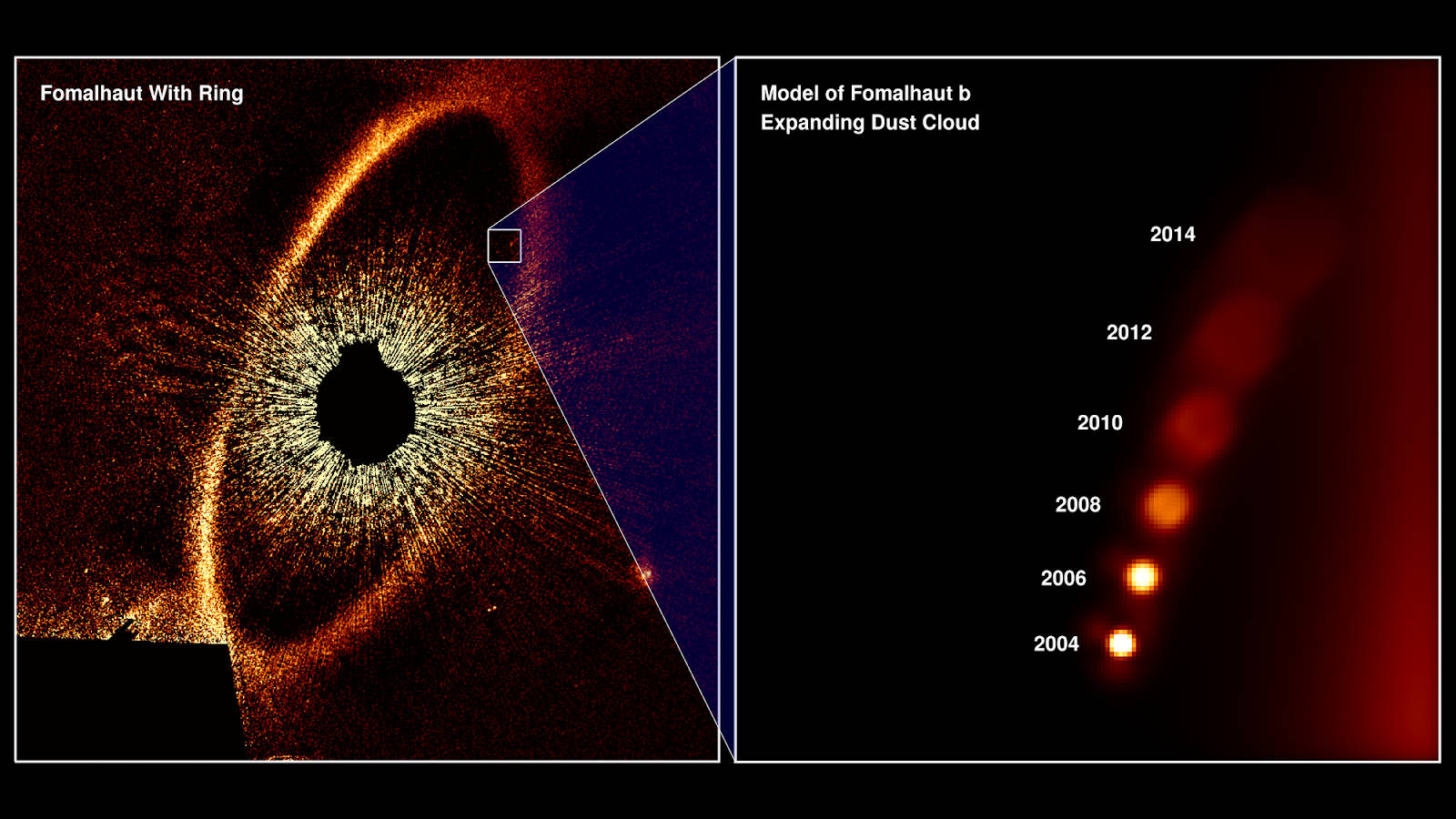
The lonely bright star low in the south-southeast at 8 p.m. these evenings is Fomalhaut, the harbinger of autumn in my book, and will leave as winter arrives. Fomalhaut is a young white star only about 400 million years old with a protoplanetary disk surrounding it. Near an outer dust ring, in 2008, the Hubble Space Telescope discovered a spot. Four years later, astronomers discovered that the spot had moved along the dust lane and announced the first direct discovery of an exoplanet. In 2010 and 2012 the planet now dubbed Fomalhaut b or Dagon was observed again. However, it appeared to be dissipating. It seems that it might actually be an expanding cloud of debris, the result of two asteroids or proto-planets colliding.
The astronomical event times given are for the Traverse City/Interlochen area of Michigan (EST, UT – 5 hours). Times will be different for other locations.
Addendum:
 Bob Moler's Ephemeris Blog