Archive
Ephemeris: 12/09/2025 – Aldebaran, the “Follower”
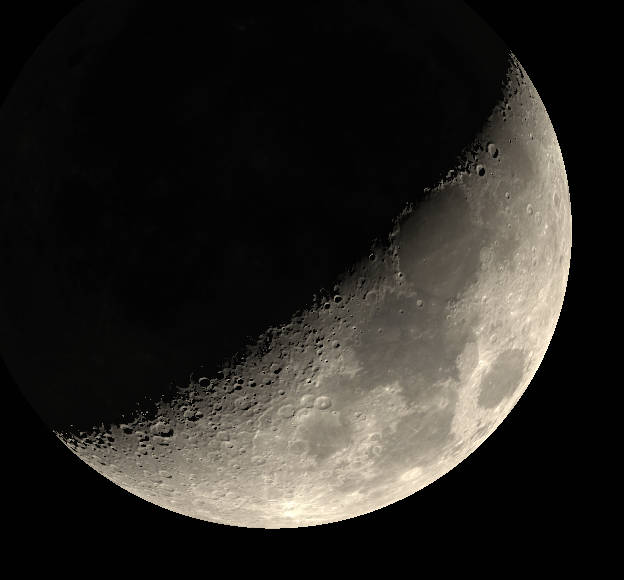
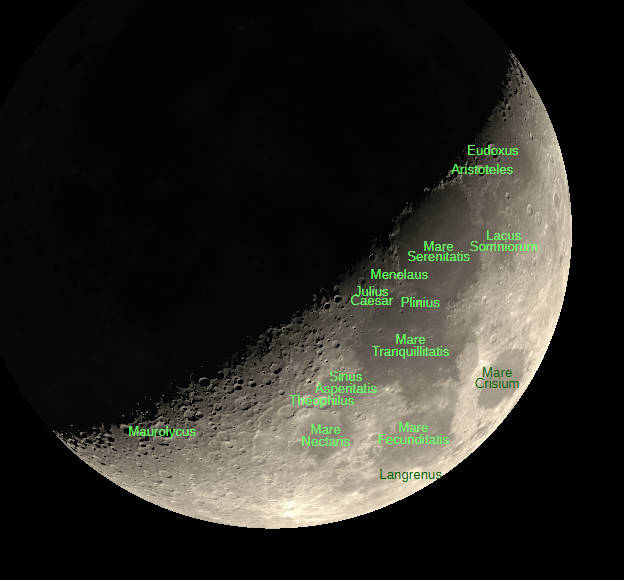
This is Ephemeris for Tuesday, December 9th. Today the Sun will be up for 8 hours and 53 minutes, setting at 5:02, and it will rise tomorrow at 8:09. The Moon, 2 days before last quarter, will rise at 10:34 this evening.
Tonight will be the night of the earliest sunset of the year. For the last few nights the Sun has been setting within the same minute. Soon the Sun will set noticeably later.
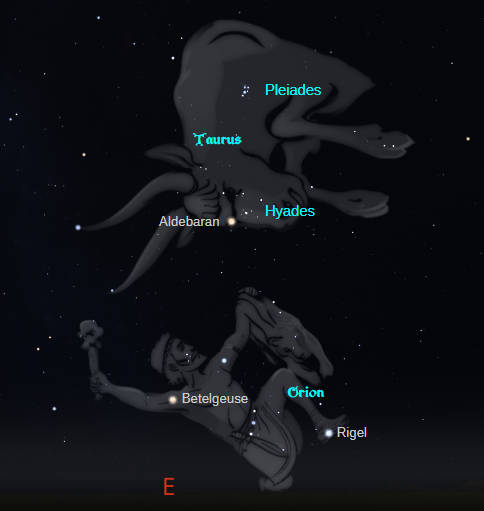
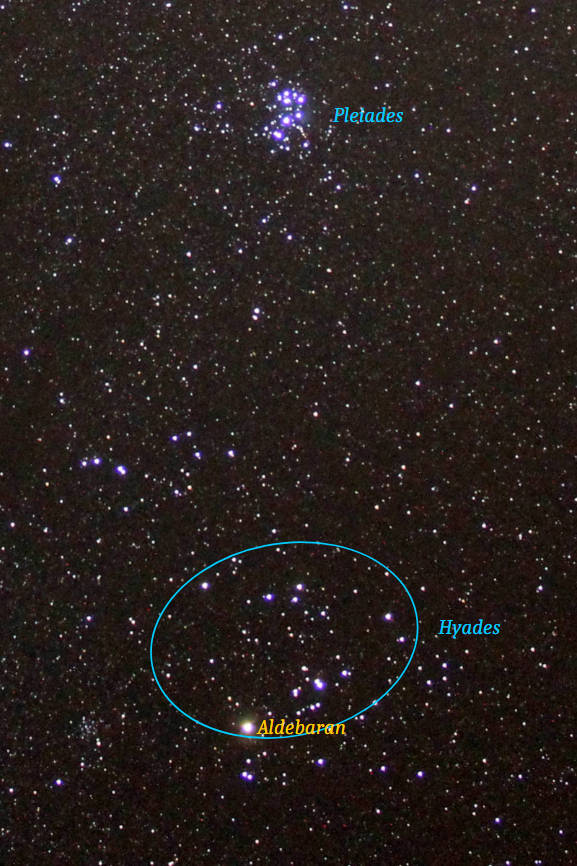
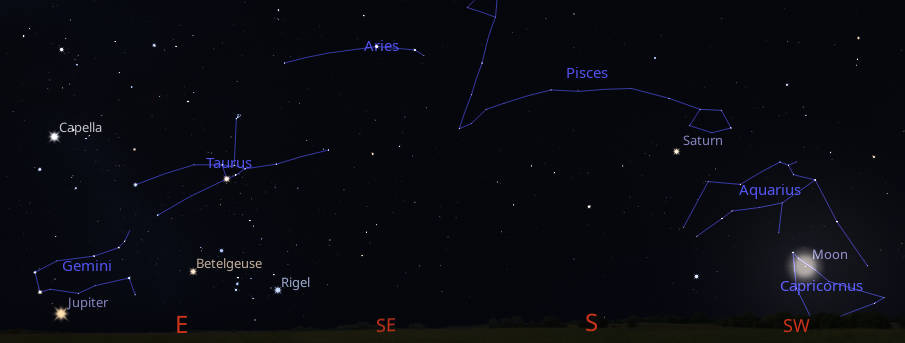
The bright star Aldebaran appears at the lower left tip of a letter V group of stars laying on it’s side, the Hyades star cluster and the face of Taurus the Bull. It’s in the east in the evening, above Orion. Aldebaran isn’t actually part of the group. The cluster is about 153 light years away, while Aldebaran is 65. The star has an orange hue because its surface is cooler than the Sun’s. However, Aldebaran is 44 times larger in diameter, and shines 425 times brighter than the Sun. The name Aldebaran means “Follower” because it follows the Pleiades star cluster across the sky.
The astronomical event times given in this blog are for the Traverse City/Interlochen area of Michigan (Lat 44.7° N, Long 85.7° W; EDT, UT – 4 hours) unless stated otherwise. Times will be different for other locations.
Addendum
Ephemeris: 12/08/2025 – Hyades, half sisters of the Pleiades
This is Ephemeris for Monday, December 8th. Today the Sun will be up for 8 hours and 54 minutes, setting at 5:02, and it will rise tomorrow at 8:08. The Moon, 3 days before last quarter, will rise at 9:19 this evening.
At 8 o’clock this evening the constellation of Orion the hunter is still in the act of rising with one leg still stuck in the snow. What is above him is the constellation of Taurus the bull. His face is a letter V of stars or as a letter A, is the star cluster called the Hyades. In Greek myth the stars are the half sisters of the Pleiades, which are right above them. The Hyades star cluster is very special. They don’t look as splashy as the Pleiades which are younger and still have their hot blue white stars. However, the Hyades are much closer, a third as far as the Pleiades. In fact they’re close enough to be measured by trigonometry using Earth’s orbit as the base of a triangle, before satellites. Which was critical in measuring distances beyond the solar system.
The astronomical event times given in this blog are for the Traverse City/Interlochen area of Michigan (Lat 44.7° N, Long 85.7° W; EDT, UT – 4 hours) unless stated otherwise. Times will be different for other locations.
Addendum
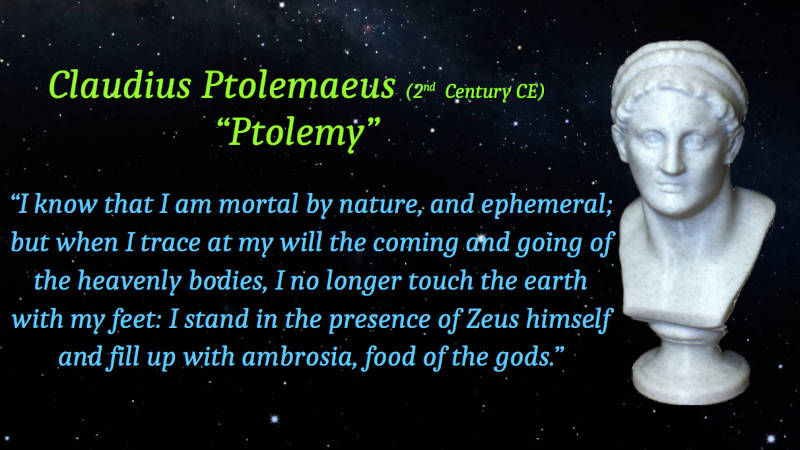
Ephemeris: 12/05/2025 – I will be giving a talk about Ptolemy and his Almagest tonight
Event is Canceled – no heat in the building – postponed to next month
This is Ephemeris for Friday, December 5th. Today the Sun will be up for 8 hours and 57 minutes, setting at 5:02, and it will rise tomorrow at 8:05. The Moon, 1 day past full, will rise at 5:25 this evening.
Tonight at this month’s meeting of the Grand Traverse Astronomical Society which will be at 8 pm at Northwestern Michigan College’s Rogers Observatory. I will be giving an illustrated talk Ptolemy: The Good, Bad and the Ugly. His second century view of the universe held sway in the western world fourteen hundred years into the Christian era. He was a geographer, astronomer, and an astrologer. His greatest work, which I will explore, is known as the Almagest, meaning The Greatest in Arabic (Not his title). Afterward if it’s clear we’ll have a star party starting about 9 pm. The meeting will also be available via Zoom, which I’ll be using to give the talk. Go to gtastro.org for instructions and a link.
The astronomical event times given in this blog are for the Traverse City/Interlochen area of Michigan (Lat 44.7° N, Long 85.7° W; EDT, UT – 4 hours) unless stated otherwise. Times will be different for other locations.
Addendum
Ephemeris: 12/04/2025 – Orion survives a full moon
This is Ephemeris for Thursday, December 4th. Today the Sun will be up for 8 hours and 59 minutes, setting at 5:02, and it will rise tomorrow at 8:04. The Moon, at full today, will rise at 4:24 this evening.
While the full moon overpowers most stars, the bright stars of winter persist. This is even true with tonight’s supermoon, a bit larger and brighter than average. Nowhere in the sky is there a concentration of bright stars as there is in the winter sky. I know it’s not winter yet, but if you stay up late enough, say 10 PM, all the winter stars will be in the sky. Last to rise is the brightest star of all, Sirius. And by 10 o’clock will be low in the southeast. Jupiter has joined the winter stars this year, outshining them all. As a constellation the mighty hunter Orion is easiest to spot on a full moon night, containing seven very bright stars, with three bright stars in a straight line as his belt, which most folks find as his most distinctive feature.
The astronomical event times given in this blog are for the Traverse City/Interlochen area of Michigan (Lat 44.7° N, Long 85.7° W; EDT, UT – 4 hours) unless stated otherwise. Times will be different for other locations.
Addendum
Ephemeris: 12/03/2025 – Taking our weekly look at the whereabouts of the naked-eye planets
This is Bob Moler with Ephemeris for Wednesday, December 3rd. Today the Sun will be up for 9 hours, setting at 5:02, and it will rise tomorrow at 8:03. The Moon, 1 day before full, will set at 7:59 tomorrow morning.
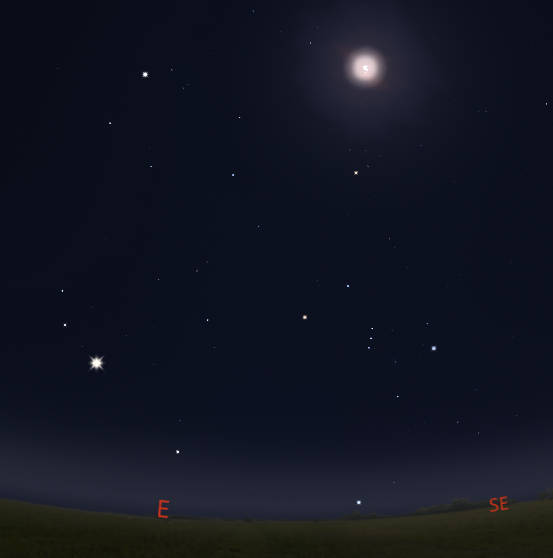
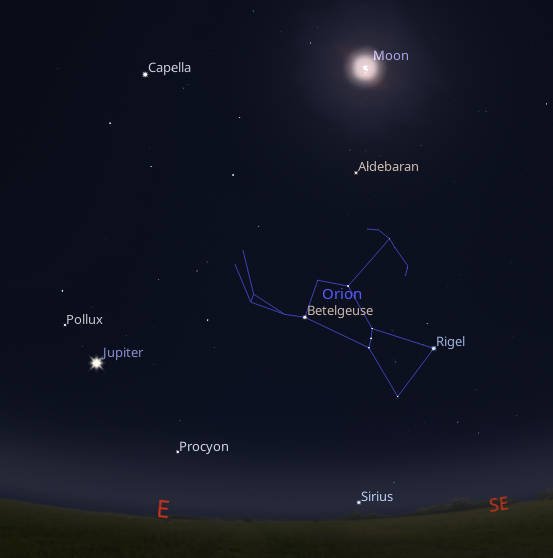
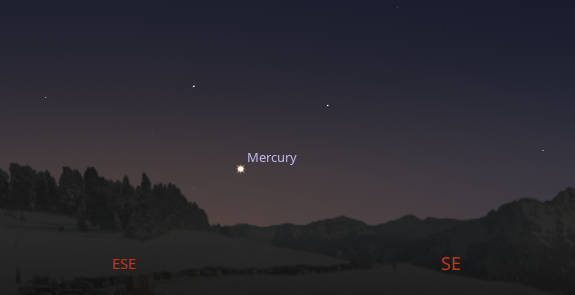
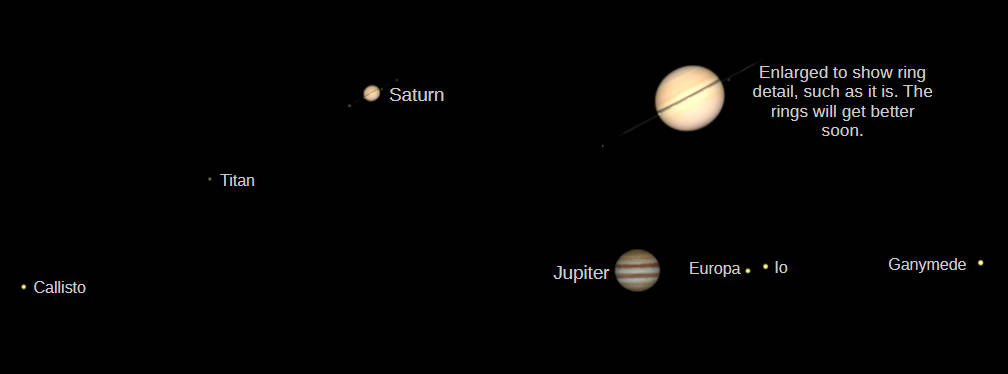
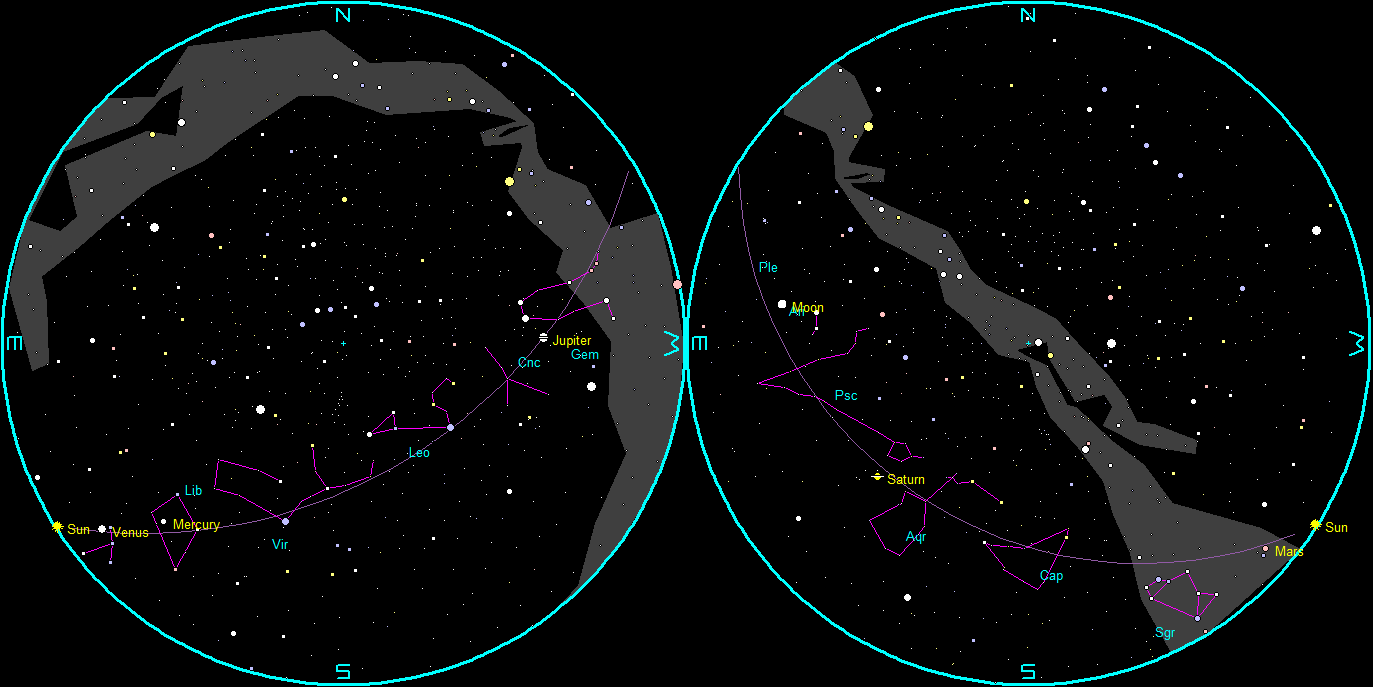
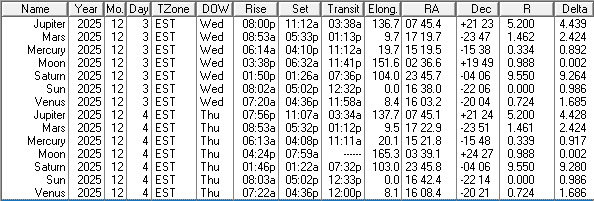
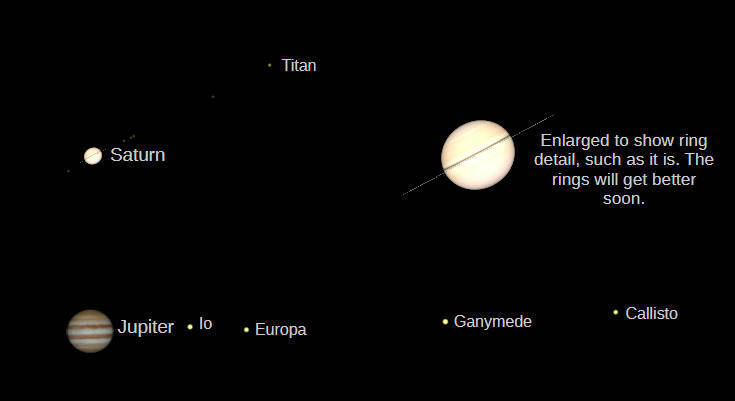
Let’s take our weekly look at the whereabouts of the naked-eye planets. Saturn is the brightest star-like object in the southern sky as soon as it gets dark. In a telescope Saturn sports a very thin ring, 4/10ths of a degree from being edge on. The rings are slowly opening up. Normally, I’d say that Saturn’s rings are easy to see in a telescope. In a couple of months the rings will be much more visible in telescopes. Jupiter will rise at 8 PM in the east-northeast, beneath Castor and Pollux, the bright stars of Gemini. Jupiter’s 4 brightest moons can even be seen in binoculars, and shift position night to night. Mercury might be spotted low in the east-southeast by 7 AM tomorrow morning, having risen 45 minutes earlier.
The astronomical event times given in this blog are for the Traverse City/Interlochen area of Michigan (Lat 44.7° N, Long 85.7° W; EDT, UT – 4 hours) unless stated otherwise. Times will be different for other locations.
Addendum
Ephemeris: 12/02/2025 – Not the famous Comet ATLAS is breaking up
This is Bob Moler with Ephemeris for Tuesday, December 2nd. Today the Sun will be up for 9 hours and 1 minute, setting at 5:03, and it will rise tomorrow at 8:02. The Moon, 2 days before full, will set at 6:32 tomorrow morning.
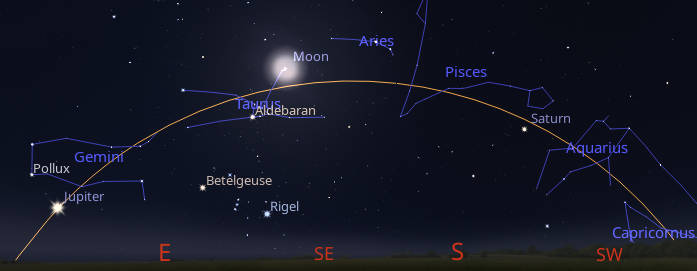
I have a story about another comet ATLAS. This one is not the famous 3I/ATLAS, the interstellar interloper that is cruising through the inner solar system right now. It is another Comet ATLAS C/2025 K1, discovered in May, a little over a month before the famous one was. What we’re finding is that with comets, breaking up is not hard to do. It’s nucleus, the solid part of a comet, has broken into at least three separate pieces which are slowly separating. A comet’s nucleus is only a few miles in diameter. It is not tightly packed like a planet would be. One might think of them as kind of fluffy, especially this one, which is probably having it’s first go round close to the Sun. It appears to be an Oort cloud comet, who’s orbital period is thousands of years long.
The astronomical event times given in this blog are for the Traverse City/Interlochen area of Michigan (Lat 44.7° N, Long 85.7° W; EDT, UT – 4 hours) unless stated otherwise. Times will be different for other locations.
Addendum
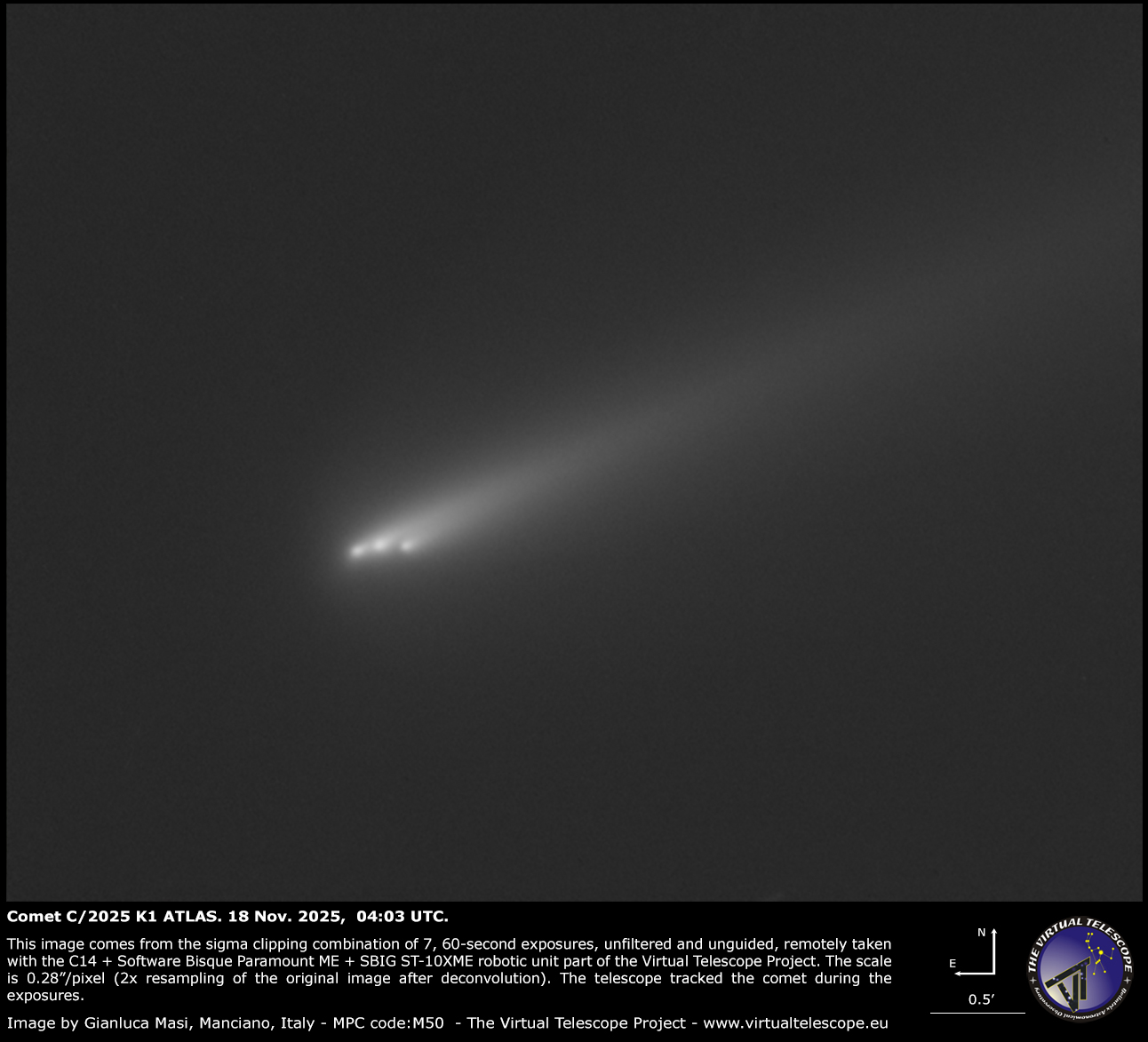
Comets are named for the person or organization that discovered it. ATLAS is the Asteroid Terrestrial-Impact Last Alert System (ATLAS) search program. There’s a lot of comet ATLASes running around out there.
Ephemeris: 12/01/2025 – Previewing December skies
This is Ephemeris for Monday, December 1st. Today the Sun will be up for 9 hours and 3 minutes, setting at 5:03, and it will rise tomorrow at 8:01. The Moon, halfway from first quarter to full, will set at 5:06 tomorrow morning.
Let’s look ahead at the skies of December. We are now in the holiday season and about to celebrate the southernmost travel of the Sun in the sky and its return northward. The Sun will stop its travel south, the winter solstice on the 21st at 10:03 a.m. That will make that day the shortest day in terms of daylight hours. However, the earliest sunset and latest sunrise don’t coincide with that date. The earliest sunset it will be on the 9th just one minute earlier than today. The latest sunrise will be just a couple of days into next year. The reason is the Earth is closer to the Sun than average and is moving faster in its orbit than it normally does. It skews the sunrise and sunset times.
The astronomical event times given in this blog are for the Traverse City/Interlochen area of Michigan (Lat 44.7° N, Long 85.7° W; EDT, UT – 4 hours) unless stated otherwise. Times will be different for other locations.
Addendum
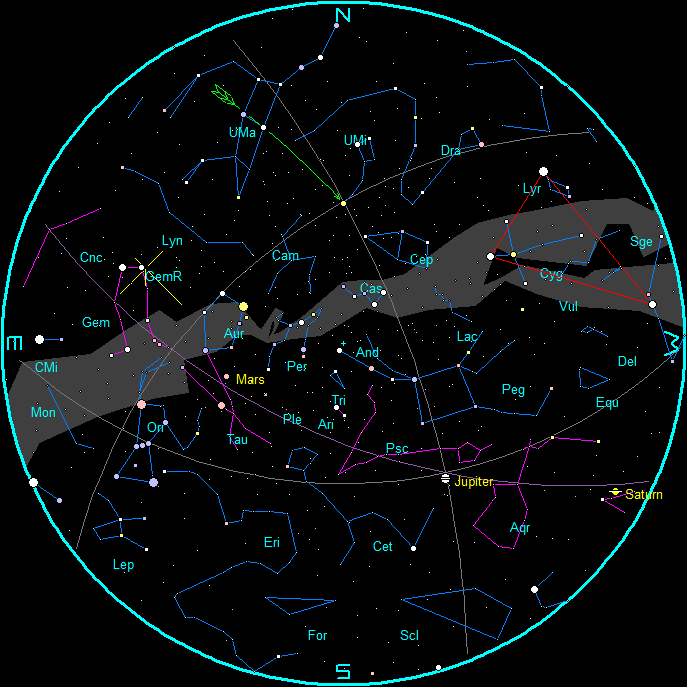
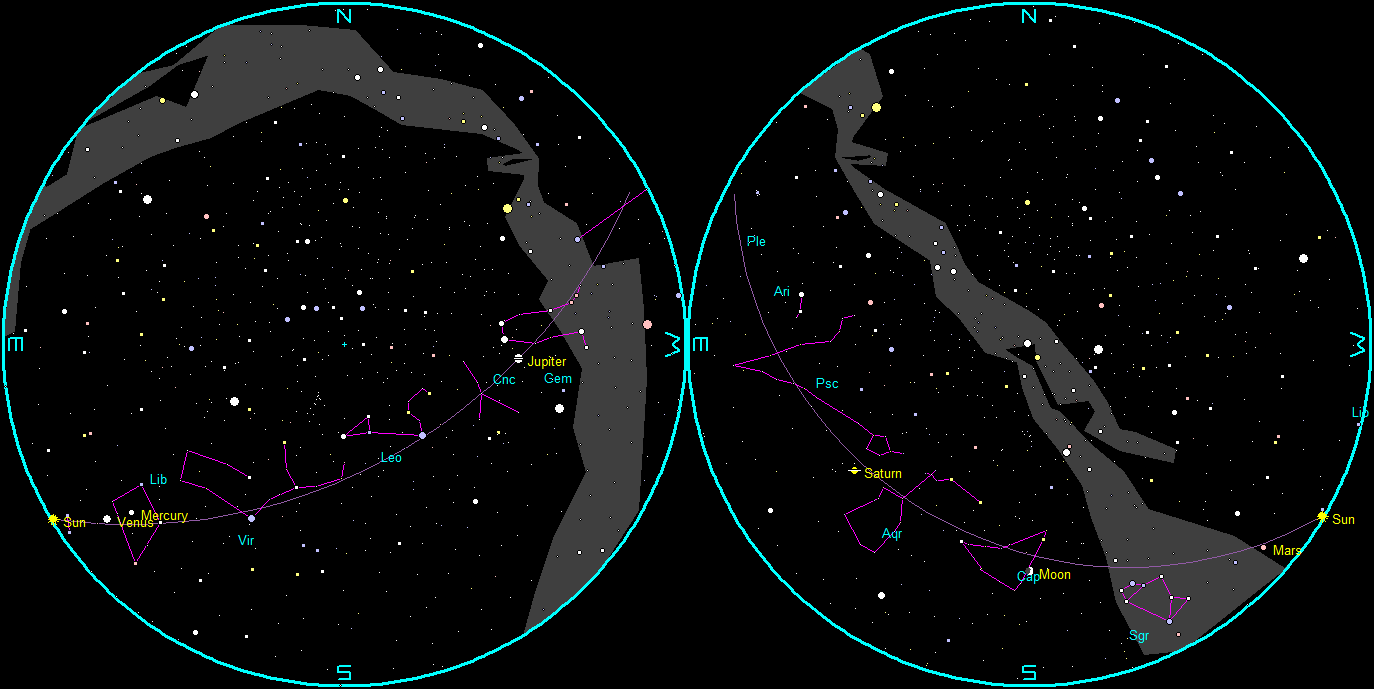
December Evening Star Chart
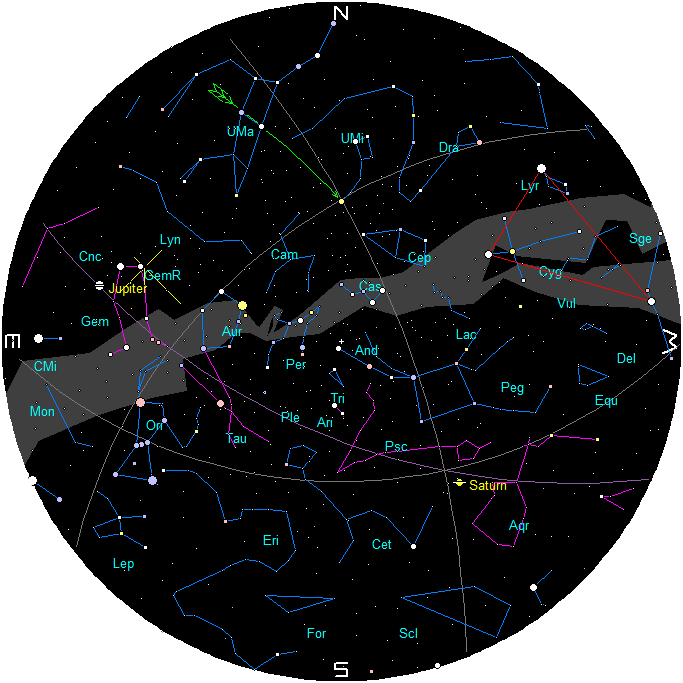
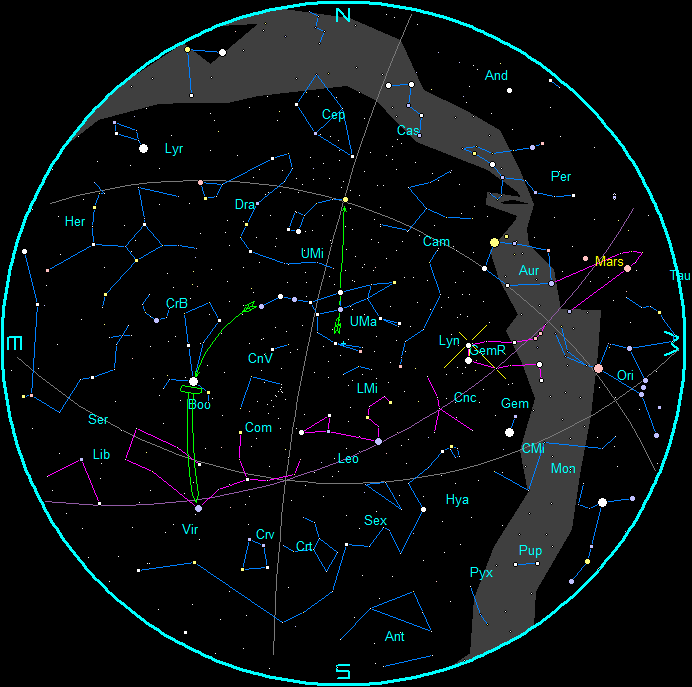
The planets and stars are plotted for the 15th at 9 pm EST in the evening and 6 a.m. for the morning chart. These are the chart times. Note that Traverse City is located approximately 45 minutes behind our time meridian, West 75° longitude. (An hour 45 minutes behind our daylight saving time meridian during EDT).
December Morning Star Chart
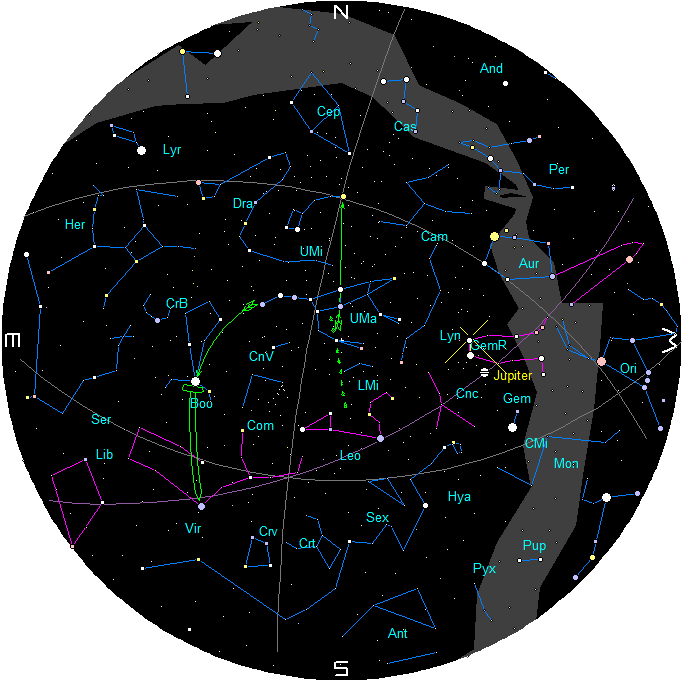
For a list of constellation names to go with the abbreviations, click here.
- Pointer stars at the front of the bowl of the Big Dipper point to Polaris, the North Star.
- The leaky bowl of the Big Dipper drips on Leo.
- Follow the arc of the handle of the Big Dipper to the star Arcturus, then
- Follow the spike to Spica.
- The Summer Triangle is in red.
- GemR on the star charts is the radiant of the Geminid meteor shower, which peaks on the morning of the 14th.
Twilight Limits, Nautical and Astronomical
| EST | |||||||
| Morning | Twilight | Evening | Twilight | Dark | Night | Moon | |
| Date | Astro. | Nautical | Nautical | Astro. | Start | End | Illum. |
| 2025-12-01 | 6h17m | 6h52m | 18h12m | 18h47m | 3h45m | 6h17m | 0.89 |
| 2025-12-02 | 6h18m | 6h53m | 18h12m | 18h47m | 5h07m | 6h18m | 0.95 |
| 2025-12-03 | 6h19m | 6h54m | 18h12m | 18h47m | – | – | 0.99 |
| 2025-12-04 | 6h20m | 6h55m | 18h11m | 18h47m | – | – | 1.00 |
| 2025-12-05 | 6h20m | 6h56m | 18h11m | 18h47m | – | – | 0.98 |
| 2025-12-06 | 6h21m | 6h57m | 18h11m | 18h47m | – | – | 0.93 |
| 2025-12-07 | 6h22m | 6h57m | 18h11m | 18h47m | 18h47m | 19h59m | 0.86 |
| 2025-12-08 | 6h23m | 6h58m | 18h11m | 18h47m | 18h47m | 21h19m | 0.77 |
| 2025-12-09 | 6h24m | 6h59m | 18h11m | 18h47m | 18h47m | 22h35m | 0.67 |
| 2025-12-10 | 6h25m | 7h00m | 18h11m | 18h47m | 18h47m | 23h46m | 0.57 |
| 2025-12-11 | 6h25m | 7h01m | 18h11m | 18h47m | 18h47m | – | 0.47 |
| 2025-12-12 | 6h26m | 7h02m | 18h12m | 18h47m | 18h47m | 0h53m | 0.37 |
| 2025-12-13 | 6h27m | 7h02m | 18h12m | 18h47m | 18h47m | 1h59m | 0.28 |
| 2025-12-14 | 6h28m | 7h03m | 18h12m | 18h48m | 18h48m | 3h03m | 0.20 |
| 2025-12-15 | 6h28m | 7h04m | 18h12m | 18h48m | 18h48m | 4h08m | 0.13 |
| 2025-12-16 | 6h29m | 7h04m | 18h13m | 18h48m | 18h48m | 5h14m | 0.07 |
| 2025-12-17 | 6h30m | 7h05m | 18h13m | 18h48m | 18h48m | 6h20m | 0.03 |
| 2025-12-18 | 6h30m | 7h06m | 18h13m | 18h49m | 18h49m | 6h30m | 0.01 |
| 2025-12-19 | 6h31m | 7h06m | 18h14m | 18h49m | 18h49m | 6h31m | 0.00 |
| 2025-12-20 | 6h31m | 7h07m | 18h14m | 18h50m | 18h50m | 6h31m | 0.01 |
| 2025-12-21 | 6h32m | 7h07m | 18h15m | 18h50m | 18h50m | 6h32m | 0.04 |
| 2025-12-22 | 6h32m | 7h08m | 18h15m | 18h51m | 19h31m | 6h32m | 0.09 |
| 2025-12-23 | 6h33m | 7h08m | 18h16m | 18h51m | 20h41m | 6h33m | 0.16 |
| 2025-12-24 | 6h33m | 7h09m | 18h16m | 18h52m | 21h51m | 6h33m | 0.24 |
| 2025-12-25 | 6h33m | 7h09m | 18h17m | 18h52m | 23h02m | 6h33m | 0.33 |
| 2025-12-26 | 6h34m | 7h09m | 18h18m | 18h53m | – | 6h34m | 0.44 |
| 2025-12-27 | 6h34m | 7h10m | 18h18m | 18h54m | 0h13m | 6h34m | 0.55 |
| 2025-12-28 | 6h34m | 7h10m | 18h19m | 18h54m | 1h27m | 6h34m | 0.66 |
| 2025-12-29 | 6h35m | 7h10m | 18h20m | 18h55m | 2h44m | 6h35m | 0.76 |
| 2025-12-30 | 6h35m | 7h10m | 18h20m | 18h56m | 4h05m | 6h35m | 0.86 |
| 2025-12-31 | 6h35m | 7h10m | 18h21m | 19h01m | 5h28m | 6h35m | 0.93 |
| 2026-01-01 | 6h35m | 7h11m | 18h22m | 19h01m | – | – | 0.98 |
Twilight calendar was generated using Cartes du Ciel (Sky Charts).
See my blog post: Twilight Zone for the definitions of the different periods of twilight here: https://bobmoler.wordpress.com/2018/09/27/.
NASA Calendar of Planetary Events
Dec  1  Mo            Venus: 8.7° W
     3  We   9:54 PM  Moon-Pleiades: 0.8° S
     4  Th   6:06 AM  Moon Perigee: 357000 km
     4  Th   6:14 PM  Full Moon
     5  Fr   4:51 PM  Moon North Dec.: 28.3° N
     7  Su  10:48 AM  Moon-Jupiter: 3.7° S
     7  Su  11:21 AM  Moon-Pollux: 2.9° N
     7  Su   3:59 PM  Mercury Elongation: 20.7° W
     8  Mo   9:23 AM  Moon-Beehive: 1.5° S
    10  We   1:32 AM  Moon-Regulus: 0.8° S
    11  Th   2:34 AM  Moon Descending Node
    11  Th   3:52 PM  Last Quarter
    14  Su   2:21 AM  Geminid Shower: ZHR = 120
    14  Su  11:27 AM  Moon-Spica: 1.5° N
    17  We   1:09 AM  Moon Apogee: 406300 km
    17  We   3:41 PM  Jupiter-Pollux: 6.5° S
    19  Fr   9:07 AM  Mercury-Antares: 5.5° N
    19  Fr   6:18 PM  Moon South Dec.: 28.2° S
    19  Fr   8:43 PM  New Moon
    21  Su  10:03 AM  Winter Solstice
    22  Mo  11:00 AM  Ursid Shower: ZHR = 10
    25  Th   5:03 PM  Moon Ascending Node
    26  Fr  10:24 PM  Moon-Saturn: 4.2° S
    27  Sa   2:10 PM  First Quarter
    31  We   8:21 AM  Moon-Pleiades: 0.9° S
All event times are given for UTC-5, Eastern Standard Time.
Sky Events Calendar by Fred Espenak and Sumit Dutta (NASA’s GSFC),
http://eclipse.gsfc.nasa.gov/SKYCAL/SKYCAL.html
If you go to the above site you can print out a list like the above for the entire year or calendar pages for your time zone.
Note that the site is now kept up for archival purposes. Fred Espenak retired from NASA several years ago and has recently passed away. His own site, AstroPixels, which is still up, contains much the same information: http://astropixels.com/almanac/almanac.html. However, it uses standard time all year.
Sun and Moon Rising and Setting Times
LU              Ephemeris of Sky Events for Interlochen/TC
December, 2025    Local time zone: EST
+-----------------------------------------------------------------------+
| DATE |  SUN     SUN  DAYLIGHT|   TWILIGHT*    |MOON  RISE OR    ILLUM |
|      |  RISE    SET    HOURS |  END    START  |PHASE SET** TIME FRACTN|
+=======================================================================+
|Mon  1| 08:00a  05:03p  09:03 | 06:12p  06:50a |      Set  05:06a   87%|
|Tue  2| 08:01a  05:03p  09:01 | 06:12p  06:51a |      Set  06:32a   94%|
|Wed  3| 08:02a  05:02p  09:00 | 06:12p  06:52a |      Set  07:59a   98%|
|Thu  4| 08:03a  05:02p  08:59 | 06:12p  06:53a |Full  Rise 04:24p  100%|
|Fri  5| 08:04a  05:02p  08:57 | 06:12p  06:54a |      Rise 05:25p   98%|
|Sat  6| 08:05a  05:02p  08:56 | 06:12p  06:55a |      Rise 06:39p   94%|
+------+-----------------------+----------------+-----------------------+
|Sun  7| 08:06a  05:02p  08:55 | 06:12p  06:56a |      Rise 07:59p   87%|
|Mon  8| 08:07a  05:02p  08:54 | 06:12p  06:57a |      Rise 09:19p   78%|
|Tue  9| 08:08a  05:02p  08:53 | 06:12p  06:58a |      Rise 10:34p   69%|
|Wed 10| 08:09a  05:02p  08:52 | 06:12p  06:59a |      Rise 11:45p   59%|
|Thu 11| 08:10a  05:02p  08:51 | 06:12p  06:59a |L Qtr Rise 12:53a   49%|
|Fri 12| 08:11a  05:02p  08:51 | 06:12p  07:00a |      Rise 01:58a   39%|
|Sat 13| 08:11a  05:02p  08:50 | 06:12p  07:01a |      Rise 03:03a   30%|
+------+-----------------------+----------------+-----------------------+
|Sun 14| 08:12a  05:02p  08:49 | 06:13p  07:02a |      Rise 04:08a   22%|
|Mon 15| 08:13a  05:02p  08:49 | 06:13p  07:02a |      Rise 05:13a   14%|
|Tue 16| 08:14a  05:03p  08:49 | 06:13p  07:03a |      Rise 06:19a    8%|
|Wed 17| 08:14a  05:03p  08:48 | 06:14p  07:04a |      Rise 07:23a    4%|
|Thu 18| 08:15a  05:03p  08:48 | 06:14p  07:04a |      Rise 08:22a    1%|
|Fri 19| 08:16a  05:04p  08:48 | 06:14p  07:05a |New   Set  04:21p    0%|
|Sat 20| 08:16a  05:04p  08:48 | 06:15p  07:05a |      Set  05:18p    1%|
+------+-----------------------+----------------+-----------------------+
|Sun 21| 08:17a  05:05p  08:48 | 06:15p  07:06a |      Set  06:22p    4%|
|Mon 22| 08:17a  05:05p  08:48 | 06:16p  07:06a |      Set  07:30p    8%|
|Tue 23| 08:18a  05:06p  08:48 | 06:17p  07:07a |      Set  08:40p   14%|
|Wed 24| 08:18a  05:06p  08:48 | 06:17p  07:07a |      Set  09:51p   22%|
|Thu 25| 08:18a  05:07p  08:48 | 06:18p  07:08a |      Set  11:01p   31%|
|Fri 26| 08:19a  05:08p  08:49 | 06:18p  07:08a |      Set  12:13a   41%|
|Sat 27| 08:19a  05:08p  08:49 | 06:19p  07:08a |F Qtr Set  01:26a   52%|
+------+-----------------------+----------------+-----------------------+
|Sun 28| 08:19a  05:09p  08:50 | 06:20p  07:09a |      Set  02:43a   63%|
|Mon 29| 08:19a  05:10p  08:50 | 06:21p  07:09a |      Set  04:04a   74%|
|Tue 30| 08:19a  05:11p  08:51 | 06:21p  07:09a |      Set  05:28a   84%|
|Wed 31| 08:20a  05:12p  08:52 | 06:22p  07:09a |      Set  06:49a   91%|
+-----------------------------------------------------------------------+
* Nautical Twilight
** Moonrise or moonset, whichever occurs between sunset and sunrise
Generated using my LookingUp for DOS program.
Ephemeris: 11/28/2025 – What will AI’s effect be on the future of society?

This is Ephemeris for Native American Heritage Day, Friday, November 28th. Today the Sun will be up for 9 hours and 8 minutes, setting at 5:04, and it will rise tomorrow at 7:57. The Moon, at first quarter today, will set at 1:12 tomorrow morning.
Let’s take one more look at AI this week. There is a real fear that artificial intelligence, AI, is displacing certain clerical jobs, and computer coding jobs. The latter is something I used to do. But I’m safe now, having retired 12 years ago. I have coded just about all the code I’ve ever needed to code. As AI takes more and more jobs, who’s gonna be able to afford to buy all the stuff the AI bots make? I’ve heard of some thoughts of a universal guaranteed income. How is that going to be funded? The rich, lower my taxes crowd, won’t go for that. Most people’s identity is defined by their job, what they do in their career. What could possibly replace that for most people?
The astronomical event times given in this blog are for the Traverse City/Interlochen area of Michigan (Lat 44.7° N, Long 85.7° W; EDT, UT – 4 hours) unless stated otherwise. Times will be different for other locations.
Ephemeris: 11/27/2025 – AIs, apparent knowledge without wisdom
This is Ephemeris for Thanksgiving Day, Thursday, November 27th. Today the Sun will be up for 9 hours and 9 minutes, setting at 5:05, and it will rise tomorrow at 7:56. The Moon, 1 day before first quarter, will set at midnight.
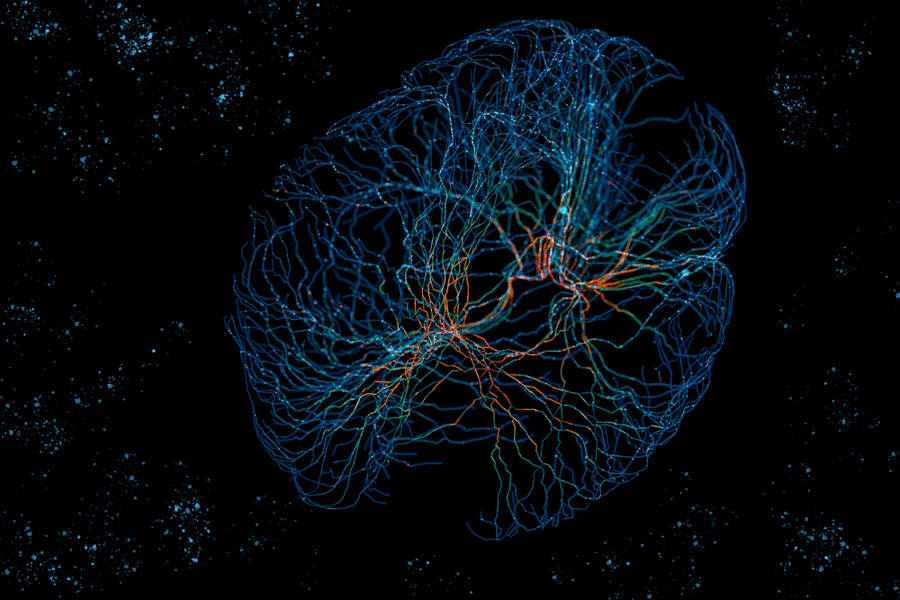
As the constellation Orion rises in the evening, the Native Americans around here would say the Winter Maker is rising, we are waiting for the glory of the winter constellations to appear and the bright Moon to disappear from the evening skies. I thought I’d talk about another topic this week. I am interested in, but really don’t know the depth of detail about: AI, artificial intelligence or what I’d rather call machine intelligence. It seems to me that there are a lot of folks being hooked on talking to these AI models such as ChatGPT and others as somebody or something that’s sympathetic to them. AIs are what you might call book smart or really Internet smart, but they’re not street smart. They were literally born yesterday, with all the wisdom that entails.
The astronomical event times given in this blog are for the Traverse City/Interlochen area of Michigan (Lat 44.7° N, Long 85.7° W; EDT, UT – 4 hours) unless stated otherwise. Times will be different for other locations.
Ephemeris: 11/26/2025 – Checking out the naked eye planets
This is Ephemeris for Wednesday, November 26th. Today the Sun will be up for 9 hours and 11 minutes, setting at 5:05, and it will rise tomorrow at 7:55. The Moon, 2 days before first quarter, will set at 10:49 this evening.
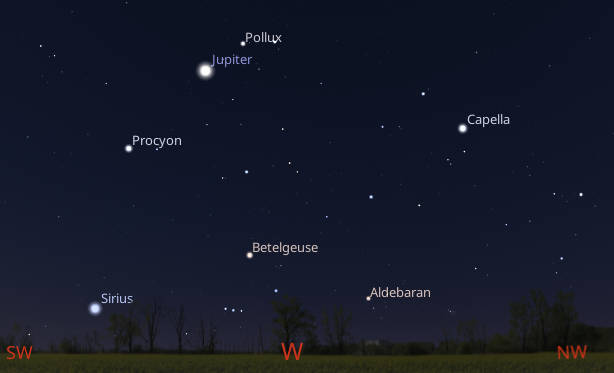
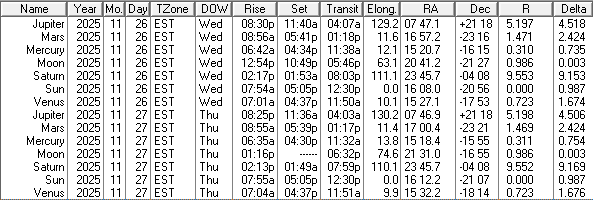
Pausing my exploration of AI to check out the naked eye planets this week. Mars and Mercury are too close to the Sun to be seen. Saturn is the brightest star like object in the southeastern sky as soon as it gets dark. In a telescope Saturn sports a very thin ring, 4/10ths of a degree from being edge on. In 4 days the rings will slowly start to open up. Normally, I’d say that Saturn’s rings are easy to see in a telescope. Currently, the rings appear extremely thin and can be difficult to pick up. Jupiter will rise at 8:29 PM in the east-northeast. Beneath Castor and Pollux, the bright stars of Gemini. By 7 AM, it will appear high in the west southwest, above the stars Procyon below and Sirius, near the horizon. Venus will rise at 7:04 in the east southeast and will probably not be visible.
The astronomical event times given in this blog are for the Traverse City/Interlochen area of Michigan (Lat 44.7° N, Long 85.7° W; EDT, UT – 4 hours) unless stated otherwise. Times will be different for other locations.
Addendum
 Bob Moler's Ephemeris Blog