Archive
11/28/2022 – Ephemeris – The Artemis Program
This is Ephemeris for Monday, November 28th. Today the Sun will be up for 9 hours and 8 minutes, setting at 5:04, and it will rise tomorrow at 7:57. The Moon, 2 days before first quarter, will set at 10:09 this evening.
Now that the Artemis I mission is ongoing, and the spacecraft is in a large orbit of the Moon, it’s time to look at the rest of the program. In 2024 the SLS or Space Launch System, which is the name for the whole rocket, will send a four-person crew in their Orion Capsule around the Moon and back. From what I’m seeing right now, it will be a simple mission. It doesn’t appear that they will actually orbit the Moon other than a free return trajectory back to the Earth. The mission a year or so after that will be one to attempt to land on one of the few flat sites near the south pole of the Moon. Speaking of the Moon, the planet Saturn will be about eight of the Moon’s diameter’s north or above the Moon tonight.
The astronomical event times given are for the Traverse City/Interlochen area of Michigan (EST, UT –5 hours). They may be different for your location.
Addendum
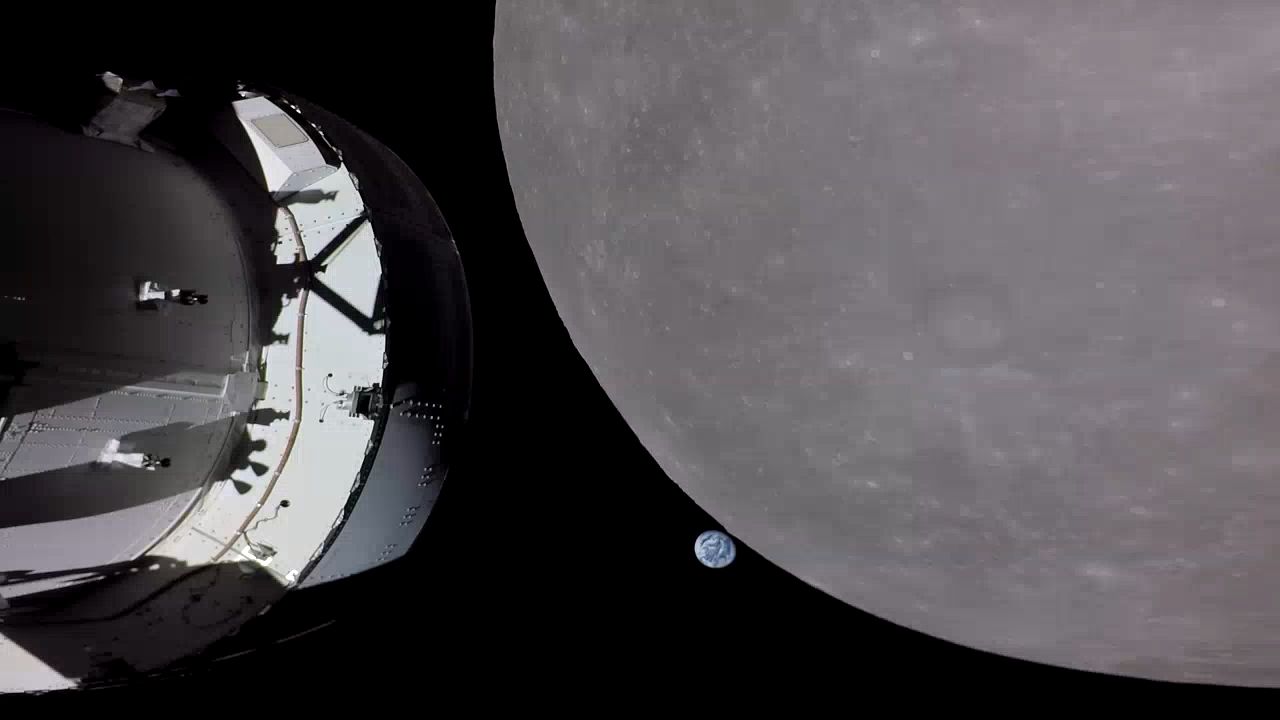
Earthset from Artemis I’s Orion spacecraft, as it moves around to the far side of the Moon. Click on the image to enlarge it. Credit: NASA
11/25/2022 – Ephemeris – The Anishinaabe constellations of Mooz and Ajijaak
This is Ephemeris for Native American Heritage Day, Friday, November 25th. Today the Sun will be up for 9 hours and 13 minutes, setting at 5:06, and it will rise tomorrow at 7:54. The Moon, 2 days past new, will set at 6:24 this evening.
The evening sky hosts two more of the constellations of the Anishinaabe native peoples of our area. High in the west, where the official constellation Cygnus the Swan is, or the Northern Cross is: Ajijaak, the Sand Hill Crane is flying upwards to the northeast through the Milky Way, wings outstretched, with its long legs trailing behind. Very high in the southern sky, above Jupiter this year, is the official constellation of Pegasus the flying horse is soaring upside down. His body is the Great Square, is an informal constellation. To the Anishinaabe, it is the Mooz (Moose), who is upright. His magnificent antlers take up the dim official constellation of Lacerta the lizard between Pegasus and Cygnus. Also in the sky is Ojiig the Fisher, our Big Dipper, whose bloody tail swooped down last month to paint the trees with their fall colors.
The astronomical event times given are for the Traverse City/Interlochen area of Michigan (EST, UT –5 hours). They may be different for your location.
Addendum
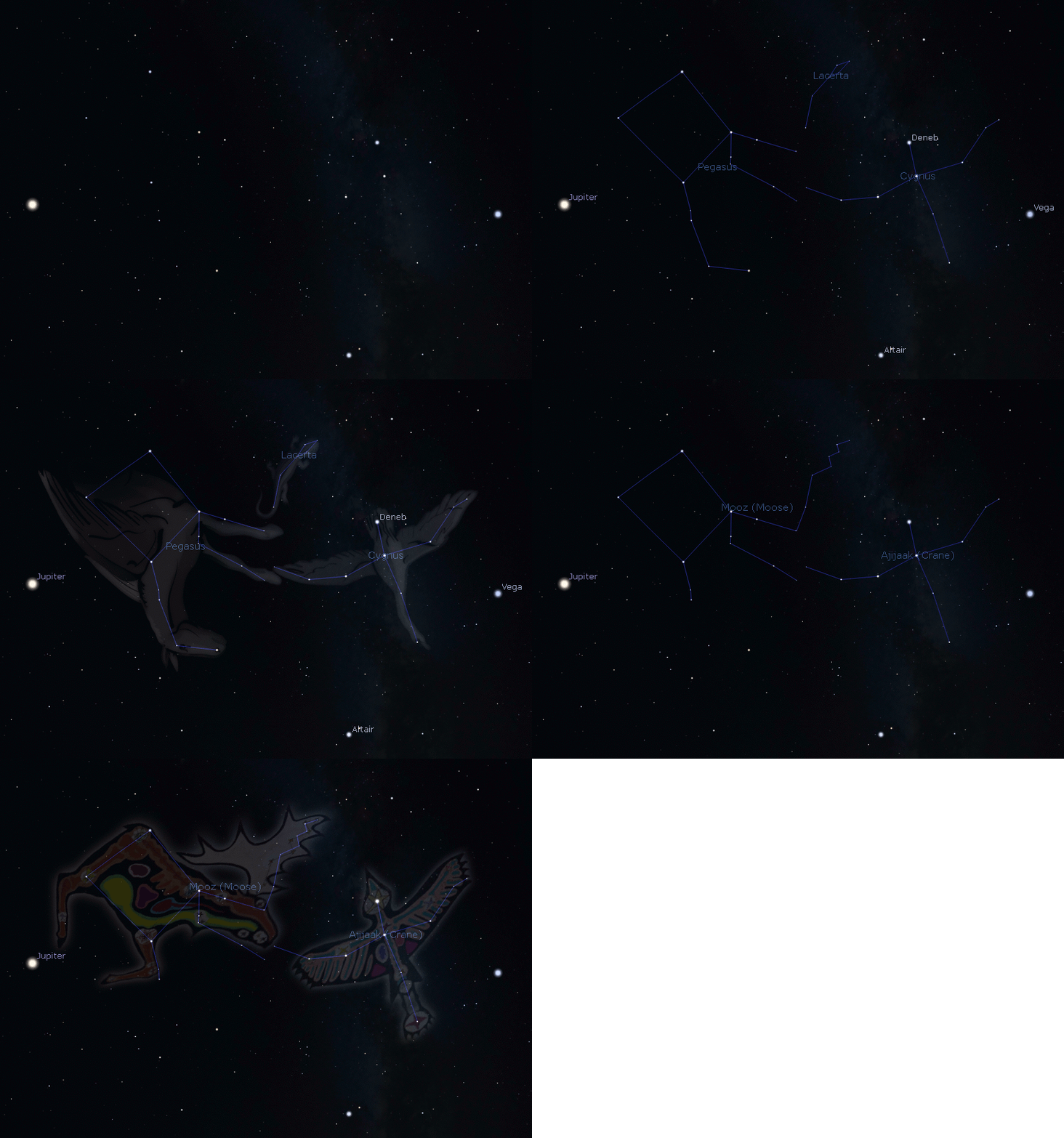
Mooz and Ajijaak finder animation for 8 pm tonight, November 25, 2022. This is looking almost to the zenith, facing southwest. First is the star field only, followed by the IAU (Western) constellation lines for Pegasus, Cygnus and Lacerta, along with their labels, and Jupiter, this year. This is followed by the constellation art. Then the Anishinaabe or Ojibwa constellation lines for Mooz and Ajijaak, Finally the constellation art for these are displayed.
Created using Stellarium and GIMP. Western constellation art by Johan Meuris. Anishinaabe (Ojibwe) art by A. Lee and W. Wilson from Ojibwe Giizhig Anung Masinaaigan – Ojibwe Sky Star Map, and is provided as part of Stellarium.
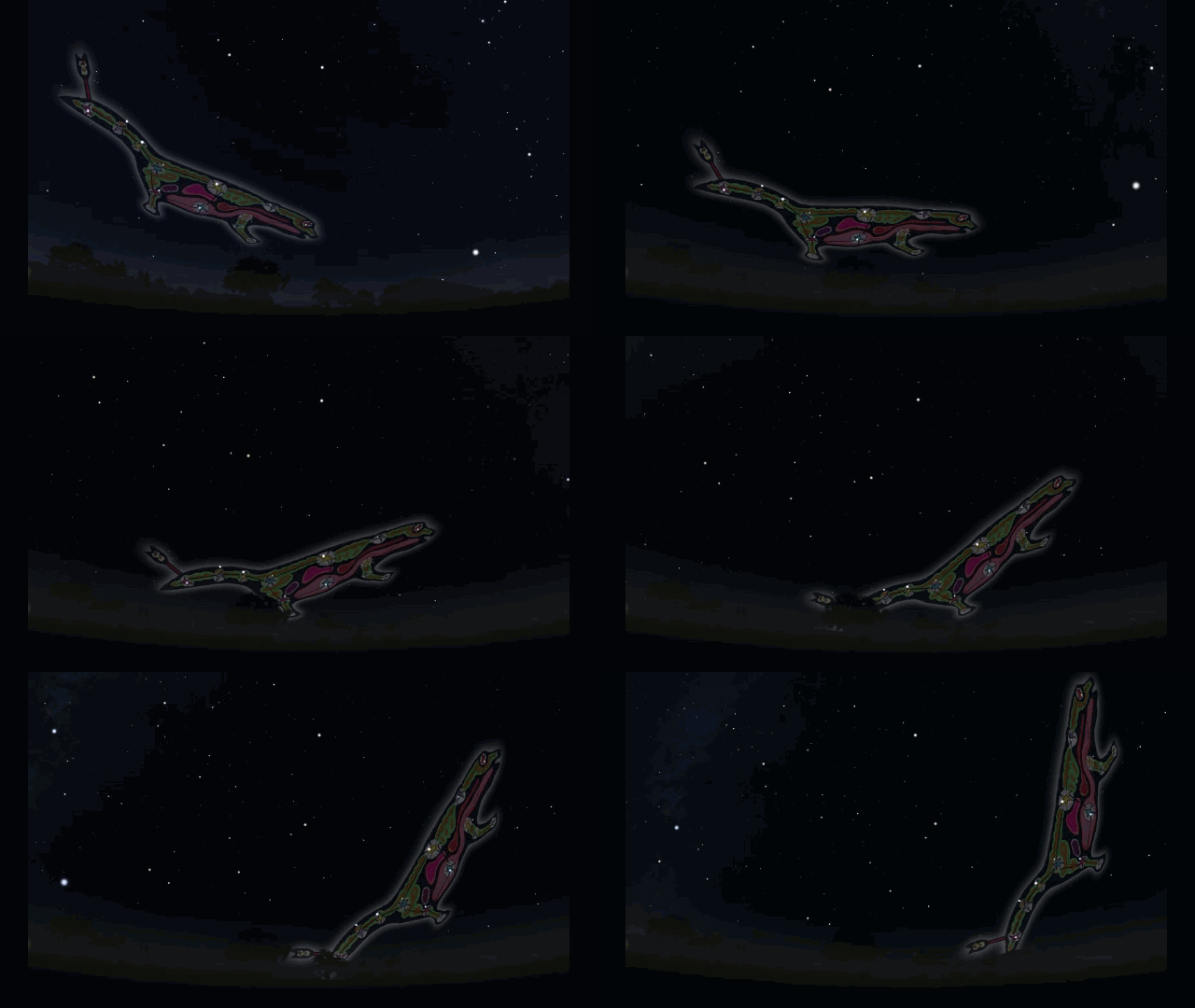
An animation of Fisher brushing his tail along the horizon on autumn nights. Created using Stellarium and GIMP. Constellation art from Ojibwe Giizhig Anung Masinaaigan – Ojibwe Sky Star Map.
11/24/2022 – Ephemeris – Finding Auriga the charioteer
This is Bob Moler with Ephemeris for Thanksgiving Day, Thursday, November 24th. Today the Sun will be up for 9 hours and 15 minutes, setting at 5:07, and it will rise tomorrow at 7:52. The Moon, 1 day past new, will set at 5:31 this evening.
The constellation Auriga the charioteer is halfway up the sky in the east northeast at 9 p.m. It is a pentagon of stars, with the brilliant star Capella at the upper left of its corners. Capella represents a mama goat he’s carrying. A narrow triangle of stars just right of Capella are her kids, that is her baby goats. The Kids is an informal constellation or asterism. The Milky Way runs through Auriga, but it’s not very bright here. We are looking away from the center of the Milky Way to the more sparse outer parts of our galaxy. Within and near that pentagon, one can sweep with binoculars and low power telescopes to find several star clusters, groups of hundreds of stars born in the clump we still see them in. These star clusters will appear as fuzzy spots in binoculars.
The astronomical event times given are for the Traverse City/Interlochen area of Michigan (EST, UT –5 hours). They may be different for your location.
Addendum
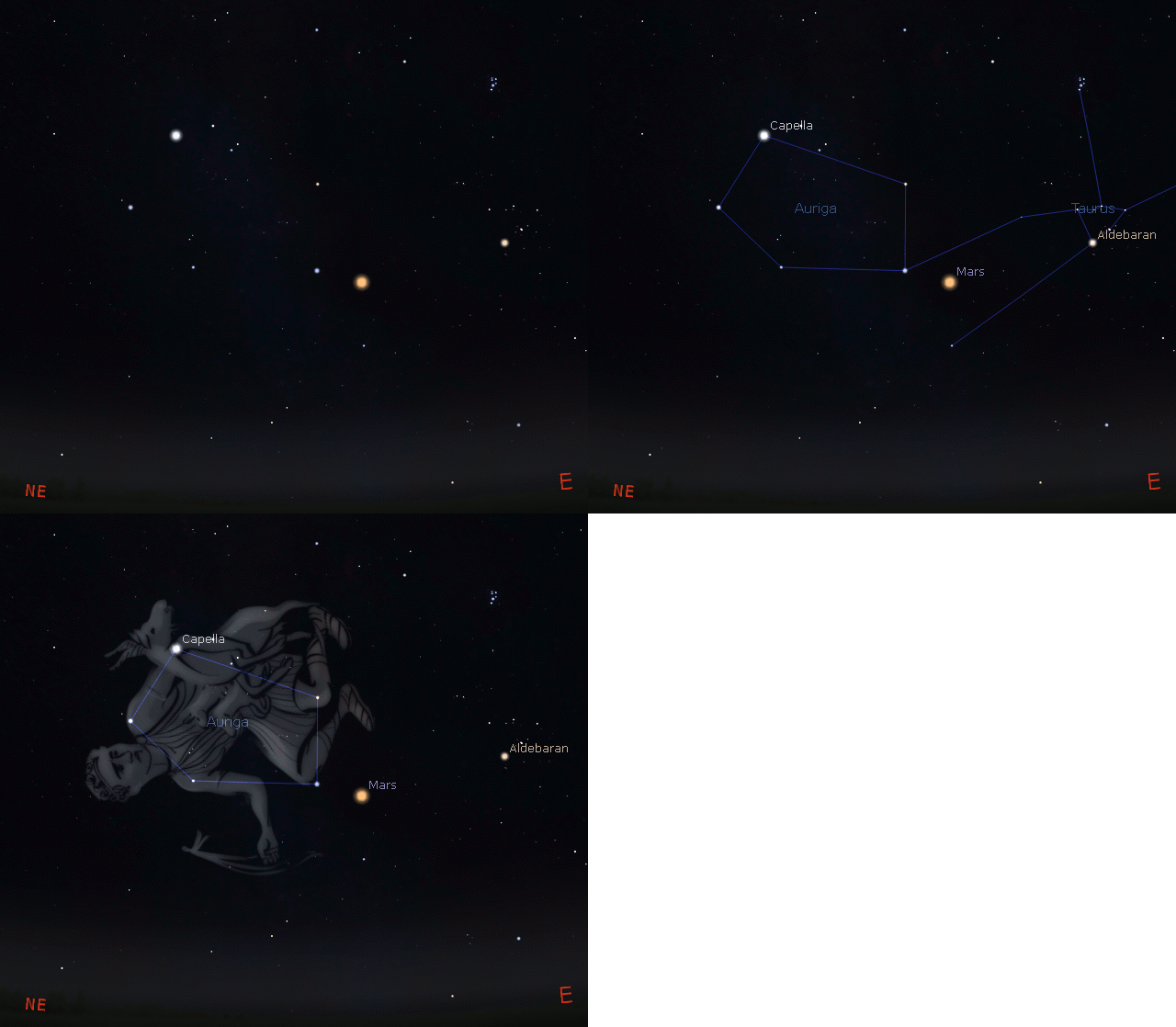
Auriga the charioteer finder animation. Mars is nearby between the horns of Taurus for the next week and a half as it works its way to the upper right. The Kids asterism is best seen in the frame without markings because the Capella label covers one of its stars. Created using Stellarium and GIMP.
11/23/2022 – Ephemeris – Let’s see where the naked-eye planets have wandered off to this week
This is Bob Moler with Ephemeris for Wednesday, November 23rd. Today the Sun will be up for 9 hours and 17 minutes, setting at 5:07, and it will rise tomorrow at 7:51. The Moon is new today, and won’t be visible.
Let’s see where the naked-eye planets have wandered off to this week. Jupiter and Saturn will be visible this evening, in the southeastern sky, as soon after sunset as it will be dark enough to see them, which would be by 6 pm. Jupiter is the brighter of the two to the left, in the southeast, while dimmer Saturn is in the south at that hour. The red planet Mars, though a morning planet, will rise tonight at 6:05 pm in the northeast. It’s located nearly between the tips of the long horns of Taurus the bull, but toward the letter V of stars that is the face of Taurus. Mars is moving westward in its retrograde motion as the Earth will pass it in a couple of weeks. Venus and Mercury, though in the evening sky, are too close to the Sun to be seen.
The astronomical event times given are for the Traverse City/Interlochen area of Michigan (EST, UT -5 hours). They may be different for your location.
Addendum
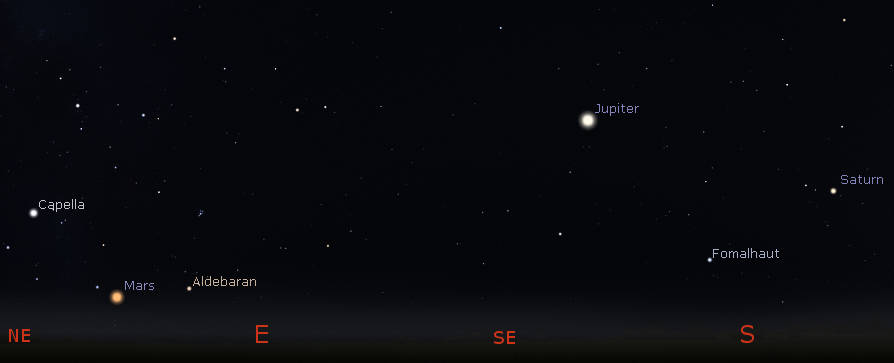
A panorama from northeast to southwest of the planets Mars, Jupiter and Saturn at 7 pm tonight, November 23, 2022. Click on the image to enlarge it. Created using Stellarium and GIMP.
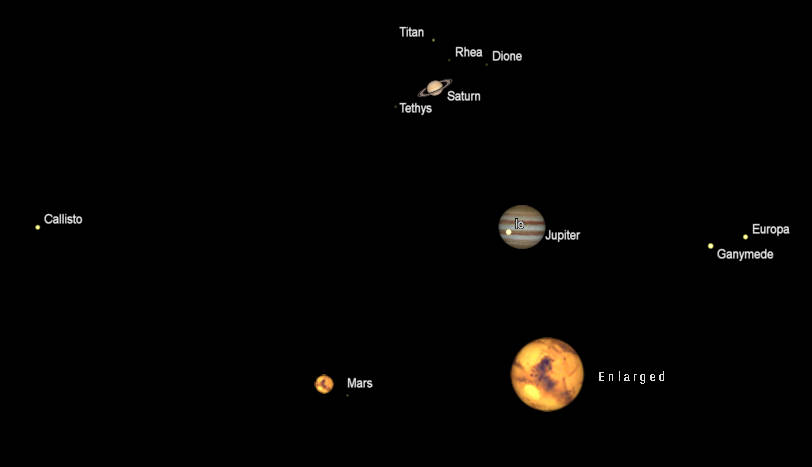
Telescopic views of Saturn Jupiter and Mars (north up) as they would be seen in a small telescope, with the same magnification. The image of Mars doesn’t show it, but the white north polar cap will appear at the top or north limb of Mars. The planets are shown at 7 pm on the 23rd. Apparent diameters: Saturn 16.61″, its rings 38.69″; Jupiter 44.57″. Mars 17.05″. Mars’ distance is 51.0 million miles (82.1 million kilometers). The ” symbol means seconds of arc (1/3600th of a degree.) Click on the image to enlarge it. Created using Cartes du Ciel (Sky Charts).
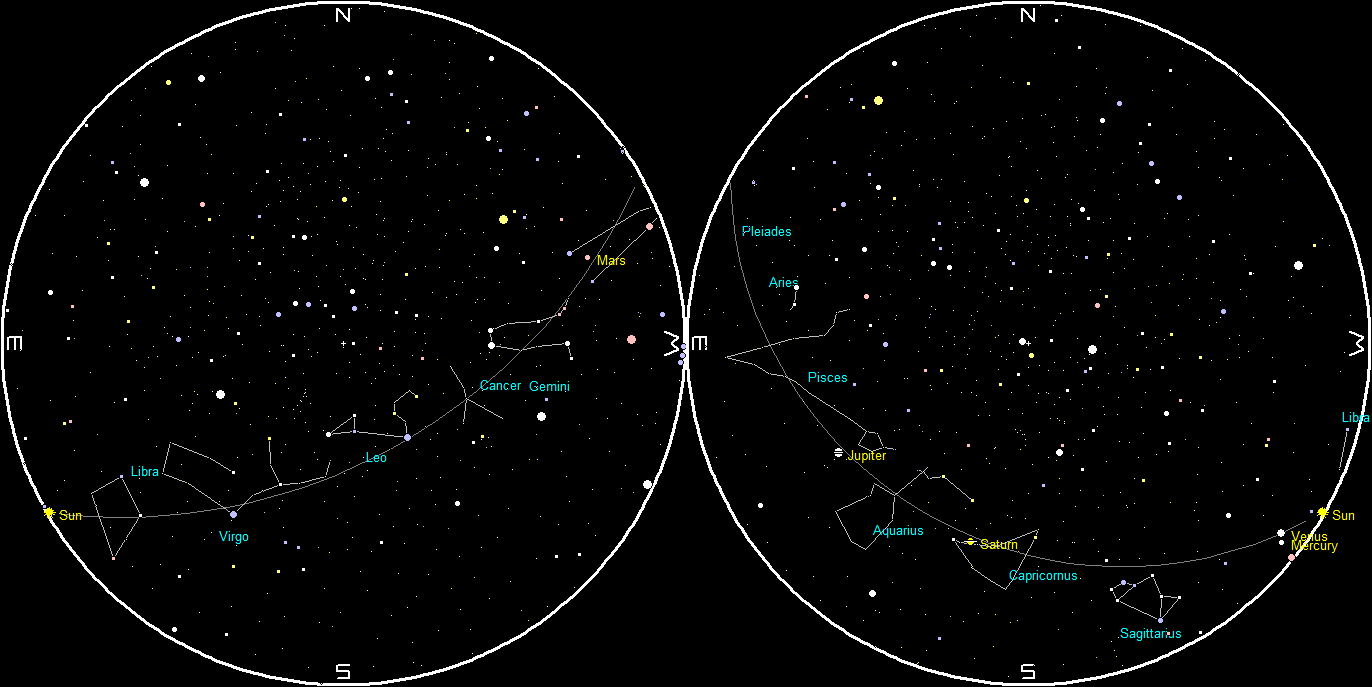
The naked-eye planets and the Moon at sunset and sunrise on a single night, starting with sunset on the right on November 23, 2022. The night ends on the left with sunrise on the 24th. Click on the image to enlarge it. Created using my LookingUp app and GIMP.
11/22/2022 – Ephemeris – Finding Taurus the bull
This is Ephemeris for Tuesday, November 22nd. Today the Sun will be up for 9 hours and 19 minutes, setting at 5:08, and it will rise tomorrow at 7:50. The Moon, 1 day before new, will rise at 7:30 tomorrow morning.
Low in the east at 8 this evening and below the beautiful Pleiades star cluster is Taurus the bull. His face is a letter V shape of stars lying on its side, the star cluster Hyades, with the bright orange-red star Aldebaran at one tip of the V as its angry blood-shot eye, but actually about halfway between us and the cluster. The Pleiades star cluster is in his shoulder. Taurus is seen charging downward at that hour, the soon to rise constellation of Orion, with bright Mars near the horn tips. Taurus in Greek mythology was the form the god Zeus assumed when he carried off the maiden Europa. Europa’s still with him as the intriguing satellite completely covered by an ocean below its icy exterior, and orbiting Zeus’ Roman equivalent, the planet Jupiter.
The astronomical event times given are for the Traverse City/Interlochen area of Michigan (EST, UT -5 hours). They may be different for your location.
Addendum
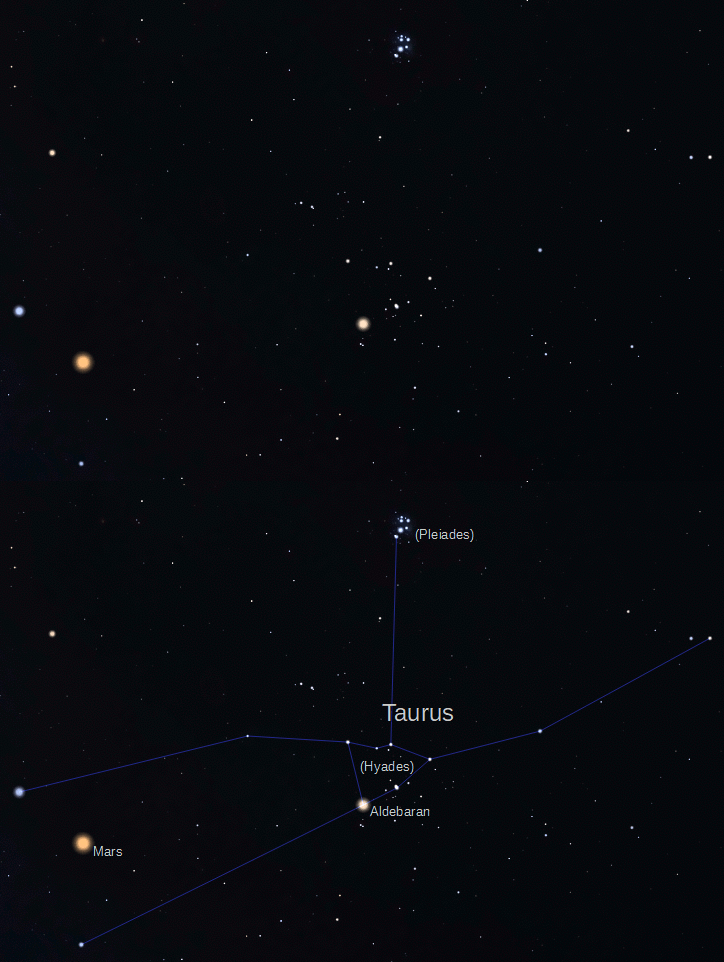
Taurus, Pleiades and Mars finder animation for 8:30 pm tonight, November 22, 2022. Mars is the interloper this year, seen between the horns of Taurus the Bull. The V of stars that make up the face of Taurus the bull is a star cluster of stars called the Hyades. In Greek mythology, they are the half-sisters of the Pleiades. Created using Stellarium, LibreOffice Draw, and GIMP.
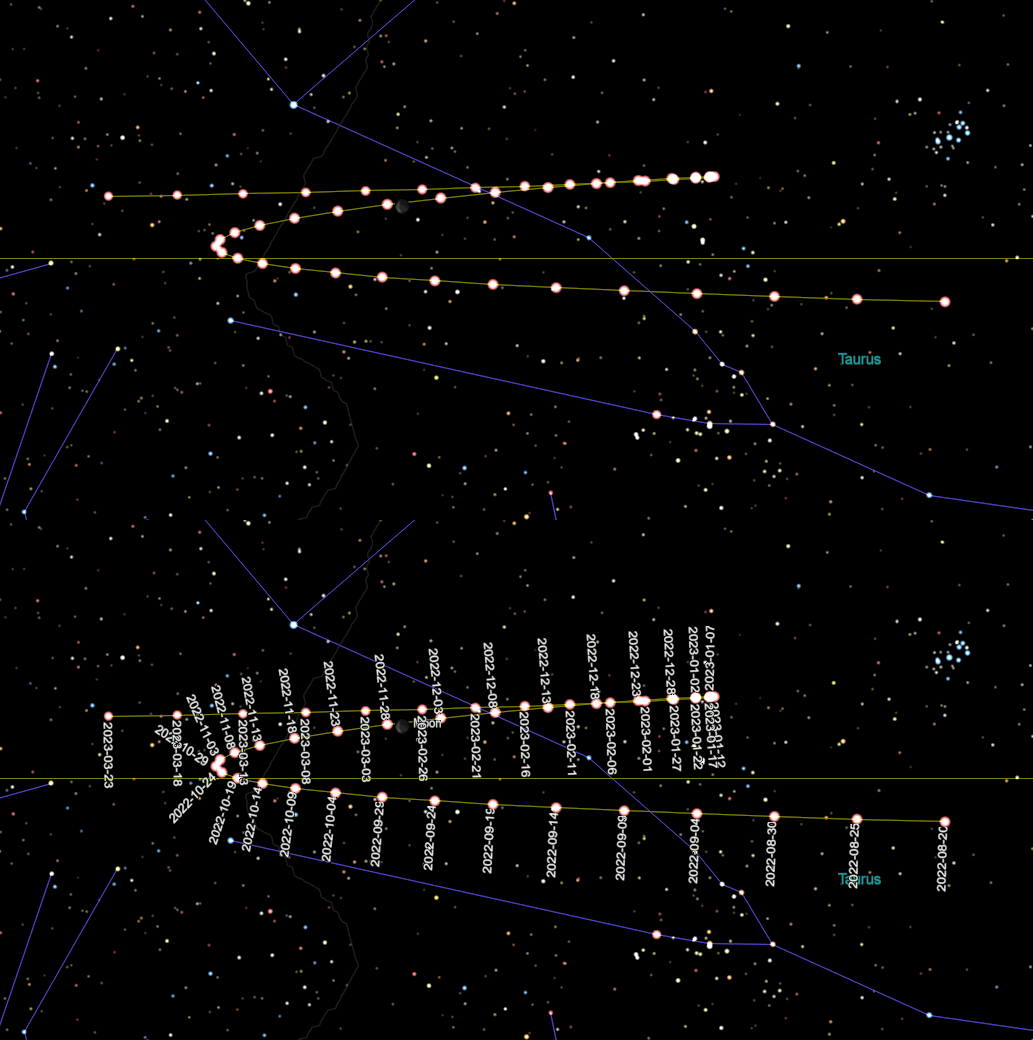
Mars retrograde path from October 29, 2022, to January 11, 2023, against the stars of Taurus the bull. It will be at opposition on December 7, and actually closest to the Earth on November 30 at 50.61 million miles or 81.45 million kilometers. In the upper right is the beautiful Pleiades star cluster, also known as the Seven Sisters. Below and right is the V shaped star cluster that represents the face of Taurus the bull, with the bright red star Aldebaran as the bull’s angry red eye. That V of stars is called the Hyades, who in mythology were the half sisters to the Pleiades. Created using Cartes du Ciel (Sky Charts) and GIMP.
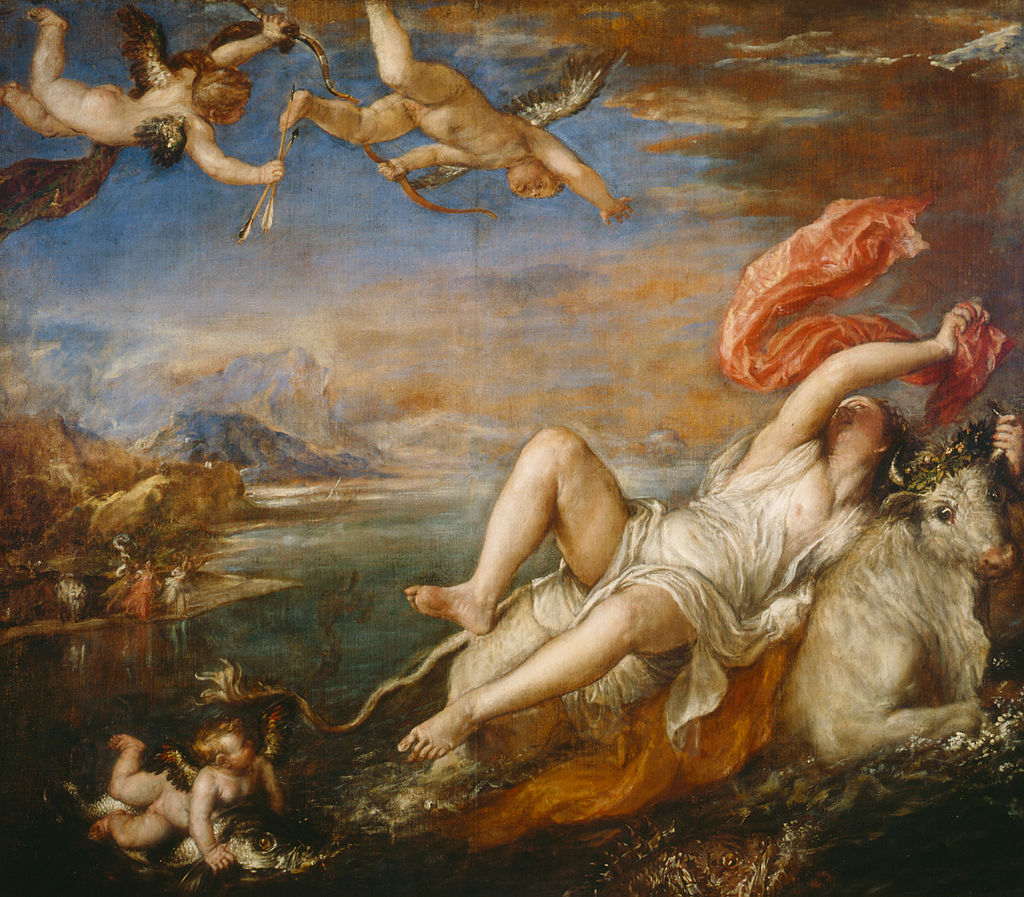
The Rape of Europa by Titian. According to the story, Zeus as a bull abducted Europa and swam to Crete, where she became the first queen of that island, and bore him three sons. Other paintings of this subject are by Rembrandt and de Troy. This painting belongs to the Isabella Stewart Gardener Museum in Boston, MA.
11/21/2022 – Ephemeris – The Pleiades or the Seven Sisters
This is Ephemeris for Monday, November 21st. Today the Sun will be up for 9 hours and 21 minutes, setting at 5:09, and it will rise tomorrow at 7:49. The Moon, 2 days before new, will rise at 6:10 tomorrow morning.
A marvelous member of the autumn skies can be found low in the east after 8 in the evening. It is the famous star cluster called the Pleiades or the Seven Sisters. I might also add the ‘Tiny Dipper’. Many people can spot a tiny dipper shape in its six or seven stars, and mistake it for the Little Dipper. With binoculars, one can see over a hundred stars appear, along with the dipper shape of the brightest. In photographs, the Pleiades actually contain wisps of the dust they are currently passing through. In Greek mythology, the sisters were daughters of the god Atlas. I’ll be revisiting the Pleiades several times this autumn, winter, and before they disappear in the west in evening twilight next spring.
The astronomical event times given are for the Traverse City/Interlochen area of Michigan (EST, UT – 5 hours). They may be different for your location.
Addendum
Pleiades finder animation for 8:30 pm tonight, November 21, 2022. Mars is the interloper this year, seen between the horns of Taurus the Bull. The V of stars that make up the face of Taurus the bull is a star cluster of stars called the Hyades. In Greek mythology, they are the half-sisters of the Pleiades. Created using Stellarium, LibreOffice Draw, and GIMP.
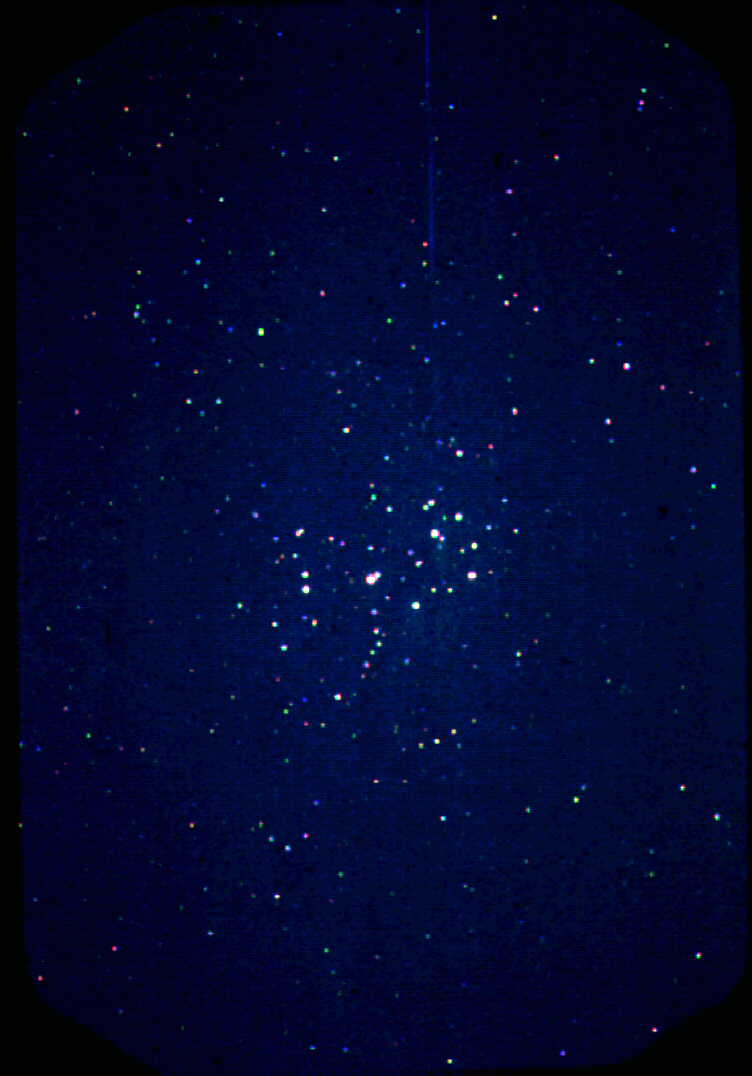
The Pleiades, about what you’d see in binoculars. To the naked eye, six or seven stars might be glimpsed. As star clusters go, it might seem small and unremarkable, but the Pleiades is nearby, and the brightest star cluster visible. Its stars are regarded by cultures around the world as female stars, generally sisters. Credit: Mine.
11/18/2022 – Ephemeris – Fomalhaut’s disappearing “planet”
This is Ephemeris for Friday, November 18th. Today the Sun will be up for 9 hours and 27 minutes, setting at 5:11, and it will rise tomorrow at 7:45. The Moon, 2 days past last quarter, will rise at 2:32 tomorrow morning.
The lonely bright star low in the south at 8 p.m. these evenings is Fomalhaut, the harbinger of autumn in my book, and about to leave as winter approaches. Fomalhaut is a young white star only about 400 million years old with a disk of dust surrounding it. Near an outer dust ring, in 2008 the Hubble Space Telescope discovered a spot. Four years later, astronomers discovered that the spot had moved along the dust lane and announced the first direct discovery of an exoplanet. In 2010 and 2012 the planet now dubbed Fomalhaut b or Dagon was observed again. However, it appears to be dissipating. It might be an expanding cloud of debris that’s the result of two asteroids colliding. We’ll keep watching.
The astronomical event times given are for the Traverse City/Interlochen area of Michigan (EST, UT -5 hours). They may be different for your location.
Addendum
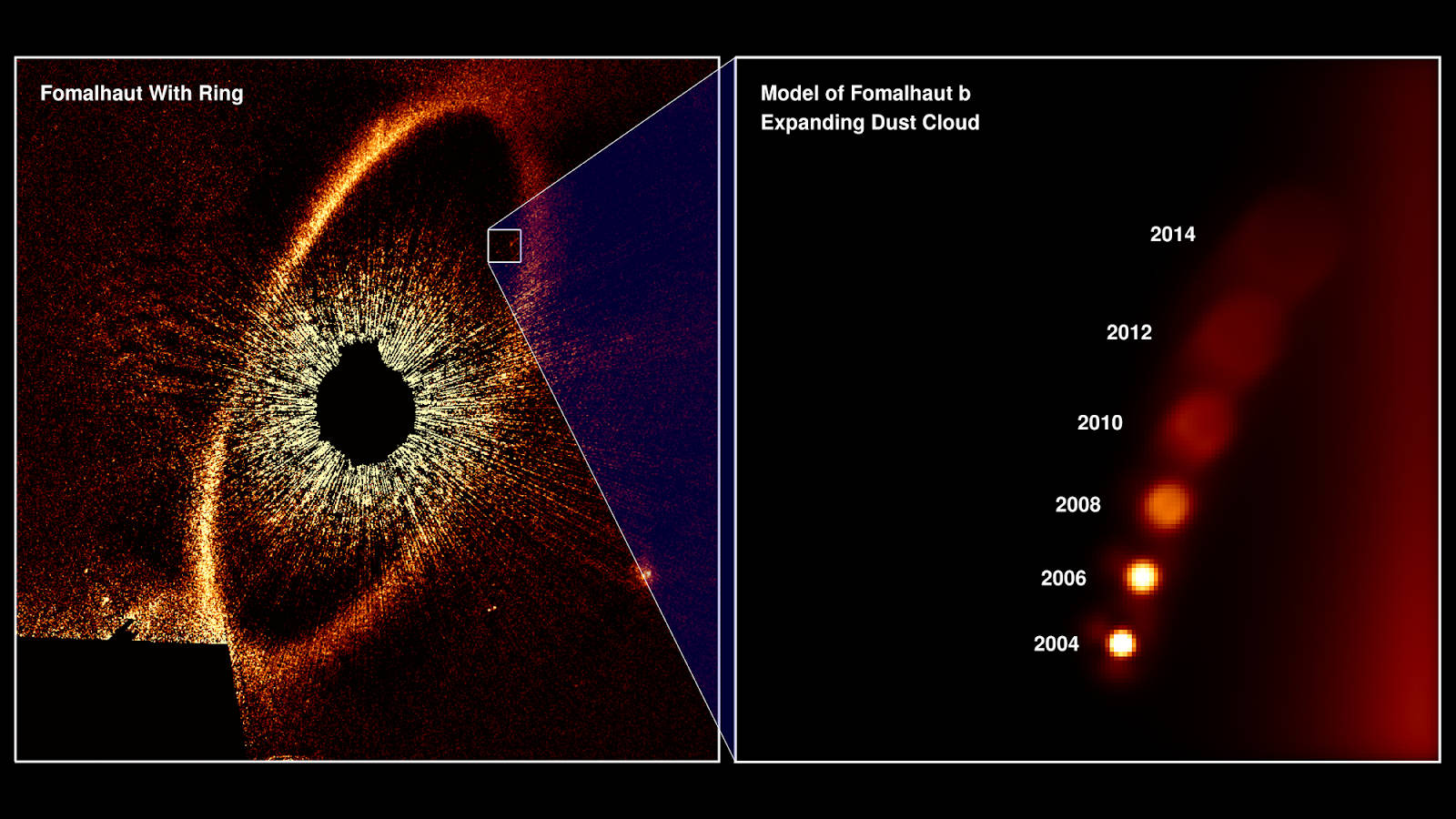
Hubble Space Telescope image of Fomalhaut’s ring and model of the disappearing dust cloud that was first thought to be a planet. Credit: Space Telescope Science Institute.
11/17/2022 – Ephemeris – The peak of the Leonid meteor shower
This is Bob Moler with Ephemeris for Thursday, November 17th. Today the Sun will be up for 9 hours and 30 minutes, setting at 5:12, and it will rise tomorrow at 7:43. The Moon, 1 day past last quarter, will rise at 1:25 tomorrow morning. | The Famous Leonid meteor shower, which has had spectacular displays about every 33 years, is forecast to reach its normal peak this year, near 6 pm our time, with another smaller peak around 2 am tomorrow. The numbers of meteors, forecast during those peaks, of only about 10 per hour. The Moon will interfere after 1:25 am. And no meteors will be seen before 11:30 p.m. when the radiant rises. The last great 33 year peak was in 1998, so we’re a ways away from the next one. The responsible body for these meteors is the Comet Tempel-Tuttle. Every time the comet passes through the inner solar system, the Sun’s heat liberates gas, dust and small grains of rock. These small grains end up following and trailing the comet.
The astronomical event times given are for the Traverse City/Interlochen area of Michigan (EST, UT -5 hours). They may be different for your location.
Addendum
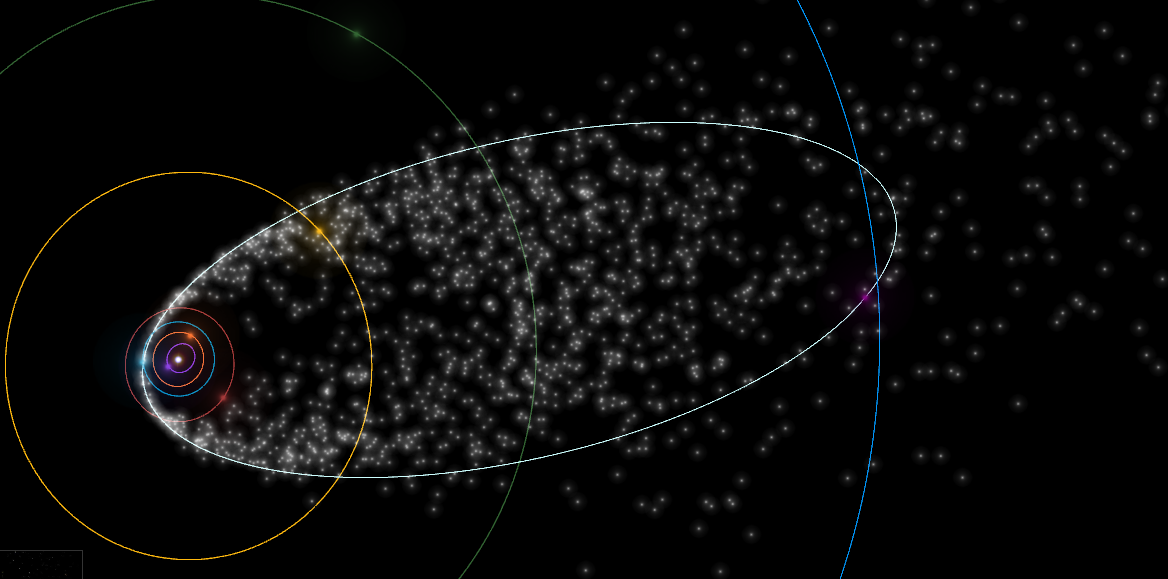
The Leonid meteor shower as seen from space. The time is set for today, so the Earth’s blue dot is lost in the stream of meteors crossing the Earth’s orbit (3rd one out from the Sun) just above 9 o’clock. The long ellipse is the orbit of Comet Tempel-Tuttle and the purple dot near the aphelion neat Uranus’ orbit is the calculated current position of the comet. The flurry of dots is the calculated positions of meteors whose orbits have been calculated. Click on the image to enlarge. Credit: NASA’s CAMS video camera surveillance network, and were calculated by meteor astronomer Peter Jenniskens of the SETI Institute and NASA Ames Research Center. This visualization is developed and hosted by Ian Webster.
11/16/2022 – Ephemeris – Let’s see where the naked-eye planets have wandered off to this week
This is Bob Moler with Ephemeris for Wednesday, November 16th. Today the Sun will be up for 9 hours and 32 minutes, setting at 5:13, and it will rise tomorrow at 7:42. The Moon, at last quarter today, will rise at 12:19 tomorrow morning.
Let’s see where the naked-eye planets have wandered off to this week. Jupiter and Saturn will be visible this evening, in the southeastern sky, as soon after sunset as it will be dark enough to see them, which would be by 6 pm. Jupiter is the brighter of the two to the left, in the southeast, while dimmer Saturn is in the south. The red planet Mars, though a morning planet, will rise tonight at 6:43 pm in the east-northeast. It’s located between the tips of the long horns of Taurus the bull. Mars is beginning to move westward in its retrograde motion as the Earth is starting to pass it. Which it will do in three weeks time. Venus and Mercury, though in the evening sky, are too close to the Sun to be seen.
The astronomical event times given are for the Traverse City/Interlochen area of Michigan (EST, UT -5 hours). They may be different for your location.
Addendum
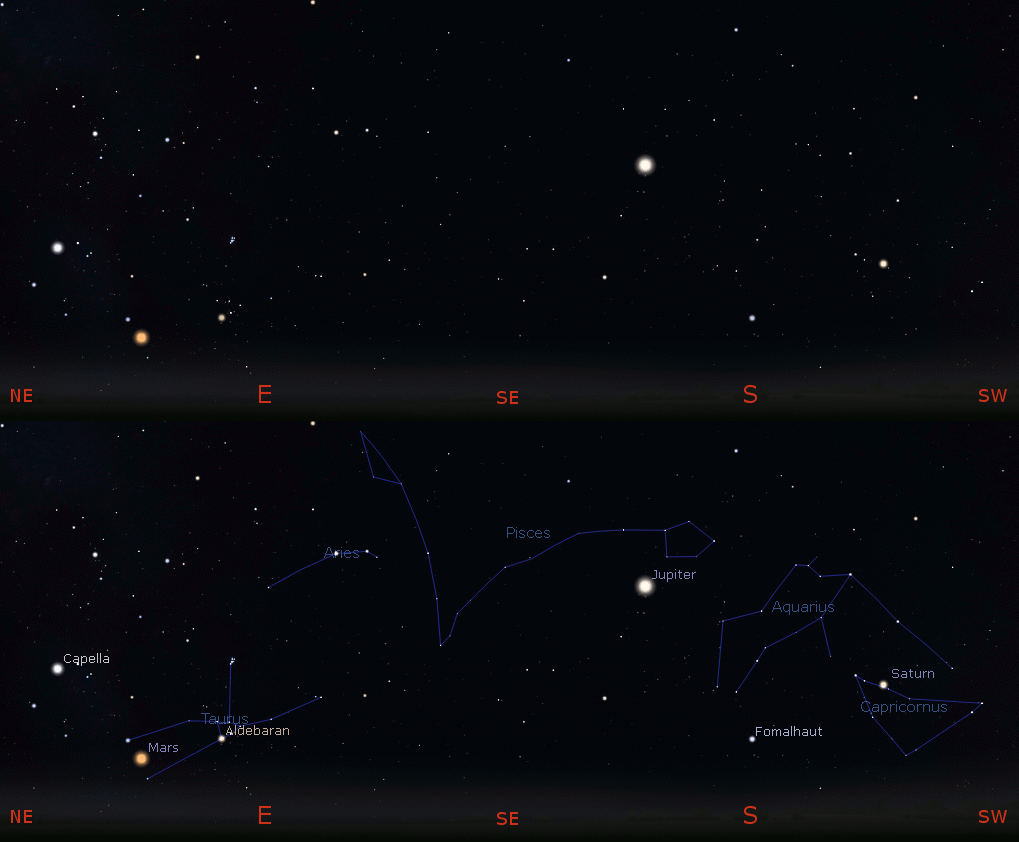
A panorama from northeast to southwest of planets and Zodiac constellations in the evening. Showing between just the sky and constellation lines and labels alternately. For tonight at 8 pm, November 16, 2022. Click on the image to enlarge it. Created using Stellarium and GIMP.
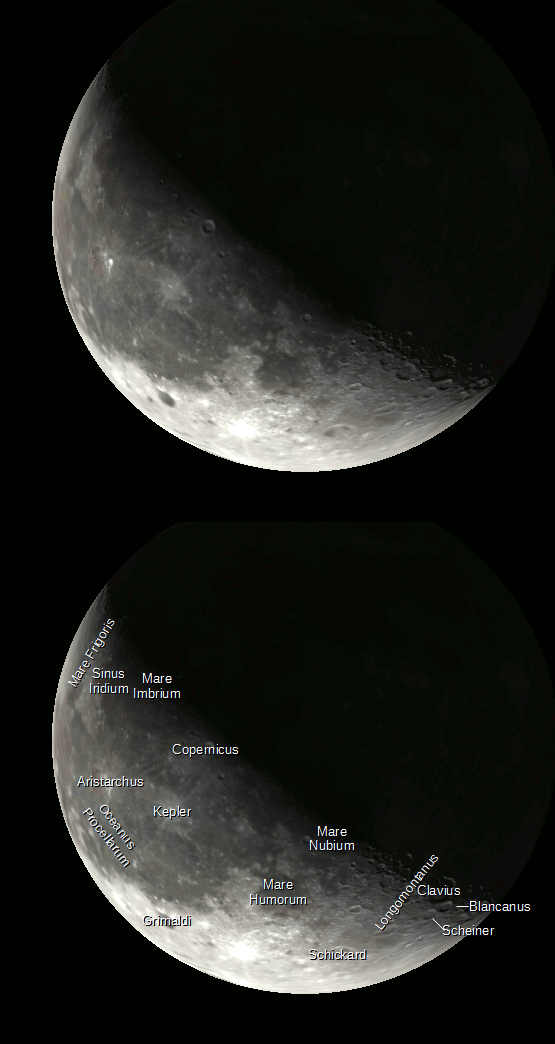
Fat waning crescent Moon with labels showing alternately for 6 am tomorrow, November 17, 2022. Labels are centered on their features, unless a pointer is used in congested areas. Created using Stellarium, LibreOffice Draw, and GIMP.
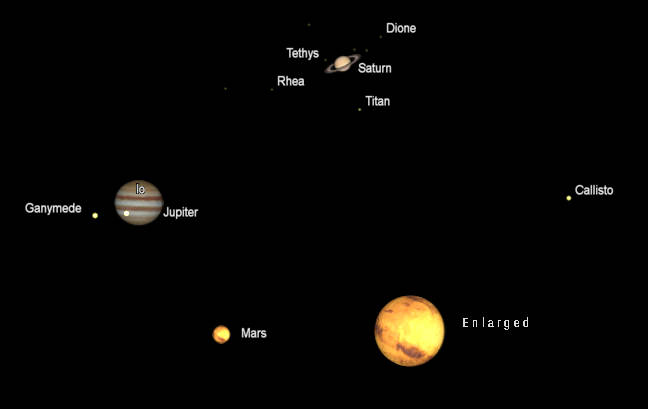
Telescopic views of Saturn Jupiter and Mars (north up) as they would be seen in a small telescope, with the same magnification. The image of Mars doesn’t show it, but the white north polar cap will appear at the top or north limb of Mars. Saturn and Jupiter are shown at 9 pm on the 16th, Mars at 6 am on the 17th. Apparent diameters: Saturn 16.80″, its rings 39.14″; Jupiter 45.55″. Mars 16.67″. Mars’ distance is 52.0 million miles (83.8 million kilometers). The ” symbol means seconds of arc (1/3600th of a degree.) Click on the image to enlarge it. Created using Cartes du Ciel (Sky Charts).
At 9 pm, only two of Jupiter’s moons will be visible next to the planet. They are Ganymede and Callisto. Io is behind the planet, while Europa is transiting the planet. In actuality, a transiting moon is very difficult to spot. However, its shadow crossing the planet is easier to spot. Europa’s shadow will start to cross the face of Jupiter at 11:42 pm EST, with Io popping out from Jupiter’s shadow 5 minutes later. The phenomena of Jupiter’s moons are printed each month in Sky and Telescope Magazine.
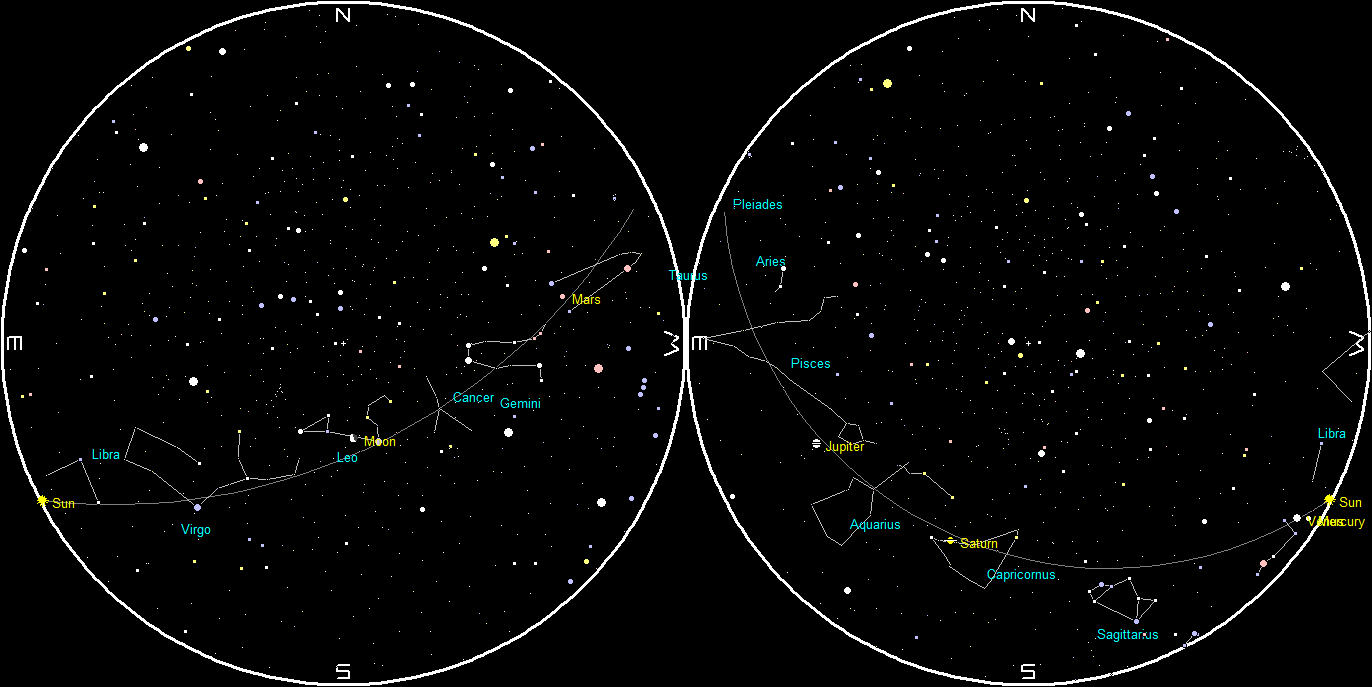
The naked-eye planets and the Moon at sunset and sunrise on a single night, starting with sunset on the right on November 16, 2022. The night ends on the left with sunrise on the 17th. Click on the image to enlarge it. Created using my LookingUp app and GIMP.
11/15/2022 – Ephemeris – Finding the constellation of Aquarius the water bearer
This is Ephemeris for Tuesday, November 15th. Today the Sun will be up for 9 hours and 34 minutes, setting at 5:14, and it will rise tomorrow at 7:41. The Moon, 1 day before last quarter, will rise at 11:13 this evening.
One of the constellations of the zodiac is in the southern sky at 8 in the evening, between Jupiter and Saturn. It’s the constellation of Aquarius, the water bearer. The image that is supposed to be depicted in the stars is that of a fellow spilling a stone jar of water. Aquarius is fairly hard to spot because it is made of faint stars. One part of him, though, is easy to spot. That is the Water Jar, an asterism or informal constellation. It is a distinctive small nearly equilateral triangle of stars with another star in the center. Stars extending to the right from the water jar are the yoke he’s holding the water jar with. The Water jar is above and centered on a line drawn between Jupiter and Saturn. The water is flowing down a line of stars to the lower left.
The astronomical event times given are for the Traverse City/Interlochen area of Michigan (EST, UT -5 hours). They may be different for your location.
Addendum
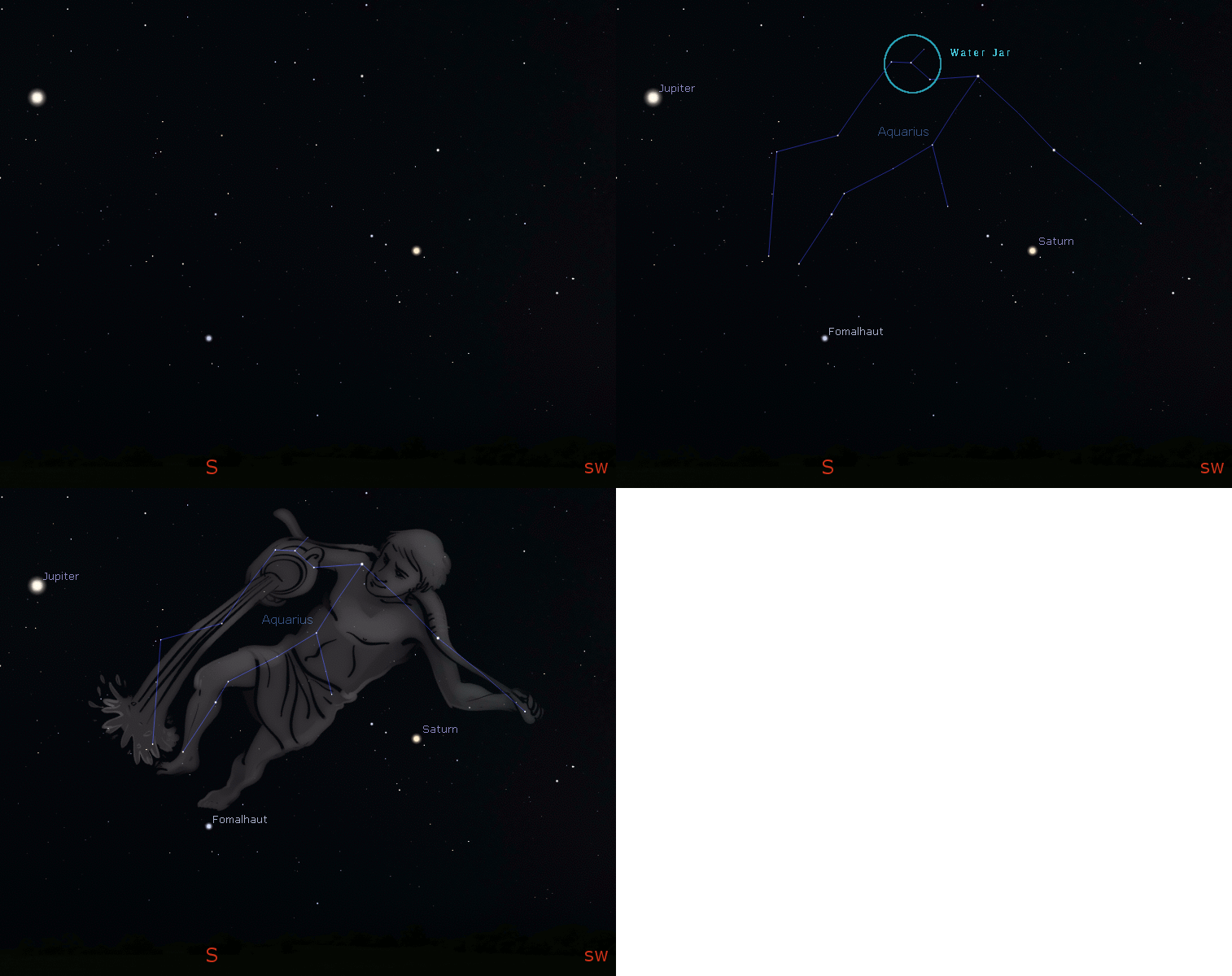
How to find Aquarius this autumn. It’s between Jupiter and Saturn. The image is set for 8 pm tonight, November 15, 2022. Created using Stellarium and GIMP.

