Archive
12/12/2022 – Ephemeris – Orion and the scorpion
This is Bob Moler with Ephemeris for Monday, December 12th. Today the Sun will be up for 8 hours and 51 minutes, setting at 5:02, and it will rise tomorrow at 8:11. The Moon, 4 days before last quarter, will rise at 9 this evening.
The wonderful constellation of Orion the hard luck hunter is seen rising in the east as twilight fades. According to one Greek myth he was killed by the sting of a scorpion, thus he can only rise as the summer constellation of Scorpius the scorpion sets in the southwest, and he must set as the scorpion rises on early spring evenings. By 9 pm, he is located in the east-southeast. His three belt stars are nearly vertically arranged in a line and equally spaced. They point down to the horizon, where the brightest nighttime star Sirius will rise at about 9:20 pm. The belt stars lie within a large rectangle of stars tilted to the left. His shoulders and knees. The top left star is the bright red Betelgeuse. The bottom right star is blue-white Rigel. We’ll explore more of Orion all winter.
The astronomical event times given are for the Traverse City/Interlochen area of Michigan (EST, UT –5 hours). They may be different for your location.
Addendum
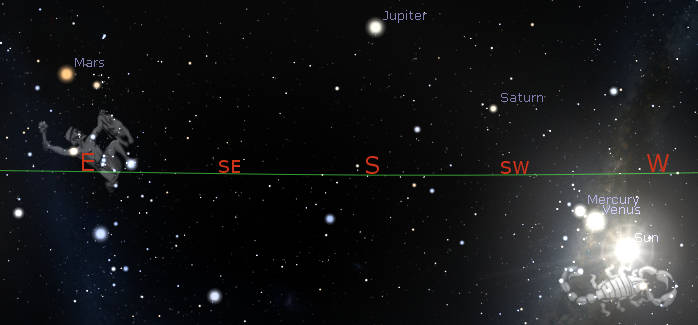
A panorama showing Orion rising while Scorpius the scorpion is below the horizon. Both the atmosphere and the ground were removed in this view. The horizon is the green horizontal line. Orion, apparently, is so afraid of the scorpion, that he won’t enter the sky until the scorpion is long gone, putting the Sun between the two. This business of the two never being in the sky at the same time only works for observers in the Earth’s Northern Hemisphere. Click on the image to enlarge it. Created using Stellarium
12/09/2022 – Ephemeris – The earliest sunset of the year
This is Bob Moler with Ephemeris for Friday, December 9th. Today the Sun will be up for 8 hours and 53 minutes, setting at 5:02, and it will rise tomorrow at 8:09. The Moon, 2 days past full, will rise at 5:59 this evening.
We are at the period of time of the earliest sunset, in the middle of a 13-day stretch where the Sun sets within the same minute. We are still 12 days from the winter solstice, the day of the shortest daylight hours, on the 21st. The reason is twofold. The Sun is near its farthest position south of the equator, where the longitude lines are closer together, so it takes less time to cross them. 15 degrees in longitude equals one hour in Earth’s rotation. Add to that we are less than a month from Earth’s perihelion in its orbit of the Sun, that is at its closest, and is moving faster than average. The combined effects delay sunrise and sunset, from what they’d be if the Sun was on the equator and the Earth’s orbit was circular. We will have our latest sunrise on January 2nd.
The astronomical event times given are for the Traverse City/Interlochen area of Michigan (EST, UT –5 hours). They may be different for your location.
Addendum
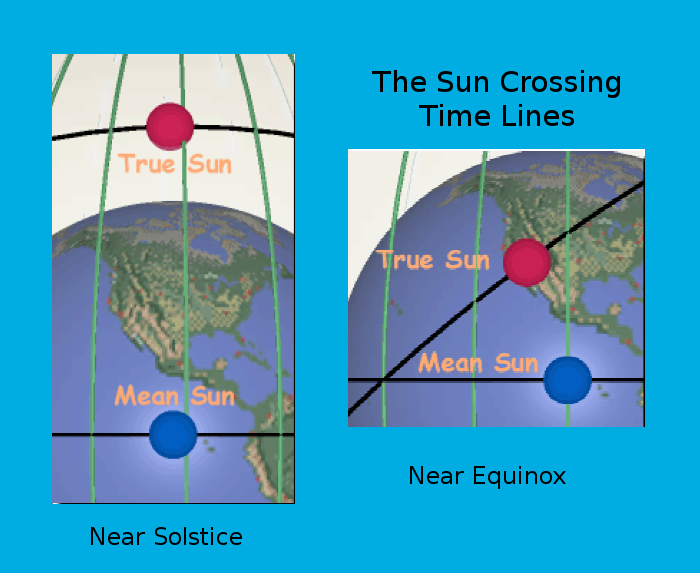
How the Sun’s declination affects how rapidly it appears to cross time lines (meridians)
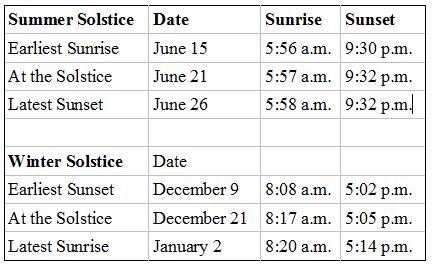
Table of Earliest and Latest Sunrises and Sunsets during the year for Interlochen/Traverse City area of Michigan.
In December the Earth is approaching perihelion, its closest to the Sun, so it moves faster than average. This makes the Sun to appear to move faster eastward against the stars in our sky. This tends to make our sunrises, apparent local noons and sunsets later than they would otherwise be. This makes sunset bottom out early and extends the date of the latest sunrise
For the June or summer solstice around here, the Earth is near aphelion, its farthest from the Sun where the Earth is at its slowest in its orbit. By reflection, the Sun appears to move its slowest against the stars in our sky. This effect works against the high latitude effect, making the effect smaller. Looking at the table above, the days between the earliest and latest times is shorter for the summer solstice than for the winter solstice.
12/08/2022 – Ephemeris – Tonight’s full-ish Moon is near where the June solstice Sun was
This is Ephemeris for Thursday, December 8th. Today the Sun will be up for 8 hours and 54 minutes, setting at 5:02, and it will rise tomorrow at 8:08. The Moon, 1 day past full, will rise at 5:10 this evening.
The bright Moon near full in December rises very high in the south around midnight to 1 am. It is near where the Sun is at the summer solstice. Actually, tonight it is to the lower right of the constellation of Gemini, and to give a topical reference. Tonight, the Moon appears as a soccer ball being kicked by Castor, one of the twins. It’s right off the toe of his foot. In June, the Sun and Full Moon’s positions are reversed. The Sun rises very high in the southern sky at local noon, while the full moon stays low in the south. Or Moon is odd in that respect, Most large satellites of the other planets orbit over their primary’s equator. Our Moon’s orbit is aligned to about 5 degrees off Earth’s own orbit of the Sun, which is angled at 23 and a half degrees from Earth’s equator.
The astronomical event times given are for the Traverse City/Interlochen area of Michigan (EST, UT –5 hours). They may be different for your location.
Addendum
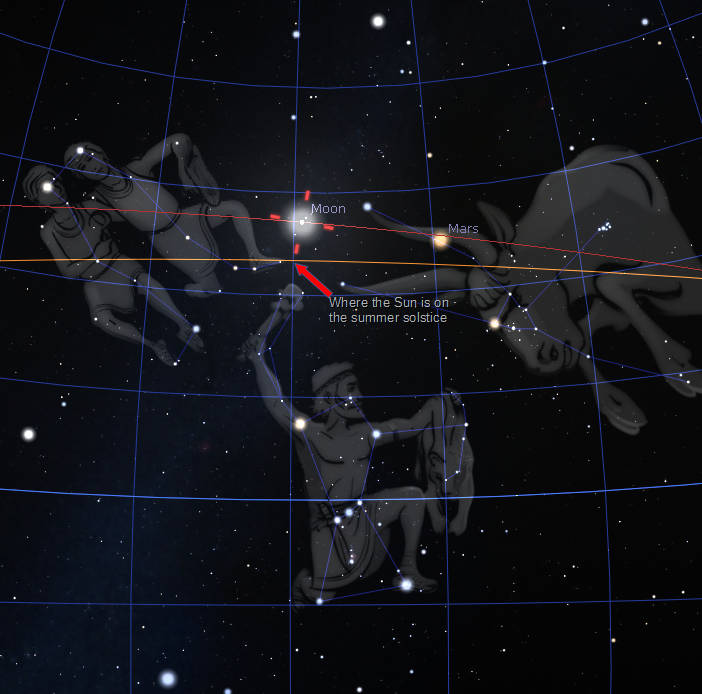
The Moon near the summer solstice point overnight tonight at 1:15 am (the 9th). The sky is overlaid with the equatorial grid. The bright blue line that runs just above Orion’s belt is the celestial equator. The declination lines match Earth’s latitude lines are 10 degrees apart. The vertical blue lines are right ascension lines, like earthly longitude lines, and are 15 degrees apart. Each one represents one hour. The orange line is the ecliptic, the path of the Sun in the sky, also the plane of the Earth’s orbit. The red line is the Moon’s orbit, which is inclined by about 5 degrees to the ecliptic. Click on the image to enlarge it. Created using Stellarium and LibreOffice Draw.
12/07/2022 – Ephemeris – An occultation of Mars and a look at the other naked eye planets.
This is Bob Moler with Ephemeris for Wednesday, December 7th. Today the Sun will be up for 8 hours and 55 minutes, setting at 5:02, and it will rise tomorrow at 8:07. The Moon, at full today, will rise at 4:31 this evening.
Let’s see where the naked-eye planets have wandered off to this week. Mars, Jupiter and Saturn will be visible this evening, in the southeastern sky by 6 pm. At that time, Mars will be below, left of the bright full Moon. Jupiter is the brightest of the three in the southeast, while dimmer Saturn is in the south-southeast at that hour. Mars will be hidden behind the Moon from about 10:15 to 11:15 pm tonight for the IPR area. Being a full moon, Mars might be difficult to spot. It may take binoculars to spot it below, left of the Moon by 9:30, and a small telescope when Mars is near the edge of the Moon. The disappearance of Mars will be at the Moon’s 7 o’clock position, and reappearance at the 4 o’clock position. Bobmoler.wordpress.com (you are already here) has more information.
The astronomical event times given are for the Traverse City/Interlochen area of Michigan (EST, UT –5 hours). They may be different for your location.
Addendum
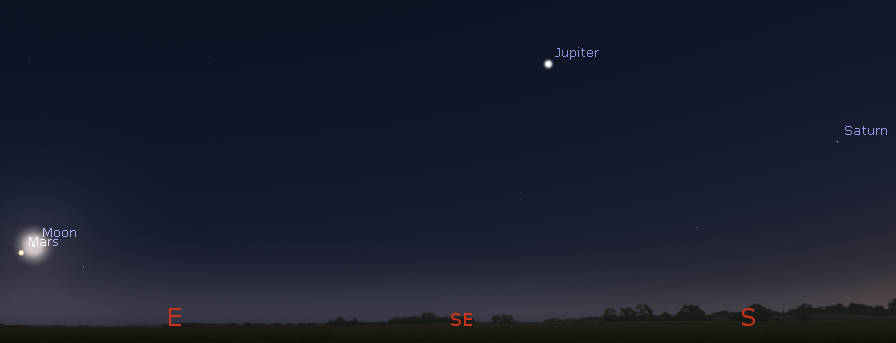
Panoramic view of planets and Moon this evening at 7 pm tonight, December 7, 2022. Click on the image to enlarge it. Created using Stellarium.
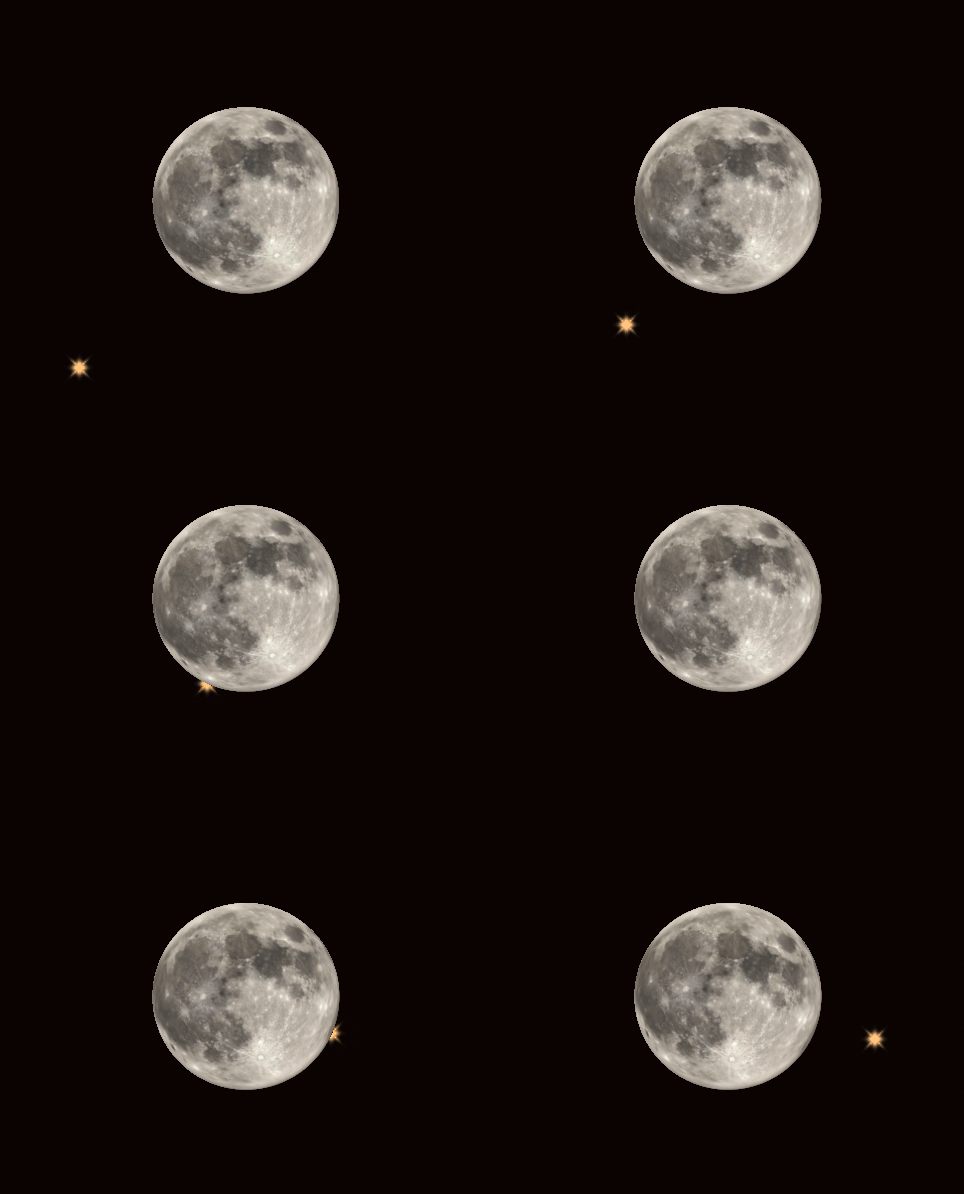
Mars occultation animation in half hour steps for 9:15 pm, 9:45 pm, 10:15 pm (Ingress), 10:45 pm (mid-occultation), 11:15 pm (egress), 11:45 pm. The Moon and the apparent path of Mars rotates as they cross the sky from east to west. In actuality, the Moon is much brighter than Mars, so picking the planet out tonight will be a challenge. It will take the Moon almost a minute to completely cover Mars, and nearly another minute to uncover it. The plot is centered on the Moon here, but the Moon provides most of the motion here. On average, the Moon moves 12 degrees a day, while Mars moves less than a degree against the starry background. Created using Stellarium and GIMP.
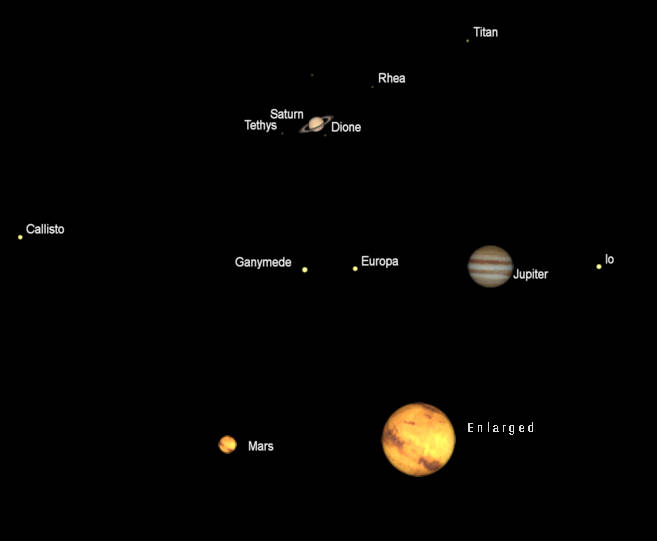
Telescopic views of Saturn Jupiter and Mars (north up) as they would be seen in a small telescope, with the same magnification. The image of Mars doesn’t show it, but the white north polar cap will appear at the top or north limb of Mars. The planets are shown at 8 pm tonight, December 7, 2022. Apparent diameters: Saturn 16.25″, its rings 37.86″; Jupiter 42.55″. Mars 17.05″. Mars’ distance is 51.0 million miles (82.1 million kilometers). This is the closest it comes to the Earth this orbit. The ” symbol means seconds of arc (1/3600th of a degree.) Click on the image to enlarge it. Created using Cartes du Ciel (Sky Charts).
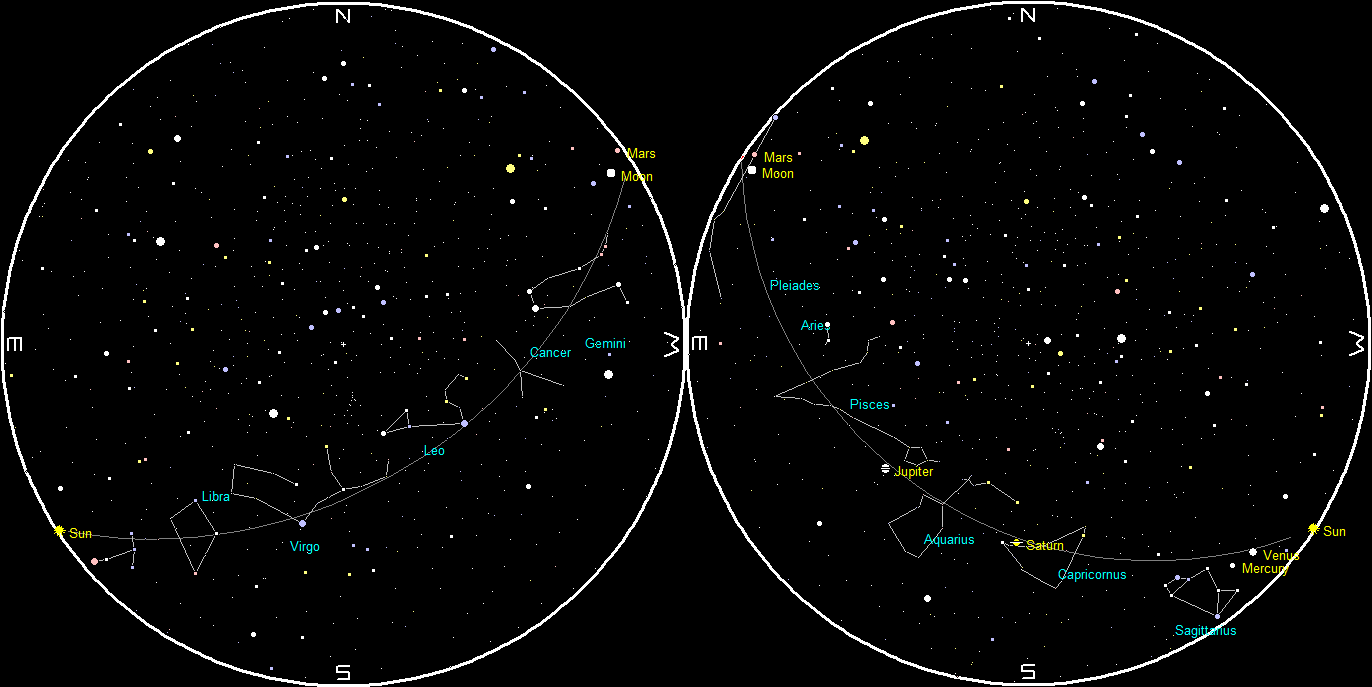
The naked-eye planets and the Moon at sunset and sunrise on a single night, starting with sunset on the right on December 7, 2022. The night ends on the left with sunrise on the 8th. Click on the image to enlarge it. Created using my LookingUp app and GIMP.
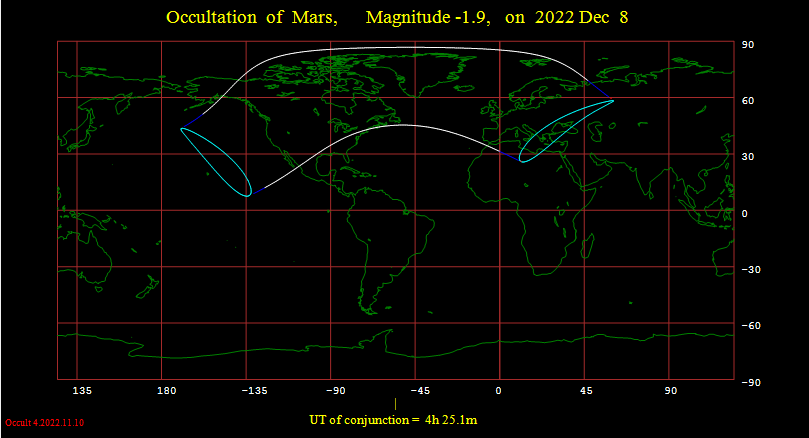
World map showing the area that the occultation of Mars will be visible. Occultation visibility will move from west to east. Credit: Occult version 4. This evening in the EST zone is the 8th for Universal Time (UT), or GMT (Greenwich Mean Time) if you’re older.
12/06/2022 – Ephemeris – The Moon will pass in front of Mars tomorrow night
This is Bob Moler with Ephemeris for Tuesday, December 6th. Today the Sun will be up for 8 hours and 57 minutes, setting at 5:02, and it will rise tomorrow at 8:06. The Moon, 1 day before full, will set at 7:45 tomorrow morning.
Late tomorrow evening we might get to view a really cool event, clouds permitting, when the full moon will cover or in astronomical lingo occult the planet Mars. In the Grand Traverse Region, this will occur for an hour between approximately 10:15 to 11:15 pm. The exact times depend on your location, and can vary by a minute or two over the IPR coverage area. Being a full moon, Mars might be difficult to spot. It may take binoculars to spot it below, left of the Moon by 9:30, and a small telescope when Mars is near the edge of the Moon. The disappearance of Mars will be at the Moon’s 7 o’clock position, and reappearance at the 4 o’clock position.
The astronomical event times given are for the Traverse City/Interlochen area of Michigan (EST, UT –5 hours). They may be different for your location.
Addendum
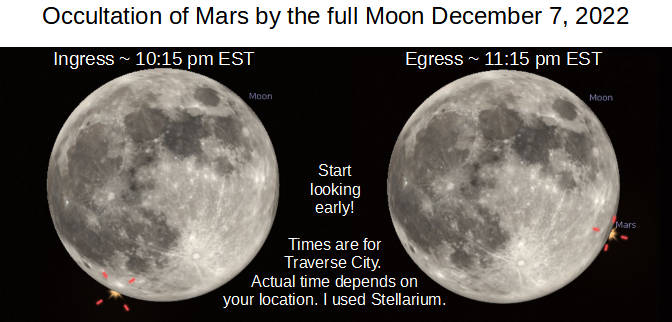
Mars ingress and egress chart and times for Traverse City, MI. The times will vary by a minute or two in the IPR listening area, ingress being earlier to the west and north and later east and south. Egress times will be earlier west and later east of Traverse City. Mars takes about a minute to completely disappear and reappear again because it’s not an unresolvable point like stars.
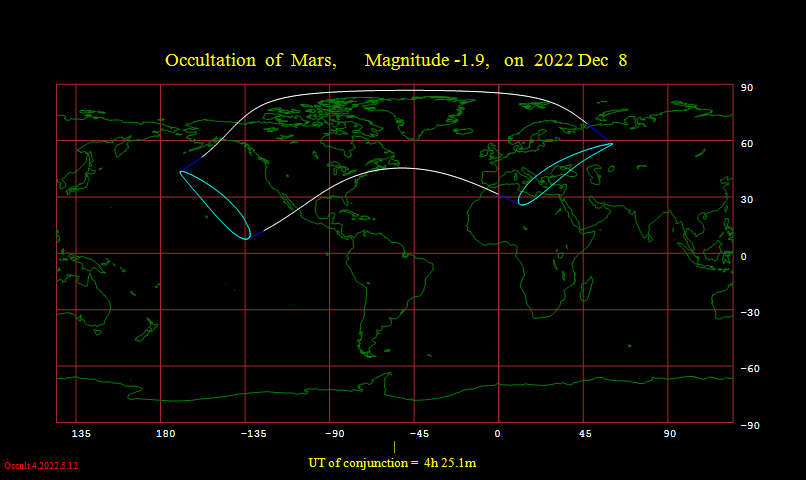
Occultation of Mars map. The occultation of Mars by the Moon will be visible from within the bounded area. For Traverse City, MI, Mars will disappear around 10:15 pm, December 7, 2022, and reappear around 11:15 pm.
In astronomical events of solar eclipses and occultations YOU are part of the event. No, not you, but your location. Whether you see the event or not or what time the contacts (ingress, egress) happen depends on your location. And will happen for that location whether you are there, or it’s clear, or not.
12/05/2022 – Ephemeris – Mars will hide behind the full Moon Wednesday night
This is Ephemeris for Monday, December 5th. Today the Sun will be up for 8 hours and 58 minutes, setting at 5:02, and it will rise tomorrow at 8:05. The Moon, 2 days before full, will set at 6:36 tomorrow morning.
Late Wednesday night we might get to view a really cool event when the full moon will cover or in astronomical lingo occult the planet Mars. In the Grand Traverse Region, this will occur for an hour between approximately 10:15 to 11:15 pm. The exact times depend on your location, and can vary by several minutes or more. Being a full moon, Mars might be difficult to spot. I’ll have more and hopefully more accurate information tomorrow. When astronomical objects line up like this, it’s called a syzygy. This time it’s a lineup of the Sun, Earth Moon and Mars in nearly a straight line, with both the Moon and Mars in opposition from the Sun on the same night. When the Moon is in opposition, we call it a full moon instead.
The astronomical event times given are for the Traverse City/Interlochen area of Michigan (EST, UT –5 hours). They may be different for your location.
Addendum
Mars ingress and egress chart and times for Traverse City, MI. The times will vary by a minute or two in the IPR listening area, ingress being earlier to the west and north and later east and south. Egress times will be earlier west and later east of Traverse City.
World map showing the area that the occultation of Mars will be visible. Occultation visibility will move from west to east. Credit: Occult version 4.
12/02/2022 – Ephemeris – Astronomical events tonight and tomorrow in Traverse City
This is Ephemeris for Friday, December 2nd. Today the Sun will be up for 9 hours and 2 minutes, setting at 5:03, and it will rise tomorrow at 8:02. The Moon, 2 days past first quarter, will set at 3:07 tomorrow morning.
We have a big astronomy and space weekend starting tonight at 8 pm I’ll be giving a talk about the Star of Bethlehem at Northwestern Michigan College’s Rogers Observatory located south of Traverse City on Birmley Road, with observing at 9 pm, clouds permitting. This is part of the December meeting of the Grand Traverse Astronomical Society. Tomorrow is NASA Family Day at the Dennos Museum Center. There are fun activities at 1 pm, making comets and exploring the phases of the Moon. At 2 pm, Dr. Jerry Dobek from NMC and the GTAS will be giving a talk at the Milliken Auditorium. Museum admission is waived for the event, which is to celebrate the Museum’s having a NASA Kiosk through the end of the month.
The astronomical event times given are for the Traverse City/Interlochen area of Michigan (EST, UT –5 hours). They may be different for your location.
12/01/2022 – Ephemeris – Let’s preview December skies
This is Ephemeris for Thursday, December 1st. Today the Sun will be up for 9 hours and 3 minutes, setting at 5:03, and it will rise tomorrow at 8:01. The Moon, 1 day past first quarter, will set at 1:57 tomorrow morning.
Let’s preview December’s skies. Winter will officially arrive on the 21st at 4:48 p.m., the winter solstice. The noontime Sun will dip from 23 ½ degrees to a bit less than 22 degrees above the southern horizon on that day. There will be little movement in the sunset times: In the Traverse City/Interlochen area this will be from 5:03 today, down to 5:02 and then advancing to 5:11 at the end of the month. The sunrise times will advance from 7:59 today to 8:20 on the 31st. The Moon will pass in front of Mars on the 7th, the night of the full moon and Mars opposition. The Geminid meteor shower whose maximum is on the morning of the 14th will have interference from the last quarter Moon.
The astronomical event times given are for the Traverse City/Interlochen area of Michigan (EST, UT –5 hours). They may be different for your location.
Addendum
December Evening Star Chart
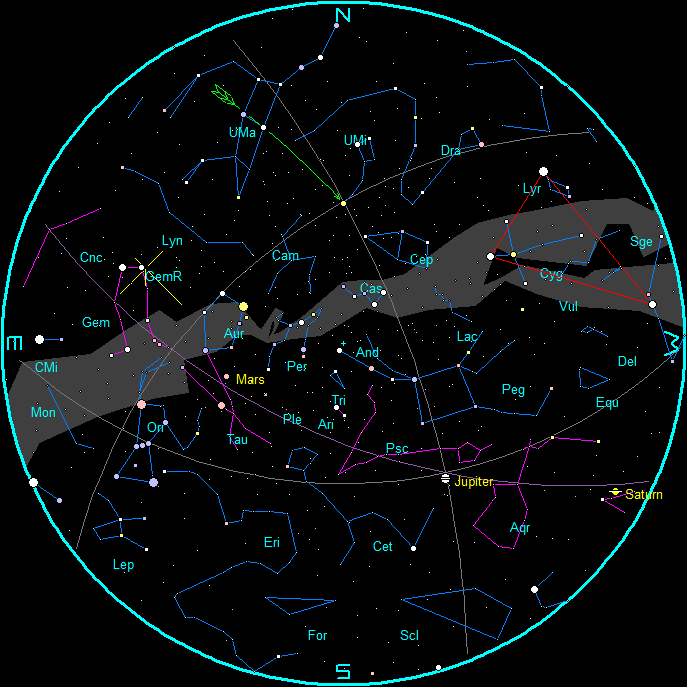
Star Chart for December 2022 (9 p.m. EST December 15, 2022). Click on image to enlarge. Created using my LookingUp program. Click on image to enlarge.
Credit my LookingUp program.
The planets and stars are plotted for the 15th at 9 pm EST in the evening and 6 a.m. for the morning chart. These are the chart times. Note that Traverse City is located approximately 45 minutes behind our time meridian, West 75° longitude. (An hour 45 minutes behind our daylight saving time meridian during EDT).
December Morning Star Chart
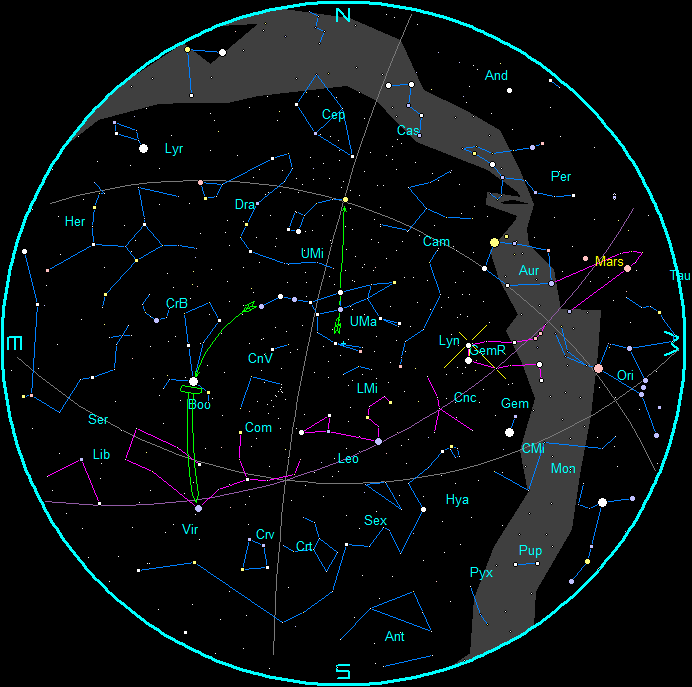
Star Chart for December mornings, 2022 (6 a.m. EST December 15, 2022). Click on image to enlarge. Created using my LookingUp program.
For a list of constellation names to go with the abbreviations, click here.
- Pointer stars at the front of the bowl of the Big Dipper point to Polaris, the North Star.
- The leaky bowl of the Big Dipper drips on Leo.
- Follow the arc of the handle of the Big Dipper to the star Arcturus, then
- Follow the spike to Spica.
- The Summer Triangle is in red.
- GemR on the star charts is the radiant of the Geminid meteor shower, which peaks on the morning of the 14th.
Twilight Limits, Nautical and Astronomical
| EST | |||||||
| Morning | Twilight | Evening | Twilight | Dark | Night | Moon | |
| Date | Astro. | Nautical | Nautical | Astro. | Start | End | Illum. |
| 2022-12-01 | 6h20m | 6h56m | 18h16m | 18h51m | 0h44m | 6h20m | 0.67 |
| 2022-12-02 | 6h21m | 6h57m | 18h16m | 18h51m | 1h57m | 6h21m | 0.77 |
| 2022-12-03 | 6h22m | 6h57m | 18h16m | 18h51m | 3h08m | 6h22m | 0.85 |
| 2022-12-04 | 6h23m | 6h58m | 18h15m | 18h51m | 4h18m | 6h23m | 0.92 |
| 2022-12-05 | 6h24m | 6h59m | 18h15m | 18h50m | 5h27m | 6h24m | 0.96 |
| 2022-12-06 | 6h25m | 7h00m | 18h15m | 18h50m | – | – | 0.99 |
| 2022-12-07 | 6h26m | 7h01m | 18h15m | 18h50m | – | – | 1 |
| 2022-12-08 | 6h27m | 7h02m | 18h15m | 18h50m | – | – | 0.99 |
| 2022-12-09 | 6h28m | 7h03m | 18h15m | 18h51m | – | – | 0.96 |
| 2022-12-10 | 6h28m | 7h04m | 18h15m | 18h51m | 18h51m | 18h55m | 0.92 |
| 2022-12-11 | 6h29m | 7h05m | 18h15m | 18h51m | 18h51m | 19h56m | 0.86 |
| 2022-12-12 | 6h30m | 7h05m | 18h16m | 18h51m | 18h51m | 21h01m | 0.79 |
| 2022-12-13 | 6h31m | 7h06m | 18h16m | 18h51m | 18h51m | 22h06m | 0.71 |
| 2022-12-14 | 6h31m | 7h07m | 18h16m | 18h51m | 18h51m | 23h11m | 0.62 |
| 2022-12-15 | 6h32m | 7h07m | 18h16m | 18h52m | 18h52m | – | 0.52 |
| 2022-12-16 | 6h33m | 7h08m | 18h16m | 18h52m | 18h52m | 0h16m | 0.42 |
| 2022-12-17 | 6h33m | 7h09m | 18h17m | 18h52m | 18h52m | 1h22m | 0.32 |
| 2022-12-18 | 6h30m | 7h05m | 18h13m | 18h49m | 18h49m | 2h31m | 0.22 |
| 2022-12-19 | 6h31m | 7h06m | 18h14m | 18h49m | 18h49m | 3h43m | 0.14 |
| 2022-12-20 | 6h31m | 7h07m | 18h14m | 18h50m | 18h50m | 5h00m | 0.07 |
| 2022-12-21 | 6h32m | 7h07m | 18h15m | 18h50m | 18h50m | 6h20m | 0.02 |
| 2022-12-22 | 6h32m | 7h08m | 18h15m | 18h51m | 18h51m | 6h32m | 0 |
| 2022-12-23 | 6h33m | 7h08m | 18h16m | 18h51m | 18h51m | 6h33m | 0.01 |
| 2022-12-24 | 6h33m | 7h08m | 18h16m | 18h52m | 18h52m | 6h33m | 0.05 |
| 2022-12-25 | 6h33m | 7h09m | 18h17m | 18h52m | 19h48m | 6h33m | 0.11 |
| 2022-12-26 | 6h34m | 7h09m | 18h17m | 18h53m | 21h11m | 6h34m | 0.2 |
| 2022-12-27 | 6h34m | 7h10m | 18h18m | 18h54m | 22h31m | 6h34m | 0.3 |
| 2022-12-28 | 6h34m | 7h10m | 18h19m | 18h54m | 23h47m | 6h34m | 0.41 |
| 2022-12-29 | 6h35m | 7h10m | 18h20m | 18h55m | – | 6h35m | 0.52 |
| 2022-12-30 | 6h35m | 7h10m | 18h20m | 18h56m | 0h59m | 6h35m | 0.62 |
| 2022-12-31 | 6h35m | 7h10m | 18h21m | 18h56m | 2h10m | 6h35m | 0.72 |
Twilight calendar was generated using Cartes du Ciel (Sky Charts).
See my blog post: Twilight Zone for the definitions of the different periods of twilight here: https://bobmoler.wordpress.com/2018/09/27/.
NASA Calendar of Planetary Events
     Date     Time    Event
Dec  1  Th            Venus: 9.9° E
     1  Th   7:52 pm  Moon-Jupiter: 2.6° N
     5  Mo   7:38 am  Moon Ascending Node
     6  Tu   2:26 pm  Moon-Pleiades: 2.9° N
     7  We  11:08 pm  Full Cold Moon
     7  We  11:21 pm  Moon-Mars: 0.6° S, Occultation!
     7  We  11:24 pm  Mars Opposition
     9  Fr   4:22 pm  Moon North Dec.: 27.4° N
    11  Su   2:06 am  Moon-Pollux: 2° N
    11  Su   7:30 pm  Moon Apogee: 405900 km
    14  We   7:53 am  Geminid Shower: ZHR = 120
    16  Fr   3:56 am  Last Quarter
    19  Mo   8:36 pm  Moon Descending Node
    21  We   9:59 am  Mercury Elongation: 20.1° E
    21  We   4:48 pm  Winter Solstice
    21  We   5:43 pm  Moon-Antares: 2.3° S
    22  Th   4:00 pm  Ursid Shower: ZHR = 10
    23  Fr   5:17 am  New Moon
    23  Fr   1:18 pm  Moon South Dec.: 27.4° S
    24  Sa   3:32 am  Moon Perigee: 358300 km
    24  Sa   6:29 am  Moon-Venus: 3.4° N
    26  Mo  11:11 am  Moon-Saturn: 4° N
    29  Th   2:13 am  Mercury-Venus: 1.4° N
    29  Th   5:29 am  Moon-Jupiter: 2.4° N
    29  Th   8:20 pm  First Quarter
All event times are given for UTC-5 Eastern Standard Time.
Sky Events Calendar by Fred Espenak and Sumit Dutta (NASA’s GSFC),
http://eclipse.gsfc.nasa.gov/SKYCAL/SKYCAL.html.
If you go to the above site, you can print out a list like the above for the entire year or calendar pages for your time zone.
Sun and Moon Rising and Setting Events
     LU                  Ephemeris of Sky Events for Interlochen/TC
December, 2022    Local time zone: EST
+-----------------------------------------------------------------------+
| DATE |  SUN     SUN  DAYLIGHT|   TWILIGHT*    |MOON  RISE OR    ILLUM |
|      |  RISE    SET    HOURS |  END    START  |PHASE SET** TIME FRACTN|
+=======================================================================+
|Thu  1| 07:59a  05:03p  09:03 | 06:12p  06:50a |      Set  01:57a   65%|
|Fri  2| 08:01a  05:03p  09:02 | 06:12p  06:51a |      Set  03:07a   75%|
|Sat  3| 08:02a  05:02p  09:00 | 06:12p  06:52a |      Set  04:17a   83%|
+------+-----------------------+----------------+-----------------------+
|Sun  4| 08:03a  05:02p  08:59 | 06:12p  06:53a |      Set  05:27a   90%|
|Mon  5| 08:04a  05:02p  08:58 | 06:12p  06:54a |      Set  06:36a   95%|
|Tue  6| 08:05a  05:02p  08:57 | 06:12p  06:55a |      Set  07:45a   99%|
|Wed  7| 08:06a  05:02p  08:55 | 06:12p  06:56a |Full  Rise 04:31p  100%|
|Thu  8| 08:07a  05:02p  08:54 | 06:12p  06:57a |      Rise 05:10p   99%|
|Fri  9| 08:08a  05:02p  08:53 | 06:12p  06:58a |      Rise 05:59p   97%|
|Sat 10| 08:09a  05:02p  08:52 | 06:12p  06:58a |      Rise 06:54p   93%|
+------+-----------------------+----------------+-----------------------+
|Sun 11| 08:10a  05:02p  08:52 | 06:12p  06:59a |      Rise 07:56p   87%|
|Mon 12| 08:10a  05:02p  08:51 | 06:12p  07:00a |      Rise 09:00p   80%|
|Tue 13| 08:11a  05:02p  08:50 | 06:12p  07:01a |      Rise 10:05p   72%|
|Wed 14| 08:12a  05:02p  08:50 | 06:13p  07:01a |      Rise 11:10p   63%|
|Thu 15| 08:13a  05:02p  08:49 | 06:13p  07:02a |      Rise 12:16a   54%|
|Fri 16| 08:13a  05:03p  08:49 | 06:13p  07:03a |L Qtr Rise 01:22a   44%|
|Sat 17| 08:14a  05:03p  08:48 | 06:14p  07:03a |      Rise 02:31a   34%|
+------+-----------------------+----------------+-----------------------+
|Sun 18| 08:15a  05:03p  08:48 | 06:14p  07:04a |      Rise 03:43a   24%|
|Mon 19| 08:15a  05:04p  08:48 | 06:14p  07:05a |      Rise 04:59a   16%|
|Tue 20| 08:16a  05:04p  08:48 | 06:15p  07:05a |      Rise 06:20a    8%|
|Wed 21| 08:16a  05:05p  08:48 | 06:15p  07:06a |      Rise 07:41a    3%|
|Thu 22| 08:17a  05:05p  08:48 | 06:16p  07:06a |      Rise 08:56a    0%|
|Fri 23| 08:17a  05:06p  08:48 | 06:16p  07:07a |New   Set  05:08p    1%|
|Sat 24| 08:18a  05:06p  08:48 | 06:17p  07:07a |      Set  06:24p    4%|
+------+-----------------------+----------------+-----------------------+
|Sun 25| 08:18a  05:07p  08:48 | 06:18p  07:08a |      Set  07:47p   10%|
|Mon 26| 08:19a  05:08p  08:49 | 06:18p  07:08a |      Set  09:10p   18%|
|Tue 27| 08:19a  05:08p  08:49 | 06:19p  07:08a |      Set  10:30p   28%|
|Wed 28| 08:19a  05:09p  08:49 | 06:20p  07:09a |      Set  11:46p   39%|
|Thu 29| 08:19a  05:10p  08:50 | 06:20p  07:09a |F Qtr Set  12:59a   49%|
|Fri 30| 08:19a  05:11p  08:51 | 06:21p  07:09a |      Set  02:09a   60%|
|Sat 31| 08:20a  05:11p  08:51 | 06:22p  07:09a |      Set  03:19a   70%|
+-----------------------------------------------------------------------+
* Nautical Twilight
** Moonrise or moonset, whichever occurs between sunrise and sunset
Generated using my LookingUp for DOS program.
Mars occultation by the Moon, the night of December 7/8, 2022
Occultation of Mars map. The occultation of Mars by the Moon will be visible from within the bounded area. For Traverse City, MI Mars will disappear around 10:15 pm, December 7, 2022 and reappear around 11:15 pm. I’ll have more on it next week. Credit: Occult v4 app.
11/30/2022 – Ephemeris – Let’s see where the naked-eye planets have wandered off to this week
This is Bob Moler with Ephemeris for Wednesday, November 30th. Today the Sun will be up for 9 hours and 5 minutes, setting at 5:04, and it will rise tomorrow at 7:59. The Moon, at first quarter today, will set at 12:44 tomorrow morning.
Let’s see where the naked-eye planets have wandered off to this week. Jupiter and Saturn will be visible this evening, in the southeastern sky, by 6 pm. Jupiter is the brighter of the two to the left, in the southeast, while dimmer Saturn is in the south at that hour. The Moon will be between them. The red planet Mars, though a morning planet for six more days, will be seen low on the east-northeast horizon at that hour. It’s located between the long horns of Taurus the bull. Mars is moving westward in its retrograde motion as the Earth will pass it a week from now. This evening, Mars will be as close as it can get to the Earth this close approach, 50.61 million miles (81.45 million kilometers). That same night, the full Moon will pass in front of it for an hour. So on the same night, in our area, we will have Mars opposition from the Sun and it being occulted by the Moon.
The astronomical event times given are for the Traverse City/Interlochen area of Michigan (EST, UT –5 hours). They may be different for your location.
Addendum
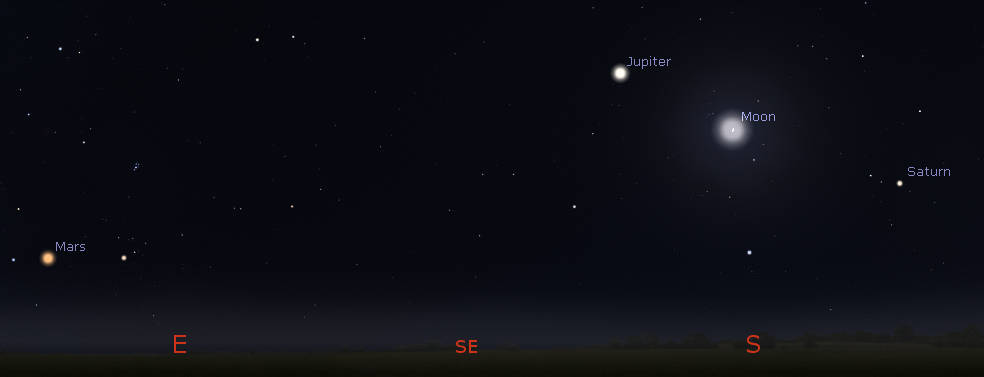
Panoramic view of planets and Moon this evening at 7 pm tonight, November 30, 2022. Click on the image to enlarge it. Created using Stellarium.
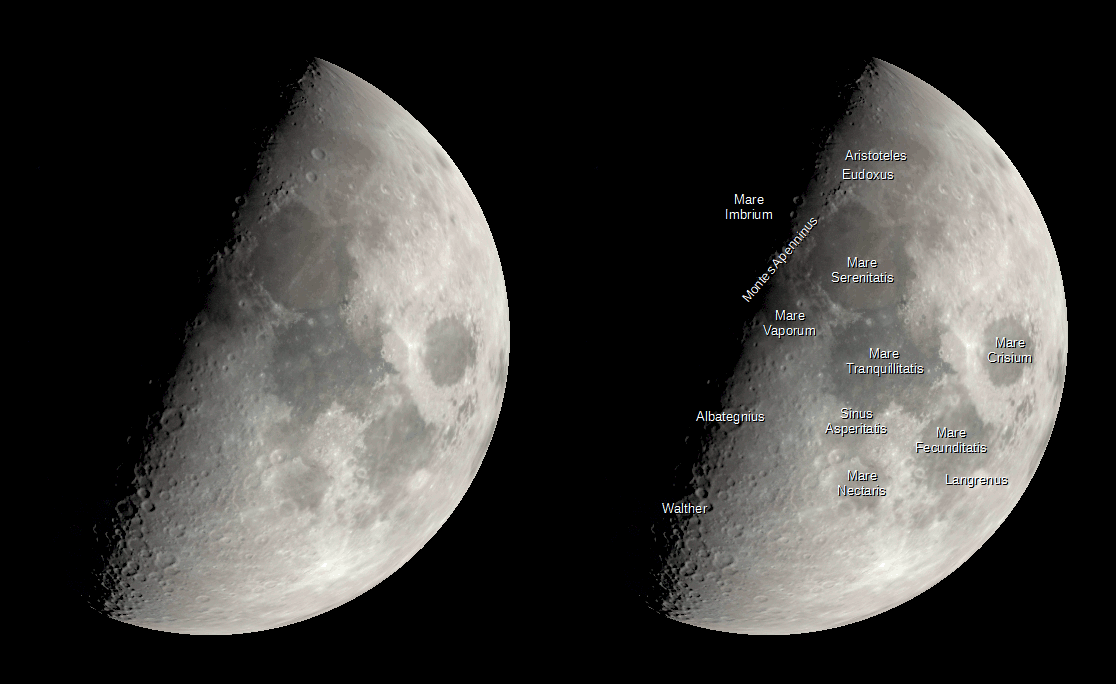
First Quarter Moon as it might be seen tonight in binoculars or low power telescope with labels for tonight, November 30, 2022. Created using Stellarium, LibreOffice Draw and GIMP.
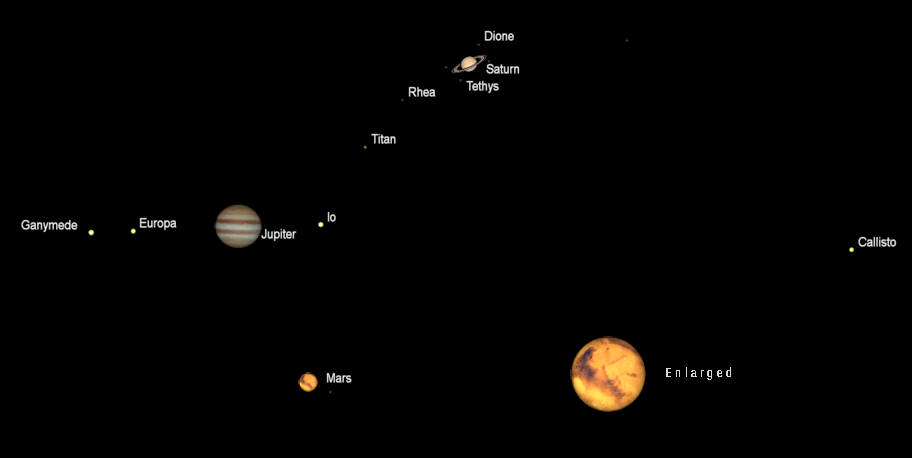
Telescopic views of Saturn Jupiter and Mars (north up) as they would be seen in a small telescope, with the same magnification. The image of Mars doesn’t show it, but the white north polar cap will appear at the top or north limb of Mars. The planets are shown at 8 pm tonight, November 30, 2022. Apparent diameters: Saturn 16.43″, its rings 38.26″; Jupiter 43.56″. Mars 17.20″. Mars’ distance is 50.5 million miles (81.4 million kilometers). This is the closest it comes to the Earth this orbit. The ” symbol means seconds of arc (1/3600th of a degree.) Click on the image to enlarge it. Created using Cartes du Ciel (Sky Charts).
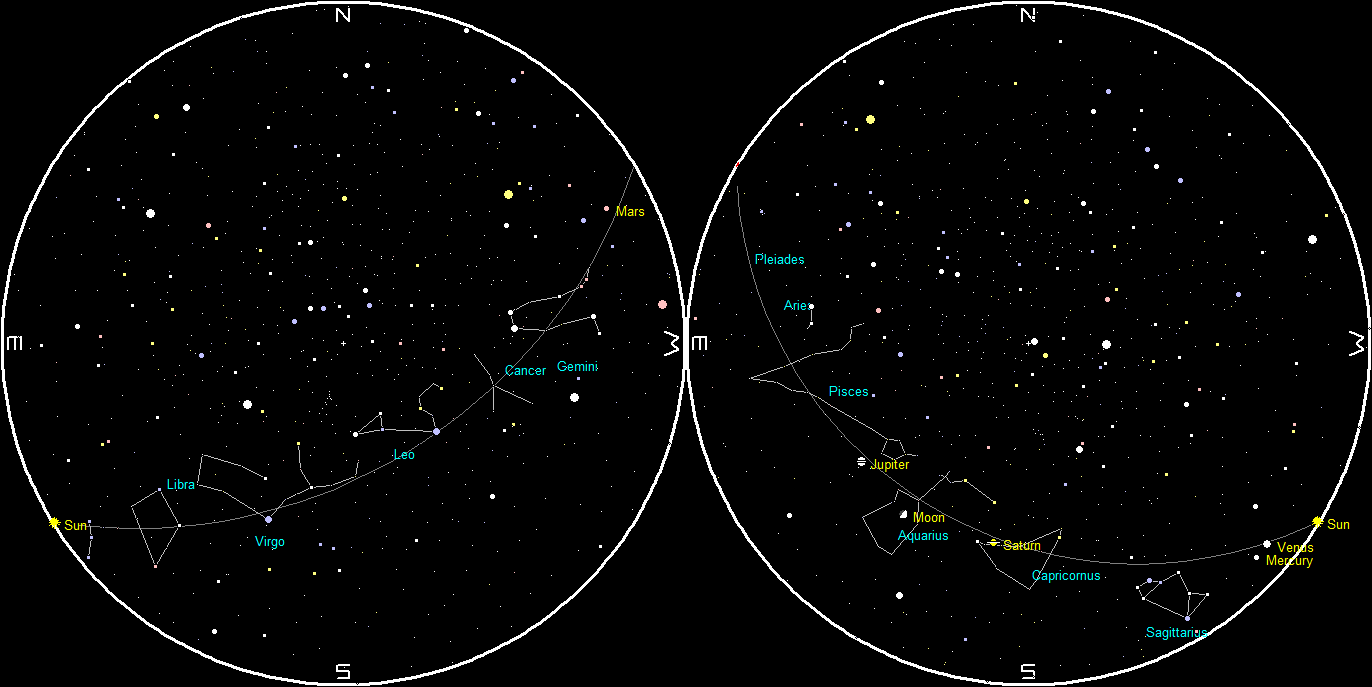
The naked-eye planets and the Moon at sunset and sunrise on a single night, starting with sunset on the right on November 30, 2022. The night ends on the left with sunrise on December 1st. Click on the image to enlarge it. Created using my LookingUp app and GIMP.
11/29/2022 – Ephemeris – Observing the Moon tonight
This is Ephemeris for Tuesday, November 29th. Today the Sun will be up for 9 hours and 6 minutes, setting at 5:04, and it will rise tomorrow at 7:58. The Moon, 1 day before first quarter, will set at 11:28 this evening.
The illuminated part of tonight’s Moon will be a fat crescent shape, 12 hours, give or take from first quarter. Besides the lunar seas visible there are some large craters on its terminator, or sunrise line On the upper right are two distinctive craters near each other. The larger is Aristoteles named after the Greek philosopher Aristotle which is 53 miles wide. The smaller is Eudoxus, named after an older Greek philosopher, 41 miles in diameter. Both of these should be visible in small telescopes or even binoculars. They stand out because there are only a few small craters around them in pretty much flat terrain. Meanwhile Artemis 1’s Orion capsule is continuing to make a large lazy loop around the Moon before heading back to the Earth in 12 days.
The astronomical event times given are for the Traverse City/Interlochen area of Michigan (EST, UT –5 hours). They may be different for your location.
Addendum
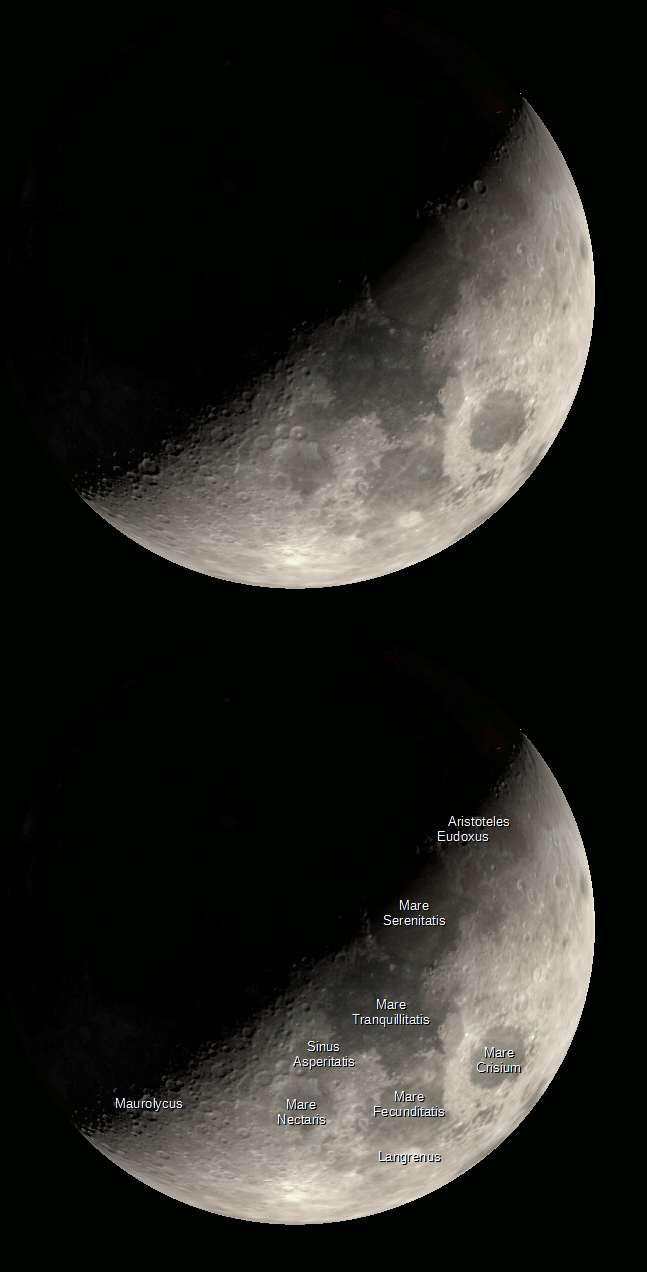
Annotated Moon animation as it might appear tonight at 8 pm, November 29, 2022. Created using Stellarium and GIMP.
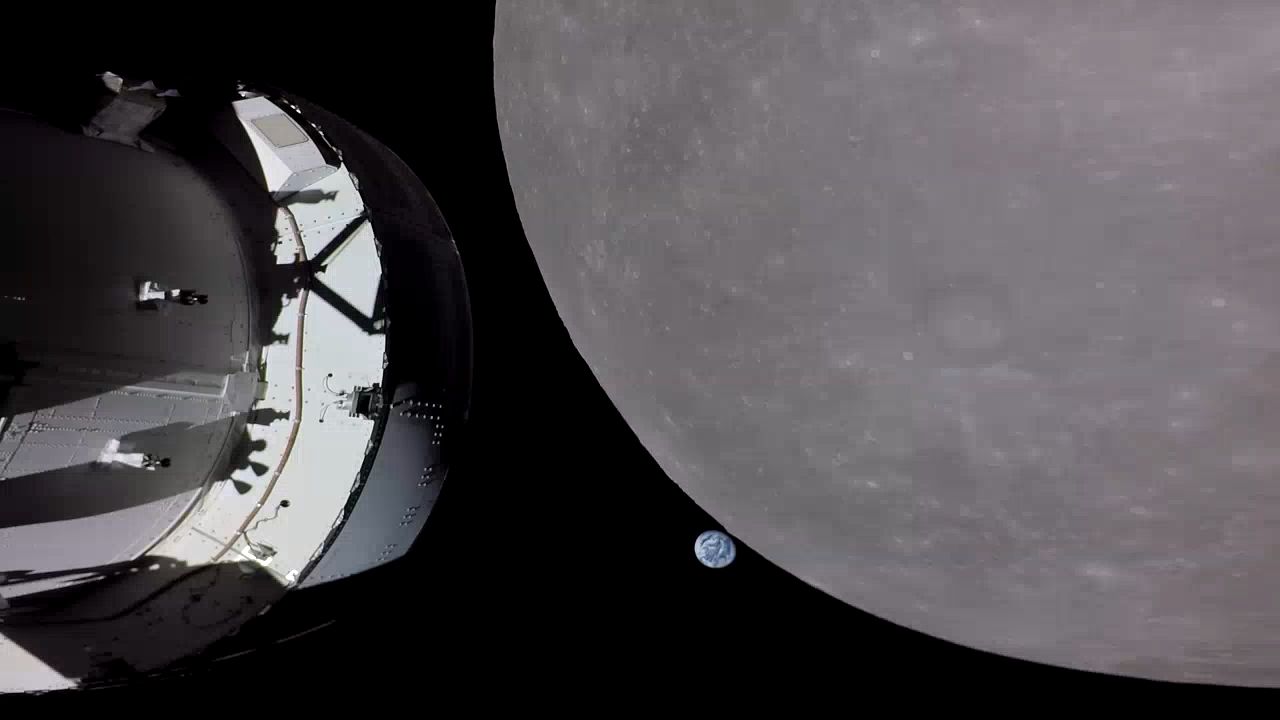
Earthset from Artemis I’s Orion spacecraft, as it moves around to the far side of the Moon. Click on the image to enlarge it. Credit: NASA

