Archive
Ephemeris: 03/20/2026 – Spring begins today!
This is Ephemeris for Friday, March 20th. Today the Sun will be up for 12 hours and 9 minutes, setting at 7:55, and it will rise tomorrow at 7:43. The Moon, 2 days past new, will set at 10:21 this evening.
At 10:46 AM today the season of spring will begin. It may or may not feel it in our neck of the woods, but astronomically at that time the Sun will appear to cross a point in the sky called the vernal equinox. Equinox means equal night, when the Sun is up for 12 hours, and set for 12 hours. It does, if you don’t look too closely, and in the old days clocks weren’t that accurate anyway. The vernal equinox is the point in the sky where the Sun crosses the celestial equator, which is above the Earth’s equator heading north. The North Pole will begin 6 months of daylight, while the rest of the Northern Hemisphere will bask in more than 12 hours of sunlight a day. The reverse is true in the Southern Hemisphere where autumn will start.
The astronomical event times given in this blog are for the Traverse City/Interlochen area of Michigan (Lat 44.7° N, Long 85.7° W; EST, UT – 5 hours) unless stated otherwise. Times will be different for other locations.
Addendum
Ephemeris: 09/25/2025 – Today is Equilux day
This is Ephemeris for Thursday, September 25th. Today the Sun will be up for 12 hours to the minute, setting at 7:33, and it will rise tomorrow at 7:35. The Moon, halfway from new to first quarter, will set at 8:50 this evening.
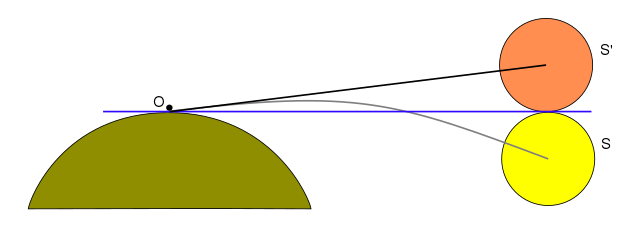
Today is Equilux day it’s the day we have exactly 12 hours of sunshine, and 12 hours of night. But isn’t that what we had three days ago on the equinox? That’s what equinox means. But, it only works on the equinox if the Earth didn’t have an atmosphere, and we decided that sunrise and sunset was when the middle of the sun crosses the horizon. The actual definition of sunrise and sunset is when the top of the Sun hits the horizon. So it rises a little earlier and so it’s a little bit later than it does geometrically. Also, the Earth has an atmosphere which causes the Sun to be higher in the sky when it’s closer to the horizon, which prolongs daylight. Check the weather app on your smartphone for your own personal sunrise and sunset times.
The astronomical event times given in this blog are for the Traverse City/Interlochen area of Michigan (Lat 44.7° N, Long 85.7° W; EDT, UT – 4 hours) unless stated otherwise. Times will be different for other locations.
Addendum
Ephemeris: 09/22/2025 – Autumn befalls us today
This is Bob Moler with Ephemeris for Monday, September 22nd. Today the Sun will be up for 12 hours and 9 minutes, setting at 7:39, and it will rise tomorrow at 7:31. The Moon, 1 day past new, will set at 7:50 this evening.
This is it! Summer will end at 2:20 this afternoon, when the center of the Sun will cross the celestial equator, an imaginary line above the Earth’s equator, heading southward. At that instant, autumn will begin. Shortly after, the Sun will be up less than half the day. The day and the point in the sky that the Sun crosses is called the autumnal equinox. The word equinox means equal night, implying that day and night are of equal length. Geometrically that’s true, but the Earth’s atmosphere and the definition of sunrise and sunset, prolong daylight by a few minutes. The amount of heat we are getting and will get from the Sun cannot sustain our current temperatures, and it will get a lot colder on average before it gets warmer again.
The astronomical event times given in this blog are for the Traverse City/Interlochen area of Michigan (Lat 44.7° N, Long 85.7° W; EDT, UT – 4 hours) unless stated otherwise. Times will be different for other locations.
Addendum
Ephemeris: 09/20/2024 – Fall will fall upon us Sunday
This is Ephemeris for Friday, September 20th. Today the Sun will be up for 12 hours and 14 minutes, setting at 7:42, and it will rise tomorrow at 7:29. The Moon, 3 days past full, will rise at 8:55 this evening.
The season of fall is about to, well, fall upon us and in a few weeks so will the leaves. At 8:44 Sunday morning (12:44 UT Sunday) the Sun will cross the celestial equator heading southward. The celestial equator is an imaginary line in the sky above the earth’s equator. At that point, the Sun will theoretically set at the North Pole and rise at the South Pole. The day is called the autumnal equinox and the daylight hours of Sunday will be 12 hours and 8 minutes instead of 12 hours exactly. That’s due to our atmosphere and our definition of sunrise and sunset. The reason for the cooler weather we are heading into is that the length of daylight is shortening, and the Sun rides lower in the sky, spreading its heat over a larger area, thus diluting its intensity.
The astronomical event times given are for the Traverse City/Interlochen area of Michigan (EDT, UT – 4 hours). Times will be different for other locations.
Addendum
Ephemeris: 12/15/2023 – Jupiter is seen in Aries this year, also precession
This is Bob Moler with Ephemeris for Friday, December 15th. Today the Sun will be up for 8 hours and 49 minutes, setting at 5:02, and it will rise tomorrow at 8:13. The Moon, 3 days past new, will set at 7:50 this evening.
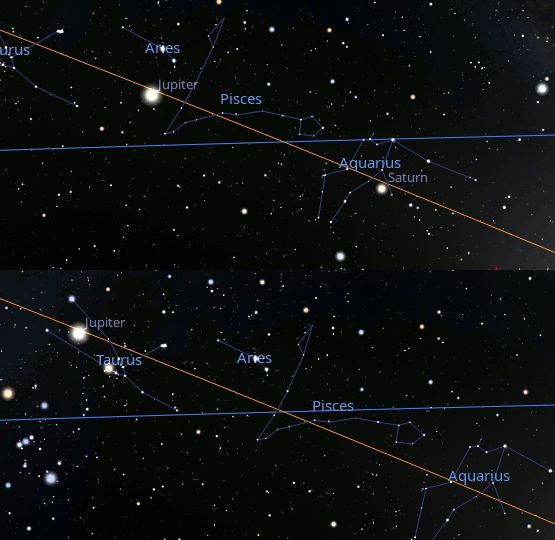
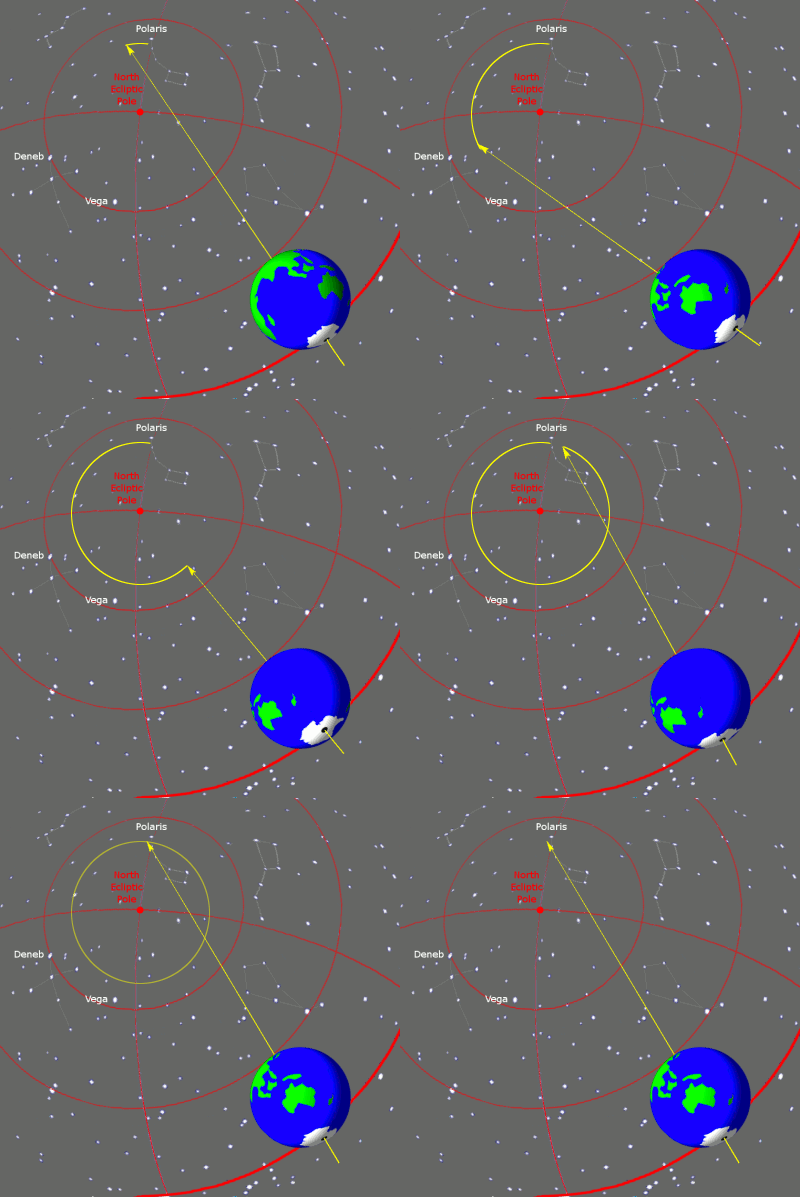
The planet Jupiter is seen against the stars of the constellation Aries the ram this year. The four stars of the constellation are seen above it, two of which are bright enough to be fairly easily seen. The other two are quite dim. The brightest is the star called Hamal. It is as bright as one of the stars of the Big Dipper. Aries used to be the constellation at the beginning of the Zodiac, where the Sun entered on the first day of spring. That honor has now moved westward to the western part of Pisces, the fish. The reason it has changed in the 1900 years since Ptolemy set up the Zodiac in the second century is that the Earth’s axis wobbles and the astrological signs of the Zodiac move with the seasons rather than the stars.
The astronomical event times given are for the Traverse City/Interlochen area of Michigan (EST, UT –5 hours). They may be different for your location.
Addendum
Ephemeris: 09/28/2023 – Tomorrow night’s full moon is the Harvest Moon
This is Ephemeris for Thursday, September 28th. Today the Sun will be up for 11 hours and 52 minutes, setting at 7:29, and it will rise tomorrow at 7:38. The Moon, 1 day before full, will set at 7:43 tomorrow morning.
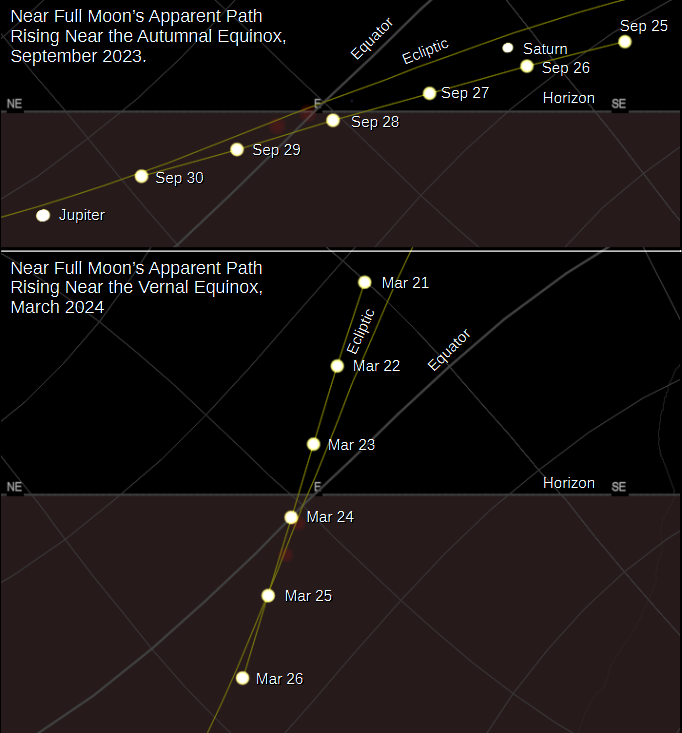
Tomorrow night’s full moon is the Harvest Moon. It is the most famous of the named full moons, and was very useful in the days before electric lights. The reason is that the Moon, around the time it is full, doesn’t advance its rising time very much from night to night, effectively adding its light to twilight to allow more time to gather in crops. This is because the Moon is moving north as well as eastward. The farther north it is, the longer it stays up and retards the advance in rise times. On average, the Moon rises 50 minutes later each night. This week, the interval is down near 22 minutes advance in moonrise times per day, extending twilight and the amount of time each day to harvest the crops for a few more days.
The astronomical event times given are for the Traverse City/Interlochen area of Michigan (EDT, UT –4 hours). They may be different for your location.
Addendum
My interest in the Harvest Moon is not in harvesting the crops. I just have a little garden, so it doesn’t take that long to pick tomatoes or whatever. But as an amateur astronomer I’m more interested in deep sky objects than I am in planets. Deep sky objects or DSOs are objects beyond the solar system and are usually very dim, which requires dark skies to view them. Near the Harvest Moon and even in August near the full moon it takes nearly a week for that @#$%^&* Moon to get the heck out of the evening sky, so I don’t have to stay up till after midnight to see anything. That’s I why have this interest in the Harvest Moon. Know your enemy!
Ephemeris: 09/25/2023 – Now that autumn has set in, what does that mean?
This is Bob Moler with Ephemeris for Monday, September 25th. Today the Sun will be up for 12 hours and 1 minute, setting at 7:34, and it will rise tomorrow at 7:34. The Moon, 3 days past first quarter, will set at 3:34 tomorrow morning.
Now that autumn has set in, what does that mean? The latitude on the Earth where the Sun passes overhead is now south of the equator, and will stay south of the equator until March 19th, our time, next year. The North Pole of the Earth is experiencing a prolonged sunset, starting six months of night, while the South Pole is enjoying an equally long sunrise, for their six months of daylight. The Earth’s seasons are not caused by our distance from the Sun. We’re closer to the Sun now than we were in early July, and will continue to move closer to the Sun until early January. The Earth’s average distance of 93 million miles only varies by a million and a half miles either way. It’s the Earth’s axial tilt that causes the seasons.
The astronomical event times given are for the Traverse City/Interlochen area of Michigan (EDT, UT –4 hours). They may be different for your location.
Addendum
09/22/2022 – Ephemeris – Autumn will begin this evening
This is Ephemeris for Thursday, September 22nd. Today the Sun will be up for 12 hours and 10 minutes, setting at 7:40, and it will rise tomorrow at 7:31. The Moon, 3 days before new, will rise at 4:46 tomorrow morning.
The season of fall is about to, ah well, fall upon us and in a few weeks so will the leaves. At 9:04 this evening (1:04 UT tomorrow) the Sun will cross the celestial equator heading south. The celestial equator is an imaginary line in the sky above the earth’s equator. At that point, the Sun will theoretically set at the North Pole and rise at the South Pole. The day is called the autumnal equinox and the daylight hours today is 12 hours and 10 minutes instead of 12 hours exactly. That’s due to our atmosphere and our definition of sunrise and sunset. The reason for the cooler weather now and the cold weather this winter is that the length of daylight is shortening, and the Sun rides lower in the sky, spreading its heat over a larger area, thus diluting its intensity.
The astronomical event times given are for the Traverse City/Interlochen area of Michigan (EDT, UT – 4 hours). They may be different for your location.
Addendum
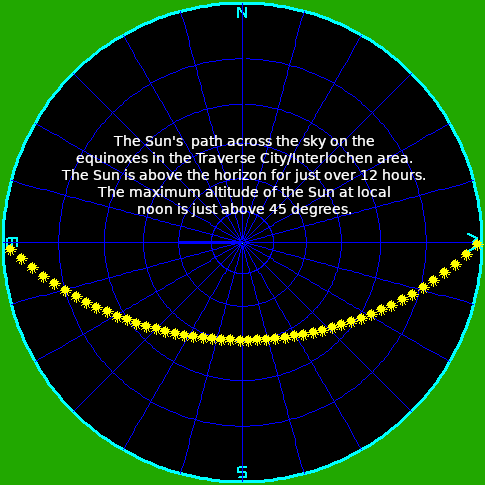
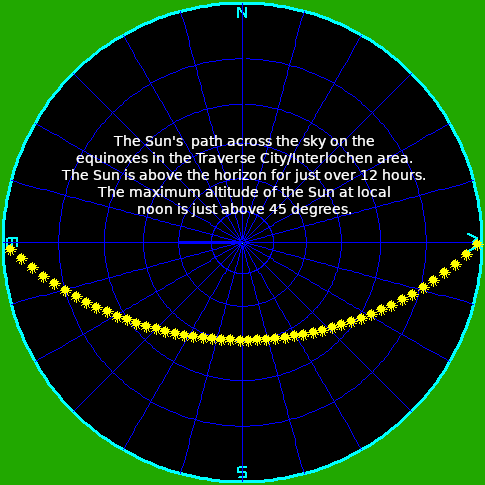
The Sun’s path through the sky on an equinox day from the Traverse City/Interlochen area in Michigan. The Sun is plotted every 15 minutes. This is a stereographic projection which compresses the image near the zenith and enlarges the image towards the horizon. Note that the Sun rises due east and sets due west. Created using my LookingUp program.
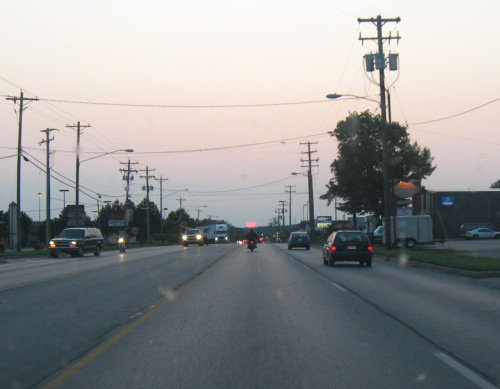
That is not a pumpkin on the head of the motorcyclist. That’s the Sun rising as I’m traveling east on South Airport Road south of Traverse City, MI on the autumnal equinox. This is the east-west section of the road. The Sun is rising over the hills some 6 miles to the east. When the Sun is on the celestial equator, it rises due east and sets due west. Credit: Bob Moler.
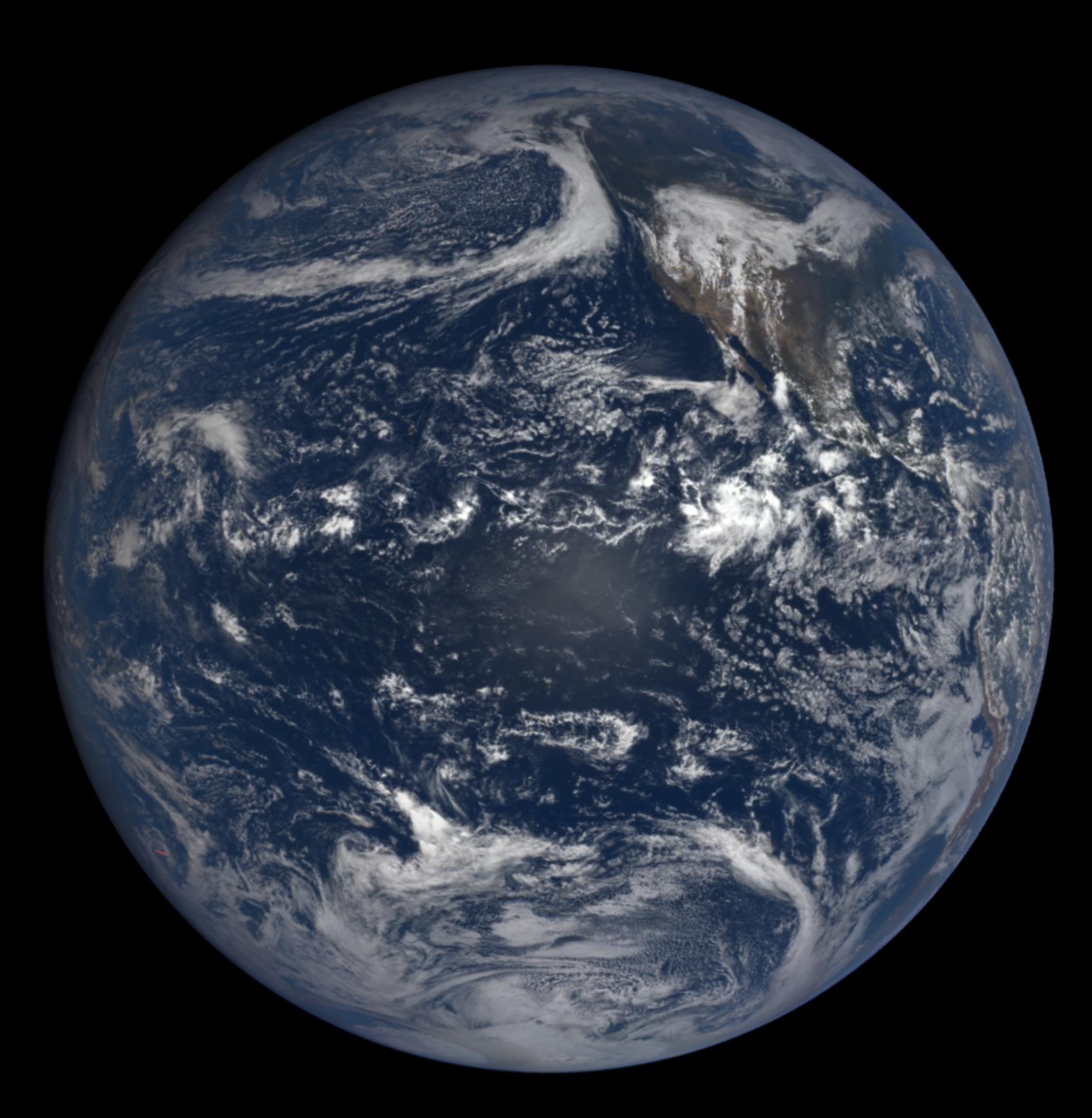
Image from the Earth Polychromatic Imaging Camera (EPIC) on NOAA’s DSCOVR satellite in halo orbit around the Earth-Sun L-1 point 1 million miles sunward from the Earth on the autumnal equinox of 2016. North America is in the upper right of the globe.
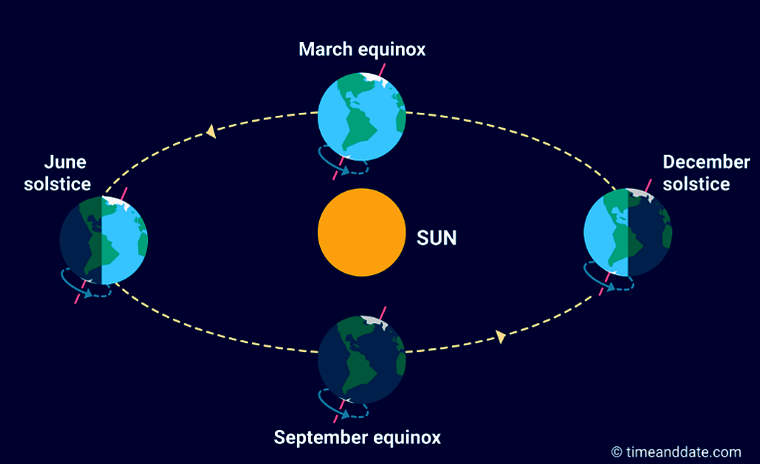
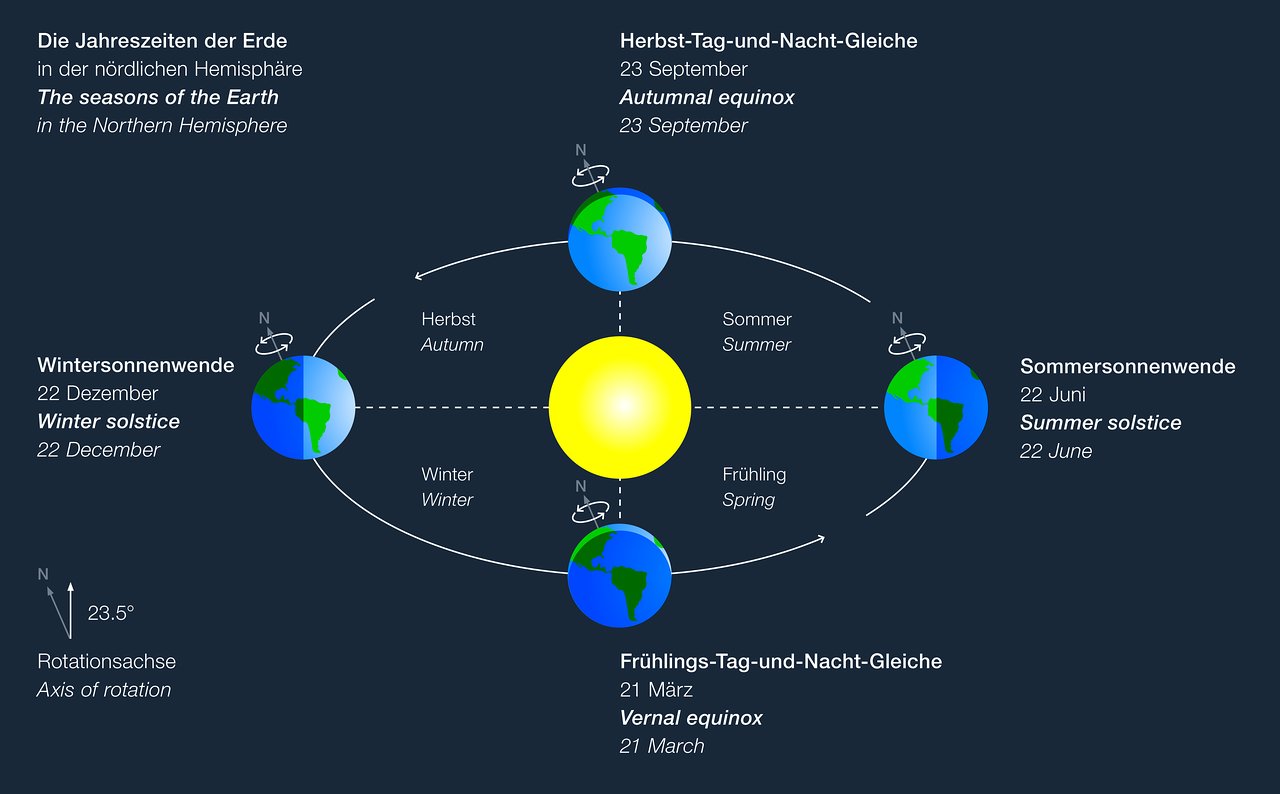
Earth’s position at the solstices and equinoxes. This is an not to scale oblique look at the Earth’s orbit, which is nearly circular. The Earth is actually farthest from the Sun on July 4th. Click on the image to enlarge. Credit: ESO (European Southern Observatory), which explains the captions in German and English.
03/18/2022 – Ephemeris – Spring is two days away!
This is Ephemeris for Friday, March 18th. Today the Sun will be up for 12 hours and 3 minutes, setting at 7:52, and it will rise tomorrow at 7:47. The Moon, at full today, will rise at 8:28 this evening.
Sunday morning March 20th, at 11:33 am the Sun will cross overhead at the earth’s equator as it appears to head north, starting for us, the season of spring. It will be the vernal equinox. As you can tell from my intro, we’re already above 12 hours of daylight, and we’ll add another 3 plus hours of daylight before summer begins in three months. We are already adding about 3 minutes a day of daylight to that goal now, the maximum rate. With the Sun out longer and its ascension higher in the sky each day, it is rapidly adding energy to the Northern Hemisphere. We won’t feel that immediately. While the land rapidly absorbs heat, the oceans and lakes, especially the Great Lakes, are big heat sinks, taking much longer to warm up.
The astronomical event times given are for the Traverse City/Interlochen area of Michigan (EDT, UT – 4 hours). They may be different for your location.
Addendum
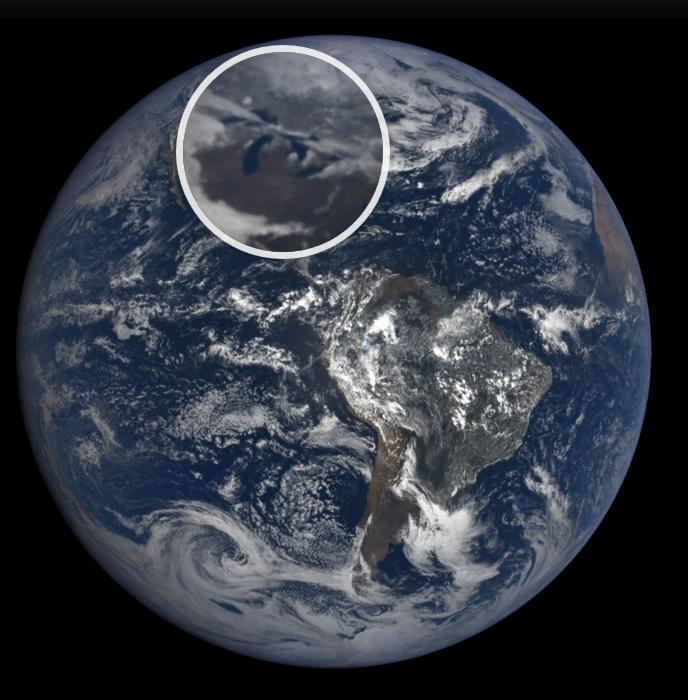
The Earth from 2 days before the vernal equinox 2018, with the North Pole not quite in sunlight. I’ve added a magnifying spot showing Michigan. It was a rare clear day when this image was taken. Credit NOAA/DSCOVR satellite/EPIC camera. The DSCOVR satellite is located in a halo orbit around the Sun-Earth Lagrange L1 point nearly a million miles sunward of the Earth.
Earth’s position at the solstices and equinoxes. This is a not to scale oblique look at the Earth’s orbit, which is nearly circular. The Earth is actually farthest from the Sun on July 4th. The dates for the equinoxes and solstices are shown one day later than it is actually. Click on the image to enlarge. Credit: ESO (European Southern Observatory), which explains the captions in German and English.
The Sun’s path through the sky on an equinox day from the Traverse City/Interlochen area in Michigan. The Sun is plotted every 15 minutes. This is a stereographic projection which compresses the image near the zenith and enlarges the image towards the horizon. Created using my LookingUp program.
03/17/2022 – Ephemeris – We have 12 hours of daylight and night today, three days early
This is Ephemeris for St. Patrick’s Day, Thursday, March 17th. Today the Sun will be up for 12 hours even, setting at 7:51, and it will rise tomorrow at 7:49. The Moon, 1 day before full, will set at 8:20 tomorrow morning.
Why is this the day of equal day and night, when the vernal equinox, which means “equal night” is still three days away? The difference is due to our atmosphere and our definition of sunrise and sunset. Our atmosphere makes objects near the horizon appear higher than they actually are, which hastens sunrise and retards sunset. Also, the instant of sunrise and sunset is when the top of the sun appears to touch the horizon, rather than when the Sun bisects the horizon. Plus, it’s moving about a degree a day (twice its diameter) against the stars. So by the time of the equinox, on Sunday the 20th, the time between sunrise and sunset will have progressed to 12 hours and 9 minutes. But it was close enough for the ancients who coined the term.
The astronomical event times given are for the Traverse City/Interlochen area of Michigan (EDT, UT – 4 hours). They may be different for your location.
Addendum
This works for the Interlochen area. It may be a different by a day for other locations, but for the northern latitudes, it will be before the true equinox day, March 20th here.
How the atmosphere bends the light of the Sun or Moon rising or setting to appear higher than it actually is. S is the actual position of the Sun, S’ is the apparent position of the Sun. The blue line is the observer O’s horizon. The gray line is the actual, though much exaggerated, light path bent or refracted by the Earth’s atmosphere. The black line is the apparent sight line to the Sun. Credit Francisco Javier Blanco González, 2017
 Bob Moler's Ephemeris Blog