Archive
03/20/2017 – Ephemeris – Spring starts today!
Ephemeris for Monday, March 20th. The Sun will rise at 7:45. It’ll be up for 12 hours and 10 minutes, setting at 7:55. The Moon, at last quarter today, will rise at 3:39 tomorrow morning.
This morning, at 6:29 (10:29 UT) the sun crosses overhead at the earth’s equator as it appears to head north, starting for us the season of spring. It’s the vernal equinox. As you can tell from my intro, we’re already above 12 hours of daylight, and we’ll add another 3 plus hours of daylight before summer begins in three months. We are already adding about 3 minutes a day of daylight to that goal now, the maximum rate. With the Sun out longer and its ascension higher in the sky each day, it is rapidly adding energy to the northern hemisphere. We don’t feel that immediately. While the land rapidly absorbs heat, the oceans and lakes, especially the Great Lakes are a big heat sink, taking a very long time to warm up.
Times are for the Traverse City/Interlochen area of Michigan. They may be different for your location.
Addendum
This March equinox also is the beginning of autumn for folks south of the equator.
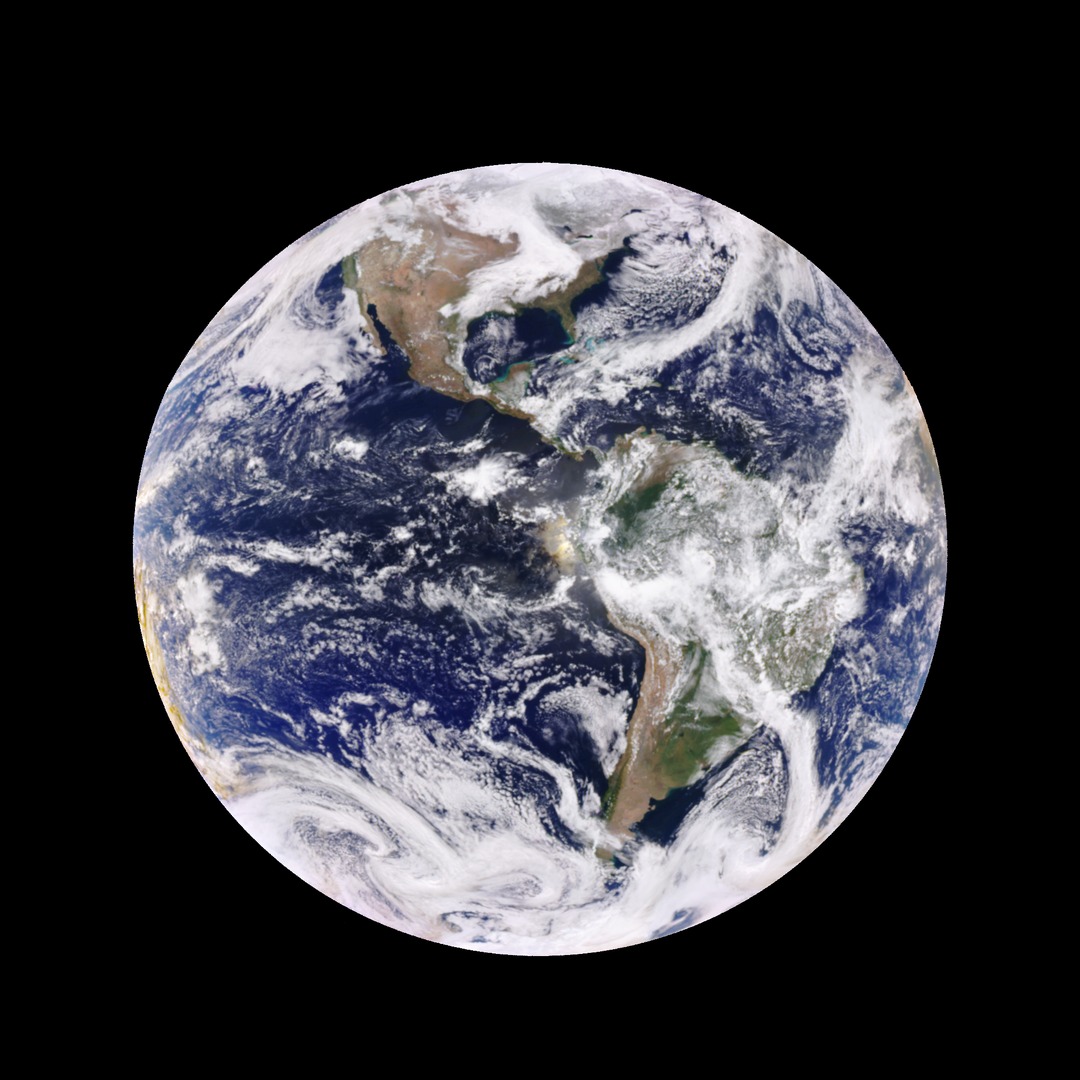
Image from the DISCOVR satellite in halo orbit at the Earth-Sun L1 point, nearly a million miles (1.6 million km) sunward of the Earth. as of March 17, 2017. As usual Michigan is covered by a cloud. Credit NOAA/NASA.
11/24/2016 – Ephemeris – The little constellation that used to start the seasonal year
Ephemeris for Thanksgiving Day, Thursday, November 24th. The Sun will rise at 7:52. It’ll be up for 9 hours and 14 minutes, setting at 5:06. The Moon, 3 days past last quarter, will rise at 3:54 tomorrow morning.
From antiquity, the first constellation of the Zodiac has been Aries the ram. That’s the constellation the Sun entered on the first day of spring, or the vernal equinox. Well that was a couple of thousand years ago. Currently the vernal equinox point is in western Pisces. This is due to the wobbling of the Earth’s axis called precession. The spinning Earth like and top or gyroscope wobbles when force is applied to it. In this case the Sun and Moon. One wobble takes 26,000 years to complete. Anyway, Aries is a small constellation of four stars in a bent line, below the triangular constellation of Triangulum, which is itself below Andromeda. It’s a bit west or right of the Pleiades or Seven Sisters star cluster.
Times are for the Traverse City/Interlochen area of Michigan. They may be different for your location.
Addendum
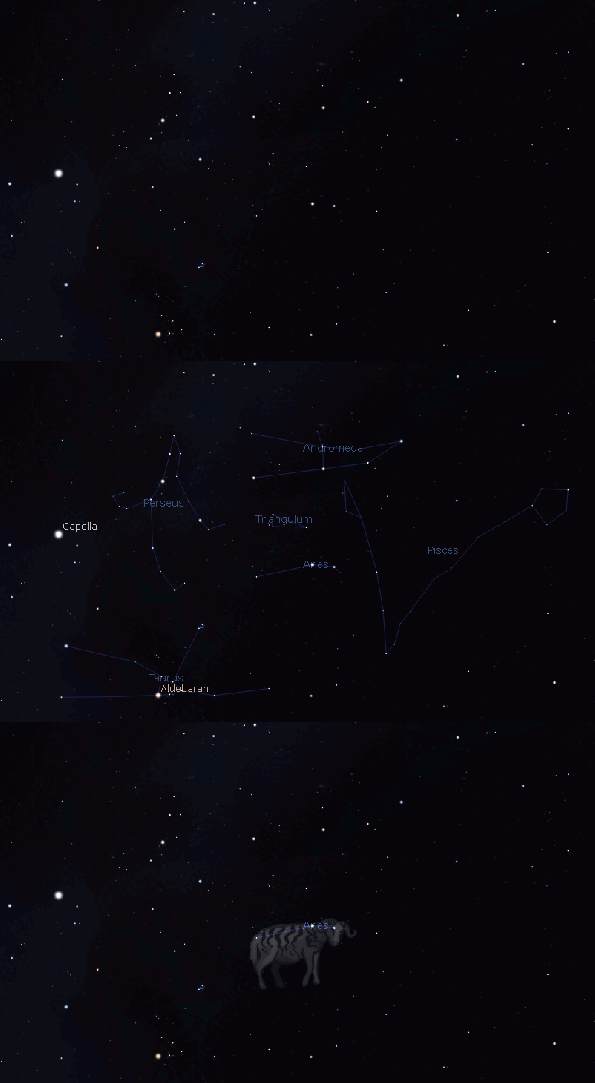
Aries the ram animated finder chart for 9 p.m. November 24, 2016. Created using Stellarium and GIMP.
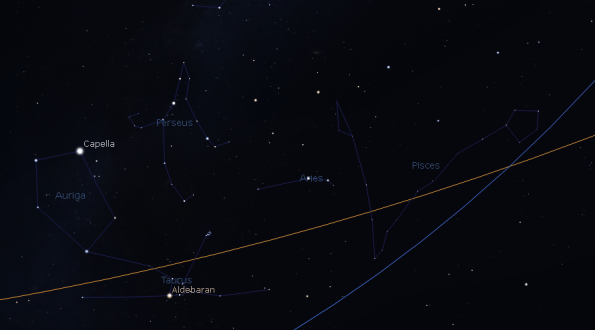
The vernal equinox today, where the blue line, the celestial equator and the orange line, the ecliptic or path of the Sun cross. The Sun is where these lines cross on the first day of spring (March 20th around here). Note that the vernal equinox is now in western Pisces. Created using Stellarium.
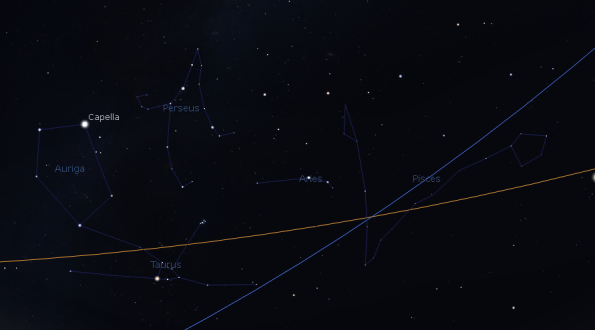
The vernal equinox back in AD 100, where the blue line, the celestial equator and the orange line, the ecliptic or path of the Sun cross. The Sun is where these lines cross on the first day of spring. Note that the vernal equinox was at the east edge of Pisces. Created using Stellarium.
09/22/2016 – Ephemeris – Autumn will begin this morning
Ephemeris for Thursday, September 22nd. The Sun will rise at 7:30. It’ll be up for 12 hours and 8 minutes, setting at 7:39. The Moon, 1 day before last quarter, will rise at 12:06 tomorrow morning.
Fall is about to a, well… fall upon us and in a few weeks so will the leaves. At 10:21 (14:21 UT) this morning the Sun will cross the celestial equator heading south. The celestial equator is an imaginary line in the sky above the earth’s equator. At that point the sun will theoretically set at the north pole and rise at the south pole. The day is called the autumnal equinox and the daylight hours today is 12 hours and 8 minutes instead of 12 hours exactly. That’s due to our atmosphere and our definition of sunrise and sunset. The reason for the cooler weather now and the cold weather this winter is that the length of daylight is shortening, and the Sun rides lower in the sky, spreading its heat over a larger area, thus diluting its intensity.
Times are for the Traverse City/Interlochen area of Michigan. They may be different for your location.
Addendum
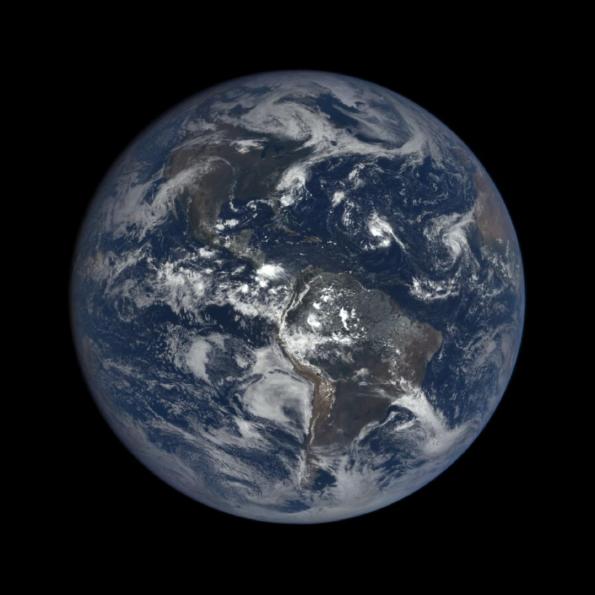
The Earth as seen a couple of days ago from NOAA,s DSCOVR satellite located near the Sun-Earth L-1 point 1 million miles sunward from the Earth. Credit NOAA/NASA.
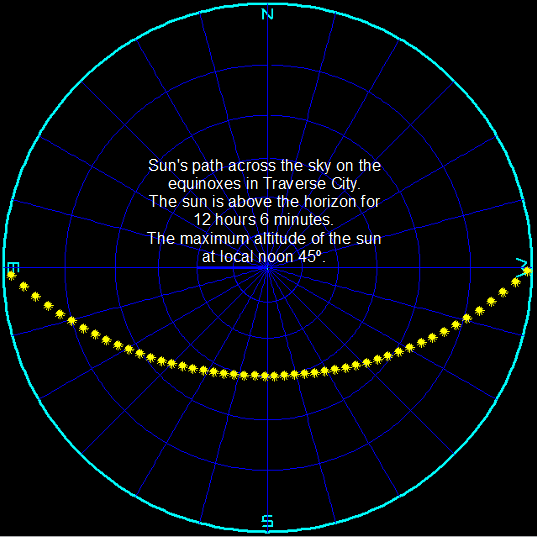
The Sun’s path through the sky on the equinox day from Traverse City, MI. Created using my LookingUp program.
09/16/2016 – Ephemeris – The Harvest Moon is slightly eclipsed for everyone but the Americas
Ephemeris for Friday, September 16th. The Sun will rise at 7:23. It’ll be up for 12 hours and 27 minutes, setting at 7:50. The Moon, at full today, will rise at 7:59 this evening.
Tonight’s full Moon is the Harvest Moon, the nearest full Moon to the autumnal equinox. For the next few nights the Moon will rise later each night by much less than the average 50 minutes later each night effectively lengthening twilight for those gathering in crops. Also this afternoon there will be a penumbral lunar eclipse visible, well not here in Michigan… because the Moon won’t be up. Actually just about the whole world except North America and most of South America will be able to see the eclipse. A penumbral eclipse is what I call a 5 o’clock shadow eclipse. You wouldn’t know it unless someone pointed it out to you, when the Moon dips into the Earth’s outer shadow and the sunlight falling part of it is diminished by a little bit.
Times are for the Traverse City/Interlochen area of Michigan. They may be different for your location.
Addendum

The not so full Moon of Monday night and its reflection on the waters of Suttons Bay after the schooner Inland Seas docked after an evening sail. Credit: the author.
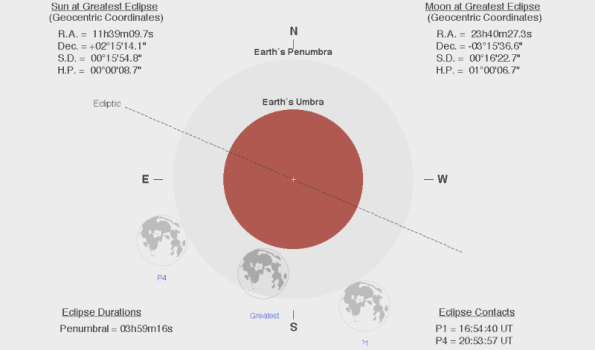
The penumbral eclipse of the Moon centered on 2:25 p.m. Eastern time, 18:54 UT, for an hour and a half before and after. Only near the middle of the eclipse will anything be visible of the effect. I find that wearing sunglasses reduces the brightness of the moon and enhances the penumbral shadow. Credit: NASA/GSFC/ Fred Espenak.
For the full-page pdf of the above click here: http://eclipse.gsfc.nasa.gov/LEplot/LEplot2001/LE2016Sep16N.pdf
09/13/2016 – Ephemeris
Ephemeris for Tuesday, September 13th. The Sun will rise at 7:19. It’ll be up for 12 hours and 36 minutes, setting at 7:56. The Moon, 3 days before full, will set at 4:40 tomorrow morning.
Last Thursday evening an Atlas V rocket lifted off with NASA’s only interplanetary mission this year. The spacecraft called by one of NASA’s tortured acronyms OSIRIS-Rex is on its way to the asteroid Bennu, which was discovered in 1999, and named by a 3rd grader in a contest. Bennu is an Egyptian deity resembling a heron and also resembling the spacecraft. OSIRIS-Rex will take two years to reach the small asteroid, orbit it for two years mapping it in great detail and will approach to retrieve a sample. It will take 3 years to return the sample to the Earth in 2023. Bennu is interesting because it contains organic compounds from the origin of the solar system and because of the tiny chance it could hit the Earth in 200 years or so.
Times are for the Traverse City/Interlochen area of Michigan. They may be different for your location.
Addendum
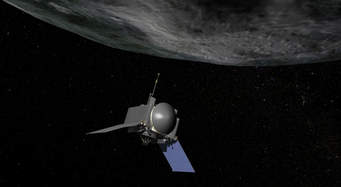
The OSIRIS-REx spacecraft with its sampler boom extended.
09/22/2015 – Ephemeris – Equinox tomorrow and September 27th Moon’s triple whammy
Ephemeris for Tuesday, September 22nd. The Sun will rise at 7:29. It’ll be up for 12 hours and 11 minutes, setting at 7:40. The Moon, 1 day past first quarter, will set at 2:02 tomorrow morning.
Tomorrow at 4:20 a.m. before most of us wake up summer will officially end and Autumn will start. That’s the exact time of the autumnal equinox. We are noticing that the days or rather daylight hours are getting noticeably shorter day by day. Autumn will end when the days will stop getting shorter on the first day of winter, December 21st. The full moon this Sunday is triply important. Most important is that a total lunar eclipse will happen. Second, it is the Harvest Moon, the nearest full moon to the autumnal equinox, more on that next week. Also it is the closest the Moon gets to the Earth all year. Yup it’s a so-called supermoon. If the Moon were a 2 inch ball it would be 20 feet from an 8 inch Earth. The supermoon is a foot closer.
Times are for the Traverse City/Interlochen area of Michigan. They may be different for your location.
Addendum
That last bit about the Moon being a two-inch ball will come in handy if you come to the Girl Scout Badge Bash at ECCO in Traverse City Thursday night.
08/31/2015 – Ephemeris – Previewing the skies of September – Part 1
Ephemeris for Monday, August 31st. The Sun will rise at 7:03. It’ll be up for 13 hours and 18 minutes, setting at 8:21. The Moon, 2 days past full, will rise at 9:31 this evening.
Let’s look forward to the skies of September. The sun will moving at its greatest speed in its retreat to the south. Daylight hours in the Interlochen/Traverse City area and will drop from 13 hours and 15 minutes tomorrow the 1st. to 11 hours 46 minutes on the 30th. The altitude of the sun above the southern horizon at local noon will be 54 degrees tomorrow, and will descend to 42 degrees on the 30th. The Straits area will see the sun a degree lower. The season of summer is getting short, so enjoy it while you can. Summer ends and autumn begins at 4:20 a.m. on September 23rd. Saturn is setting before midnight now, but Venus and Mars are appearing in the morning sky soon. Tomorrow we’ll look at September’s lunar eclipse.
Times are for the Traverse City/Interlochen area of Michigan. They may be different for your location
Addendum
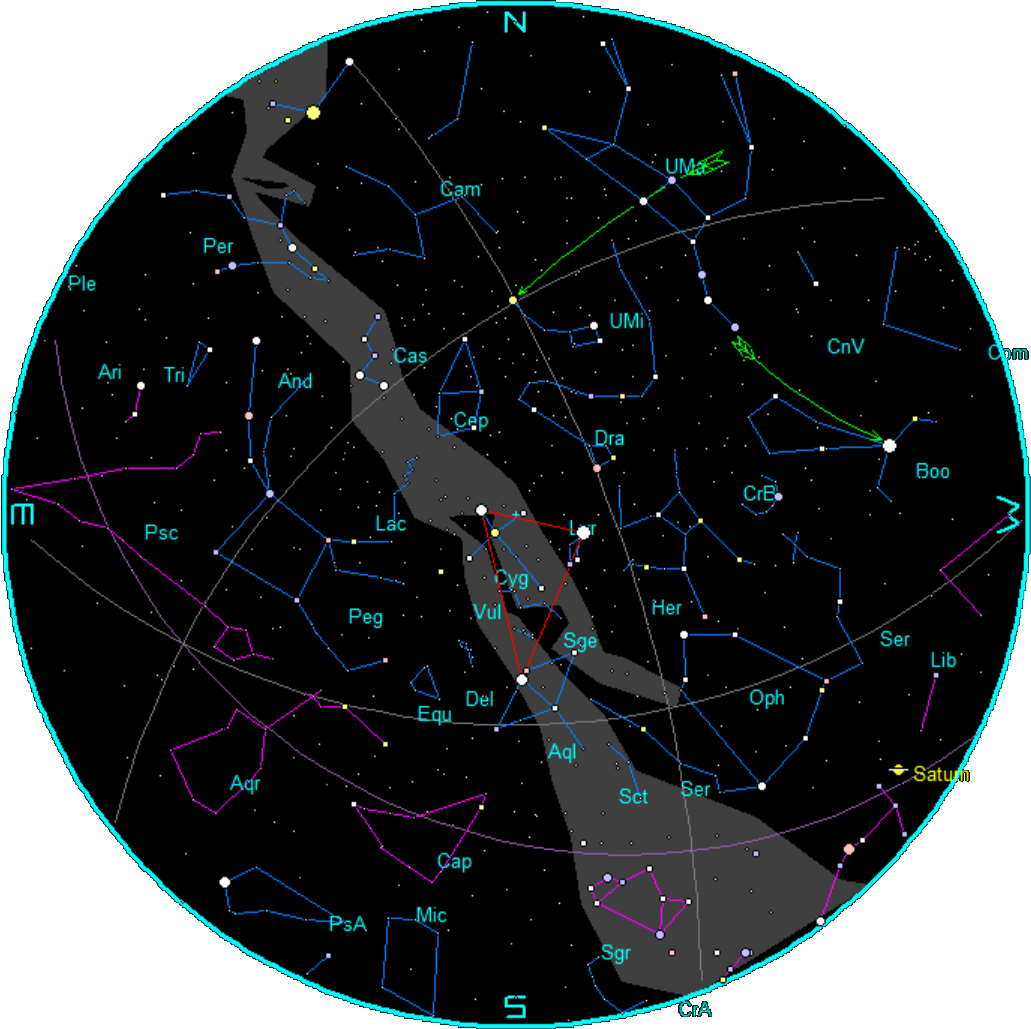
Star Chart for September 2015. Created using my LookingUp program.
The planets and stars are plotted for the 15th at 10 p.m. EDT. That is chart time. Note, Traverse City is located 1 hour 45 minutes behind our time meridian. To duplicate the star positions on a planisphere you may have to set it to 1 hour 45 minutes earlier than the current time.
Evening astronomical twilight ends at 10:04 p.m. EDT on August 1st, decreasing to 9:02 p.m. EDT on the 30th..
Morning astronomical twilight starts at 5:19 a.m. EDT on August 1st, and increasing to 6:01 a.m. EDT on the 30th.
Add a half hour to the chart time every week before the 15th and subtract and hour for every week after the 15th.
For a list of constellation names to go with the abbreviations click here.
The green pointer from the Big Dipper is:
- Pointer stars at the front of the bowl of the Big Dipper point to Polaris the North Star.
- Follow the arc of the Big Dipper’s handle to Arcturus.
- The Summer Triangle is shown in red.
Calendar of Planetary Events
Credit: Sky Events Calendar by Fred Espenak and Sumit Dutta (NASA’s GSFC)
To generate your own calendar go to http://eclipse.gsfc.nasa.gov/SKYCAL/SKYCAL.html
Times are Eastern Daylight Time on a 24 hour clock. Some additions made to aid clarity.
Conjunctions like the Mars-Regulus: 0.8° N means Regulus will appear 0.8° north of Mars.
| Sep | 01 | Tu | Venus: 25° W | |
| 04 | Fr | 05:59 | Mercury Elongation: 27.1° E | |
| 05 | Sa | 01:09 | Moon-Aldebaran: 0.6° S Occultation?* | |
| 05 | Sa | 05:54 | Last Quarter | |
| 06 | Su | 13:06 | Moon North Dec.: 18.2° N | |
| 10 | Th | 01:53 | Moon-Venus: 2.9° S | |
| 13 | Su | 02:41 | New Moon | |
| 13 | Su | 02:55 | Partial Solar Eclipse (Southern tip of Africa to Antarctica) | |
| 14 | Mo | 00:38 | Moon Ascending Node | |
| 14 | Mo | 07:28 | Moon Apogee: 406500 km | |
| 18 | Fr | 22:54 | Moon-Saturn: 3.1° S | |
| 21 | Mo | 04:59 | First Quarter | |
| 21 | Mo | 08:02 | Moon South Dec.: 18.1° S | |
| 23 | We | 04:20 | Autumnal Equinox | |
| 24 | Th | 15:38 | Mars-Regulus: 0.8° N | |
| 27 | Su | 17:04 | Moon Descending Node | |
| 27 | Su | 21:46 | Moon Perigee: 356900 km – Super moon | |
| 27 | Su | 22:48 | Total Lunar Eclipse | |
| 27 | Su | 22:50 | Full Moon – Harvest Moon | |
| 30 | We | 10:36 | Mercury Inferior Conjunction with the Sun | |
| Oct | 01 | Th | Venus: 43.6° W |
* For the Grand Traverse Region the Moon will rise at 12:10 a.m. occulting Aldebaran. Aldebaran will appear at the Moon’s unilluminated top right edge at approximately 12:40 a.m.
Note: All lunar conjunctions in the table above are geocentric. Double check with a program like Stellarium to check on the position of the body with respect to the moon for your location.
09/22/2014 – Epmemeris – Autumn begins tonight
Ephemeris for Monday, September 22nd. The sun will rise at 7:29. It’ll be up for 12 hours and 10 minutes, setting at 7:39. The moon, 2 days before new, will rise at 6:54 tomorrow morning.
Welcome to the last, almost full, day of summer. The Sun will reach the autumnal equinox point in the sky at 10:30 this evening. At that moment the Sun will cross the celestial equator, a projection of the Earth’s equator, heading southward. All locations on the earth except two will experience 12 hours of daylight and 12 hours of night. Well they would if the Earth didn’t have an atmosphere and sunset and sunrise were defined differently. The two locations that don’t experience equal night, which is what equinox means, are the north pole where the sun will be setting and the south pole where the sun will be rising. For us in the northern hemisphere daylight hours will be shorter and the Sun will peak lower in the south each day until the December solstice.
Times are for the Traverse City/Interlochen area of Michigan. They may be different for your location.
Addendum
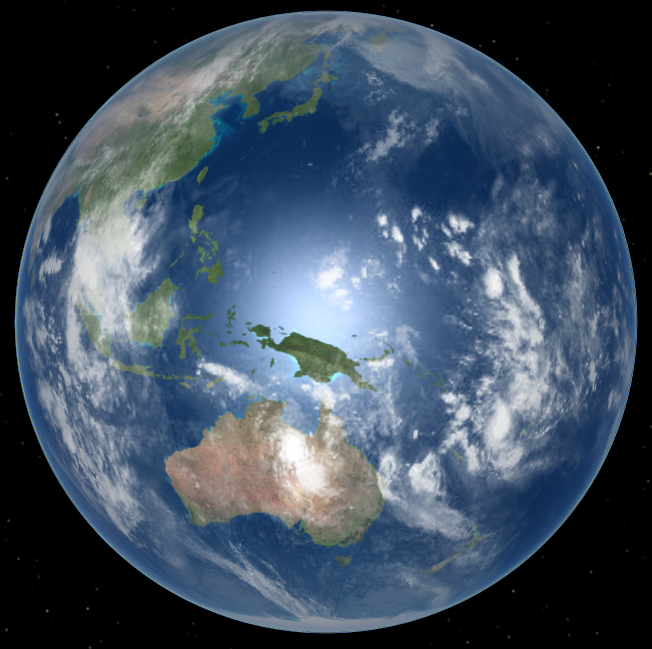
The Earth as seen from the direction of the Sun as it crosses over the Earth’s equator heading south. Created using Celestia.
03/20/2014 – Ephemeris – Spring is a few hours away
Ephemeris for Thursday, March 20th. The sun will rise at 7:45. It’ll be up for 12 hours and 9 minutes, setting at 7:54. The moon, 3 days before last quarter, will rise at 12:24 tomorrow morning.
Just hang on for a few more hours and winter will be over. At 12:57 p.m. this afternoon (16:57 UT, March 20, 2014) the sun will appear to cross the earth’s celestial equator heading northward signaling the start of spring in the northern hemisphere. Unfortunately our weather won’t change that instantaneously. The word equinox means equal night, meaning at day and night are of equal length. However due to how astronomers actually define the instant of sunrise and sunset we are already above 12 hours daylight, and increasing by 3 minutes a day. The southern hemisphere of the earth will see the start of autumn as we see spring. The sun will rise due east today and set due west, which may mean hazardous visibility on east west roads with the low sun for a few days.
Times are for the Traverse City/Interlochen area of Michigan. They may be different for your location.
Addendum
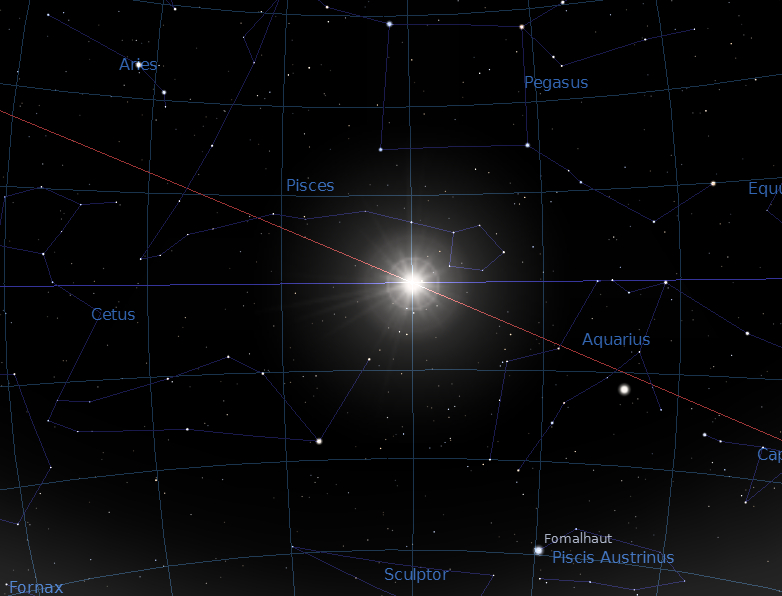
The sun at the vernal equinox point in the sky. The horizontal line the sun is crossing is the celestial equator. The red line is the sun’s path, the ecliptic. The sun is heading to the upper left. Created using Stellarium.
02/28/2014 – Ephemeris – Looking forward to March and spring
Ephemeris for Friday, February 28th. The sun will rise at 7:21. It’ll be up for 11 hours and 7 minutes, setting at 6:29. The moon, 1 day before new, will rise at 7:11 tomorrow morning.
Let’s look at the skies for the month of March. The sun will pass the celestial equator in March as the promising season of spring will begin. Daylight hours in the Interlochen/Traverse City area and will increase from 11 hours and 10 minutes tomorrow to 12 hours 43 minutes on the 31st. The altitude, or angle, of the sun above the southern horizon at local noon will be just under 38 degrees tomorrow and will ascend to nearly 50 degrees on the 31st. The altitude of the sun in the Straits area will be a degree lower. Local apparent noon this month, when the sun passes due south, will be about 12:49 p.m. Spring will begin on the 20th at 11:57 a.m. Eastern Daylight Time (15:57 UT), which now rules most of the year and will start a week from Sunday.
Times are for the Traverse City/Interlochen area of Michigan. They may be different for your location.
Addendum
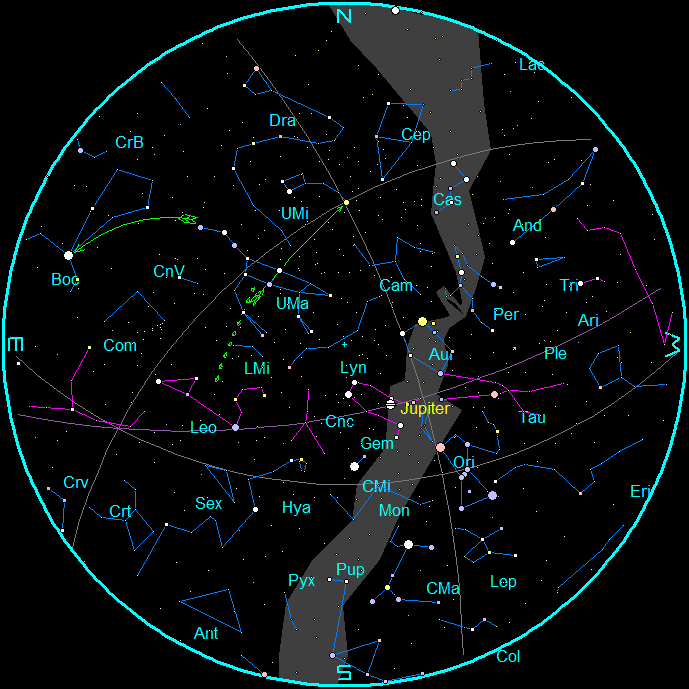
Star Chart for mid-month for March 2014 at 10 p.m. Credit: Bob Moler.
Add a half hour to every week before the 15th and subtract and hour for every week after the 15th.
For a list of constellation names to go with the abbreviations click here.
 Bob Moler's Ephemeris Blog