Archive
04/16/2018 – Ephemeris – The Virgo cluster of galaxies
Ephemeris for Monday, April 16th. The Sun rises at 6:56. It’ll be up for 13 hours and 32 minutes, setting at 8:29. The Moon, 1 day past new, will set at 9:16 this evening.
The stars around the constellation Leo and Virgo below and left of it feature relatively few stars, compared to those around Orion and the other winter constellations. That isn’t just a lot of blank sky, but beyond what can be seen with the naked eye in the region of southwestern Virgo, just to the lower left of the tail star Denebola of Leo is a vast cluster of galaxies that outnumber the stars of the same brightness in that direction. It is the Virgo Galaxy Cluster. Astronomers shorten the name to the Virgo Cluster. Two centuries ago the comet hunter Charles Messier swept this region with his small telescope and found many fuzzy bodies that could be confused with comets. He didn’t know what they were, but they sure weren’t comets, because they didn’t move against the stars.
The times given are for the Traverse City/Interlochen area of Michigan. They may be different for your location.
Addendum
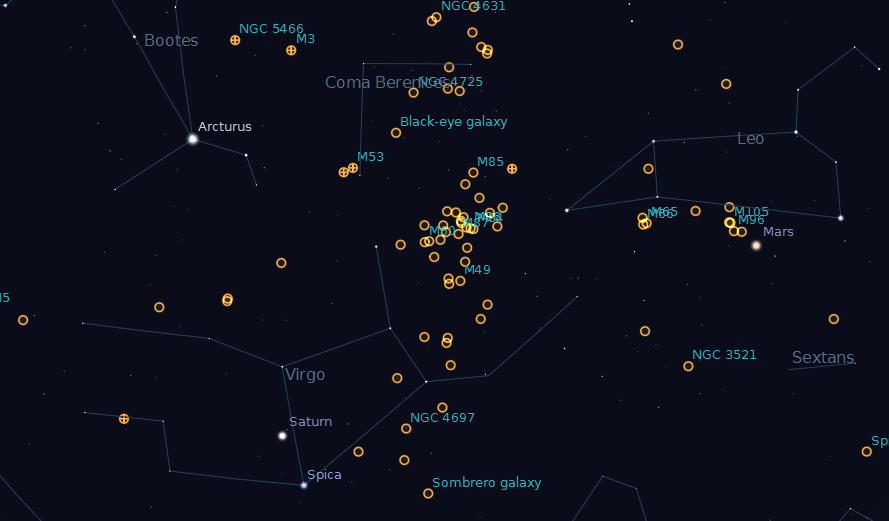
Brighter members of the Virgo Cluster. Created using Stellarium. Open circles are galaxies, circles with crosses are globular star clusters, outlying members of our Milky Way galaxy. This image is from a few years ago – Saturn, above Spica, has moved on.
04/12/2018 – Ephemeris – Where did the Milky Way go in the spring?
Ephemeris for Thursday, April 12th. The Sun will rise at 7:03. It’ll be up for 13 hours and 20 minutes, setting at 8:24. The Moon, 3 days before new, will rise at 6:14 tomorrow morning.
The Bright stars of winter are sliding into the western twilight in the evening. Taking their place in the south and east are the much more sparse stars of spring. The Milky Way passes through the winter and summer skies as well as the northern autumn sky. In the spring it runs below our southern horizon. Way back 200 years ago William Herschel realized that the stars around us lie in a flattened disk, that it was deeper in the direction of the milky glow than 90 degrees from it. It wasn’t until a bit less than 100 years ago that astronomers realized that there was anything outside this disk of stars. Today we call the fuzzy objects we find out there galaxies after the Greek word for Milky Way. They were seen in the 18th and 19th centuries, but were not recognized as such.
The times given are for the Traverse City/Interlochen area of Michigan. They may be different for your location.
Addendum
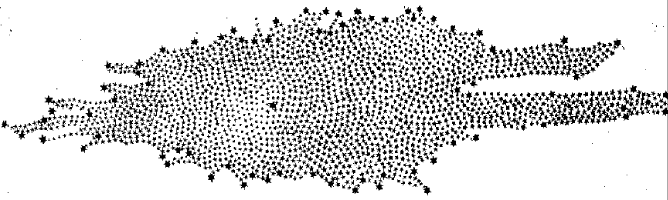
The shape of the universe (Milky Way) as measured by William Herschel by counting stars in the eyepiece fields of his telescope pointed in various directions. The large indent on the right is caused by the Great Rift, clouds of gas and dust the block the light of the stars behind it, not the lack of stars in that direction. The Great Rift is easily seen in the summer sky running through the Milky Way.
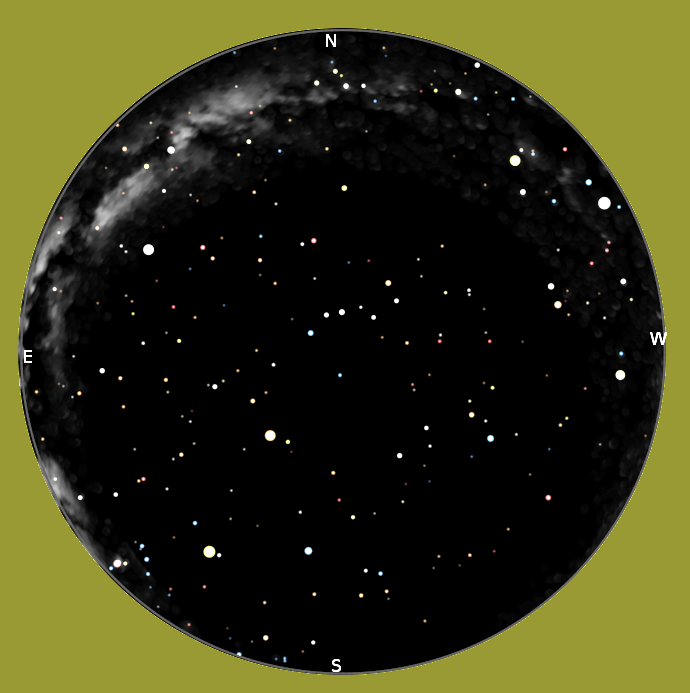
The dome of the spring sky showing the Milky Way visible mostly on the northeastern sky. In spring, we are looking out the thin side of the Milky Way. Created using Cartes du Ciel (Sky Charts).
Some Spring Galaxies
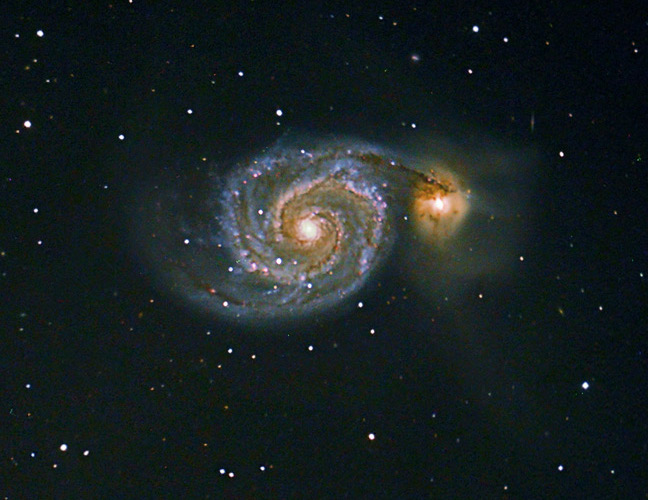
The Whirlpool Galaxy, M51 in Canes Venatici. Credit Scott Anttila.
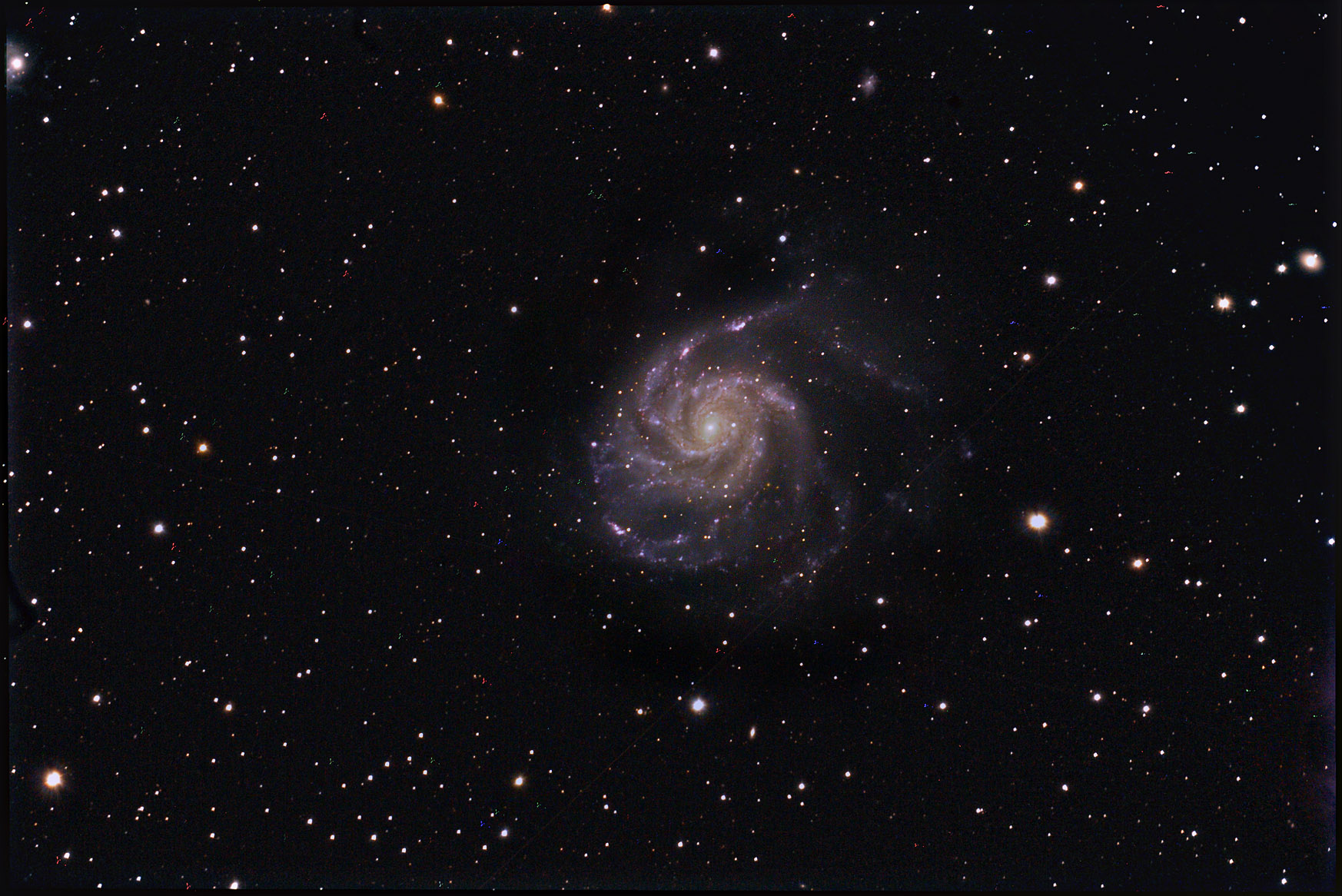
The Pinwheel Galaxy, M101 near the star Mizar in the handle of the Big Dipper. Credit Scott Anttila.
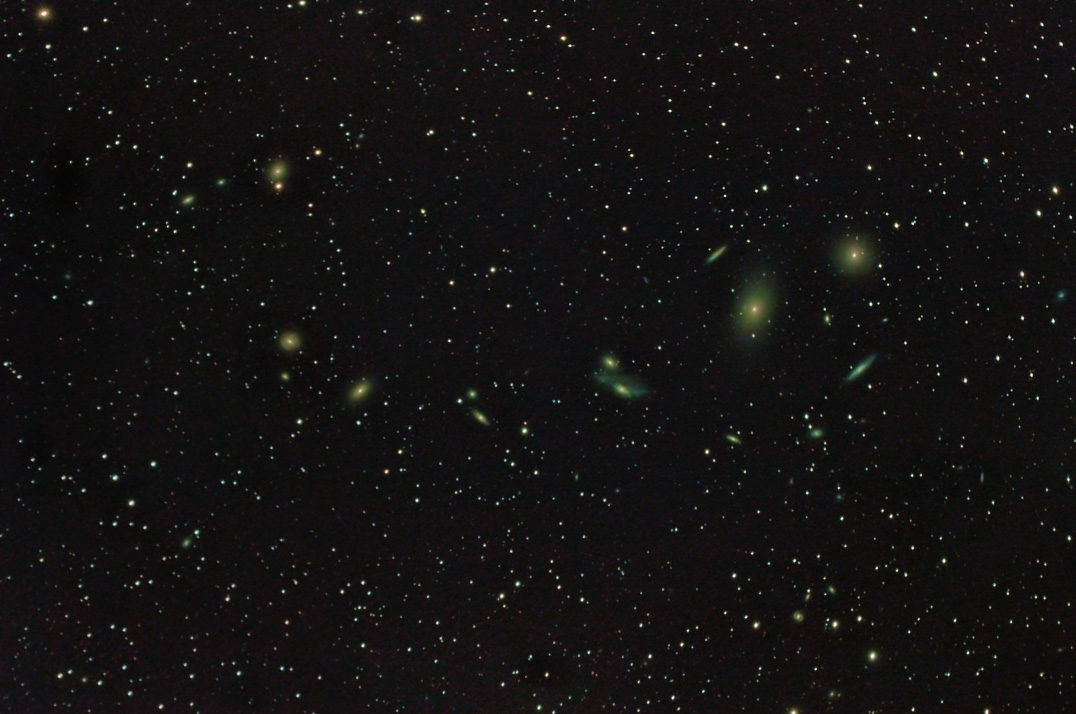
Markarian Chain of galaxies in Virgo. Credit Scott Anttila.
05/16/2017 – Ephemeris – The Virgo Cluster of Galaxies
Ephemeris for Tuesday, May 16th. Today the Sun will be up for 14 hours and 51 minutes, setting at 9:05, and it will rise tomorrow at 6:12. The Moon, 2 days before last quarter, will rise at 1:43 tomorrow morning.
Yesterday I talked about the constellation of Virgo the virgin. When we are looking at the constellation of Virgo, we are looking out the thin side of our galaxy, the Milky Way. The Milky Way galaxy is a flat disk. When we look into the disk we see the milky band we call the Milky Way. That band, what we can see of if is now low in the north, So the stars are much more sparse with the exception of those relatively close to us, like those of the big Dipper. Beyond the stars of Virgo is a huge cluster of over a thousand galaxies. Charles Messier, a comet hunter of the late 18th century, ran into quite a few fuzzy spots between Virgo and Leo to the upper right. Because they didn’t move in relation to the stars, they couldn’t be comets, so he added them to his list of nuisance objects, which we now enjoy looking at.
The times given are for the Traverse City/Interlochen area of Michigan. They may be different for your location.
Addendum
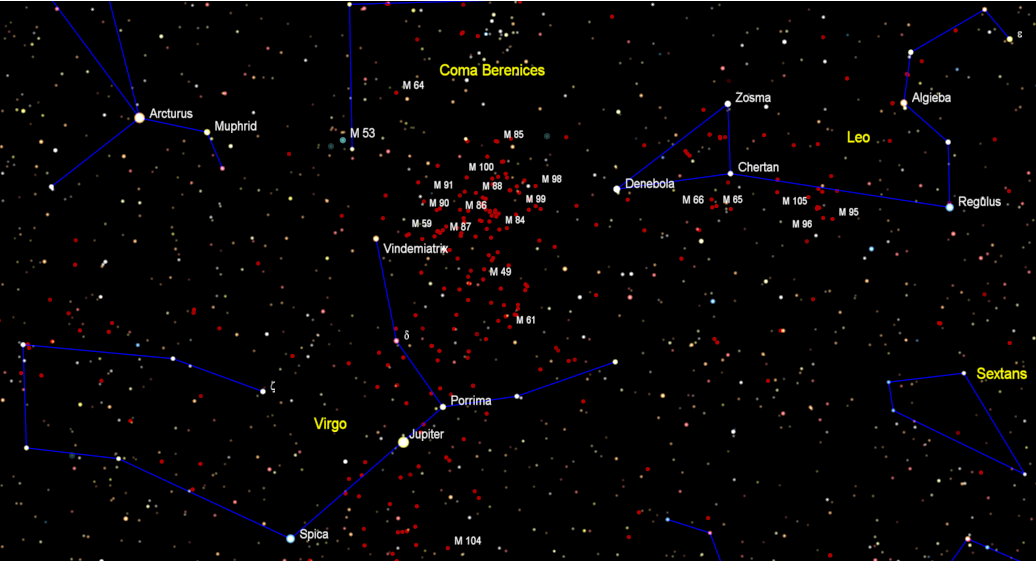
Some of the brighter members of the Virgo Cluster (of galaxies) as tiny red ovals. The galaxies marked with an ‘M’ number are part of Charles Messier’s catalog. It took a telescope of 8 inch diameter for me to spot them. Someone with better vision, like Messier himself can spot them with a smaller telescope. Created using Cartes du Ciel (Sky Charts). Click on image to enlarge.
05/12/2017 – Ephemeris – There will be a star party at the Sleeping Bear Dunes National Lakeshore Saturday night the 13th
Ephemeris for Friday, May 12th. Today the Sun will be up for 14 hours and 42 minutes, setting at 9:00, and it will rise tomorrow at 6:16. The Moon, 2 days past full, will rise at 10:37 this evening.
Tomorrow night May 13th there will be, weather permitting a star party at Sleeping Bear Dunes National Lakeshore, this time the venue is Pierce Stocking Scenic Drive at Stop number 3, the Dunes Overlook. The event starts at 9 p.m., while it’s still light out and the location can be found. Park at Picnic Mountain, which is after Stop 2, and right before stop 3, and walk over. The planet Jupiter and all four of its bright moons and cloud bands will be featured. Sharp eyed observers will also be able to see the Great Red Spot. As the sky darkens there will be a twilight talk about the wonders of the spring sky. Near the last half hour it will be dark enough to spot some of the galaxies and globular star clusters of spring. The star party is made possible by the rangers of the park and the Grand Traverse Astronomical Society.
The times given are for the Traverse City/Interlochen area of Michigan. They may be different for your location.
Addendum
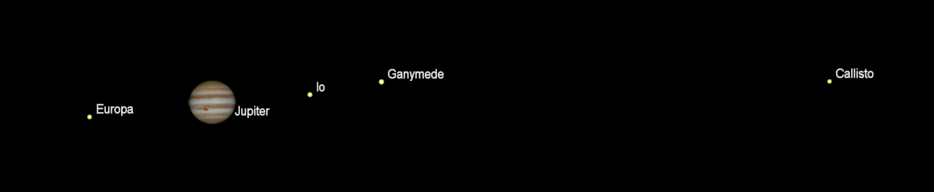
Jupiter, its cloud bands, Great Red Spot and moons as it might be seen around 10 p.m. at the star party. The actual orientation will depend on the telescope used to view them. Created using Cartes du Ciel (Sky Charts).
05/27/2016 – Ephemeris – Alkaid, the star at the end of the Big Dipper
Ephemeris for Friday, May 27th. Today the Sun will be up for 15 hours and 14 minutes, setting at 9:17, and will rise tomorrow at 6:02. The Moon, 2 days before last quarter, will rise at 1:40 tomorrow morning.
The star at the end of the handle of the Big Dipper is named Alkaid. It is the bright star that’s closest to the zenith at 11 p.m. It is a rare blue-white star. Alkaid and Dubhe, at the other end of the Big Dipper are stars that do not belong to the Ursa Major Association. And thousands of years from now these two stars will leave the central stars of the dipper behind, and deform the Big Dipper. Over the millennia the Big Dipper would look like a tin cup. Near Alkaid are two popular deep sky objects. And being this far from the hazy band of the Milky Way one would guess that they would be galaxies. And they are. The Whirlpool Galaxy and the Pinwheel Galaxy. Two gorgeous spiral galaxies.
Times are for the Traverse City/Interlochen area of Michigan. They may be different for your location.
Addendum
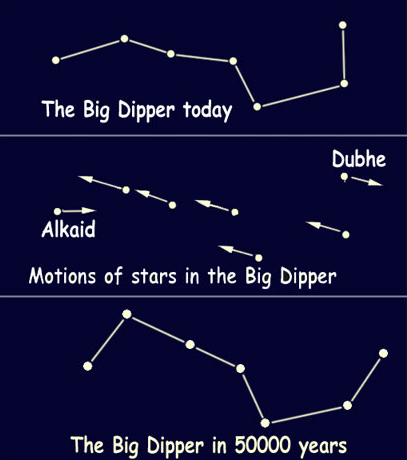
The change in the Big Dipper over time. Source: stargazerslounge.com. Ultimate source: Stellarium.
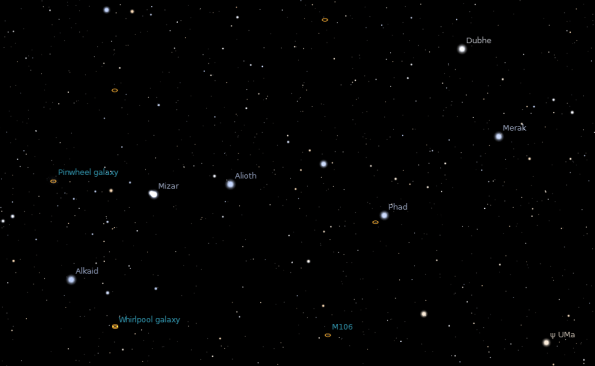
The Big Dipper and Alkaid with the Whirlpool (M51) and Pinwheel (M101) galaxies. Created using Stellarium.
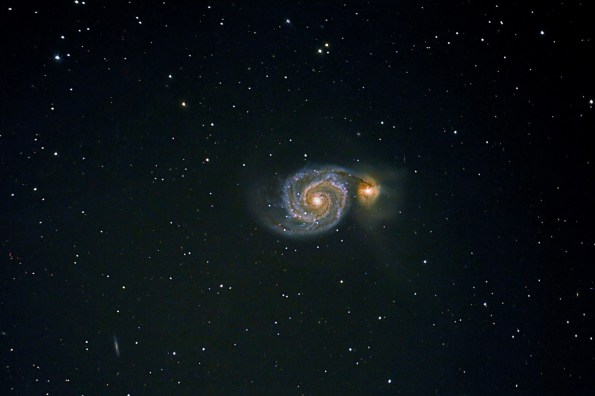
The Whirlpool Galaxy, M51. Credit Scott Anttila.
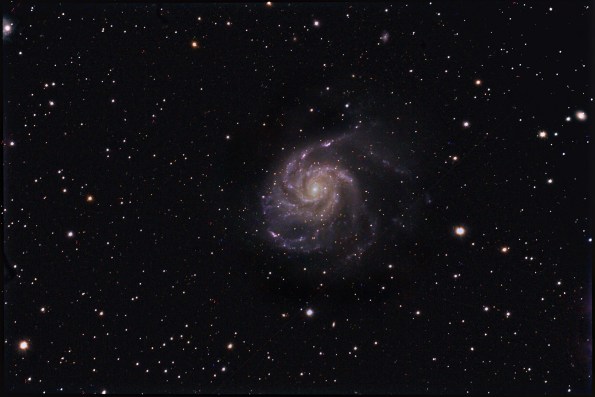
The Pinwheel Galaxy, M101. Credit Scott Anttila.
09/10/2015 – Ephemeris – Andromeda the chained maiden
Ephemeris for Thursday, September 10th. The Sun will rise at 7:15. It’ll be up for 12 hours and 47 minutes, setting at 8:03. The Moon, 3 days before new, will rise at 5:40 tomorrow morning.
In the east at 10 this evening can be found a large square of stars, the Great Square of Pegasus the flying horse. The square is standing on one corner. What look like its hind legs stretching to the left from the left corner star is another constellation, Andromeda the chained maiden. She is seen in the sky as two diverging curved strings of stars that curve upward. She was rescued by the hero Perseus, a nearby constellation, riding his steed Pegasus. Andromeda’s claim to astronomical fame is the large galaxy seen with the unaided eye just above the upper line of stars. The Great Andromeda Galaxy is two and a half million light years away. To the unaided eye the galaxy appears as a small smudge of light. In binoculars the galaxy is a delicate spindle of light. The galaxy is known as M31, the 31st object on Charles Messier’s list of fuzzy objects that aren’t comets.
Times are for the Traverse City/Interlochen area of Michigan. They may be different for your location.
Addendum
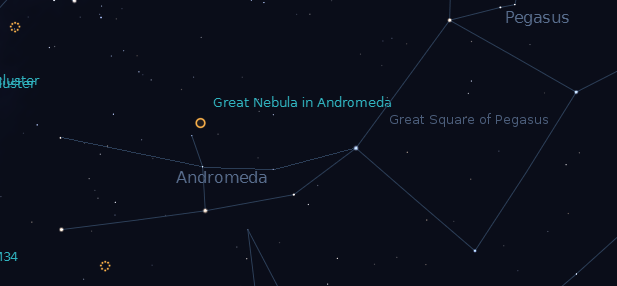
Andromeda at 10 p.m. with the Great Andromeda Galaxy. Created using Stellarium.
05/08/2015 – Ephemeris – May’s missing Milky Way
Ephemeris for Friday, May 8th. Today the Sun will be up for 14 hours and 32 minutes, setting at 8:55. The Moon, 3 days before last quarter, will rise at 1:08 tomorrow morning. Tomorrow the Sun will rise at 6:22.
In May we look up to the sky and notice that the Milky Way is missing. Will not really it’s as if the sky has pattern baldness with the Milky Way as a fringe on the horizon around the north half of the sky. Overhead, where none should be is a galactic star cluster, a star cluster that should normally be in the Milky band. That cluster is the constellation of Coma Berenices. Its is a sparse star cluster of about 50 stars only 288 light years away. If we were a thousand light years from it, it would appear in the Milky band. One notes too that the stars of spring are also fewer, not the riot of stars we see in the winter or late summer. The Milky Way galaxy is a thin disk, and in spring we are looking out the thin side.
Times are for the Traverse City/Interlochen area of Michigan. They may be different for your location.
Addendum
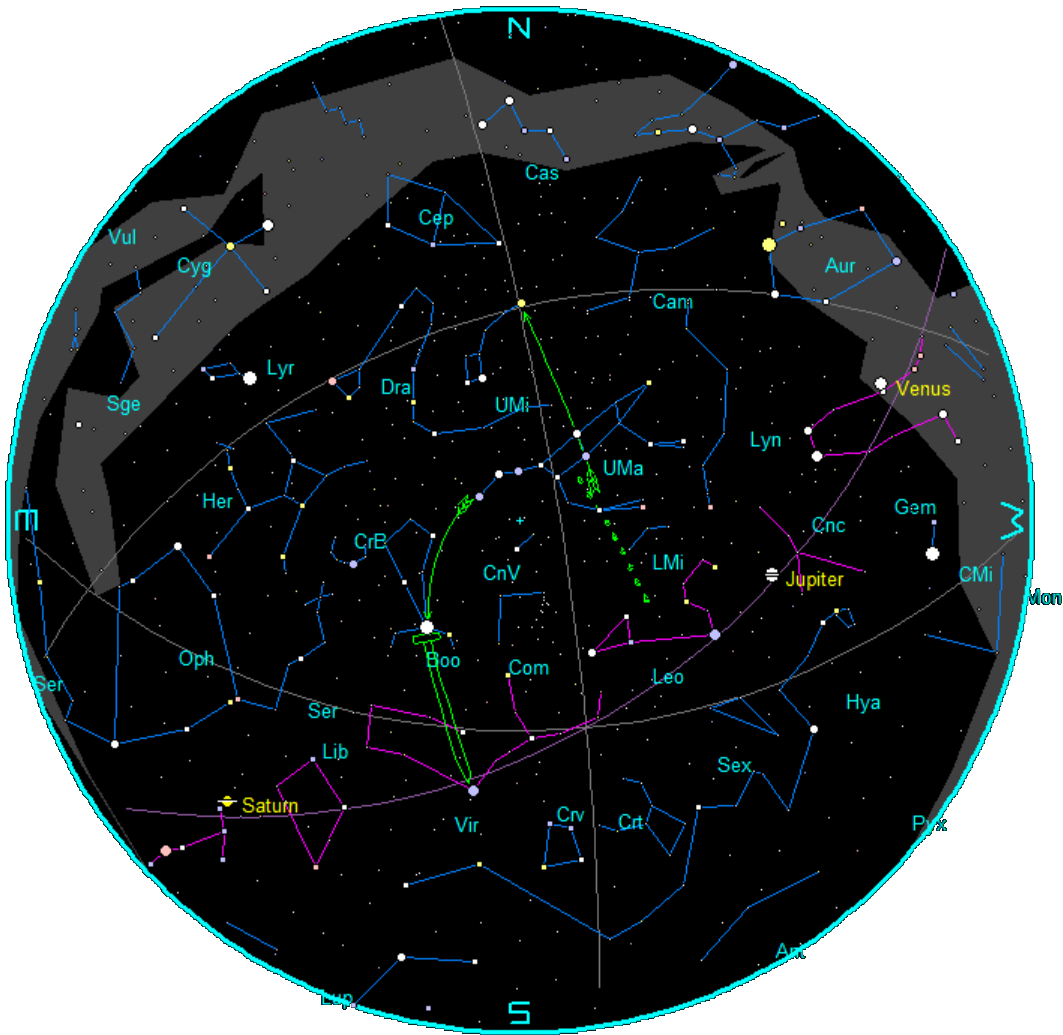
Star Chart for May 2015. Note the Milky way in the north. The Coma Berenices cluster is located between the labels CnV and Com. Created using my LookingUp program.
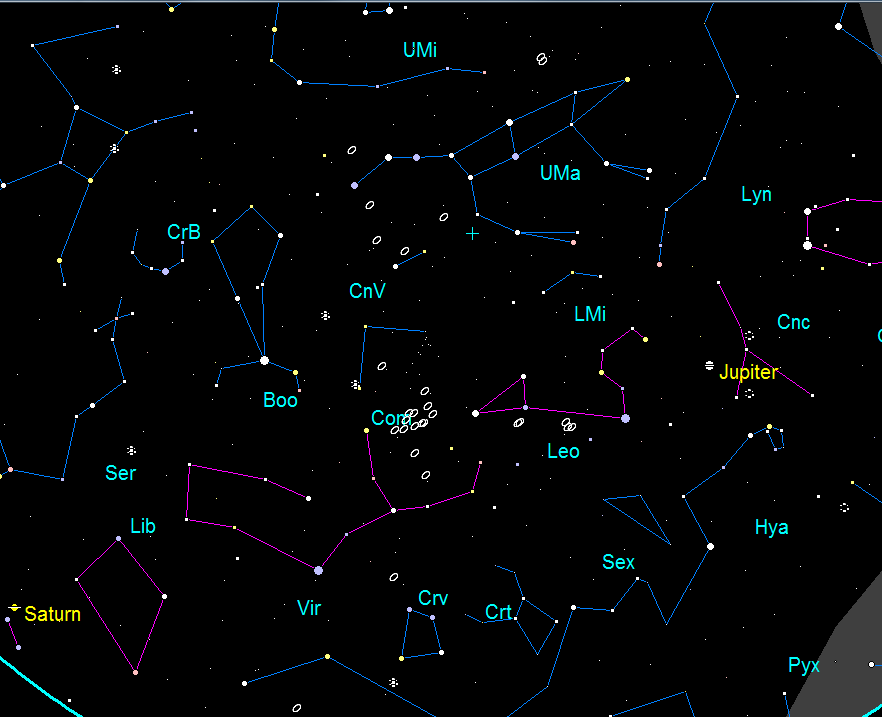
Messier objects, mostly galaxies (ovals) in the spring sky. Created using my LookingUp program.
Most of the galaxies in the above chart belong to the Virgo Cluster a cluster of several thousand galaxies about 53 million light years away. Charles Messier was a comet hunter active in the period around the time of the American Revolution at the Paris Observatory. He made a catalog of fuzzy objects he ran into that didn’t move and thus were not comets. The Messier catalog, which ran to 110 galaxies, star clusters and nebulae, some added posthumously, became a must-see list of some of the best sights for the telescope.
05/01/2015 – Ephemeris – A talk about the Virgo Cluster of galaxies tonight and a star party
Ephemeris for Friday, May 1st. Today the Sun will be up for 14 hours and 14 minutes, setting at 8:47. The Moon, 2 days before full, will set at 5:55 tomorrow morning. Tomorrow the Sun will rise at 6:31.
Tonight yours truly will be presenting the program: The Galaxy Cluster Next Door, at this evening’s meeting of the Grand Traverse Astronomical Society at 8 p.m. at Northwestern Michigan College’s Rogers Observatory. Following at 9 p.m. will be a star party featuring the Moon and planets Venus, Jupiter and later, Saturn. As to the program: There is a patch of the spring sky in the constellation of Virgo the virgin, where we are looking out the thin side of our Milky Way galaxy where there is a huge group of over a thousand galaxies astronomers have dubbed the Virgo Cluster. Galaxy clusters are held together by the gravity of mysterious dark matter, but the clusters are expanding from all the other clusters.
Times are for the Traverse City/Interlochen area of Michigan. They may be different for your location.
Addendum
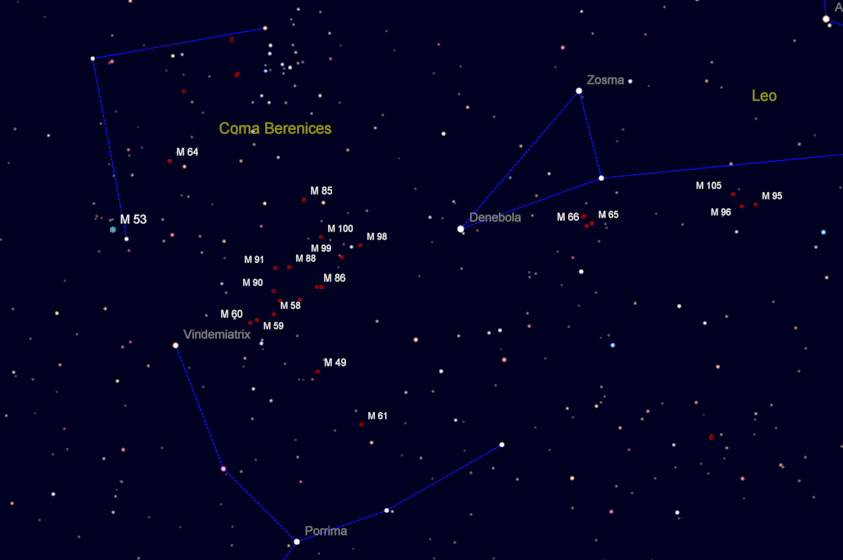
The Messier objects in the central part of the Virgo Cluster. Created with Cartes du Ciel (Sky Charts).
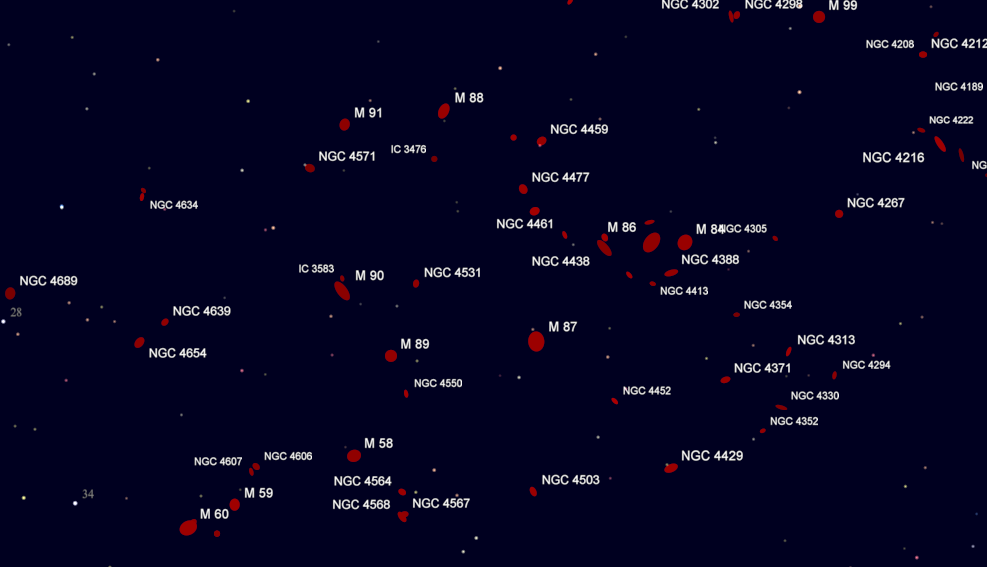
Some of the galaxies in the heart of the Virgo Cluster. Created with Cartes du Ciel (Sky Charts).
Happiness is being a massive galaxy cluster
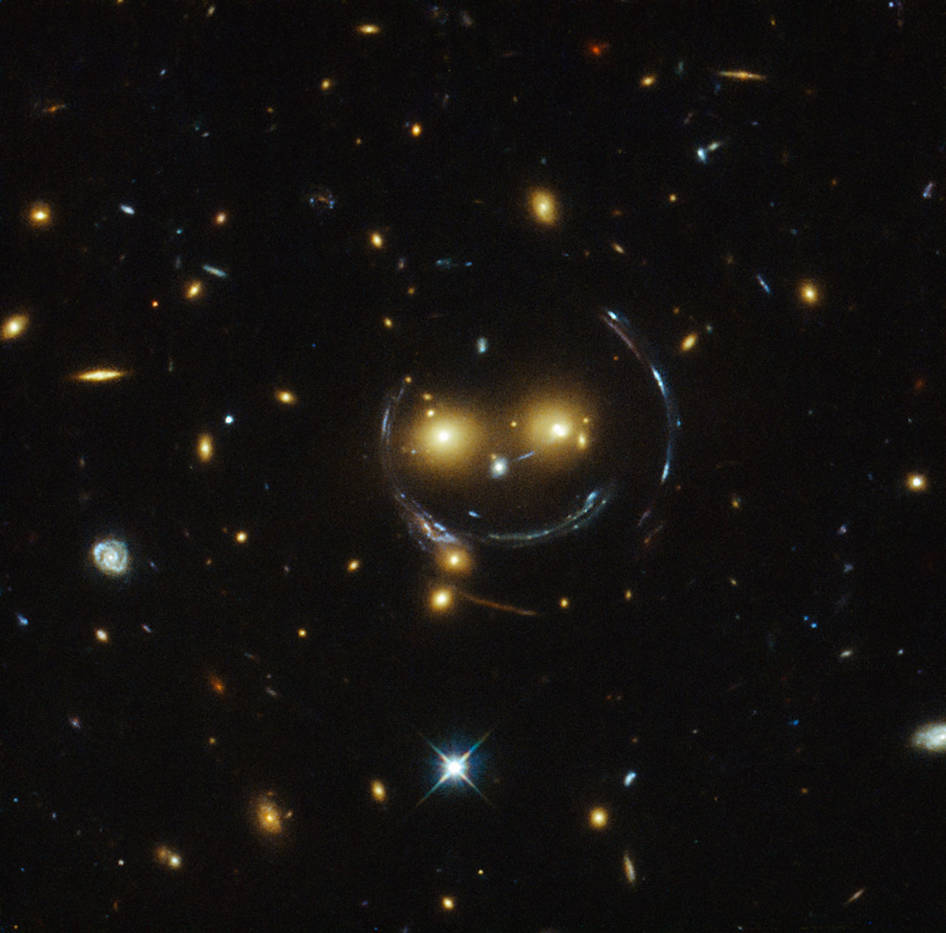
In the centre of this image, taken with the NASA/ESA Hubble Space Telescope, is the galaxy cluster SDSS J1038+4849 — and it seems to be smiling. You can make out its two orange eyes and white button nose. In the case of this “happy face”, the two eyes are very bright galaxies and the misleading smile lines are actually arcs caused by an effect known as strong gravitational lensing. Galaxy clusters are the most massive structures in the Universe and exert such a powerful gravitational pull that they warp the spacetime around them and act as cosmic lenses which can magnify, distort and bend the light behind them. This phenomenon, crucial to many of Hubble’s discoveries, can be explained by Einstein’s theory of general relativity. In this special case of gravitational lensing, a ring — known as an Einstein Ring — is produced from this bending of light, a consequence of the exact and symmetrical alignment of the source, lens and observer and resulting in the ring-like structure we see here. Hubble has provided astronomers with the tools to probe these massive galaxies and model their lensing effects, allowing us to peer further into the early Universe than ever before. This object was studied by Hubble’s Wide Field and Planetary Camera 2 (WFPC2) and Wide Field Camera 3 (WFC3) as part of a survey of strong lenses. A version of this image was entered into the Hubble’s Hidden Treasures image processing competition by contestant Judy Schmidt.
Credit: NASA/ESA
Caption: ESA
This image from the Hubble Space Telescope has been making the rounds. It shows how a massive cluster of galaxies can warp space-time and distort the images of the galaxies behind it into arcs. Here’s more from the Bad Astronomer Phil Plait. It comes in time for Valentine’s day to brighten the dreary month of February.
11/14/2014 – Ephemeris – When Galaxies collide… With ours (Gulp)
Ephemeris for Friday, November 14th. The sun will rise at 7:37. It’ll be up for 9 hours and 37 minutes, setting at 5:15. The moon, at last quarter today, will rise at 12:33 tomorrow morning.
Yesterday we looked at the closest spiral galaxy to our own Milky Way, the Great Andromeda Galaxy. I said that it would collide with the Milky Way in about 4 billion years. Usually no stars are harmed by such a collision. What does collide are the dust and gasses in each galaxy, that will trigger a burst of star formation. Over the next several billion years the two galaxies will probably merge into one giant elliptical galaxy. The sun at that time will see some changes of life the too. The Earth would by then be uninhabitable because the sun would be too hot, and by then would begin to bloat out into a red giant star. It would be a great spectacle, but no one would be around to watch it. However there are many distant colliding galaxies to watch.
Closer to home, Saturday night there will be a star party at NMC’s Rogers Observatory starting at 9 p.m.
Times are for the Traverse City/Interlochen area of Michigan. They may be different for your location.
Addendum
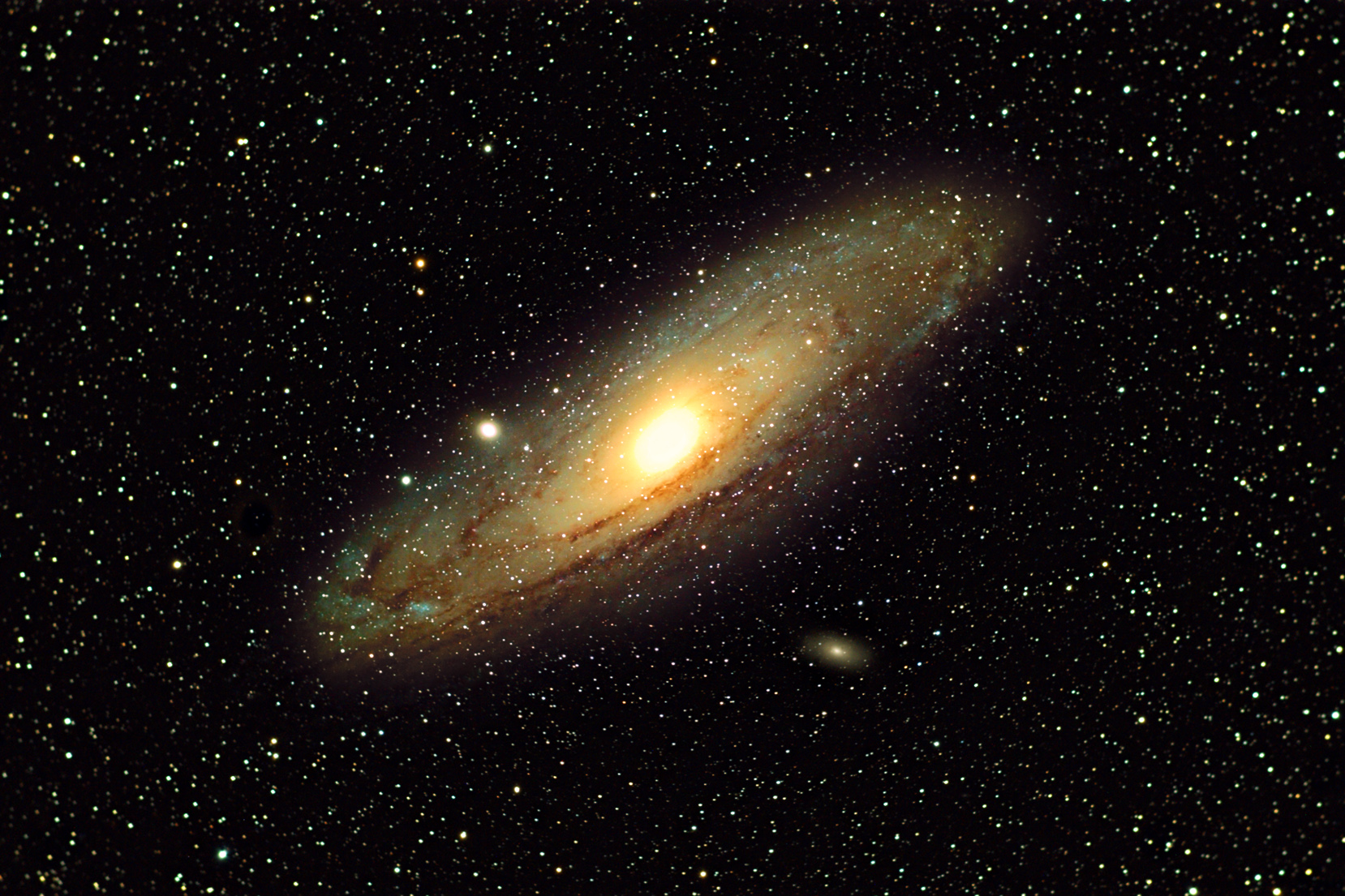
The Great Andromeda Galaxy (M31). Image taken by Scott Anttila.
Here’s a link to a YouTube video of a computer simulation of the collision of the Andromeda galaxy with our Milky Way galaxy.
 Bob Moler's Ephemeris Blog