Archive
01/02/2012 – Ephemeris – The moon and Jupiter and telescope tips
Monday, January 2nd 2012. The sun will rise at 8:19. It’ll be up for 8 hours and 54 minutes, setting at 5:13. The moon, 1 day past first quarter, will set at 3:04 tomorrow morning.
Tonight the bright planet Jupiter will appear below the moon. This is a great time to try out that new telescope or binoculars, or dig that old one out of the closet or attic. With a telescope use the lowest power to locate the moon and get an overview. The bright southern part of the moon, which may appear at the top of the image, because telescopes normally invert the image is heavily cratered. The other part has several dark nearly flat structures called seas. These are really huge craters that caused the internal lava to well up, making the smooth floors. Recently some astronomers hypothesized that a second moon was created with ours and that it crashed into our moon creating the lunar seas.
* Times, as always are for the Traverse City/Interlochen area of Michigan.
Addendum
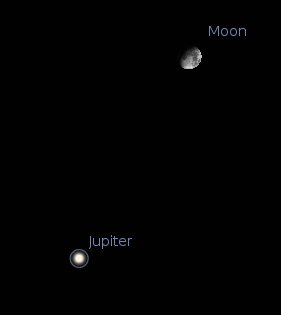
Jupiter appears below moon Jan 2, 2012 9 p.m. Created using Stellarium.
12/23/11 – Ephemeris – This year’s Christmas stars
Friday, December 23rd. The sun will rise at 8:17. It’ll be up for 8 hours and 48 minutes, setting at 5:06. The moon, 1 day before new, will rise at 8:04 tomorrow morning.
We have two bright planets and the brightest nighttime star out to be our Christmas stars this year. The planet Venus appears in the southwest in the evening and in seen higher and higher each evening, leading the sun in its slow climb as we move through winter into spring. Jupiter holds forth high in the south, the brightest star-like object once Venus sets. The brightest of all the night-time stars is Sirius, whose name means “Dazzling One” rising higher in the southeast, whiter than any planet with a tinge of blue, especially when seen in binoculars or a telescope.. It is accompanied by the rest of the bright stars of winter, including those of the great constellation Orion the hunter, whose three stars of his belt point down and to the left at Sirius.
* Times, as always are for the Traverse City/Interlochen area of Michigan.
12/21/11 – Ephemeris – Where are the bright planets this week?
Wednesday, December 21st. The sun will rise at 8:16. It’ll be up for 8 hours and 48 minutes, setting at 5:04. The moon, 3 days before new, will rise at 5:58 tomorrow morning.
It’s Wednesday and time again to take a look at the whereabouts of the bright planets. The planet Venus is prominent in the southwestern twilit sky after sunset setting at 7:30. Jupiter is now the most prominent planet of the evening sky located in the high in the south and is seen against the stars of the constellation Aries. It will pass due south at 8:36 p.m. It will set at 3:20 a.m.. Mars will rise at 11:25 p.m in the east northeast and will be in the constellation Leo. Mars will be due south at 6:01 a.m. It is 105 million miles away and closing. Saturn will rise at 2:57 a.m. just to the left of the bright star Spica in the east southeast. Winter starts at 12:30 tomorrow morning. I’ll have more on that tomorrow.
* Times, as always are for the Traverse City/Interlochen area of Michigan.
12/14/11 – Ephemeris – Where are the bright planets this week?
Wednesday, December 14th. The sun will rise at 8:11. It’ll be up for 8 hours and 51 minutes, setting at 5:02. The moon, 3 days before last quarter, will rise at 9:29 this evening.
It’s Wednesday and time again to take a look at the whereabouts of the bright planets. The planet Venus is prominent in the southwestern twilit sky after sunset setting at 7:12[, and should be visible by 5:45]. Jupiter is now the most prominent planet of the evening sky located in the high in the southeast to south and is seen against the stars of the constellation Aries. It will pass due south at 9:04 p.m. It will set at 3:48 a.m.. Mars will rise at 11:41 p.m in the east northeast and will be in the constellation Leo. [Mars will be due south at 6:17 a.m.] It is 111 million miles away and closing. Saturn will rise at 3:22 a.m. just to the left of the bright star Spica in the east southeast. Remember Comet Lovejoy will enter SOHO’s LASCO C3 frame today.
* Times, as always are for the Traverse City/Interlochen area of Michigan. Text in brackets deleted from the program due to time constraints.
Update 6:16 a.m.
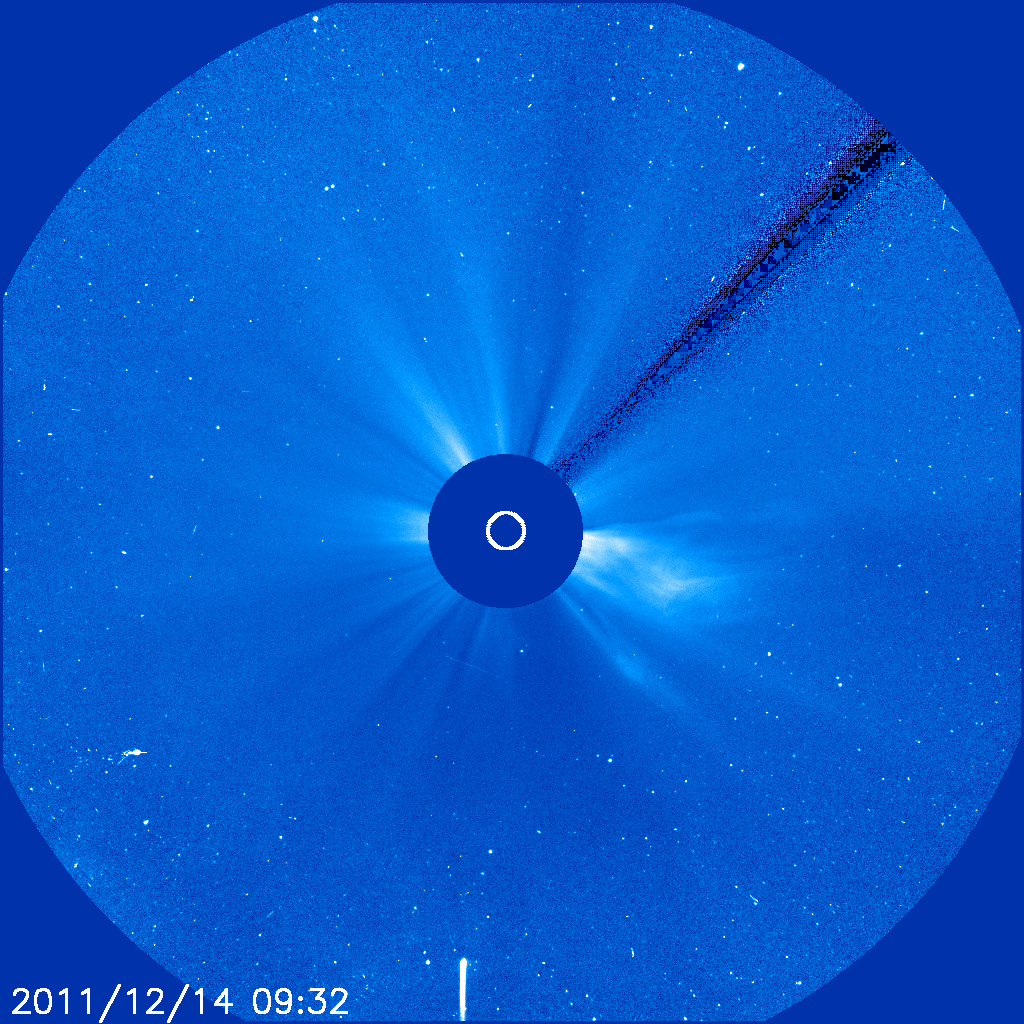
Comet Lovejoy entering at the bottom of the LASCO C3 frame. Courtesy SOHO, ESA, NASA. Timestamp on image.
Click to enlarge.
12/07/11 – Ephemeris – Where are the planets this week?
Wednesday, December 7th. The sun will rise at 8:05. It’ll be up for 8 hours and 57 minutes, setting at 5:02. The moon, 3 days before full, will set at 6:16 tomorrow morning.
It’s Wednesday and time again to take a look at the whereabouts of the bright planets. The planet Venus is low in the southwestern twilit sky sunset setting at 6:57, and should be visible by 5:45. Jupiter is now the most prominent planet of the evening sky located in the high in the southeast and is seen against the stars of the constellation Aries. It will pass due south at 9:33 p.m. In a telescope it will be accompanied by its 4 brightest moons. It will set at 4:18 a.m.. Mars will rise at 11:55 p.m in the east northeast and will be in the constellation Leo. Mars will be due south at 6:34 a.m. It is 117 million miles away and closing. Saturn will rise at 3:46 a.m. just to the left of the bright star Spica in the east southeast.
* Times, as always are for the Traverse City/Interlochen area of Michigan.
12/06/11 – Ephemeris – Jupiter will appear close to the moon tonight
Tuesday, December 6th. The sun will rise at 8:04. It’ll be up for 8 hours and 58 minutes, setting at 5:02. The moon, half way from first quarter to full, will set at 5:16 tomorrow morning.
This evening the planet Jupiter will appear to the lower right of the moon. They will appear at their closest at 2 p.m., but that’s before they rise. Jupiter is the largest of the planets and three of its four largest moons that we can see in small telescopes, are larger than our moon. Last month I spent a day at the National Radio Astronomy Observatory in Green Bank West Virginia. One of the studies they were doing was a radar study of the Jovian moon Europa to see if the suspected ocean that separates the moon’s core from its surface would cause the surface to slip a bit and show that Europa’s not completely solid. Radar pulses would be sent from Aricebo in Puerto Rico to be received by their GBT 100 meter telescope.
* Times, as always are for the Traverse City/Interlochen area of Michigan.
Addendum
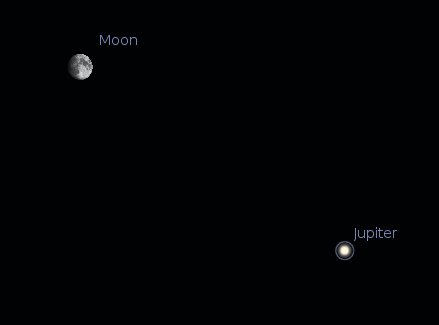
Jupiter and the moon the evening of December 6, 2011. Created using Stellarium
11/30/11 – Ephermeris – The location of the planets tonight
Wednesday, November 30th. The sun will rise at 7:57. It’ll be up for 9 hours and 6 minutes, setting at 5:04. The moon, 2 days before first quarter, will set at 11:08 this evening.
It’s Wednesday and time again to take a look at the whereabouts of the bright planets. The planet Venus is low in the southwestern sky just after sunset setting at 6:44, and should be visible by 5:45. Jupiter is now the prominent planet of the evening sky located in the southeast and is seen against the stars of the constellation Aries. It will pass due south at 10:33 p.m. In a telescope it will be accompanied by its 4 brightest moons. It will set at 4:48 a.m.. Mars will rise at 12:07 a.m in the east northeast and will be left of the star Regulus in the constellation Leo tomorrow morning.. It is 122 million miles away and closing. Saturn will rise at 4:10 a.m. just to the left of the bright star Spica in the east southeast.
* Times, as always are for the Traverse City/Interlochen area of Michigan.
11/23/11 – Ephemeris – Where are the bright planets this week?
Wednesday, November 23rd. The sun will rise at 7:49. It’ll be up for 9 hours and 18 minutes, setting at 5:08. The moon, 2 days before new, will rise at 7:09 tomorrow morning.
It’s Wednesday and time again to take a look at the whereabouts of the bright planets. The planet Venus is still rather close to the sun in the evening setting at 6:33, and should be visible by 5:45 low in the southwest. Jupiter is now the prominent planet of the evening sky located in the southeast and is seen against the stars of the constellation Aries. It will pass due south at 10:33 p.m. In a telescope it will be accompanied by its 4 brightest moons. It will set at 5:18 a.m.. Mars will rise at 12:18 a.m in the east northeast and will be left of the star Regulus in the constellation Leo tomorrow morning. [It is 128 million miles away and closing.] Saturn will rise at 4:34 a.m. just to the left of the bright star Spica in the east southeast.
* Times, as always are for the Traverse City/Interlochen area of Michigan. Bracketed passage was omitted from the audio program due to time constraints.
11/16/11 – Ephemeris – Where are the bright planets this week?
Wednesday, November 16th. The sun will rise at 7:40. It’ll be up for 9 hours and 33 minutes, setting at 5:13. The moon, 2 days before last quarter, will rise at 10:29 this evening.
It’s Wednesday and time again to take a look at the whereabouts of the bright planets. The planet Venus is still rather close to the sun in the evening setting at 6:28, and should be visible by 5:45. Jupiter is now the prominent planet of the evening sky located in the east and southeast and is seen against the stars of the constellation Aries. It will pass due south at 11:03 p.m. In a telescope it will be accompanied by its 4 brightest moons. The moons and planetary features change from night to night and sometimes while you watch. Jupiter will set at 5:50 a.m.. Mars will rise at 12:28 a.m in the east northeast and will be left of the star Regulus in the constellation Leo tomorrow morning.. [It is 134 million miles away and closing.]
* Times, as always are for the Traverse City/Interlochen area of Michigan. Bracketed passage was omitted from the audio program due to time constraints.
11/11/11 – Ephemeris – More on Jupiter
Veteran’s Day, Friday, November 11th. The sun will rise at 7:33. It’ll be up for 9 hours and 45 minutes, setting at 5:19. The moon, 1 day past full, will rise at 5:43 this evening.
Lets check out again the giant planet Jupiter, visible in the southeastern sky in the evening. Jupiter is more massive than all the other planets, moons, and asteroids twice over. [In fact the famous science and science fiction writer Isaac Asimov once stated that the solar system consists of the sun, Jupiter and debris.] Jupiter is huge, 11 times the earth’s diameter, and 13 hundred times its volume. It is mostly made of hydrogen with methane and ammonia clouds. In the deeper parts of Jupiter the temperature rises as the pressure increases, compressing the hydrogen into a hot sea. Thee is nowhere on Jupiter to land. Below that it turns into a liquid metallic hydrogen, and Jupiter’s rapid 10 hour spin creates a huge magnetic field and radiation bands.
* Times are for the Traverse City/Interlochen area of Michigan. They may be different for your location. Text in brackets omitted from program due to time constraints.
 Bob Moler's Ephemeris Blog