Archive
10/09/2014 – Ephemeris – The next lunar eclipses and recollections of what happened with yesterday’s eclipse
Ephemeris for Thursday, October 9th. The sun will rise at 7:50. It’ll be up for 11 hours and 18 minutes, setting at 7:08. The moon, 1 day past full, will rise at 8:01 this evening.
With the two total lunar eclipses done for this year, we can look forward to two more next year. The April 4th, 2015 eclipse won’t appear total here because the moon will set before totality. However the September 28th, 2015 lunar eclipse will be an evening eclipse. These 4 eclipses make a rare tetrad of total lunar eclipses that won’t be repeated until 2032 and 2033. After September 28th the next total lunar eclipse visible from northern Michigan will be in 2021. On the solar eclipse side there’s one on the 23rd of this month, a partial eclipse at sunset. I’ll have more on that later. After that is the big event, the total solar eclipse on August 21, 2017. The path of totality will run from coast to coast, running just south of St. Louis Missouri, and just north of Nashville Tennessee.
Times are for the Traverse City/Interlochen area of Michigan. They may be different for your location.
Addendum
What follows is my recollection of the October 8th lunar eclipse. Originally relayed in an email to Pat Stinson, freelance writer and author of the wonderful article in the Grand Traverse Insider about the activities of Space Week and the astronomical events in October:
The skies were trending clearer at midnight and again at 2:30 a.m. when I took a shower to prepare for the eclipse. After that it got slowly worse. That afternoon Ranger Marie Scott of the Sleeping Bear Dunes National Lakeshore said she’d go to our site, Platte River Point, clouds or not, and I was willing. In setting up the eclipse observing sites,earlier in the year, this site was the one place that if it were clear, we could see either the moon or the sun set onto the Lake Michigan horizon for the three eclipses this year. I loaded my van with my two telescopes, the C8 and an 11″ Dobsonian and lots of coffee.
I got to the site at 4:30 and began to set up. Marie arrived a few minutes later and another Grand Traverse Astronomical Society member Don Flegel arrived shortly after that. They had some rain in Kingsley, where he lived that morning. We had a strong, cold northwest wind. When we’re at the Point we commandeer the small parking lot to the north of the road that’s up against a hill. That hill and my van offered some protection from the wind. I got the C8 set up just in time to spot the moon emerging from the clouds a few minutes after first contact. We were able to follow the eclipse intermittently until about 5:45 when a large cloud covered the moon big time. We could see the glint of the moon off the water until after totality.
This was our situation until about 7:30 when the clouds began to break up, By then the moon was so low that the foreshortened breaks weren’t all that open. Then about 10 minutes before moon set it did peek out at intervals. Unlike the Cheshire Cat’s smile, the moon (cat) had a frown because the upper edge of the moon was coming back into sunlight. 5 minutes later the moon finally disappeared for good in a cloud bank as the puffy clouds overhead caught the sun’s golden sunrise rays.
Marie Scott counted 18 folks that at one time or another came out to witness the event. Marie also posted some pictures she took of the eclipse on the park’s Facebook page.
04/15/2014 – Ephemeris – One eclipse down, what’s next?
Ephemeris for Tuesday, April 15th, Tax Deadline Day. The sun rises at 6:58. It’ll be up for 13 hours and 29 minutes, setting at 8:27. The moon, at full today, will rise at 9:08 this evening.
Since I’m recording this before this morning’s eclipse, I don’t know if it was visible from the northern Lower Peninsula. However we do have a shot at another total lunar eclipse this year. That one is on October 8th. Though it’s in the morning, it’s closer to dawn. One which one can catch by going to bed early and getting up early to enjoy. The weather prospects are somewhat better in October than they are in April. That eclipse we’ll miss a bit of the ending partial phase as the moon sets during that time. As a bonus, 15 days later we will see half of a partial solar eclipse, because the sun will set around mid eclipse. That eclipse will not be total anywhere as the core of the moon’s shadow misses to the north of the Earth.
Times are for the Traverse City/Interlochen area of Michigan. They may be different for your location.
Addendum
There’s another eclipse I didn’t mention due to time. It follows this one by 14 days, on April 29th. It is an odd partial eclipse visible from the Indian Ocean, Australia and a bit of Antarctica. It is an annular eclipse, where the moon is too far away to completely cover the bright ball of the sun. The annular shadow touches the earth in Antarctica, but not the central part, which just misses the earth. It’s truly an odd eclipse. Next year will provide us with two more lunar eclipses. The first one we’ll see a part of before the moon sets, and the second will be an evening eclipse well placed for viewing. None of next years solar eclipses will be visible from North America.
Check out this and next year’s eclipses on the NASA Eclipse website.
04/14/2014 – Ephemeris – The total lunar eclipse is tonight after midnight.
Updated 4 p.m. EDT: See bottom of the post.
Ephemeris for Monday, April 14th. The sun will rise at 7:00. It’ll be up for 13 hours and 26 minutes, setting at 8:26. The Moon, 1 day before full, will set at 7:05 tomorrow morning.
We’re hoping for clear skies for tonight’s total lunar eclipse. Actually it’s in the wee hours of tomorrow morning. So if you’re a night owl, stay up tonight or otherwise catch all or part of it by setting your alarm clock. Here’s the timings: The partial phase begins as the Moon enters the earth’s inner shadow at 1:58 a.m. Totality starts at 3:06 a.m. Totality will last until 4:24,when the upper left edge of the moon again peeks into sunlight. The ending partial phase will end at 5:33 a.m. If it’s clear or at least partly cloudy there are two locations in the Grand Traverse area to view the eclipse, other than your own back yard, which is perfectly acceptable. The first is the NMC Rogers Observatory, and the other is the Dune Climb parking lot at Sleeping Bear Dunes.
Times are for the Traverse City/Interlochen area of Michigan. They may be different for your location.
Addendum
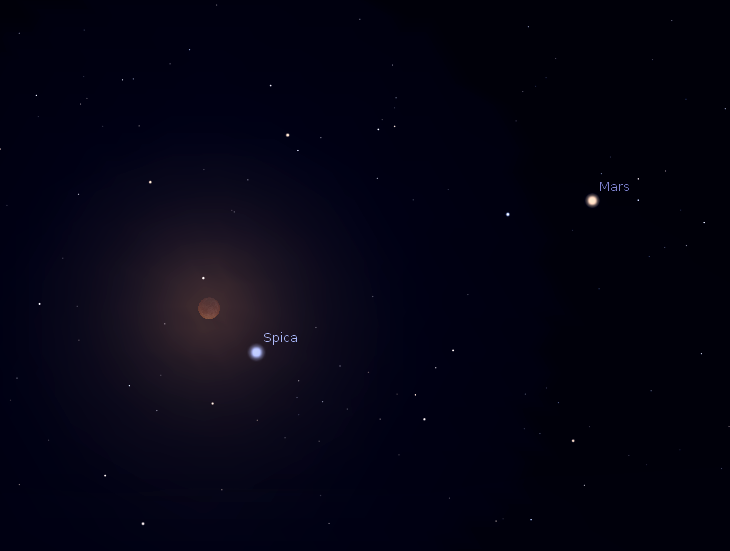
The April 15, 2014 lunar eclipse simulated by Stellarium. Note that Mars and the star Spica will be nearby.
As of 24 hours before the eclipse the weather prospects don’t look good for northwestern lower Michigan or all the east coast for that matter. We’re on the edge of the clouds. The western shore Lake Michigan and parts of the U.P. may be clear. But things could change.
There will be a live webcast from University of Georgia at http://www.ccssc.org/webcast.html, who may be stuck with the same overcast we may have. Hat Tip to Spaceweather.com
There is also another live stream of the eclipse from Griffith Observatory in Los Angeles. Or go to http://www.griffithobservatory.org and click on the Griffith TV button. Coverage starts at 9:45 PDT or 12:45 a.m. EDT which is a bit more than an hour before the partial phase of the eclipse starts. Hat Tip to Carla Johns of the NASA Museum Alliance for the links.
Here’s a link to the official NASA eclipse website for this eclipse.
Here’s a link to my in-depth discussion of the April 15, 2014 eclipse.
Update
Here’s another link to a live feed of the eclipse: Virtual Telescope Project.
Universe Today has more links.
The Sleeping Bear eclipse viewing has been canceled.
04/11/2014 – Ephemeris – Get ready for Tuesday’s total lunar eclipse
Ephemeris for Friday, April 11th. The sun will rise at 7:05. It’ll be up for 13 hours and 17 minutes, setting at 8:22. The Moon, half way from first quarter to full, will set at 5:36 tomorrow morning.
Next Tuesday morning’s total eclipse of the moon is the first we’ve seen for several years. The partial phase begins as the Moon enters the earth’s inner shadow at 1:58 a.m. Totality starts at 3:06 a.m. The entire Moon should be a red or orange color. The depth of color will slowly change during totality until 4:24, when totality ends and the upper left edge of the moon again peeks into sunlight. The ending partial eclipse will end at 5:33 a.m. If it’s clear or at least partly cloudy there are two locations in the Grand Traverse area to view the eclipse, other than your own back yard, which is perfectly acceptable. The first is the NMC Rogers Observatory, and the other is the Dune Climb parking lot at Sleeping Bear Dunes.
Times are for the Traverse City/Interlochen area of Michigan. They may be different for your location.
Addendum

Something like what Tuesday’s eclipse will look like from the eastern US. Total lunar eclipse in Egypt. Photo credit: Sean Bagshaw from sservi.nasa.gov.
In a composite photo like this the Earth’s rotation is carrying the moon westward (right) toward setting, while the Moon’s orbital motion is carrying it toward the east (left) more slowly through the Earth’s shadow. This appears to be a real composite. Morning twilight would approach from the opposite side of the sky.
04/10/2014 – Ephemeris – Get ready for the April 15, 2014 total lunar eclipse
Ephemeris for Thursday, April 10th. The sun will rise at 7:07. It’ll be up for 13 hours and 14 minutes, setting at 8:21. The Moon, 3 days past first quarter, will set at 5:09 tomorrow morning.
Next Tuesday morning we’re in for a treat as the Moon enters the Earth’s shadow producing a total lunar eclipse. The eclipse will be a challenge especially if you wait for April 15th to do your taxes. Next Tuesday is tax deadline day, and the eclipse will happen is the wee hours of that morning. You don’t have to watch the whole thing, but I will if it’s clear. The partial phase begins as the Moon enters the earth’s inner shadow at 1:58 a.m. Totality starts at 3:06 a.m. The entire Moon should be a red or orange color. The depth of color will slowly change during totality until 4:24, when totality ends and the upper left edge of the moon again peeks into sunlight. The ending partial eclipse will end at 5:33 a.m.
Times are for the Traverse City/Interlochen area of Michigan. They may be different for your location.
Addendum

How a lunar eclipse happens. Credit spaceplace.nasa.gov
The outer shadow is the Earth’s penumbra which gradually darkens from the outside edge to the umbra, the Earth’s inner shadow. It’s been my experience that it isn’t noticeable until about a half hour before the partial phase starts, when the Moon starts to dip into the umbra.
Here’s a link to the official NASA eclipse website for this eclipse.Here’s a link to my in-depth discussion of the April 15, 2014 eclipse.
Tax Day Eclipse – April 15, 2014
From the April 2014 Stellar Sentinel, the newsletter of the Grand Traverse Astronomical Society
If you stay up April 14th or get up early on April 15th to watch the total lunar eclipse that morning, make sure your taxes are done, because you might not be good for much of anything during the day on the 15th.
That being said, let’s take a look at the what and where of the eclipse. Lunar eclipses only occur at full moon. The Sun, Earth and Moon have to line up so the the Earth casts its shadow on the Moon. This occurs in about one in six full moons. Below is the Moon and the earth’s shadow at the March full moon.
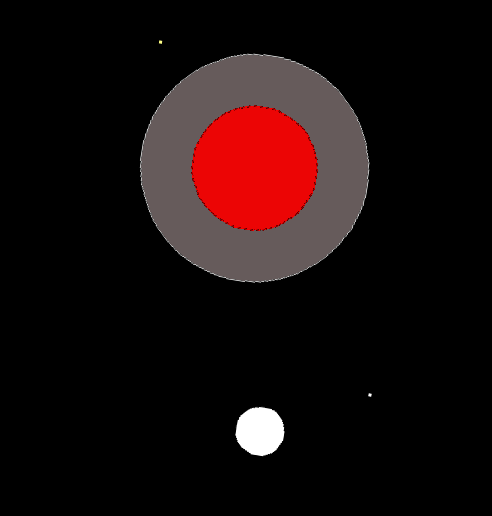
On March 16, 2014 the full Moon missed the Earth’s shadow, so no eclipse was seen. Created using Cartes duCiel.
In the illustration above the “bulls-eye” is the Earth’s shadow as it would appear at the Moon’s distance. The outer gray circle represents the Earth’s penumbra, where the sun’s light is increasingly blocked by the earth. The umbra (in red for emailed PDF versions of this newsletter) is the Earth’s inner shadow where no direct sunlight enters. When the Moon enters the umbra the partial phase of the eclipse begins. When the Moon is entirely within the umbra the Moon will be totally eclipsed. The Moon back on March 16th missed the earth’s shadow by passing several degrees south of it. When the moon is in the umbra it is still dimly lit indirectly to some degree by the combined rays of the sun that are refracted through Earth’s from all the accumulated sunrises and sunsets occurring around the Earth at that time. Back in 1967 the robotic lunar soft lander Surveyor 3 was able to take some images of the earth during a lunar eclipse. For Surveyor this was a solar eclipse and illustrated the light being refracted around the earth.
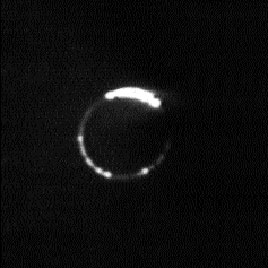
Solar eclipse by the Earth as viewed by Surveyor 3, April 24, 1967. Credit: NASA
The current Chinese Chang’e 3, should it survive one more lunar night, has a chance to take a better quality photograph of the eclipsed Sun this April 15th if its camera can tilt far up enough.
The light that illuminates the Moon in the Earth’s umbra is generally red in color, though the edge of the umbra generally has a gray cast to it. The light level is so low in the umbra, that, to the naked eye, it appears that the Moon is indeed being eaten by something invisible as the ingress partial phase progresses. About three quarters the way in the color of the umbra can be perceived even to the naked eye.
There are exceptions. Two notable lunar eclipse of this person’s memory occurred in 1982. On July 6, 1982 the early morning eclipse when the Moon passed centrally through the umbra the Moon was unevenly lit. The top or northern half was much darker than the southern half. In late March and early April that year the El Chichón volcano erupted in southern Mexico sending 20 million metric tons of ash high into the stratosphere. Apparently it masked the light from the northern hemisphere making it into the earth’s shadow. That year’s December 30th lunar eclipse was exceptionally dark. In fact during totality one had to hunt to find the Moon at all with the naked eye.
The events of the April 15th eclipse
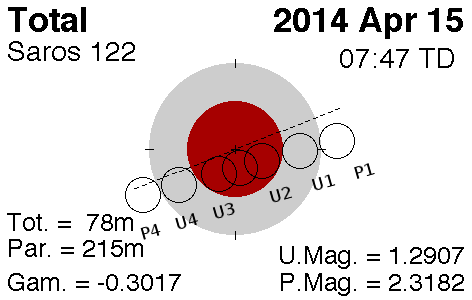
The Moon travels through the Earth’s shadow from right to left. What are seen are points of contact with the shadow and mid-eclipse. From Five Millennium Canon of Lunar Eclipses (Espenak & Meeus) NASA.
Contact times are labeled P1, U1, U2, U3, U4, and P4. P2 and P3 are omitted because they are synonymous with U2 and U3 respectively:
P1 – 12:53:37 a.m. Enter the penumbra (unseen). By about 1:30 the duskiness on the left edge of the Moon will start to be pronounced.
U1 – 1:58:19 a.m. Enter the umbra (partial eclipse begins).
U2 – 3:06:47 a.m. Totality begins.
Mid eclipse 3:49:40 a.m.
U3 – 4:24:35 a.m. Totality ends, egress partial phase begins.
U4 – 5:33:04 a.m. Partial phase ends. The Moon’s upper right edge should appear dusky for the next half hour or so.
P4 – 6:37:37 a.m. Penumbral phase ends (unseen).
Note: The duskiness of the penumbral phase of the eclipse can be enhanced by viewing through sunglasses.
Weather permitting there will be two Grand Traverse Astronomical Society venues to view this eclipse. The first will be the NMC Rogers Observatory. The second will be at the Sleeping Bear Dunes National Lakeshore in the Dune Climb parking lot on M109. Both start at 1:30 a.m. if it’s clear.
Note: All times are Eastern Daylight Time. For locations other than Northwestern Lower Michigan, check with your local astronomy club. However this is a perfect event to be viewed from one’s back yard. No optical aid is required.
Correction: The U2 timing was incorrectly stated in the original post.
10/18/2013 – Ephemeris – Penumbral lunar eclipse tonight
Ephemeris for Friday, October 18th. The sun will rise at 8:01. It’ll be up for 10 hours and 50 minutes, setting at 6:52. The Moon, at full today is the full Hunters Moon, will rise at 6:41 this evening.
There will be a penumbral eclipse of the moon tonight as the moon rises. This is a special case of a partial eclipse, in that the moon dips only into the earth outer shadow, where sunlight to it is only partially blocked by the earth. To the casual observer nothing appears to be happening, but near mid eclipse the bottom right part of the moon will appear to have a dusky appearance, a 5 o’clock shadow, so to speak, which is best seen wearing sun glasses to cut the bright glare of the full moon. That mid eclipse point will occur at 7:50 this evening. The moon will be in eclipse as it rises, and the eclipse will officially end at 9:52 p.m., though the shadow effect will be long gone by that time.
Times are for the Traverse City/Interlochen area of Michigan. They may be different for your location.
Addendum
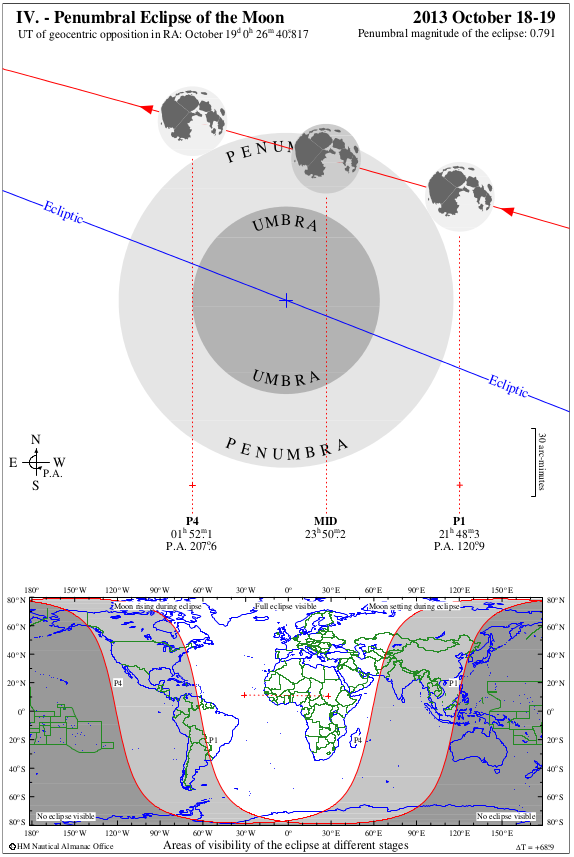
Penumbral Eclipse of October 18-19. Times on this chart are Universal Time. The times in the post above are Eastern Daylight Time. Credit: H M Nautical Almanac Office, UK.
Note: The moon has to dip into the Umbra for the eclipse to be a partial or total eclipse. In the world map above Michigan is in the partially shaded part of the diagram, where the eclipse starts before the moon rises. The darker shaded portions of the earth cannot see the eclipse at all.
12/09/11 – Ephemeris – Glimpse a piece of a lunar eclipse tomorrow morning
Friday, December 9th. The sun will rise at 8:07. It’ll be up for 8 hours and 55 minutes, setting at 5:02, the earliest sunset of the year. The moon, 1 day before full, will set at 8:08 tomorrow morning.
There will be an eclipse of the moon tomorrow, however we will get a chance to spot the very beginning of the partial phase. The eclipse will be best seen in the western United States, Australia and most of Asia. The partial phase starts at 7:46 a.m. with the moon low in the west northwest. The sun will rise about the time the moon will set. That will occur at 8:09 a.m., give or take a few minutes depending where you are in northern Michigan. It will have to be really crystal clear to see this at all. Next year we’ll see the tail end of an eclipse of the sun as it sets on May 20th. And we’ll see partial eclipse of the moon on June 4th. The next evening we’ll have the rare transit of Venus which won’t reoccur for over 100 years.
* Times, as always are for the Traverse City/Interlochen area of Michigan.
Addendum
More Information here: http://eclipse.gsfc.nasa.gov/OH/OHfigures/OH2011-Fig06.pdf
Update
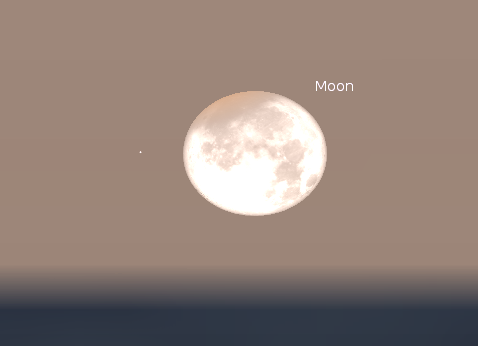
Lunar Eclipse at 8 a.m. December 10, 2011. Created using Stellarium.
06/15/11 – Ephemeris – The bright planets for this week and a Lunar Eclipse
Wednesday, June 15th. Today the sun will be up for 15 hours and 32 minutes, setting at 9:29. The moon, at full today, will rise at 9:35 this evening. Tomorrow the sun will rise at 5:56.
It’s Wednesday and time again to take a look at the whereabouts of the bright planets. The ringed planet Saturn will be visible in the south southwest as it gets dark. It’s near the bright star Spica to its lower left. Spica has a blue tinge, while Saturn is yellowish. It will set at 2:44 a.m. Saturn is a wonderful sight is a telescope with its rings. Jupiter will rise at 3:19 a.m. in the east. Mars will rise at 4:19. Venus now rises too close to sunrise to be seen in the twilight as is Mercury. There will be a total lunar eclipse this afternoon our time, making it completely invisible from here. However it will be perfectly visible from Asia where among others my grandson Chris is serving as a Marine. I’ve emailed him the times which are also available on the Ephemeris Blog.
* Times are for the Traverse City/Interlochen area of Michigan. They may be different for your location.
Addendum
Here’s the poop on the Total Lunar Eclipse on the night of the 15th-16th.
I’m giving the timings in both Universal Time (UT), also known as Greenwich Mean Time (GMT) or Zulu and Afghanistan Standard Time (AST) (UT+4.5 hours).
Event                             UT            AST
Partial Eclipse Starts        15th 18:22     15th 22:52
Total Phase Starts            15th 19:22     15th 23:52
Total Phase Ends              15th 21:03     16th 01:33
Partial Eclipse Ends          15th 02:02     16th 02:32
The moon will enter the earth’s shadow from right to left.
During the total phase of the eclipse (we call it totality), the moon will probably appear red in color with gray near the edge of the earth’s shadow.
If you were on the moon, looking back at the earth at maximum eclipse the earth will appear as a red ring, the total of all the sunrises and sunsets around the earth.
06/15/11 – Ephemeris – The bright planets this week and a total lunar eclipse for Asia
Wednesday, June 15th. Today the sun will be up for 15 hours and 32 minutes, setting at 9:29. The moon, at full today, will rise at 9:35 this evening. Tomorrow the sun will rise at 5:56.
It’s Wednesday and time again to take a look at the whereabouts of the bright planets. The ringed planet Saturn will be visible in the south southwest as it gets dark. It’s near the bright star Spica to its lower left. Spica has a blue tinge, while Saturn is yellowish. It will set at 2:44 a.m. Saturn is a wonderful sight is a telescope with its rings. Jupiter will rise at 3:19 a.m. in the east. Mars will rise at 4:19. Venus now rises too close to sunrise to be seen in the twilight as is Mercury. There will be a total lunar eclipse this afternoon our time, making it completely invisible from here. However it will be perfectly visible from Asia where among others my grandson Chris is serving as a Marine. I’ve emailed him the times which are also available on the Ephemeris Blog.
* Times are for the Traverse City/Interlochen area of Michigan. They may be different for your location.
Addendum
See http://eclipse.gsfc.nasa.gov/OH/OHfigures/OH2011-Fig03.pdf.
I’m giving the timings in both Universal Time (UT), also known as Greenwich Mean Time (GMT) or Zulu and Afghanistan Standard Time (AST) (UT+4.5 hours)
Event                         UT                  AST
Partial Eclipse Starts    15th 18:22            15th 22:52
Total Phase Starts        15th 19:22            15th 23:52
Total Phase Ends          15th 21:03            16th 01:33

Partial Eclipse Ends      15th 02:02            16th 02:32
The moon will enter the earth’s shadow from right to left.
During the total phase of the eclipse (we call it totality), the moon will probably appear red in color with gray near the edge of the earth’s shadow.
If you were on the moon, looking back at the earth at maximum eclipse the earth will appear as a red ring, the total of all the sunrises and sunsets around the earth.
 Bob Moler's Ephemeris Blog