Archive
11/18/2013 – Ephemeris – Mercury is visible in the morning near Comet ISON
Ephemeris for Monday, November 18th. The sun will rise at 7:43. It’ll be up for 9 hours and 28 minutes, setting at 5:11. The moon, 1 day past full, will rise at 6:12 this evening.
The planet Mercury is now visible in the morning sky rising at 5:59 a.m. While Mercury is only 19 and a half angular degrees from the sun its direction is closer to the vertical than Venus and the other planets are in the evening sky. That situation will change in 3 months when evening planets will be favored. The star Spica will be above and right of Mercury, along with Comet ISON which will be nine moon diameters below and right of Spica, about a third of the way to Mercury tomorrow. Comet ISON will rise at 5:19 tomorrow morning. Morning twilight will begin at 6:08 tomorrow morning, but remember the moon will still be nearly full so the sky won’t be really dark before twilight begins. The Moon is light pollution you can’t get around.
Times are for the Traverse City/Interlochen area of Michigan. They may be different for your location.
Addendum
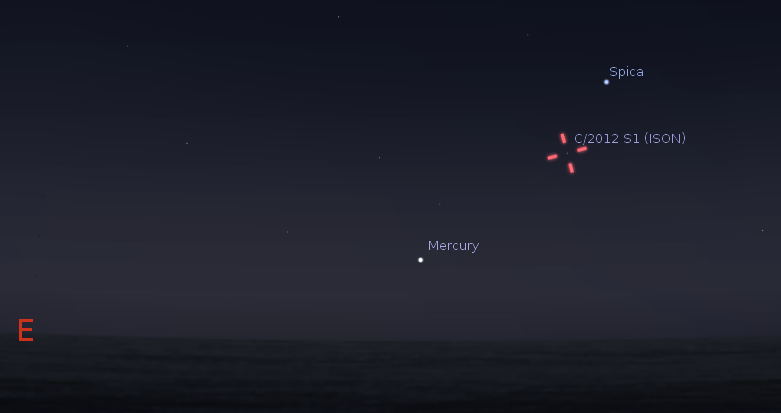
Mercury and Comet ISON at 6:30 a.m. on November 19, 2013. Created using Stellarium.
Comet ISON’s tail may be visible to the naked eye or in binoculars after it’s outburst last Thursday night. The comet may be able to live up to its advance billing after all.
07/30/2013 – Ephemeris – Mercury appears in the morning
Ephemeris for Tuesday, July 30th. The sun rises at 6:27. It’ll be up for 14 hours and 43 minutes, setting at 9:10. The moon, 1 day past last quarter, will rise at 1:23 tomorrow morning.
Mercury is joining the morning planets Jupiter and Mars now. This morning is the time of its greatest elongation or separation from the sun of 20 degrees, but this planet will actually brighten as it starts its journey back around the sun. Mercury’s phase at greatest elongation is half illuminated. As it moves back around the sun the phase becomes fuller. To find Mercury it’s best to use binoculars. At around 5:30 look to the east northeast on a very low horizon. First locate Jupiter, the brightest and highest of the three. Then look below for reddish Mars. Once found, Mercury can be located by extending a line one and a half times further than Mars. These planets can be seen until 6 a.m. or a bit later.
Times are for the Traverse City/Interlochen area of Michigan. They may be different for your location.
Addendum
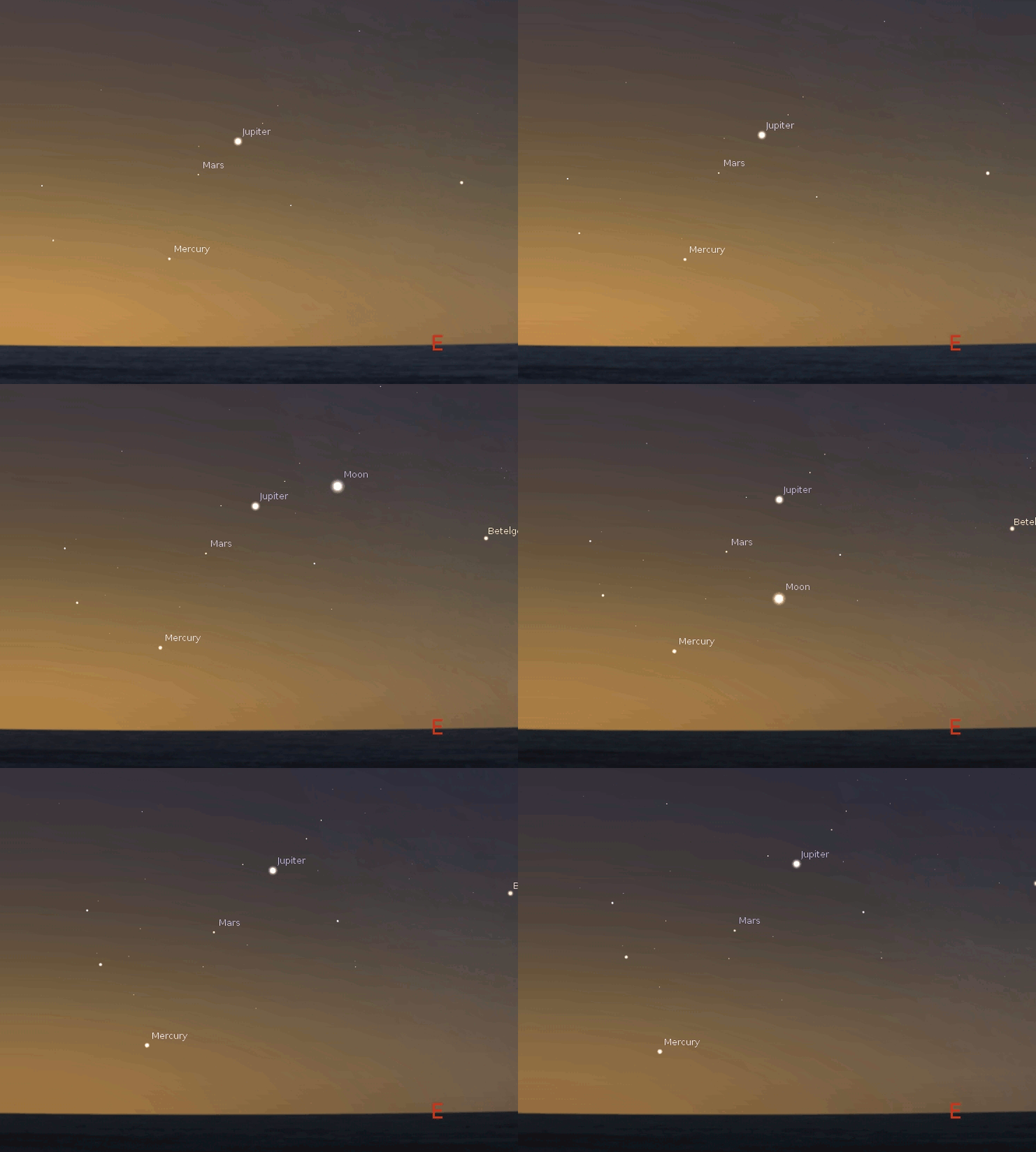
Animation of Mercury, Mars and Jupiter at one day intervals from July 31 to August 7, 2013 at 5:45 a.m. Created using Stellarium and the GIMP. Click to enlarge and animate.
2/11/2013 – Ephemeris – The moon will appear near Mercury tonight
Ephemeris for Monday, February 11th. The sun will rise at 7:48. It’ll be up for 10 hours and 17 minutes, setting at 6:05. The moon, 1 day past new, will set at 8:09 this evening.
Mercury will appear below the skinny crescent moon tonight shortly after sunset. The best time to spot them is about 6:45 p.m. looking very low to the west southwestern horizon. Binoculars as always are a real help in picking them out of the evening twilight. Mercury will appear about 6 degrees or 12 moon widths below the moon. They will be actually at their closest appearance this afternoon, and will have separated a bit before we will get to see them. As a rule of thumb, the moon will move its diameter against the stars in an hour’s time. Mercury’s got its thing going too. In 5 days it will be at greatest elongation or apparent angle of separation from the sun of about 18.1 degrees. At about the same time Mercury will actually pass its closest to the sun.
Times are for the Traverse City/Interlochen area of Michigan. They may be different for your location.
Addendum
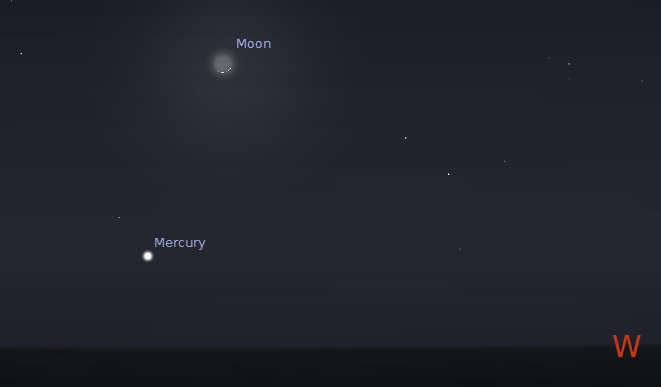
Mercury and the moon at 7:15 p.m. on February 11, 2013. Created using Stellarium. Note a one day old moon doesn’t show well in this view.
12/04/2012 – Ephemeris – Mercury in the morning
Ephemeris for Tuesday, December 4th. The sun will rise at 8:02. It’ll be up for 8 hours and 59 minutes, setting at 5:02. The moon, 2 days before last quarter, will rise at 10:59 this evening.
The planet Mercury has joined the morning planets for a week or so. Mercury can be best spotted low in the east southeast starting about 7 a.m. It will be below and slightly left of Venus, the brightest planet, about the same distance below as Saturn is above Venus. They’re just about in straight line. Binoculars will help in the search. Once found Mercury may be tracked past 7:30. Mercury will be visible for about a week as become somewhat brighter as it does. That’s because Mercury’s phase at its half illuminated today at its greatest elongation from the sun. It will be becoming more and more full as it moves around the sun mostly away from us now. Mercury is a prise, few people have ever seen it.
Times are for the Traverse City/Interlochen area of Michigan. They may be different for your location.
Addendum
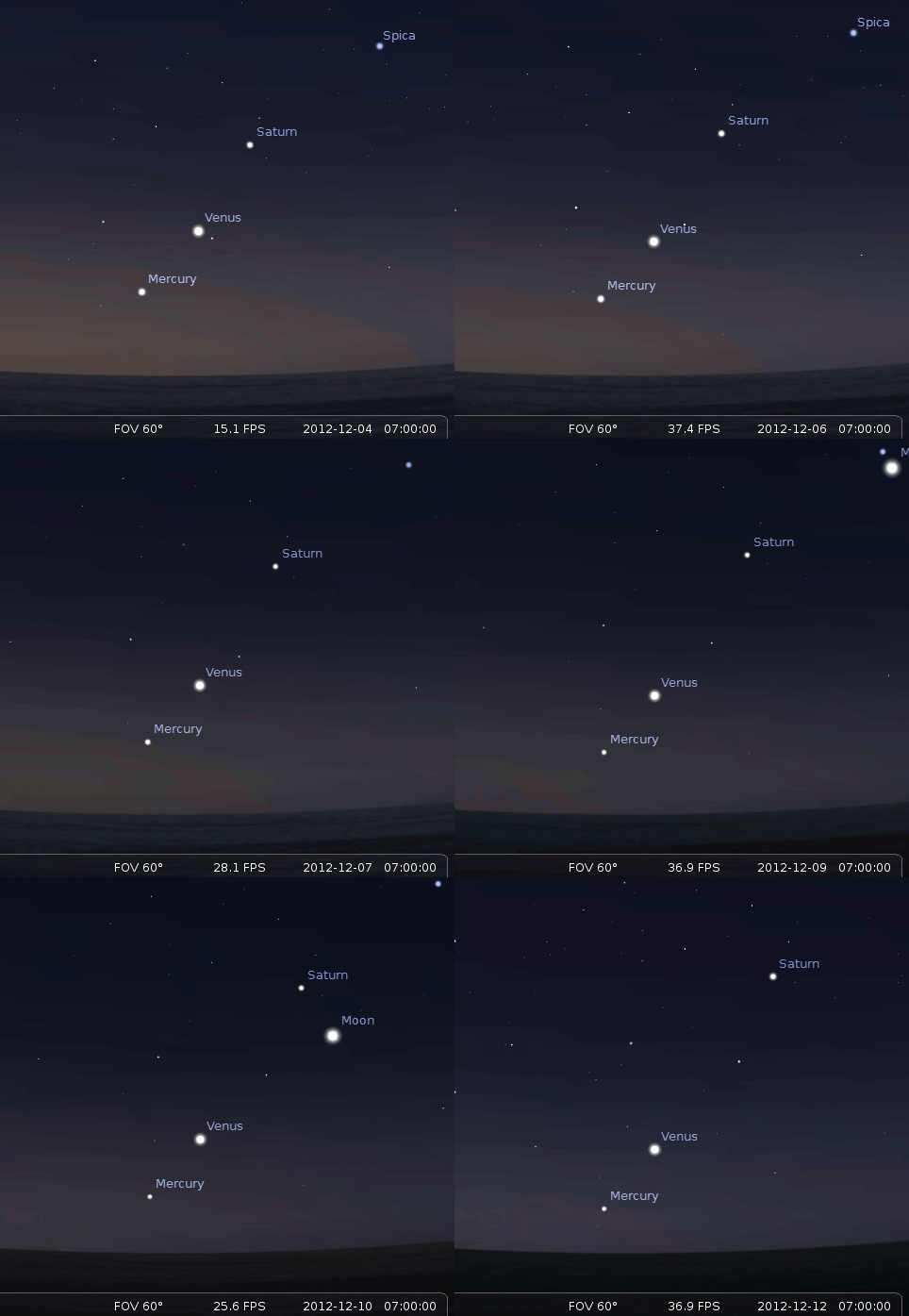
Mercury animation starting December 4, 2012. Created using Stellarium
Note the passage of the moon on the mornings of the 10th and 11th. The moon will actually be a thin crescent.
05/25/2012 – Ephemeris – Of conjunctions, superior and inferior
Ephemeris for Friday, May 25th. Today the sun will be up for 15 hours and 10 minutes, setting at 9:14. The moon, 3 days before first quarter, will set at 12:45 tomorrow morning. Tomorrow the sun will rise at 6:03.
The planet Mercury will pass the behind the sun this weekend, in what is called superior conjunction. It is called that because Mercury is beyond or superior to the sun. Venus and Mercury can have both superior and inferior conjunctions because they are inferior planets, not a statement of their quality, but simply because they reside in orbits between the earth and the sun. A conjunction occurs when two solar system bodies pass each other from our point of view. Anyway Mercury will slowly move into our evening sky and by July first might be glimpsed in evening twilight. Mercury can be seen near its greatest elongations or separations from the sun on spring evenings and autumn mornings. July will push it a bit.
Times are for the Traverse City/Interlochen area of Michigan. They may be different for your location.
03/14/2012 – Ephemeris – Where are the bright planets this week?
Wednesday, March 14th. The sun will rise at 7:55. It’ll be up for 11 hours and 52 minutes, setting at 7:47. The moon, at last quarter today, will rise at 3:35 tomorrow morning.
Let’s see what’s happening with the bright planets for this week. Mercury will make a brief appearance in the west after sunset. It will set at 8:54. Venus and Jupiter are brilliant in the western sky after sunset. Jupiter will be just below left of Venus, the brighter planet. Jupiter will set first at 11:40 p.m. followed by Venus at 11:53. Mars is up in the east in the evening with its unmistakable bright reddish color. It’s in the constellation Leo the lion now. It is 63.5 million miles and moving away. Mars will pass due south at 1:04 a.m. and will be setting in the west near sunrise. Saturn will rise at 10:31 p.m. just to the left of the bright star Spica in the east southeast.
* Times are for the Traverse City/Interlochen area of Michigan. They may be different for your location.
Addendum
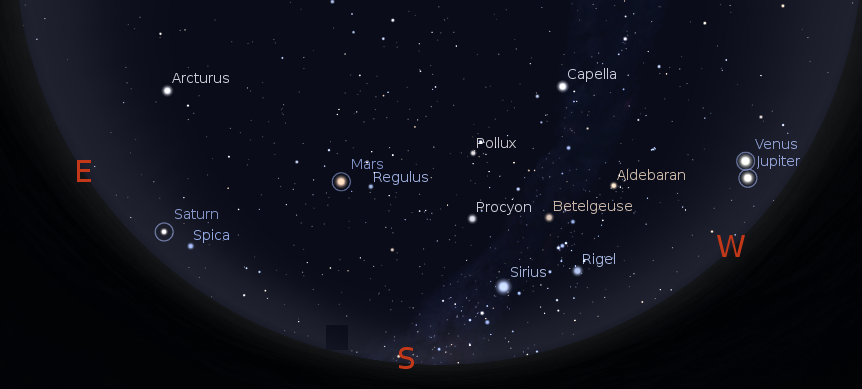
The planets at 11 p.m. March 14, 2012. Created using Stellarium.
03/06/2012 – Ephemeris – Comparing Mercury with the moon
Ephemeris for Tuesday, March 6th. The sun will rise at 7:10. It’ll be up for 11 hours and 27 minutes, setting at 6:37. The moon, 2 days before full, will set at 6:18 tomorrow morning.
The planet Mercury, which is visible shortly after sunset, is the smallest planet and the one closest to the sun. Its diameter of about 3,030 miles is 50 percent larger than the moon. At first glance Mercury looks like the moon. However to the spacecraft now orbiting Mercury, it appears as a much different place. Mercury is very dense with a large iron core. The moon in contrast is a lightweight. There are no dark lava plains called seas on Mercury, as there are on the near face of the moon. The largest impact basin on Mercury is the Caloris basin, some 650 miles in diameter. At the antipodal point from the Caloris Basin, there is a patch of jumbled terrain actually called Weird Terrain where the impact forces were focused.
* Times are for the Traverse City/Interlochen area of Michigan. They may be different for your location.
03/05/2012 – Ephemeris – Mars closest and Mercury at greatest elongation from the sun
Ephemeris for Monday, March 5th. The sun will rise at 7:12. It’ll be up for 11 hours and 24 minutes, setting at 6:36. The moon, 3 days before full, will set at 5:48 tomorrow morning.
The planet Mars is at its closest to the earth of this time around today. The distance is 62.6 million miles. All planets have elliptical orbits. The Earth varies its distance from the sun by 3 million miles. Mars has a remarkably elliptical orbit which varies its distance from the sun by nearly 30 million miles. It is now at its farthest from the sun. Another small planet is making its appearance in the evening sky now. That’s Mercury seen low in the west after sunset, much closer to the horizon than bright Venus and Jupiter. Mercury is at its greatest apparent distance or elongation from the sun. Mercury will set at 8:14 p.m. It is hard to spot in twilight, so binoculars will help. Like Mars Mercury’s orbit is also very elliptical.
* Times are for the Traverse City/Interlochen area of Michigan. They may be different for your location.
Addendum
The southern sky with the planets at 7:15 p.m. Created using Stellarium.
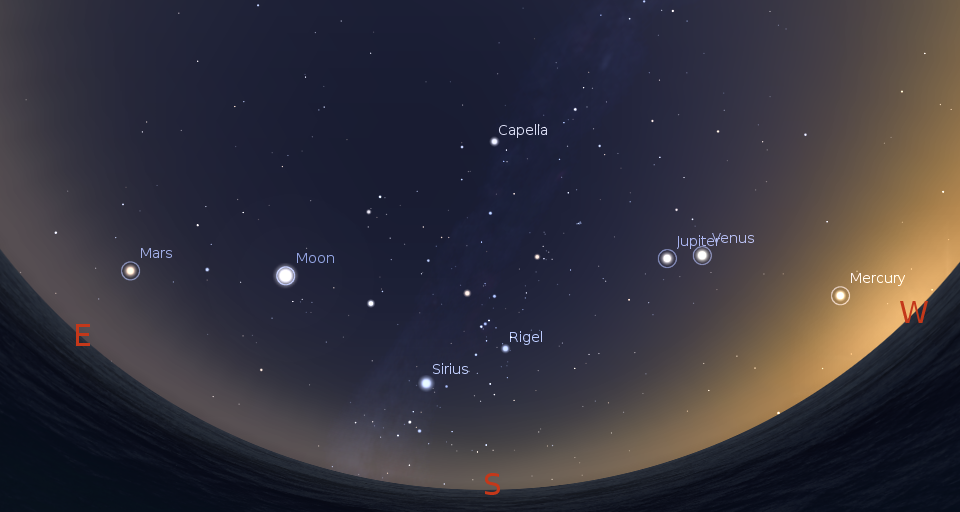
The sky after sunset showing all the evening planets. Created using Stellarium.
Click on the image to enlarge.
09/14/11 – Ephemeris – The bright planets visible this week
Wednesday, September 14th. The sun will rise at 7:19. It’ll be up for 12 hours and 35 minutes, setting at 7:55. The moon, 2 days past full, will rise at 8:29 this evening.
It’s Wednesday and time again to take a look at the whereabouts of the bright planets. The planet Venus is rather close to the sun in the evening setting 23 minutes after the sun and not really visible. The ringed planet Saturn is not really visible in the west in evening twilight. It will set 45 minutes after the sun. Jupiter is now the prominent planet of the evening sky after it rises at 9:41 p.m. in the east northeast and is seen against the stars of the constellation Aries now. It will be accompanied by its 4 brightest moons. Mars will rise at 2:31 a.m also in the east northeast and is now between the constellation Gemini and Cancer. Mercury is briefly visible now from about half an hour after its rising in the east at 6:17 until about 7 a.m.
* Times are for the Traverse City/Interlochen area of Michigan. They may be different for your location.
09/07/11 – Ephemeris – The bright planets visible this week
Wednesday, September 7th. The sun will rise at 7:11. It’ll be up for 12 hours and 56 minutes, setting at 8:08. The moon, 3 days past first quarter, will set at 3:23 tomorrow morning.
It’s Wednesday and time again to take a look at the whereabouts of the bright planets. The ringed planet Saturn will be barely visible in the west southwest in evening twilight. It’s near the bright star Spica to its left. Spica has a blue tinge, while Saturn is yellowish. It will set at 9:25 p.m. Because we are seeing Saturn in evening twilight now its image is being deteriorated by the earth’s atmosphere being low in the sky. Jupiter will rise at 10:10 p.m. in the east northeast and is seen against the stars of the constellation Aries now. Mars will rise at 2:36 a.m also in the east northeast and is now passing through the constellation Gemini the twins. Mercury is briefly visible now from about half an hour after its rising in the east at 5:43 until about 20 minutes before sunrise.
* Times are for the Traverse City/Interlochen area of Michigan. They may be different for your location.
 Bob Moler's Ephemeris Blog