Archive
07/01/2014 – Ephemeris – July 2014 Preview
Ephemeris for Tuesday, July 1st. Today the Sun will be up for 15 hours and 30 minutes, setting at 9:31. The Moon, half way from new to first quarter, will set at 11:42 this evening. Tomorrow the sun will rise at 6:01.
Lets preview July’s skies. The sun, having reached its northern solstice, is beginning to slide southward again, at first imperceptibly, then with greater speed. The daylight hours will decrease from 15 hours and 30 minutes today to 14 hours 41 minutes at month’s end. The daylight hours will be slightly shorter south of Interlochen, and slightly longer to the north. The altitude of the sun at local noon, when the sun is due south will decrease from 68 degrees today to 63 degrees at month’s end. The sun will be a degree lower in the Straits area. Despite the warmth, the earth will reach its greatest distance from the sun on Thursday the 3rd. The planets visible this month in the evening are Mars and Saturn.
Times are for the Traverse City/Interlochen area of Michigan. They may be different for your location.
Addendum
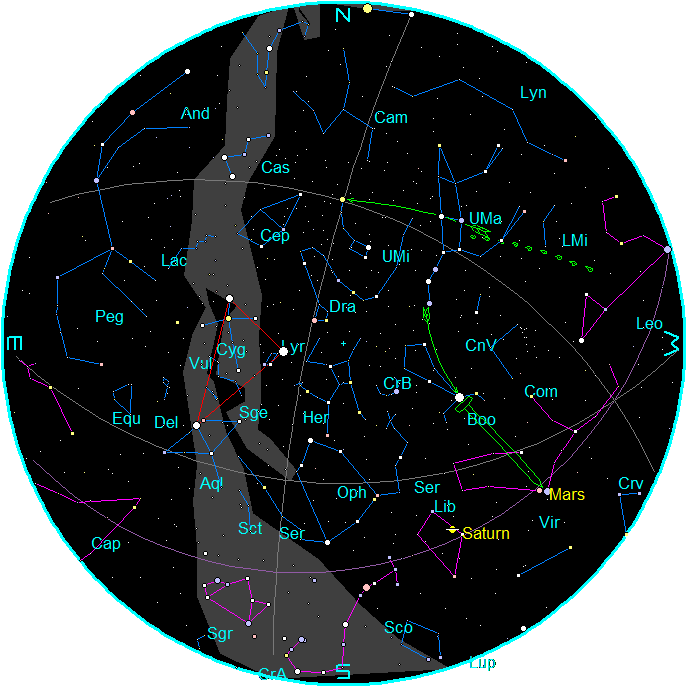
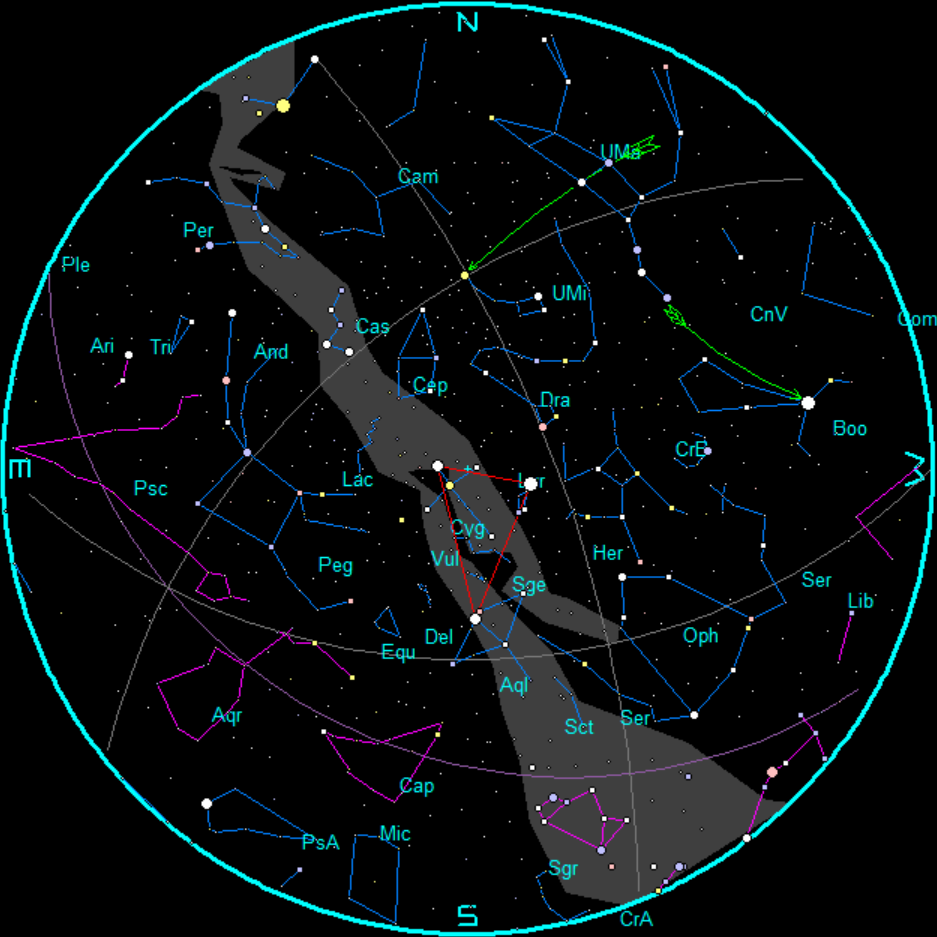
July star chart for 11 p.m. on July 15, 2014. Created by my LookingUp program.
Astronomical twilight ends at 11:58 p.m. on July 1st, decreasing to 11:13 on the 31st.
Add a half hour to every week before the 15th and subtract and hour for every week after the 15th.
For a list of constellation names to go with the abbreviations click here.
Also shown is the Summer Triangle in red. Clockwise from the top star is Deneb in Cygnus, Vega in Lyra and Altair in Aquila.
The green pointers from the Big Dipper are:
- Pointer stars at the front of the bowl of the Big Dipper point to Polaris the North Star.
- The leaky bowl drips on the back of Leo the lion.
- The arc of the dipper’s handle points to Arcturus.
- The straighten the ark to a spike to point to Spica.
05/30/2014 – Ephemeris – Previewing June skies or Where’d the night go?
Ephemeris for Friday, May 30th. Today the sun will be up for 15 hours and 17 minutes, setting at 9:18. The moon, 2 days past new, will set at 10:51 this evening. Tomorrow the sun will rise at 6:01. | Let’s preview June skies. There will be a lot of sun in June and very little night. The daylight hours will increase a bit from 15 hours and 20 minutes Sunday to 15 hours and 33 minutes on the 21st, retreating back to 15 hours 30 minutes at month’s end. The altitude of the sun above the southern horizon at local noon will hover around 68 to 69 degrees. Local noon, when the sun is actually due south will occur at about 1:43 p.m. Summer begins on the 21st at 6:52 a.m. when the sun reaches its farthest north. The actual amount of night-time will be quite short mostly due to the length of daylight, but also because twilight last much longer than average because the sun sets at a shallow angle. On the 21st there’s only 3 ½ hours of total darkness, starting after midnight.
Times are for the Traverse City/Interlochen area of Michigan. They may be different for your location.
Addendum
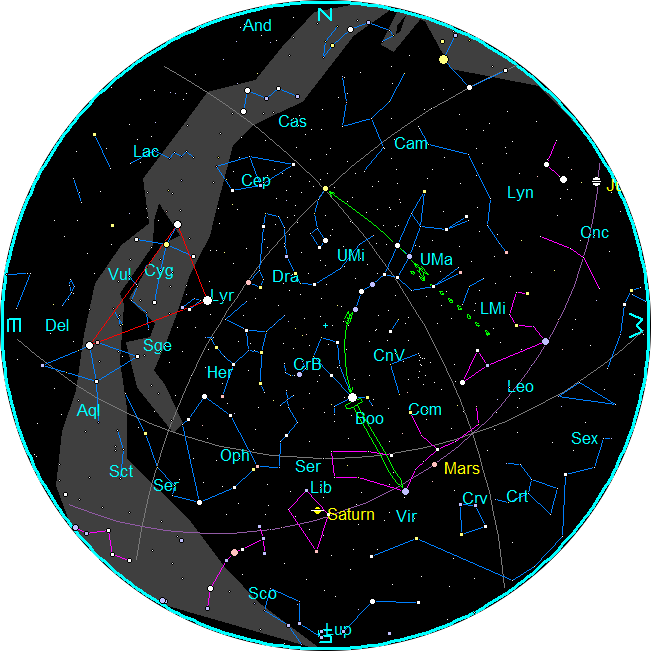
June star chart for 11 p.m. on June 15, 2014. Created by my LookingUp program.
Astronomical twilight ends about midnight in June.
Add a half hour to every week before the 15th and subtract and hour for every week after the 15th.
For a list of constellation names to go with the abbreviations click here.
Also shown is the Summer Triangle in red. Clockwise from the top star is Deneb in Cygnus, Vega in Lyra and Altair in Aquila.
The green pointers from the Big Dipper are:
- Pointer stars at the front of the bowl of the Big Dipper point to Polaris the North Star.
- The leaky bowl drips on the back of Leo the lion.
- The arc of the dipper’s handle points to Arcturus.
- The straighten the ark to a spike to point to Spica.
05/01/2014 – Ephemeris – Previewing May skies
Ephemeris for Thursday, May 1st. The sun rises at 6:32. It’ll be up for 14 hours and 14 minutes, setting at 8:47. The moon, 2 days past new, will set at 11:21 this evening.
Today we will start the month when the promise of spring is finally fulfilled, we hope. Daylight hours in the Interlochen/Traverse City area will increase from 14 hours and 14 minutes today to 15 hours 18 minutes on May 31st. The altitude, or angle, of the sun above the southern horizon at local noon will ascend from 60 degrees today to 67 degrees at month’s end. The altitude of the sun in the Straits area will be a degree lower than that but your length of daylight will be a few minutes longer. Local apparent noon this month, when the sun passes due south, will be about 1:38 p.m. The Eta Aquarid meteor shower will reach its peak about 2 a.m. this Sunday morning the 4th. I’ll have more on my blog bobmoler.wordpress.com today.
Times are for the Traverse City/Interlochen area of Michigan. They may be different for your location.
Addenda
The Eta Aquarid Meteor Shower
This shower is associated with Halley’s Comet. We see two meteor showers from Halley’s comet. One in October where the comet debris is crossing the earth’s orbit heading toward the sun, and again as its leaving. This shower is caused by the debris leaving the vicinity of the sun.
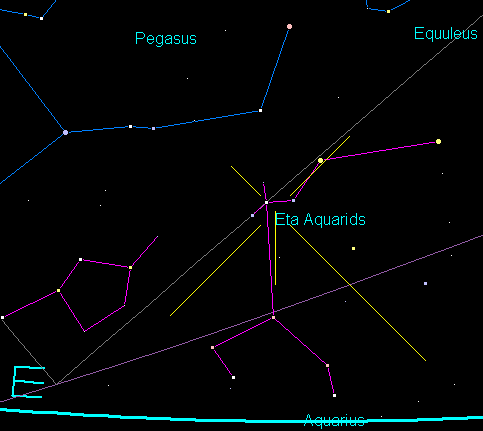
The Eta Aquarid radiant at the peak of the shower. The radiant moves slowly to the east with time. Credit: Bob Moler’s LookingUp program.
The peak of the shower will be at 7 h UT on May 6th. That’s 3 a.m. EDT, about 20 minutes before the radiant will rise. This will give about one hour before astronomical twilight starts to view the meteor shower in completely dark skies.
Possible Meteor Storm – May 24
There will be the possibility of a meteor storm on the morning of May 24th. A meteor storm differs from a meteor shower in the numbers of meteors seen and duration. There is a possibility of up to 400 meteors per hour for the hours of 7h to 8h UT (3 to 4 a.m. EDT).
The body responsible is Comet 209P/LINEAR. It was the 209th periodic comet discovered on February 3, 2004 by Lincoln Near-Earth Asteroid Research (LINEAR). Despite the recent discovery 209P has been orbiting the sun for hundreds of years, maybe longer. This year the comet will come close to the Earth and will allow the Earth to pass through debris that it shed hundreds of years ago.
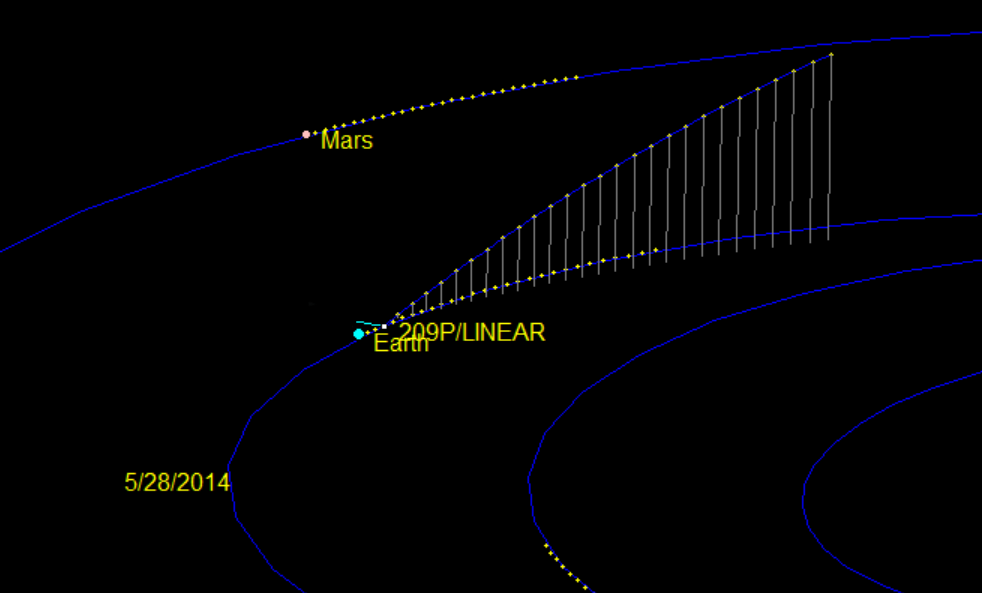
Comet 209P/LINEAR crosses the Earth’s orbit around May 28, 2014. The “stilts” on the comet’s orbit show that it is coming from north of the Earth’s orbital plane. Credit: Bob Moler’s LookingUp program.
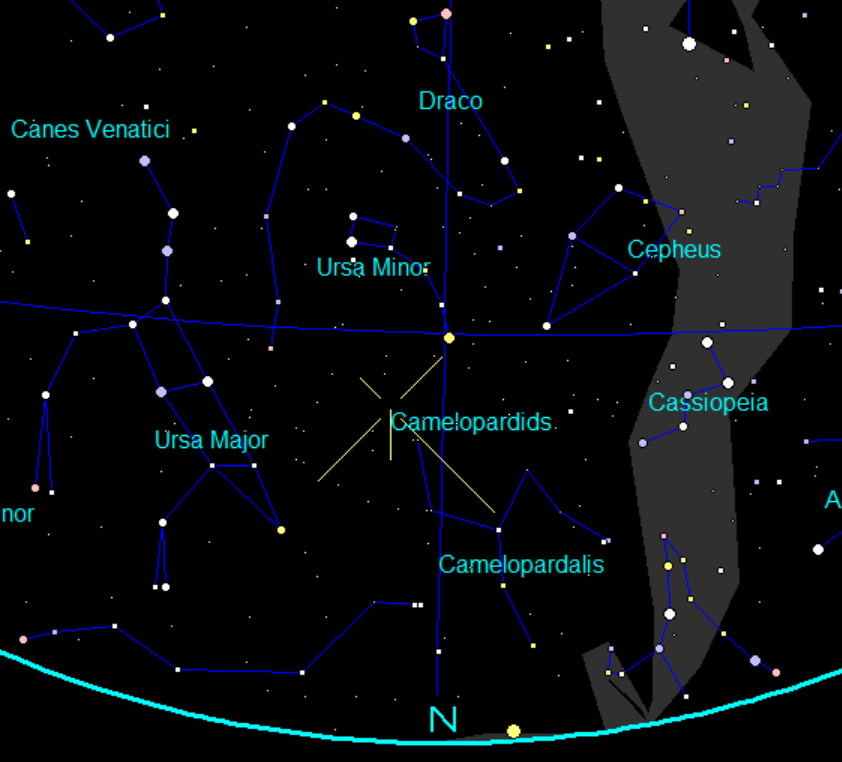
The radiant for the Comet 209P/LINEAR debris. For this purpose I’ve designated it Camelopardids (not official and probably not correct). Credit: Bob Moler’s LookingUp program. Note that the constellation of Camelopardalis is a giraffe.
Astronomical Twilight starts at 3:51 a.m., but the skies should remain dark enough. The 24% illuminated moon will rise about 2:45 or so and may not be much of an impediment in seeing the meteor storm.
May Star Chart
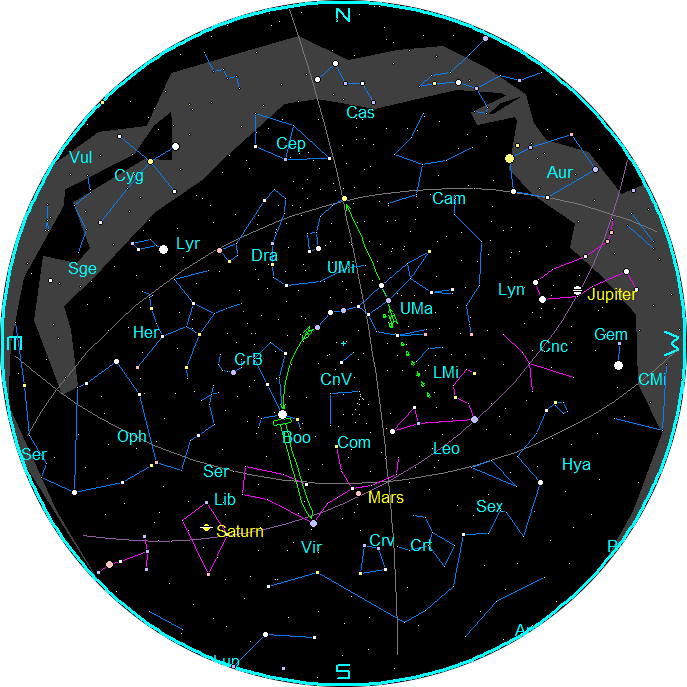
Star Chart for mid-month for May 2014 at 11 p.m. Credit: Bob Moler’s LookingUp program.
Add a half hour to every week before the 15th and subtract and hour for every week after the 15th.
For a list of constellation names to go with the abbreviations click here.
03/31/2014 – Ephemeris – Previewing April skies
Ephemeris for Monday, March 31st. The sun will rise at 7:25. It’ll be up for 12 hours and 43 minutes, setting at 8:08. The moon, 1 day past new, will set at 9:30 this evening.
The 4th month of the year begins tomorrow. Daylight hours in the Interlochen/Traverse City area and will increase from 12 hours and 46 minutes tomorrow to 14 hours 11 minutes on April 30th. The altitude, or angle, of the sun above the southern horizon at local noon will be 50 degrees tomorrow and will ascend to 60 degrees on April 30th. The altitude of the sun in the Straits area will be a degree lower. The actual time of local apparent noon this month for the Interlochen/Traverse City area, when the sun passes due south, will be about 1:43 p.m. The big event for this month will be a total lunar eclipse visible from our area in the wee hours of the morning on April 15th. It’s the first or two lunar eclipses visible from here this year. The other is in October.
Times are for the Traverse City/Interlochen area of Michigan. They may be different for your location.
Addendum
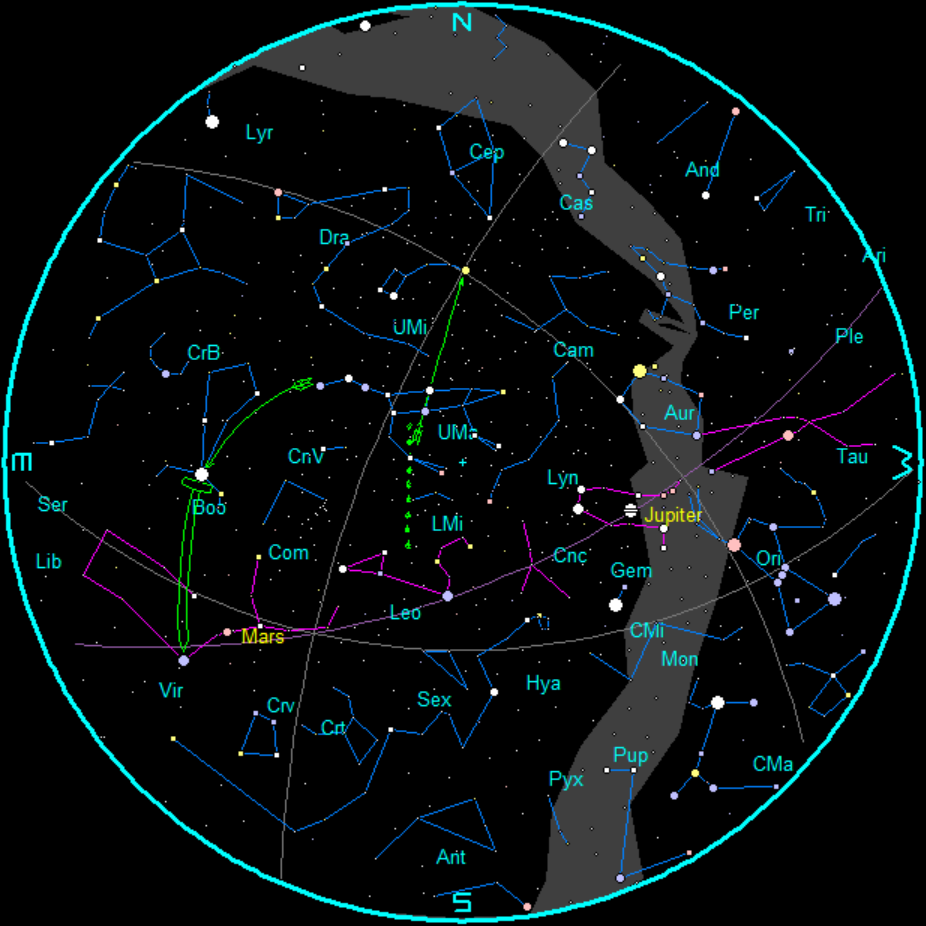
Star Chart for mid-month for April 2014 at 10 p.m. Credit: Bob Moler.
Add a half hour to every week before the 15th and subtract and hour for every week after the 15th.
For a list of constellation names to go with the abbreviations click here.
02/28/2014 – Ephemeris – Looking forward to March and spring
Ephemeris for Friday, February 28th. The sun will rise at 7:21. It’ll be up for 11 hours and 7 minutes, setting at 6:29. The moon, 1 day before new, will rise at 7:11 tomorrow morning.
Let’s look at the skies for the month of March. The sun will pass the celestial equator in March as the promising season of spring will begin. Daylight hours in the Interlochen/Traverse City area and will increase from 11 hours and 10 minutes tomorrow to 12 hours 43 minutes on the 31st. The altitude, or angle, of the sun above the southern horizon at local noon will be just under 38 degrees tomorrow and will ascend to nearly 50 degrees on the 31st. The altitude of the sun in the Straits area will be a degree lower. Local apparent noon this month, when the sun passes due south, will be about 12:49 p.m. Spring will begin on the 20th at 11:57 a.m. Eastern Daylight Time (15:57 UT), which now rules most of the year and will start a week from Sunday.
Times are for the Traverse City/Interlochen area of Michigan. They may be different for your location.
Addendum
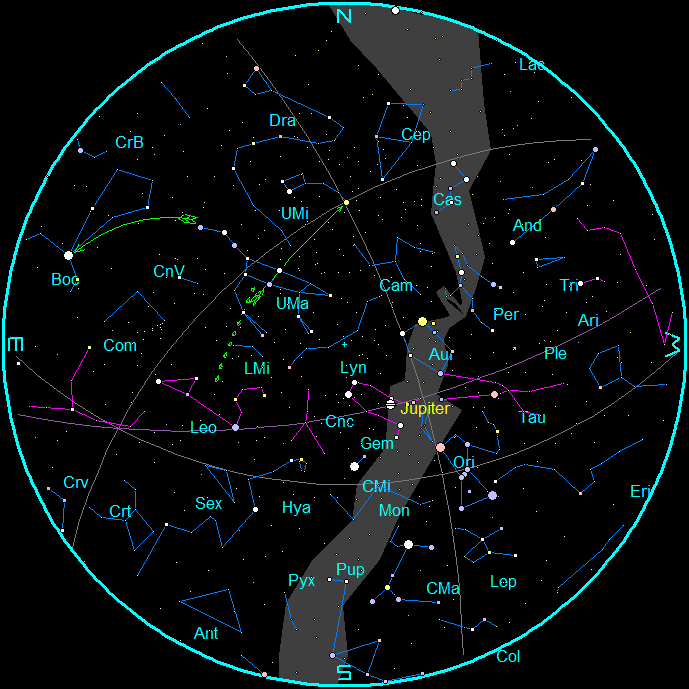
Star Chart for mid-month for March 2014 at 10 p.m. Credit: Bob Moler.
Add a half hour to every week before the 15th and subtract and hour for every week after the 15th.
For a list of constellation names to go with the abbreviations click here.
01/31/2014 – Ephemeris – Previewing February skies
Ephemeris for Friday, January 31st. The sun will rise at 8:02. It’ll be up for 9 hours and 47 minutes, setting at 5:50. The moon, 1 day past new, will set at 7:18 this evening.
Lets look ahead at the short month of February. It’s so short that this year it has no new moons. To make up for it both January and March have two. We’re in the depths of winter but the sun is continuing its return to northern climes. This is reflected in the increase in daylight hours, from 9 hours 50 minutes tomorrow to 11 hours 7 minutes on the 28th. These times are for the Interlochen/Traverse City area. Durations are slightly shorter in the northern part of our listening area and slightly longer to the south.. As the month goes on the weather should generally warm up, though this year who knows what will happen. Mercury is seen early for the next week or so and Jupiter are seen in the evening along with all the wonderful constellations of winter.
Times are for the Traverse City/Interlochen area of Michigan. They may be different for your location.
Addendum
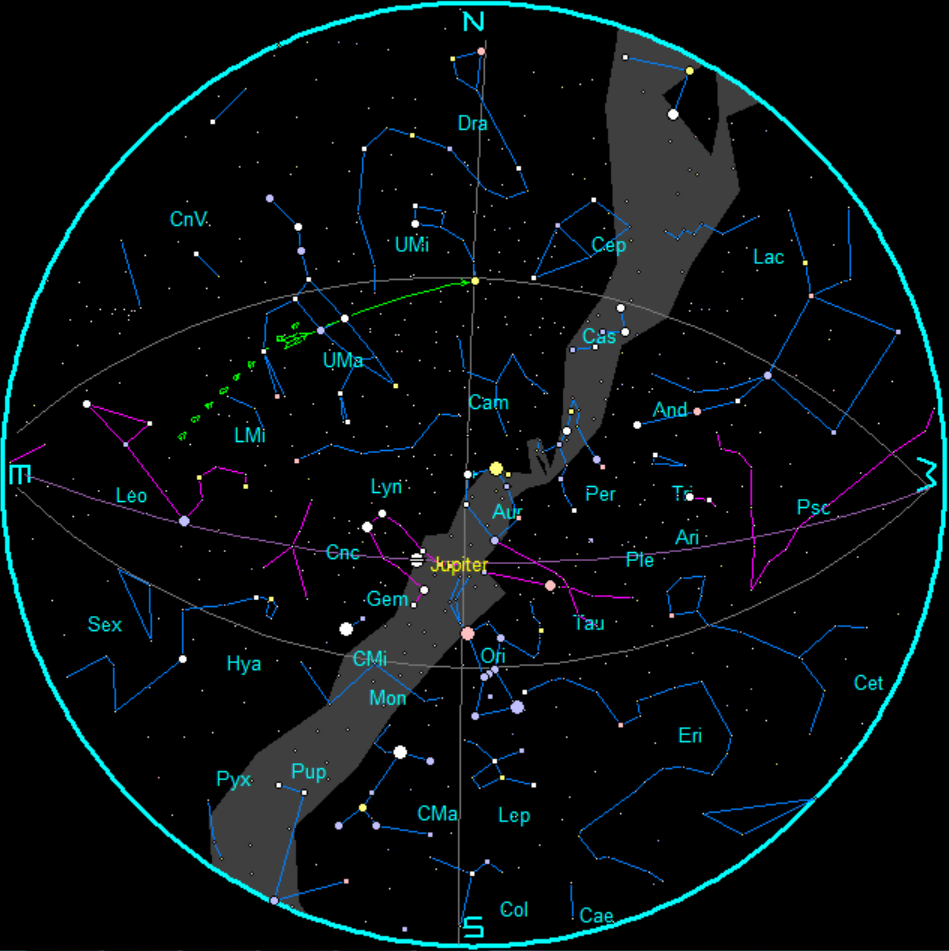
A star chart for February 15th at 9 p.m. Add a half hour to every week before the 15th and subtract and hour for every week after the 15th. Created using my LookingUp program.
For a list of constellation names to go with the abbreviations click here
01/01/2014 – Ephemeris – A look at events the month and for the next few days and the planets
Note: The two paragraphs below were aired on IPR. They are not my usual Wednesday feature on the planets which is in the addendum. The first few days of January are busy with astronomical happenings. I’ll have a preview of this year’s eclipses on Monday the 6th with the daily and an extra post.
Ephemeris for New Years Day, Wednesday, January 1st, 2014. The sun will rise at 8:19. It’ll be up for 8 hours and 53 minutes, setting at 5:13. The moon is new today, and won’t be visible.
Happy New Year. We’re too busy with astronomical events to preview the year. Today and tomorrow we’ll cover the highlights of this month. We’re a day from the latest sunrise at about the same time as today and will back down to 8:02 by the 31st. Sunset is current increasing by a minute a day and will set at 5:50 at month’s end. Listeners on the shore of Lake Michigan will have about the same sunrise time from Ludington to Mackinaw City, but the sunset times will vary markedly. Jupiter will be in opposition from the sun and rise at sunset on the 4th. This is your last week to see Venus in the evening sky. It will leave the evening sky on the 11th and enter the morning sky. Start looking for the Quadrantid meteor shower that will peak on the 3rd.
Times are for the Traverse City/Interlochen area of Michigan. They may be different for your location.
Addendum
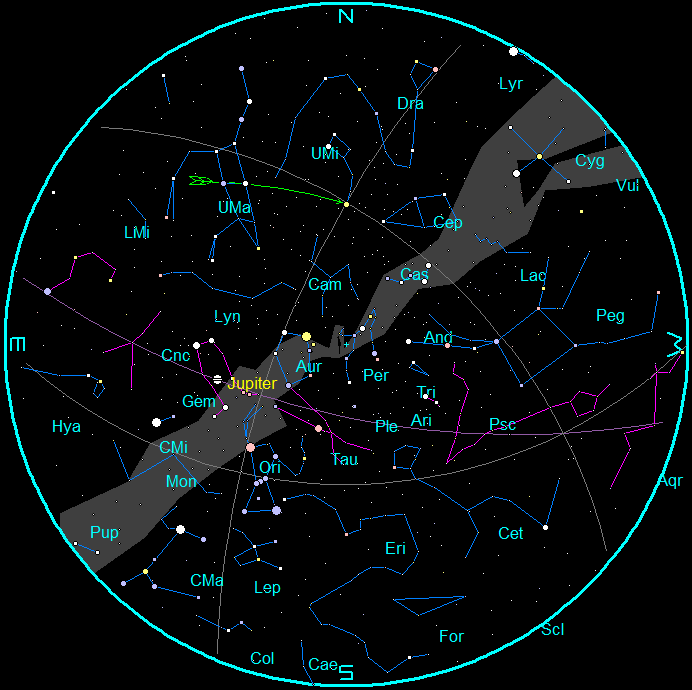
A star chart for January 15th at 9 p.m. Add a half hour to every week before the 15th and subtract and hour for every week after the 15th. Created using my LookingUp program.
For a list of constellation names to go with the abbreviations click here
This is our weekly look at the planets. Venus is brilliant in the southwest after sunset. It will set at 6:36 p.m. Venus is noticeably closing with the sun. It will be lost in the glare of the sun in less than a week. Venus is a thin crescent, and we’re at the point where the crescent can be visible in binoculars. The giant planet Jupiter will rise at 5:24 p.m. in the east northeast. It’s cruising against the stars of Gemini now. It will pass due south at 1:04 a.m. It will be in opposition from the sun on the 4th, where it will rise at sunset and set at sunrise. Mars will rise at 12:51 a.m. in the east. Reddish Mars is to the upper right of the bright star Spica in Virgo. Saturn will rise at 4:12 a.m. in the east southeast. It will be in Libra this year. The ringed planet will best be seen in the evening next summer. There is a comet visible in binoculars in the morning sky. It’s Comet Lovejoy (C/2013R1).
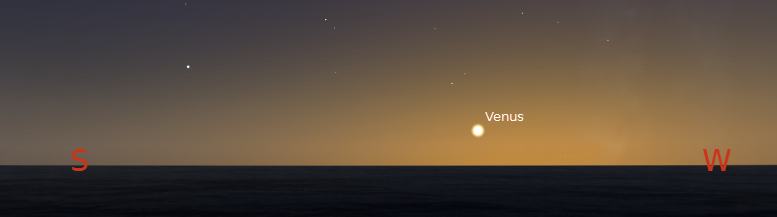
Venus in the west southwest at 6 p.m. on January 1, 2014. Venus will be harder and harder to spot between now and its inferior conjunction with the sun on the 11th. Created using Stellarium.
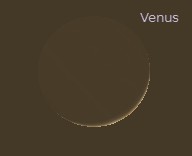
Venus’ thin crescent on January 1, 2014 at 6 p.m. The crescent will be bright but the night side will not be visible as Stellarium suggests. Created using Stellarium.
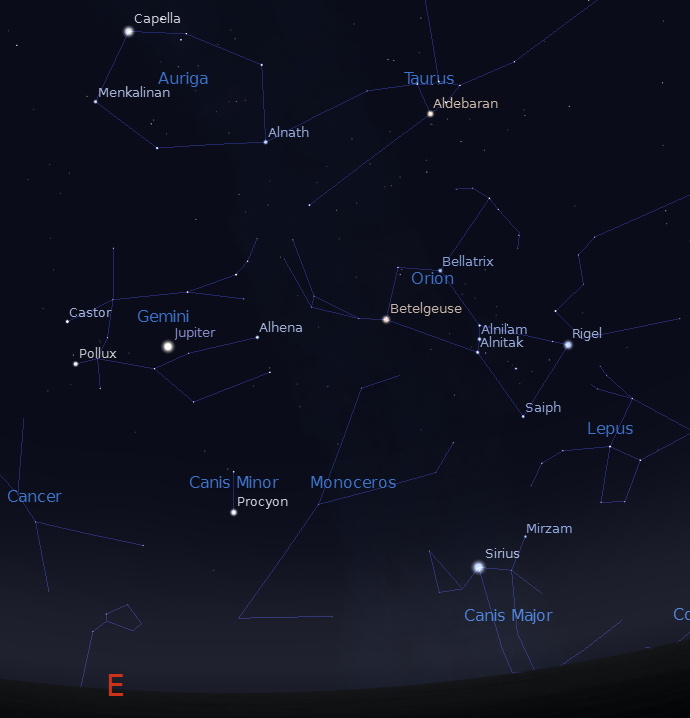
Jupiter and the constellations of winter at 9 p.m. on January 1, 2014. Created using Stellarium.
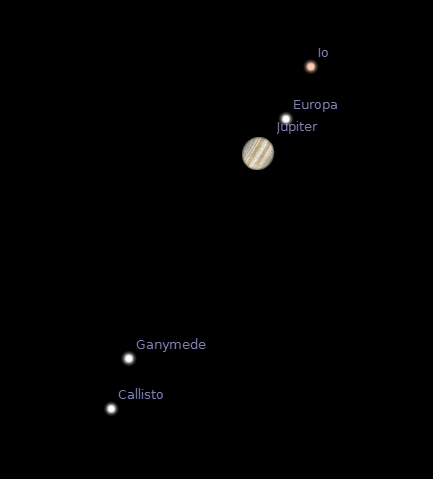
Jupiter and its satellites as seen in a telescope at 9 p.m. on January 1, 2014. That actual rotation of the image depends on the telescope. Created using Stellarium.
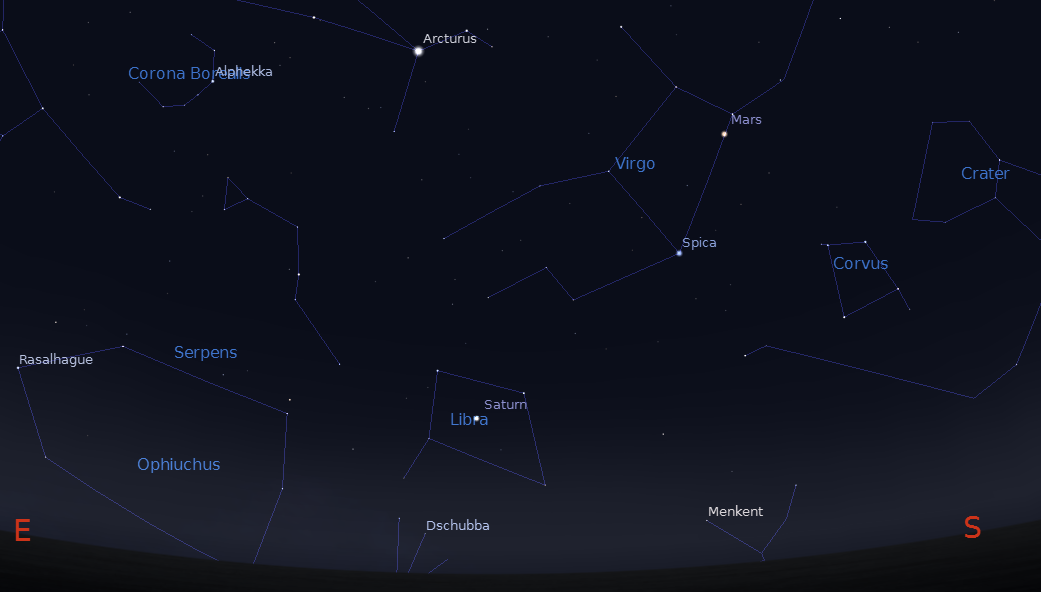
Mars and Saturn among the spring constellations at 6 a.m. January 2, 2014. Created using Stellarium.
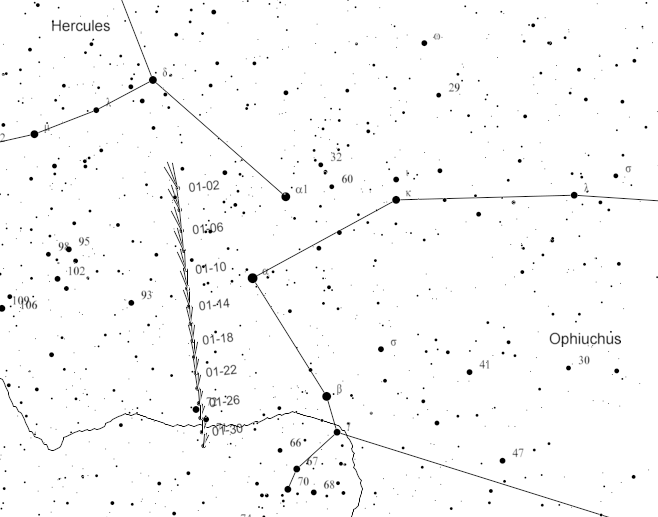
The track of Comet Lovejoy, which still should be visible in binoculars from 01/02/14 to 01/31/14 at 6:30 a.m. Created using Cartes du Ciel (Sky Charts).
10/31/2013 – Ephemeris – A look ahead at the skies of November
Ephemeris for Halloween, Thursday, October 31st. The sun will rise at 8:19. It’ll be up for 10 hours and 13 minutes, setting at 6:32. The moon, 3 days before new, will rise at 6:07 tomorrow morning.
Let’s look at the skies for the month of November. Comet ISON will continue to brighten this month, but will encounter bright twilit skies as it closes in with the sun the week of Thanksgiving. I’m hoping the comet will be visible to the naked eye by mid-month. The sun is still moving south rapidly. Daylight hours in the Interlochen/Traverse City area and will drop from 10 hours and 10 minutes tomorrow to 9 hours 5 minutes on the 30th. The altitude, or angle, of the sun above the southern horizon at local noon will be at 30 degrees tomorrow and will descend to 23 and a half degrees on the 30th. The altitude of the sun in the Straits area will be a degree lower. Local noon, this month, will be about 12:30 p.m. when standard time returns.
Times are for the Traverse City/Interlochen area of Michigan. They may be different for your location.
Addendum
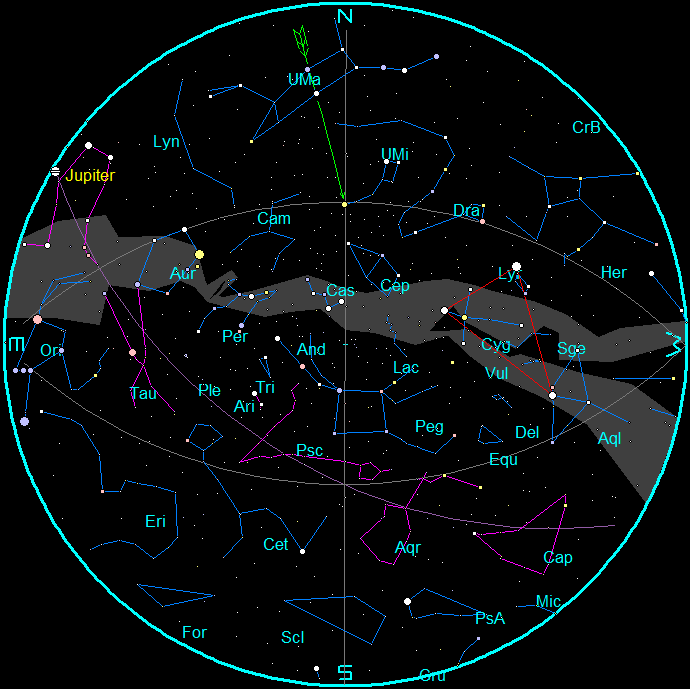
Star Chart based on 9 p.m. on November 15, 2013. Created using my program LookingUp.
The constellation abbreviations, names and bright star names are found here.
The red triangle is the Summer Triangle. The arrow through then front of the Big Dipper point to Polaris.
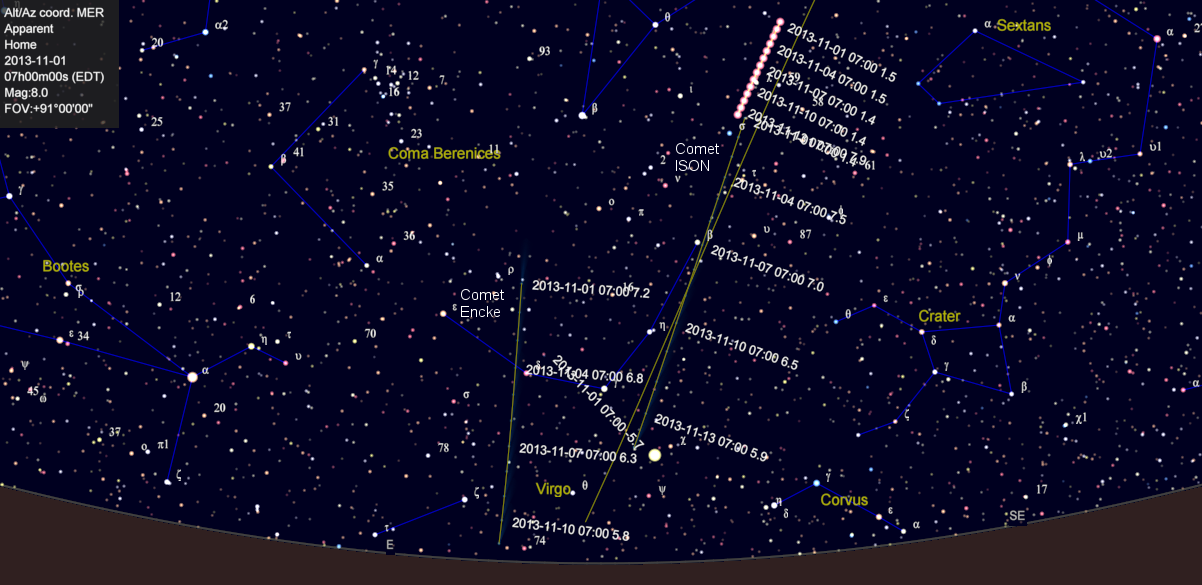
The path of Comet ISON and Comet Encke for November 1st through 14th, 2013. Created using Cartes du Ciel. Labels contain date and predicted magnitude. Click to enlarge.
Comet ISON will remain an early morning comet for November and most of December.
The oddball object with the skewed label is the moon.
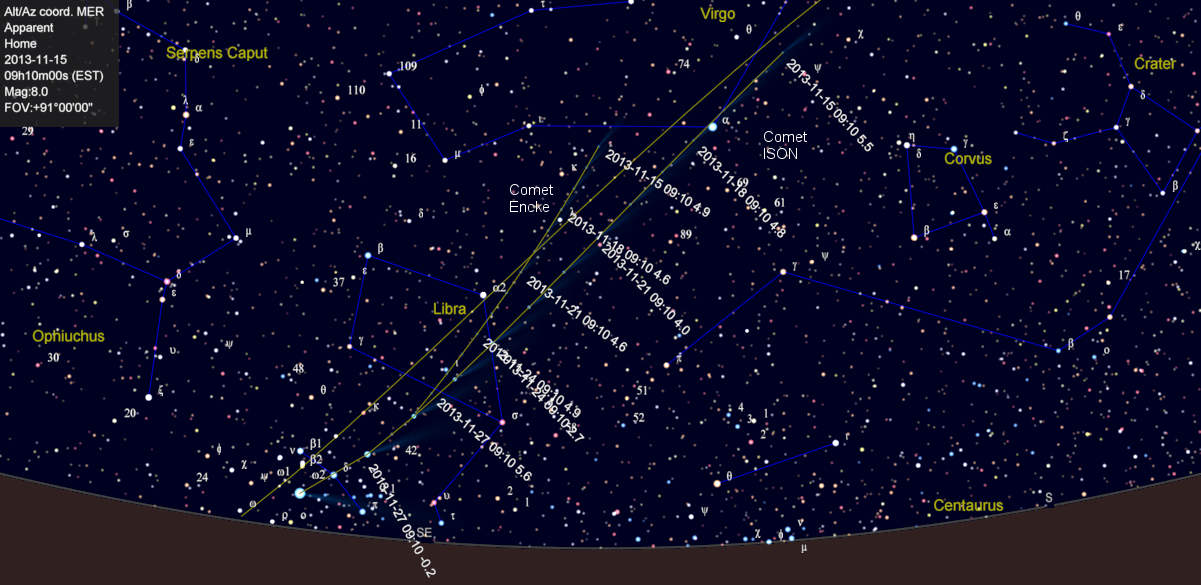
The path of Comet ISON and Comet Encke for November 15th through 28th, 2013. Created using Cartes du Ciel. The planets, Sun and Moon have been removed for clarity. Labels contain date and predicted magnitude. Click to enlarge.
The above two images are from my program Prospects for Viewing Comet ISON to be given tomorrow night at the regular meeting of the Grand Traverse Astronomical Society starting at 8 p.m. at Northwestern Michigan College’s Rogers Observatory south of Traverse City on Birmley Road.
Local school groups or clubs ca request the program by commenting to this post or emailing to info@gtastro.org.
10/01/2013 – Ephemeris – Let’s Preview October Skies
Ephemeris for Tuesday, October 1st. The sun will rise at 7:40. It’ll be up for 11 hours and 41 minutes, setting at 7:22. The moon, 3 days before new, will rise at 5:10 tomorrow morning.
Let’s look at the skies for the month of October. The sun will still be moving south rapidly. Daylight hours in the Interlochen/Traverse City area will drop from 11 hours and 41 minutes today to 10 hours 13 minutes on the 31st. The altitude of the sun above the southern horizon at local noon will be 42 degrees today, and will descend to 31 degrees on Halloween, also in the Interlochen/Traverse City area. The Straits area will have the sun a degree lower. Local noon, when the sun is due south will be about 1:30 p.m. in Interlochen/Traverse City. Comet ISON is currently about a sixth as bright as original estimates would predict. However comets can unpredictable in their brightness. So we will know for sure in two months.
Times are for the Traverse City/Interlochen area of Michigan. They may be different for your location.
Addendum
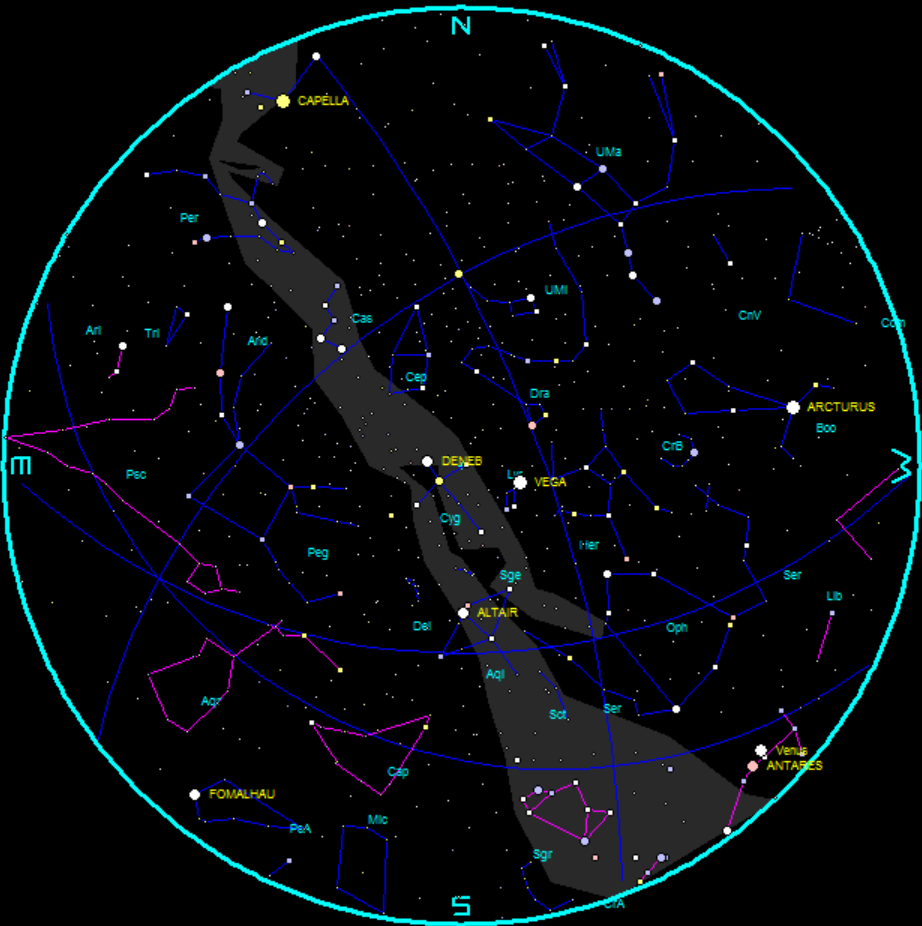
Star Chart for October 15th, 2013 at 9 p.m. Created by my LookingUp program.
08/29/2013 – Ephemeris – Previewing September Skies
Ephemeris for Friday, August 30th. The sun will rise at 7:02. It’ll be up for 13 hours and 19 minutes, setting at 8:22. The moon, 2 days past last quarter, will rise at 2:25 tomorrow morning.
Let’s look at the skies for the month of September. The sun will moving at its greatest speed in its retreat to the south. Daylight hours in the Interlochen/Traverse City area and will drop from 13 hours and 13 minutes Sunday to 11 hours 44 minutes on the 30th. The altitude of the sun above the southern horizon at local noon will be 54 degrees Sunday, and will descend to 42 degrees on the 30th. The season of summer is getting short, so enjoy it while you can. Summer ends and autumn begins at 4:44 p.m. on September 22nd. On the 18th Saturn will be overtaken by Venus as Venus increases its separation from the Sun and Saturn moves around toward the sun. We’ll soon lose Saturn in its glare.
Times are for the Traverse City/Interlochen area of Michigan. They may be different for your location.
Addendum
Star chart for September 15, 2013 at 10 p.m. Created using my program LookingUp.
The constellation abbreviations, names and bright star names are found here.
- The arrow from the pointer stars of the Big Dipper to Polaris the North Star, near the north celestial pole.
- Follow the arc of the handle of the Big Dipper to Arcturus.
- A Leaky Dipper drips on Leo
- The Summer Triangle (in red)
 Bob Moler's Ephemeris Blog