Archive
Ephemeris: 12/23/2025 – An alternate possibility of the Star of Bethlehem
This is Bob Moler with Ephemeris for Tuesday, December 23rd. Today the Sun will be up for 8 hours and 48 minutes, setting at 5:06, and it will rise tomorrow at 8:18. The Moon, halfway from new to first quarter, will set at 8:40 this evening.
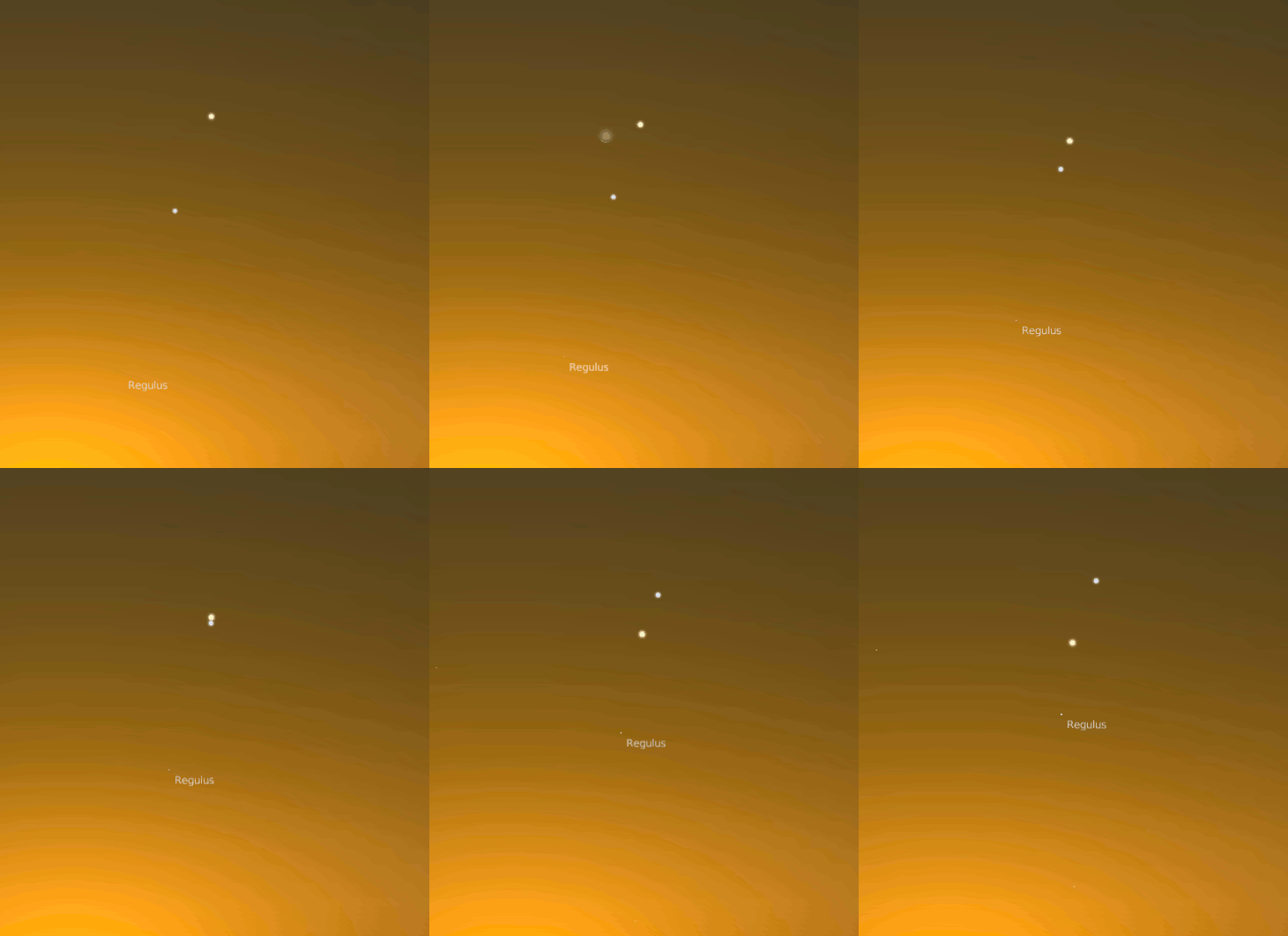
Many writers of the early church place Jesus’ birth around 2 BC, which had to be before Herod the Great’s death, which I suggest was in 1 BC marked by a total lunar eclipse, rather than the 4 BC partial lunar eclipse, normally accepted. In 3 and again in 2 BC there were star-like conjunctions or apparent joining of the planets Jupiter and Venus against the backdrop of the constellation of Leo the Lion. A lion is related to Judah, son of Jacob by a blessing the latter gave his sons in Genesis. The first conjunction occurred in the morning sky of August, 3 BC. In June the next year the two planets got together again, in the evening sky, just after Jesus would have been born in the lambing season, when shepherds would be guarding their flocks at night.
The astronomical event times given in this blog are for the Traverse City/Interlochen area of Michigan (Lat 44.7° N, Long 85.7° W; EST, UT – 5 hours) unless stated otherwise. Times will be different for other locations.
Addendum
Ephemeris: 04/10/2025 – Saturn is soon going to emerge from the morning twilight
This is Ephemeris for Thursday, April 10th. Today the Sun will be up for 13 hours and 15 minutes, setting at 8:22, and it will rise tomorrow at 7:04. The Moon, 2 days before full, will set at 6:29 tomorrow morning.
The planets that have transitioned from the evening sky to the morning sky are beginning to show up in the morning now as they separate themselves from the Sun. Venus is the first to appear low in the east starting about 6:00 in the morning. Saturn will be very near Venus and below right of it on the 28th of this month. Saturn will separate itself more and more from the Sun over the spring and summer months until in late September when it becomes, officially, an evening planet again. Venus will increase its separation from the Sun until May 31st, its greatest separation from the sun of 46°. Then it will slowly head back towards the direction of the Sun. However, it will stay in the morning sky for the rest of the year.
The astronomical event times given are for the Traverse City/Interlochen area of Michigan (EDT, UT – 4 hours). Times will be different for other locations.
Addendum
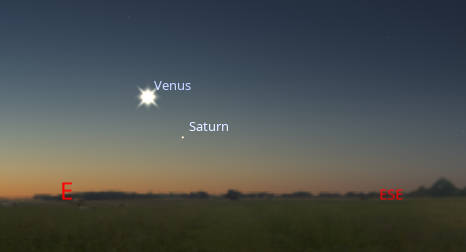
On the 28th, both planets will be at the same distance west of the sun in right ascension, which is the same as longitude in the Earth’s coordinate system. The two planets were a bit closer on the 25th. Saturn is just a little bit less than three degrees above the horizon in the above image. One needs a low eastern horizon to spot it. Saturn may be visible a few days before that, however it is lacking a bright ring right now. The Earth passed through the Saturn’s ring plane on March 23rd, and we are now looking at, probably, a thin line through the planet. The ring should be fairly dim because the Sun is shining on the other side of the rings, and will until its crossover on May 6th.
Ephemeris: 12/24/2024 – Looking at another possibility for the Star of Bethlehem
This is Ephemeris for Christmas Eve, Tuesday, December 24th. Today the Sun will be up for 8 hours and 48 minutes, setting at 5:07, and it will rise tomorrow at 8:18. The Moon, 2 days past last quarter, will rise at 3:10 tomorrow morning.
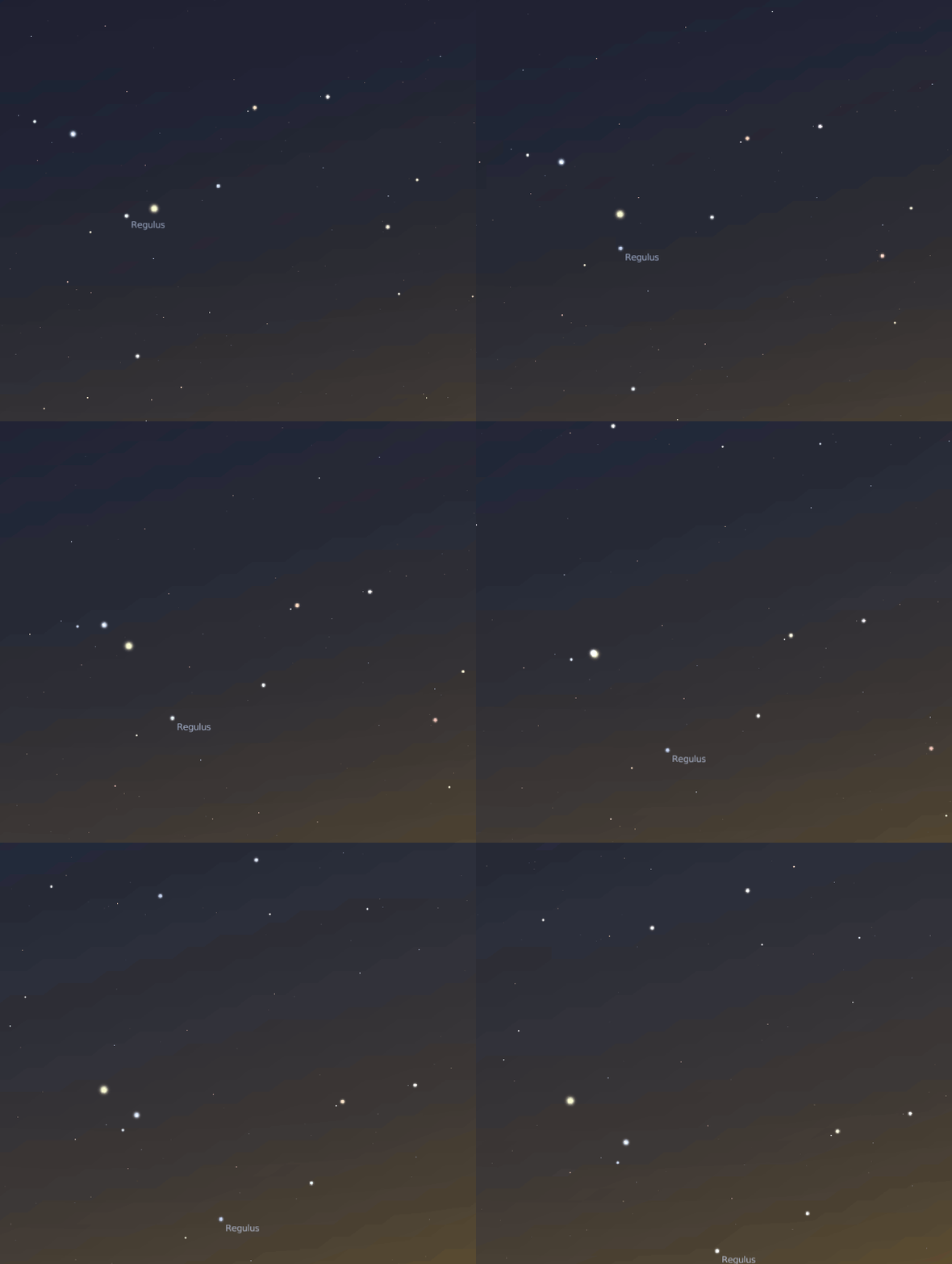
Many writers of the 2nd and 3rd centuries CE place Jesus’ birth, via Roman events, around 2 BCE. So the Star of Bethlehem could appear several years later than the triple conjunction of Jupiter and Saturn in 7 BCE that’s been popular. In 3 and again in 2 BCE there were star-like conjunctions or apparent joining of the planets Jupiter and Venus against the backdrop of the constellation of Leo the Lion. A lion is related to Judah, son of Jacob, by a blessing the latter gave his 12 sons in Genesis. The first conjunction occurred in August in the morning sky. On June 16th of the next year the two planets got together again, this time in the evening sky, a month or more after Jesus would have been born in the vulnerable spring lambing season when shepherds would most likely be out at night guarding the flocks, not December 25th.
The astronomical event times given are for the Traverse City/Interlochen area of Michigan (EST, UT – 5 hours). Times will be different for other locations.
Addendum
An edited excerpt from this year’s Star of Bethlehem presentation I gave to the Grand Traverse Astronomical Society on December 6th.
The triple conjunction of Jupiter and Saturn in 7 BCE is the generally accepted Star of Bethlehem, with Jesus being born in 6 or 5 BCE and Herod’s death being in 4 BCE after a lunar eclipse. What if the lunar eclipse in question was in 1 BCE? If so, there is that other possibility. It involves the constellation Leo, which is a lion. There is a passage in Genesis in which Jacob, who, by this time, is called Israel, is blessing his sons, each the heads of the twelve tribes of Israel. In Genesis 49 9-10 He compares him to a lion cub, the king of beasts, from whom the leaders of Israel will come. We can make a connection between Judah and the celestial lion, Leo. Let’s take a look at the celestial happenings against the constellation of Leo with Jupiter and Venus in 3 and 2 BCE.
On August 12th of 3 BCE Jupiter and Venus appeared to come together so close as to be separable only in telescopes. This may have been the Star at its rising mentioned to Herod. Could this predawn celestial mating of Jupiter, who the Babylonians saw as the god Marduk and Venus as Ishtar, the goddess of fertility, to bring forth a powerful king? The Magi, I’m pretty sure, would have known that 10 months later, a little longer than the human gestation period, by the way, that the two planets would again come together.
Ten months after the first conjunction of Jupiter and Venus, perhaps as the Magi neared Jerusalem, they saw Jupiter and Venus approaching each other again. Later as they left Herod’s palace on the evening of June 16th, 2 BCE the conjunction was at its tightest. They saw the “Star” again, as Matthew relates. Telescopes, which wouldn’t be invented for another sixteen hundred years, could have seen this extremely close conjunction of Jupiter and Venus. Venus, near its greatest eastern elongation from the Sun, would appear half illuminated. But even to the best naked eye observer, Jupiter and Venus would merge into a single star. Venus was much brighter than Jupiter than it appears here. In fact, it was nearly twelve times brighter, so Jupiter’s added brightness wouldn’t contribute much to the combined brightness. Jupiter would seem to disappear at their closest.
Also, there was a conjunction of Jupiter with the “Little King” star Regulus on September 14th 3 BCE, one or two days after the beginning of the Jewish New Year. Was this another sign that a new King of the Jews would be born? It is actually the first of three conjunctions Jupiter has with Regulus in the next 9 months. Yes, another triple conjunction. Jupiter passed Regulus the second time on February 17, of 2 BCE and for a final time on May 9th. During this time Venus had moved back toward the Sun and entered the evening sky where Jupiter met it once again.
04/27/2022 – Ephemeris – Let’s search for the naked-eye planets for this week
This is Bob Moler with Ephemeris for Wednesday, April 27th. Today the Sun will be up for 14 hours and 4 minutes, setting at 8:42, and it will rise tomorrow at 6:37. The Moon, 3 days before new, will rise at 5:56 tomorrow morning.
Let’s search for the naked-eye planets for this week. There is one bright planet in the evening sky. Mercury may be spotted around and after 9:30 this evening very low in the west-northwest and be visible for the next hour or so before it sets at 10:43 pm. After that, the planet action shifts to the morning sky. The other 4 naked-eye planets are there. By 5:45 am, the planets will be spread out low from the east to southeast with brilliant Venus closer than ever to Jupiter, lowest in the east. Dim Mars will be to the right and a bit above Venus, while brighter Saturn will be right and above Mars. Saturn will rise tomorrow at 4 am, with Mars following at 4:40. Venus will rise at 5:10 tomorrow morning, followed by Jupiter four minutes later.
The astronomical event times given are for the Traverse City/Interlochen area of Michigan (EDT, UT – 4 hours). They may be different for your location.
Addendum
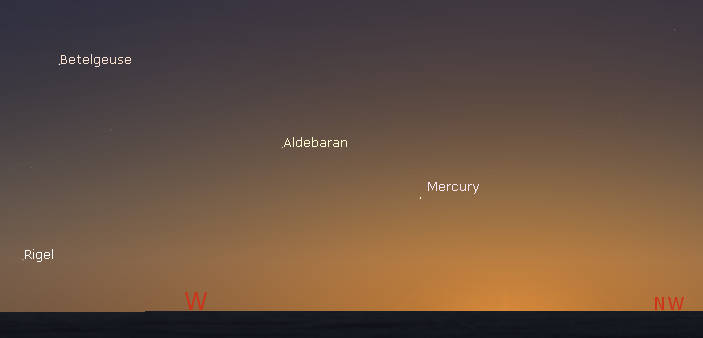
Mercury and bright winter stars in evening twilight at 9:30 tonight, or about 45 minutes after sunset tonight, April 27, 2022. It might take binoculars to spot the stars of Orion and Taurus, and Mercury itself, which is fading, becoming a crescent. Click on the image to enlarge it. Created using Stellarium.
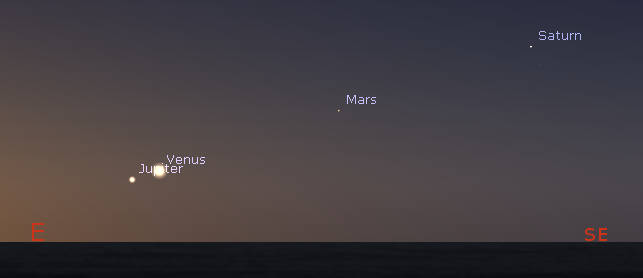
The morning planet parade at 5:45 am or about 50 minutes before sunrise tomorrow, April 28, 2022. Venus will overtake Jupiter during the day, Saturday the 30th. Created using Stellarium.
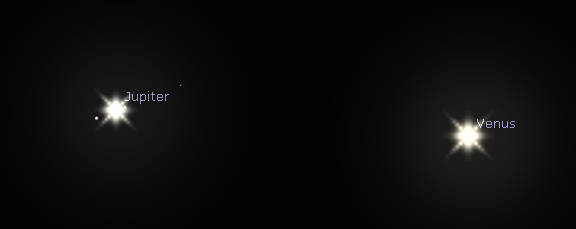
Jupiter and Venus in as they might be seen in binoculars, Saturday morning, April 30, 2022. The difference in brightness of Venus compared to Jupiter will be much greater than seen here. The planets will be about a half a degree apart, or about the width of the Moon. The image shows two satellites of Jupiter, Ganymede to the lower left of Jupiter and Callisto to the upper right. A third satellite, Io, is close to the upper right, within the enlarged Jupiter image. Europa is either behind the planet or in its shadow. Sunday morning, Jupiter will be on the other side of Venus, and a bit farther away. Created using Stellarium.
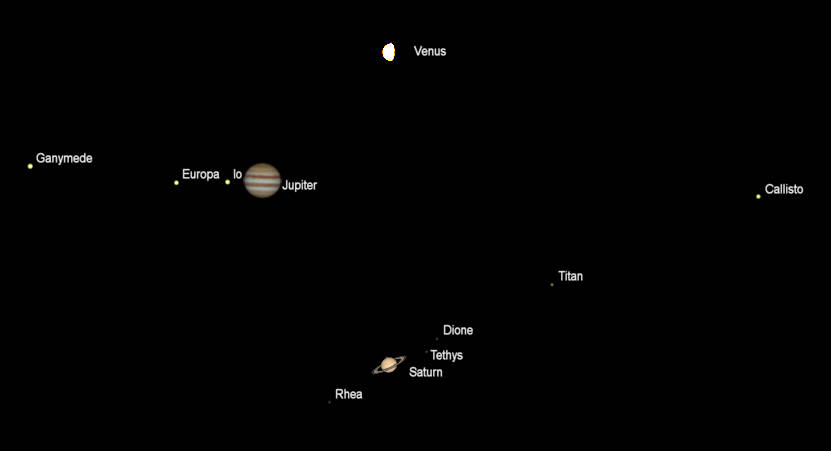
Views of Venus, Jupiter, and Saturn (north up) as they would be seen in a small telescope, with the same magnification, tomorrow morning at 5:45 am, April 28, 2022. I do not show planets less than 10 seconds of arc in diameter. Apparent diameters: Venus 16.78″, 67.4% illuminated; Saturn 16.47″, its rings 38.35″; Jupiter 34.76″. Mars is not shown, its apparent diameter is 5.74″ and is 89.5% illuminated. Mercury, in the evening, has an apparent diameter of 8.05″, and it’s 35.6% illuminated. The ” symbol means seconds of arc (1/3600th of a degree.) Created using Cartes du Ciel (Sky Charts).
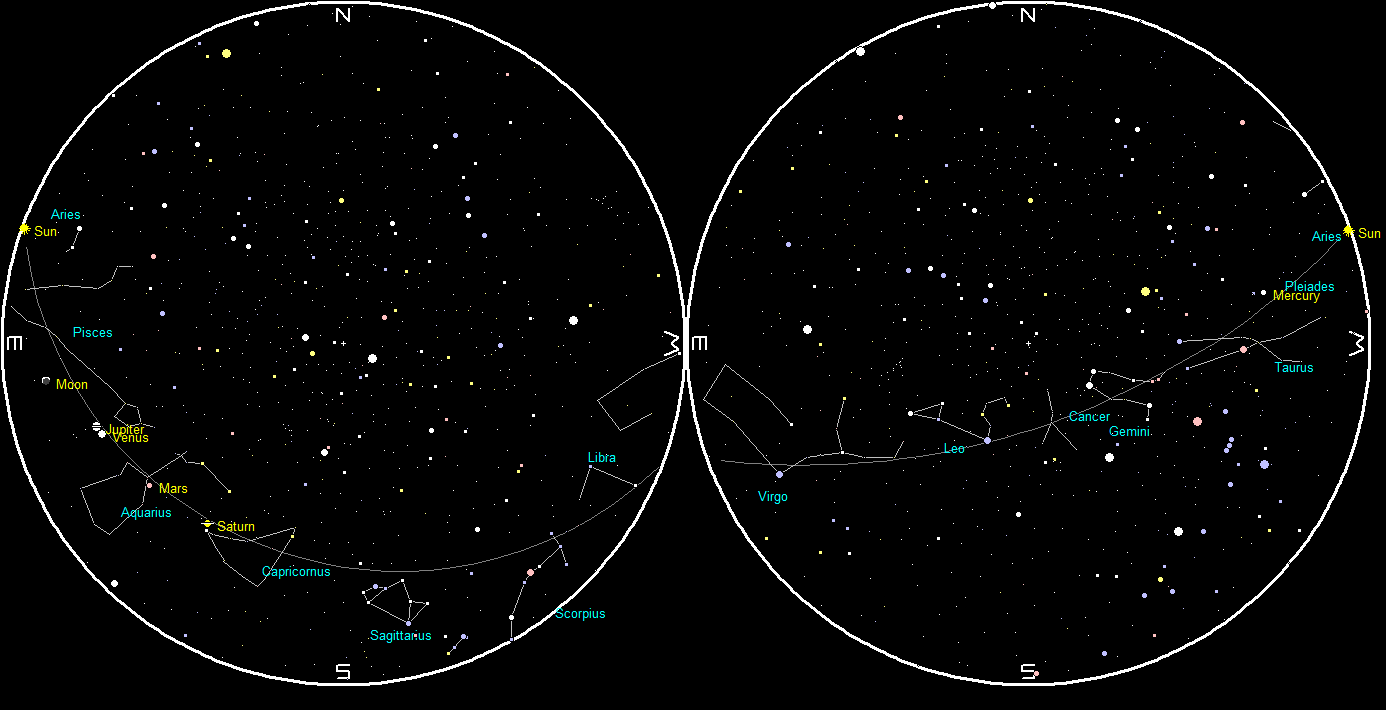
The naked-eye planets and the Moon at sunset and sunrise on a single night, starting with sunset on the right on April 27, 2022. The night ends on the left with sunrise on the 28th. Notice that all the naked-eye planets except Mercury are in the morning sky now. Click on the image to enlarge it. Created using my LookingUp program.
04/26/2022 – Ephemeris – Tomorrow is the Moon’s final stop in passing the parade of morning planets
This is Bob Moler with Ephemeris for Tuesday, April 26th. Today the Sun will be up for 14 hours and 1 minute, setting at 8:41, and it will rise tomorrow at 6:38. The Moon, 3 days past last quarter, will rise at 5:37 tomorrow morning.
Also, tomorrow morning, the Moon will conclude its sweep under the four bright planets of the morning sky by being seen below the left-most and lowest of the four, Jupiter. With nearby Venus, it makes a small right triangle The other planets in order to the right of Jupiter are Venus, Mars and finally Saturn. Jupiter and Venus are appearing to get closer to each other every day now. They will cross paths in conjunction this Saturday. Venus is slowly retreating back and around behind the Sun. Jupiter now appears to be moving away from the Sun. Both, however, are still moving eastward against the stars, it’s just that Venus is moving faster. Next month, when the Moon passes by these planets, they will be a different order.
The astronomical event times given are for the Traverse City/Interlochen area of Michigan (EDT, UT – 4 hours). They may be different for your location.
Addendum
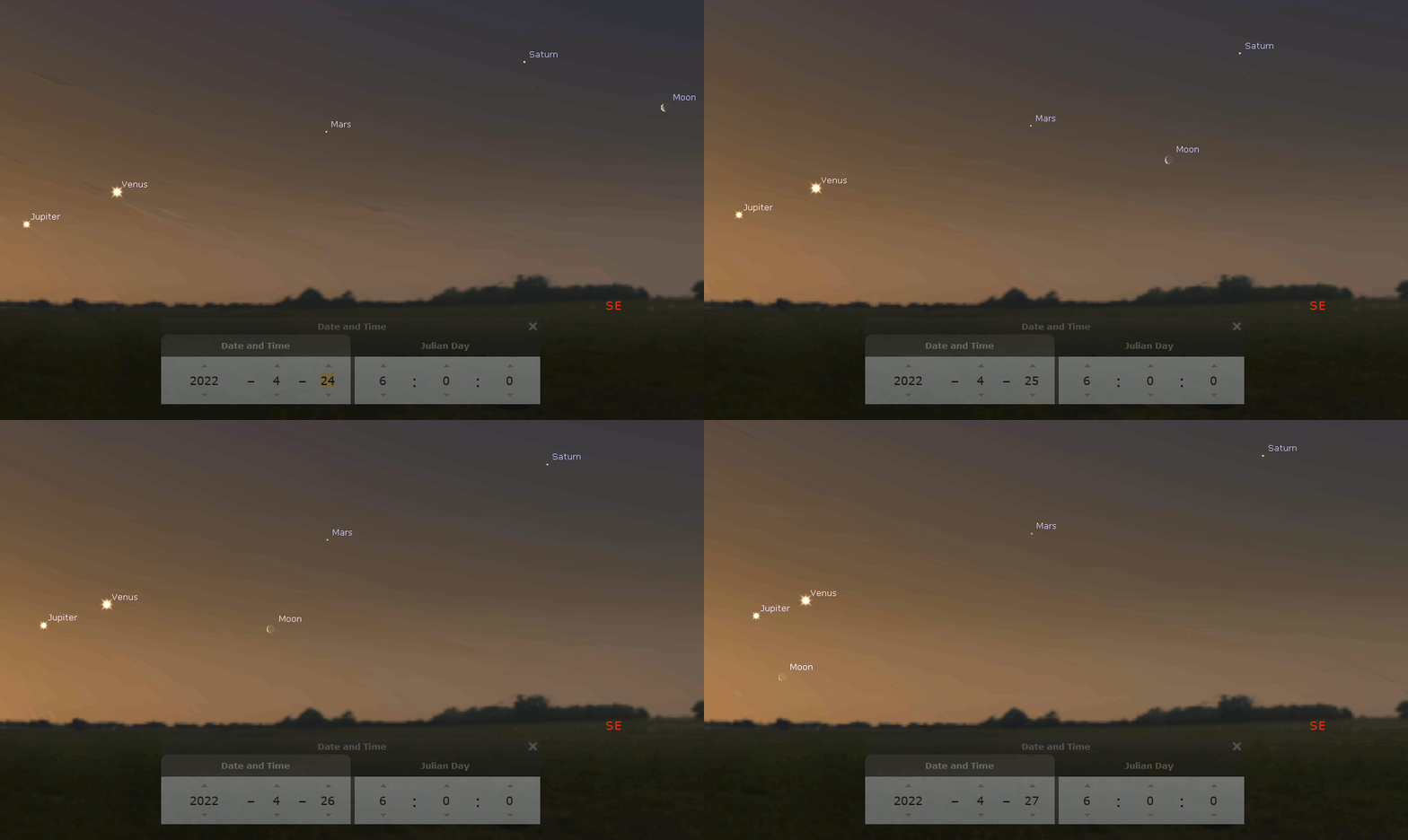
The Moon passing the morning planets from Sunday to Wednesday mornings 4/24 to 4/27/2022. Note also the approach of Jupiter and Venus. Their paths will cross on Saturday, 4/30/2022. Click on the image to enlarge it. Created using Stellarium and GIMP.
04/25/2022 – Ephemeris – The moon is passing the morning planet parade
This is Bob Moler with Ephemeris for Monday, April 25th. Today the Sun will be up for 13 hours and 58 minutes, setting at 8:40, and it will rise tomorrow at 6:40. The Moon, 2 days past last quarter, will rise at 5:16 tomorrow morning.
Over this and the next couple of mornings, the waning crescent Moon will be passing the four morning planets. This morning it was below and between Saturn and Mars. Tomorrow morning, the Moon will be between and below Mars and Venus. Wednesday morning the Moon, Venus and Jupiter will make a nice right triangle with Jupiter above and a bit left of the Moon and Venus will appear above and a bit to the right of it. There’s some motion between Venus and Jupiter. While both are traveling eastward when comparing them to the stars, Venus is moving eastward faster, and is moving toward the Sun in our sky. Jupiter is moving away from the Sun from our vantage point. They will cross paths on Saturday.
The astronomical event times given are for the Traverse City/Interlochen area of Michigan (EDT, UT – 4 hours). They may be different for your location.
Addendum
The Moon passing the morning planets from Sunday to Wednesday mornings 4/24 to 4/27/2022. Note also the approach of Jupiter and Venus. Their paths will cross on Saturday, 4/30/2022. Click on the image to enlarge it. Created using Stellarium and GIMP.
04/22/2022 – Ephemeris – Earth Day and the Moon passes four planets in the morning
This is Ephemeris for Earth Day, Friday, April 22nd. Today the Sun will be up for 13 hours and 50 minutes, setting at 8:36, and it will rise tomorrow at 6:45. The Moon, 1 day before last quarter, will rise at 3:43 tomorrow morning.
The Lyrid meteor shower will still be active tonight and tomorrow morning from 10 pm to almost 4 am. Speaking of things hitting the Earth, NASA’s DART Mission to collide and deflect a small asteroid is still on its way to smash into a tiny asteroid in September to see how it works. A more predictable disaster is climate change or global warming, which is continuing to appear more rapid than earlier thought. It demands that nations start immediately to reduce carbon emissions to slow and eventually stop the rise in global temperatures. As someone said: “There is no Planet B”. Mars isn’t it. It’s too cold, too small, too dry, and the air is too thin and contains no free oxygen. So support your local planet, it’s the only one we’ve got.
The astronomical event times given are for the Traverse City/Interlochen area of Michigan (EDT, UT – 4 hours). They may be different for your location.
Addendum
There is an interesting Planet and morning planet encounter Sunday through Wednesday mornings as the Moon passes four planets.
The Moon passing the morning planets from Sunday to Wednesday mornings 4/24 to 4/27/2022. Note also the approach of Jupiter and Venus. Their paths will cross on Saturday, 4/30/2022. Click on the image to enlarge it. Created using Stellarium and GIMP
04/04/2022 – Ephemeris – Two apparent planetary encounters tonight and tomorrow morning
This is Ephemeris for Monday, April 4th. Today the Sun will be up for 12 hours and 56 minutes, setting at 8:14, and it will rise tomorrow at 7:16. The Moon, 3 days past new, will set at 12:10 tomorrow morning. | We have action at both end of the night tonight. This evening the Pleiades, or Seven Sisters star cluster, will be seen just above and right of the three-day old crescent Moon. The cluster will be at the one o’clock position from the Moon at 9 pm. At the other side of night, at 6:30 tomorrow morning, Venus will be shining brilliantly in the east-southeast and the planets Mars and Saturn will be very close together. This type of appearance is called a conjunction. Mars will appear about three-quarters of a moon diameter below and left of the slightly brighter Saturn. Mars is getting slowly brighter as the Earth creeps up on it, to overtake it this December. It’s currently 165 million miles (266 million kilometers) away.
The astronomical event times given are for the Traverse City/Interlochen area of Michigan (EDT, UT – 4 hours). They may be different for your location.
Addendum
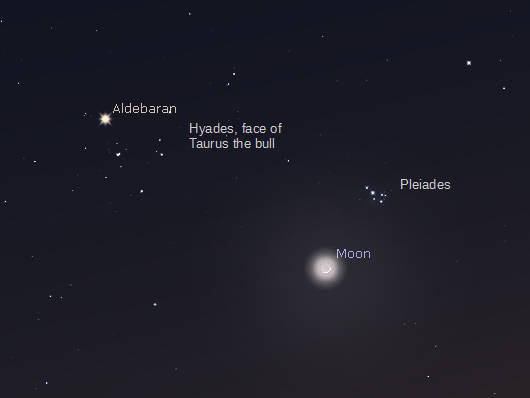
The Moon and the Pleiades and Hyades tonight at 9 pm EDT, April 4, 2022. The Moon appears near the stepsister star clusters tonight. In Greek mythology, these two star clusters were indeed stepsisters, fathered by the god Atlas with different mothers. Created using Stellarium with additional captions in LibreOffice.
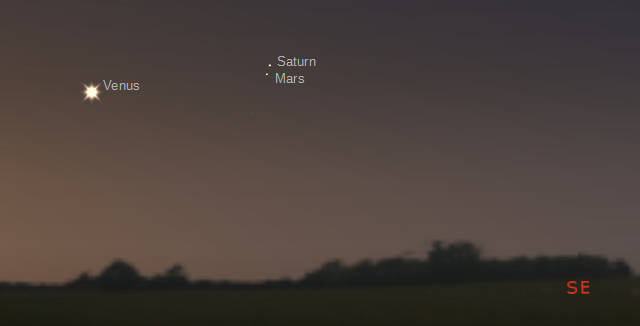
A Saturn-Mars conjunction with brilliant Venus nearby as it might look like tomorrow morning, April 5, 2022. Created using Stellarium with labels added in LibreOffice.
03/25/2022 – Ephemeris – Over the weekend there will be the continued gathering of morning planets
This is Bob Moler with Ephemeris for Friday, March 25th. Today the Sun will be up for 12 hours and 25 minutes, setting at 8:01, and it will rise tomorrow at 7:34. The Moon, at last quarter today, will rise at 4:56 tomorrow morning.
Over the weekend there will be the continued gathering of morning planets, Venus, Mars and Saturn, culminating on Monday morning when the waning crescent Moon will join the group by slipping beneath them. During the three day period between Saturday and Monday mornings at a specific time, like 6:45 am, about 45 minutes before sunrise, these planets will be in the east southeast and quite low in the sky. A low horizon in that direction will help, especially when the Moon joins the group, because it will be lower than the three planets. Over the weekend Venus and Mars will keep their separation with Mars to the right and a bit below Venus. Saturn will scoot below Venus, moving to the right. The Moon will move below the group Monday morning.
The astronomical event times given are for the Traverse City/Interlochen area of Michigan (EDT, UT – 4 hours). They may be different for your location.
Addendum
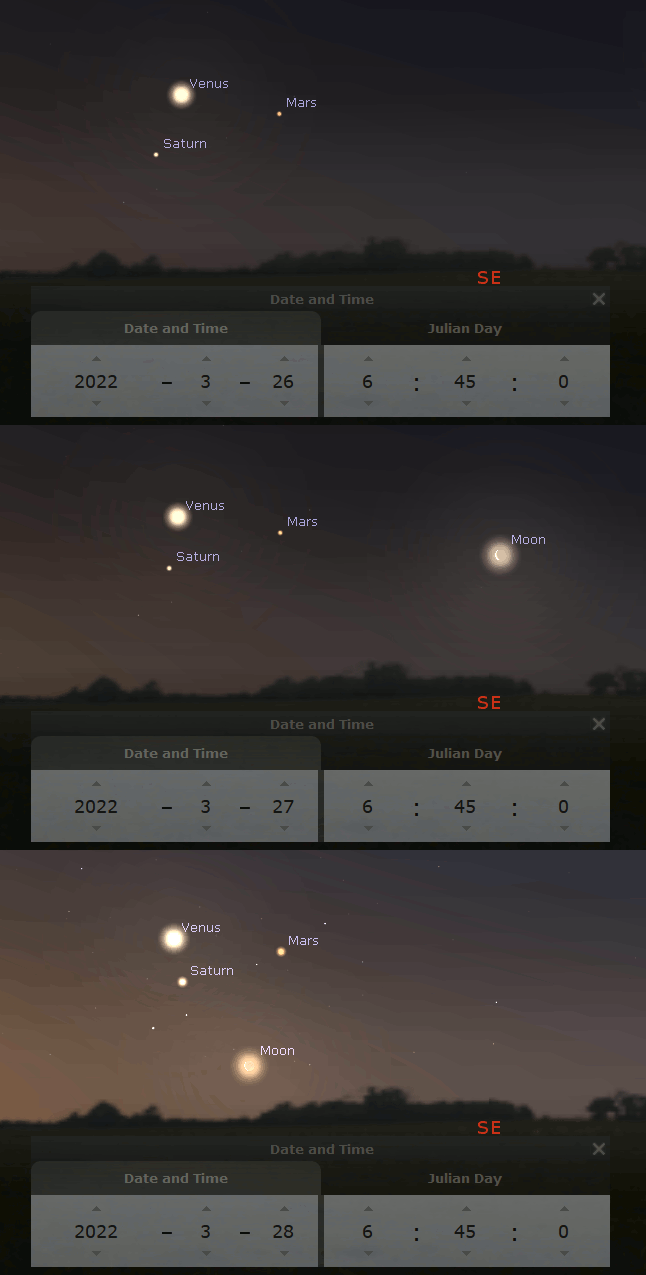
The grouping of Venus, Mars, Saturn and the Moon which will develop over the mornings of Saturday, March 26th through Monday, March 28, 2022. Created using Stellarium and GIMP.
10/22/2020 – Ephemeris – Tonight the Moon is hanging out with Jupiter and Saturn
This is Ephemeris for Thursday, October 22nd. Today the Sun will be up for 10 hours and 37 minutes, setting at 6:45, and it will rise tomorrow at 8:09. The Moon, 1 day before first quarter, will set at 11:41 this evening.
The fat crescent Moon and the planets Jupiter and Saturn will make a pretty triangle low in the southwestern sky tonight. Jupiter has been noticeably approaching Saturn the last few years. Their paths will appear to cross for us the evening of December 21st, the first day of winter. I won’t make any bets on it being clear that night, or any night around here in December. On the 21st of December they will be seen low in the southwest in twilight a third of the diameter of the Moon apart, and both be seen together in binoculars or low power telescope. The eye should resolve them, though Jupiter’s brightness compared to Saturn may make that difficult. Jupiter passes Saturn on average every 20 years.
The event times given are for the Traverse City/Interlochen area of Michigan. They may be different for your location.
Addendum
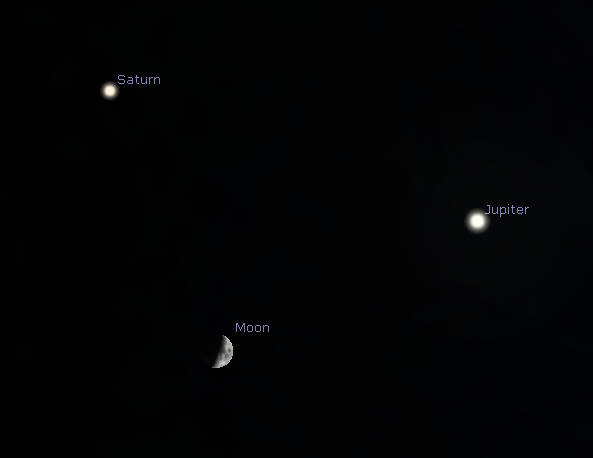
Jupiter, Saturn, and Moon triangle as it will appear in the south at 8 pm in the eastern US. In the western US the Moon will slide closer to Saturn at the same local time. Created using Stellarium.
 Bob Moler's Ephemeris Blog