Archive
04/17/2019 – Ephemeris – Let’s look for the bright planets
Ephemeris for Wednesday, April 17th. Today the Sun will be up for 13 hours and 34 minutes, setting at 8:30, and it will rise tomorrow at 6:53. The Moon, 2 days before full, will set at 6:53 tomorrow morning.
Let’s look at the planets for this week. Mars will be in the western sky this evening, above the V-shaped stars of the face of Taurus the bull. It will set at 12:23 a.m. In the morning sky we have Jupiter, in Ophiuchus, which will rise tomorrow at 1:07 a.m. in the east-southeast. Saturn will be next to rise at 2:54 a.m., also in the east-southeast. It is in Sagittarius. Venus will rise at 5:56 a.m. again in the east-southeast. By 6:30 in the morning they will be strung out from the south down to the eastern horizon. Venus will remain in our morning sky, though more difficult to see until August when it passes behind the Sun to enter the evening sky. Tiny Mercury may be glimpsed a bit left and just below Venus in the bright twilight.
The times given are for the Traverse City/Interlochen area of Michigan. They may be different for your location.
Addendum
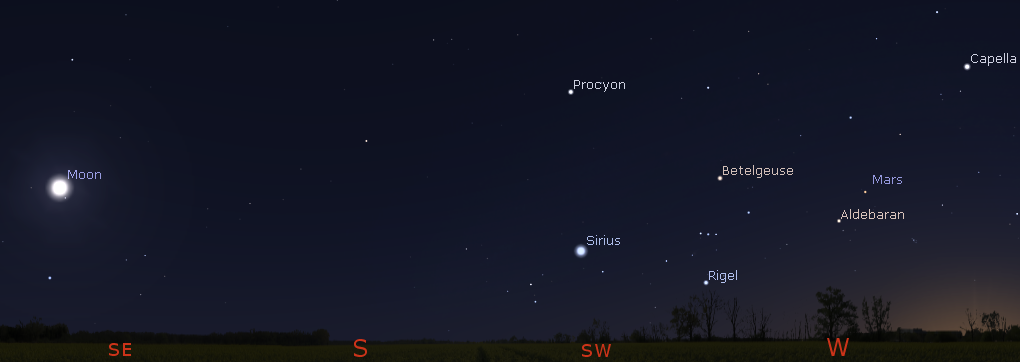
Mars and the Moon tonight at 9:30 p.m. April 17, 2019. Click on the image to enlarge. Created using Stellarium.
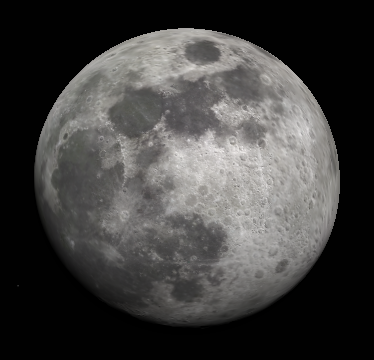
The waxing gibbous nearly full Moon at 9:30 p.m. April 17, 2019. Created using Stellarium.
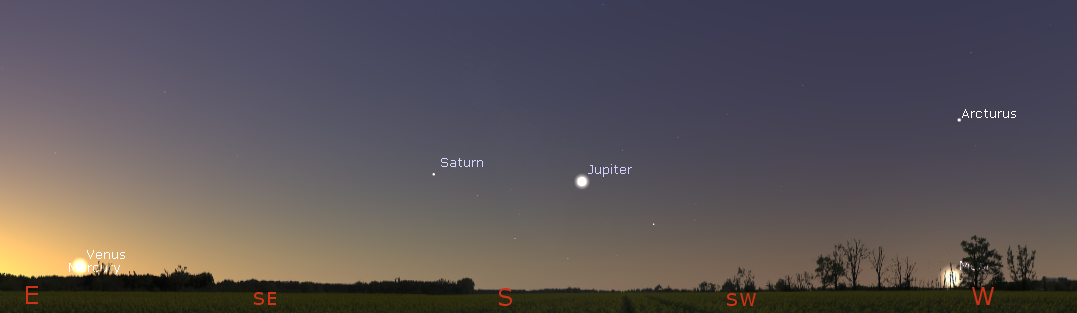
Morning planets and Moon at 6:30 a.m. April 18, 2019. Click on the image to enlarge. Created using Stellarium.
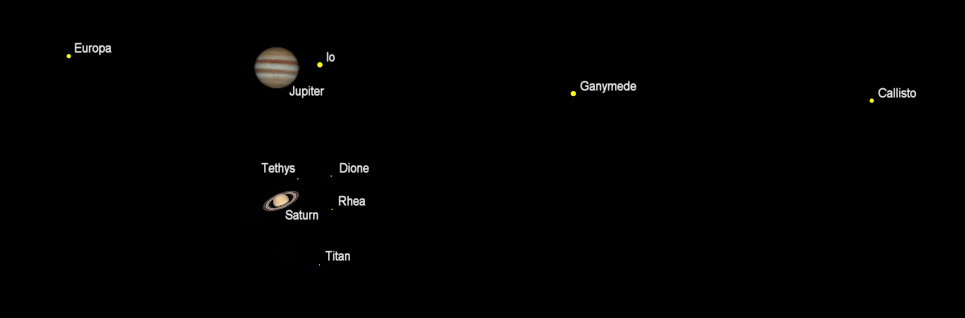
Jupiter and Saturn with the same magnification at 6:30 a.m. tomorrow morning April 18, 2019. Click on the image to enlarge. Created using Cartes du Ciel (Sky Charts).
Jupiter’s moon Io events earlier in the morning
| Moon | Event | Date | U.T. | EDT |
| Io | Shadow start | 18 Apr 2019 | 05:40 | 1:40 AM |
| Io | Transit start | 18 Apr 2019 | 06:44 | 2:44 AM |
| Io | Shadow end | 18 Apr 2019 | 07:51 | 3:51 AM |
| Io | Transit end | 18 Apr 2019 | 08:56 | 4:56 AM |
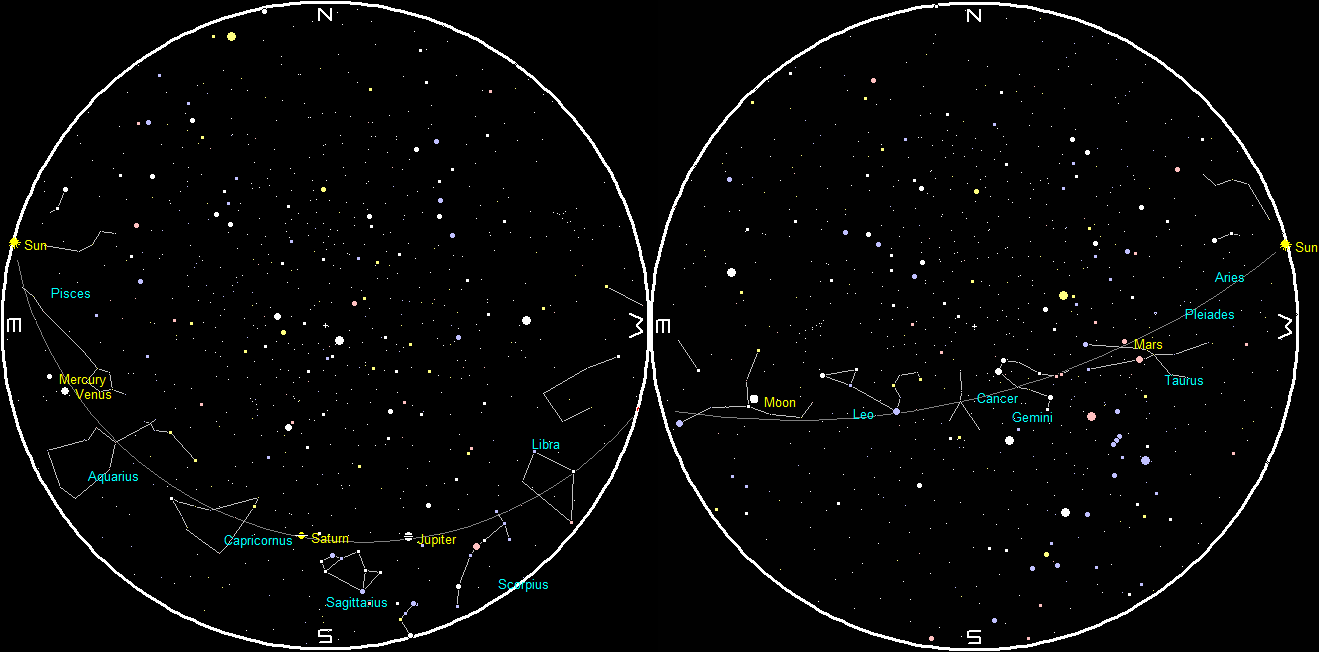
Planets and the Moon at sunset and sunrise of a single night starting with sunset on the right on April 17, 2019. The night ends on the left with sunrise on the 18th. Click on the image to enlarge. Created using my LookingUp program.
04/10/2019 – Ephemeris – Looking for the bright planets for this week
Ephemeris for Wednesday, April 10th. Today the Sun will be up for 13 hours and 13 minutes, setting at 8:21, and it will rise tomorrow at 7:05. The Moon, 2 days before first quarter, will set at 2:04 tomorrow morning.
Let’s look at the planets for this week. Mars will be in the western sky this evening, to the right of the V-shaped stars of the face of Taurus the bull. It will set at 12:27 a.m. In the morning sky we have Jupiter which will rise tomorrow at 1:35 a.m. in the east-southeast. It is second to Venus in brightness. Saturn will be next to rise at 3:21 a.m., also in the east-southeast. Venus will rise at 6:05 a.m. again in the east-southeast. By 6:30 in the morning they will be strung out from the southeast to the south. Venus will remain in our morning sky until August when it passes behind the Sun. Tiny Mercury may be glimpsed a bit left and just below Venus in the bright twilight.
The times given are for the Traverse City/Interlochen area of Michigan. They may be different for your location.
Addendum
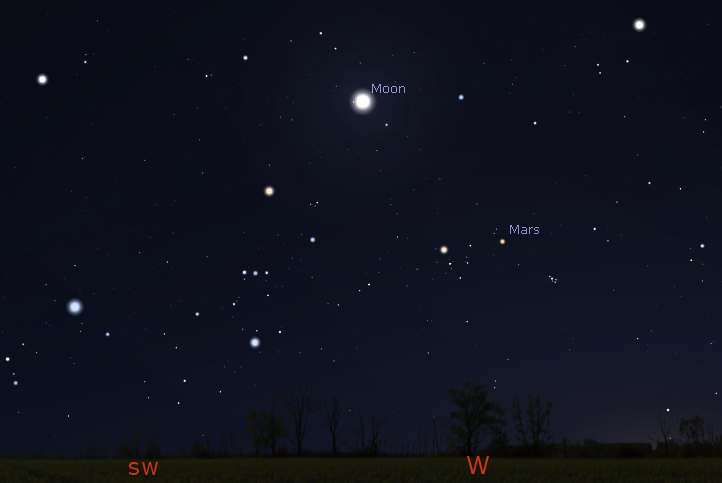
Mars and the Moon in the evening at 9:30 p.m. April 10, 2019. Click on the image to enlarge. Created using Stellarium.
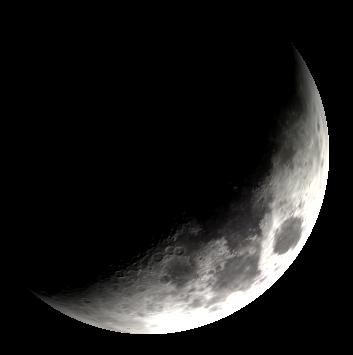
The Moon as it might appear in binoculars or a small telescope tonight at 9 p.m. April 10, 2019. Created using Stellarium.
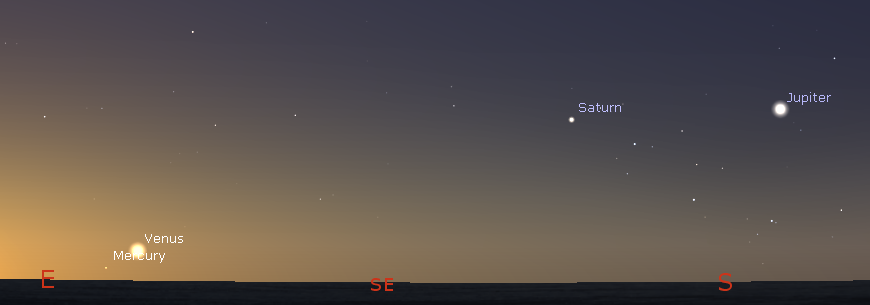
Morning planets at 6:30 a.m. April 11, 2019. Click on the image to enlarge. Created using Stellarium.
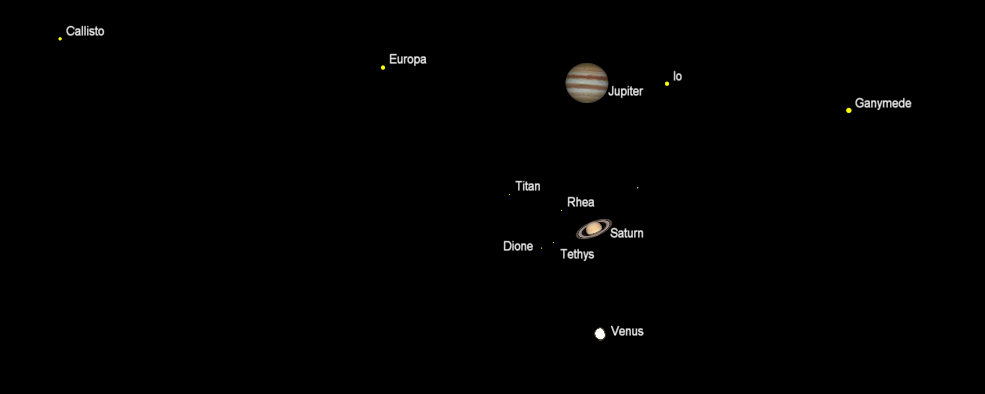
Jupiter, Saturn and Venus with the same magnification at 6:30 a.m. tomorrow morning April 11, 2019. Created using Cartes du Ciel (Sky Charts).
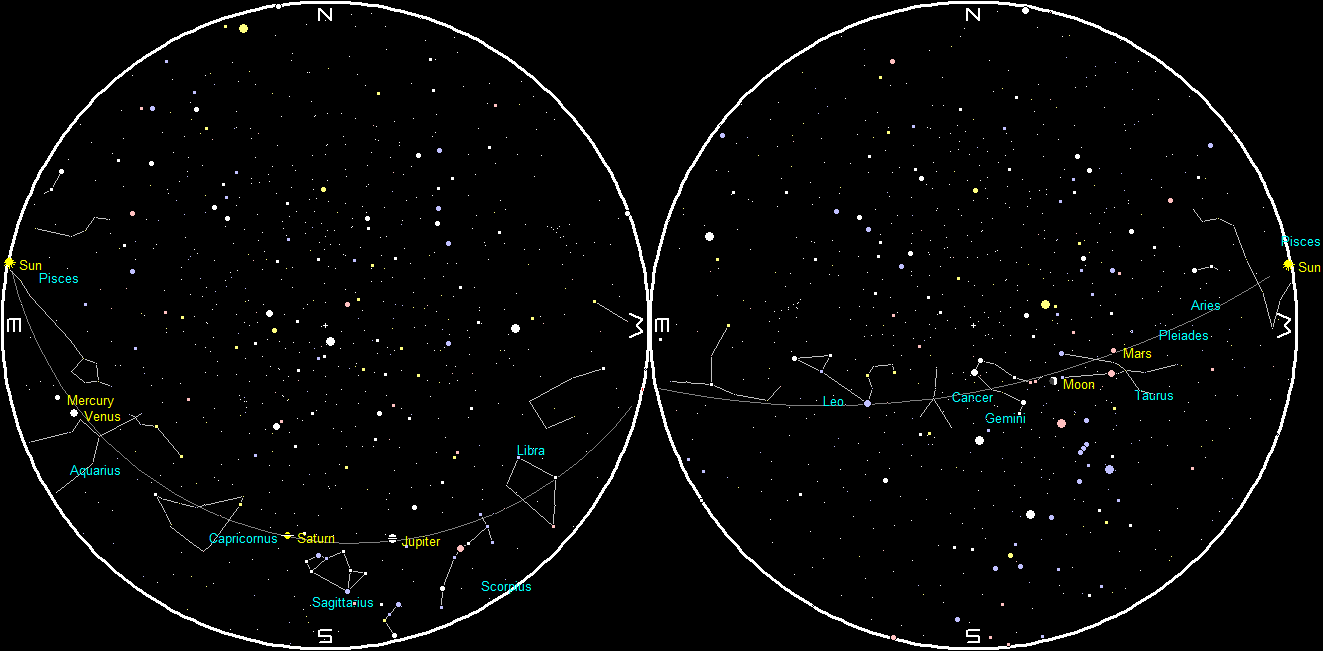
Planets and the Moon at sunset and sunrise of a single night starting with sunset on the right on April 10, 2019. The night ends on the left with sunrise on the 11th. Click on the image to enlarge. Created using my LookingUp program.
04/03/2019 – Ephemeris – Let’s check out the bright planets for this week
Ephemeris for Wednesday, April 3rd. Today the Sun will be up for 12 hours and 52 minutes, setting at 8:12, and it will rise tomorrow at 7:18. The Moon, 2 days before new, will rise at 7:27 tomorrow morning.
Let’s look at the planets for this week. Mars will be in the western sky this evening, to the right of the V shaped stars of the face of Taurus the bull. It will set at 12:31 a.m. In the morning sky we have Jupiter which will rise tomorrow at 2:02 a.m. in the east-southeast. It is second to Venus in brightness. Saturn will be next to rise at 3:48 a.m., also in the east-southeast. Venus will rise at 6:13 a.m. again in the east-southeast. By 7 in the morning they will be strung out from the southeast to the south. Venus will remain in our morning sky until August when it passes behind the Sun. It will emerge to become a bright addition to our winter and spring evening skies later this year and next. Mercury will be
The times given are for the Traverse City/Interlochen area of Michigan. They may be different for your location.
Addendum
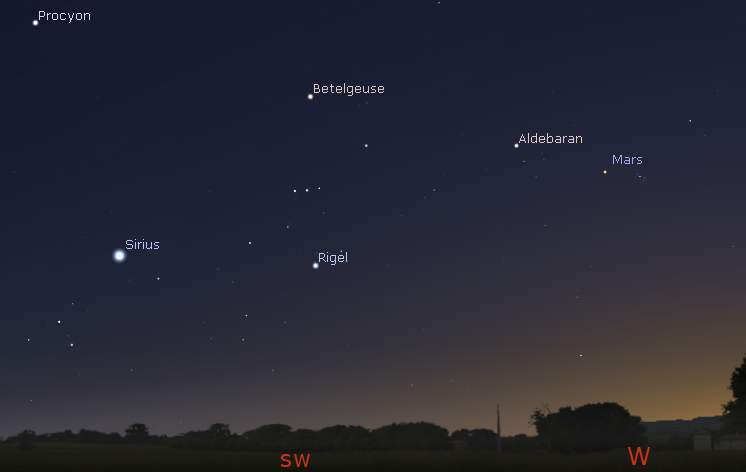
Mars in the evening at 9 p.m. April 3, 2019. Click on the image to enlarge. Created using Stellarium.
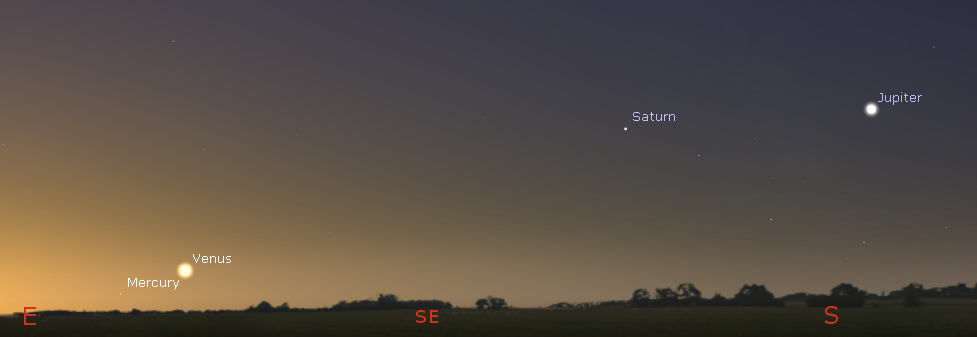
Morning planets at 6:45 a.m. April 4, 2019. Click on the image to enlarge. Created using Stellarium.
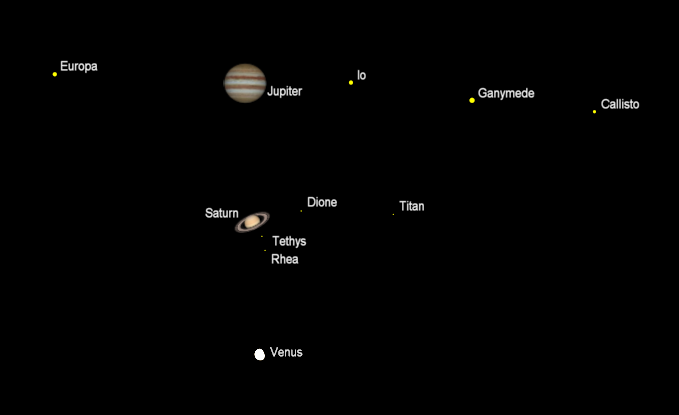
Jupiter, Saturn and Venus with the same magnification at 6:45 a.m. tomorrow morning April 4, 2019. Created using Cartes du Ciel (Sky Charts).
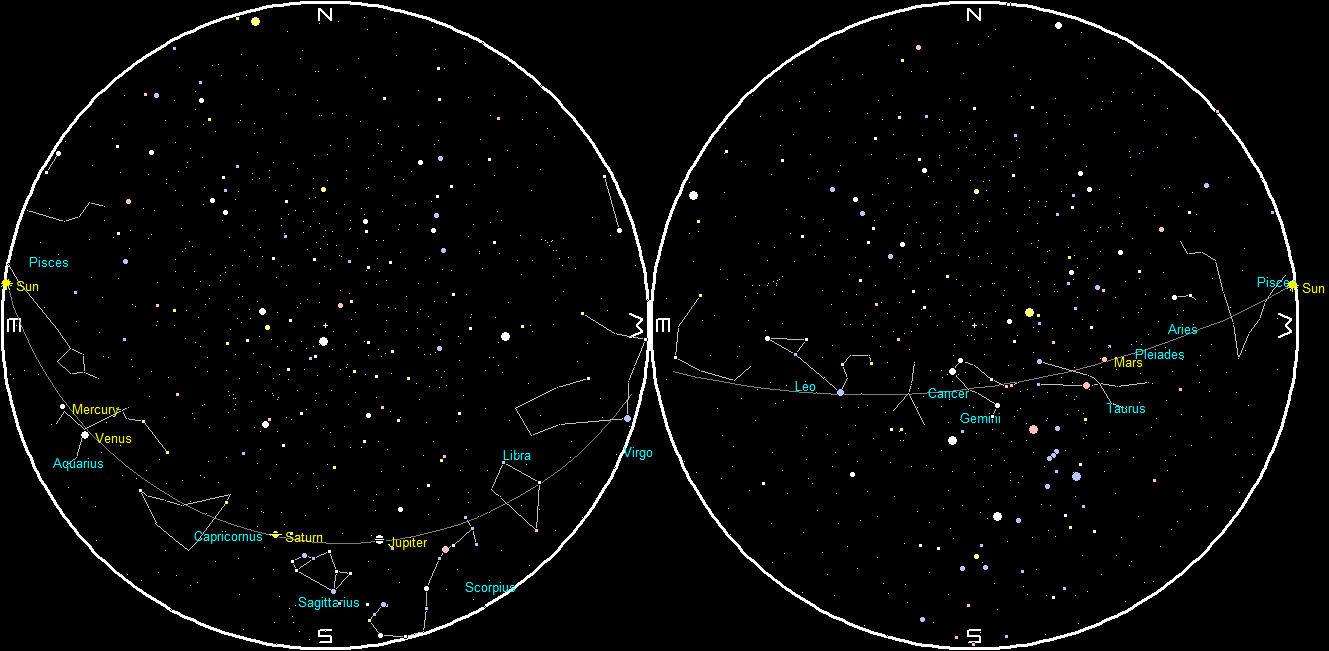
Planets and the Moon at sunset and sunrise of a single night starting with sunset on the right on April 3, 2019. The night ends on the left with sunrise on the 4th. Click on the image to enlarge. Created using my LookingUp program.
03/27/2019 – Ephemeris – Looking for and at the bright planets for this week
Ephemeris for Wednesday, March 27th. Today the Sun will be up for 12 hours and 30 minutes, setting at 8:03, and it will rise tomorrow at 7:31. The Moon, 1 day before last quarter, will rise at 3:33 tomorrow morning.
Let’s look at the planets for this week. Mars will be in the western sky this evening, below the Pleiades, or Seven Sisters, star cluster. It will pass to the left of the Pleiades Saturday night. Tonight, however, it will set at 12:34 a.m. In the morning sky we have Jupiter which will rise tomorrow at 2:29 a.m. in the east-southeast. It is second to Venus in brightness. Saturn will be next to rise at 4:14 a.m., also in the east-southeast. Venus will rise at 6:20 a.m. also in the east-southeast. By 7 in the morning they will be strung out from the southeast to the south, with the last quarter Moon between Jupiter and Saturn. The Moon will pass Saturn early Friday morning before it rises and will be seen then to the left of Saturn.
The times given are for the Traverse City/Interlochen area of Michigan. They may be different for your location.
Addendum
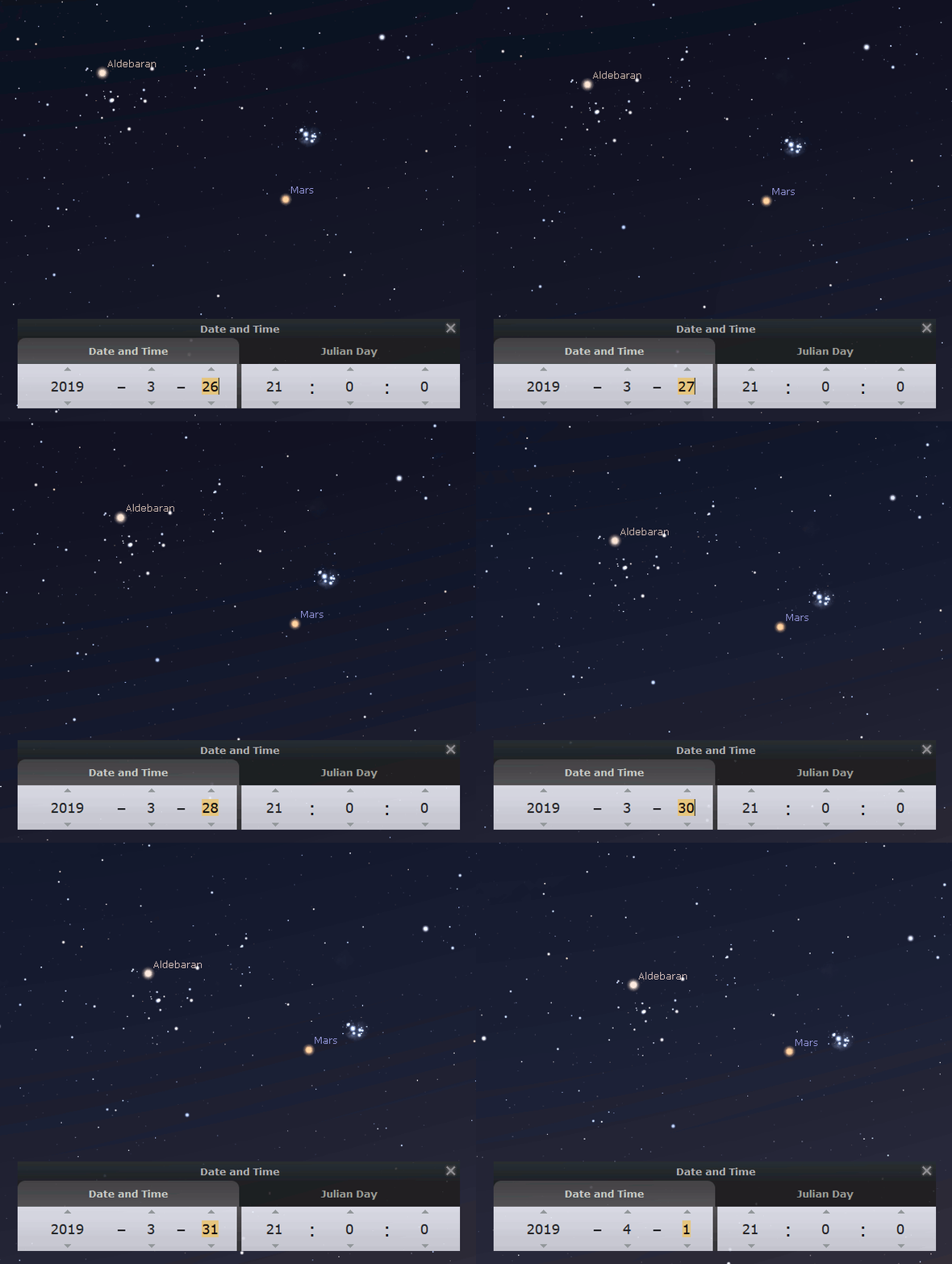
Mars tiptoeing past the Pleiades nightly from March 26th to April 1st, 2019. Looking west. Created using Stellarium and GIMP.
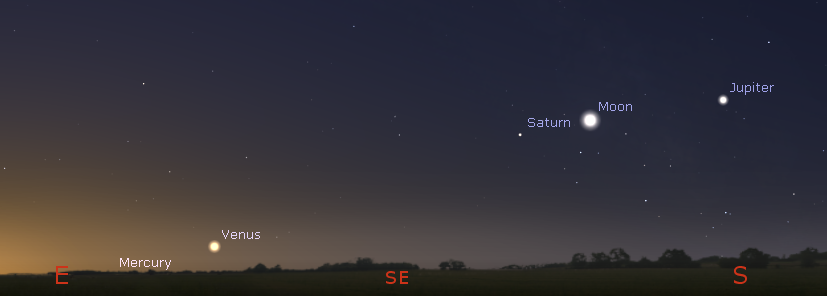
Morning planets and the Moons at 6:45 a.m. tomorrow March 28, 2019. Click on the image to enlarge. Created using Stellarium.
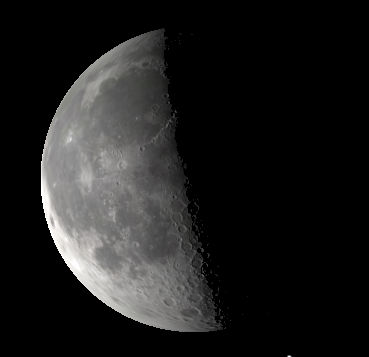
The moon as it might appear in binoculars tomorrow morning, March 28, 2019. Created using Stellarium.
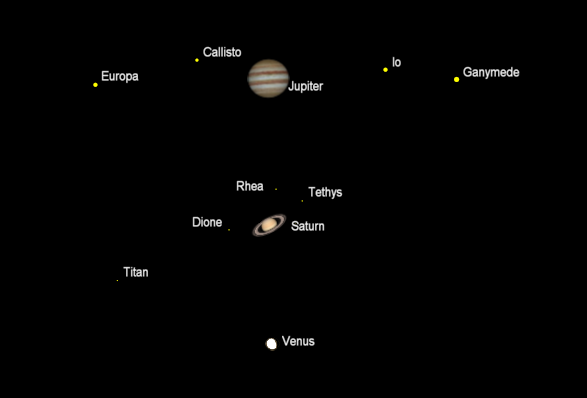
Jupiter, Saturn and Venus with the same magnification at 6:45 a.m. tomorrow morning March 28, 2019. Created using Cartes du Ciel (Sky Charts).
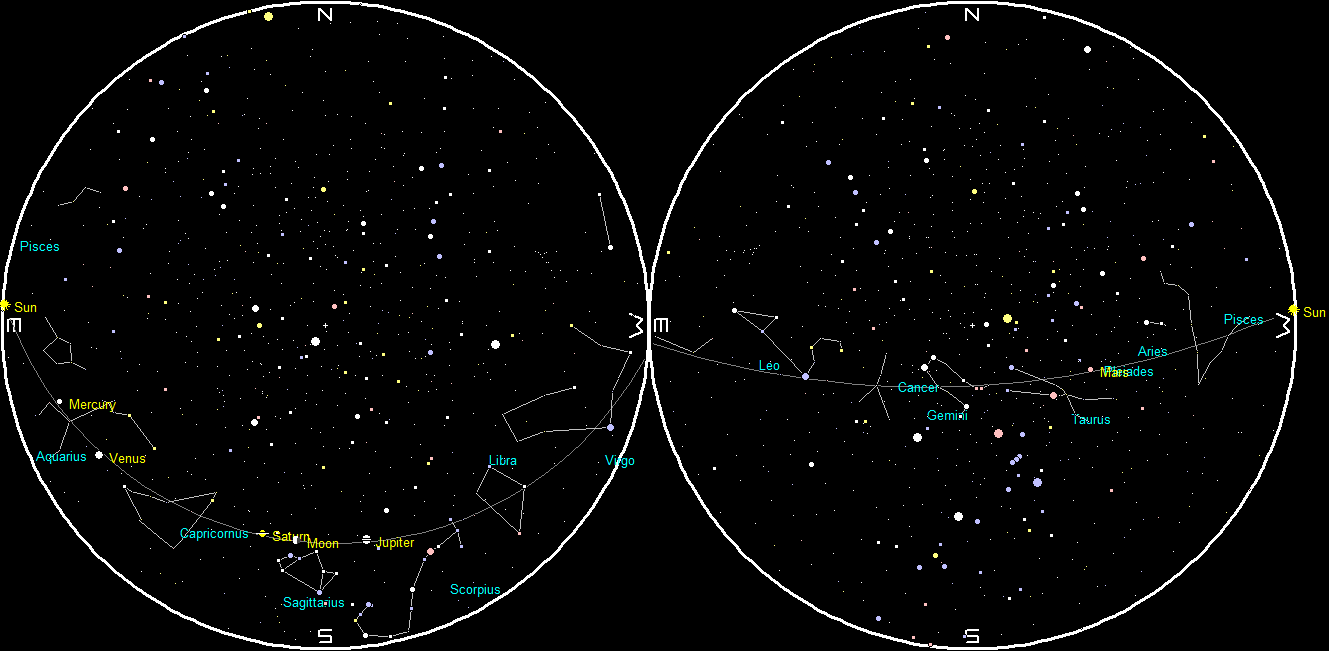
Planets and the Moon at sunset and sunrise of a single night starting with sunset on the right on March 27, 2019. The night ends on the left with sunrise on the 28th. Click on the image to enlarge. Created using my LookingUp program.
03/26/2019 – Ephemeris – Mars is approaching the Pleiades this week
Ephemeris for Tuesday, March 26th. Today the Sun will be up for 12 hours and 27 minutes, setting at 8:02, and it will rise tomorrow at 7:33. The Moon, 2 days before last quarter, will rise at 2:38 tomorrow morning.
Daylight time and spring time are catching up with us with the Sun setting now just after 8 p.m. By 9 p.m. tonight the brighter stars appear and most of the well known constellations will be recognizable. Looking off to the west at that time the famous star group of the Pleiades, or Seven Sisters will appear. Folks with good eyesight can see six or maybe even seven of its stars. Tonight, right below the Pleiades is a bright reddish star. It would be the 22nd of the first magnitude stars, except it’s not a star. It’s a wanderer, according to the ancient Greeks, one of seven*. They called it Ares the god of war. The Romans turned it into Mars. Over the week Mars will be closing in and passing by the Pleiades this weekend.
The times given are for the Traverse City/Interlochen area of Michigan. They may be different for your location.
Addendum
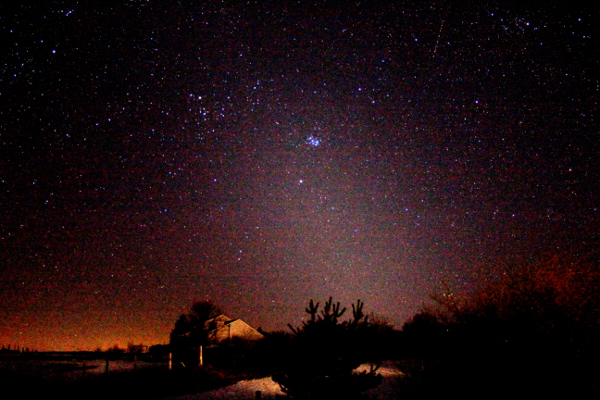
The western sky at 10:22 last night March 25, 2019. Mars appears below the Pleiades in zodiacal light. Credit, mine – Canon EOS Rebel T5 18mm f.l., f/3.5, 8 sec. ISO 12,800.
Mars tiptoeing past the Pleiades nightly from March 26th to April 1st, 2019 at 9 p.m. Looking west. Created using Stellarium and GIMP.
The letter V of stars to the left of the Pleiades is the Hyades, in mythology the half sisters to the Pleiades. It is also the face of Taurus the bull.
* We get the word planet from the Greek planētes meaning wander. Five are the classical planets, Mercury, Venus, Mars, Jupiter, and Saturn. The other two are the Sun and Moon. The other celestial objects were the fixed stars. Other things that appear in the sky, like comets, novae and meteors were thought to be in the Earth’s atmosphere.
03/20/2019 – Ephemeris – The first look, of spring, at the bright planets
Ephemeris for Wednesday, March 20th. Today the Sun will be up for 12 hours and 8 minutes, setting at 7:55, and it will rise tomorrow at 7:44. The Moon, at full today, will rise at 7:35 this evening.
Let’s look at the planets for this week. Looking down we see the Earth which will reach a point in its orbit at 5:58 p.m. (21:58 UT) where spring will start. Mars will be in the west-southwestern sky this evening. It will set at 12:37 a.m. Mars is fading as the Earth, in its inner and faster orbit is leaving Mars behind. In the morning sky we have Jupiter which will rise tomorrow at 2:55 a.m. in the east-southeast It is second to Venus in brightness. Saturn will be next to rise at 4:40 a.m., also in the east-southeast. Venus will rise at 6:26 a.m. also in the east-southeast By 7 in the morning they will be strung out from the southeast to the south. They will be a beautiful sight as morning twilight advances.
The times given are for the Traverse City/Interlochen area of Michigan. They may be different for your location.
Addendum
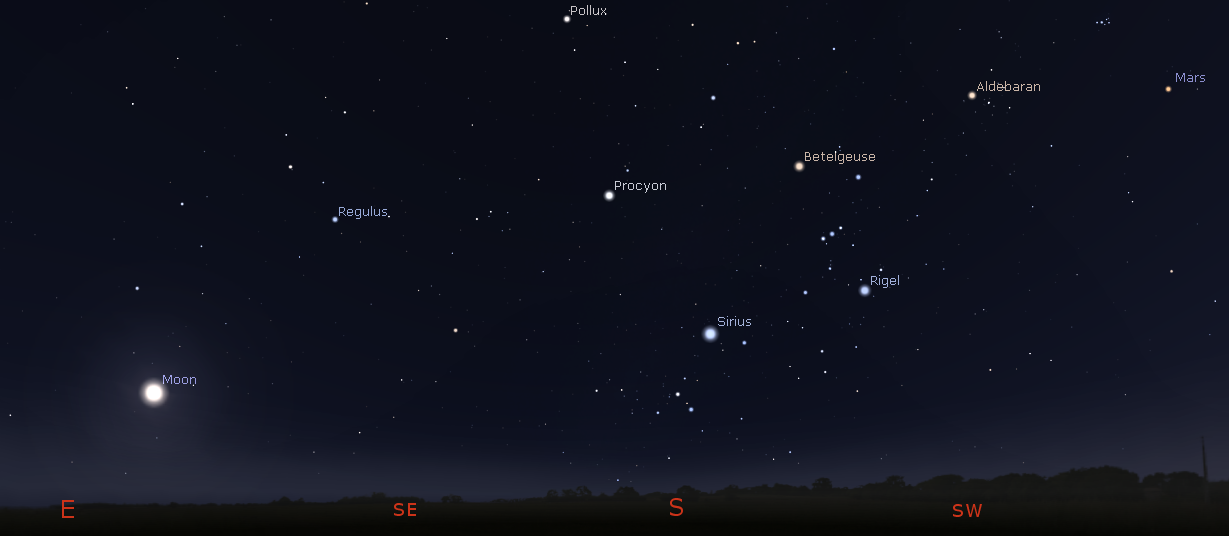
Mars and the Moon and the bright stars on the first day of spring at 9 p.m. March 20, 2019. Click on the image to enlarge. Created using Stellarium.
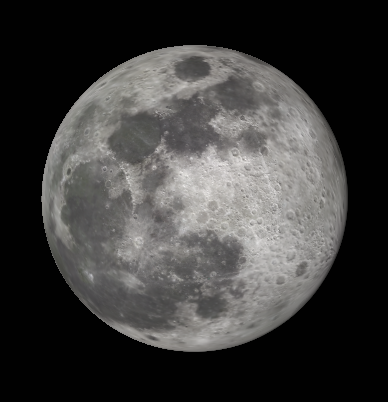
The full moon, and super moon at that, at 9 p.m. March 20, 2019. Created using Stellarium.
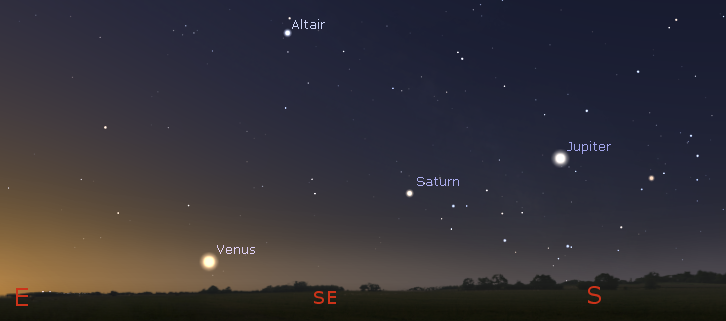
Morning planets and the constellations at 7 a.m. tomorrow March 21, 2019. Created using Stellarium.
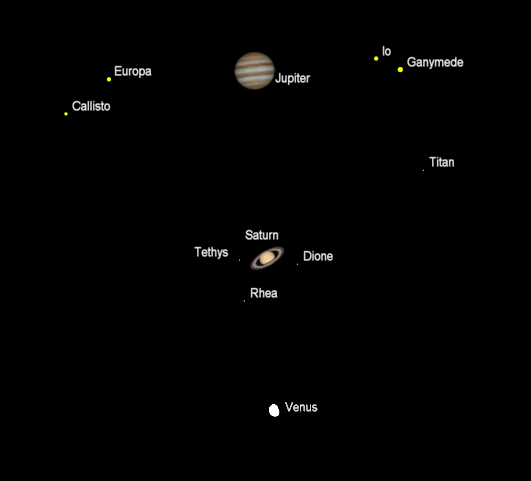
Jupiter, Saturn and Venus with the same magnification at 7 a.m. tomorrow morning March 21, 2019. Created using Cartes du Ciel (Sky Charts).
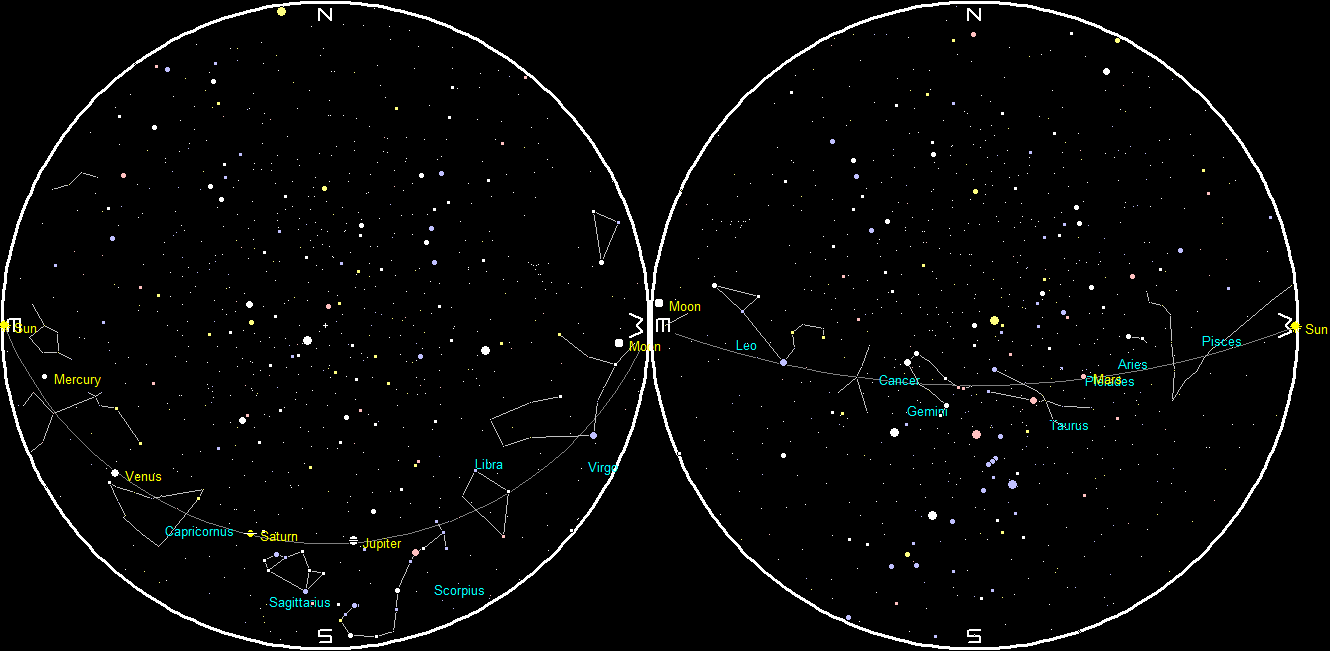
Planets and the Moon at sunset and sunrise of a single night starting with sunset on the right on March 20, 2019. The night ends on the left with sunrise on the 21st. Note the motion of the Moon from sunrise and sunset. Click on the image to enlarge. Created using my LookingUp program.
03/13/2019 – Ephemeris – Let’s find the bright planets for this week
Ephemeris for Wednesday, March 13th. Today the Sun will be up for 11 hours and 46 minutes, setting at 7:46, and it will rise tomorrow at 7:57. The Moon, 1 day before first quarter, will set at 3:06 tomorrow morning.
Let’s look at the planets for this week. We are back to one evening planet visible now. Mars will be in the west-southwestern sky this evening and will set at 12:39 a.m. Mars is fading as the Earth, in its inner and faster orbit is leaving Mars behind at 175 million miles (282 million km) away. In the morning sky we have Jupiter which will rise tomorrow at 3:20 a.m. in the east-southeast It is second to Venus in brightness. Saturn will be next to rise at 5:06 a.m., also in the east-southeast It will be to the upper right of Venus which will rise at 6:30 a.m. By 7 in the morning they will be strung out from the southeast to the south. They will be a beautiful sight as morning twilight advances.
The times given are for the Traverse City/Interlochen area of Michigan. They may be different for your location.
Addendum
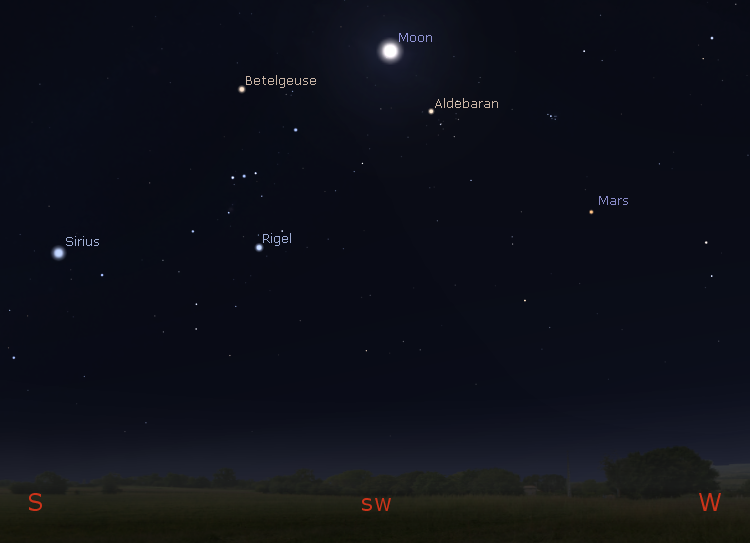
Mars and the Moon with the brighter stars at 9 p.m. March 13, 2019. Created using Stellarium.
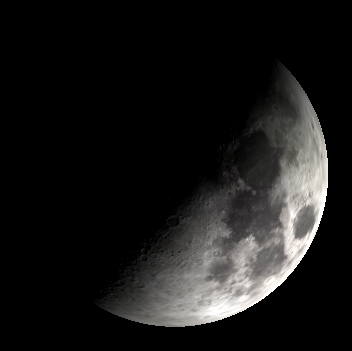
The Moon as it might appear in binoculars or a small telescope tonight at 9 p.m. March 13, 2019. Created using Stellarium.
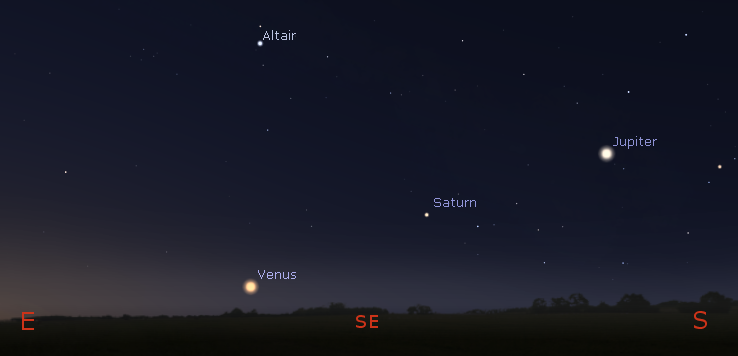
Morning planets and the constellations at 7 a.m. Tomorrow March 14, 2019. Click on the image to enlarge. Created using Stellarium.
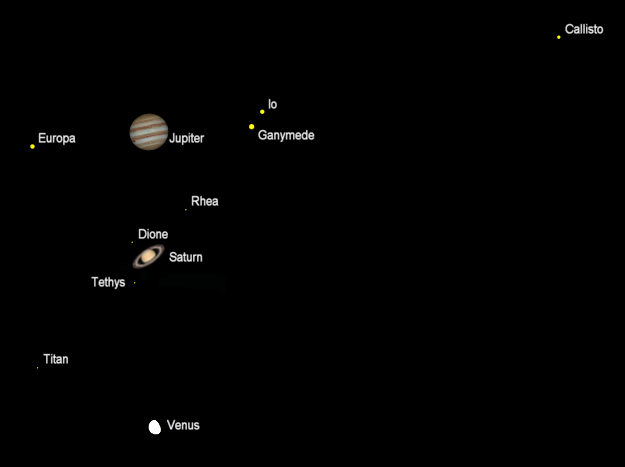
Jupiter, Saturn and Venus with the same magnification at 7 a.m. tomorrow morning March 14, 2019. Created using Cartes du Ciel (Sky Charts).
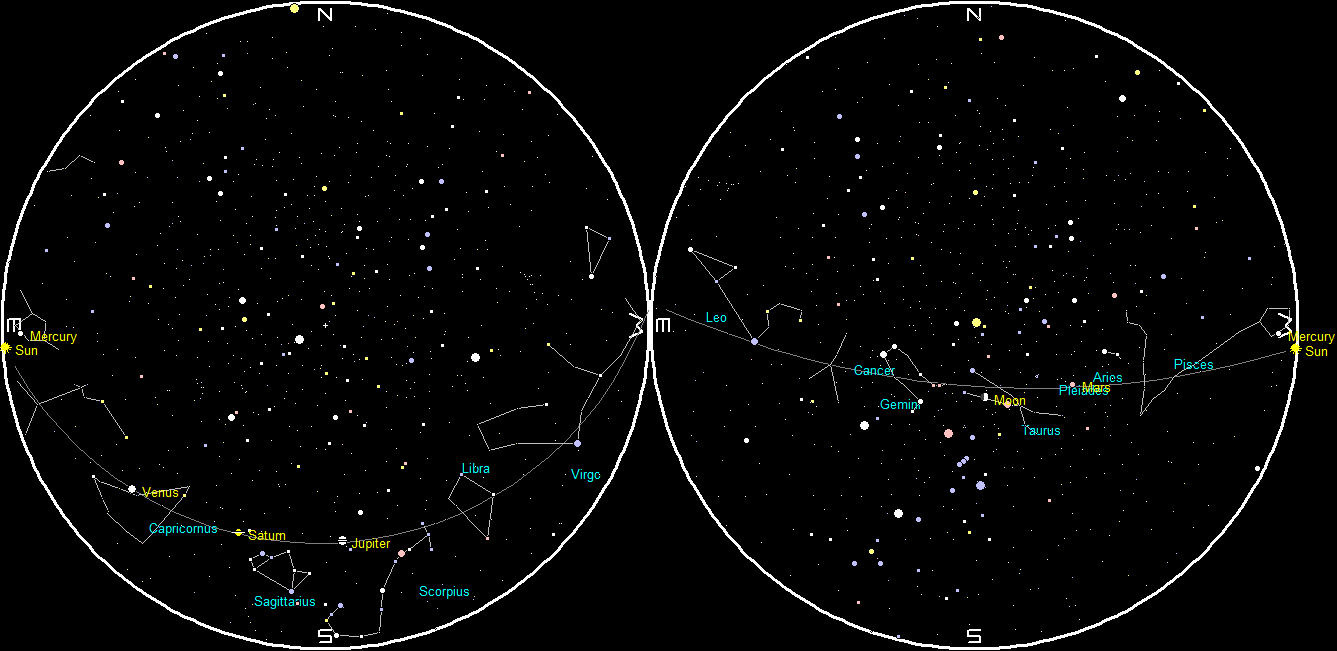
Planets and the Moon at sunset and sunrise of a single night starting with sunset on the right on March 13, 2019. The night ends on the left with sunrise on the 14th. Click on the image to enlarge. Created using my LookingUp program.
03/06/2019 – Ephemeris – Looking at the bright naked eye planets for this week
Ephemeris for Ash Wednesday, March 6th. Today the Sun will be up for 11 hours and 25 minutes, setting at 6:36, and it will rise tomorrow at 7:10. The Moon is new today, and won’t be visible.
Let’s look at the planets for this week. We have two evening planets visible now. Tiny and elusive Mercury is really hard to spot low in the west from about 7 p.m. until it sets at 7:52 p.m. It is fading fast. Binoculars are the only way to spot it now. Mars will be in the west-southwestern sky this evening and will set at 11:42 p.m. Mars too is fading. In the morning sky we have Jupiter which will rise tomorrow at 2:45 a.m. It is second to Venus in brightness. Saturn will be next to rise at 4:32 a.m. It will be to the upper right of Venus which will rise at 5:32 a.m. tomorrow. By 6 in the morning they will be string out from the southeast to the south. They will be a beautiful sight as morning twilight advances.
The times given are for the Traverse City/Interlochen area of Michigan. They may be different for your location.
Addendum
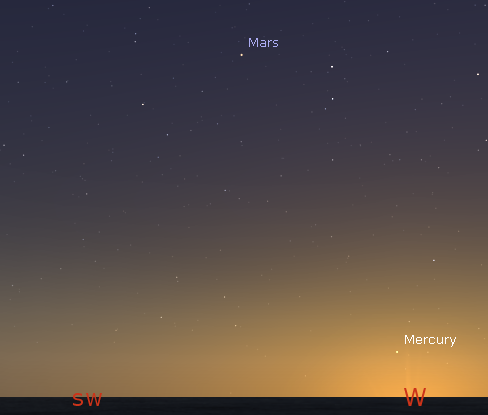
Mars and Mercury at 7:15 p.m. tonight March 6, 2019. I had to increase the star and planet brightness to make Mercury appear in the bright twilight because it has dropped to second magnitude. Created using Stellarium.
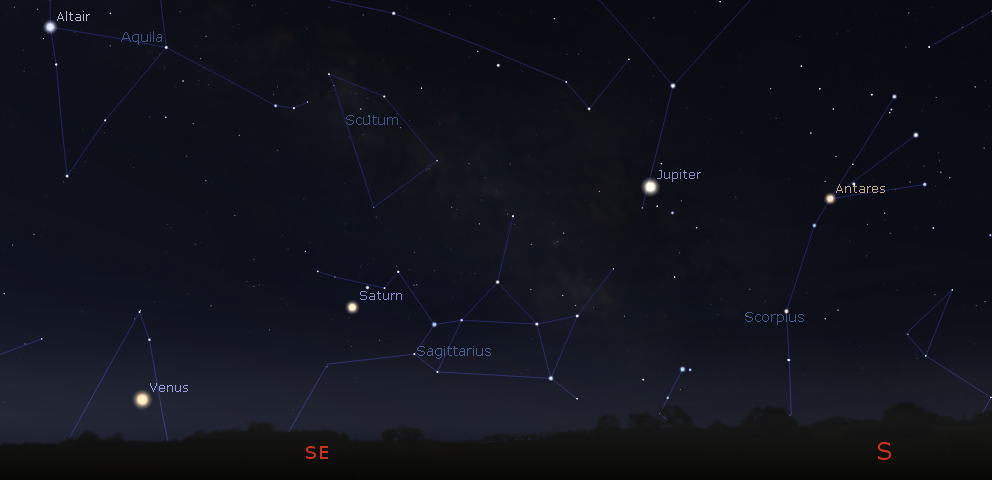
Morning planets and the constellations at 6 a.m. Tomorrow March 7, 2019. Click on image to enlarge. Created using Stellarium.
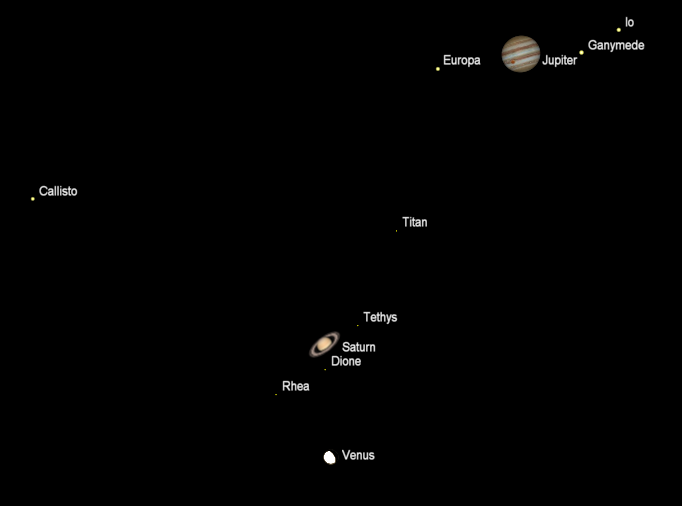
Jupiter, Saturn and Venus with the same magnification at 6 a.m. tomorrow morning March 7, 2019. Created using Cartes du Ciel (Sky Charts).
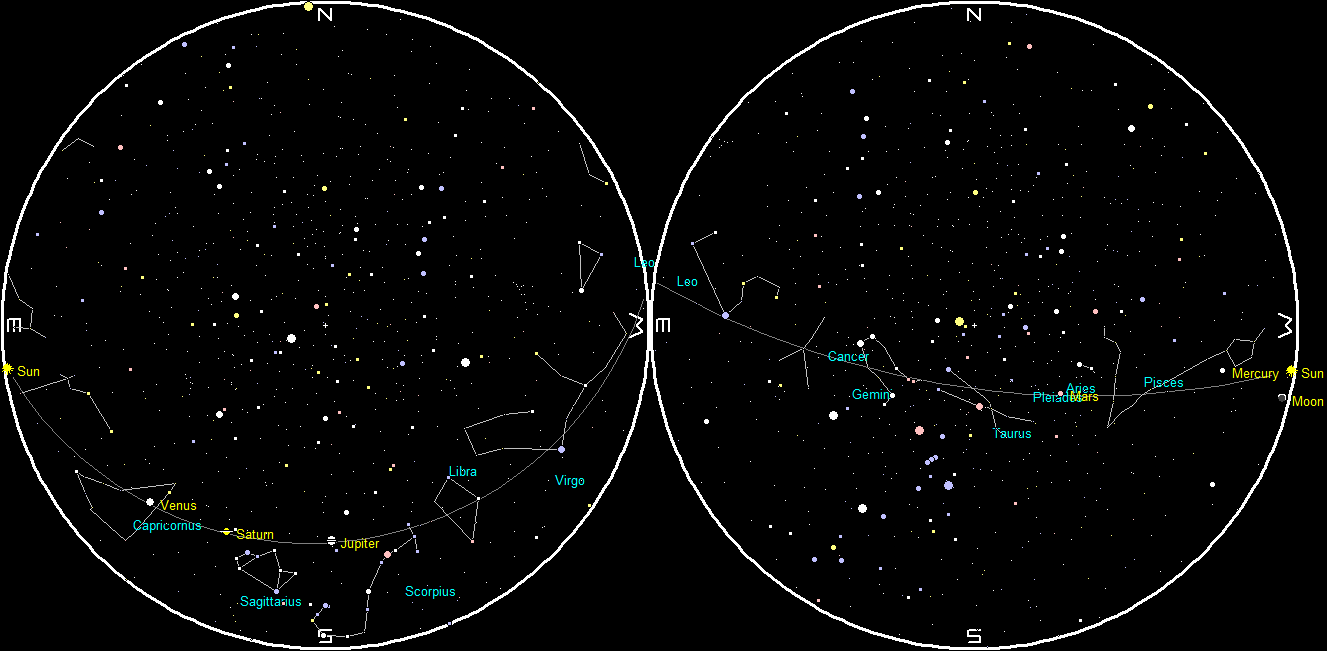
Planets and the Moon at sunset and sunrise of a single night starting with sunset on the right on March 6, 2019. The night ends on the left with sunrise on the 7th. Click on the image to enlarge. Created using my LookingUp program.
02/27/2019 – Ephemeris – All the classical planets from antiquity are now visible
Ephemeris for Wednesday, February 27th. Today the Sun will be up for 11 hours and 3 minutes, setting at 6:27, and it will rise tomorrow at 7:22. The Moon, 1 day past last quarter, will rise at 3:46 tomorrow morning.
Let’s look at the planets for this week. We have two evening planets visible now. Tiny and elusive Mercury should be visible low in the west from about 7 p.m. to about 7:45 p.m. It should be visible for the next few days. Binoculars are a big help in spotting it. Mars will be in the west-southwestern sky this evening and will set at 11:44 p.m. In the morning sky we have Jupiter which will rise tomorrow at 3:05 a.m. It is second to Venus in brightness. Saturn will be next to rise at 4:57 a.m. It will be to the upper right of Venus which will rise at 5:31 a.m. tomorrow. In small telescopes Saturn will show its rings and Venus will show a small slightly gibbous moon shape which will shrink and grow more full over the next months
The times given are for the Traverse City/Interlochen area of Michigan. They may be different for your location.
Addendum
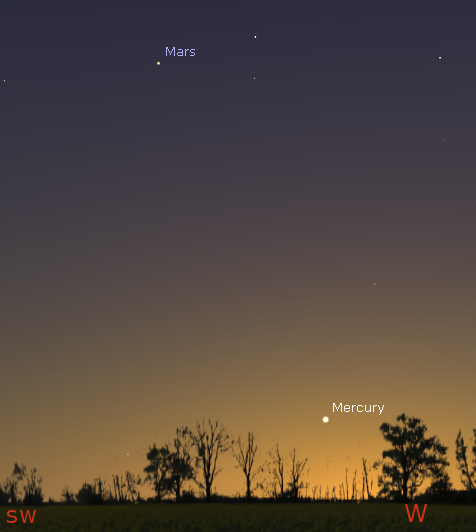
Mars and Mercury at 7 p.m. tonight February 17, 2019. Created using Stellarium.
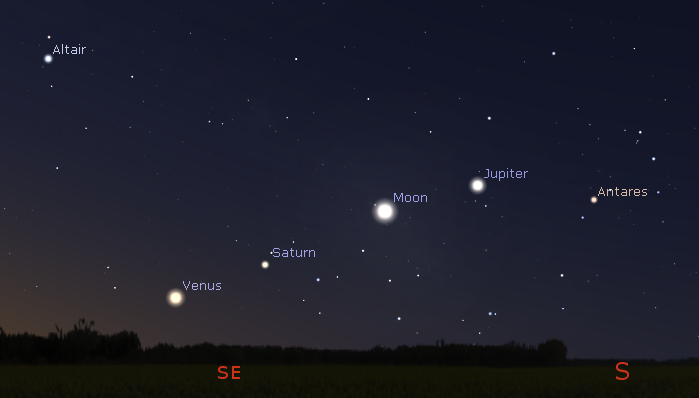
Morning planets and the Moon at 6:30 a.m. Tomorrow February 28, 2019. The actual Moon image is below. Created using Stellarium.
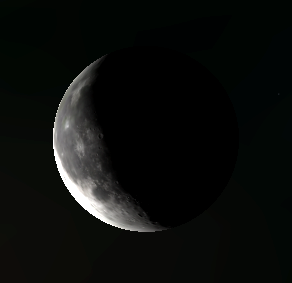
The moon as it might appear in binoculars tomorrow morning, February 28, 2019. Created using Stellarium.
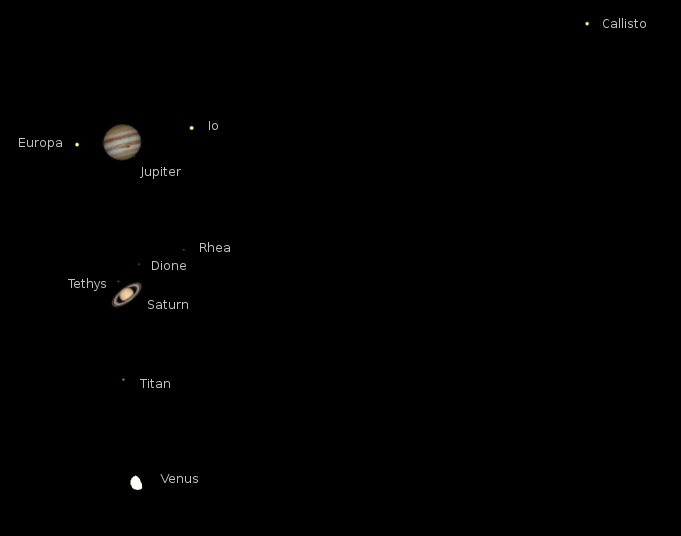
Jupiter, Saturn and Venus with the same magnification at 6:30 a.m. tomorrow morning February 28, 2019. Ganymede is behind Jupiter at that hour. See the table of Jupiter moon events tomorrow morning. Created using Cartes du Ciel (Sky Charts).
| Satellite | Event | Date | UT | EST |
| Ganymede | Eclipse start | 28 Feb 2019 | 06:16 | — |
| Ganymede | Eclipse end | 28 Feb 2019 | 08:21 | 3:21 a.m. |
| Europa | Shadow start | 28 Feb 2019 | 11:09 | 6:09 a.m. |
| Ganymede | Occultation start | 28 Feb 2019 | 11:13 | 6:13 a.m. |
| Ganymede | Occultation end | 28 Feb 2019 | 13:23 | — |
| Europa | Shadow end | 28 Feb 2019 | 13:31 | — |
| Europa | Transit start | 28 Feb 2019 | 13:34 | — |
| Io | Eclipse start | 28 Feb 2019 | 13:42 | — |
| Europa | Transit end | 28 Feb 2019 | 15:58 | — |
| Io | Occultation end | 28 Feb 2019 | 17:06 | — |
Jupiter satellites will have a busy morning. Events with EST times are visible from Northern Michigan. Events with UT only times are visible in other longitudes in the western hemisphere.
Times are provided by the Project Pluto: https://www.projectpluto.com/jevent.htm.
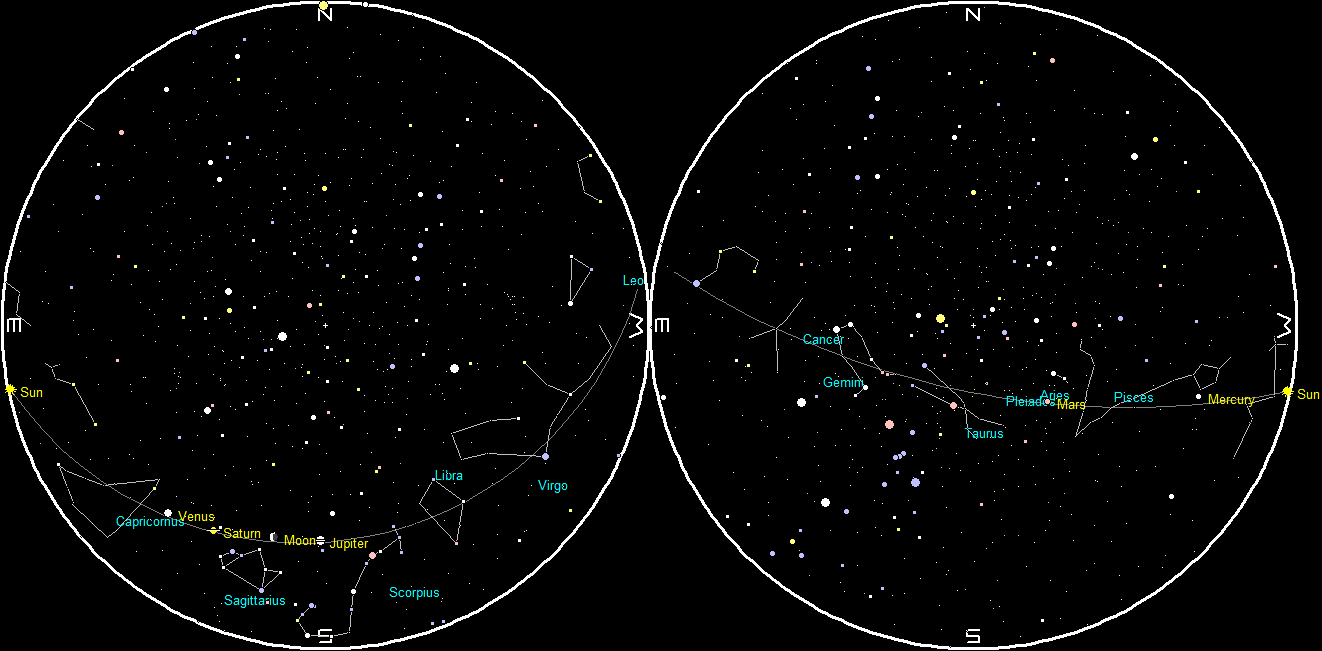
Planets and the Moon at sunset and sunrise of a single night starting with sunset on the right on February 27, 2019. The night ends on the left with sunrise on the 28th. Click on the image to enlarge. Created using my LookingUp program.
02/20/2019 – Ephemeris – Theoretical all 5 bright planets are now visible
Ephemeris for Wednesday, February 20th. Today the Sun will be up for 10 hours and 42 minutes, setting at 6:18, and it will rise tomorrow at 7:34. The Moon, 1 day past full, will rise at 7:47 this evening.
Let’s look at the planets for this week. We have two evening planets visible now. Tiny and elusive Mercury should be visible low in the west for about a half hour after 7 p.m. It should be visible for a little over a week. Binoculars are a big help in spotting it. Mars will be in the southwestern sky this evening and will set at 11:46 p.m. In the morning sky we have Jupiter which will rise tomorrow at 3:32 a.m. It is second to Venus in brightness. Saturn will be next to rise at 5:22 a.m. It is just to the right of Venus which will rise at 5:29 a.m. tomorrow. In small telescopes Saturn will show its rings and Venus will show a small slightly gibbous moon shape which will shrink and grow more full over the next months
The times given are for the Traverse City/Interlochen area of Michigan. They may be different for your location.
Addendum
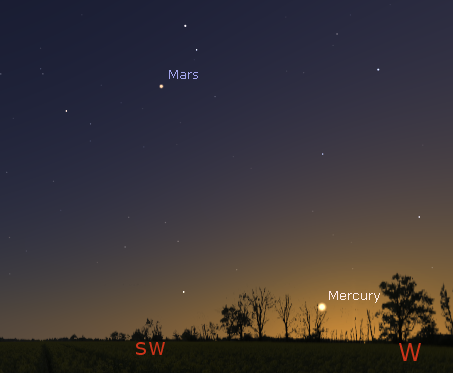
Mars, Mercury and bright stars in twilight at 7 p.m. February 20, 2019. Created using Stellarium.
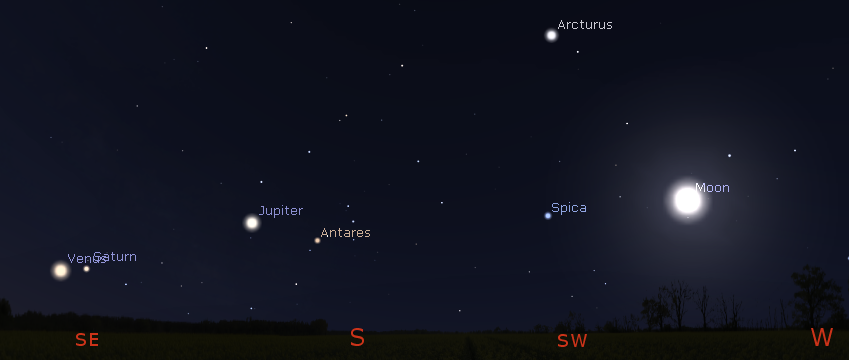
Morning planets and the Moon at 6:30 a.m. February 21, 2019. Click on the image to enlarge. created using Stellarium.
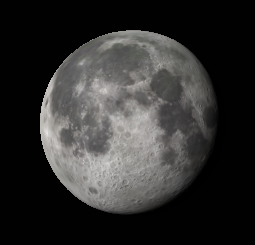
The waning gibbous Moon as it should appear tomorrow morning with binoculars. Created using Stellarium.
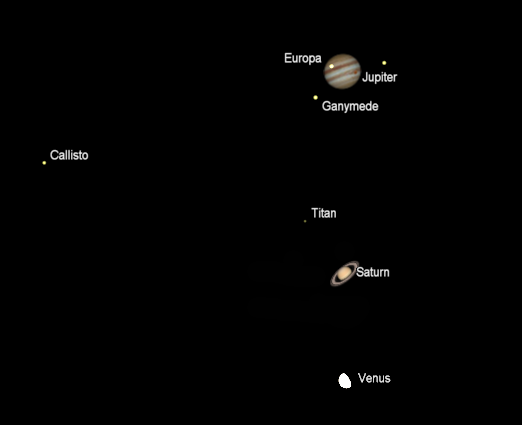
Jupiter, Saturn and Venus with the same magnification at 6:30 a.m. tomorrow morning February 21, 2019. See the table of Jupiter moon events tomorrow morning. Created using Cartes du Ciel (Sky Charts).
| Satellite | Event | Date | UT | EST | Notes |
| Ganymede | Occultation start | 21 Feb 2019 | 07:05:00 AM | 2:05 a.m. | Not visible from Michigan |
| Europa | Shadow start | 21 Feb 2019 | 08:36:00 AM | 3:36 a.m. | |
| Ganymede | Occultation end | 21 Feb 2019 | 09:15:00 AM | 4:15 a.m. | |
| Europa | Transit start | 21 Feb 2019 | 10:57:00 AM | 5:57 a.m. | |
| Europa | Shadow end | 21 Feb 2019 | 10:58:00 AM | 5:58 a.m. | |
| Io | Eclipse start | 21 Feb 2019 | 11:49:00 AM | 6:49 a.m. | |
| Europa | Transit end | 21 Feb 2019 | 01:21:00 PM | 8:27 a.m. | Not visible from Michigan |
Jupiter satellite events are from https://www.projectpluto.com/jevent.htm
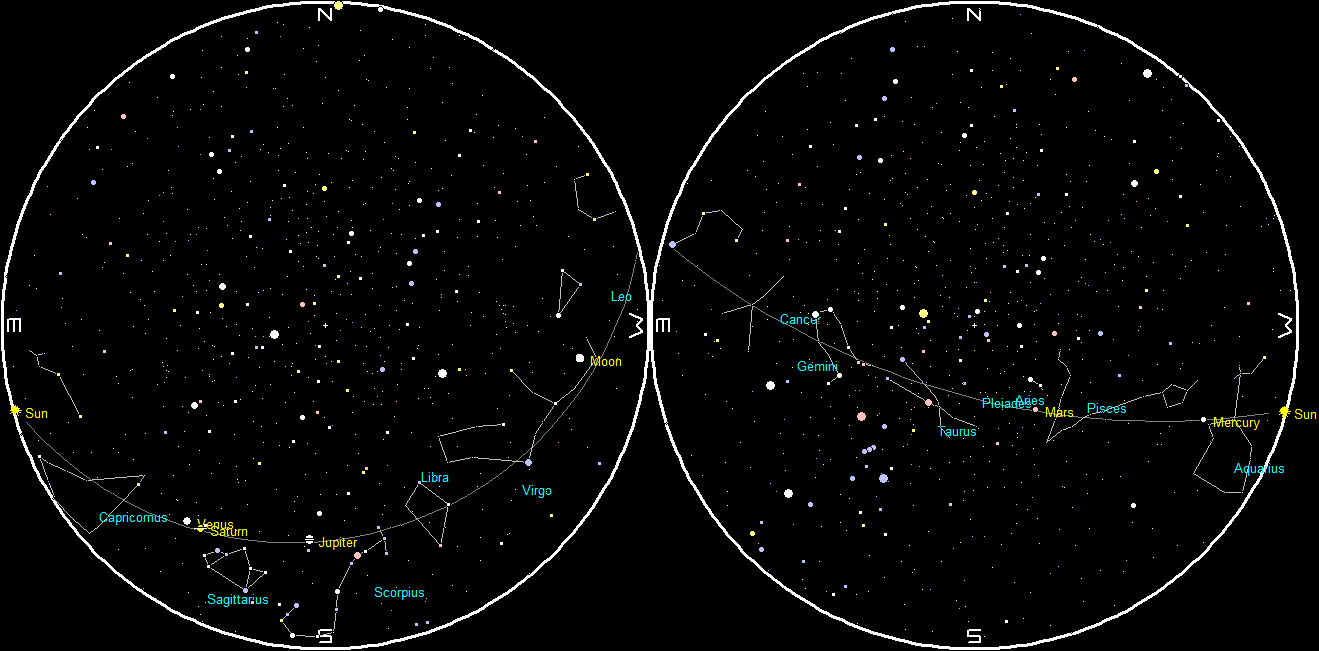
Planets and the Moon at sunset and sunrise of a single night starting with sunset on the right on February 20, 2019. The night ends on the left with sunrise on the 21st. Click on the image to enlarge. Created using my LookingUp program.
 Bob Moler's Ephemeris Blog