Archive
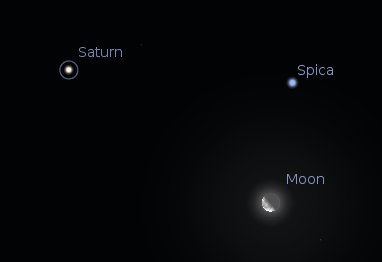
Saturn will appear above the moon on the morning of February 3rd
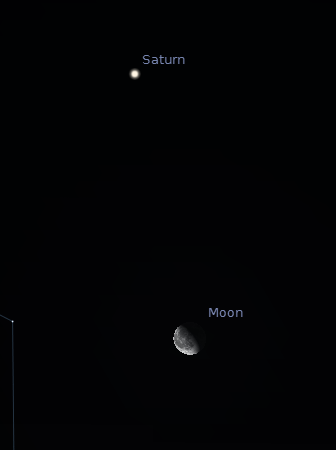
Here’s what you’ll see looking to the south at 4:55 a.m. EST. Created using Stellarium.
While you’re at it check out both with a telescopes. The two will hang out next to each other through the beginning of twilight.
12/04/2012 – Ephemeris – Mercury in the morning
Ephemeris for Tuesday, December 4th. The sun will rise at 8:02. It’ll be up for 8 hours and 59 minutes, setting at 5:02. The moon, 2 days before last quarter, will rise at 10:59 this evening.
The planet Mercury has joined the morning planets for a week or so. Mercury can be best spotted low in the east southeast starting about 7 a.m. It will be below and slightly left of Venus, the brightest planet, about the same distance below as Saturn is above Venus. They’re just about in straight line. Binoculars will help in the search. Once found Mercury may be tracked past 7:30. Mercury will be visible for about a week as become somewhat brighter as it does. That’s because Mercury’s phase at its half illuminated today at its greatest elongation from the sun. It will be becoming more and more full as it moves around the sun mostly away from us now. Mercury is a prise, few people have ever seen it.
Times are for the Traverse City/Interlochen area of Michigan. They may be different for your location.
Addendum
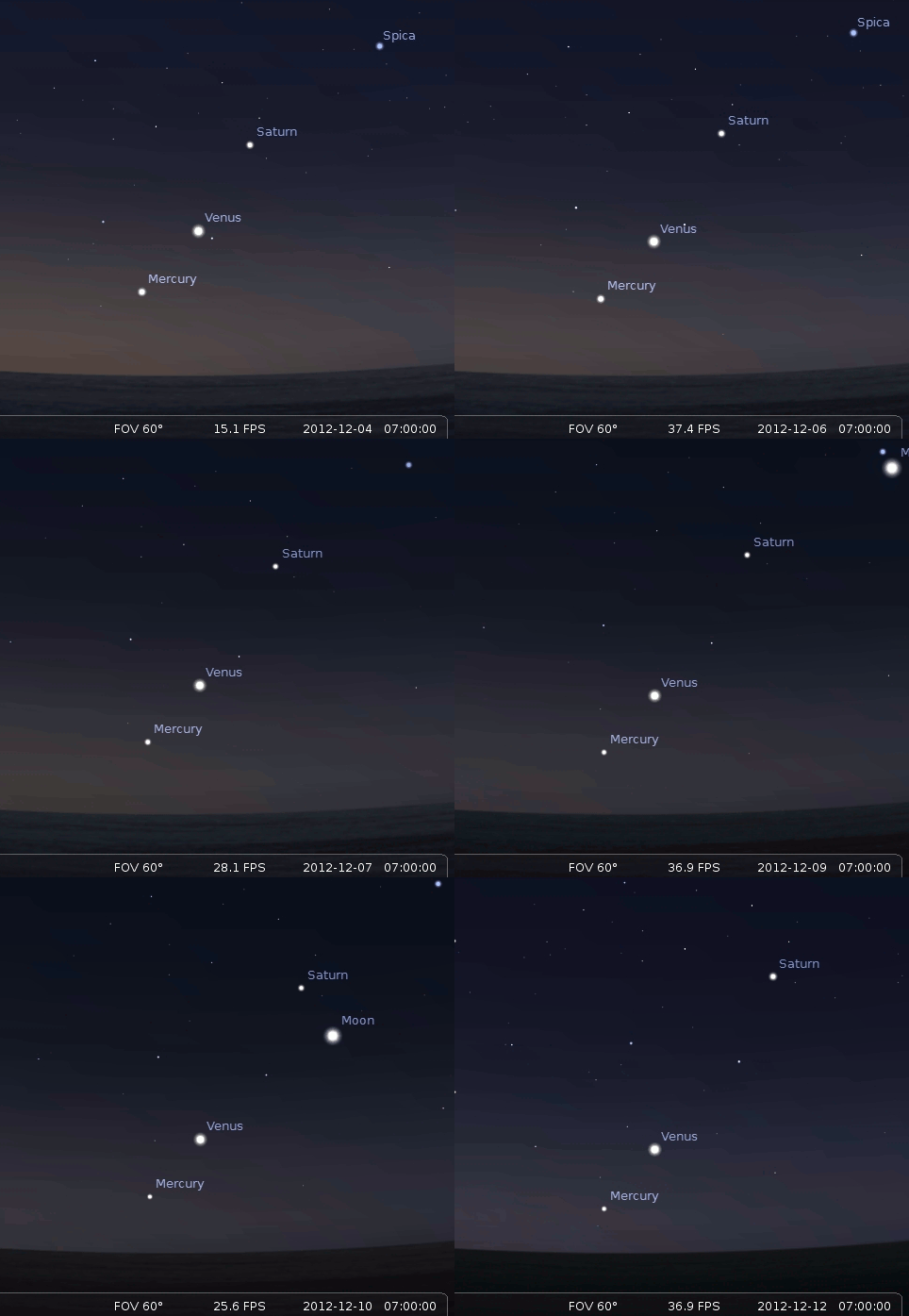
Mercury animation starting December 4, 2012. Created using Stellarium
Note the passage of the moon on the mornings of the 10th and 11th. The moon will actually be a thin crescent.
05/08/2012 – Ephemeris – Observing Saturn’s Rings
Ephemeris for Tuesday, May 8th. The sun rises at 6:22. It’ll be up for 14 hours and 33 minutes, setting at 8:56. The moon, 3 days past full, will rise at 12:09 tomorrow morning.
The planet Saturn is a wonderful sight in telescopes now. In a little as 20 power a spotting scope with show Saturn’s rings, but may not distinctly separate the planet out. At 50 power the planet is easily separated from the rings. It you have a telescope with eyepieces of differing focal lengths and/or a Barlow lens that doubles the magnification of your eyepieces, you can experiment with using higher powers. I like a crisp image at lower powers rather than a fuzzy image at higher powers. Saturn’s rings are its best known feature. They are about 170 thousand miles wide and perhaps only a hundred feet thick. They aren’t solid but billions of small icy particles each orbiting Saturn at their own speed, and kept in line by collisions with its ring mates.
Times are for the Traverse City/Interlochen area of Michigan. They may be different for your location.
Addendum
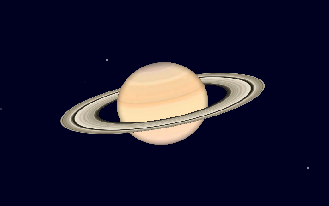
Image of Saturn created with Cartes di Ciel showing current ring tilt.
The rings as they appear from earth. The outside ring is the A ring. Then the dark Cassini’s Division, which is sometimes hard to spot. Then the broad and bright B ring. The inner C ring is hard to spot.
04/16/2012 – Ephemeris – Saturn a day after opposition
Ephemeris for Monday, April 16th. The sun rises- at 6:55. It’ll be up for 13 hours and 33 minutes, setting at 8:29. The moon, 3 days past last quarter, will rise at 4:59 tomorrow morning.
Saturn was in opposition from the sun yesterday. That means that Saturn was opposite the sun in the sky. That means that Saturn was closest to the earth at 811 million miles. The difference from today’s distance isn’t worth mentioning. Saturn, being 9 and a half times the earth’s distance from the sun doesn’t make much difference in Saturn’s apparent size, whether we view it from the nearest point in our orbit of the farthest. Saturn, which is just left of the bright bluish star Spica in the southeast in the evening, is definitely not star-like in binoculars, but a 20 power spotting scope will just bring out Saturn’s rings elliptical nature. Those rings will open up for the next four years, so the rings at their narrowest part will be as wide as the planet.
* Times are for the Traverse City/Interlochen area of Michigan. They may be different for your location.
Addendum
Image of Saturn created with Cartes du Ciel showing current ring tilt.
03/14/2012 – Ephemeris – Where are the bright planets this week?
Wednesday, March 14th. The sun will rise at 7:55. It’ll be up for 11 hours and 52 minutes, setting at 7:47. The moon, at last quarter today, will rise at 3:35 tomorrow morning.
Let’s see what’s happening with the bright planets for this week. Mercury will make a brief appearance in the west after sunset. It will set at 8:54. Venus and Jupiter are brilliant in the western sky after sunset. Jupiter will be just below left of Venus, the brighter planet. Jupiter will set first at 11:40 p.m. followed by Venus at 11:53. Mars is up in the east in the evening with its unmistakable bright reddish color. It’s in the constellation Leo the lion now. It is 63.5 million miles and moving away. Mars will pass due south at 1:04 a.m. and will be setting in the west near sunrise. Saturn will rise at 10:31 p.m. just to the left of the bright star Spica in the east southeast.
* Times are for the Traverse City/Interlochen area of Michigan. They may be different for your location.
Addendum
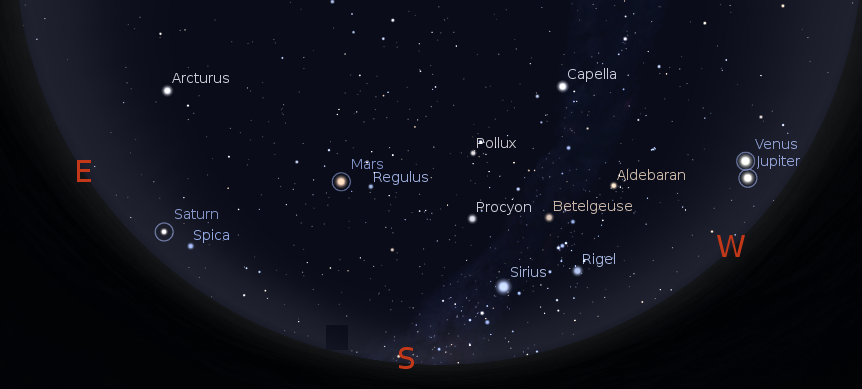
The planets at 11 p.m. March 14, 2012. Created using Stellarium.
03/09/2012 – Ephemeris – The moon will pass Spica and Saturn tomorrow
Ephemeris for Friday, March 9th. The sun will rise at 7:04. It’ll be up for 11 hours and 36 minutes, setting at 6:41. The moon, 1 day past full, will rise at 8:47 this evening.
The moon will be passing by the bright star Spica and the planet Saturn tomorrow evening. They will make a neat triangle with the moon at the point below. I should remind everyone that the moon will only pass these object from our point of view. We are lining up the nearby moon, only a quarter million miles away with Saturn, nearly a billion miles away, and Spica trillion and trillions of miles away. Though the heavens appear as a sphere overhead, it is unimaginably deep. The ancients called the heavens the firmament, meaning that it was literally solid. It was, according to Genesis, placed there to divide the waters above from that below. We find now that time is as deep into the past as space is deep, some 13.7 billion years.
Not mentioned in the program: Daylight Time will start at 2 a.m. Sunday March 11th at 2 a.m.
* Times are for the Traverse City/Interlochen area of Michigan. They may be different for your location.
Addendum
Below is The moon below Spica and Saturn at 11 p.m. on Saturday, march 10, 2012.
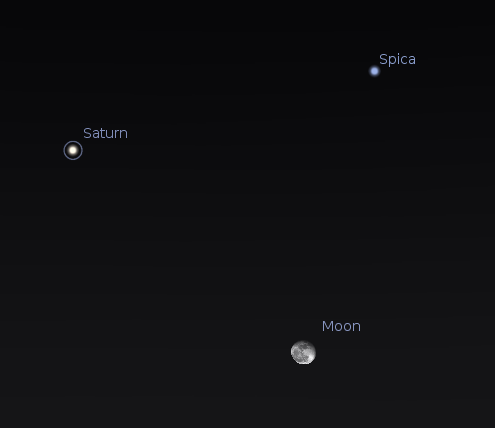
The Moon, Spica and Saturn at 11 p.m March 10, 2012. Chart created using Stellarium.
02/10/2011 – Ephemeris – The moon will be near Saturn Sunday morning
Ephemeris for Friday, February 10th. The sun will rise at 7:50. It’ll be up for 10 hours and 12 minutes, setting at 6:03. The moon, 3 days past full, will rise at 9:52 this evening.
Sunday morning the moon will pass Saturn in our sky. The ringed planet is just to the left of the bright blue-white star Spica in the constellation of Virgo. Saturn and Spica rise around midnight now. Saturn will be best seen in the evening this spring and early summer. Its rings are still opening up from their edge on passage in 2009. Saturn’s rings can be seen in any telescope with 20 power or over. In fact in sturdily mounted binoculars, Saturn will appear not point-like as stars do but may appear somewhat oblong, due to its rings. The rings are not solid, a fact that’s been known for a few centuries. A solid disk would be tour asunder by the tidal forces on it by the difference in the gravitational forces across the rings.
* Times are for the Traverse City/Interlochen area of Michigan. They may be different for your location.
Addendum
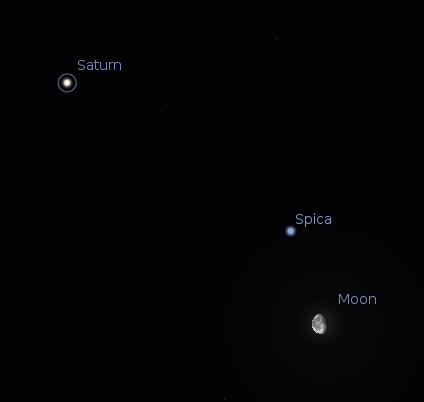
Saturn, Spica and the moon at 6 a.m. February 12, 2012. Created using Stellarium.
02/08/2011 – Ephemeris – Where are the bright planets?
Ephemeris for Wednesday, February 8th. The sun will rise at 7:53. It’ll be up for 10 hours and 7 minutes, setting at 6:00. The moon, 1 day past full, will rise at 7:24 this evening.
Let’s see what’s happening with the bright planets for this week. Venus is brilliant in the southwestern sky after sunset and will set at 9:35 in the west. Jupiter the second brightest planet after Venus. It’s located high in the southwest as it gets dark and is seen against the stars of the constellation Aries. It will set at 12:25 a.m.. Mars is the up and coming planet. It will rise at 8:31 p.m in the east and is below the hind end of the constellation Leo the lion. It is 69.2 million miles away and closing and is getting brighter. It’s now as bright as most first magnitude stars. Mars will pass due south at 3:01 a.m. Saturn will rise at 11:54 p.m. just to the left of the bright star Spica in the east southeast.
* Times are for the Traverse City/Interlochen area of Michigan. They may be different for your location.
Addendum
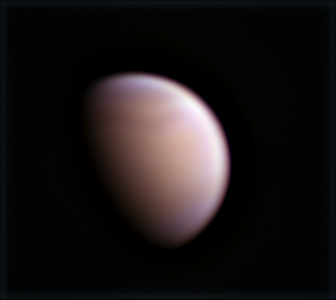
Venus by Scott Anttila. Taken Monday evening February 6, 2012
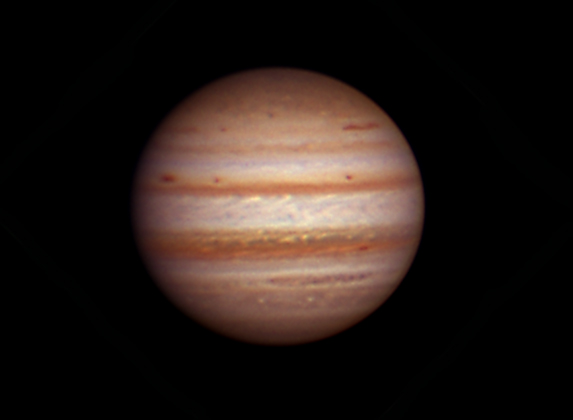
Jupiter by Scott Anttila. Taken Monday evening February 6, 2012
01/18/2012 – Ephemeris – Where are the bright planets this week
Ephemeris for Wednesday, January 18th. The sun will rise at 8:14. It’ll be up for 9 hours and 17 minutes, setting at 5:31. The moon, 2 days past last quarter, will rise at 4:51 tomorrow morning.
It’s time again to take a look at the whereabouts of the bright planets. Venus is brilliant in the southwestern sky after sunset and will set at 8:44. Jupiter is the most prominent planet of the evening sky, once Venus sets. It’s located high in the south and is seen against the stars of the constellation Aries. It will pass due south at 6:49 p.m. It will set at 1:36 a.m. Mars will rise at 10:03 p.m in the east northeast and is below the hind end of the constellation Leo the lion. It is 82.4 million miles away and closing. Mars will pass due south at 4:29 a.m. Saturn will rise at 1:15 a.m. just to the left of the bright star Spica in the east southeast.
* Times, as always are for the Traverse City/Interlochen area of Michigan.
01/16/2012 – Ephemeris – The moon will appear below Saturn and Spica this morning
Ephemeris for Martin Luther King Day, Monday, January 16th. The sun will rise at 8:15. It’ll be up for 9 hours and 13 minutes, setting at 5:29. The moon, at last quarter today, will rise at 2:31 tomorrow morning. | This morning the crescent moon will appear below Saturn and the bright blue-white star Spica in the southeast before twilight brightens too much. When seen together Saturn and Spica really show the difference in their colors. Saturn reflects the light of our yellow sun, and that’s accentuated by it’s cream colored clouds. Only Saturn’s rings reflect the sun’s light pretty much unaltered because they’re made mostly of ice. Spica has the hottest surface temperature of any first magnitude star and shines with a blue tinge. This came home to me a long time ago, when I photographed a lunar eclipse with color film when the moon was next to Spica. Spica came out looking very blue indeed.
* Times, as always are for the Traverse City/Interlochen area of Michigan.
Addendum
Saturn, Spica and the Moon on the morning of January 16, 2012. Created using Stellarium.
 Bob Moler's Ephemeris Blog