Archive
07/19/2016 – Ephemeris – The bright Moon is seen low in the summer
Ephemeris for Tuesday, July 19th. Today the Sun will be up for 15 hours and 6 minutes, setting at 9:22, and it will rise tomorrow at 6:16. The Moon, at full today, will rise at 9:00 this evening.
In the summer time the moon appears to be seen low in the south. If you can remember back six month to winter and where the bright moon was then. It was very high in the sky then. The reason for the difference in altitude of the bright moon is that the Moon follows closely the Sun’s yearly track against the stars. That track is the ecliptic, along which the constellations of the Zodiac lie. The Moon’s own orbit of the Earth departs from that by five degrees. Tonight the Moon will be about 3 degrees, or 6 Moon diameters above of north of that line. The full Moon happens to be in the same place, plus or minus up to five degrees north or south of where the Sun was 6 months ago or will be 6 months hence.
Times are for the Traverse City/Interlochen area of Michigan. They may be different for your location.
Addendum
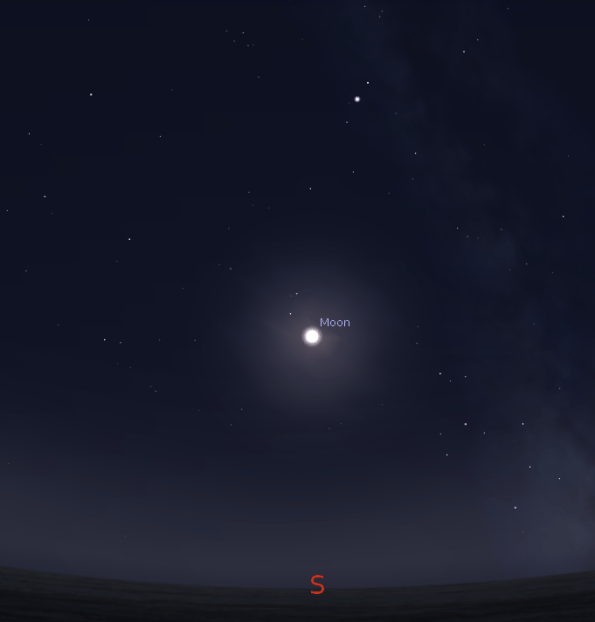
The Moon is low in the south on July 20, 2016. Created using Stellarium.
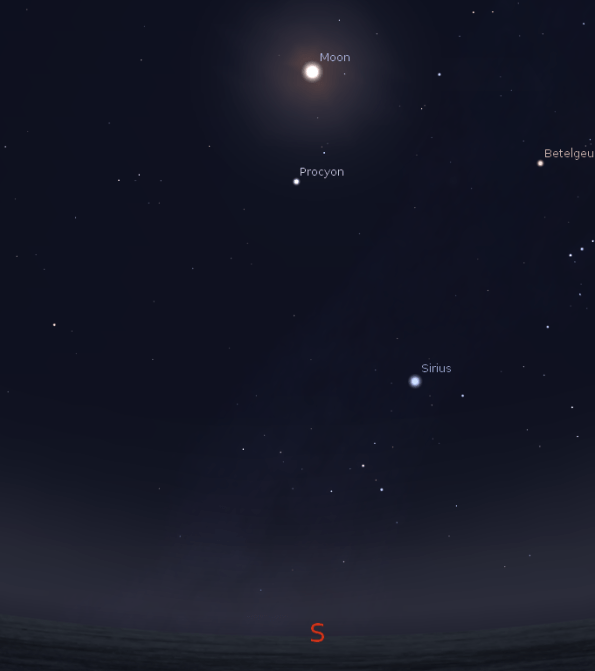
The Moon is high in the south on January 23, 2016. Created using Stellarium.
These images are the same scale.
06/27/2016 – Ephemeris – Astronomical twilight lasts till after midnight… Bummer!
Ephemeris for Monday, June 27th. Today the Sun will be up for 15 hours and 33 minutes, setting at 9:32, and it will rise tomorrow at 5:59. The Moon, at last quarter today, will rise at 1:57 tomorrow morning.
Here we are a week into summer and we find that the latest sunset was already last night. That means that the last vestiges of twilight* don’t end until just after midnight. It wouldn’t be so bad if the Sun was in the south at noon instead of 1:43 in the afternoon, due to being in the extreme western part of the eastern time zone and the imposition of daylight time. For latitudes north of 48 ½ degrees, twilight currently doesn’t end. That latitude will move northward as the Sun heads south. As it is now we in the Grand Traverse region are currently getting only 4 ½ hours of darkness Moon willing. And it won’t for the next few days at least. Our darkness situation will start to get better in about a month from now.
Times are for the Traverse City/Interlochen area of Michigan. They may be different for your location.
*Astronomical twilight begins and ends when the Sun is 18° below the horizon.
06/20/2016 – Ephemeris – Summer will start later today
Ephemeris for Monday, June 20th. Today the Sun will be up for 15 hours and 34 minutes, setting at 9:31, and it will rise tomorrow at 5:57. The Moon, at full today, will rise at 9:32 this evening.
Well, this is it, the last 12 hours of spring. Summer will begin at 6:35 this evening. In the southern hemisphere the season of winter will begin, and the south pole of the Earth will begin* is in the middle of its six months of darkness. The north above 66 ½ degrees north latitude is the land of the midnight Sun. Over summer that line will creep northward as the Sun heads southward. The seasons are caused by the tilt of the Earth’s axis, not by the Earth’s change in distance from the Sun. In fact we are approaching our farthest distance from the Sun, of about 94.5 million miles (152 million km) on the fourth of July called aphelion. The greater than normal distance makes summer the longest season at 93.7 days, winter being the shortest at 89 days.
Times are for the Traverse City/Interlochen area of Michigan. They may be different for your location.
* Thanks to Jeff Silagy for spotting the error.
Addendum
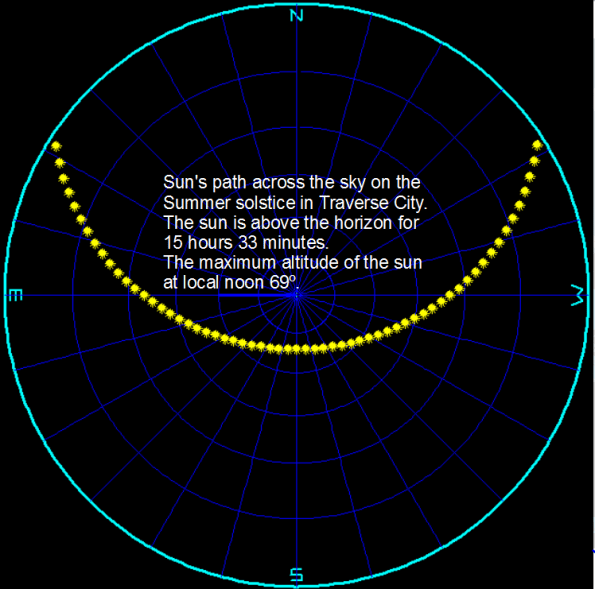
The sun’s daily path through the sky from horizon to horizon on the first day of summer, the summer solstice. Credit My LookingUp program.
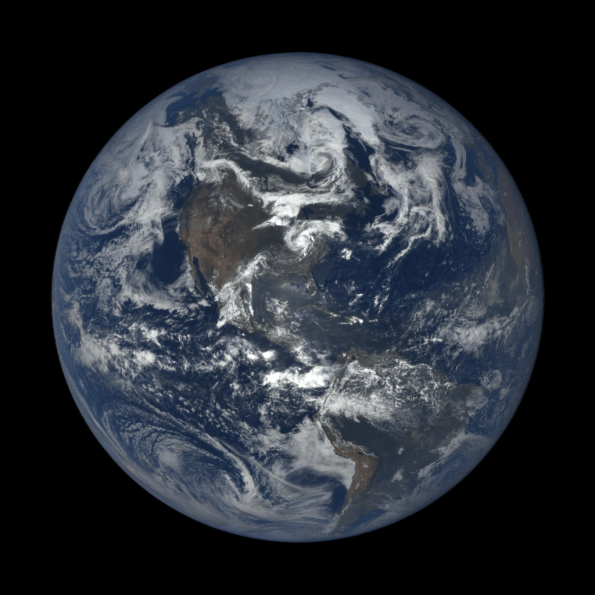
Earth from the DSCOVR satellite at the June solstice 2015. Credit NOAA.
06/14/2016 – Ephemeris – Tomorrow is the earliest sunrise of the year
Ephemeris for Flag Day, Tuesday, June 14th. Today the Sun will be up for 15 hours and 33 minutes, setting at 9:30, and it will rise tomorrow at 5:56. The Moon, 2 days past first quarter, will set at 3:22 tomorrow morning.
Tomorrow morning’s sunrise is the earliest sunrise of the year. Sunrises of the next few days will stay within the same minute. The bottoming out of the earliest sunrise is a slow affair, but the advance of the sunrise times will accelerate in the coming weeks. We are still nearly two weeks from the latest sunset on the 26th. That means that the summer solstice, the first day of summer is near, on the 20th. The reason for the uneven sunrise and sunset peaks is due to a combination of the Earth’s axial tilt and the Earth’s elliptical orbit which is too complicated to explain here. These times of sunrise and sunset are for the Traverse City/Interlochen area. I have a link for other locations and times on bobmoler.wordpress.com.
Times are for the Traverse City/Interlochen area of Michigan. They may be different for your location.
Addendum
Here is the link to the calendar page on my Ephemeris website.
03/18/2016 – Ephemeris – Spring comes this weekend!
Ephemeris for Friday, March 18th. The Sun will rise at 7:48. It’ll be up for 12 hours and 4 minutes, setting at 7:53. The Moon, 3 days past first quarter, will set at 5:48 tomorrow morning.
Sunday’s the day I’ve been waiting for. Maybe you feel that way too. Because at 12:31 a.m. EDT (4:31 a.m. UT) Sunday March 20th the season of spring will begin. It’s not that we’ve had a hard winter. As winters go this has been a mild one. The Grand Traverse Bay never froze over. My heating bill has been low. Of course we have a chance for another snow storm or two before May gets here. However at the top of the show notice we’re getting over 12 hours of sunlight even now. The sun will reach its peak altitude of about 45 degrees at local noon. Those at the Straits will have to wait only a few more days for he Sun to reach that altitude. The Sun is rapidly moving northward, and the daylight hours are increasing by about 3 minutes a day.
Times are for the Traverse City/Interlochen area of Michigan. They may be different for your location.
Addendum
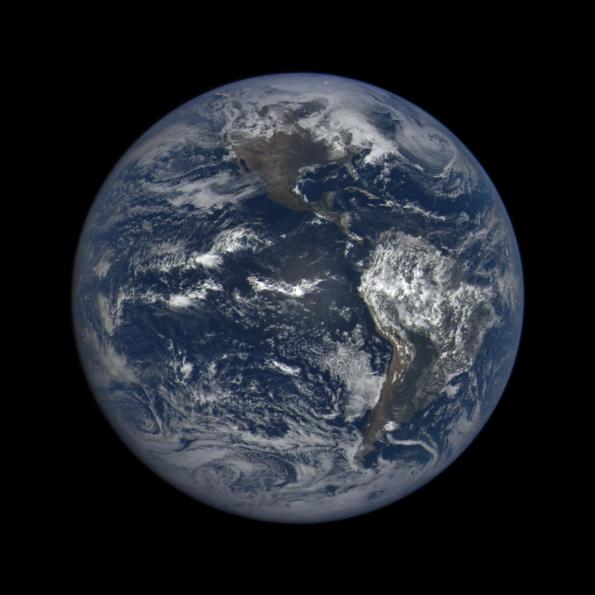
Getting close to the equinox. Earth image from NOAA DSCOVR satellite’s Epic camera in a halo orbit around the Earth-Sun Lagrangian point 1, a million miles Sunward of the Earth. Taken March 14, 2016.
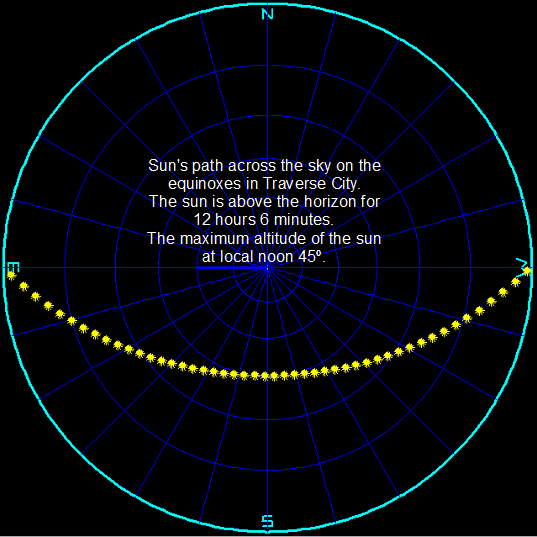
The Sun’s path through the sky from due east to due west on the equinox day from Traverse City, MI. Created using my LookingUp program.
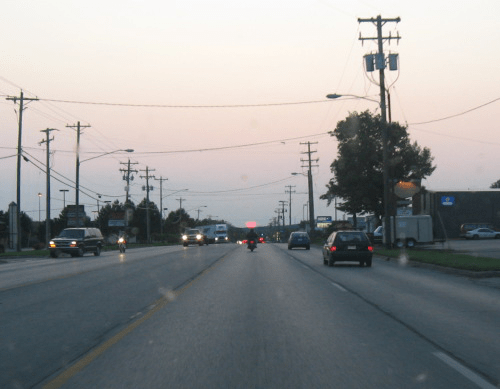
That’s not a pumpkin on the head of the motorcyclist. That’s the Sun rising as I’m traveling east on South Airport Road south of Traverse City Mi. on the autumnal equinox. This is the east-west section of the road. The Sun is rising over the hills some 6 miles to the east. Credit: Bob Moler.
Traverse City’s latitude is 1/3º south of 45º north latitude. The Suns are plotted at 15 minute intervals. Each day the Sun will rise higher and higher until the summer solstice when the Sun’s path in the sky looks like this:
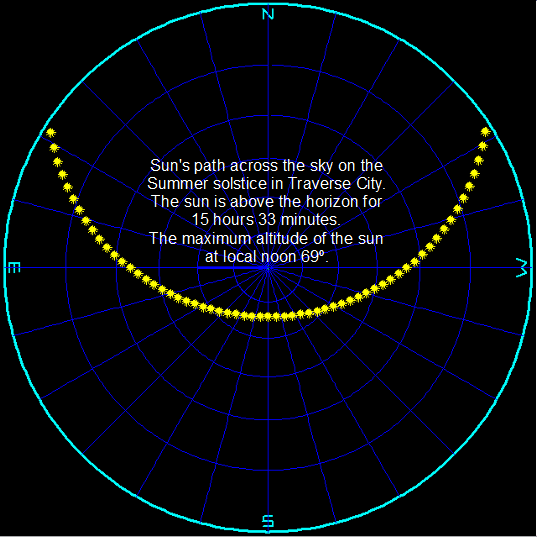
The Sun’s path through the sky on the summer solstice day from Traverse City, MI. Created using my LookingUp program.
For those south of the equator, summer is ending and autumn is starting.
12/22/2015 – Ephemeris – Welcome to winter, or summer if you’re down under
Ephemeris for Tuesday, December 22nd. The Sun will rise at 8:17. It’ll be up for 8 hours and 48 minutes, setting at 5:05. The Moon, 3 days before full, will set at 5:59 tomorrow morning.
Today is the first full day of winter. For folks south of the equator this is the first full day of summer. The Earth reached a point in its orbit where its north pole is tipped its furthest away from the Sun, and is in shadow in the middle of it’s six month night. We do see the Sun, though less than 9 hours of daylight, and to boot the Sun only rises 22 degrees above the horizon giving us the least amount of energy of any day of the year. Why did the ancients celebrate this time of year? That’s because the Sun had slowed and stopped its drift southward and was beginning to come back higher in the sky. They still had to go through the worst of winter, but the Sun was coming back. Spring and summer would eventually return!
Times are for the Traverse City/Interlochen area of Michigan. They may be different for your location.
Addendum
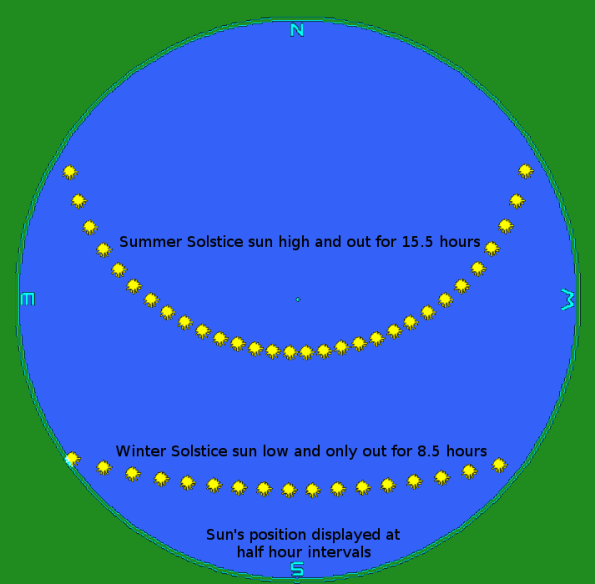
Comparing the sun’s path at the summer and winter solstices. This is a stereographic representation of the whole sky which distorts the sky and magnifies the size of the sun’s path near the horizon.
The above chart shows the diurnal path of the Sun at the winter and summer solstices for Traverse City, MI near 45º north latitude. Peak Sun altitude at noon at the winter solstice is 22º, while it’s 69º at the summer solstice.
07/06/2015- Ephemeris – Today we are at our greatest distance from the sun.
Ephemeris for Monday, July 6th. Today the Sun will be up for 15 hours and 26 minutes, setting at 9:30. The Moon, 2 days before last quarter, will rise at 12:23 tomorrow morning and tomorrow the Sun will rise at 6:04.
This is the day the we are the farthest we can get from the Sun for the year. The point in the Earth’s orbit that it occurs is called aphelion. Earth is closest to the Sun in January at perihelion. The actual distance difference between perihelion and aphelion is 3 million miles out of roughly 93 million miles. So now we’re roughly 94 and a half million miles from the Sun or 152 million kilometers., and will swoop down to 91 and a half million miles(91.4) or 147 kilometers from the Sun in early January. Because Earth’s northern and southern hemispheres have different ratios and placement of land versus ocean I’m not sure you could correlate seasonal differences of the hemispheres with the Earth’s distance from the Sun. Anyway the approximate time we reach aphelion will be 3 p.m. EDT (19 hr UT).
Times are for the Traverse City/Interlochen area of Michigan. They may be different for your location.
Addendum
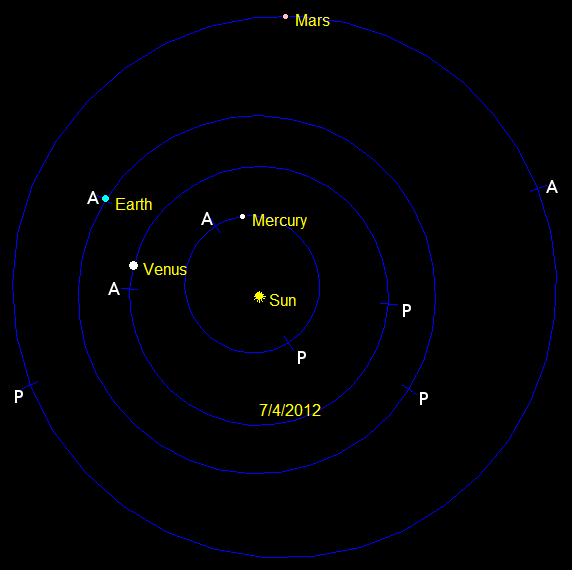
The orbits of the inner planets. (P)erihelion – (A)phelion
The above is a diagram from three years ago, so the planets other than the Earth will be in different positions today. The date of aphelion and perihelion move around over a greater range of dates than the equinoxes and solstices. I’m not sure why without researching it, but I suspect that the Moon has something to do with it.
06/26/2015 -Ephemeris – The latest sunset of the year
Ephemeris for Friday, June 26th. Today the Sun will be up for 15 hours and 33 minutes, setting at 9:32. The Moon, 2 days past first quarter, will set at 2:57 tomorrow morning and tomorrow the Sun will rise at 5:59.
This evening we will experience the latest sunset of the year. The sun has been setting within the same minute for a few days now. Now the Sun will begin to set earlier and earlier, at first imperceptibly, but soon with greater speed. By the middle of August the Sun will set 45 minutes earlier. Just in time to enjoy the summer Milky Way at a semi-decent hour. The shorter days, or actually daylight hours, and the diminishing altitude of the Sun at noon will cause a decrease in the heat we receive from the Sun. Still, right now we’re still warming up. However there is a tipping point around mid to late July, when we will not get enough heat to keep getting warmer and we’ll start to cool.
Times are for the Traverse City/Interlochen area of Michigan. They may be different for your location.
Addendum
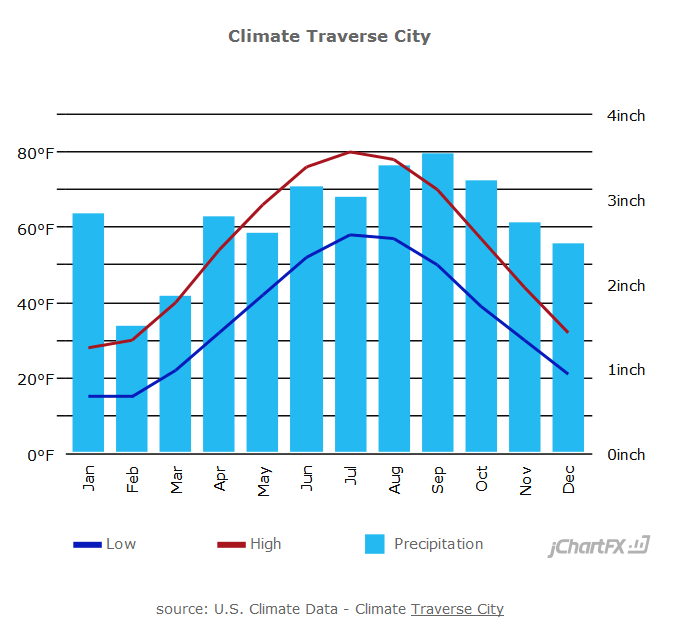
Traverse City Climate Chart. The hottest day is around July 15, and coldest day is around January 20. Credit: http://www.usclimatedata.com
www.usclimatedata.com has monthly and daily average data for many locations in the United States. They have code to embed this chart on your website. However it didn’t embed properly in the blog, so I took a screen shot.
06/22/2015 – Ephemeris – The summer full moon and the winter Sun trade places
Ephemeris for Monday, June 22nd. Today the Sun will be up for 15 hours and 34 minutes, setting at 9:32. The Moon, 2 days before first quarter, will set at 1:04 tomorrow morning. Tomorrow the Sun will rise at 5:57.
Summer’s here, and it’s a few days before the latest sunset and latest end of twilight. It might be instructive to check out the height of the moon over the next two weeks or so. The moon is heading south in front of the Sun. The Sun besides its apparent westward motion during the day caused by the Earth’s rotation also moves about twice its diameter each day eastward against the stars caused by the earth’s motion in its orbit of the Sun. Around July 1st, the moon will be about where the Sun will be next winter solstice, 4 days before Christmas. Actually it will be about 8 moon widths above where the Sun will be because its orbit is tilted a bit to the Earth’s. But it will serve as an illustration of the seasonal difference.
Times are for the Traverse City/Interlochen area of Michigan. They may be different for your location.
Addendum
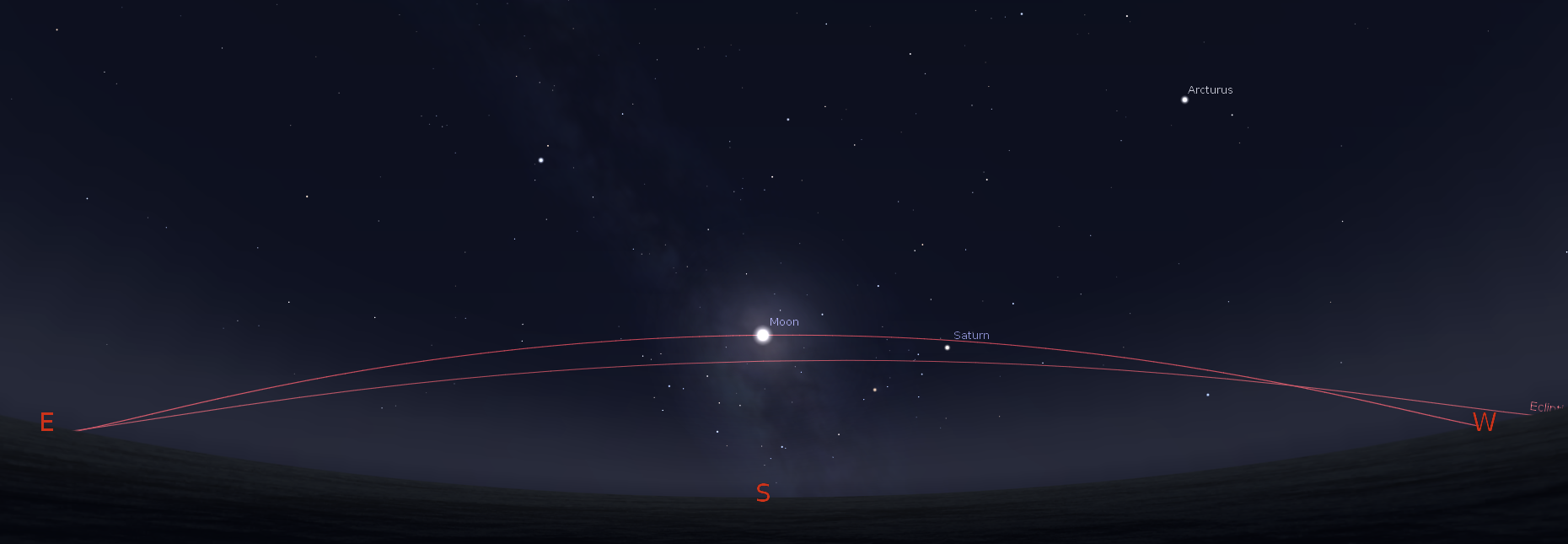
The full moon nearest the summer solstice. The full moon appears near where the sun would appear low in the south at the winter solstice. The bottom red line is the ecliptic, the path of the Sun. Created using Stellarium.
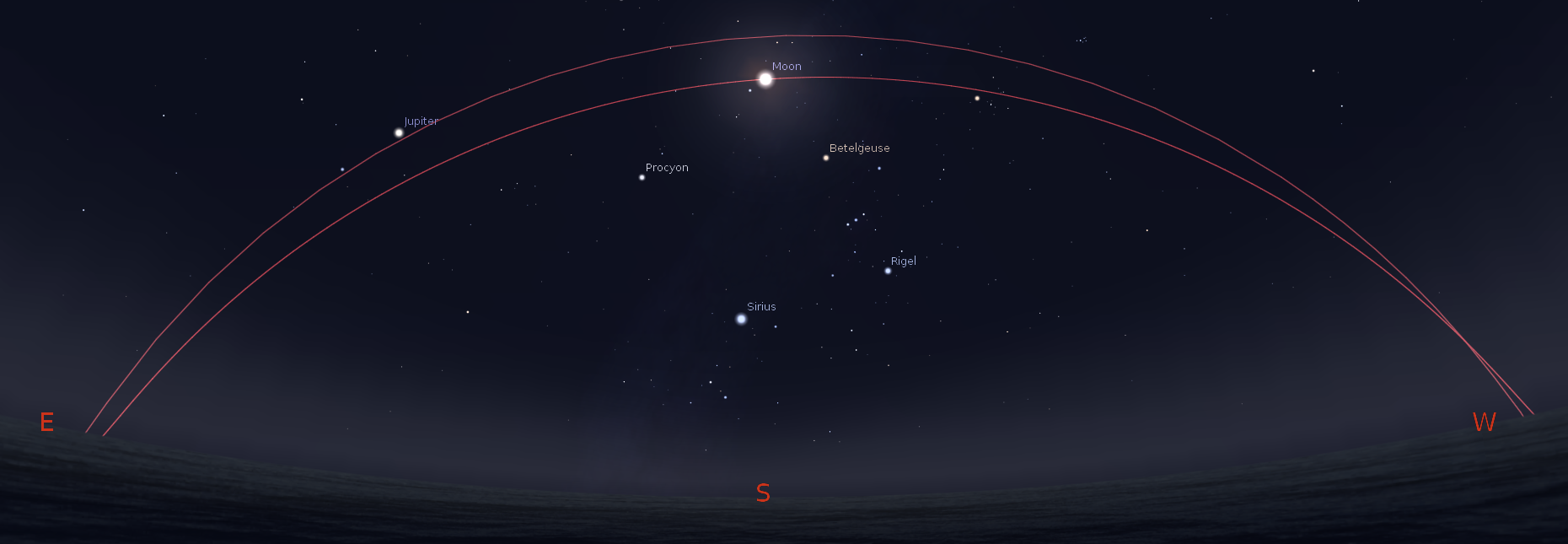
The full moon nearest the winter solstice. The full moon appears near where the sun would appear high in the south at the summer solstice. The top red line is the ecliptic, the path of the Sun. Created using Stellarium.
The Moon’s orbit has a slight tilt of a bit more than 5 degrees from the ecliptic, or plane of the Earth’s orbit of the sun. The crossing point is called a node. In the bottom image the node near the western horizon is called the descending node due to the fact that the Moon is heading south of the ecliptic. When the Sun and Moon are near the same node the Moon will be new and we have a chance for a solar eclipse. When at opposite nodes, a lunar eclipse. The nodes slowly slide westward slowly one revolution in about 18.6 years, which causes eclipse seasons, about 6 months apart to occur a bit earlier each year.
06/19/2015 – Ephemeris – Two events this weekend: one local, one global
Ephemeris for Friday, June 19th. Today the Sun will be up for 15 hours and 34 minutes, setting at 9:31. The Moon, 3 days past new, will set at 11:34 this evening. Tomorrow the Sun will rise at 5:56.
There’s a couple of astronomical events coming up this weekend. On Saturday there will be another Sun ‘n Star Party at the Sleeping Bear Dunes National Lakeshore if weather cooperates. This time the telescopes will be set up at the Pierce Stocking Scenic Drive, Stop 3, the Dunes Overlook from 4 to 6 p.m. and from 9 to 11 p.m. The best place to park is Picnic Mountain, just before the Dunes Overlook. On Sunday a truly global event, the Summer solstice will occur at 12:38 p.m. (16:38 UT), when the Sun will reach its farthest north signaling the start of summer in the northern hemisphere. For folks south of the equator it will be the winter solstice signaling the start of winter for them.
Times are for the Traverse City/Interlochen area of Michigan. They may be different for your location.
Addendum
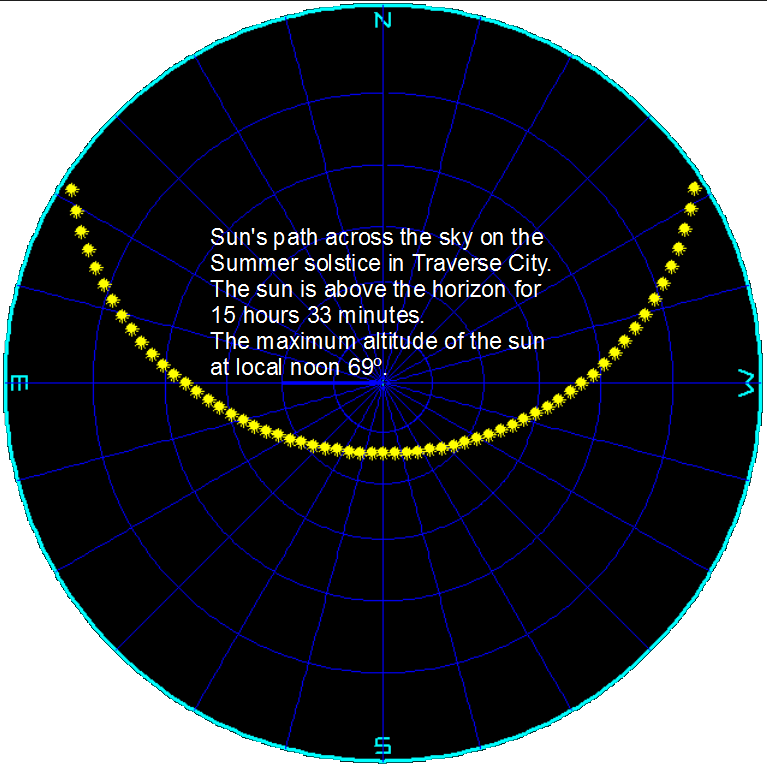
The Sun’s apparent path in the sky on the summer solstice. The cyan circle is the horizon and the Sun is plotted every 15 minutes throughout the day. Created by Bob Moler using LookingUp. This is a slide from his school program on the cause of the seasons.

