Archive
Ephemeris: 10/13/2023 – Tomorrow’s solar eclipse
This is Ephemeris for Friday, October 13th. Today the Sun will be up for 11 hours and 6 minutes, setting at 7:01, and it will rise tomorrow at 7:56. The Moon, 1 day before new, will rise at 7:45 tomorrow morning.
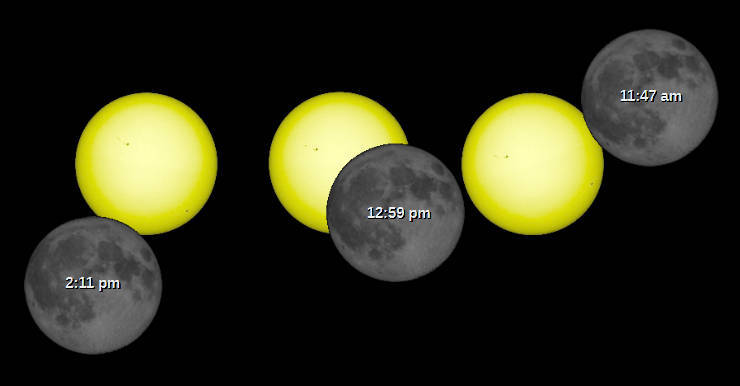
The safest way to view tomorrow’s solar eclipse is by projection, we call it pinhole projection, although the pinhole can be up to 1/4 inch in diameter and will cast a usable image of the Sun about 6 feet. My wife once used the mirror in her compact to reflect the Sun’s image onto the north side of a building across the street. It’s probably too late to buy them, but if you have any eclipse glasses leftover from the 2017 eclipse make sure they don’t have any pinholes in them. They can be used to view the eclipse. Make sure they are ISO approved. Still projection is your safest bet. For our area the eclipse will last from 11:42 am to 2:18 pm. I’ll be at the Betsie Valley District Library in Thompsonville for the eclipse. You’ll be in good shape for next April 8th total eclipse, whose path of totality will be much closer to us.
Jerry Dobek, Northwestern Michigan College instructor will be on campus with telescopes to view the eclipse on campus.
The astronomical event times given are for the Traverse City/Interlochen area of Michigan (EDT, UT –4 hours). They may be different for your location.
Addenda
In case of clouds, I will still be at the Betsie Valley District Library with an alternate program of my experience with five previous total solar eclipses, and a look at some future eclipses. Being a NASA Solar System Ambassador, I’ll have some NASA stickers and other things to hand out to the kids, big or small.
The next solar eclipse
The next eclipse visible from our area will occur on April 8, 2024, six months from now. It will be a total solar eclipse whose path of totality is within a day trip from our area, if it’s clear in Indiana or Ohio. I’ll have a lot more information as we approach April. On the Internet search for american eclipse 2024, or words to that effect. It’s always best to plan early.
Ephemeris: 10/12/2023 – Saturday’s (October 14, 2023) Annular Solar Eclipse
This is Bob Moler with Ephemeris for Thursday, October 12th. Today the Sun will be up for 11 hours and 9 minutes, setting at 7:03, and it will rise tomorrow at 7:55. The Moon, 2 days before new, will rise at 6:39 tomorrow morning.
There will be a partial solar eclipse Saturday for most of the unit for the 48 Continental United States. It will be maximum on a line from Oregon through Texas. It’s called an annular eclipse. At its maximum an annular eclipse is an eclipse where the Moon is too far away to completely cover the face of the Sun so at maximum it leaves a ring of the Sun. Some call it a Ring of Fire. We’re well north of that line so we will see a partial eclipse where about 35% of the Sun will be covered by the Moon at its peak, although the Moon will encroach about 45% of the diameter of the Sun. For northern Michigan the eclipse will start at about 11:42 am, maximum eclipse is about 1 pm and the eclipse will end at 2:18 pm. I’ll talk about eclipse viewing safety tomorrow.
The astronomical event times given are for the Traverse City/Interlochen area of Michigan (EDT, UT –4 hours). They may be different for your location.
Addendum
05/19/2023 – Ephemeris – It’s new moon, why is there no solar eclipse today?
This is Bob Moler with Ephemeris for Friday, May 19th. Today the Sun will be up for 14 hours and 58 minutes, setting at 9:08, and it will rise tomorrow at 6:09. The Moon is new today, and won’t be visible.
We are five months from witnessing a solar eclipse. That’s five lunar months, of approximately 29 and a half days. Solar eclipses can only happen at new moon, when the Moon is in the same direction as the Sun. Today, at 11:53 am, the instant of new moon, the Moon will be about two and a half of its diameters north of the Sun, so it won’t create a solar eclipse for us in Northern Michigan, or for any other place on the Earth for that matter. For locations south of Michigan, that Moon will appear somewhat farther from the Sun. For locations north of us, the Moon will appear closer to the Sun. But nobody will get a solar eclipse today. We will have to wait for the new moon of October 14th to see an eclipse of the Sun.
The astronomical event times given are for the Traverse City/Interlochen area of Michigan (EDT, UT –4 hours). They may be different for your location.
Addendum
The orbit of the Moon is tilted by about 5 degrees from the orbital plane of the Earth, so there’s a solar eclipse visible somewhere on the planet one out of six new moons on average. If our moon orbited near the earth’s equator like most major moons of their planet, eclipses would be much rarer than they are now, and only occur around the spring or autumn equinoxes. That’s because the Moon’s orbit would be tilted, on average, of 23½ degrees to Earth’s orbital plane.
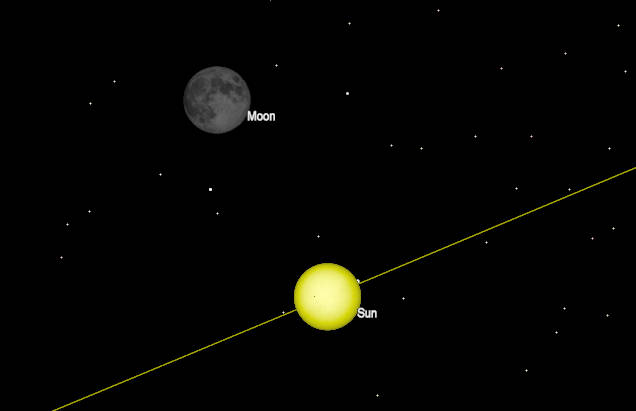
The new moon’s position north of the Sun at 11:53 am EDT. The yellow line is the ecliptic, which is the path of the Sun against the stars, or Earth’s orbital plane projected on the sky. If one could see the stars in the daytime, the Sun and Moon are below the Pleiades star cluster, which will make their first appearance in the evening sky this fall. While 11:53 am is only 7 minutes from noon EDT, for our location, local apparent solar noon, when the Sun is actually due south, isn’t until 1:39 pm. Our Eastern Daylight Saving Time meridian is off the coast of the US in the Atlantic Ocean at longitude 60 degrees west. We are located between 85 and 86 degrees west. Created using Cartes du Ciel (Sky Charts).
05/05/2023 – Ephemeris – Learn about the upcoming total solar eclipse tonight
This is Ephemeris for Cinco de Mayo, Friday, May 5th. Today the Sun will be up for 14 hours and 25 minutes, setting at 8:52, and it will rise tomorrow at 6:25. The Moon, at full today, will rise at 9:13 this evening.
Eleven months is not too early to plan for a total solar eclipse. On April 8th next year there will be such an eclipse whose path of totality clips the southeastern corner of Michigan. Indianapolis, Toledo and Cleveland also lie in the path of totality. The path runs from Texas to Maine. Member Dan Dall’Olmo will have all the particulars at this month’s meeting of the Grand Traverse Astronomical Society, starting at 8 pm tonight at Northwestern Michigan College’s Joseph H. Rogers Observatory. For those staying home, the Sun for this eclipse will be a bit more covered by the Moon than the 2017 August solar eclipse. We’ll also have another partial solar eclipse to practice on this October 14th.
The astronomical event times given are for the Traverse City/Interlochen area of Michigan (EDT, UT –4 hours). They may be different for your location.
Addendum
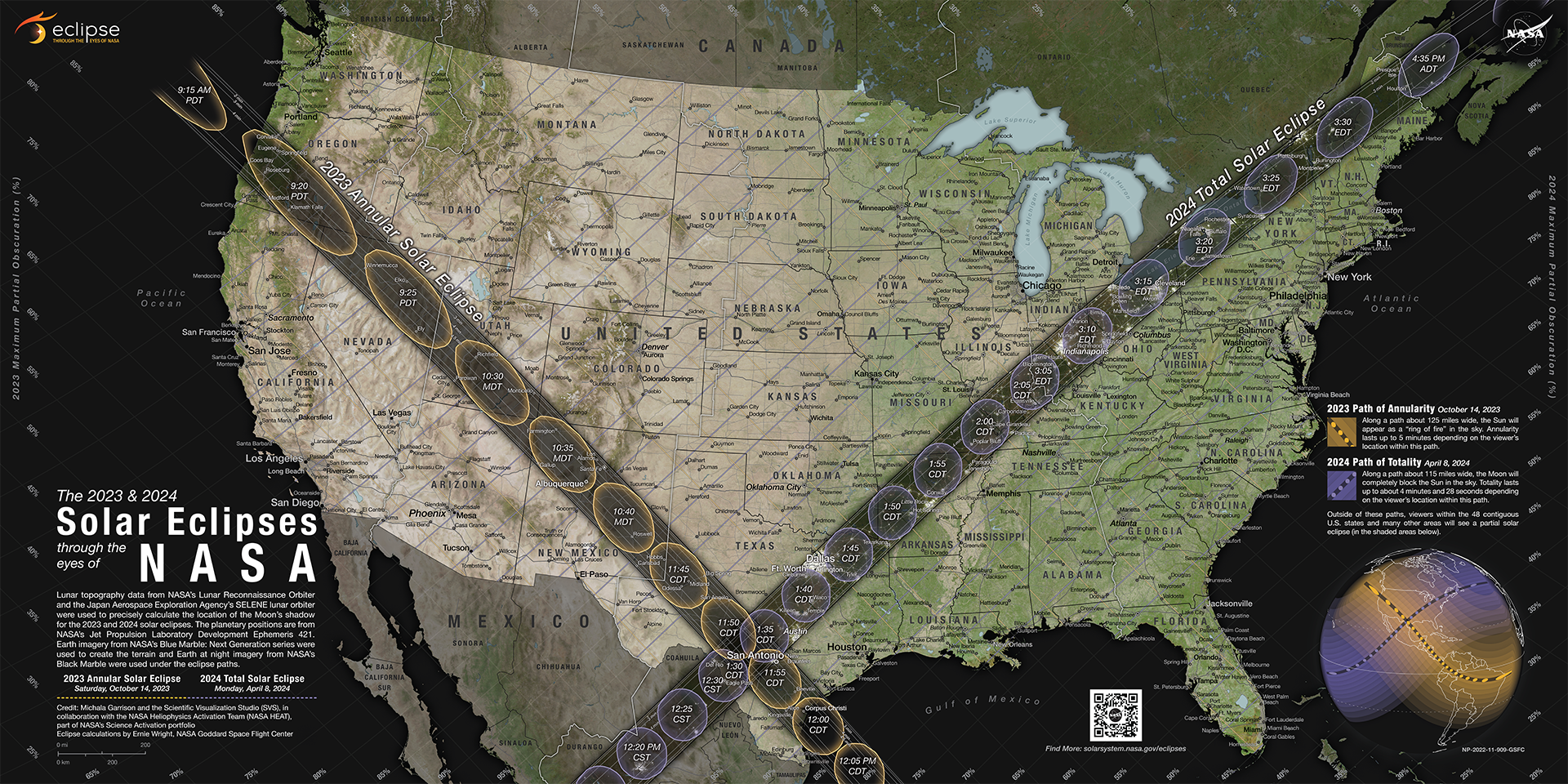
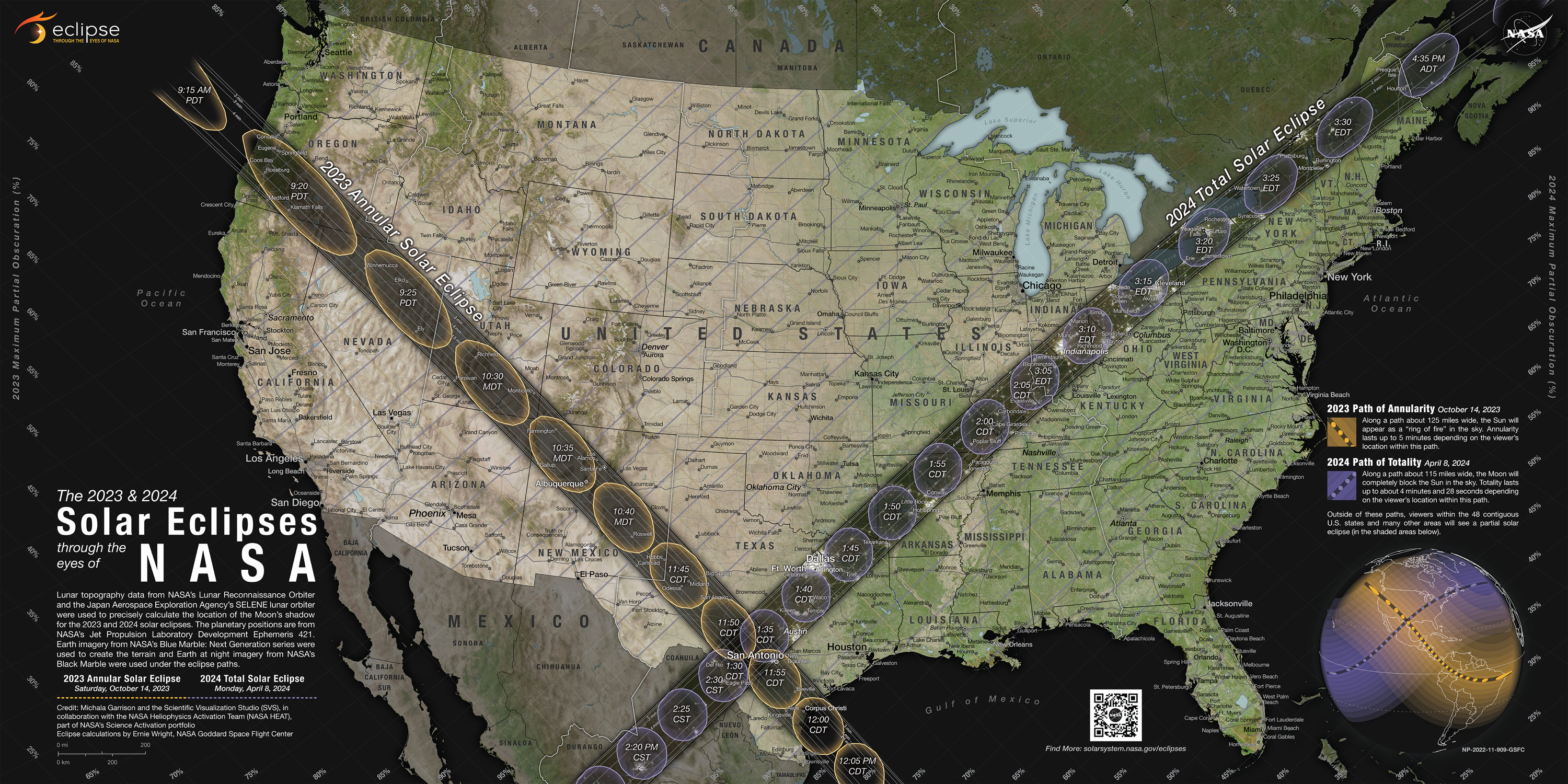
The paths of maximum eclipse of the October 14, 2023, and April 8, 2024. Click or tap on the image to enlarge it. Credit: NASA/Scientific Visualization Studio/Michala Garrison; eclipse calculations by Ernie Wright, NASA Goddard Space Flight Center.
04/20/2023 – Ephemeris – There’s a hybrid solar eclipse happening today*
This is Ephemeris for Thursday, April 20th. Today the Sun will be up for 13 hours and 43 minutes, setting at 8:33, and it will rise tomorrow at 6:48. The Moon is new today, and won’t be visible.
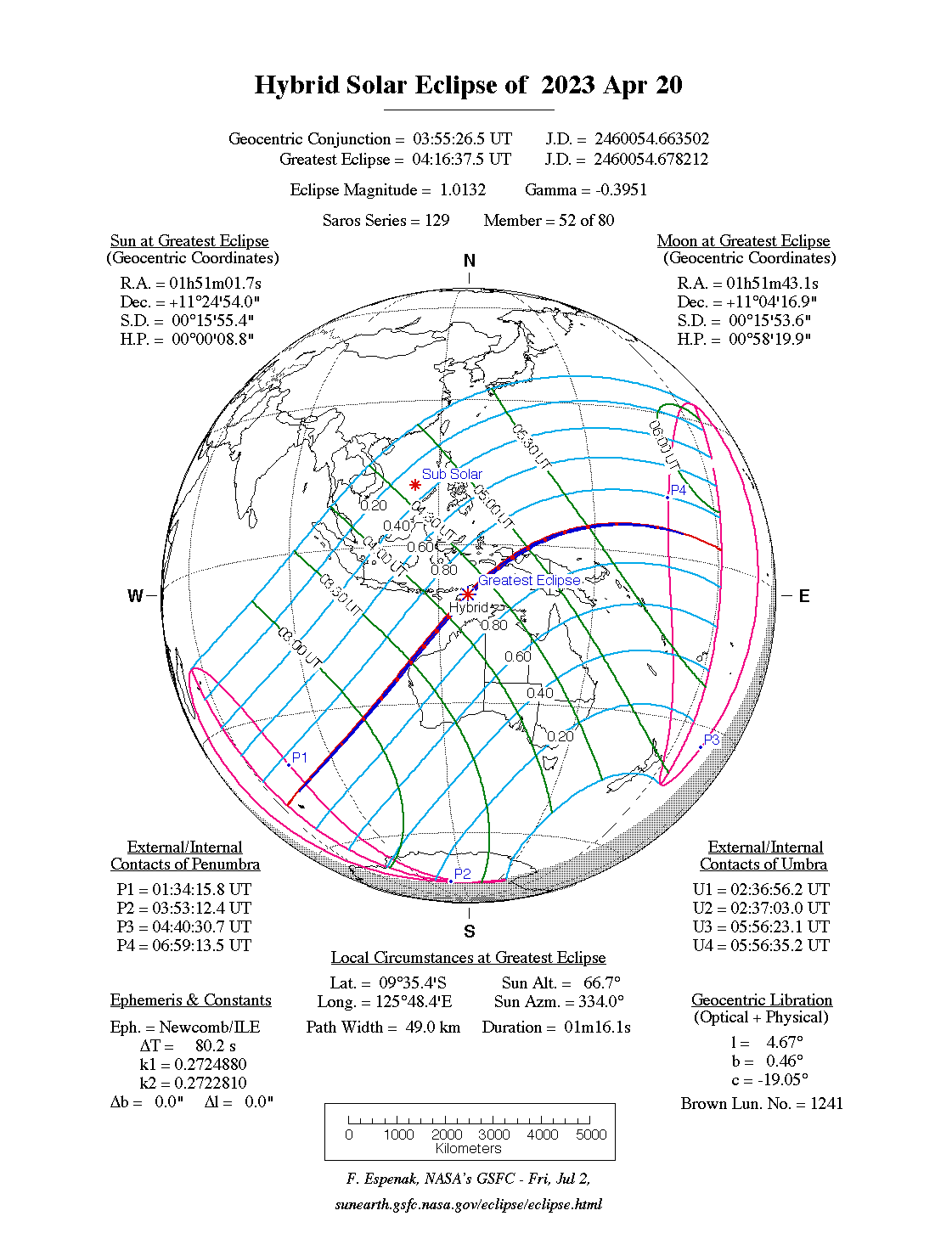
Last night and in the early morning hours this morning, for us, there was a solar eclipse visible from the Indian Ocean, through Indonesia and ending in the Pacific Ocean. This was a type of eclipse that I haven’t talked about before, a hybrid eclipse. It started at sunrise with the Moon too far away to completely cover the face of the Sun, as an annular eclipse. The central part of the eclipse path, due to the fact that the Earth is a sphere, was nearly four thousand miles closer to the Moon than at sunrise and sunset, evolves into a total eclipse. As the Moon’s shadow falls off toward the limb of the Earth, the increasing distance of the shadow to the Earth’s surface, causes the Moon to shrink enough to revert to an annular eclipse once again.
Next eclipse season, more specifically October 14th, there will be an annular eclipse, whose path crosses the US from the Oregon-California border to Texas. We will get a partial eclipse out of it. The big event will occur in the next eclipse season when a total solar eclipse will occur to cross the US from Texas to Maine on April 8, 2024. The path of totality will clip the southeast corner of Michigan.
The astronomical event times given are for the Traverse City/Interlochen area of Michigan (EST, UT –4 hours). They may be different for your location.
* By the time you read this, the eclipse is either happening right now, or it’s over.
Addendum
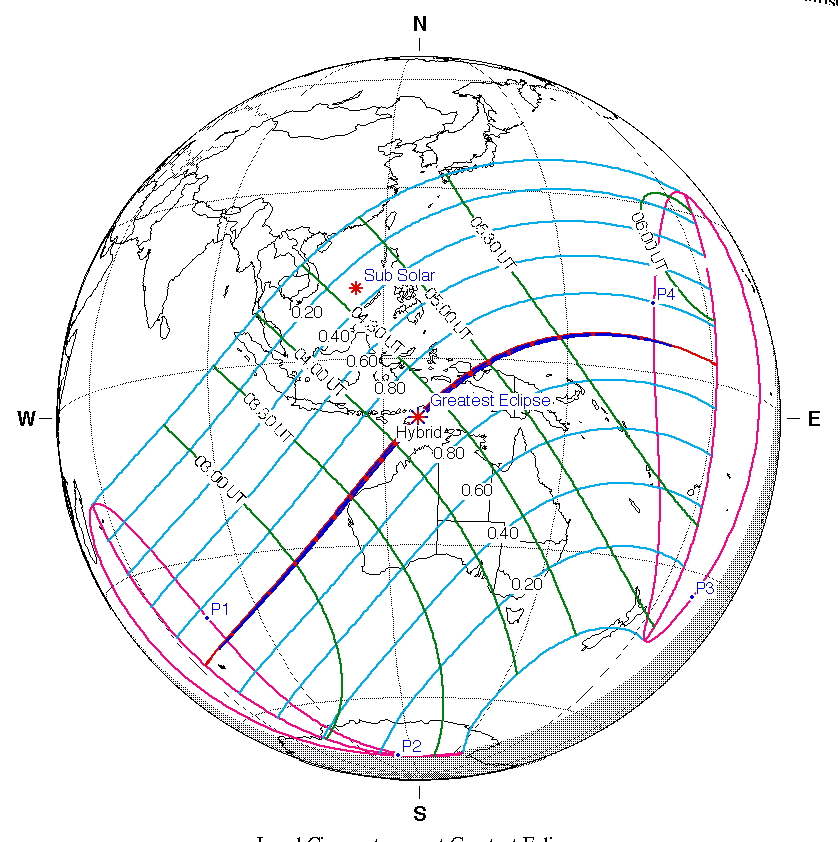
World solar eclipse map for the hybrid eclipse, April 20, 2023. The central path is in red, while the total eclipse part of the path is highlighted in blue. The image is of the world solar eclipse map for the hybrid eclipse, April 20, 2023. Taken from https://eclipse.gsfc.nasa.gov/SEplot/SEplot2001/SE2023Apr20H.GIF. Credit: NASA’s GSFC, Fred Espenak.
04/17/2023 – Ephemeris – I’m back. And a look ahead
This is Ephemeris for Monday, April 17th. Today the Sun will be up for 13 hours and 34 minutes, setting at 8:30, and it will rise tomorrow at 6:53. The Moon, 3 days before new, will rise at 6:23 tomorrow morning.
I’m back, still in physical therapy, but hopefully to stay. The next year and a half will see some spectacular celestial events, plus the Sun is getting unusually active this solar cycle, which means more displays of the northern lights or aurora borealis. For us, the first event will be a partial eclipse of the Sun on Saturday, October 14th. It’s an annular or ring eclipse, where the Moon is too far away to completely block the Sun, leaving a ring of light at its peak for a narrow path in the southwestern US. Then next April, a total solar eclipse will occur. Much more of the Sun will be blocked for us. Then the following October we might get to see a bright comet, if it performs as expected. Comet Tsuchinshan-ATLAS was discovered three months ago.
The astronomical event times given are for the Traverse City/Interlochen area of Michigan (EST, UT –4 hours). They may be different for your location.
Addendum
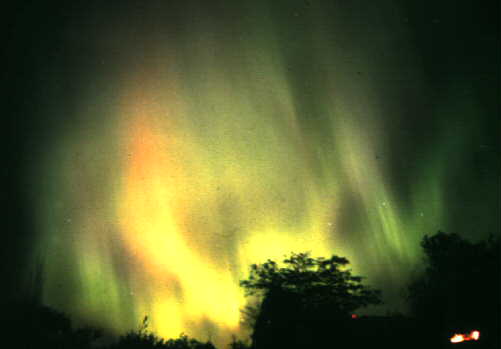
An aurora display from a couple of sunspot cycles ago. Credit: Bob Moler.
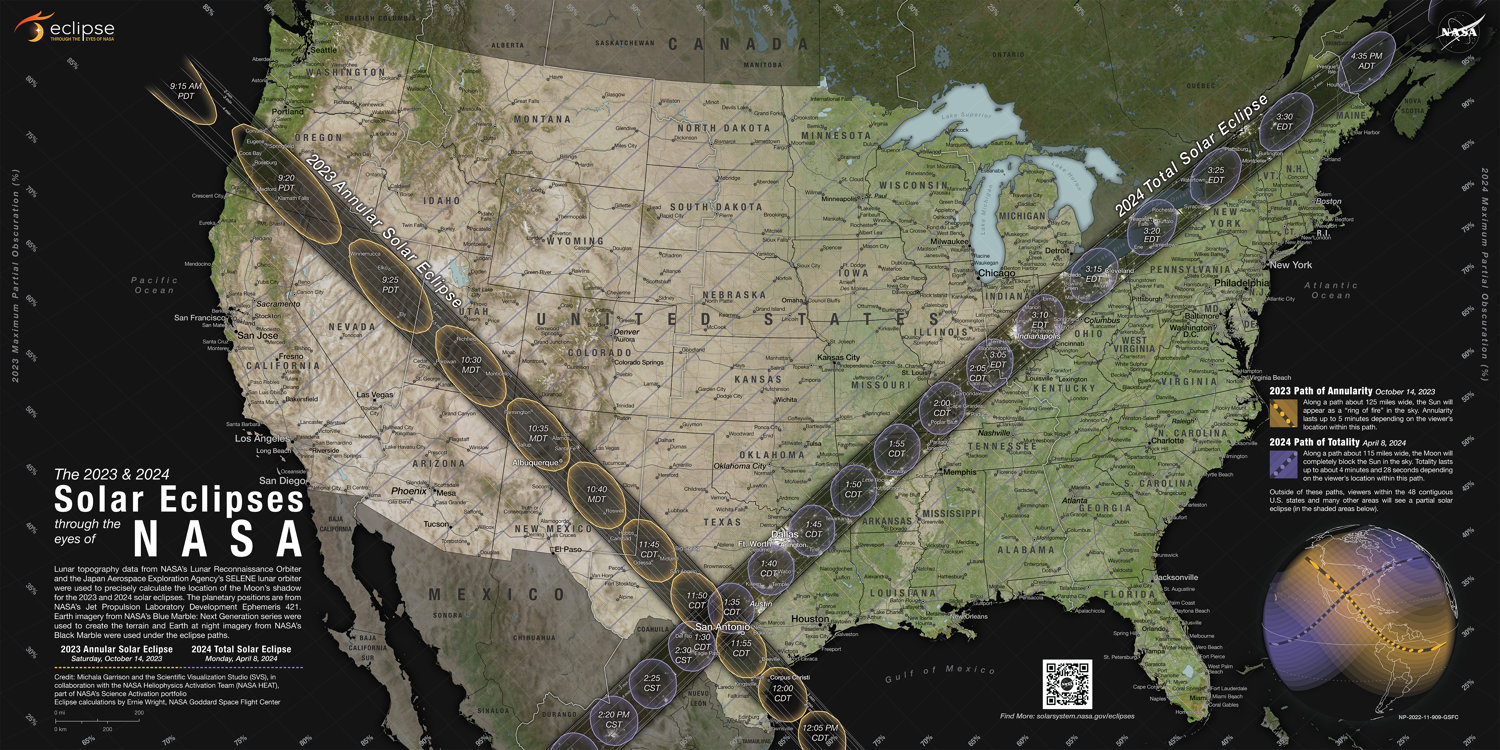
NASA Eclipse Map for the United States for the annular eclipse of October 14, 2023, and total eclipse of April 8, 2024. The tracks are the path of annularity, where the ring of light around the Moon is seen, and the path of totality, where the Sun’s face is completely covered by the Moon. Subtract 4 hours from the times given to convert to Eastern Daylight Saving Time. Click on the image to enlarge it. Credit NASA.
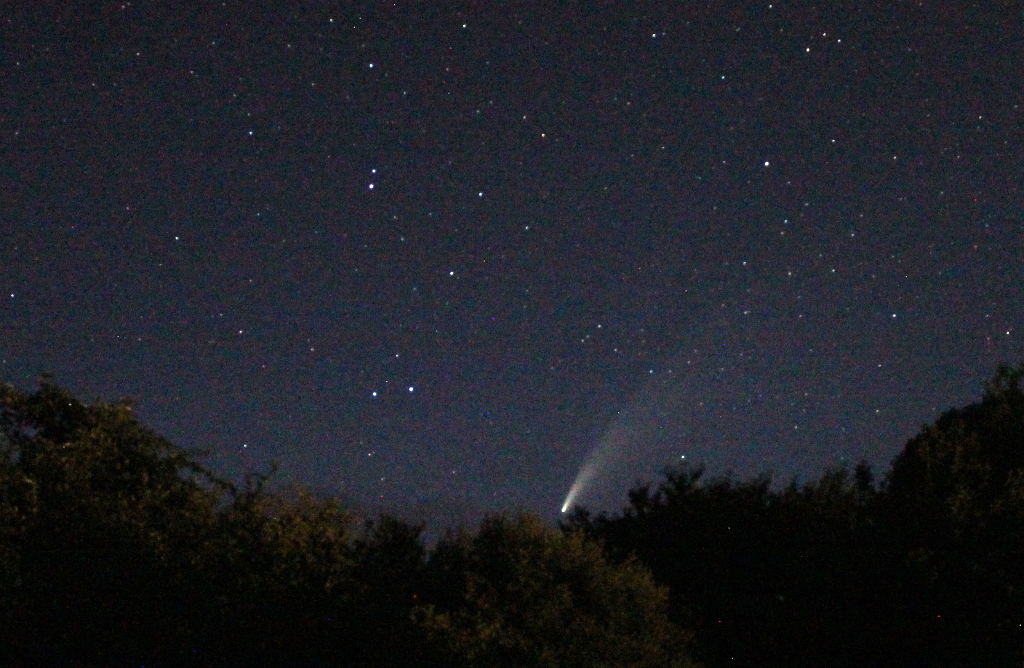
Comet NEOWISE from backyard over tall shrubbery 11:18 pm, July 16, 2020. I didn’t have time to focus properly, which actually accentuates the stars. Comet Tsuchinshan-ATLAS has the potential of being many times brighter. It was seen in the northeast before sunrise and in the northwest after sunset. Our new comet will be best seen low in the southwest in the evening.
11/08/2022 – Ephemeris – Solar Eclipses in our future
This is Ephemeris for Election Day, Tuesday, November 8th. Today the Sun will be up for 9 hours and 51 minutes, setting at 5:22, and it will rise tomorrow at 7:31. The Moon, at full today, will rise at 5:28 this evening.
If you are listening to me early this morning, and it’s clear there is a lunar eclipse in progress. The eclipse will be total before 6:41 am, and partial until the Moon sets at 7:40 am. We will have to wait until March 2025 to see the next total lunar eclipse from our area.
However, we will be able to see two partial solar eclipses in the next year and a half. The first is October 14th, 2023. Nearly half of the Sun will be blocked by the Moon for us. The next one is the big one! April 8th, 2024 is a total eclipse less than a day’s drive away. The path of totality runs from Texas to Maine, just clipping the southeast corner of Michigan. Here in Northern Michigan, nearly 90% of the Sun will be covered by the Moon, so it will get noticeably dark at the peak of the eclipse.
The astronomical event times given are for the Traverse City/Interlochen area of Michigan (EDT, UT – 5 hours). They may be different for your location.
Addendum
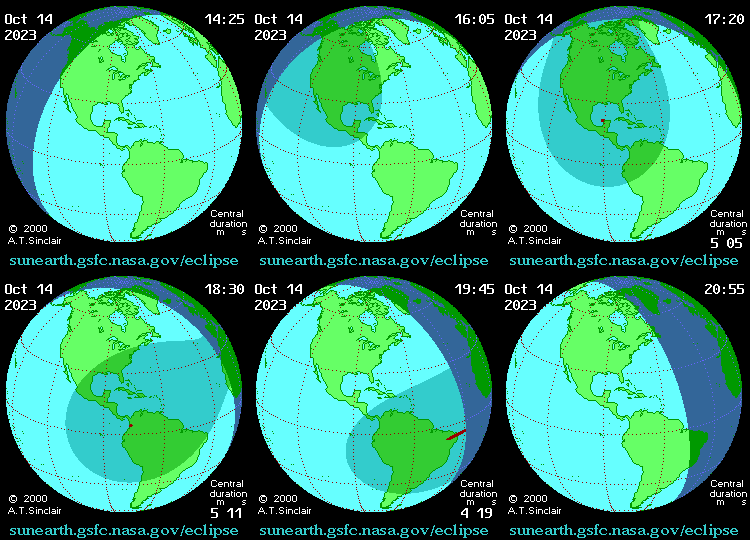
Areas on the Earth where the solar eclipse of October 14, 2023 can be seen via animation. The gray area is where the partial eclipse is visible. The dot is the place where the ring of the annular eclipse can be seen. Credit: NASA, A. T. Sinclair.
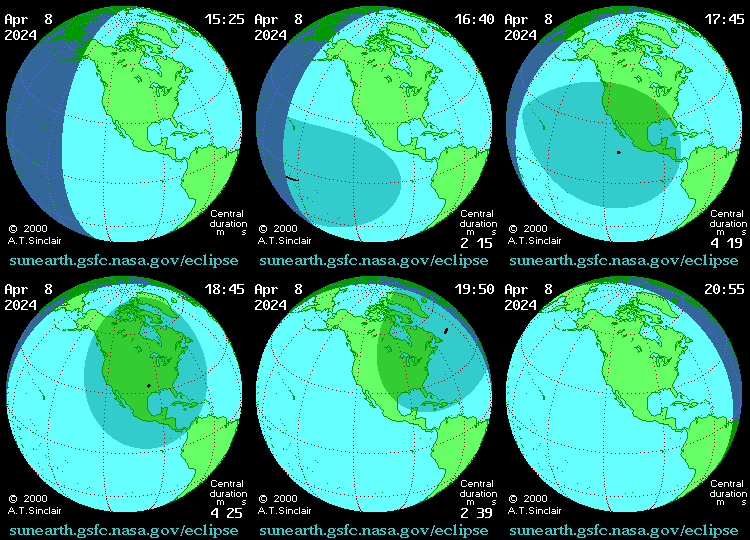
Areas on the Earth where the solar eclipse of April 8, 2024 can be seen via animation. The gray area is where the partial eclipse is visible. The dot is the place where the totally eclipsed Sun can be seen. Credit: NASA, A. T. Sinclair.
For more information on solar and lunar eclipses past and present, go here, NASA’s Eclipse Website.
10/25/2022 – Ephemeris – This eclipse season starts with a partial solar eclipse, but not for us
“But not for us” means not for Michigan in the United States. This is a script, as always, for a local radio program. Which also mentions the midterm election day, two weeks from now, which coincides with the total lunar eclipse that morning. I’ll have an Ephemeris Extra post before the lunar eclipse, which looks into the next few lunar and solar eclipses visible in Michigan and the United States.
This is Ephemeris for Tuesday, October 25th. Today the Sun will be up for 10 hours and 30 minutes, setting at 6:41, and it will rise tomorrow at 8:12. The Moon is new today, and won’t be visible.
The Moon will be visible in a negative way for some folks at this time. There is a partial solar eclipse in progress now for parts of Europe, Asia and Africa. So that thing blocking the northern part of the Sun for them will be the Moon. Being a partial eclipse means that an eclipse season has started, and we should have a lunar eclipse in about two weeks, when the Moon is full. There sure is, and it’s visible from here. In exactly two weeks, there will be. In the early morning hours of November 8th, Election Day, a total eclipse of the Moon. And if you’re standing outside the polling place waiting for the polls to open at 7 am, and it’s clear, and you have a view to the west, the partially eclipsed Moon will still be visible. That will be the ending partial phase of the eclipse.
The astronomical event times given are for the Traverse City/Interlochen area of Michigan (EDT, UT – 4 hours). They may be different for your location.
Addendum
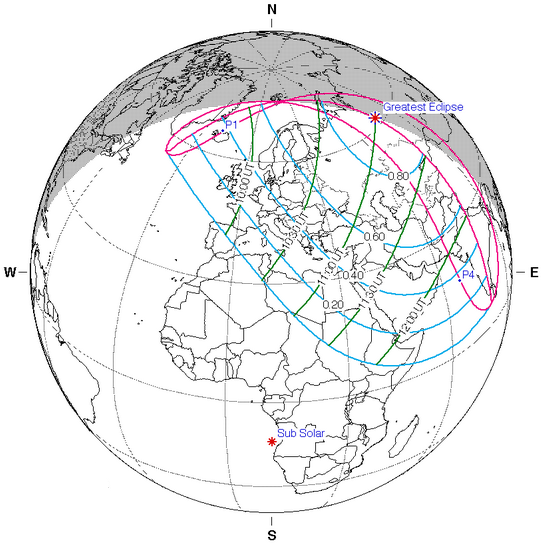
Map for the area on the Earth where the partial solar eclipse of October 25, 2022, will be visible. Credit: NASA/GSFC, Fred Espenak.
05/16/2022 – Ephemeris – More eclipses in our future
This is Ephemeris for Monday, May 16th. Today the Sun will be up for 14 hours and 52 minutes, setting at 9:05, and it will rise tomorrow at 6:12. The Moon, at full today, will rise at 10:13 this evening.
Last night’s eclipse was the only eclipse that was visible in our area this year. However, in the next two years we will have a chance, weather permitting, to see two partial solar eclipses, the second of which will be even better than the partial solar eclipse seen here in August 2017. On October 14, 2023, there will be an annular eclipse. An annular eclipse is where the Moon is too far away to completely cover the face of the Sun. It leaves a ring of bright sun around the Moon. The technical term for a ring like that is annulus. The path of annularity will run from Oregon to Texas. For the Grand Traverse Area of Michigan, the Moon will cover less than half the face of the Sun. On April 8, 2024, the total eclipse path will run from Texas to Maine and just nip the Southeast corner of Michigan covering, for us in the Grand Traverse Area, about 85 percent of the Sun.
The astronomical event times given are for the Traverse City/Interlochen area of Michigan (EDT, UT – 4 hours). They may be different for your location.
Addendum
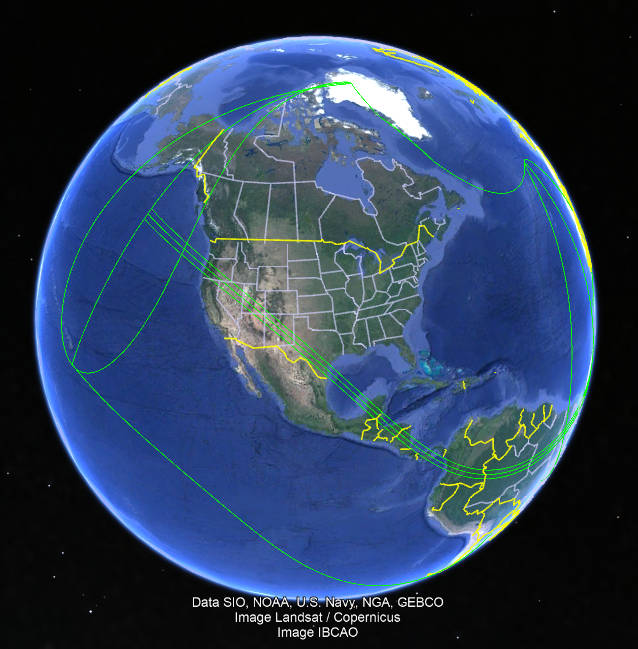
The areas where the October 14, 2023 solar eclipse can be seen are bounded by the outer green lines. The path where the annular part of the eclipse is visible is denoted by the triple green lines. Plotted on Google Earth using a file created by Occult4 software from the International Occultation Timing Association.
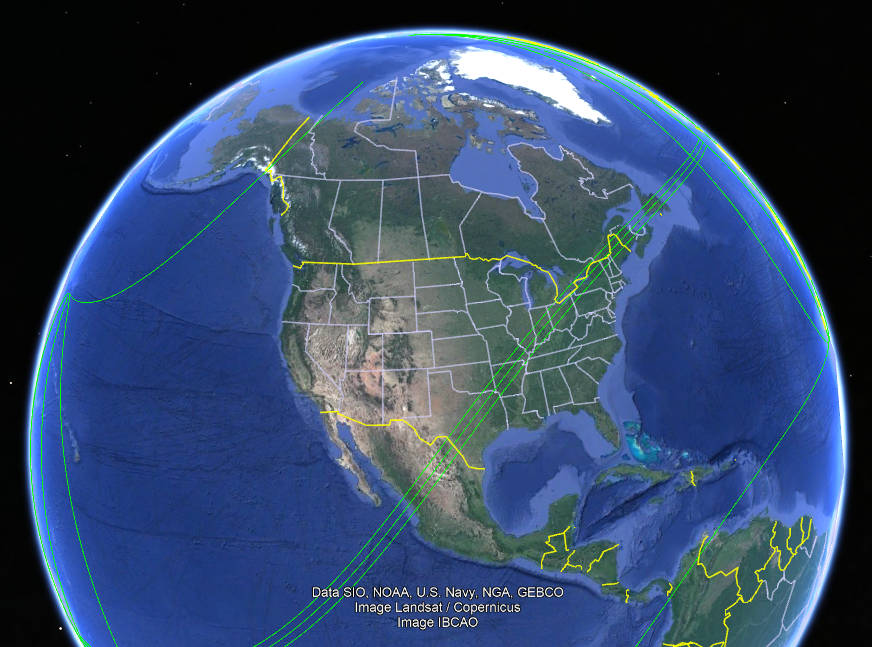
The areas across the U.S. where the April 8, 2024 solar eclipse can be seen are bounded by the outer green lines. The path where the total part of the eclipse is visible is denoted by the triple green lines. Plotted on Google Earth using a file created by Occult4 software from the International Occultation Timing Association.
Ephemeris Extra – Sunrise solar eclipse
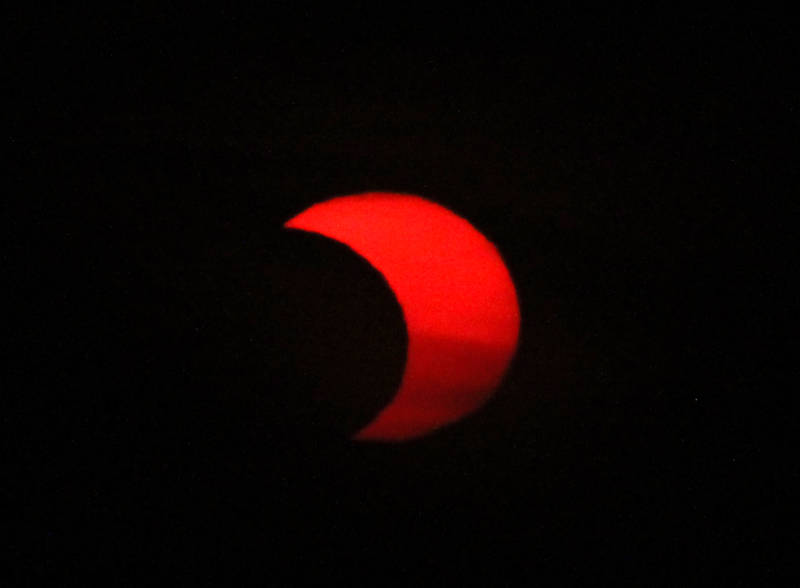
The partially eclipsed Sun this morning, taken through a solar filter, so it’s redder than it actually was. Taken shortly after 6 am from Traverse City, MI West Middle School. There were quite a bit of clouds on the horizon. Credit Bob Moler.
Here is an unfiltered view taken a few minutes earlier:
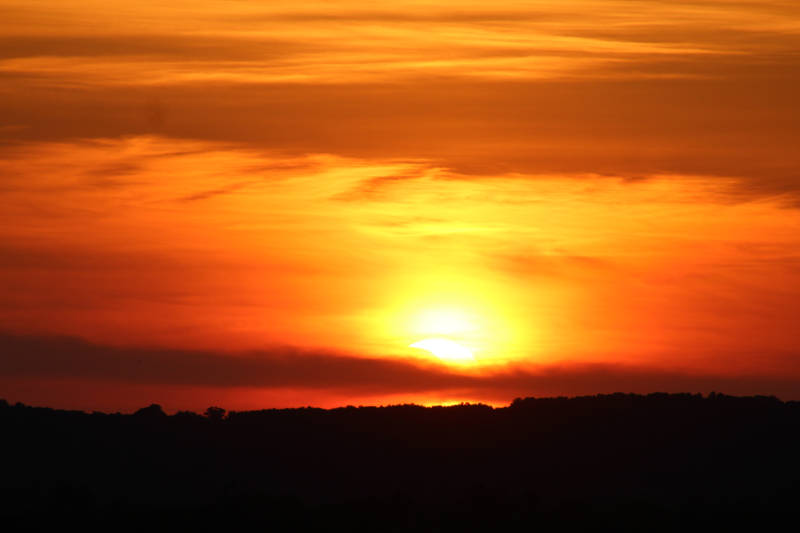
Here is an unfiltered shot of the Sun bisected by a cloud. Credit Bob Moler.
 Bob Moler's Ephemeris Blog