Archive
11/28/2016 – Ephemeris – The Hyades the star cluster in the face of Taurus the bull
Ephemeris for Monday, November 28th. The Sun will rise at 7:57. It’ll be up for 9 hours and 7 minutes, setting at 5:04. The Moon, 1 day before new, will rise at 7:45 tomorrow morning.
Rising in the east now is the bright star Aldebaran an orange star that’s at one end of the sideways letter V of stars that is the head of Taurus the bull. Above it is the jewel-like Pleiades or Seven Sisters star cluster. There’s more to Taurus, like it’s freakishly long horns and front part of its body. But you can say you’ve seem Taurus, if you can spot his face. That V of stars is actually a star cluster called the Hyades, and in Greek Myth were the half-sisters of the Pleiades, also fathered by the god Atlas. Both the Hyades and Pleiades are being pursued by Orion, which as Robert Frost put it is throwing a leg over the eastern horizon at 8 to 9 pm. He isn’t the only one following the Pleiades, the name Aldebaran means “The Follower”.
Times are for the Traverse City/Interlochen area of Michigan. They may be different for your location.
Addendum
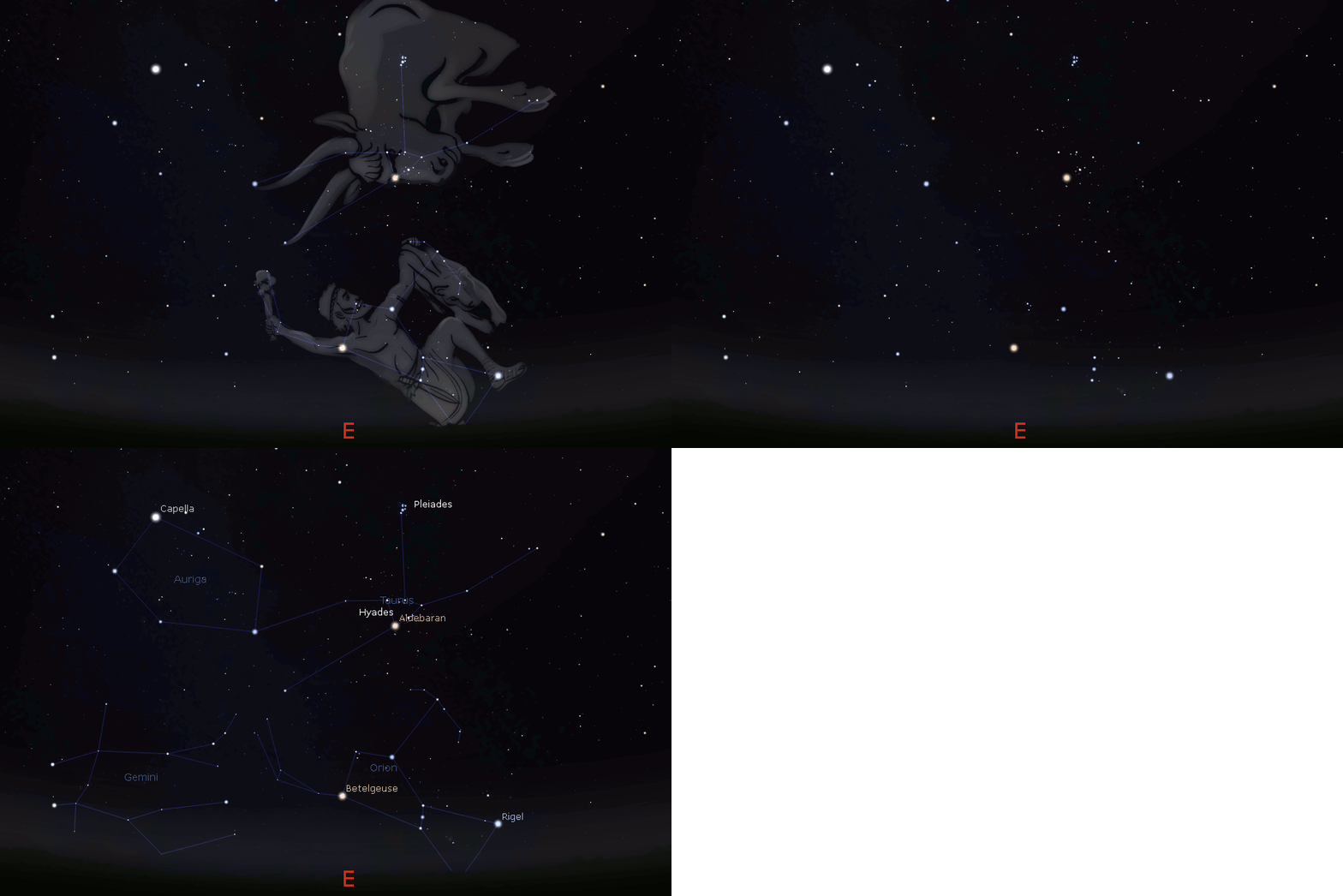
An animation showing the Hyades, Taurus, Orion and the Pleiades. Created using Stellarium and GIMP. Click on image to enlarge.
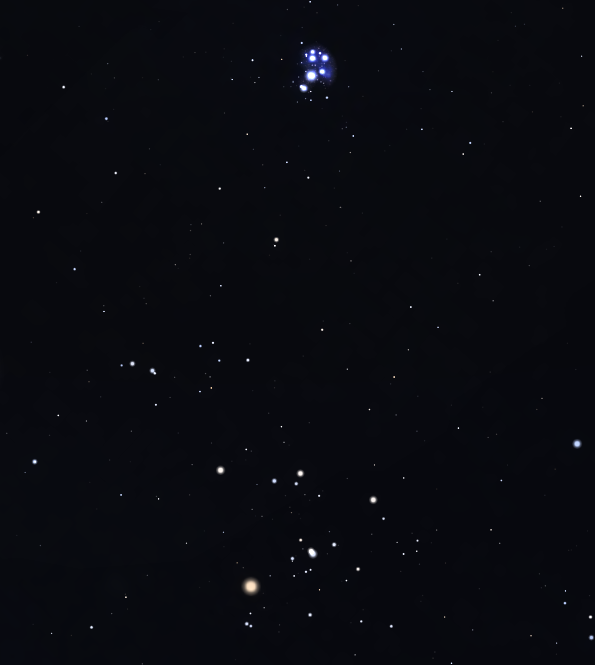
Closeup of the Hyades and the Pleiades. Created using Stellarium.
04/05/2016 – Ephemeris – Coma Berenices, the second closest star cluster
Ephemeris for Tuesday, April 5th. The Sun will rise at 7:15. It’ll be up for 13 hours and 1 minute, setting at 8:16. The Moon, 2 days before new, will rise at 6:53 tomorrow morning.
Midway up the sky in the east at 10 p.m. is a tiny sprinkle of faint stars arrayed to look like several strands of hair. It’s the constellation of Coma Berenices, or Berenice’s hair. The whole group will fit in the field of a pair of binoculars, which is the best way to see it, and will also show more stars. The cluster contains about 50 stars and lies at a distance of 280 light years from us, which makes it the second closest star cluster. The closest being the Hyades, that is the face of Taurus the bull now about to set in the west. The star cluster appears to be about 480 million years old. It is an open or galactic star cluster, born along the plane of the Milky Way. It appears away from the milky band due to its proximity to us.
Times are for the Traverse City/Interlochen area of Michigan. They may be different for your location.
Addendum
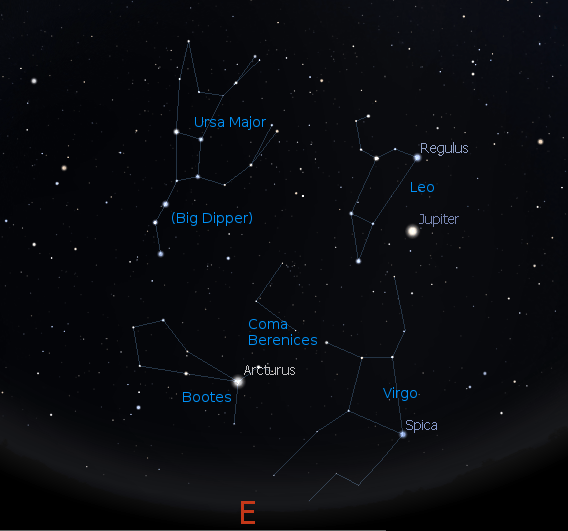
Coma Berenices finder chart 10 p.m., April 5, 2016. Created using Stellarium.
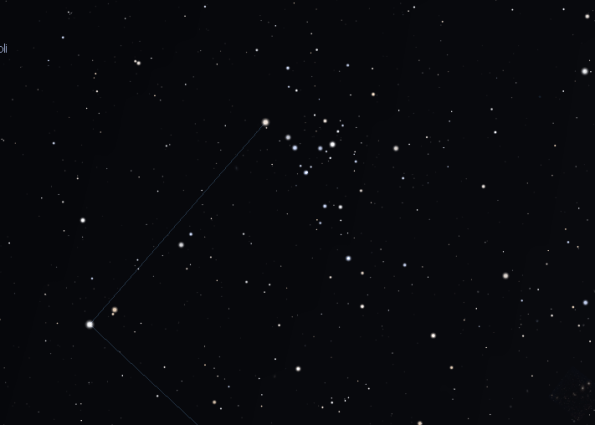
Coma Berenices as it might look in a pair of binoculars. Telescopes are too powerful. Created using Stellarium.
11/09/2015 – Ephemeris – The celestial sisters
Ephemeris for Monday, November 9th. The Sun will rise at 7:31. It’ll be up for 9 hours and 50 minutes, setting at 5:21. The Moon, 2 days before new, will rise at 6:15 tomorrow morning.
A marvelous member of the autumn skies can be found rising in the east at 8 in the evening. It is the famous star cluster called the Pleiades or the Seven Sisters. I might also add the ‘Tiny Dipper’. Many people can spot a tiny dipper shape in its six or seven stars, and mistake it for the Little Dipper. As nearsighted as I am, though corrected, I’ve never been able to see more than a few stars and a bit of fuzz. However with binoculars, over a hundred stars appear along with the dipper shape of the brightest. The fuzz I saw was unresolved stars, but in photographs the Pleiades actually contains wisps of dust that reflect the star’s blue light which the cluster is passing through. In Greek and Plains Indian mythology the sisters were young maidens.
Times are for the Traverse City/Interlochen area of Michigan. They may be different for your location.
Addenda
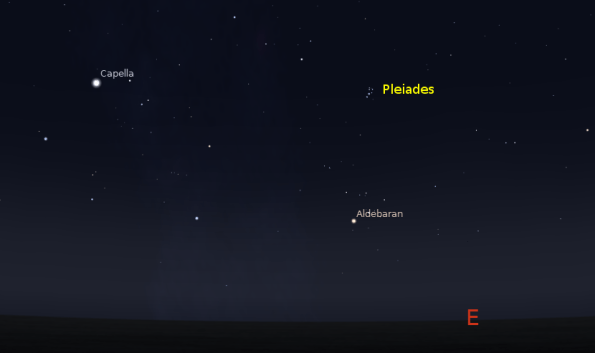
The Pleiades rising at 8 p.m. November 9th. Created using Stellarium.
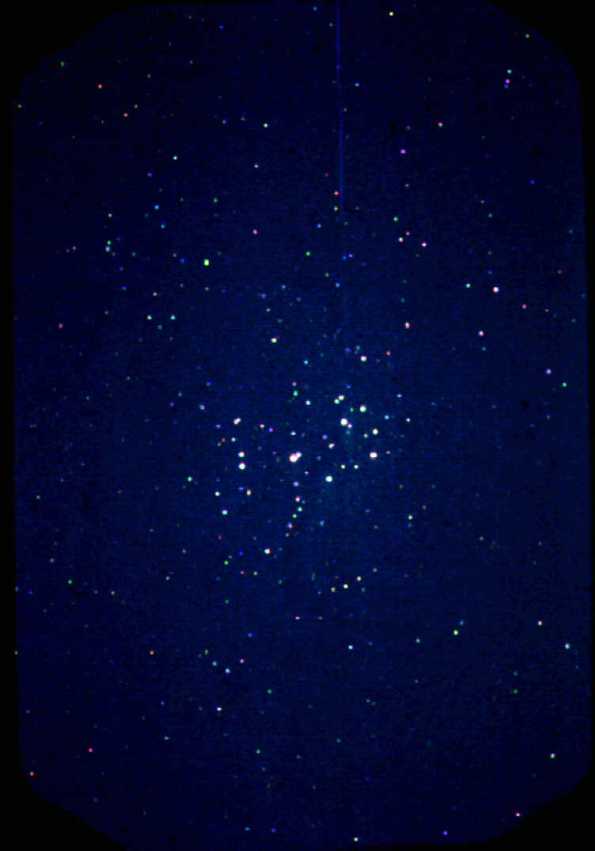
The Pleiades, about what you’d see in binoculars.
I’ll be in Cadillac tonight
I’ll be giving an illustrated talk tonight to the Cadillac Garden Club at St. Ann’s Parish in Cadillac at 7 p.m. I’ll be talking about all the ways the Sun affects the Earth. At 8 p.m., if it’s clear, I and other members of the Grand Traverse Astronomical Society will have some telescopes set up in the parking lot to view the wonders of the heavens. The meeting appears to be open to the public and the viewing after definitely is.
05/08/2015 – Ephemeris – May’s missing Milky Way
Ephemeris for Friday, May 8th. Today the Sun will be up for 14 hours and 32 minutes, setting at 8:55. The Moon, 3 days before last quarter, will rise at 1:08 tomorrow morning. Tomorrow the Sun will rise at 6:22.
In May we look up to the sky and notice that the Milky Way is missing. Will not really it’s as if the sky has pattern baldness with the Milky Way as a fringe on the horizon around the north half of the sky. Overhead, where none should be is a galactic star cluster, a star cluster that should normally be in the Milky band. That cluster is the constellation of Coma Berenices. Its is a sparse star cluster of about 50 stars only 288 light years away. If we were a thousand light years from it, it would appear in the Milky band. One notes too that the stars of spring are also fewer, not the riot of stars we see in the winter or late summer. The Milky Way galaxy is a thin disk, and in spring we are looking out the thin side.
Times are for the Traverse City/Interlochen area of Michigan. They may be different for your location.
Addendum
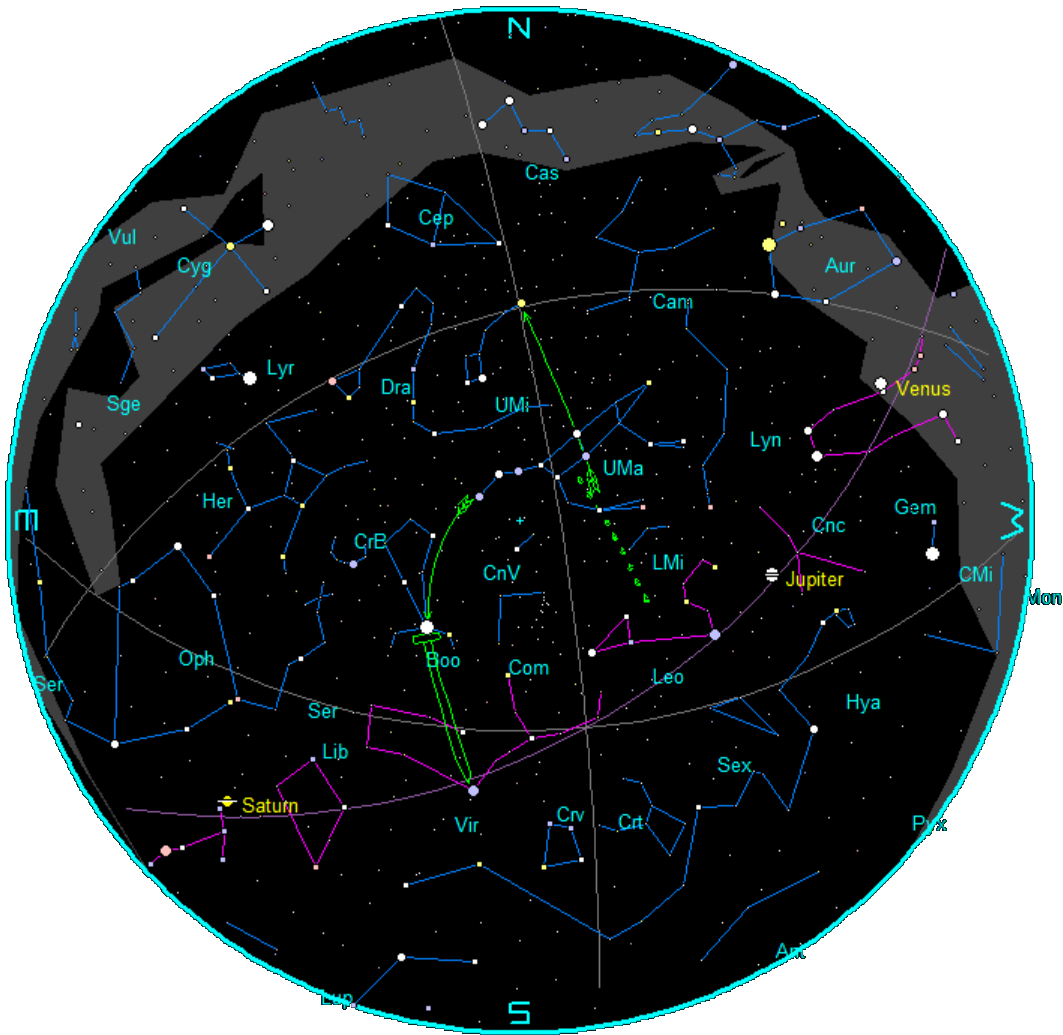
Star Chart for May 2015. Note the Milky way in the north. The Coma Berenices cluster is located between the labels CnV and Com. Created using my LookingUp program.
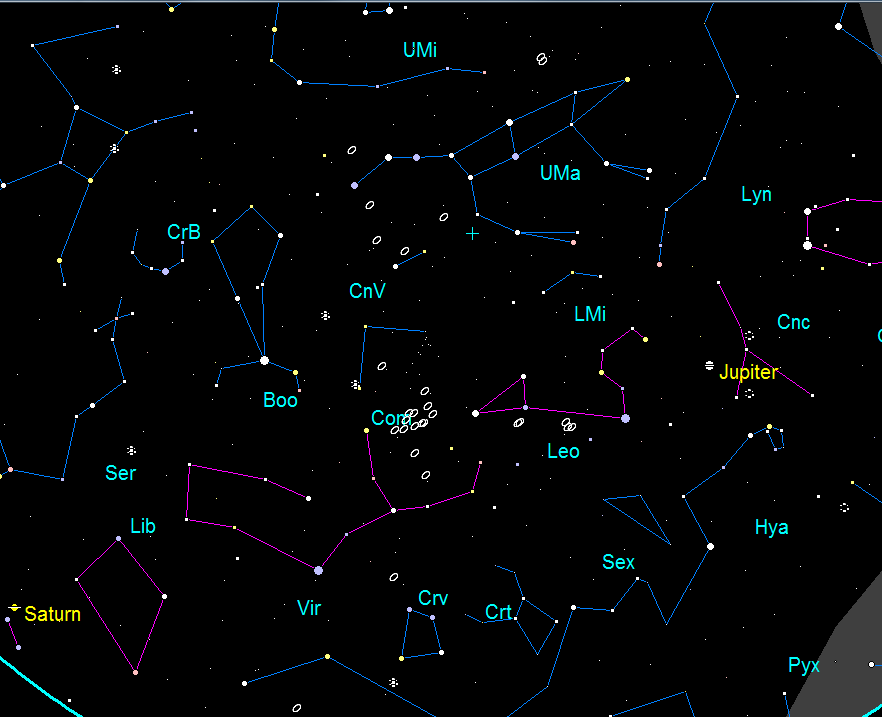
Messier objects, mostly galaxies (ovals) in the spring sky. Created using my LookingUp program.
Most of the galaxies in the above chart belong to the Virgo Cluster a cluster of several thousand galaxies about 53 million light years away. Charles Messier was a comet hunter active in the period around the time of the American Revolution at the Paris Observatory. He made a catalog of fuzzy objects he ran into that didn’t move and thus were not comets. The Messier catalog, which ran to 110 galaxies, star clusters and nebulae, some added posthumously, became a must-see list of some of the best sights for the telescope.
11/21/2014 – Ephemeris – The Hyades a very important star cluster
Ephemeris for Friday, November 21st. The sun will rise at 7:47. It’ll be up for 9 hours and 22 minutes, setting at 5:09. The moon, 1 day before new, will rise at 7:42 tomorrow morning.
The face of the constellation Taurus the bull looks like the letter V sideways above the rising Orion the Hunter in the east at 9 p.m. The bright star at the tip of a letter V of stars is Aldebaran. Look with binoculars at the letter V shape and you will see the stars of the Hyades star cluster The Hyades is the closest star cluster to us, at about 151 light years. And is important for that reason. Before satellites like Hipparcos. The Hyades were the only star cluster to be directly measured by a technique called parallax, using the radius of the earth’s orbit as one side of a surveyors enormous triangle. Its many stars at the same distance were used to determine distances of star clusters even farther away. Additional techniques based on the distance of the Hyades allow us to measure distances to the galaxies.
Times are for the Traverse City/Interlochen area of Michigan. They may be different for your location.
Addendum
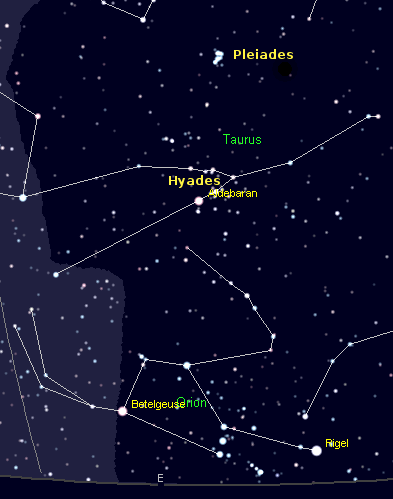
Orion and the Hyades.
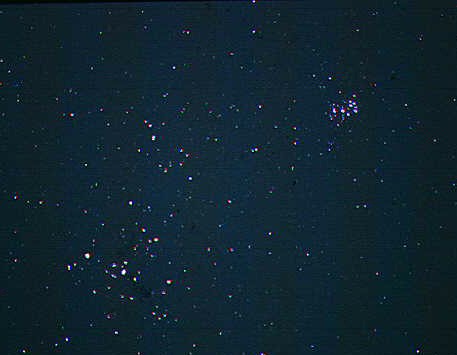
The Hyades (lower left) and the Pleiades (upper right). My photograph from many years ago.
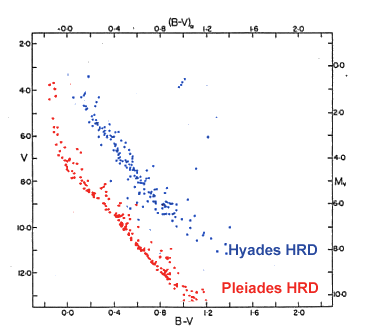
H-R diagram showing the Hyades and Pleiades. Credit: European Southern Observatory.
The Hertzsprung-Russell diagram or H-R diagram plots stars by brightness on the vertical axis versus surface temperature on the horizontal axis, hot to the left to cool on the right. The plot of stars for open or galactic star clusters, where the stars are burning hydrogen in their cores lie on a diagonal line called the main sequence. When matching the plots of two star clusters based on apparent magnitude the main sequence plot for the more distant star cluster will be dimmer by a certain magnitude difference. Since the brightness of and light source diminishes by the inverse square of the distance. The difference in brightness equates to a difference in distance.
For more information on the H-R diagram check out the Wikipedia article. It’s more than about distance.
10/28/2014 – Ephemeris – The Pleiades Distance Controversy
Ephemeris for Tuesday, October 28th. The sun will rise at 8:14. It’ll be up for 10 hours and 22 minutes, setting at 6:37. The moon, 2 days before first quarter, will set at 10:37 this evening.
Yesterday we looked at the Pleiades or Seven Sisters star cluster. The Pleiades is nearby. For a long time the Pleiades distance was calculated to be about 435 light years. It was beyond the distance that could be determined from the Earth by triangulation or parallax. In the early 1990s the European Space Agency satellite Hipparcos was launched to improve and extend the parallax measurement of nearby stars. However the distance determined to the Pleiades was 392 light years, 90 percent of the previous value. A lot of what we have determined about stars and their evolution was based on the original distance to the Pleiades. It meant that the Pleiades stars were dimmer than first calculated, affecting our ideas of stellar evolution. Many astronomers were wary of the supposed more accurate Hipparcos result. However recently using a network of radio telescopes that span the diameter of the Earth in a Very Long Base Interferometry Array, a new distance was determined, a more agreeable 444 light years.
Times are for the Traverse City/Interlochen area of Michigan. They may be different for your location.
Addendum
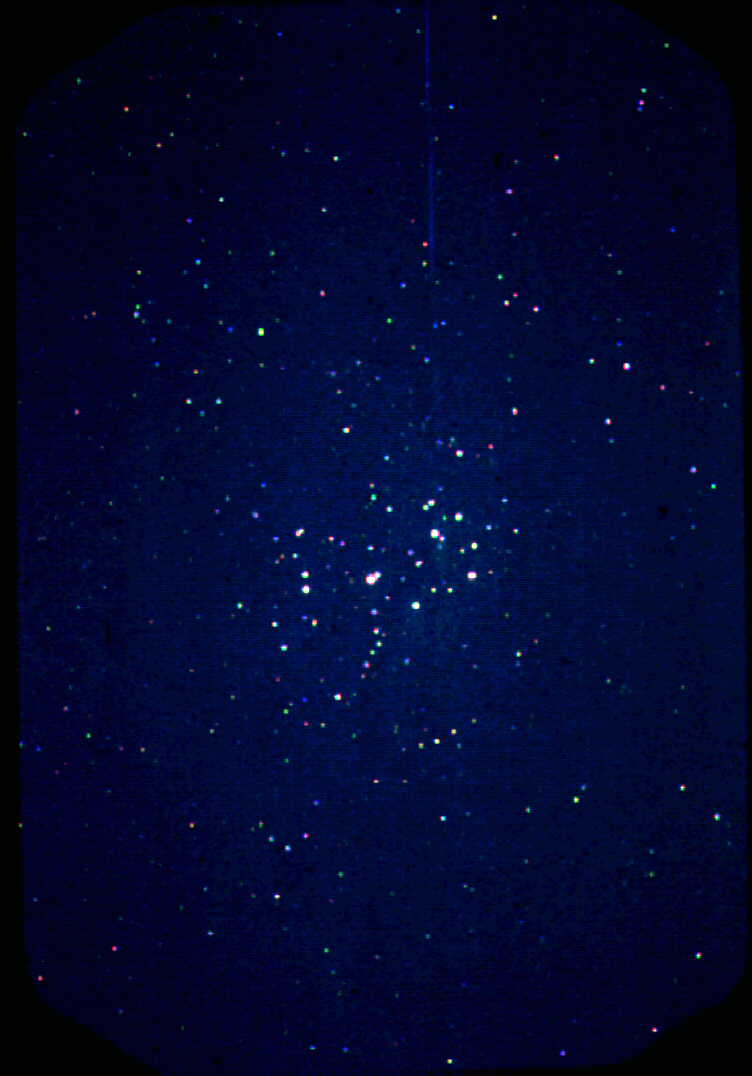
The Pleiades, about what you’d see in binoculars.

10/20/2014 – Ephemeris – Looking for the Pleiades or Seven Sisters
Oct 20. This is Bob Moler with Ephemeris for Monday, October 20th. The sun will rise at 8:04. It’ll be up for 10 hours and 45 minutes, setting at 6:49. The moon, 3 days before new, will rise at 5:43 tomorrow morning.
A marvelous member of the autumn skies can be found low in the east northeast after 9 in the evening. It is the famous star cluster called the Pleiades or the Seven Sisters. I might also add the ‘Tiny Dipper’. Many people can spot a tiny dipper shape in its six or seven stars, and mistake it for the Little Dipper. As nearsighted as I am, though corrected, I’ve never been able to see more than a few stars and a bit of fuzz. However with binoculars, even I can see over a hundred stars appear along with the dipper shape of the brightest. The fuzz I saw was unresolved stars, but in photographs the Pleiades actually contain wisps of the gas they are passing through currently. In Greek mythology the sisters were daughters of the god Atlas.
Times are for the Traverse City/Interlochen area of Michigan. They may be different for your location.
Addendum
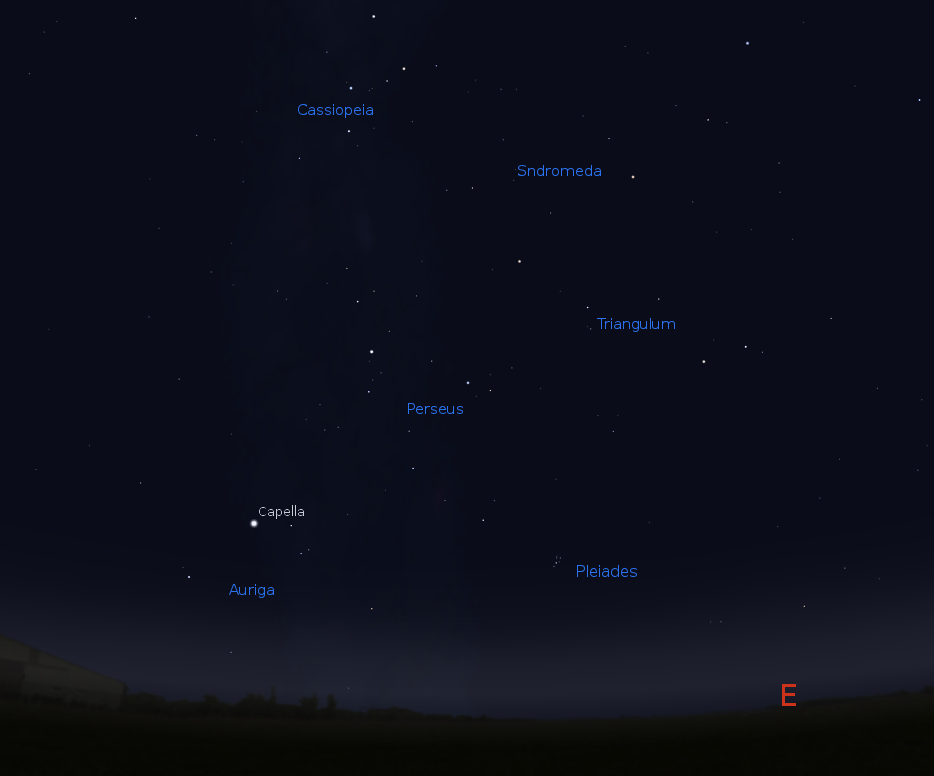
Looking to the east northeast at the Pleiades: 9 p.m.. Created using Stellarium.
The Pleiades, about what you’d see in binoculars.
10/17/2014 – Ephmeris – There’s a star party Saturday at the NMC Rogers Observatory
Ephemeris for Friday, October 17th. The sun will rise at 8:00. It’ll be up for 10 hours and 54 minutes, setting at 6:54. The moon, 2 days past last quarter, will rise at 2:47 tomorrow morning.
Tomorrow night the Grand Traverse Astronomical Society will host a Star Party at Northwestern Michigan College’s Rogers Observatory from 9 p.m. to 11 p.m. On tap, if it’s clear will be the wonders of both the summer and the autumn skies, The summer Milky Way is still visible moving off to the southwest with its star clusters and nebulae. The autumn sky has star clusters too, including the famous Pleiades, best seen in binoculars or telescope finders, and the wonderful Double Cluster. The autumn sky is also host to the closest spiral galaxy to us the Great Andromeda Galaxy, which will get a whole lot closer in 4 billion years. Come on out to the observatory on Birmley Road, about 2 miles south of South Airport Road.
Times are for the Traverse City/Interlochen area of Michigan. They may be different for your location.
Addendum
The Pleiades, about what you’d see in binoculars.
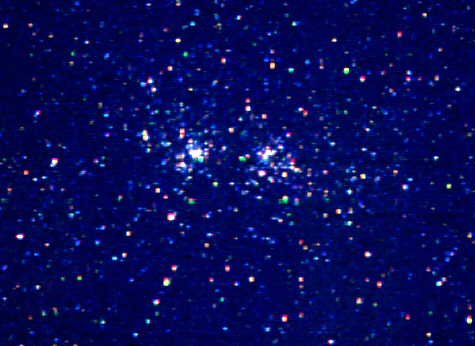
Double Cluster as it would be seen in a small telescope.
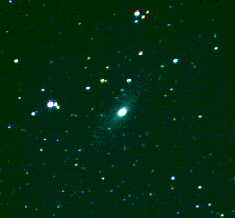
The Great Andromeda Galaxy (M31) as seen in binoculars. Visually even in a telescope the hub of this galaxy is all that is seen. However it also can be seen with the naked eye. However a telescope can also show its two satellite galaxies.
02/24/2014 – Ephemeris – Two more bright star clusters of winter
Ephemeris for Monday, February 24th. The sun will rise at 7:28. It’ll be up for 10 hours and 55 minutes, setting at 6:23. The moon, 2 days past last quarter, will rise at 4:27 tomorrow morning.
The Milky Way isn’t as bright in the winter as it is in the summer. That’s because we are looking away from the galactic center, the central part of the Milky Way. But there’s still a lot to see as can be attested to by the bright stars of winter that outshine those of summer. There are a lot of Galactic or open star clusters visible, such as the Pleiades. With binoculars one can spot at least two more. Just below Sirius the Dog Star the brightest night-time star which can be found by extending the line of the belt stars of Orion to the lower left. It’s Messier 41. Then off Castor’s toe in Gemini, where the sun would be on the first day of summer, as I mentioned last Tuesday, is another bright binocular star cluster cataloged as Messier 35.
Times are for the Traverse City/Interlochen area of Michigan. They may be different for your location.
Addendum
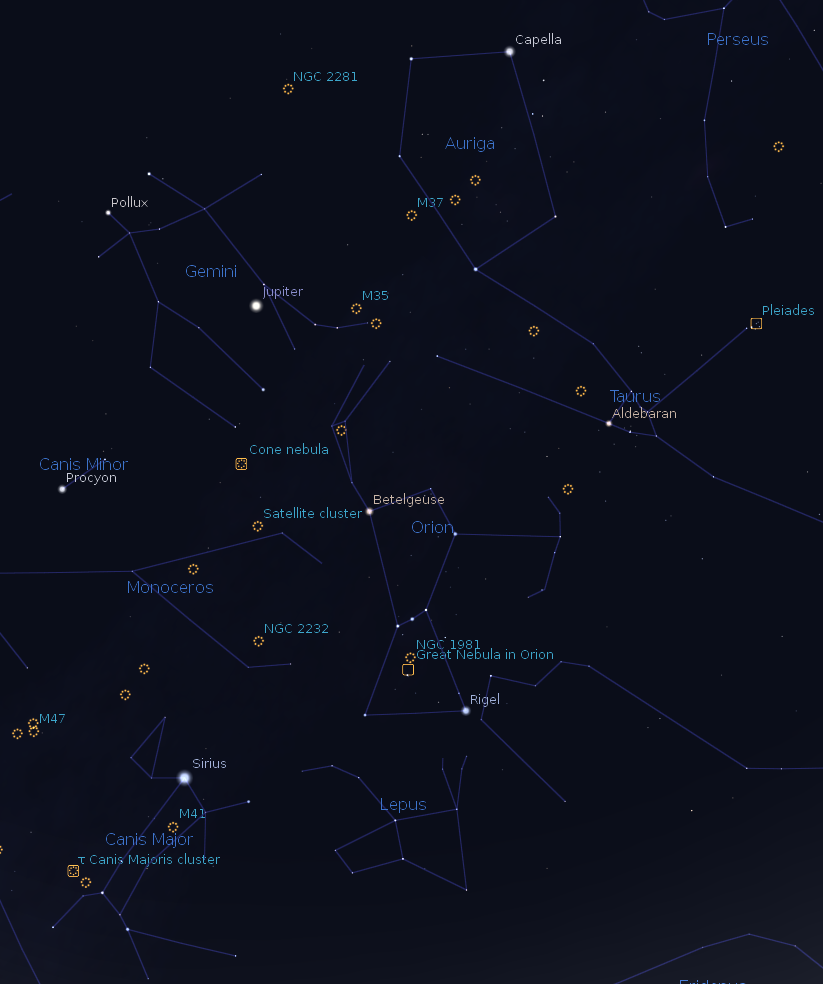
Winter Deep Sky Objects including the Pleiades, M35 and M41. Created using Stellarium.
08/08/2013 – Ephemeris – The wonders located in Scutum the shield
Ephemeris for Thursday, August 8th. The sun rises at 6:37. It’ll be up for 14 hours and 20 minutes, setting at 8:58. The moon, 2 days past new, will set at 9:28 this evening.
The teapot pattern of stars that is the constellation of Sagittarius lies at the southern end of the Milky Way this evening. It appears that the Milky Way is steam rising from the spout. The area above Sagittarius in the brightest part of the Milky Way is the dim constellation of Scutum the shield. Don’t bother looking for the stars that make up the constellation; what’s important is the star clouds of the Milky Way. Scan this area with binoculars or small telescope for star clusters and nebulae or clouds of gas. In binoculars both clusters and nebulae will appear fuzzy, but a small telescope will tell most of them apart. Even if you’ve never been able to find anything in your telescope, put on the lowest power eyepiece you have and scan back and forth for these wonders.
Times are for the Traverse City/Interlochen area of Michigan. They may be different for your location.
Addendum
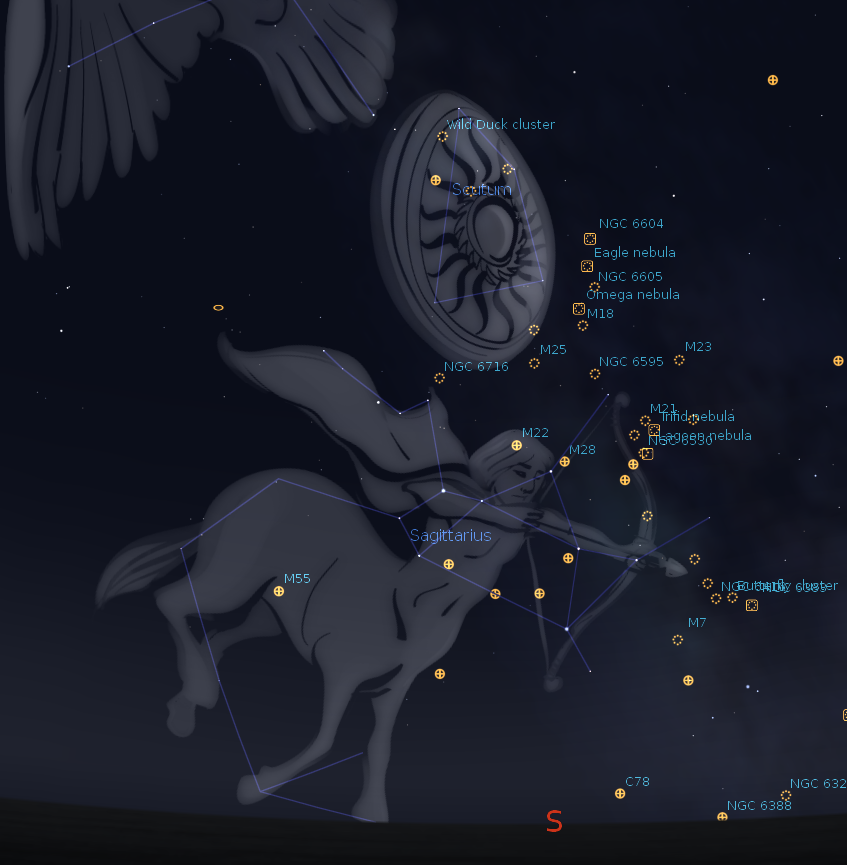
Binocular and telescope deep sky objects in Scutum and Sagittarius. Created using Stellarium.
The symbols mean:
Circle with embedded cross – Globular star cluster (Very old compact star cluster)
Open dotted circle – Open or galactic star cluster (Young loose star cluster)
Square – Nebula (Here emission nebulae. In many cases with associated open clusters)
Ellipse – Galaxy
 Bob Moler's Ephemeris Blog