Archive
02/24/2014 – Ephemeris – Two more bright star clusters of winter
Ephemeris for Monday, February 24th. The sun will rise at 7:28. It’ll be up for 10 hours and 55 minutes, setting at 6:23. The moon, 2 days past last quarter, will rise at 4:27 tomorrow morning.
The Milky Way isn’t as bright in the winter as it is in the summer. That’s because we are looking away from the galactic center, the central part of the Milky Way. But there’s still a lot to see as can be attested to by the bright stars of winter that outshine those of summer. There are a lot of Galactic or open star clusters visible, such as the Pleiades. With binoculars one can spot at least two more. Just below Sirius the Dog Star the brightest night-time star which can be found by extending the line of the belt stars of Orion to the lower left. It’s Messier 41. Then off Castor’s toe in Gemini, where the sun would be on the first day of summer, as I mentioned last Tuesday, is another bright binocular star cluster cataloged as Messier 35.
Times are for the Traverse City/Interlochen area of Michigan. They may be different for your location.
Addendum
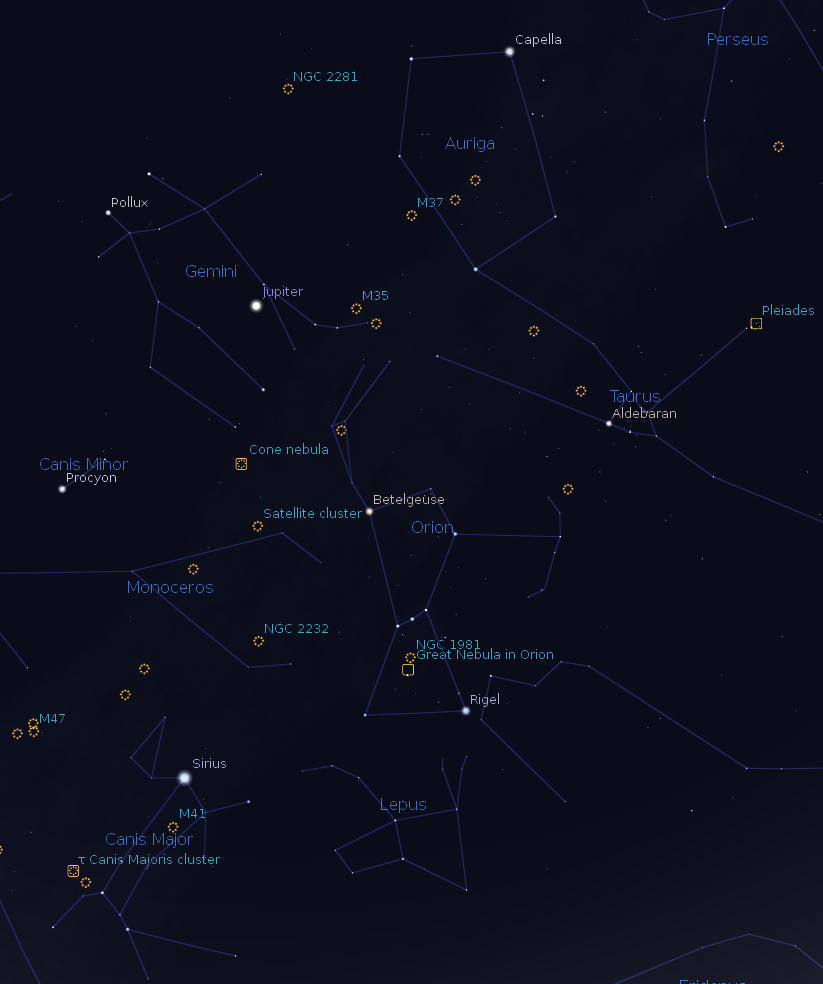
Winter Deep Sky Objects including the Pleiades, M35 and M41. Created using Stellarium.
08/08/2013 – Ephemeris – The wonders located in Scutum the shield
Ephemeris for Thursday, August 8th. The sun rises at 6:37. It’ll be up for 14 hours and 20 minutes, setting at 8:58. The moon, 2 days past new, will set at 9:28 this evening.
The teapot pattern of stars that is the constellation of Sagittarius lies at the southern end of the Milky Way this evening. It appears that the Milky Way is steam rising from the spout. The area above Sagittarius in the brightest part of the Milky Way is the dim constellation of Scutum the shield. Don’t bother looking for the stars that make up the constellation; what’s important is the star clouds of the Milky Way. Scan this area with binoculars or small telescope for star clusters and nebulae or clouds of gas. In binoculars both clusters and nebulae will appear fuzzy, but a small telescope will tell most of them apart. Even if you’ve never been able to find anything in your telescope, put on the lowest power eyepiece you have and scan back and forth for these wonders.
Times are for the Traverse City/Interlochen area of Michigan. They may be different for your location.
Addendum
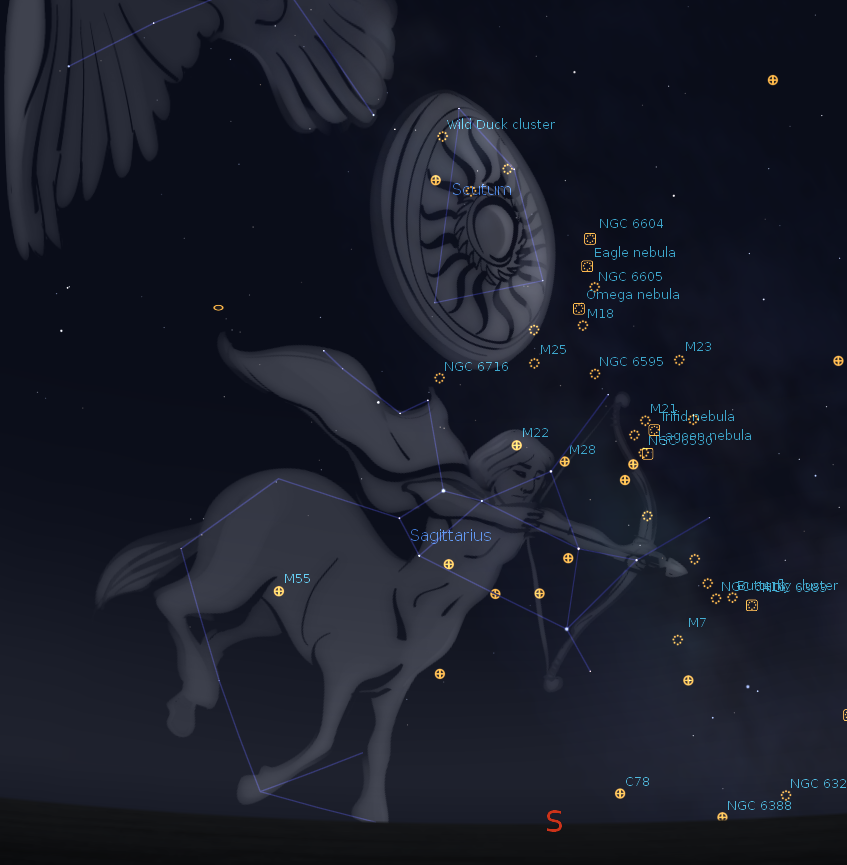
Binocular and telescope deep sky objects in Scutum and Sagittarius. Created using Stellarium.
The symbols mean:
Circle with embedded cross – Globular star cluster (Very old compact star cluster)
Open dotted circle – Open or galactic star cluster (Young loose star cluster)
Square – Nebula (Here emission nebulae. In many cases with associated open clusters)
Ellipse – Galaxy

