Archive
Ephemeris: 02/20/2026 – The star that’s called “Before the Dog”
This is Ephemeris for Friday, February 20th. Today the Sun will be up for 10 hours and 43 minutes, setting at 6:18, and it will rise tomorrow at 7:33. The Moon, 3 days past new, will set at 10:21 this evening.
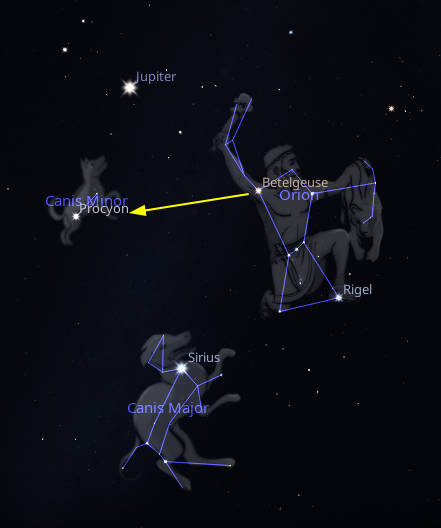
The star Procyon is in Orion’s little hunting dog, Canis Minor, which contains only one other star. It can be found by using the shoulder stars of Orion, Bellatrix and Betelgeuse, pointing to the left and down a bit to Procyon at 9 PM. With Jupiter above, Betelgeuse to the right and Sirius below, it makes an imposing diamond of stars. The word Procyon means “Before the Dog” meaning that rises before the Dog Star, Sirius, even though it is east of it. Procyon is also north of Sirius, which for observers above 30° north latitude, it does indeed rise before the Dog Star. It is a star like Sirius, though it’s not as bright, or white. Procyon is 11.5 light years away while Sirius is 8.6. Both have tiny white dwarf companion stars.
The astronomical event times given in this blog are for the Traverse City/Interlochen area of Michigan (Lat 44.7° N, Long 85.7° W; EST, UT – 5 hours) unless stated otherwise. Times will be different for other locations.
Addendum
Ephemeris: 01/08/2026 – The star named “Before the Dog”
This is Ephemeris for Thursday, January 8th. Today the Sun will be up for 9 hours even, setting at 5:20, and it will rise tomorrow at 8:19. The Moon, 2 days before last quarter, will rise at 11:45 this evening.
After 8 o’clock this evening look to the southeastern sky for the Orion the hunter constellation. Below into the left of it are two very bright stars. The one below is Sirius also known as the Dog Star, in the heart of Canis Major, the Great Dog, which is still rising at 8. Above and to the left of it is a star called Procyon which is the heart of Orion’s little dog, Canis Minor. The name Procyon is from the Greek meaning Before the Dog. The reason for Procyon’s name is the fact that it, though east of Sirius, rises before it. All things being equal, Sirius should rise before Procyon. The reason is, viewing from the Northern Hemisphere Procyon is north of Sirius, and stays out longer. It is far enough north and not that far to the east of Sirius, that it can rise before Sirius or before the Dog… Star.
The astronomical event times given in this blog are for the Traverse City/Interlochen area of Michigan (Lat 44.7° N, Long 85.7° W; EST, UT – 5 hours) unless stated otherwise. Times will be different for other locations.
Addendum
Ephemeris: 02/05/2024 – Looking at the star Procyon
This is Ephemeris for Monday, February 5th. Today the Sun will be up for 9 hours and 59 minutes, setting at 5:56, and it will rise tomorrow at 7:56. The Moon, 3 days past last quarter, will rise at 5:44 tomorrow morning.
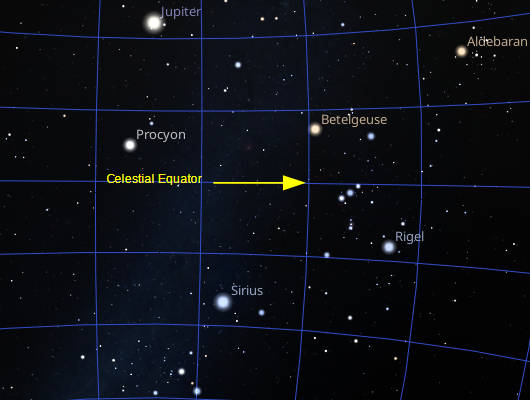
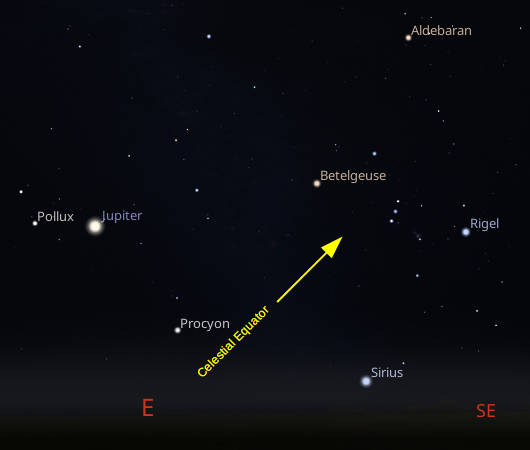
The star Procyon is in Orion’s little hunting dog Canis Minor, which contains only one other star. It can be found by using the shoulder stars of Orion, Bellatrix and Betelgeuse, pointing to the left and down a bit to Procyon in the evening. The word Procyon appears to mean “Before the Dog” meaning that rises before the Dog Star, Sirius, even though it is east of it. Procyon is also north of Sirius, which for observers above 30° north latitude does indeed rise before the Dog Star. It is a star like Sirius, though it’s not as bright, or white. Procyon is 11.5 light years away while Sirius is 8.4 light years away. Both have tiny white dwarf companion stars.
The astronomical event times given are for the Traverse City/Interlochen area of Michigan (EST, UT –5 hours). They may be different for your location.
Addendum
Ephemeris: 07/21/2023 – Antares just looks weird
This is Ephemeris for Friday, July 21st. Today the Sun will be up for 15 hours and 3 minutes, setting at 9:20, and it will rise tomorrow at 6:18. The Moon, halfway from new to first quarter, will set at 11:34 this evening.
We’ve had our Fourth of July fireworks over two weeks ago, but there’s one star still celebrating as a sparkler. That’s Antares in Scorpius the scorpion low in the south tonight. We in Michigan always see Antares low in the south. It’s a bright red giant star which twinkles mightily, and since it’s low in the sky, it spits and sputters all kinds of colors due to our atmosphere’s turbulence, and the fact that we’re looking through so much of it at Antares. At it’s highest, due south, we are seeing it though 3 times more atmosphere than we would be if it was overhead. The more magnification one uses with binoculars or a telescope, the greater the sparkler effect. It is even called in sometimes as a UFO.
The astronomical event times given are for the Traverse City/Interlochen area of Michigan (EDT, UT –4 hours). They may be different for your location.
Addendum
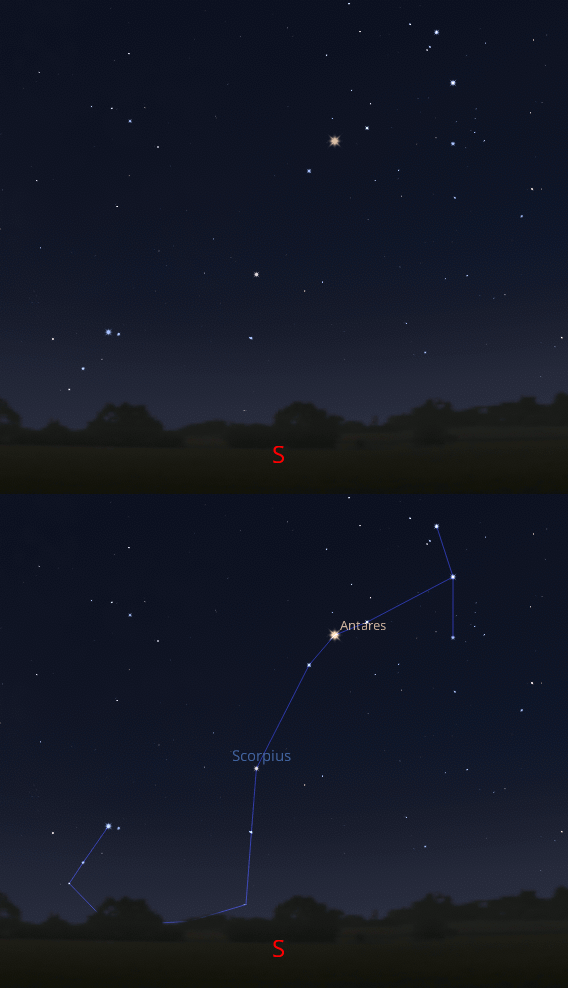
The name of the star Antares means “Rival of Mars”. “Ant” meaning anti, “Ares”, the Greek equivalent to the Roman god Mars. The reason is their similar reddish color. Antares is red because it is a cool star, a red giant. Mars is red due to its red dust, colored by iron rust. The planet passes Antares about every 23 1/2 months. Mars will next pass Antares on December 8th, 2023. However, the event will not be visible, because both the star and the planet will be too close to the Sun in the morning sky then. Their next meeting, or conjunction, after that, on November 17th, 2025 will be in the evening sky, but still too close to the Sun to be spotted. The conjunction after that will be in the evening sky, again rather close to the Sun, on October 28, 2027. For these three encounters, Mars will be north or above Antares, and dimmer than the star.
05/16/2023 – Ephemeris – Regulus, the Little King Star
This is Ephemeris for Tuesday, May 16th. Today the Sun will be up for 14 hours and 51 minutes, setting at 9:05, and it will rise tomorrow at 6:12. The Moon, 3 days before new, will rise at 5:08 tomorrow morning.
Regulus is the brightest star in the constellation of Leo, the lion at the bottom of the backward question mark that is the head and mane of Leo. It’s in the southwest at 10 pm. Alluding to the lion’s status in the animal kingdom, Regulus is the little king star. It is dead last in order of brightness of the 21 brightest first magnitude stars, 1/13th the brightness of Sirius the brightest nighttime star, now lost in the evening twilight glow. To the Babylonians it was the king, the 15th of their constellations, that marked the passage of the Sun. Regulus is about 79 light years away, and 288 times the brightness of the sun. It is a rapidly spinning ellipsoid 3 times the sun’s diameter, rotating in just under 16 hours.
The astronomical event times given are for the Traverse City/Interlochen area of Michigan (EDT, UT –4 hours). They may be different for your location.
Addendum
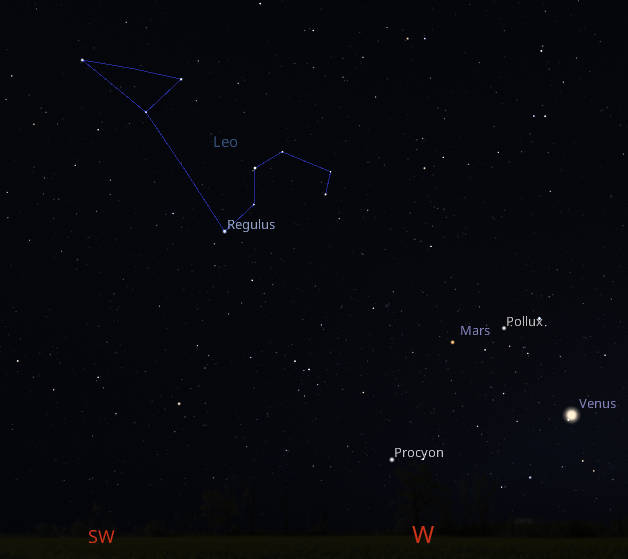
Regulus and Leo and the other stars and planets in the western sky at 11 pm, May 16, 2023. Created using Stellarium.
02/09/2023 – Ephemeris – Orion’s Belt stars
This is Ephemeris for Thursday, February 9th. Today the Sun will be up for 10 hours and 10 minutes, setting at 6:02, and it will rise tomorrow at 7:50. The Moon, halfway from full to last quarter, will rise at 10:07 this evening.
Orion’s belt of three stars is one of the most noticeable star groupings in the sky. There are no other groups of three bright stars in a straight line visible anywhere else in the sky. The star’s names from left to right are Alnitak, Alnilam and Mintaka. They are actually a bit farther away than the other bright stars of Orion. Alnilam, the center star, is over three times the distance of red giant Betelgeuse above them and over twice as far as blue white giant star Rigel below them. Alnilam is 375 thousand times brighter than the Sun according to the SIMBAD Astronomical Database. These three stars were also known as Frigga’s Spindle by the Norsemen. Frigga also known as Freya is the goddess from which we get the name of the day of the week Friday.
The astronomical event times given are for the Traverse City/Interlochen area of Michigan (EST, UT –5 hours). They may be different for your location.
Addendum
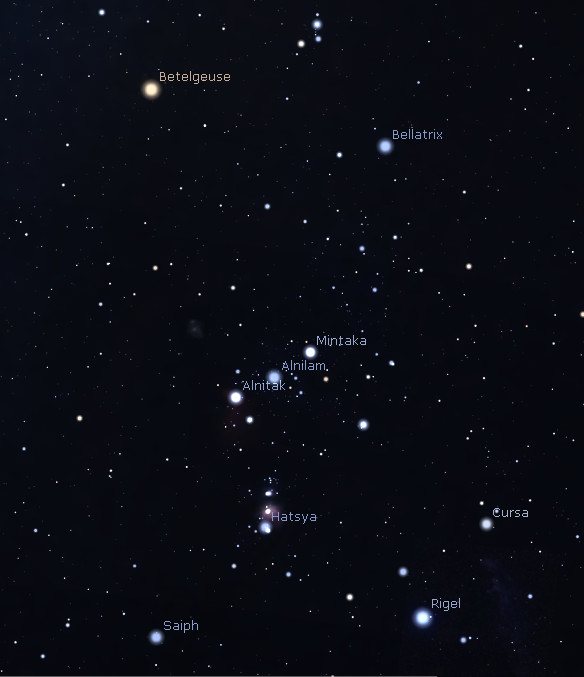
Orion’s named stars, including the belt stars. Created using Stellarium.
01/05/2023 – Ephemeris – I’m Sirius about this being the brightest nighttime star!
Jan 5. This is Bob Moler with Ephemeris for Thursday, January 5th. Today the Sun will be up for 8 hours and 56 minutes, setting at 5:16, and it will rise tomorrow at 8:19. The Moon, 1 day before full, will set at 8:33 tomorrow morning.
The brightest nighttime star, Sirius, rises before 8 pm tonight. It can be found by following the constellation Orion’s three belt stars downward to near the east-southeastern horizon. As far as star-like objects go, Jupiter and Venus can always outshine Sirius. Mars can too, but only when it is near the Earth and this early evening when Mars is high in the sky and Sirius is low in the sky. When the Moon clears out of the evening sky, and Sirius rises higher, the other stars of its constellation will become visible. That constellation is Canis Major, Orion’s great hunting dog, from which it gets its nickname: Dog Star. The name Sirius means Dazzling One, an allusion to its great brightness and, being low in the sky, it twinkles mightily.
The astronomical event times given are for the Traverse City/Interlochen area of Michigan (EST, UT –5 hours). They may be different for your location.
Addendum
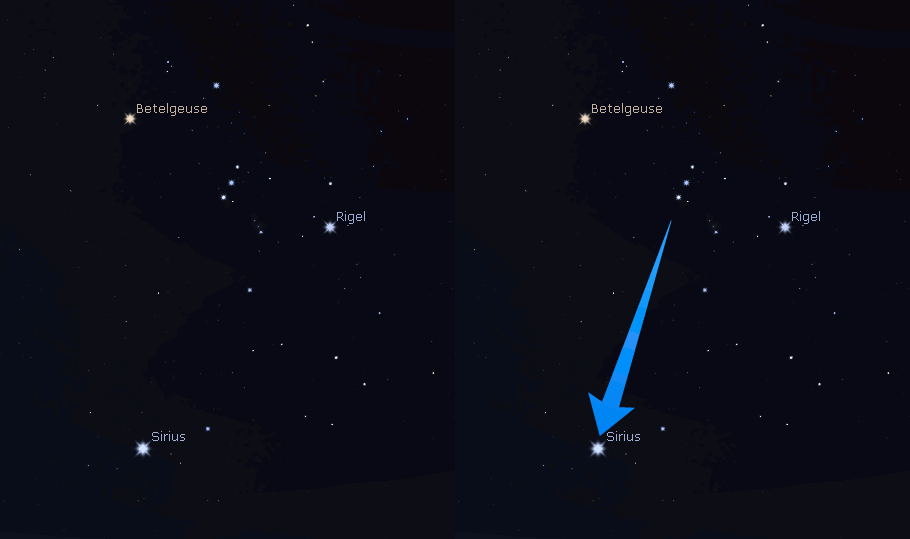
A Sirius finder animation for January/early February at around 8 pm. Even in bright moonlight, the seven bright stars of Orion can be seen. The three stars of Orion’s belt make a great pointer to Sirius. Created using Stellarium, GIMP and LibreOffice (for the arrow).
01/06/2022 – Ephemeris – The named stars of Orion
This is Ephemeris for Thursday, January 6th. Today the Sun will be up for 8 hours and 58 minutes, setting at 5:18, and it will rise tomorrow at 8:19. The Moon, 3 days before first quarter, will set at 10:07 this evening.
Orion is still on an angle, leaning to the left, at 8 to 9 pm in the southeastern sky. It’s seven brightest stars have names from antiquity, and some of them are familiar. Starting from the top left, the bright reddish star is famous Betelgeuse. The top right star is Bellatrix, a name familiar to Harry Potter fans. The three stars of his belt, from bottom to top, are Alnilam, Alnitak, and Mintaka. The final bottom two stars from left to right are Saiph, pronounced “safe”. And blue-white Rigel, usually the brightest star of the constellation. These are the stars of Orion’s shoulders, belt and knees. He has other stars that delineate an arm with an upraised club and an arm holding a lion skin shield and a sword hanging from his belt.
The astronomical event times given are for the Traverse City/Interlochen area of Michigan (EST, UT – 5 hours). They may be different for your location.
Addendum
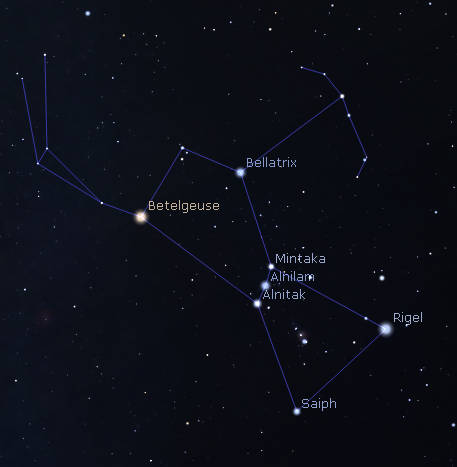
Orion’s named stars. Betelgeuse means “Armpit”. Bellatrix means “Female warrior”. The names of Orion’s belt stars refer to belt or girdle, Rigel refers to Orion’s foot. Saiph means sword, however Orion’s sword is the line of three stars below the belt stars. In binoculars, there’s more than three stars here. Around the second “star” of the sword is the Great Orion Nebula, barely visible here. Created using Stellarium.
04/09/2021 – Ephemeris – Follow the arc to Arcturus
This is Bob Moler with Ephemeris for Friday, April 9th. Today the Sun will be up for 13 hours and 12 minutes, setting at 8:20, and it will rise tomorrow at 7:06. The Moon, 2 days before new, will rise at 6:57 tomorrow morning.
The fourth or fifth brightest night-time star, depending on whose list you see, is now up in the east in the evening. It is Arcturus, a bright star with an orange hue. It can be found otherwise by finding the Big Dipper and tracing out and extending the curve of the handle and “Follow the arc of the handle to Arcturus”, to remember the name of the star and how to find it. Arcturus is about 37 light years from us and is moving quite rapidly across the sky, compared to most stars, though one would not notice it to the naked eye in one’s lifetime. Arcturus is slightly more massive than our Sun, and about 7 billion years old, and is entering its red giant stage of life after using all the hydrogen fuel in its core. Our Sun, being slightly less massive will survive on hydrogen a bit longer.
The astronomical event times given are for the Traverse City/Interlochen area of Michigan. They may be different for your location.
Addendum
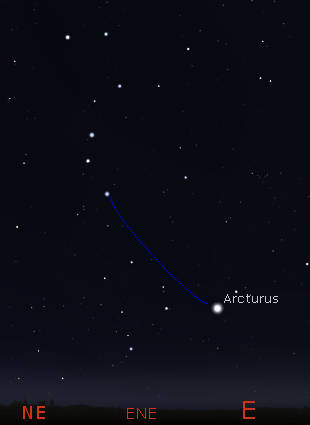
I’ll be talking more about Arcturus and the constellation it’s in Boötes the herdsman, a kite shaped constellation that’s currently laying on its side. He’s not herding, but chasing the Great Bear. But that’s another story.
01/11/2021 – Ephemeris – Procyon, the before the Dog Star
This is Bob Moler with Ephemeris for Monday, January 11th. Today the Sun will be up for 9 hours and 5 minutes, setting at 5:23 pm, and it will rise tomorrow at 8:17 am. The Moon, 2 days before new, will rise at 8:05 tomorrow morning.
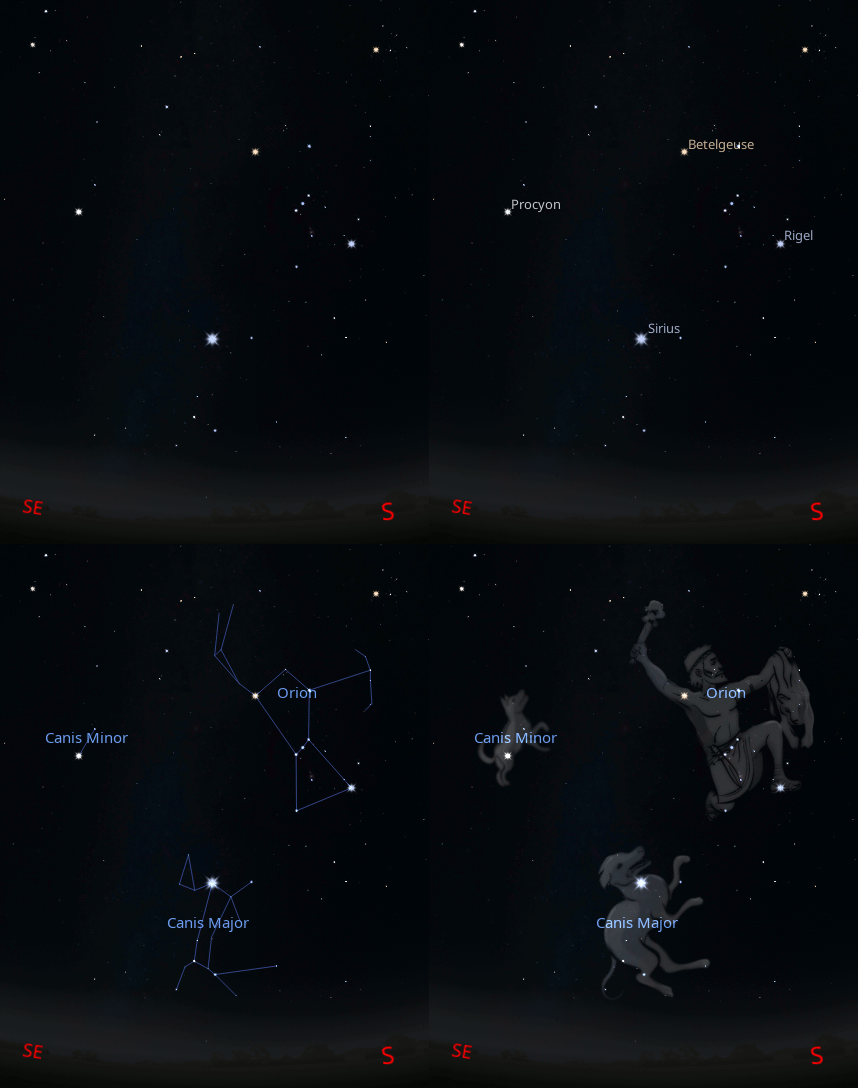
Visible low in the east at 8 p.m. appears the star Procyon. To its right and below is Sirius the brightest night-time star. Procyon is the bright star in the constellation Canis Minor, or lesser dog. I can find only one other star in Canis Minor. Perhaps it’s a hot dog. If Sirius, in Canis major is the Dog Star then Procyon should be the Little Dog Star. However, Procyon is an interesting name. It means “Before the dog”, which is an allusion to the fact that Procyon, though east of Sirius actually rises before it. This is due to Procyon’s more northerly position. This effect doesn’t work south of the equator, however. Sirius will rise at about 7:30 tonight. Procyon is a star much like Sirius but is 32% farther away. It’s 11.4 to Sirius’ 8.6 light years away.
The event times given are for the Traverse City/Interlochen area of Michigan. They may be different for your location.
Addendum
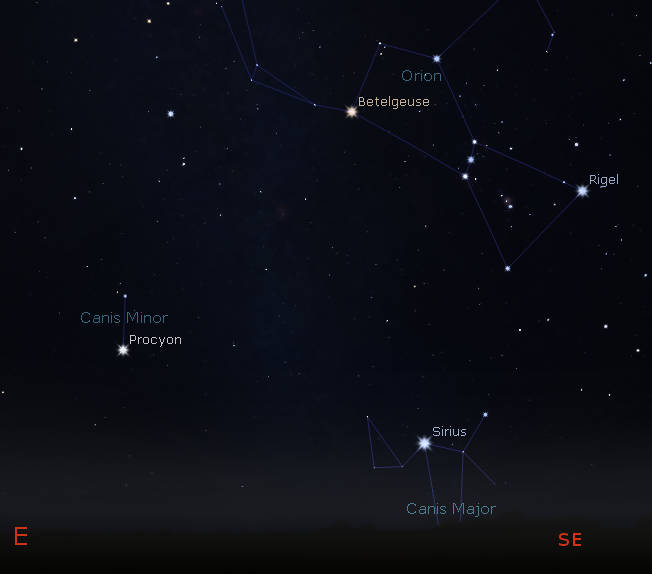
Orion and his hunting dogs in early winter (8 pm, January 11, 2021) showing that Procyon does rise before Sirius.
 Bob Moler's Ephemeris Blog