Archive
06/24/2014 – Ephemeris – The bright star Vega is high in the east
Ephemeris for Tuesday, June 24th. Today the sun will be up for 15 hours and 33 minutes, setting at 9:31. The moon, 3 days before new, will rise at 4:53 tomorrow morning. Tomorrow the sun will rise at 5:58.
The bright star high in the east is Vega, one of the stars of the Summer Triangle an informal constellation called an asterism. Vega belongs to the official constellation Lyra the harp, which includes a narrow parallelogram of stars to its south. Vega is regarded by astronomers as a standard calibration star. Though a first magnitude star, its actual magnitude is 0.03. It is a type A0 pure white star, and is 27 light years away. Astronomers however got a shock in 1983 when calibrating the Infrared Astronomy Satellite (IRAS) on it: Vega showed an excess of Infrared radiation that means the star is orbited by a disk of dust, perhaps the beginnings of a planetary system. Due to the slow wobble of the earth’s axis Vega will be our pole star in 14 thousand years.
Times are for the Traverse City/Interlochen area of Michigan. They may be different for your location.
Addendum
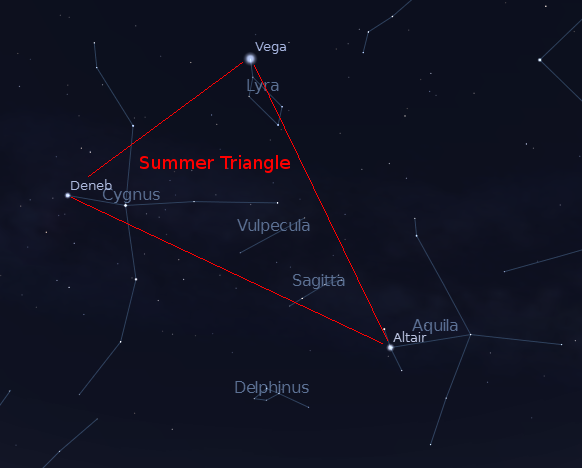
The Summer Triangle. Created using Stellarium and The Gimp.
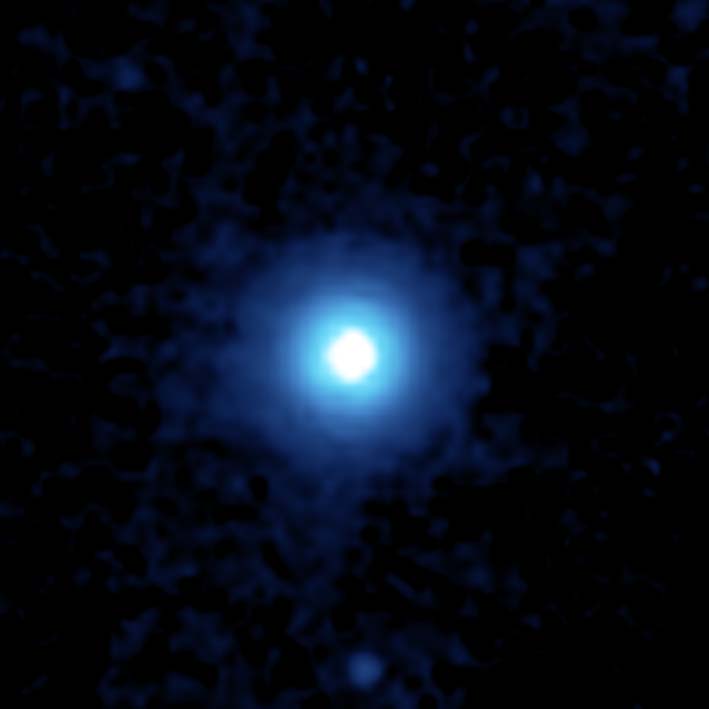
Vega in the mid-infrared from the Spitzer Space Telescope. Credit: NASA/JPL-Caltech/University of Arizona
02/20/2014 – Ephemeris – Winter Circle plus 1
Ephemeris for Thursday, February 20th. The sun will rise at 7:34. It’ll be up for 10 hours and 43 minutes, setting at 6:18. The moon, 2 days before last quarter, will rise at 12:27 tomorrow morning.
The winter skies are blessed with more first magnitude stars than any other season. Six of these stars lie in a large circle centered on the seventh. This circle is up at 9 p.m. Starting high overhead is Capella in Auriga the charioteer. Moving down clockwise is Aldebaran in the face of Taurus the Bull. Then down to Orion’s knee we find Rigel. Down and left is the brightest star of all Sirius the Dog Star in Canis Major, lowest of these stars in the south-southeast. Moving up and left is Procyon in Canis Minor, Above Procyon is Pollux in Gemini the twins. All these are centered on Betelgeuse the bright red star in Orion’s shoulder. The interloper this year is Jupiter which is situated in Gemini and outshines them all.
Times are for the Traverse City/Interlochen area of Michigan. They may be different for your location.
Addendum
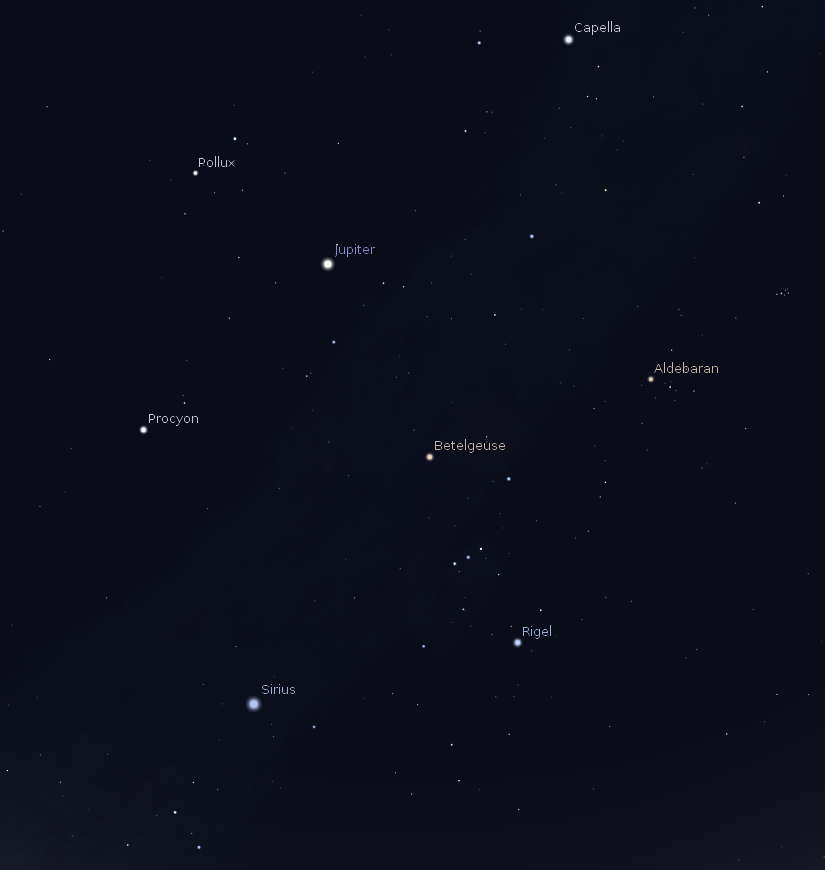
The Winter Circle plus Jupiter at 9 p.m. on February 20, 2014. Created using Stellarium.
12/27/2013 – Ephemeris – The star Procyon: “Before the Dog”
Ephemeris for Friday, December 27th. The sun will rise at 8:18. It’ll be up for 8 hours and 50 minutes, setting at 5:08. The moon, 2 days past last quarter, will rise at 3:48 tomorrow morning.
Yesterday I talked about the brilliant star Sirius, the dog star pointed to by the stars of the belt of Orion. Today we’ll look at another dog star. Procyon, the bright star in Canis Minor, the lesser dog. It is pointed to by the top two stars in the Orion rectangle Bellatrix and Betelgeuse. One of the translations of Procyon means “Before the Dog”. This seemingly odd title is explained that even though Procyon is east of Sirius and all things being equal, well at least latitude or declination the eastern star should rise after the western star. However Procyon is north of Sirius and if one is sufficiently north of the equator, the eastern most star can rise first. This is what happens. Procyon is a bit farther away than Sirius and isn’t quite as bright either.
Times are for the Traverse City/Interlochen area of Michigan. They may be different for your location.
Addendum
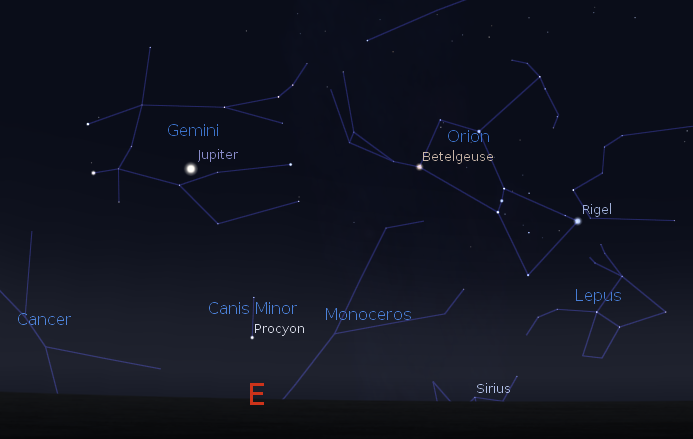
Procyon is already up as Sirius rises. Procyon also sets after Sirius. Created using Stellarium.
Note: Stellarium approximates atmospheric extinction, that is dims objects when they are near the horizon an effect due to looking through more of the Earth’s atmosphere when looking close to the horizon. That’s why Sirius looks rather fainter than in yesterday’s image.
12/26/2013 – Ephemeris – Sirius, the brightest night-time star
Ephemeris for Thursday, December 26th. The sun will rise at 8:18. It’ll be up for 8 hours and 49 minutes, setting at 5:08. The moon, 1 day past last quarter, will rise at 2:40 tomorrow morning.
At 9 in the evening the great constellation of Orion the hunter can be seen in the southeast. Its large rectangle of bright stars is tilting to the left, while in the center is a row of three stars, his belt. These stars tilt downward and a bit to the left to a very bright star merrily twinkling above the horizon in the southeast. This star is called Sirius, also known as the Dog Star because it’s in the heart of Orion larger hunting dog, Canis Major. It is an arc light white star as seen in binoculars or telescope. It’s a neighboring star, just twice the distance of the closest star to the sun at 8.6 light years. It’s name, Sirius, has nothing to do with a dog, but is from the Greek meaning scorching for its brightness or sparkling, due to its intense twinkling.
Times are for the Traverse City/Interlochen area of Michigan. They may be different for your location.
Addendum
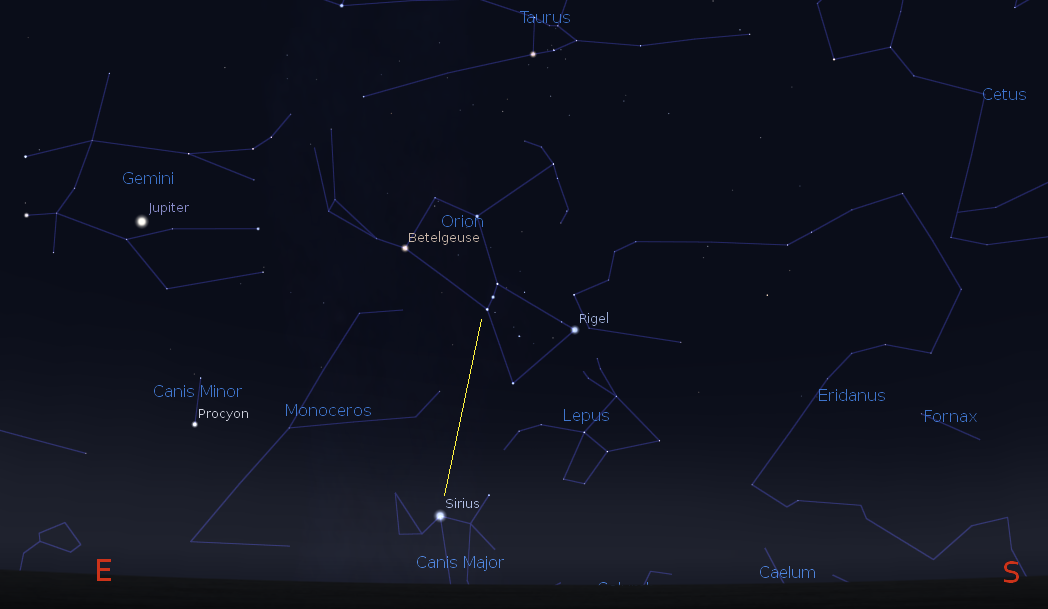
How to find Sirius from Orion. 9 p.m., December 26, 2013. Created using Stellarium.
12/16/2013 – Ephemeris – Orion’s bright blue-white star Rigel
Ephemeris for Monday, December 16th. The sun will rise at 8:13. It’ll be up for 8 hours and 49 minutes, setting at 5:03. The moon, 1 day before full, will set at 8:07 tomorrow morning.
Last week I talked about the star Betelgeuse the bright red star in the top left of Orion’s rectangle in the hunter’s shoulder. Orion is seen in the southeast at 9 in the evening. The blue-white star in Orion’s opposite corner is usually brighter. It is Rigel whose longer Arabic name of which Rigel is the first part means Left Leg of the Giant. Rigel is a giant itself, actually a super giant star, which is more a measure of its mass than its size, that of 17 solar masses. Its surface temperature is more than twice as hot as the sun. It is 130 thousand times as bright as the sun and 74 times its diameter. Its distance is around 860 light years. A telescope might reveal a close companion star to Rigel, off the edge of the bright arc light image of Rigel itself.
Times are for the Traverse City/Interlochen area of Michigan. They may be different for your location.
Addendum
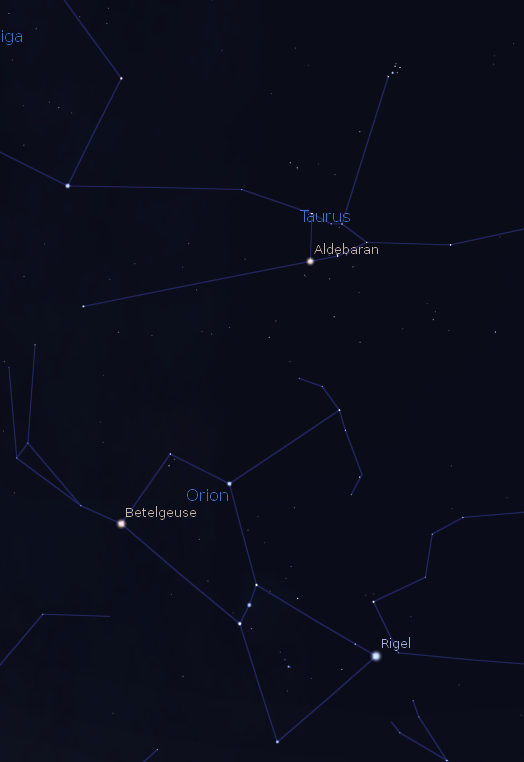
Taurus and Orion with Orion’s brightest stars named. Created using Stellarium.
12/12/2013 – Ephemeris – The bright star Betelgeuse (Don’t say it three times)
Ephemeris for Thursday, December 12th. The sun will rise at 8:10. It’ll be up for 8 hours and 52 minutes, setting at 5:02. The moon, 3 days past first quarter, will set at 4:26 tomorrow morning.
The bright red star in the constellation Orion’s shoulder is Betelgeuse, and it’s about 643 light years away. Despite its great distance, it is the star whose surface is easiest seen, after the sun of course. That’s because it’s so big, maybe as large around as the orbit of Jupiter. Its true diameter is hidden by the cloud of gas it’s expelling. Betelgeuse varies in size and brightness, so its size varies by nearly 30 percent. The Hubble telescope has sent back pictures of the star, and has found a bright spot, seen in ultraviolet light on what may be its surface. It has a really hot core generating energy that pushes out its gaseous envelope to a great size. Some astronomers think the Betelgeuse will become a supernova within a million years.
Times are for the Traverse City/Interlochen area of Michigan. They may be different for your location.
Addendum
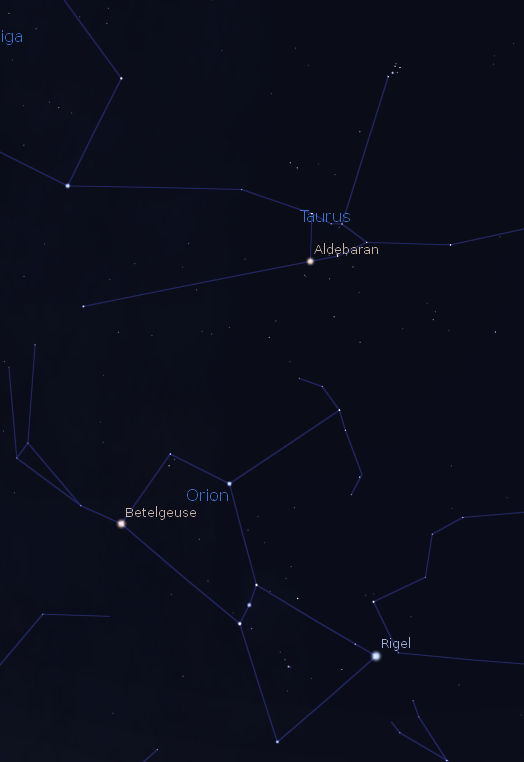
Aldebaran, the Hyades, of Taurus, Orion and the Pleiades at 10 p.m. December 12, 2013. Created using Stellarium.
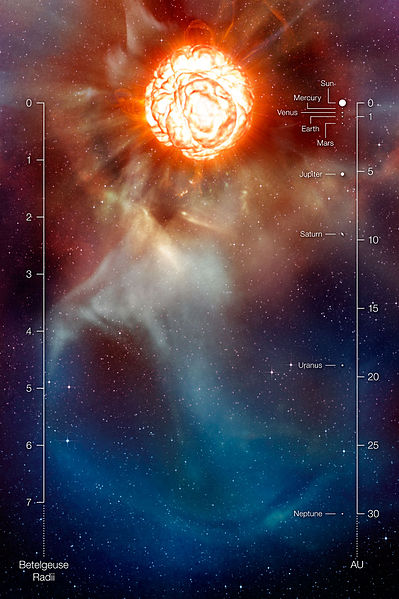
“This artist’s impression shows the supergiant star Betelgeuse as it was revealed thanks to different state-of-the-art techniques on ESO’s Very Large Telescope, which allowed two independent teams of astronomers to obtain the sharpest ever views of the supergiant star Betelgeuse. They show that the star has a vast plume of gas almost as large as our Solar System and a gigantic bubble boiling on its surface. These discoveries provide important clues to help explain how these mammoths shed material at such a tremendous rate. The scale in units of the radius of Betelgeuse as well as a comparison with the Solar System is also provided.” Credit: ESO/L. Calçada (ESO is the European Southern Observatory)
12/10/2013 – Ephemeris – The bright star Aldebaran, the Follower
Ephemeris for Tuesday, December 10th. The sun will rise at 8:08. It’ll be up for 8 hours and 53 minutes, setting at 5:02. The moon, 1 day past first quarter, will set at 2:18 tomorrow morning.
The central constellation of winter, Orion, is in the east southeast at 9 p.m. Above it is Taurus the bull. The bright orange star in Taurus is Aldebaran. Aldebaran appears at the lower left tip of a letter V group of stars lying on its side that is the face of the bull. Aldebaran isn’t actually part of the group, called the Hyades star cluster. The cluster is about 153 light years away, while Aldebaran is 65. The star has an orange hue because its surface is cooler than the sun’s. However Aldebaran is 44 times larger in diameter, and shines 465 times brighter than the sun. The name Aldebaran means “Follower” because it follows the Pleiades star cluster through the skies. The Pleiades is above right of Aldebaran.
Times are for the Traverse City/Interlochen area of Michigan. They may be different for your location.
Addendum
Aldebaran, the Hyades, of Taurus, Orion and the Pleiades at 10 p.m. December 10, 2013. Created using Stellarium.
12/09/2013 – Ephemeris – The bright star Capella, the she-goat
Ephemeris for Monday, December 9th. The sun will rise at 8:07. It’ll be up for 8 hours and 54 minutes, setting at 5:02, the earliest sunset of the year. The moon, at first quarter today, will set at 1:12 tomorrow morning.
A bright star called Capella is now high in the east. Capella is the farthest north of winter’s seven brilliant first magnitude stars. Capella never quite sets for anyone north of Ludington. Due to its brightness, and being the closest first magnitude star to the pole, Capella appears to move slowly as the earth rotates, and spends summer and autumn evenings close to the horizon and is a reminder that winter’s not far away. It has in years past elicited a few phone calls and other queries about that ‘bright object in the northeast’. Capella belongs to the pentagonal constellation of Auriga the Charioteer. Capella represents a mother goat he is holding. Three stars in a thin triangle nearby to the star’s right are her kids.
Times are for the Traverse City/Interlochen area of Michigan. They may be different for your location.
Addendum
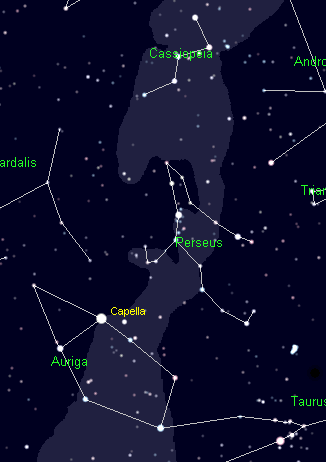
The Constellations Cassiopeia, Perseus and Auriga. Created using Cartes du Ciel
Note the small slender triangle of stars under the “p” in Capella. That’s the Kids, an asterism or informal constellation.
10/25/2013 – Ephemeris – Fomalhaut the lonely star actually has companions
Ephemeris for Friday, October 25th. The sun will rise at 8:11. It’ll be up for 10 hours and 30 minutes, setting at 6:41. The moon, 1 day before last quarter, will rise at 11:56 this evening.
The lonely bright star low in the south at 9 p.m. these evenings is Fomalhaut the harbinger of autumn in my book. Fomalhaut has a recently discovered planet orbiting it Fomalhaut lower case b. However astronomers just announced the discovery of a third star in the system. I didn’t know it had two. The second star, Fomalhaut (capital) B is a binocular object 2 degrees of 4 moon widths south or below Fomalhaut. The just reported third star (now Fomalhaut big C) is a red dwarf star nearly 6 degrees or 11 moon diameters to the north of Fomalhaut or should I say Fomalhaut A. This star is 3 light years from the primary star which is itself only 25 light years from us. I think the more we study this star the more alphabet soup we’ll find.
Times are for the Traverse City/Interlochen area of Michigan. They may be different for your location.
Addendum
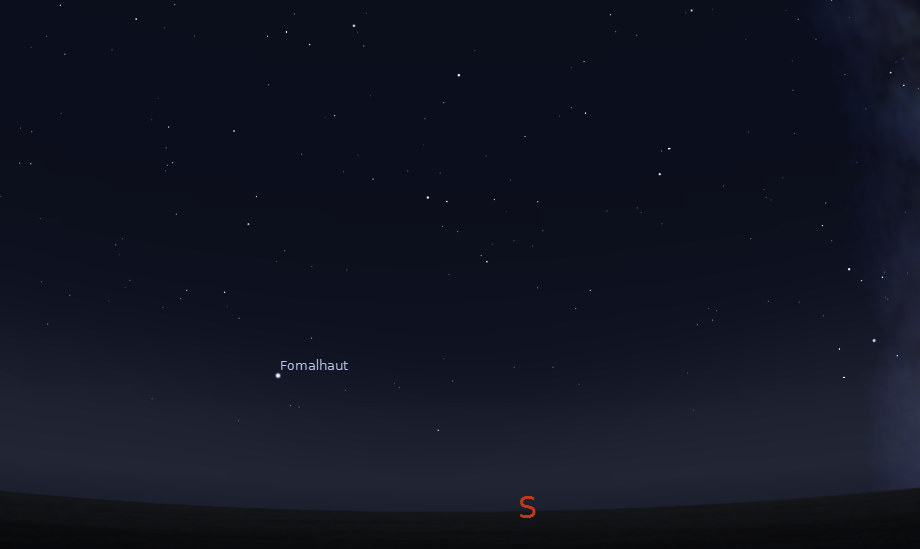
The bright star Fomalhaut all alone at 8:30 p.m. Created using Stellarium.
10/17/2013 – Ephemeris – The lonely star
Ephemeris for Thursday, October 17th. The sun will rise at 8:00. It’ll be up for 10 hours and 53 minutes, setting at 6:54. The moon, 1 day before full, will set at 7:37 tomorrow morning.
There’s a bright star that appears for only seven and a half hours on autumn evenings. It’s appearance, low in the southeast at 10 p.m., is a clear indication of the autumn season. The star’s name is Fomalhaut, which means fish’s mouth. That’s fitting because it’s in the constellation of Piscis Austrinus, the southern fish. At our latitude it’s kind of the fish that got away, because Fomalhaut appears to be quite alone low in the sky. The dimness of the constellation’s other stars and location close to the horizon make the faint stars hard to spot. The earth’s thick atmosphere near the horizon reduces their brightness by a factor of two or more, so Fomalhaut, one of the brightest stars in the sky, keeps a lonely vigil in the south.
Times are for the Traverse City/Interlochen area of Michigan. They may be different for your location.
Addendum
The bright star Fomalhaut all alone at 9 p.m. Created using Stellarium.
 Bob Moler's Ephemeris Blog