Archive
02/13/2015 – Ephemeris – The stars Castor and Pollux
Ephemeris for Friday, February 13th. The sun will rise at 7:46. It’ll be up for 10 hours and 21 minutes, setting at 6:08. The moon, 2 days past last quarter, will rise at 3:51 tomorrow morning.
At 9 p.m. the constellation of Gemini the twins will be seen high in the southeast. The namesake stars of the two lads are the two bright stars at the top of the constellation. Pollux the pugilist, or boxer, is the lower of the two, while Castor, the horseman, is the other star, or rather a six star system. In telescopes two close stars may be seen each is a spectroscopic binary, meaning the lines of two stars can be seen in the spectrum. A faint nearby spectroscopic binary also belongs. Pollux, though a single star, does have at least one planet, one over twice the mass of Jupiter orbiting the star at a distance somewhat greater than Mars is from the sun. Pollux is 34 light years away while Castor is 50 light years away. Not too far away as stars go.
Times are for the Traverse City/Interlochen area of Michigan. They may be different for your location.
Addendum
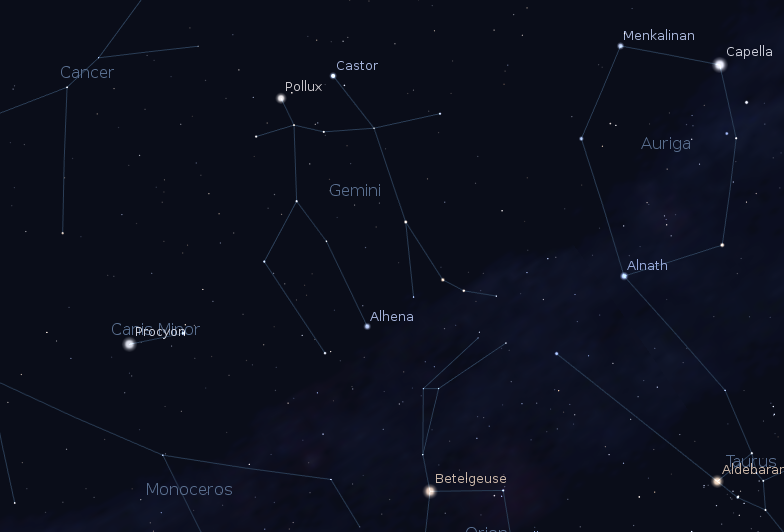
Gemini with the stars Castor and Pollux. Created using Stellarium.
02/12/2015 – Ephemeris – The brilliant blue star in Orion: Rigel
Ephemeris for Thursday, February 12th. The sun will rise at 7:47. It’ll be up for 10 hours and 18 minutes, setting at 6:06. The moon, 1 day past last quarter, will rise at 2:52 tomorrow morning.
Two days ago I talked about the star Betelgeuse the bright red star in the top left of Orion’s upright rectangle. Orion is seen in the south at 9 in the evening. The blue-white star in Orion’s opposite corner is usually brighter. It is Rigel whose longer Arabic name of which Rigel is the first part means Left Leg of the Giant. Rigel is a giant itself, actually a super giant star, which is more a measure of its mass than its size, that of 21 solar masses. Its surface temperature is more than twice as hot as the sun. It is 120 thousand times as bright as the sun and 78 times its diameter. Its distance is around 860 light years. Those with telescopes might be able to spot a close companion star to Rigel, just at the edge of the bright arc light image of Rigel itself.
Times are for the Traverse City/Interlochen area of Michigan. They may be different for your location.
Addendum
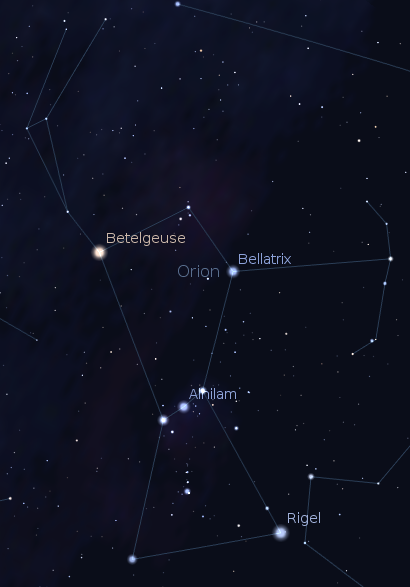
Orion upright and due south. Created using Stellarium.
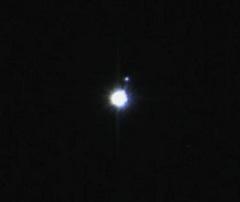
Rigel with its companion star as photographed through a telescope. No attribution. Source: http://washedoutastronomy.com/content/urban-orion?page=1
02/10/2015 – Ephemeris – Orion’s bright red star, Betelgeuse
Ephemeris for Tuesday, February 10th. The sun will rise at 7:50. It’ll be up for 10 hours and 13 minutes, setting at 6:03. The moon, 1 day before last quarter, will rise at 12:51 tomorrow morning.
The bright red star in constellation Orion’s shoulder is Betelgeuse, and its now thought to be about 640 light years away give or take a couple of hundred light years*. The name Betelgeuse means “Armpit of the central one” in Arabic. Orion is seen in the south at 9 in the evening. Even at Betelgeuse’ great distance it’s the star whose surface is easiest seen, after the sun of course. That’s because it’s so big. As large around as the size of the orbit of Jupiter. Betelgeuse is losing mass in a huge cloud around it. It is a massive star in the late stages of its life even though it’s only 7 million years old. Some astronomers speculate that it will explode in a massive supernova within the next million years.
Times are for the Traverse City/Interlochen area of Michigan. They may be different for your location.
Update
* I’m being a bit facetious here. See the addendum, and also by coincidence a post from EarthSky today How far is Betelgeuse?
Addendum
Orion upright and due south. Created using Stellarium.
Our estimates of the size, mass and luminosity of Betelgeuse depend on knowing its distance. The distance is not well-known because Betelgeuse is a single star, it is not a binary for which can be applied Newton’s laws to calculate these values. Therefore these values in the broadcast program, where I have 59 seconds total, appear more certain than they really are. Wait for Thursday’s program when I cover Rigel and see how close the values are between the two. But Rigel appears to be a different star altogether. Somebody’s wrong.
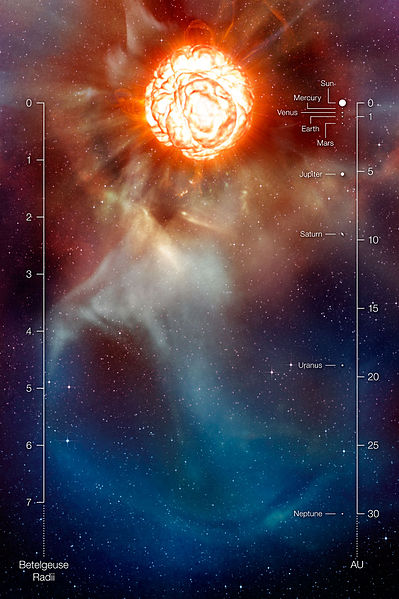
“This artist’s impression shows the supergiant star Betelgeuse as it was revealed thanks to different state-of-the-art techniques on ESO’s Very Large Telescope, which allowed two independent teams of astronomers to obtain the sharpest ever views of the supergiant star Betelgeuse. They show that the star has a vast plume of gas almost as large as our Solar System and a gigantic bubble boiling on its surface. These discoveries provide important clues to help explain how these mammoths shed material at such a tremendous rate. The scale in units of the radius of Betelgeuse as well as a comparison with the Solar System is also provided.” Credit: ESO/L. Calçada (ESO is the European Southern Observatory)
01/19/2015 – Ephemeris – Sirius, the brightest star in the night
Ephemeris for Martin Luther King Day, Monday, January 19th. The sun will rise at 8:14. It’ll be up for 9 hours and 19 minutes, setting at 5:33. The moon, 1 day before new, will rise at 7:53 tomorrow morning. | The star Sirius is the brightest night-time star in the heavens. It’s up on frosty winter evenings, and currently low in the southeastern sky in the early evening. It can be found in line and left of the three stars of Orion’s belt. It’s known as the Dog Star because it’s in the heart of the constellation Canis Major the greater dog. Sirius, however means dazzling one or sparkling one due to its brightness and the long time it spends low to the horizon where our turbulent atmosphere breaks up its light as a sparkler of color in telescopes and binoculars. Sirius owes its brightness mostly to its close proximity of 8.6 light years. It is 25 times brighter than the sun. It also has a white dwarf companion star nicknamed the Pup.
Times are for the Traverse City/Interlochen area of Michigan. They may be different for your location.
Addendum
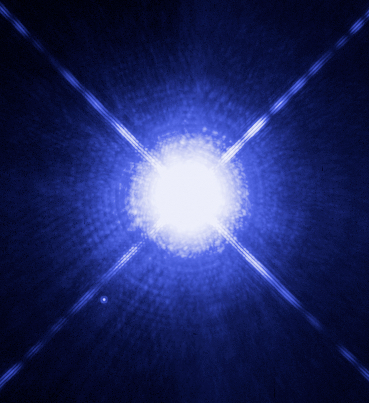
Sirius A and B (near the diffraction spike to the lower left), A Hubble Space Telescope photograph. Credit NASA, ESA.
01/06/2015 – Ephemeris – Star to stir up solar system’s comets, but you’re gotta wait a bit.
Ephemeris for Tuesday, January 6th. The sun will rise at 8:19. It’ll be up for 8 hours and 57 minutes, setting at 5:17. The moon, 2 days past full, will rise at 7:12 this evening.
In about a quarter to half a million years from now a star with the name HIP 85605 will pass through the Oort cloud of comets that is the extreme outer part of the solar system. The star’s name comes from the Hipparcos catalog created from data from the European satellite which created improved distances of nearby stars. HIP 85605 star is nearby and very faint. The star should pass through the Oort cloud twice, coming and going. What happens is the star will tend to scatter small bodies in its wake, throwing some comets in toward the sun and others it will eject from the solar system. There were all kinds of scare headlines out of this. Something like this “Will a comet shower end life on the Earth?” No it won’t. This kind of thing happens every few million years.
Times are for the Traverse City/Interlochen area of Michigan. They may be different for your location.
Addendum
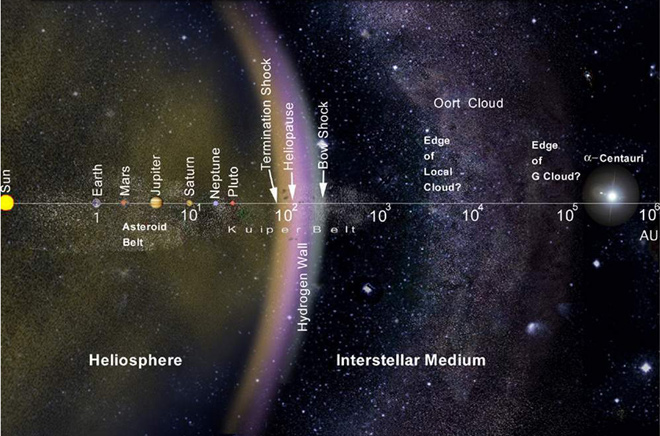
NASA diagram of the solar system on a logarithmic scale. Each interval is ten times longer than the one on the left. On this scale the star HIP 85605 will penetrate to the inner part of the Oort cloud. Click to enlarge.
Tip o’the old astronomer’s cap to Universe Today where I found this story.
12/18/2014 – Ephemeris – Capella’s kids
Ephemeris for Thursday, December 18th. The sun will rise at 8:14. It’ll be up for 8 hours and 49 minutes, setting at 5:03. The moon, 3 days before new, will rise at 5:23 tomorrow morning.
Tuesday I talked about the bright star Capella in the constellation Auriga the charioteer, the brightest star in the eastern sky until Jupiter rises around 9:30. I mentioned a slim triangle of stars called the Kids, offspring of the mama goat Capella. The star at the tip of that slim triangle is designated by the Greek letter epsilon and so in known as Epsilon Aurigae. It was discovered to be variable in brightness in 1821. It turns out to be an eclipsing binary, where stars eclipse each other. Only the period between eclipses is 27 years, and the eclipses last about 2 years. Typical eclipsing binary stars have periods of days and the eclipses last hours. The eclipsing star has a large debris ring around it that’s also eclipsing the other star.
Times are for the Traverse City/Interlochen area of Michigan. They may be different for your location.
Addendum
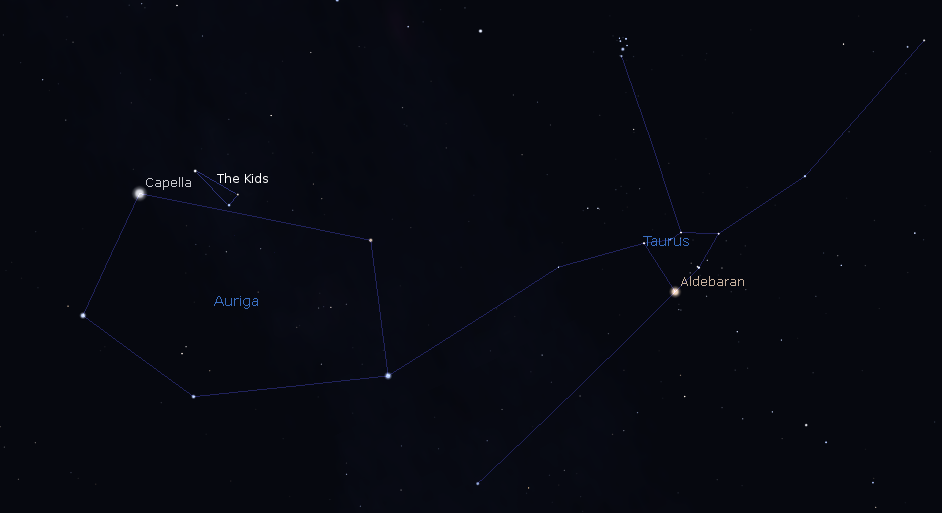
Capella and her kids. at 9 p.m. December 18, 2014. Created using Stellarium.
11/24/2014 – Ephemeris – The Summer Triangle is still with us
Ephemeris for Monday, November 24th. The sun will rise at 7:50. It’ll be up for 9 hours and 16 minutes, setting at 5:07. The moon, 2 days past new, will set at 7:29 this evening.
Well it’s almost Thanksgiving and about time that the Summer Triangle of bright summer stars finally set. Except it won’t go just yet. The stars Vega, Altair and Deneb are still hanging around in the west. The bright summer part of the Milky Way is gone. The constellations the three stars are in are Altair in Aquila the Eagle, now flying vertically up, Deneb in Cygnus the swan flying vertically down, and Vega in Lyre the harp, lying on its side. Altair the southernmost of these three will set first, later Vega will also set. What happens to Deneb depends on your location in the Interlochen Public Radio area. It you are north of Traverse City, Deneb will not actually set over Lake Michigan’s northern horizon.
Times are for the Traverse City/Interlochen area of Michigan. They may be different for your location.
Addendum
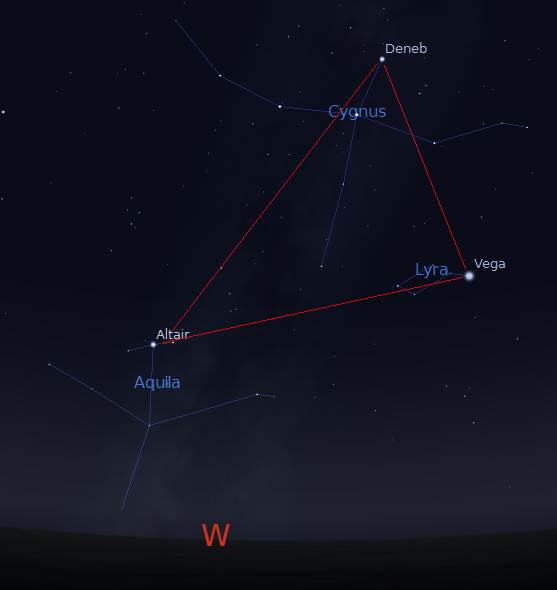
The Summer Triangle at 9 p.m. on November 24, 2014. Created using Stellarium.
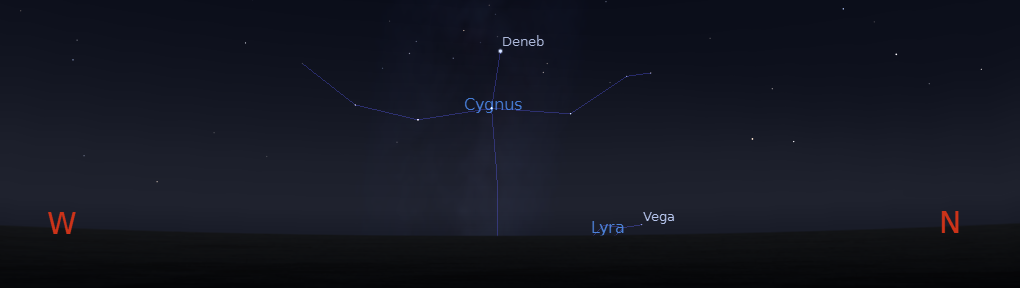
Vega near its setting point at 11:07 p.m. p.m. on November 24, 2014. Created using Stellarium.
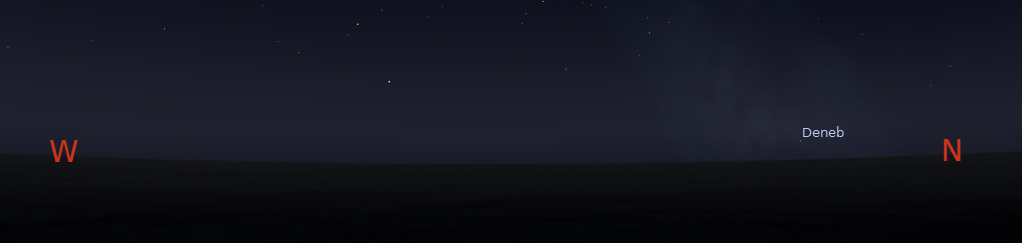
Deneb near its setting point at 5:05 a.m. p.m. on November 25, 2014. Created using Stellarium.
But will Deneb really set for Traverse City. Geometrically it will. However with a flat northern horizon looking northward over the bays to a clean Lake Michigan horizon, atmospheric refraction will bend the light from Deneb making it appear higher in the sky than it really is, so it won’t actually set. On the other side atmospheric extinction, the dimming of stars close to the horizon due to the filtering effect of looking through so much atmosphere would make Deneb impossible to see without a telescope. It might be an interesting challenge to spot.
10/31/2014 – Ephemeris – The spookiest star
Ephemeris for Halloween, Friday, October 31st. The sun will rise at 8:18. It’ll be up for 10 hours and 13 minutes, setting at 6:32. The moon, 1 day past first quarter, will set at 1:59 tomorrow morning.
Not all the ghosts and goblins out Sunday will be children. One will be out every night, because it’s a star. Its name is Algol, from the Arabic for Ghoul Star or Demon Star. The Chinese had a name for it that meant “piled up corpses”. It’s the second brightest star in the constellation Perseus the hero, rising in the northeast this evening. The star is located where artists have drawn the severed head of Medusa, whom he had slain. Medusa was so ugly that she turned all who gazed upon her to stone. Algol is her still glittering eye. Astronomers finally found out what was wrong with Algol. It does a slow 6 hour wink every two days 21 hours, because it is two stars that eclipse each other. Her next wink will be 10 p.m. Sunday night.
Times are for the Traverse City/Interlochen area of Michigan. They may be different for your location.
Addendum
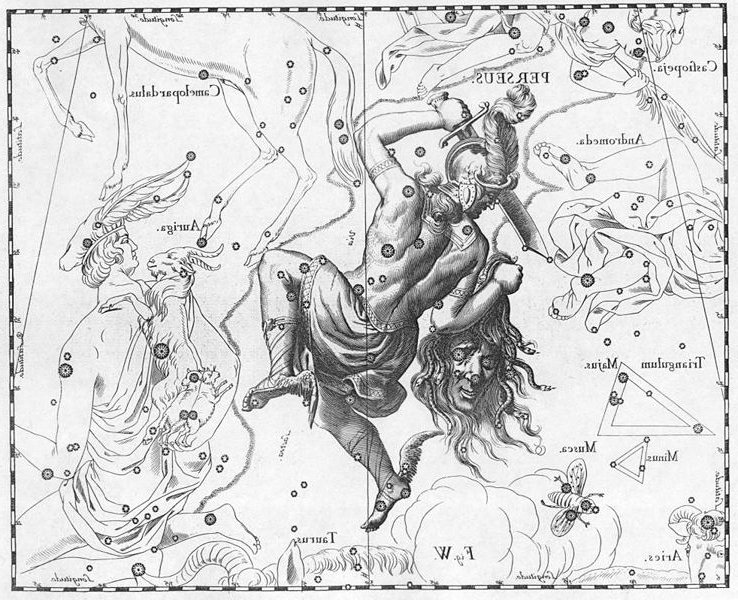
Perseus and the head of Medusa from the 1690 Uranographia by Johannes Hevelius. Image found with the article on Algol in Wikipedia.
Celestial globes of the day showed the celestial sphere from the outside, so the constellations appeared reversed. The star atlases of the day kept the trend. I reversed the image to correspond with the actual sky.
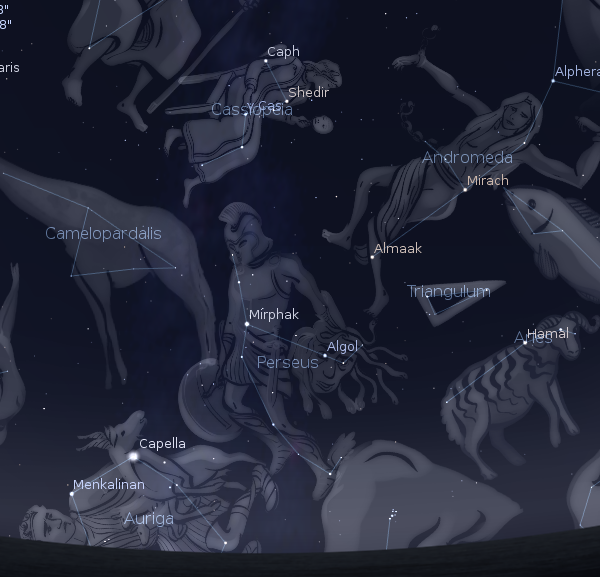
Algol at 7:30 p.m. on Halloween, in a modern portrayal. Created using Stellarium.
Update
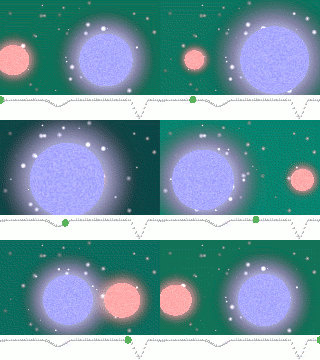
Animation of an eclipsing binary star like Algol. Credit: Wikimedia Commons. H/T EarthSky
Here’s a link to EarthSky’s post on Algol.
10/14/2014 – Ephemeris – The loneliest star
Ephemeris for Tuesday, October 14th. The sun will rise at 7:56. It’ll be up for 11 hours and 3 minutes, setting at 6:59. The moon, 1 day before last quarter, will rise at 11:57 this evening.
There’s a bright star that appears for only seven and a half hours a night on autumn evenings. It’s appearance, low in the south, is a clear indication of the autumn season. At 9 p.m. tonight it’s low in the southeast. The star’s name is Fomalhaut, which means fish’s mouth. That fits because it’s in the constellation of Piscis Austrinus, the southern fish. At our latitude it’s the fish that got away, because Fomalhaut appears to be the loneliest star in the sky. The dimness of the constellation’s other stars and location close to the horizon make the fainter stars hard to spot. They would be overhead in Australia. The earth’s thick atmosphere near the horizon reduces the stars brightness by a factor of two or more.
Times are for the Traverse City/Interlochen area of Michigan. They may be different for your location.
Addendum
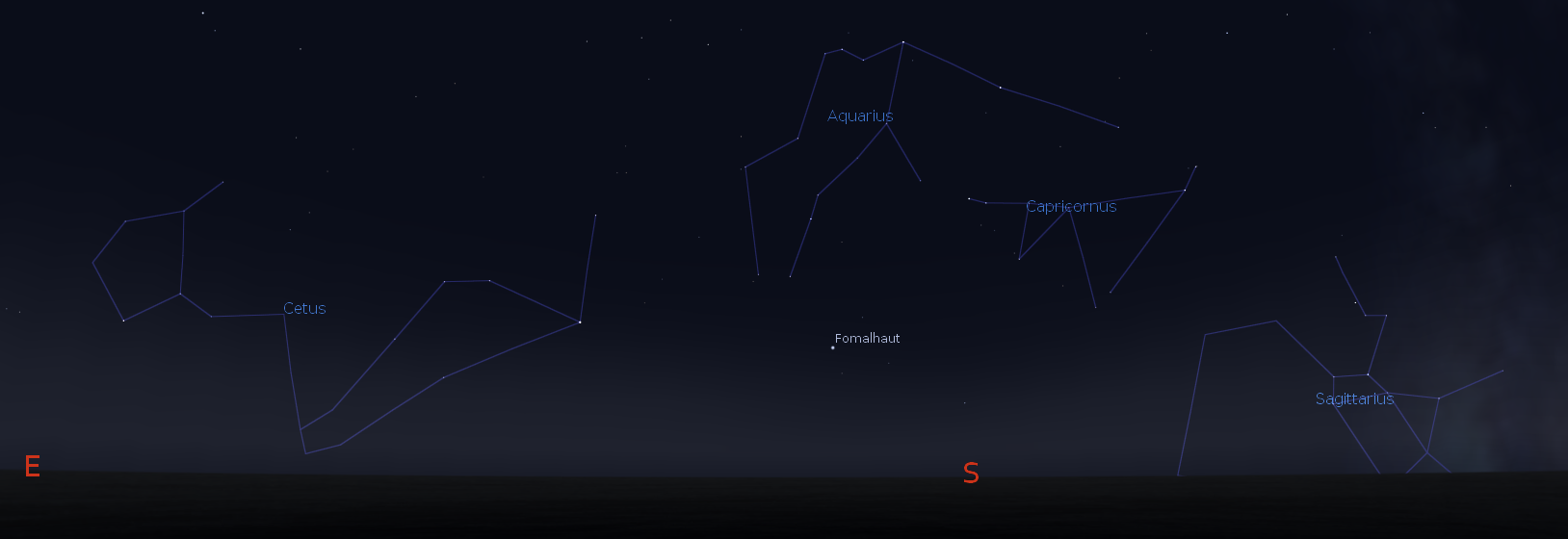
Fomalhaut appears quite alone in the south-southeast at 10 p.m. October 14, 2014. Created using Stellarium. Click on the image to enlarge.
09/29/2014 – Ephemeris – The Moon, Mars and Antares will line up tonight
Ephemeris for Monday, September 29th. The sun will rise at 7:37. It’ll be up for 11 hours and 48 minutes, setting at 7:26. The moon, 2 days before first quarter, will set at 10:49 this evening.
Tonight we’ll still have Mars hanging around the star Antares. However we’ll have the Moon joining the party. The three will nearly be in line at 9 p.m. with the fat crescent Moon on top, Mars below it and Antares below Mars. They will be in a straighter line but the Sun out makes them impossible to see. With binoculars or a small telescope the lunar seas visible, kind of in order from the Moon’s sunlit edge are Crises, Fertility, Nectar, Tranquility and half of Serenity. If you’re looking for the Man in the Moon, you’ll have to wait until the Moon is nearly full to completely discern his face. However most of the upside down rabbit is visible. The seas of Fertility and Nectar make up his ears, Tranquility, his head, and Serenity his body.
Times are for the Traverse City/Interlochen area of Michigan. They may be different for your location.
Addendum
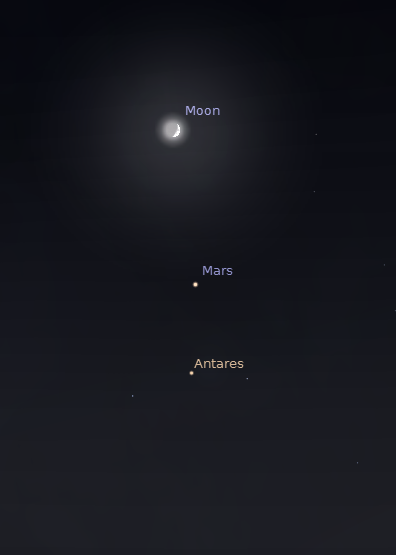
The Moon, Mars and the bright red star Antares line up on the evening of September 29, 2014. Created using Stellarium.
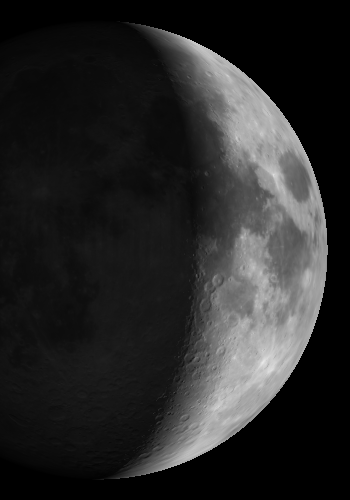
The moon tonight September 29, 2014. Created using Virtual Moon Atlas.
 Bob Moler's Ephemeris Blog