Archive
Ephemeris: 11/13/2023 – Betelgeuse is acting weird again
This is Ephemeris for Monday, November 13th. Today the Sun will be up for 9 hours and 40 minutes, setting at 5:16, and it will rise tomorrow at 7:38. The Moon is new today, and won’t be visible.
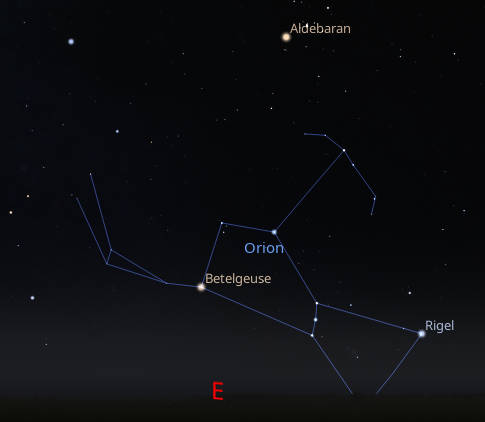
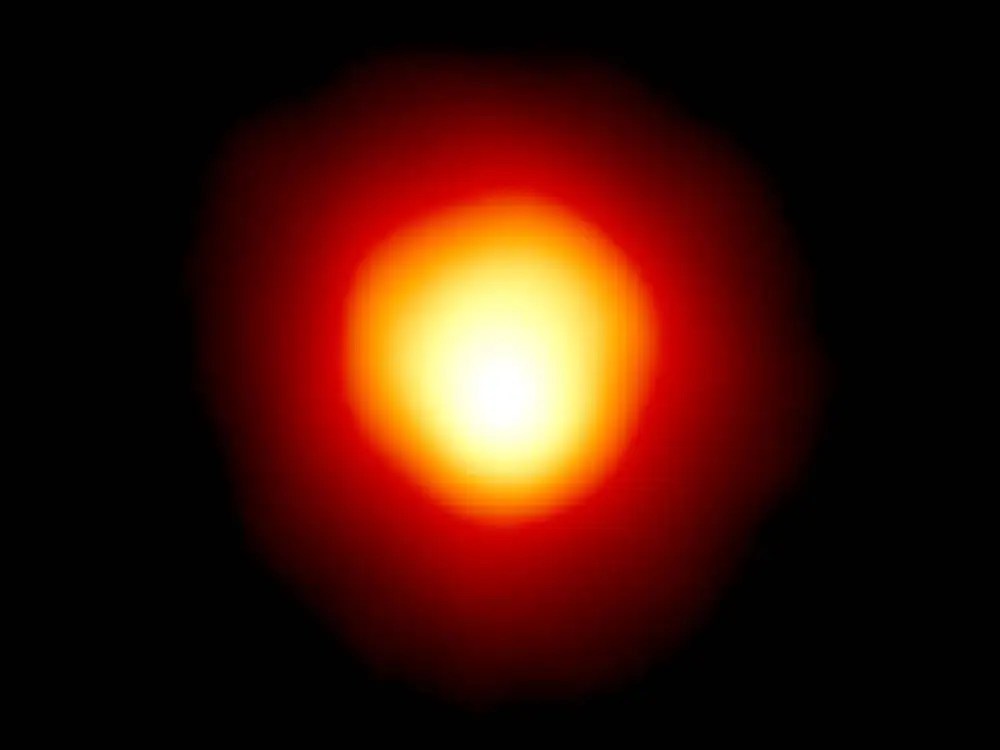
The constellation Orion is rising early in the evening now so what’s up with Betelgeuse. Betelgeuse is the bright reddish upper leftmost star of the torso of Orion the hunter, it’s in his shoulder. Betelgeuse has been acting up lately. In 2019 and 2020 Betelgeuse had dimmed significantly. Astronomers didn’t know why at the time, but found out later that it ejected a large cloud of gas and dust which blocked the light from the star. Now in the last year Betelgeuse has increased its brightness significantly, so it’s much brighter than normal. Again, we don’t exactly know why. Some have speculated that Betelgeuse is about ready to go supernova. We’ve known that for a while, but soon is measured within hundreds of thousands of years. So astronomers are keeping an eye on Betelgeuse to see what happens next.
The astronomical event times given are for the Traverse City/Interlochen area of Michigan (EST, UT –5 hours). They may be different for your location.
Addendum

Ephemeris: 10/19/2023 – The southern star of autumn – Fomalhaut
This is Bob Moler with Ephemeris for Thursday, October 19th. Today the Sun will be up for 10 hours and 48 minutes, setting at 6:51, and it will rise tomorrow at 8:04. The Moon, 2 days before first quarter, will set at 9:39 this evening.
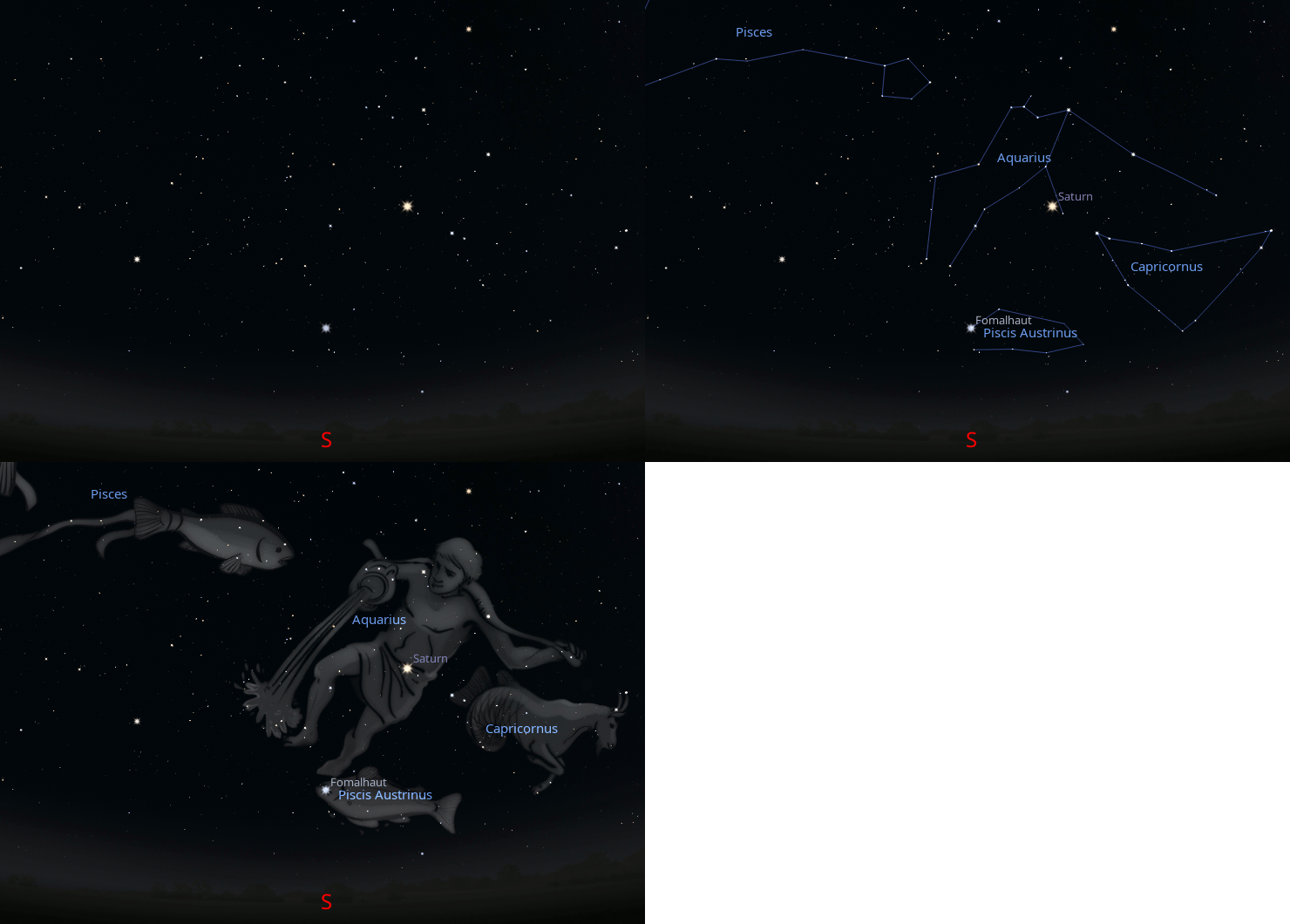
There’s a bright star that appears for only seven and a half hours on autumn evenings. Its appearance, low in the south-southeast at 9 p.m., is a clear indication of the autumn season. It is currently below the much brighter Saturn. The star’s name is Fomalhaut, which means fish’s mouth. That’s fitting because it’s in the constellation of Piscis Austrinus, the southern fish. At our latitude it’s kind of the fish that got away, because usually Fomalhaut appears to be quite alone low in the sky. For the last few years Jupiter and then Saturn have kept it company. In a couple of years Saturn will have moved on leaving Fomalhaut to its lonely vigil in the south.
The astronomical event times given are for the Traverse City/Interlochen area of Michigan (EDT, UT –4 hours). They may be different for your location.
Addendum
Ephemeris: 07/18/2023 – Vega, the brightest star of the Summer Triangle
This is Ephemeris for Tuesday, July 18th. Today the Sun will be up for 15 hours and 9 minutes, setting at 9:23, and it will rise tomorrow at 6:15. The Moon, 1 day past new, will set at 10:30 this evening.
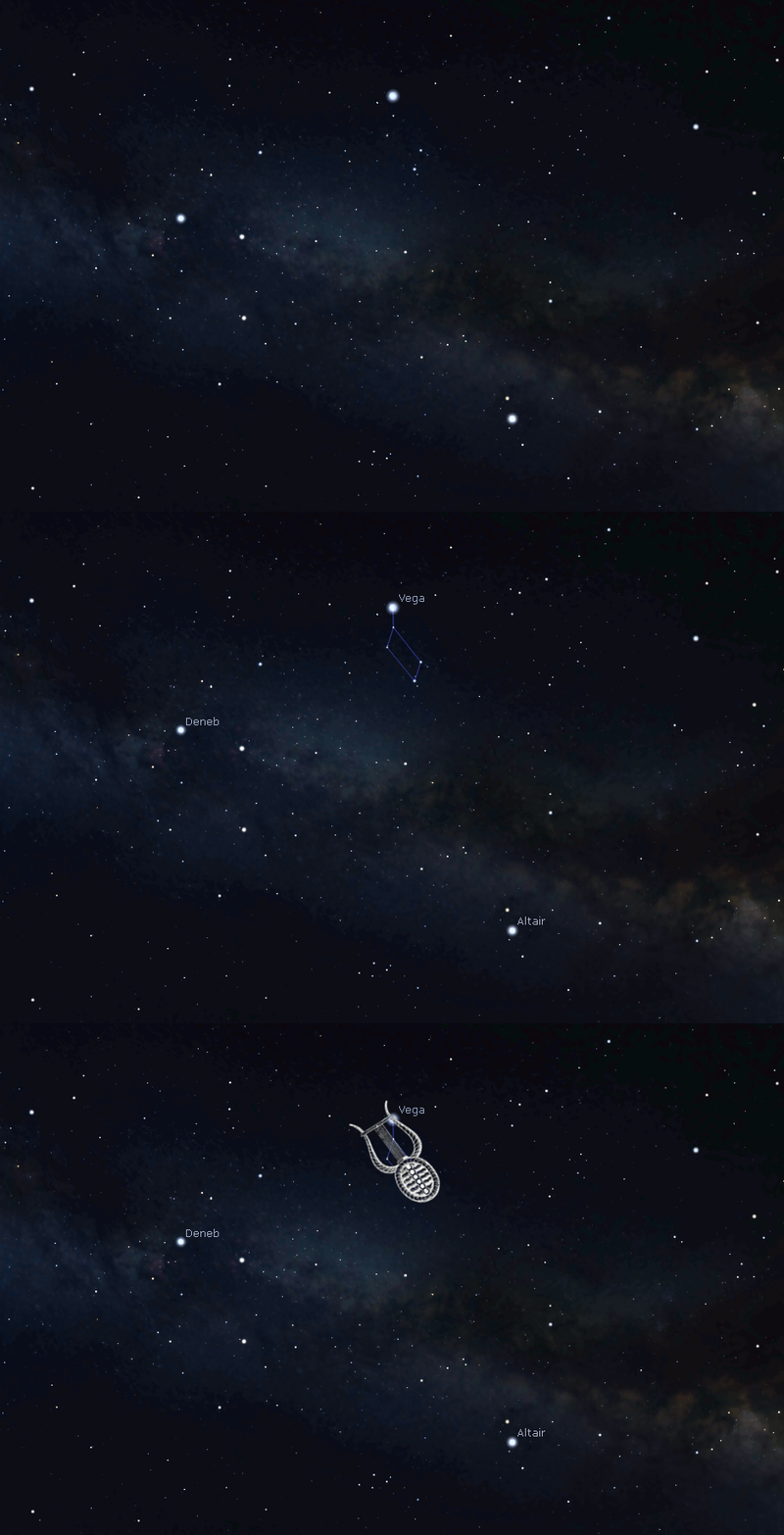
Vega, in the constellation Lyra the harp, is the highest bright star In the east and brightest star of the Summer Triangle also rising in that direction. It is an important and much studied star, first as a standard for brightness for the magnitude scale at almost exactly zero. In 1983 the Infrared Astronomy Satellite, IRAS, discovered an excess of infrared radiation coming from the star. It seems now that there are two orbiting rings around the star, an inner warm ring and an outer cold ring. This is somewhat like the two disks of material the Sun has: The asteroid belt between Mars and Jupiter and the Kuiper belt, beyond Neptune. No planets have yet been discovered around Vega, but I wouldn’t bet against it.
The astronomical event times given are for the Traverse City/Interlochen area of Michigan (EDT, UT –4 hours). They may be different for your location.
Addendum

07/17/2023 – Ephemeris – Arcturus, a look at the Sun’s future
This is Ephemeris for Monday, July 17th. Today the Sun will be up for 15 hours and 11 minutes, setting at 9:24, and it will rise tomorrow at 6:14. The Moon is new today, and won’t be visible.
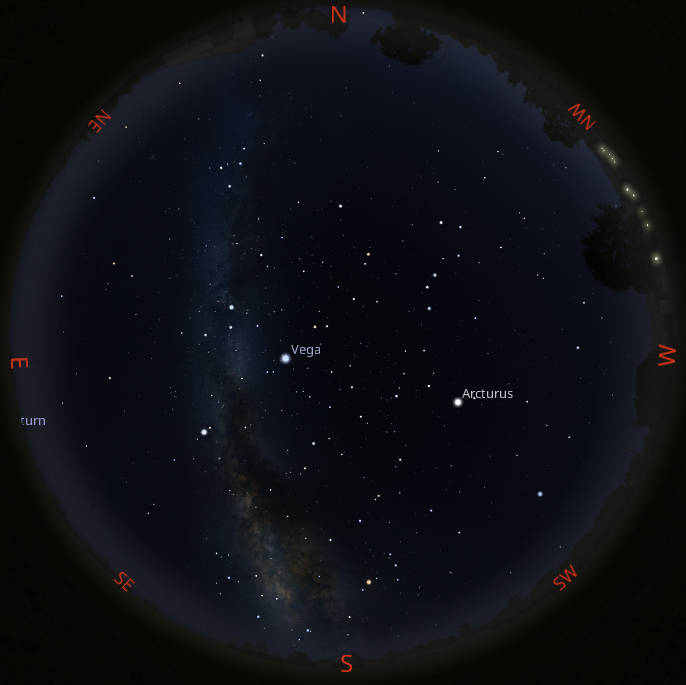
Arcturus, a red giant star, is about two thirds the way up the sky in the southwest at 10:30 or 11 p.m. It’s one of the earliest stars to appear in twilight, being nearly tied in brightness with Vega, a white star about as high in the east. A pointer to Arcturus is the handle of the Big Dipper, following the arc of the handle to Arcturus. Though only 37 light years away, it’s not from around here. It’s passing through the galactic disk from north to south. Arcturus is about 7 billion years old, and is about 8% more massive than our Sun. It appears to be starting its red giant phase, after running out of hydrogen to fuse into helium in its core, and is beginning to fuse the helium. It’s 25 times the size of the Sun and 170 times brighter, and a preview of our Sun when it gets that old.
The astronomical event times given are for the Traverse City/Interlochen area of Michigan (EDT, UT –4 hours). They may be different for your location.
Addendum
07/03/2023 – Ephemeris – The Sun is more massive than most stars
This is Bob Moler with Ephemeris for Monday, July 3rd. Today the Sun will be up for 15 hours and 29 minutes, setting at 9:31, and it will rise tomorrow at 6:02. The Moon, at full today, will rise at 10:28 this evening.
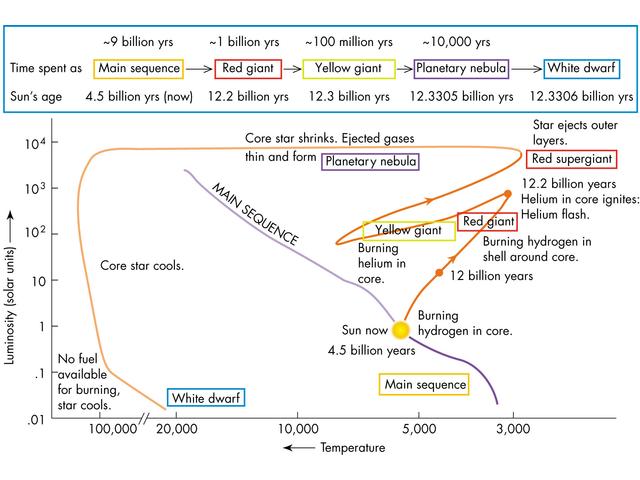
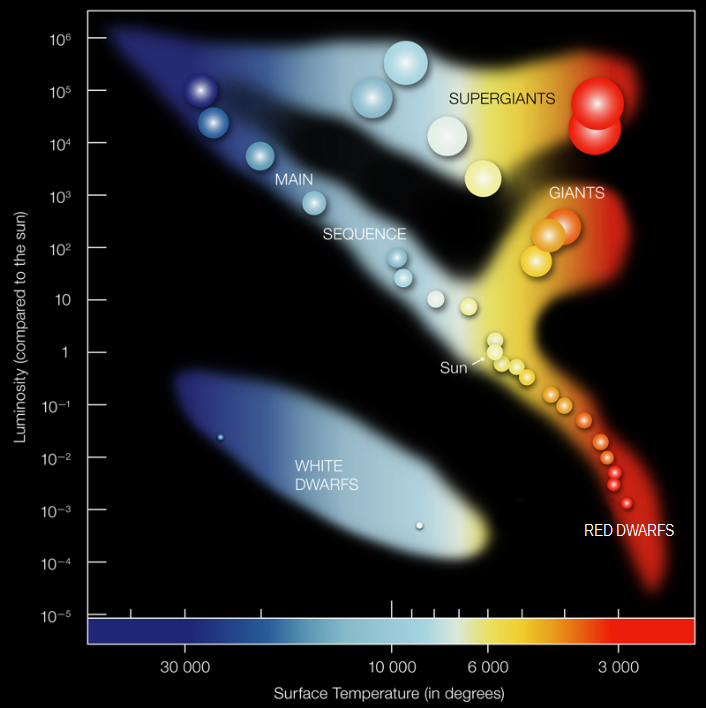
The Sun appears to be a singular object in the sky. There is none other. But is that true? No, it’s not. The Sun is a star, middle-aged for a star of its mass. The Sun is bigger than most stars, because most stars are runty red dwarf stars. In fact the closest star to our Sun is a red dwarf, called Proxima Centauri, the third, outlying star in the triple star system whose brightest star is called Rigil Kentaurus, though better known by its 1603 Bayer catalog designation, Alpha Centauri. Proxima is a challenge to spot even with binoculars. It turns out that stars visible to the naked eye are all brighter than the Sun. As far as the range of stellar masses go, the Sun is pretty much in the middle. Rigil Kentaurus itself is 8 percent more massive than the Sun and 50 percent brighter. Both Rigil Kentaurus and Proxima are too far south to see from Michigan.
The astronomical event times given are for the Traverse City/Interlochen area of Michigan (EDT, UT –4 hours). They may be different for your location.
Addendum
06/08/2023 – Ephemeris – The first stars that appear tonight

Subscribe to continue reading
Subscribe to get access to the rest of this post and other subscriber-only content.
05/18/2023 – Ephemeris – Spica, the bluest first magnitude star
This is Bob Moler with Ephemeris for Thursday, May 18th. Today the Sun will be up for 14 hours and 55 minutes, setting at 9:07, and it will rise tomorrow at 6:10. The Moon, 1 day before new, will rise at 5:56 tomorrow morning.
In the south at 11 p.m. is the bright star Spica, which can be found from all the way back overhead to the Big Dipper. Follow the arc of the handle of the Big Dipper to the bright star Arcturus high in the southeast. Then straighten the curve of the arc to a straight spike which points to Spica, the brightest star in Virgo the virgin. Arcturus is much brighter than Spica and has an orange tint to Spica’s bluish hue. In fact, Spica is the bluest of the 21 first magnitude stars. That means that it has a really hot surface temperature. Actually, Spica is really two blue stars orbiting each other in 4 days. Spica is 250 light years away. It also was an important star to the ancient Greeks. One temple was built, and aligned to its setting point.
The astronomical event times given are for the Traverse City/Interlochen area of Michigan (EDT, UT –4 hours). They may be different for your location.
Addendum
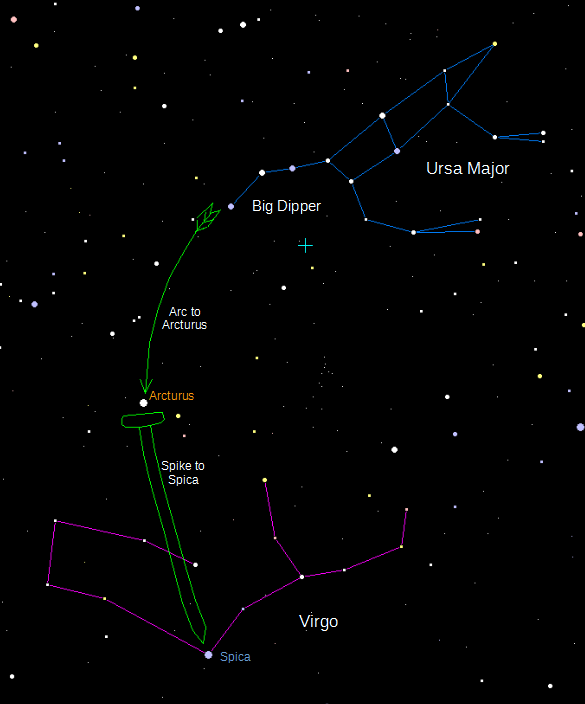
Finding Virgo from the Big Dipper at 10:30 pm, May 18th. There are no planetary interlopers this year. The small + sign marks the zenith, and the image faces south. Created using my LookingUp app, with captions added using LibreOffice Draw.
05/16/2023 – Ephemeris – Regulus, the Little King Star
This is Ephemeris for Tuesday, May 16th. Today the Sun will be up for 14 hours and 51 minutes, setting at 9:05, and it will rise tomorrow at 6:12. The Moon, 3 days before new, will rise at 5:08 tomorrow morning.
Regulus is the brightest star in the constellation of Leo, the lion at the bottom of the backward question mark that is the head and mane of Leo. It’s in the southwest at 10 pm. Alluding to the lion’s status in the animal kingdom, Regulus is the little king star. It is dead last in order of brightness of the 21 brightest first magnitude stars, 1/13th the brightness of Sirius the brightest nighttime star, now lost in the evening twilight glow. To the Babylonians it was the king, the 15th of their constellations, that marked the passage of the Sun. Regulus is about 79 light years away, and 288 times the brightness of the sun. It is a rapidly spinning ellipsoid 3 times the sun’s diameter, rotating in just under 16 hours.
The astronomical event times given are for the Traverse City/Interlochen area of Michigan (EDT, UT –4 hours). They may be different for your location.
Addendum
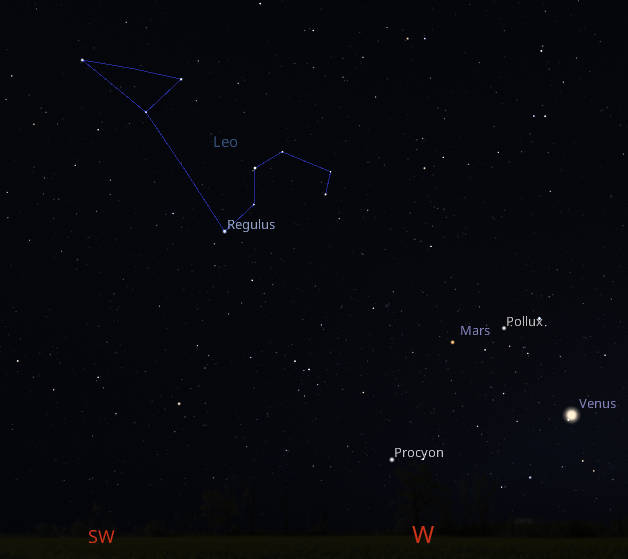
Regulus and Leo and the other stars and planets in the western sky at 11 pm, May 16, 2023. Created using Stellarium.
01/20/2023 – Ephemeris – Gemini’s Castor is six stars orbiting each other
This is Ephemeris for Friday, January 20th. Today the Sun will be up for 9 hours and 21 minutes, setting at 5:34, and it will rise tomorrow at 8:12. The Moon, 1 day before new, will rise at 8:34 tomorrow morning.
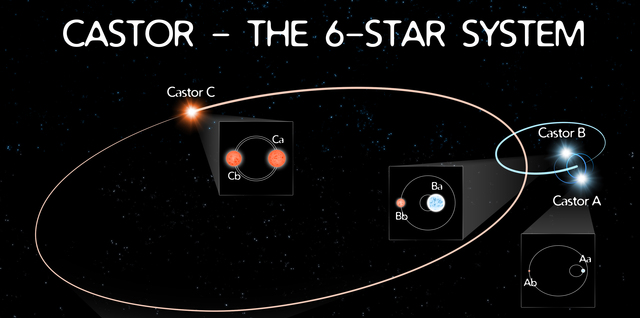
At 9 p.m. the constellation of Gemini the twins will be seen high in the east-southeast. The namesake stars of the two lads are the two bright stars at the left of the constellation. Pollux the pugilist, or boxer, is the lower and slightly brighter of the two, while Castor, the horseman, is the other star, or rather a six-star system. In telescopes two close stars may be seen, each is a spectroscopic binary, meaning the lines of two stars can be seen in the spectrum, shifting as they orbit each other. Another faint spectroscopic binary also belongs. Pollux, though a single star, does have at least one planet with over twice the mass of Jupiter orbiting the star. Pollux and Castor are respectively 34 and 50 light years away. Not too far away as stars go.
The astronomical event times given are for the Traverse City/Interlochen area of Michigan (EST, UT –5 hours). They may be different for your location.
Addendum
01/09/2023 – Ephemeris – The Summer Triangle is still with us in the early evening
This is Ephemeris for Monday, January 9th. Today the Sun will be up for 9 hours and 1 minute, setting at 5:21, and it will rise tomorrow at 8:18. The Moon, 3 days past full, will rise at 7:56 this evening.
The bright Moon is now slowly leaving the evening sky tonight, giving us nearly an hour of dark skies after 7 pm. At 7pm, Orion is holding forth in the east-southeast. At that time, also, the Summer Triangle is still in the sky, west and northwest. The Northern Cross, which is also the constellation of Cygnus the swan, is standing upright in the west northwestern sky. Its top star Deneb, dimmest of the three Summer Triangle stars, will not set for observers north of Traverse City, though it will take a flat northern horizon and exceptionally clear skies to spot it at its lowest in the north. Altair, the southernmost of the triangle stars will set first in the west at 7:57 pm, Vega, the brightest will set in the northwest at 9:41 pm.
The astronomical event times given are for the Traverse City/Interlochen area of Michigan (EST, UT –5 hours). They may be different for your location.
Addendum
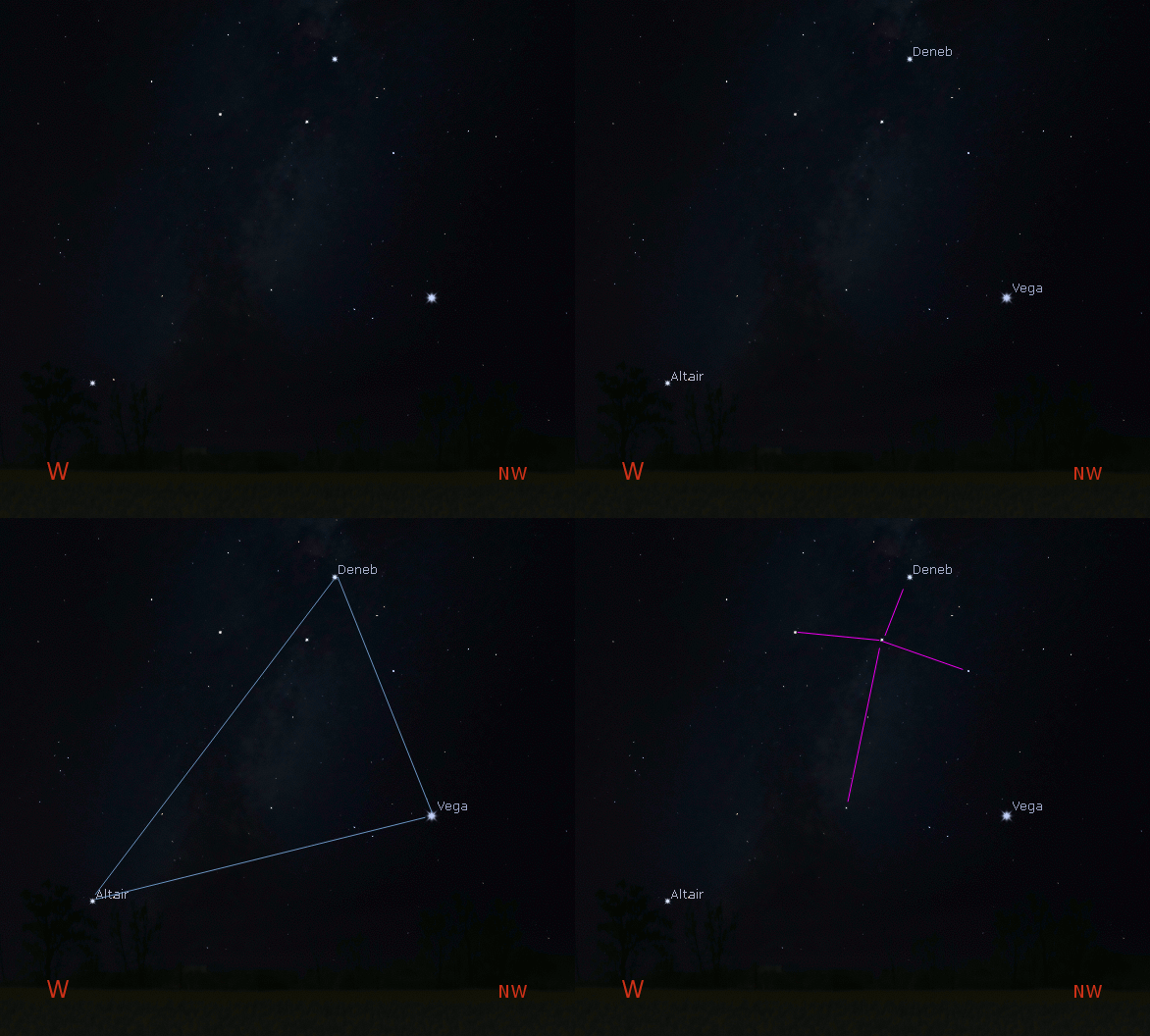
The setting Summer Triangle and Northern Cross in the west and northwestern sky at 7 pm tonight, January 9th.
 Bob Moler's Ephemeris Blog