Archive
04/07/2022 – Ephemeris – The Sun is getting active again
This is Ephemeris for Thursday, April 7th. Today the Sun will be up for 13 hours and 5 minutes, setting at 8:17, and it will rise tomorrow at 7:10. The Moon, 2 days before first quarter, will set at 3:11 tomorrow morning.
For the last year and a half, the Sun has entered a new sunspot cycle, solar cycle 25. It had been predicted to be a rather mild cycle with an average peak in sunspot numbers of around 120 in 2025, three years from now. Last Sunday’s daily sunspot number was 118. Sunspot numbers are not just the numbers of individual sunspots on the Sun. Groups of spots count for 10 before the individual spots are counted. These counts are averaged, from many observatories, over a month to chart the progress of the approximately 11 year sunspot cycle. The more sunspots, the more solar flares. The more flares, the more CMEs or coronal mass ejections. If CMEs are aimed toward the Earth, we get northern lights, and headaches for satellite operators and electric power companies.
The astronomical event times given are for the Traverse City/Interlochen area of Michigan (EDT, UT – 4 hours). They may be different for your location.
Addendum
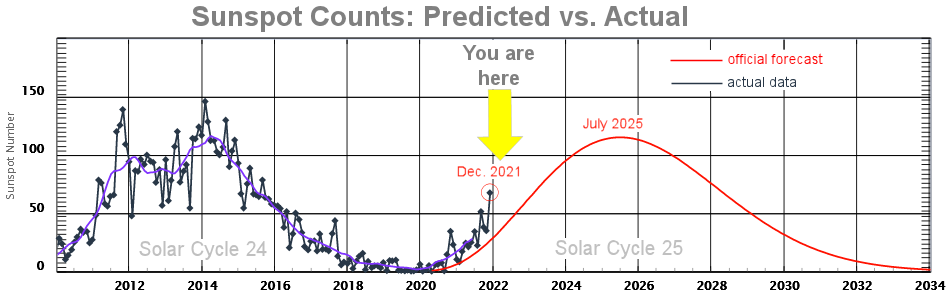
Current and last solar cycle sunspot plot. The current trend in sunspots is increasing much faster than what was predicted. Click on the image to enlarge it. Credit NOAA.
Go to spaceweather.com to keep up with what’s happening between the Sun and the Earth.
05/21/2021 – Ephemeris – For everything there is a season… even eclipses
This is Ephemeris for Friday, May 21st. Today the Sun will be up for 15 hours and 3 minutes, setting at 9:11, and it will rise tomorrow at 6:07. The Moon, 2 days past first quarter, will set at 4:14 tomorrow morning.
There are seasons for everything: baseball season, football season, spring, summer, what have you. There are also eclipse seasons. The Moon’s orbit is tilted by about 5 degrees to the ecliptic, the path of the Sun in the sky. The points where they cross are called nodes, 180 degrees apart. When the Sun is near one of those nodes we are in an eclipse season, where a solar eclipse can occur at new moon, and a lunar eclipse can occur at full moon. We are guaranteed one of each per eclipse season, and on rare occasions a third eclipse. Of course one has to be at the right place to see an eclipse. This eclipse season we will be at a marginal place to see both eclipses. Both are at sunrise, so we’ll see just a part of each of them.
The astronomical event times given are for the Traverse City/Interlochen area of Michigan. They may be different for your location.
Addendum
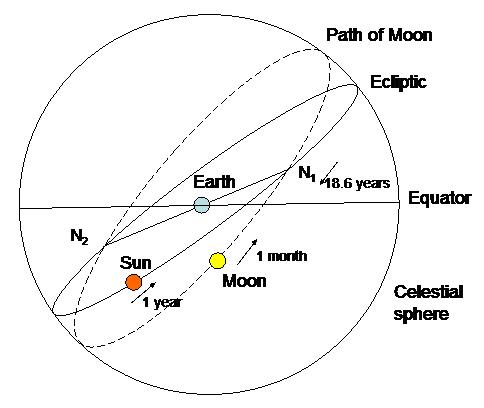
For a more extensive treatment of this subject check out: https://earthsky.org/astronomy-essentials/definition-what-is-an-eclipse-season
09/28/2020 – Ephemeris – A new sunspot cycle has started
This is Bob Moler with Ephemeris for Monday, September 28th. Today the Sun will be up for 11 hours and 50 minutes, setting at 7:27, and it will rise tomorrow at 7:38. The Moon, 3 days before full, will set at 5:06 tomorrow morning.
Word has come down from NOAA, the National Oceanic and Atmospheric Administration that the new solar or sunspot cycle has definitely started as of last December. The length of a sunspot cycle is about 11 years and may vary in length from one cycle to the next. The peak in sunspot numbers isn’t expected until 2025. The intensity of the cycle, that is numbers of sunspots around peak are expected to be about the same as the last cycle, about 150 observed daily. Each cycle is different and not really wholly predictable. Fewer spots means fewer solar flares and coronal mass ejections and less worry for satellite owners and power companies, and fewer displays of the northern lights for us.*
The event times given are for the Traverse City/Interlochen area of Michigan. They may be different for your location.
Addendum
* I didn’t have time to add that we will have more cosmic rays penetrate the heliosphere, the magnetic bubble that protects us from damaging particles produced by high energy events in the universe. We’re at a solar minimum now, so cosmic ray flux is high. With a weak sunspot or solar activity cycle cosmic ray flux will not dip too much.
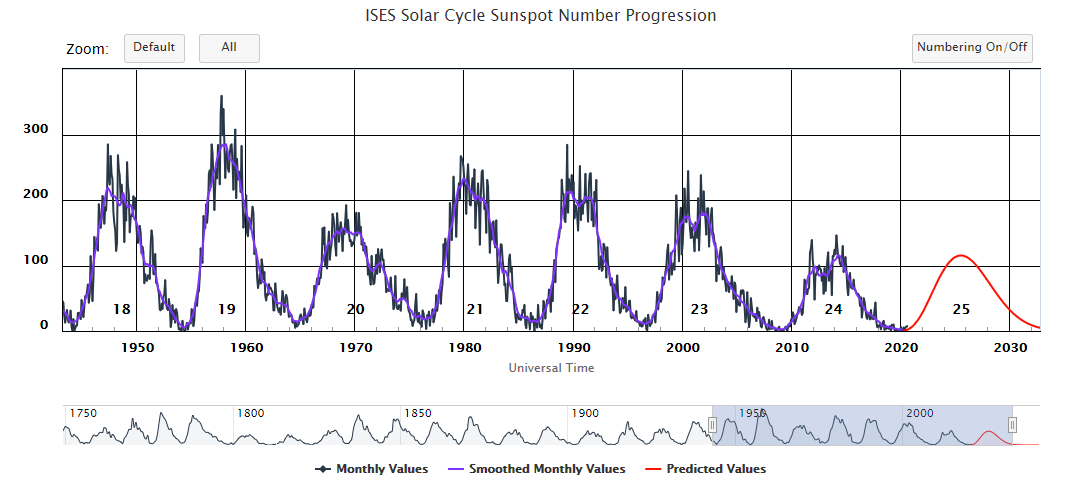
Sunspot numbers from solar cycle 19 to the prospective cycle 25. Credit: NOAA NWS Space Weather Prediction Center https://www.swpc.noaa.gov/products/solar-cycle-progression
I came of age, astronomically speaking, during cycle 19, the most active peak since the 1779. I saw quite a few displays of the aurora borealis (northern lights) from Grand Rapids, MI 140 miles south from where I now live.
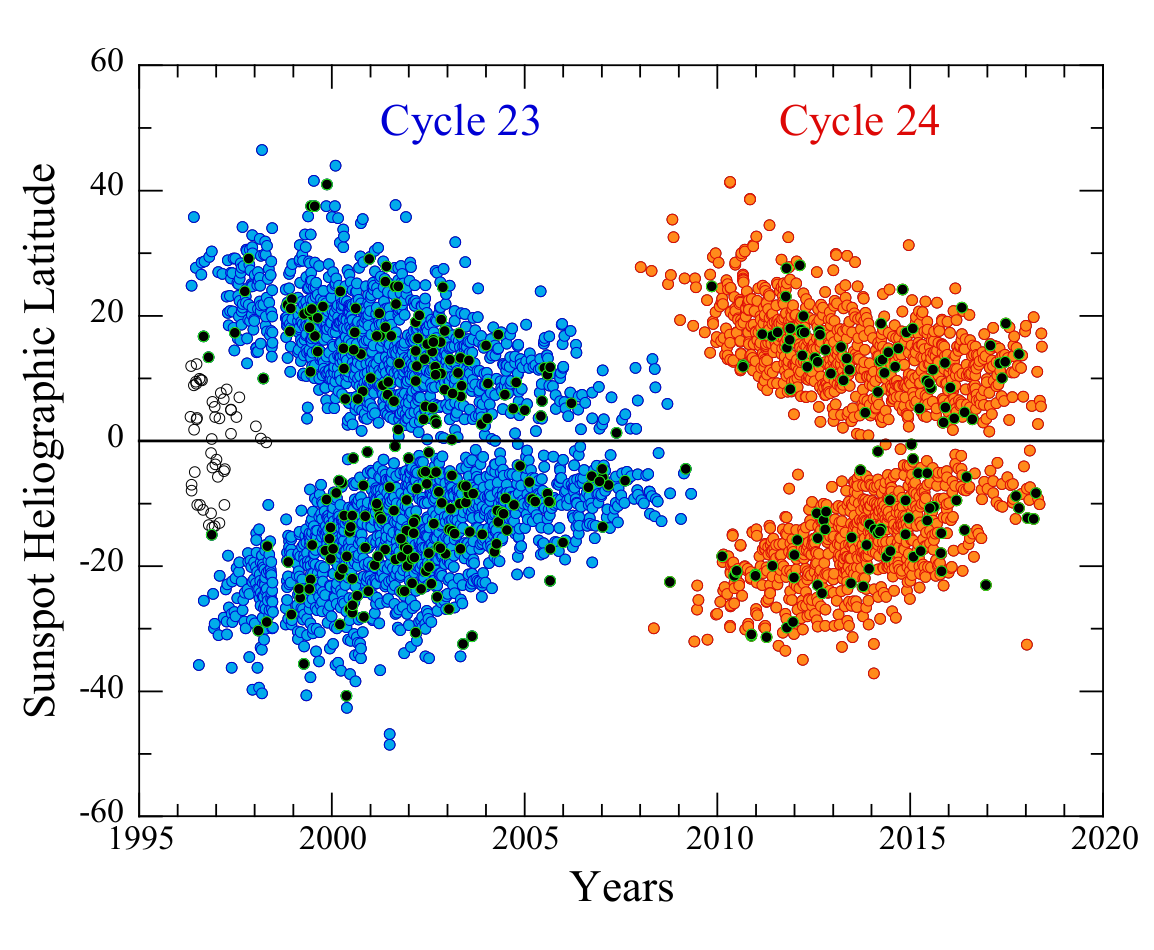
Sunspot butterfly diagram for solar cycles 23 and 24. Sunspots of a new cycle begin to appear at a relatively high latitude on the Sun. Sunspots of the old cycle form close to the equator. There is some overlap of spots from the old cycle seen at the same time as spots from the new cycle.
At one of 2019 summer’s Sun party at Sleeping Bear Dunes National Lakeshore we saw a high latitude sunspot popping up as a precursor to cycle 25. We watched two solar flares from the spot in our hydrogen alpha solar telescopes that afternoon, ejecting short term filaments of hydrogen. It was cool watching it in real time.
03/02/2020 – Ephemeris – Greek use of the first quarter Moon
Ephemeris for Monday, March 2nd. Today the Sun will be up for 11 hours and 14 minutes, setting at 6:32, and it will rise tomorrow at 7:15. The Moon, at first quarter today, will set at 2:39 tomorrow morning.
The Moon is at first quarter at 2:57 this afternoon. The ancient Greek philosopher/astronomer Aristarchus* tried to determine the distance to the Sun by observing the Moon at exactly first quarter and measuring the angle between it and the Sun. If we see the Moon at exactly first quarter when the sunrise line called the terminator cuts the Moon exactly in half then the angle at the Moon between the Sun and the Earth is a right or 90 degree angle. If we, on the Earth at that same instant were able to measure the angular distance between the Moon and the Sun. we could theoretically calculate the distance to the Sun. He was correct about the Moon’s distance, but calculated the Sun was at only about 10% of its actual distance.
The times given are for the Traverse City/Interlochen area of Michigan. They may be different for your location.
* In the actual broadcast program I erroneously credited the later Greek astronomer Hipparchus.
Addendum
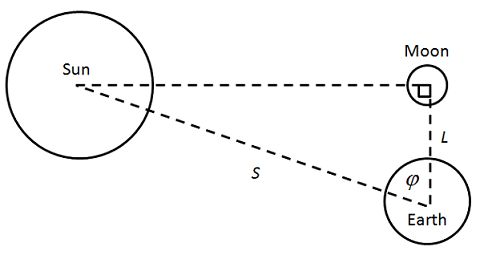
Quarter Moon method of determining the Sun’s distance by Aristarchus. Credit: andonee
08/21/2018 – Ephemeris – How will the Parker Solar Probe get near to the Sun?
Ephemeris for Tuesday, August 21st. The Sun rises at 6:52. It’ll be up for 13 hours and 46 minutes, setting at 8:38. The Moon, 3 days past first quarter, will set at 3:09 tomorrow morning.
I introduced the Parker Solar Probe yesterday. It’s on its way to Venus to have some of its velocity stolen by that planet as to drop to nearly 15 million miles (24 million km) of the Sun at its first perihelion, before heading almost all the way out to the Earth’s orbit. Its next encounter with Venus will steal even more velocity from the probe to drop even closer to the Sun. It will take nearly 7 years to reach as close as 3.9 million miles (6.2 million km) from he center of the Sun of 3.8 million miles (6.1 million km) from what looks like its surface, the photosphere, the bright ball we see of the Sun. The probe has a huge heat shield that will handle the over two thousand degree heat from the Sun. Even though the corona is several million degrees in temperature, it’s not dense enough to heat the probe.
The times given are for the Traverse City/Interlochen area of Michigan. They may be different for your location.
Addendum
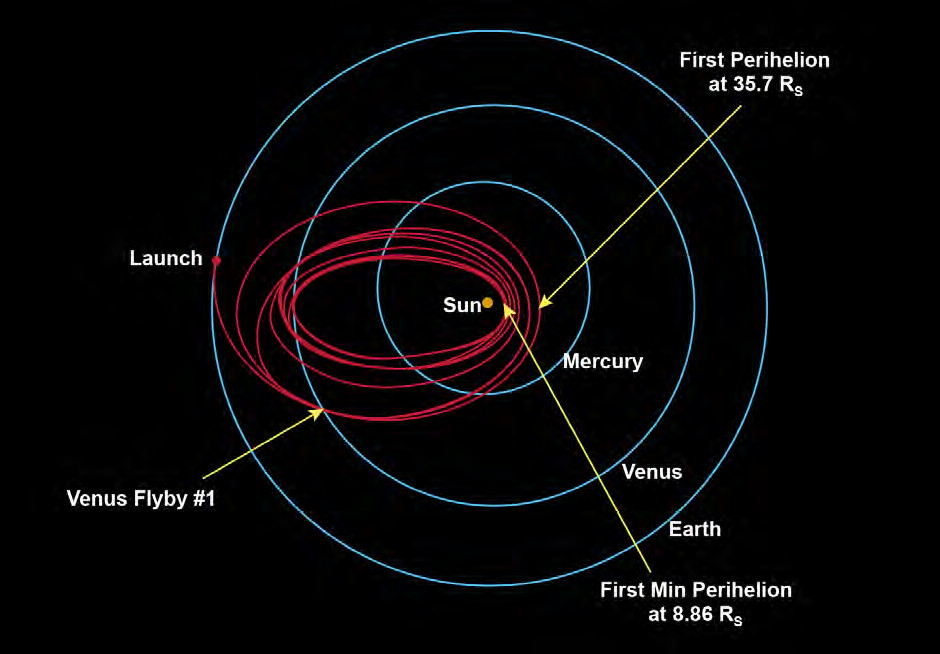
The planned orbits of the Parker Solar Probe. First flyby of Venus will occur on October 3rd 2018. The first perihelion passage a bit more than a month later on November 6th. Credit: NASA
A close look at the Sun
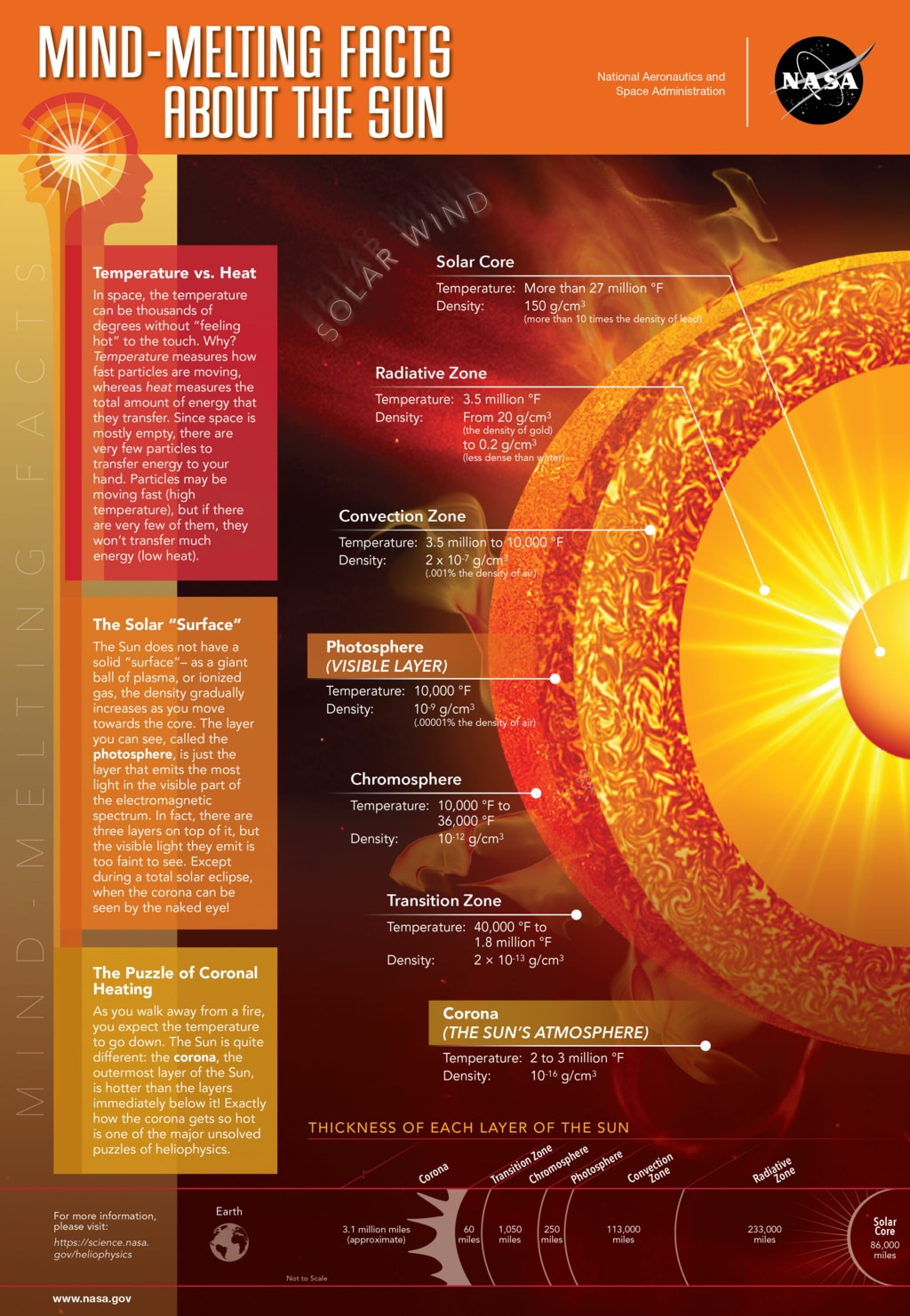
Click on image to enlarge. Credit NASA.
08/20/2018 – Ephemeris – The Parker Solar probe is on its way to skim through the Sun’s corona
Ephemeris for Monday, August 20th. The Sun rises at 6:51. It’ll be up for 13 hours and 49 minutes, setting at 8:40. The Moon, 2 days past first quarter, will set at 2:22 tomorrow morning.
Eight days ago the Parker Solar Probe was launched toward the Sun. It is the first NASA spacecraft named after a living person, Eugene Parker, a Michigander, born in Houghton in 1927, graduated from Michigan State, before moving on to Caltech. He eventually landed at the University of Chicago. In the 1950’s he put forth the theory of the supersonic solar wind of charged particles pervading the solar system. The theory was not initially accepted, but has been verified by satellites. The Parker Solar Probe will make multiple passes of Venus, giving up its velocity to fall closer to the Sun on each pass, taking almost 7 years to inch closer to the Sun at its perihelion until it gets down to about 3.8 million miles of our star.
The times given are for the Traverse City/Interlochen area of Michigan. They may be different for your location.
Addendum
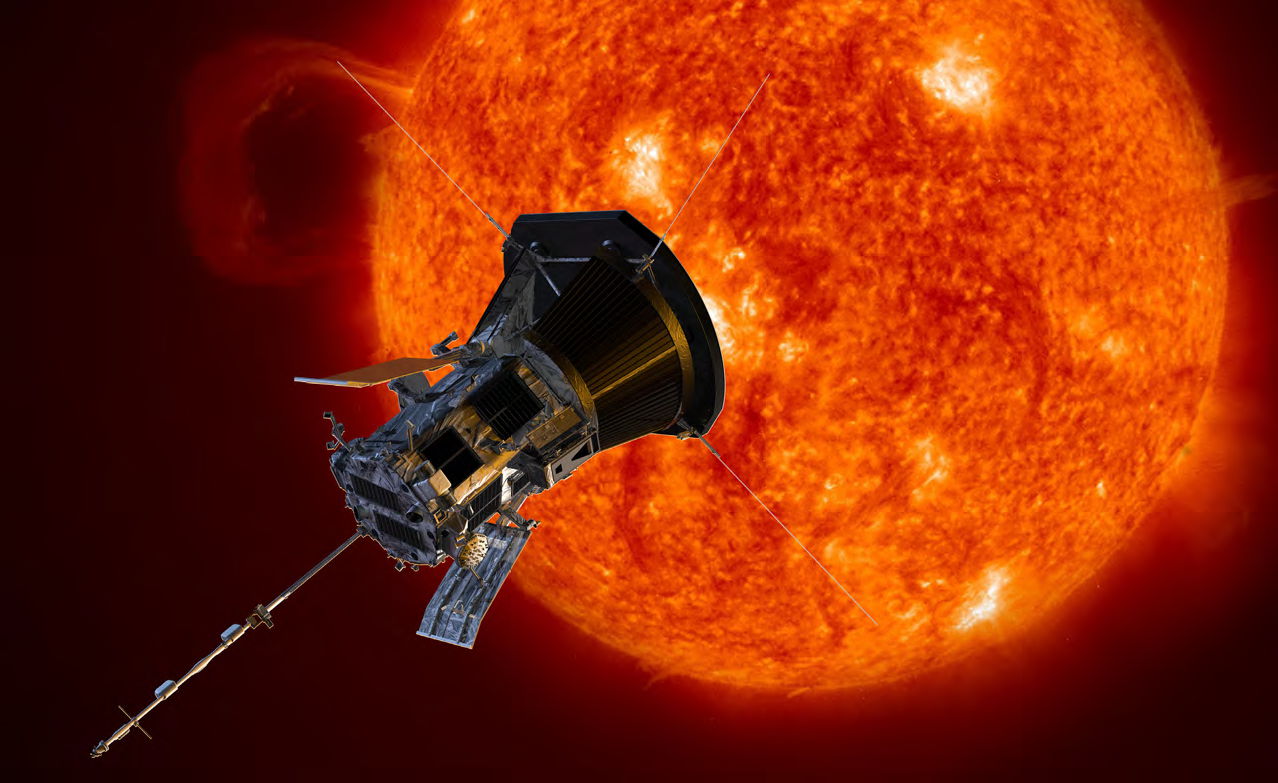
Artist’s visualization of the Parker Solar Probe near the Sun. Credit: NASA/Johns Hopkins APL/Steve Gribben.
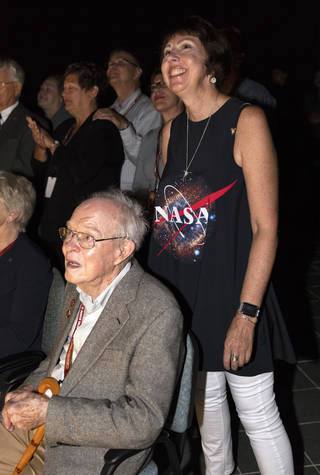
Dr. Eugene Parker (seated in the foreground), a pioneer in heliophysics and S. Chandrasekhar distinguished service professor emeritus for the Department of Astronomy and Astrophysics at the University of Chicago, watches the launch of NASA’s Parker Solar Probe. This is the first agency mission named for a living person. Standing behind Parker is Nicky Fox, Parker Solar Probe project scientist at Johns Hopkins Applied Physics Laboratory. The liftoff took place at 3:31 a.m. EDT on Sunday, Aug. 12, 2018. The spacecraft was built by the Johns Hopkins University Applied Physics Laboratory in Laurel, Maryland. The mission will perform the closest-ever observations of a star when it travels through the Sun’s atmosphere, called the corona. The probe will rely on measurements and imaging to revolutionize our understanding of the corona and the Sun-Earth connection. Credit: NASA/Glenn Benson.
06/21/2018 – Ephemeris – Yay, summer is here!
Ephemeris for Thursday, June 21st. Today the Sun will be up for 15 hours and 34 minutes, setting at 9:32, and it will rise tomorrow at 5:57. The Moon, 1 day past first quarter, will set at 2:57 tomorrow morning.
Welcome to summer! It began at 6:07 this morning. If you remember back to winter and the beautiful constellation of Orion. Some folks could trace the club he was holding over his head off the red star Betelgeuse. The Sun now appears above that. If you remember Gemini the twins, well the Sun is off Castor’s big toe. That’s all pretty high in the sky and giving us 15 hours and 34 minutes of daylight. That’s why summer’s so hot. This despite the fact that in two weeks we will be the farthest we get from the Sun all year. The 3 million mile difference in the Sun’s annual distance is peanuts compared to the seasonal fluctuations caused by the tilt of the Earth’s axis.
The times given are for the Traverse City/Interlochen area of Michigan. They may be different for your location.
Addendum
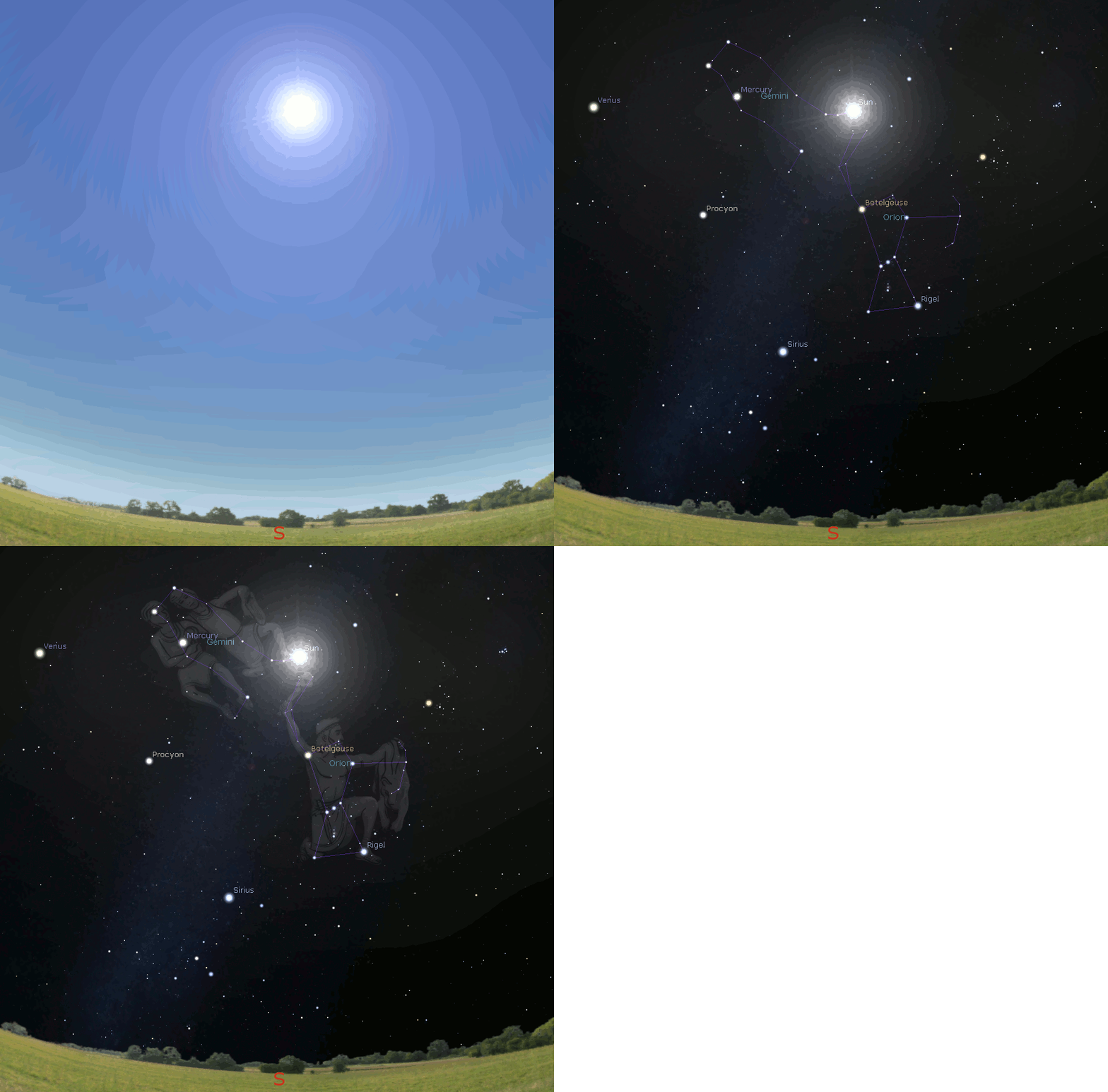
The Sun with its position with the stars at the summer solstice, June 2018. Click on the image to enlarge. Created using Stellarium and GIMP.
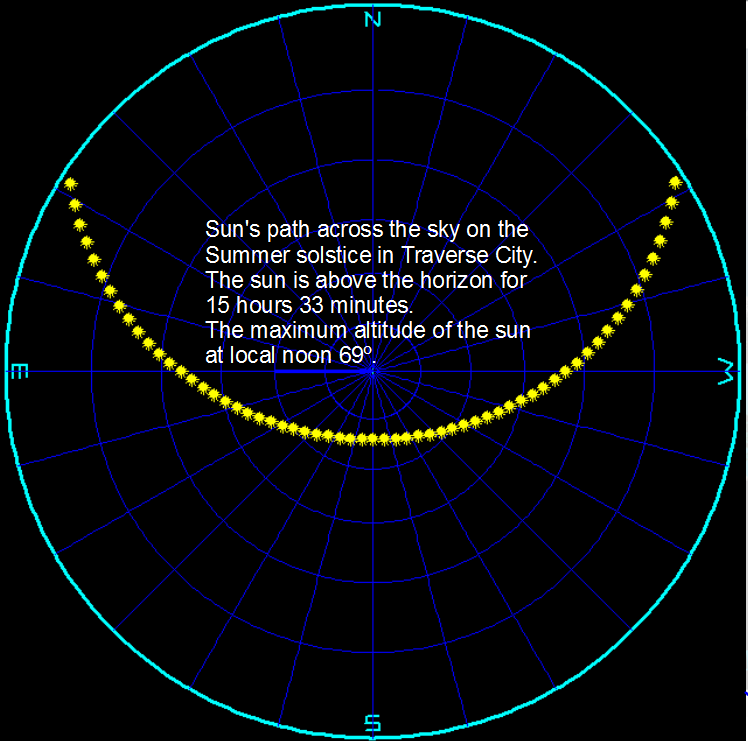
The sun’s daily path through the sky from horizon to horizon on the first day of summer, the summer solstice. Grid lines are 15° apart. The Sun os plotted at 15 minute intervals. Credit: My LookingUp program.
11/03/2017 – Ephemeris – The Sun is the topic at tonight’s GTAS meeting
Ephemeris for Friday, November 3rd. The Sun will rise at 8:23. It’ll be up for 10 hours and 5 minutes, setting at 6:28. The Moon, 1 day before full, will set at 8:35 tomorrow morning.
This evening the Grand Traverse Astronomical Society will hold its monthly meeting at the Northwestern Michigan College’s Rogers Observatory at 8 p.m. with a program featuring member Don Flegel in a talk about the Sun. Don’s the keeper of our solar telescope and wanted a good excuse to learn more about the Sun, so he decided to study up and give this talk. That’s how I do it.
After the talk, at 9 p.m. there will be a star party, if it’s clear, to view the heavens including the Moon. The observatory is located south of Traverse City, on Birmley Road between Garfield and Keystone roads.
It’s time to change our clocks again at 2 a.m. Sunday. Turn your clocks back one hour. That’s Fall Back one hour for a bit of extra sleep.
The times given are for the Traverse City/Interlochen area of Michigan. They may be different for your location.
Addenda
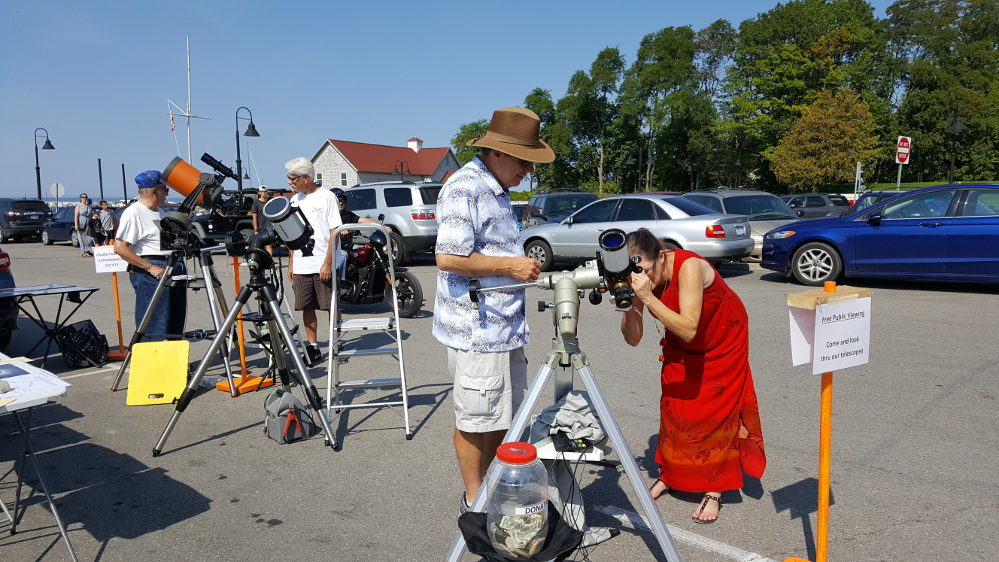
Don Flegel, in the foreground, with the society’s solar telescope assisting a person viewing the Sun at he Leland Heritage Festival 2017 at Fishtown. Man in the background in the blue cap is Gary Carlisle. The telescope in the middle is mine.
Occultation of Aldebaran by the Moon Sunday Night
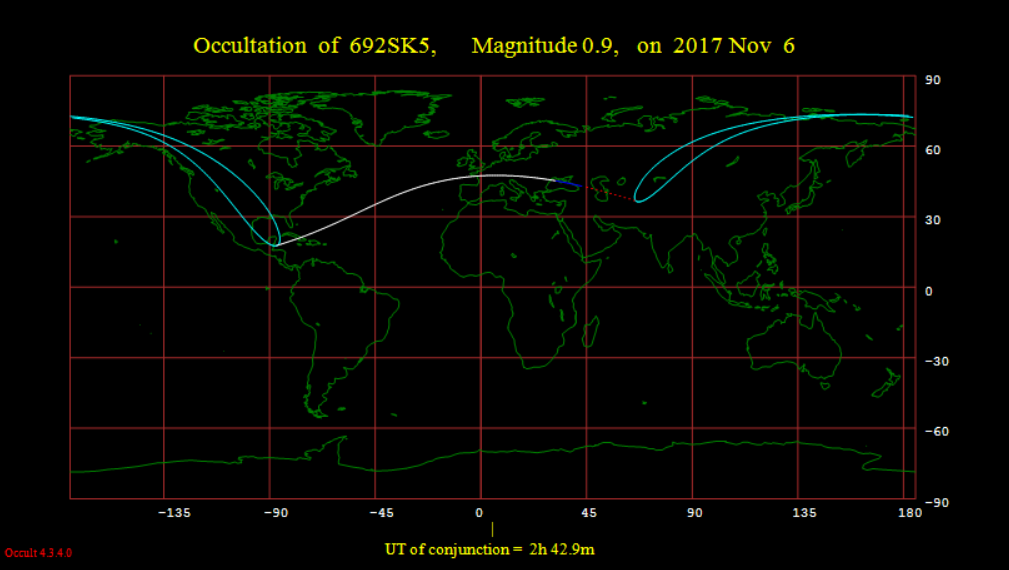
Occultation Map for the occultation of Aldebaran by the Moon . Credit Occult 4 program from IOTA.org.
For the Traverse City/Interlochen area:
Aldebaran Occultation start 8:07 p.m. Nov 5th (01:07 UT Nov 6th)
Aldebaran Occultation end 9:00 p.m. Nov 5th (02:00 UT Nov 6th)
I’ll have an Ephemeris Extra posting, Sunday November 5th with more information.
10/26/2017 – Ephemeris – Jupiter at perihelion and 96P/Comet Machholz 1 rounds the Sun
Ephemeris for Thursday, October 26th. The Sun will rise at 8:12. It’ll be up for 10 hours and 27 minutes, setting at 6:39. The Moon, 1 day before first quarter, will set at 11:48 this evening. | Today at 2:02 in the afternoon the planet Jupiter will be in conjunction with the Sun, moving from east to west with respect to the Sun. Leaving the evening sky to enter the morning sky. While invisible from the Earth’s surface. There are cameras recording the Sun at all times that will also pick up Jupiter. Two on the Solar and Heliospheric Observatory perched a million miles sunward of the Earth. are chronagraphs, and contain disks that block out the light of the Sun creating total eclipses. The planet will pass above or north of the Sun. The easiest way to find these images is to go to spaceweather.com, go down to the link section and select Solar and Heliospheric Observatory and click on The Sun Now. The images to check out at the two LASCO images.
The times given are for the Traverse City/Interlochen area of Michigan. They may be different for your location.
Addendum
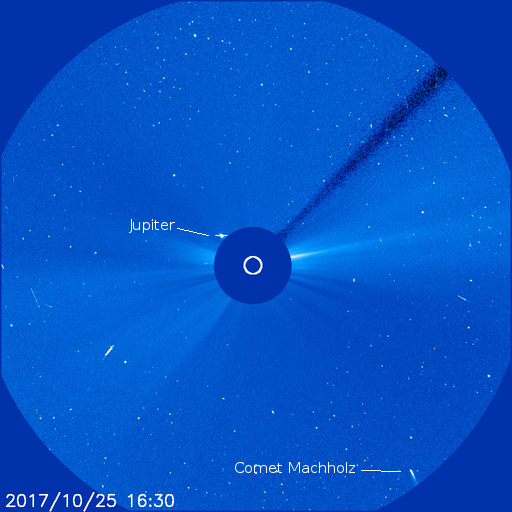
The current LASCO C3 image at this blog’s posting time Credit: ESA/NASA/SOHO.
Jupiter is about to be covered by the LASCO C3 coronagraph’s occulting disk. It will still be visible in the C2 field. As an extra bonus Comet 96P/Machholz entered the LASCO C3 field of view on the 25th and will exit on the 30th.
To follow Jupiter’s progress check out these animated GIFs: https://sohowww.nascom.nasa.gov/data/LATEST/current_c3.gif and https://sohowww.nascom.nasa.gov/data/LATEST/current_c2.gif.
Note that these animations will be current as of the date you click on them.
09/15/2017 – Ephemeris – Two local astronomy events tomorrow
Ephemeris for Friday, September 15th. The Sun will rise at 7:21. It’ll be up for 12 hours and 30 minutes, setting at 7:52. The Moon, 2 days past last quarter, will rise at 3:10 tomorrow morning.
There are two local astronomical events tomorrow. Tomorrow the Leland Heritage Celebration will take place from 10 a.m. to 4 p.m. at Fish Town in Leland. The Grand Traverse Astronomical Society will be there to show the Sun through member’s telescopes and give out NASA items for the kids. We’ll exhibit pictures gained from last month’s total solar eclipse. Then starting at 9 p.m. the crew will be at Northwestern Michigan College’s Rogers Observatory for a star party, viewing Saturn and the wonders of the Milky Way including star clusters and nebulae of clouds of gas and dust that mark locations of either the birth or death of stars. Rain will affect the Leland event. The observatory is located on Birmley Road.
The times given are for the Traverse City/Interlochen area of Michigan. They may be different for your location.
Addendum
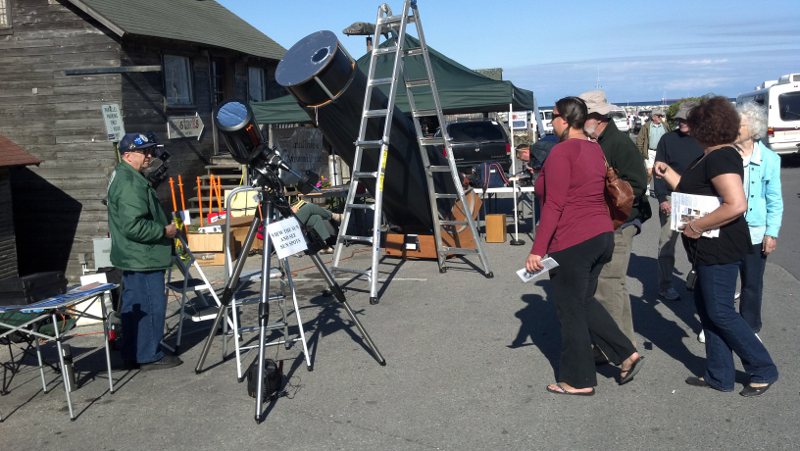
GTAS telescopes at Leland Heritage Celebration in 2011.
 Bob Moler's Ephemeris Blog