Archive
05/14/2013 – She’ll be coming ’round the sun when she comes
AR 1748 is near the sun’s eastern limb. Already it has caused three radio blackouts. AR means active region, read sunspot group. It’s been kicking up quite a ruckus as it’s poised to rotate onto the earth facing side of the sun. this afternoon spaceweather.com‘s servers appear to be overloaded. I was able to get into the governments NOAA spaceweather website for the latest information.
We could be in for a week of so of northern lights. More later.
08/02/2012 – Ephemeris – The sun’s kicking up again this week
Thursday, August 2nd. The sun rises at 6:30. It’ll be up for 14 hours and 35 minutes, setting at 9:05. The moon, 1 day past full, will rise at 9:05 this evening.
With the sun really being active, there’s a good chance we’ll see several displays of the northern lights of aurora borealis. Those south of the equator will see the southern equivalent, the aurora australis. There’s an active group of sunspots rotating onto the earth-side face of the sun that should give us a chance to see the aurora in the next week or so. Sunspots are caused by tremendous magnetic fields generated below the bright photosphere we rather improperly call the sun’s surface. The sun has no solid surface, it’s all gas. The magnetic fields cool the gas, making it darker. The spots are maybe at a temperature 2,000 degrees cooler than the rest of the photosphere which is about 10,000 degrees Fahrenheit. In complex sunspot groups there is a potential for huge explosions.
Times are for the Traverse City/Interlochen area of Michigan. They may be different for your location.
Addendum
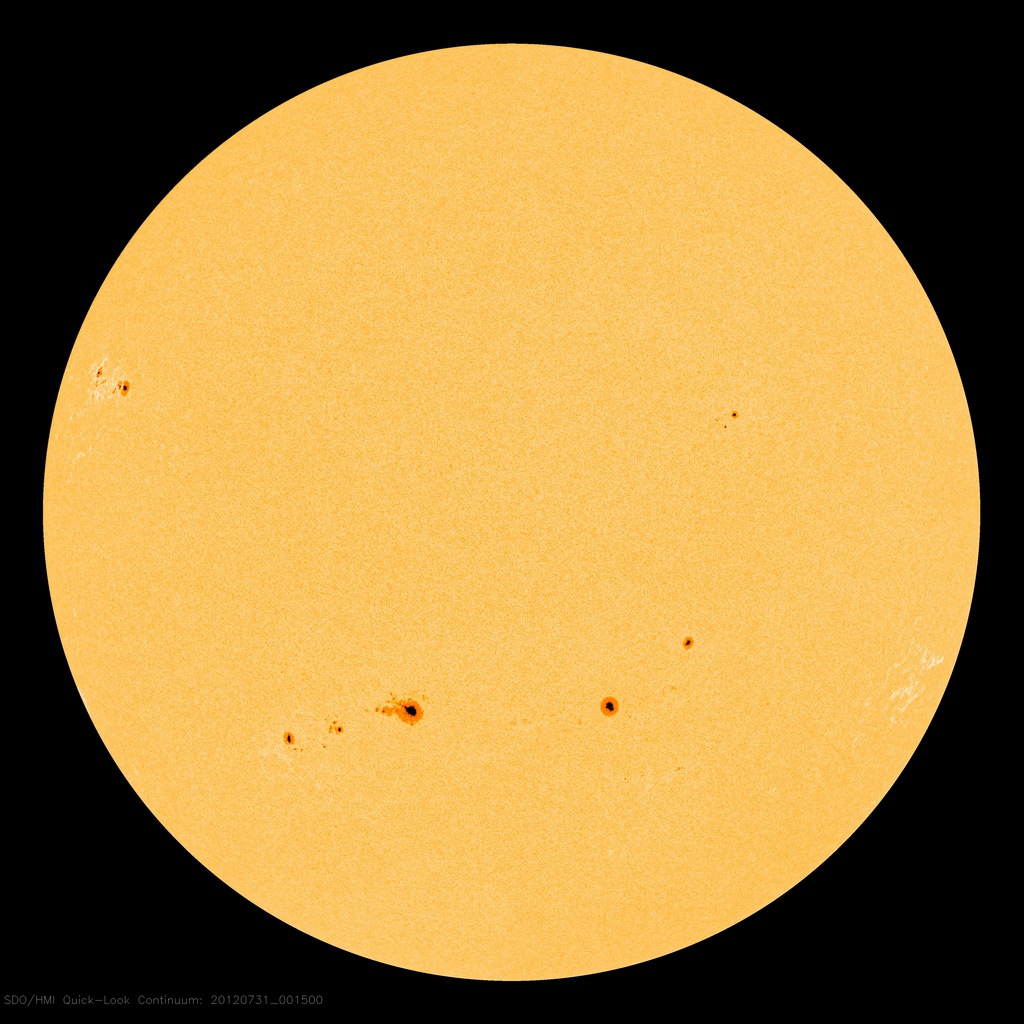
Solar Dynamics Observatory white light image of the sun from Monday. Credits NASA / SDO. Click on image to enlarge.
07/06/2012 – Ephemeris – Sun and planet viewing tonight
Ephemeris for Friday, July 6th. Today the sun will be up for 15 hours and 25 minutes, setting at 9:29. The moon, 3 days past full, will rise at 11:06 this evening. Tomorrow the sun will rise at 6:05.
This evening the Grand Traverse Astronomical Society will hold its monthly meeting at the Northwestern Michigan College’s Rogers Observatory at 8 p.m. This meeting will be devoted to viewing the sun through the society’s new solar telescope. After that starting at 9 p.m. Will be a star party. For both events, the public is welcome. The tiny planet Mars and the ringed planet Saturn will be visible as will a number of binary stars and brighter wonders of the heavens as the skies darken. Mercury is now receded toward the sun so is not visible. For the rest of the abbreviated planet report this week: A note for early risers that Jupiter and Venus make a fine sight low in the east northeast in the morning after 5 a.m.
Times are for the Traverse City/Interlochen area of Michigan. They may be different for your location.
Grand Traverse Astronomical Society’s Transit of Venus Watch – What a Time!
This was a fantastic event at Traverse City’s Open Space on the bay front. The clouds that threatened all day parted and dissolved to reveal a perfect sky. Hundreds of people turned out. Here are some crowd shots I made with my Android phone, plus one of the transit.
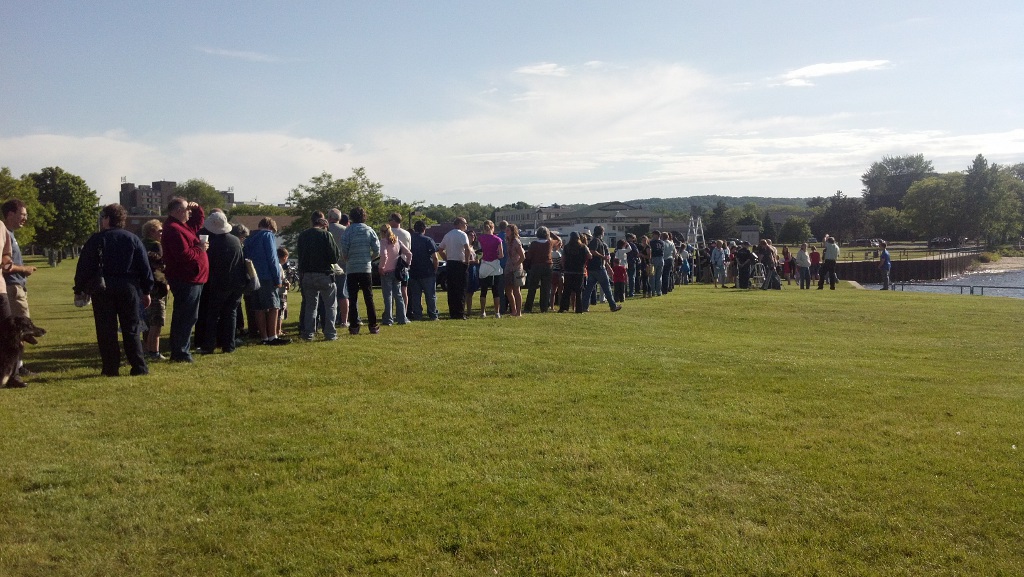
Most of a huge line to see the transit with the GTAS’ 25″ Dobsonian telescope.
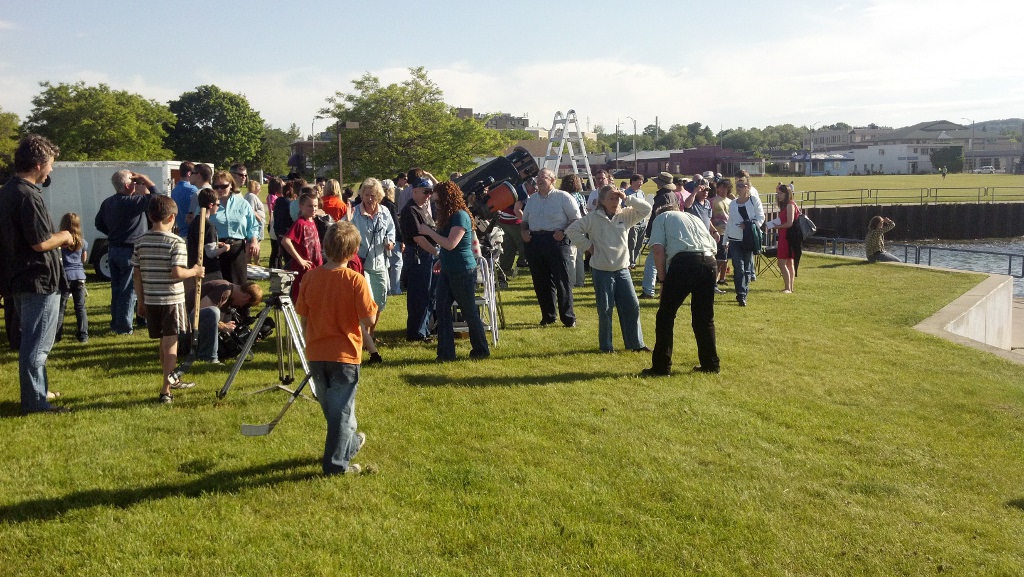
Transit Crowds near the telescopes.
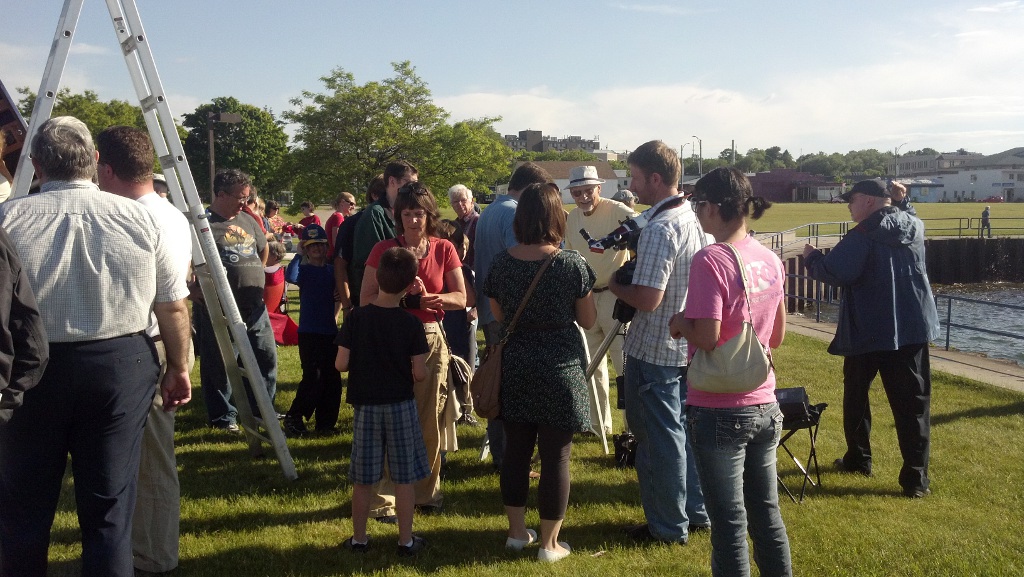
More of the Transit Crowd an Bill Renis manning our Lunt Hydrogen Alpha Solar Telescope.
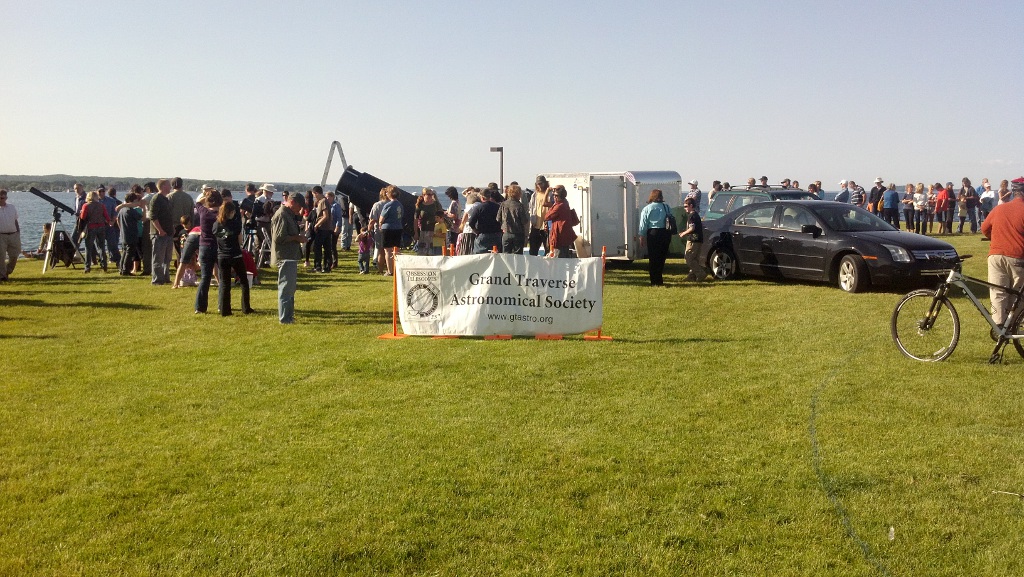
A look at the crowd and our GTAS Banner.
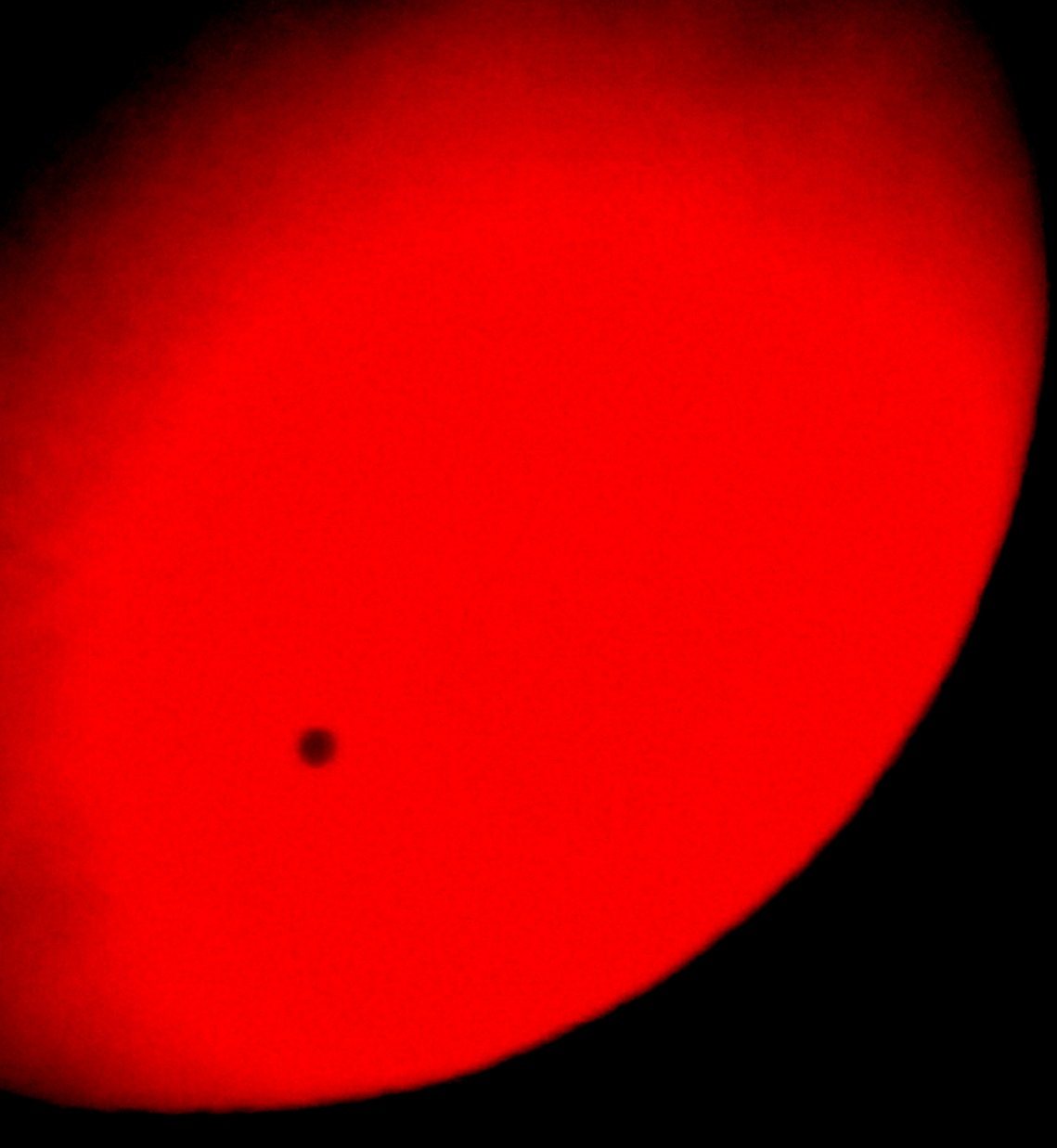
Venus against the sun taken at 8:49 p.m. through the Lunt solar telescope and a Droid Bionic phone.
Update (06/22/2012)
I received photographs from Gary and Eileen Carlisle and put them on the gtastro.org website. Here are theirs below. Eileen took the crowd shots, while Gary took the transit shot just before sunset as the crowds thinned. Gary’s crowd estimate was 500 folks.
More information: The transit started at 6:04 p.m. EDT. I spotted first contact through the Lunt. It took another minute or so to spot it in the white light telescopes. The Lunt showed the sun’s chromosphere that extends some 6,000 miles above the sun’s photosphere. The transit ended fro us as the sun set into the hills of Leelanau County across the west arm of Grand Traverse Bay.
The location we viewed from was the Open Space Park on the bay front in Traverse City, Michigan US. It is also used as the main venue of the National Cherry festival in early July and free outdoors screenings of movies at the Traverse City Film Festival in late July or early August.
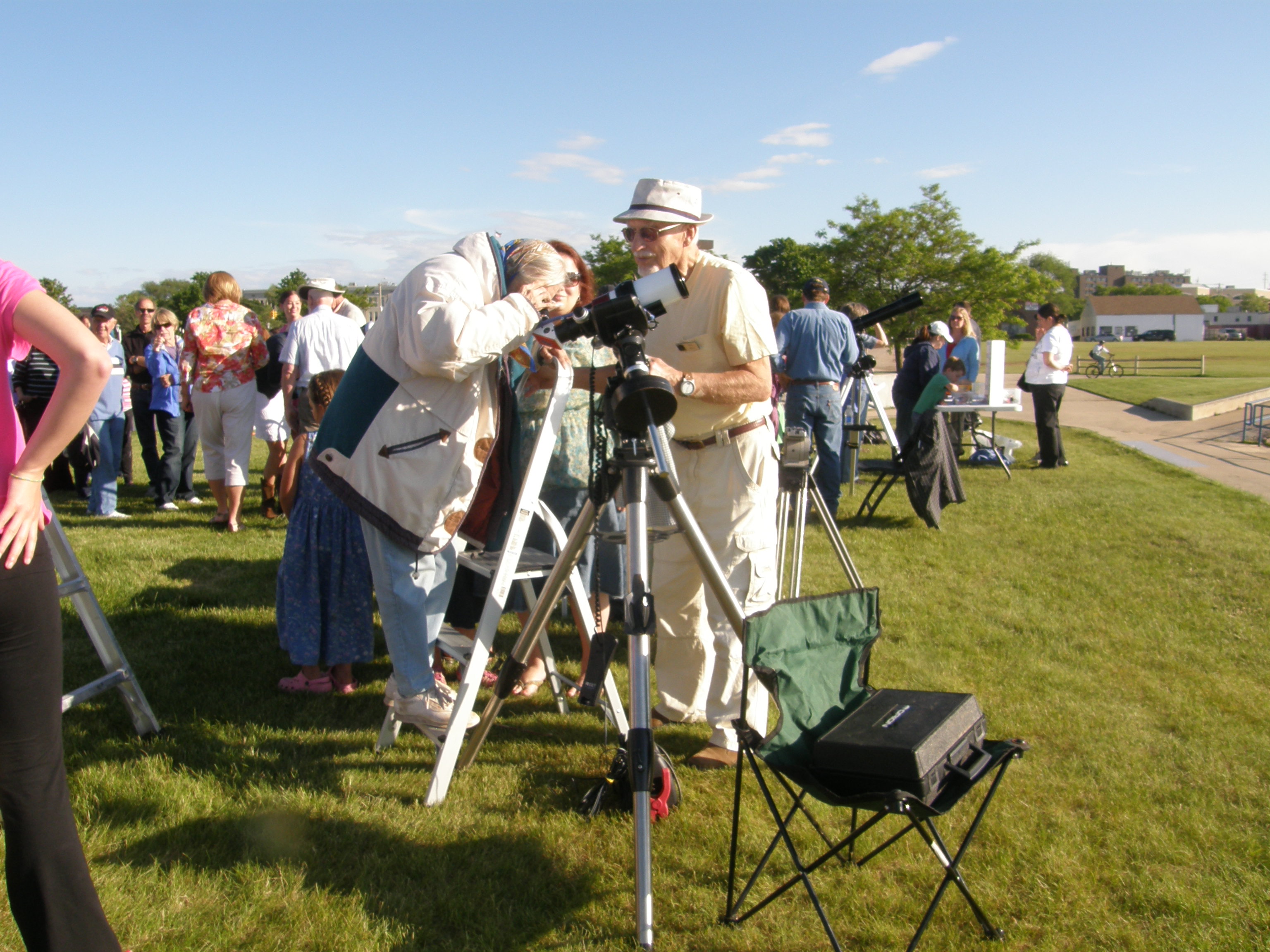
Bill Renis (yellow shirt, white hat and sunglasses) helping a person view the transit using the Lunt Solar Telescope. This was also the society’s 30th anniversary. Bill and I were the only two charter members attending.
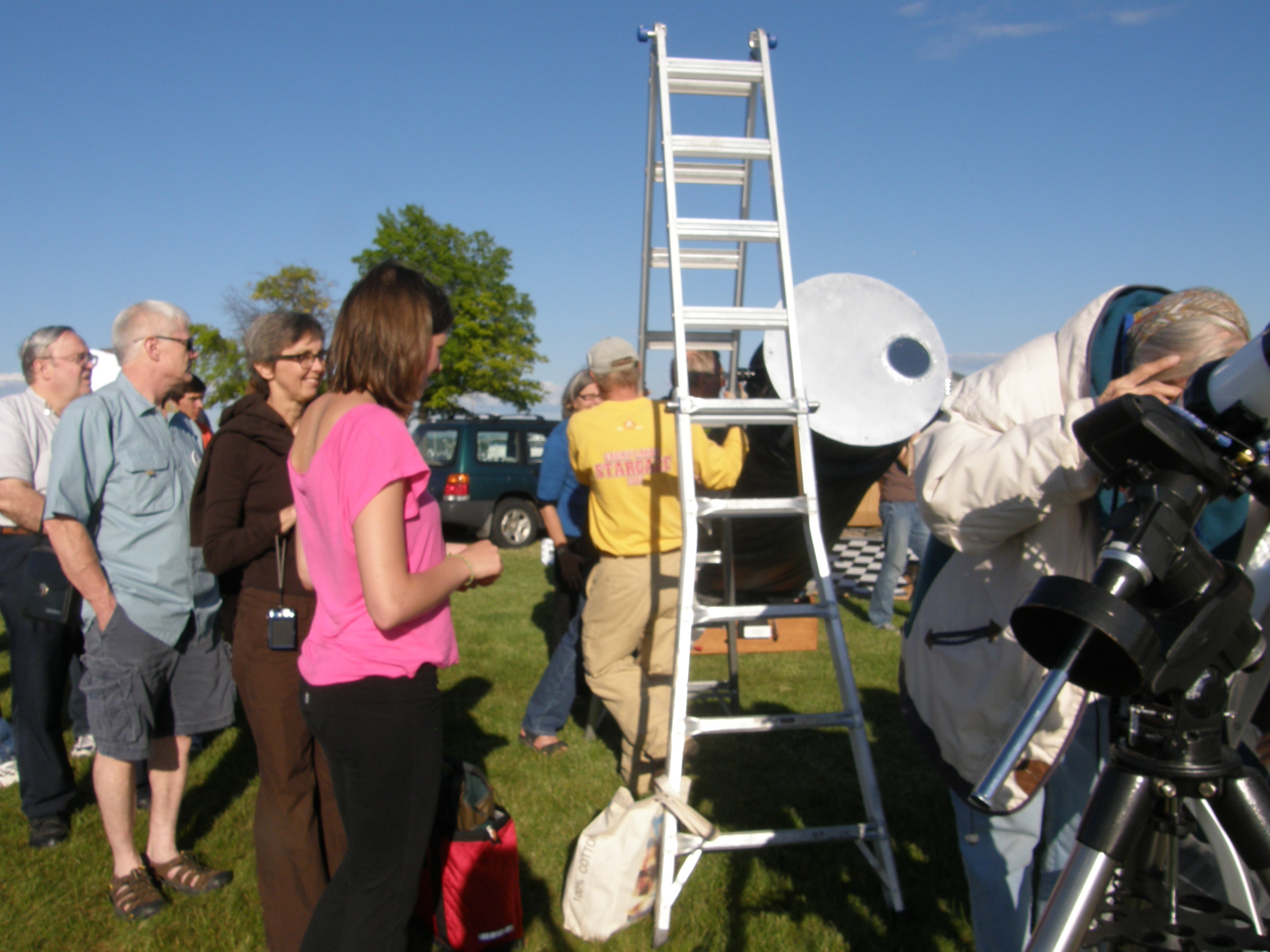
We brought out our Obsession 25″ telescope, stopped down to 8 inches with a solar filter. It gave excellent images. I saw second contact without the annoying teardrop effect.

Our “Meteorite Man” Joe Brooks brings out his meteorite collection for our events.
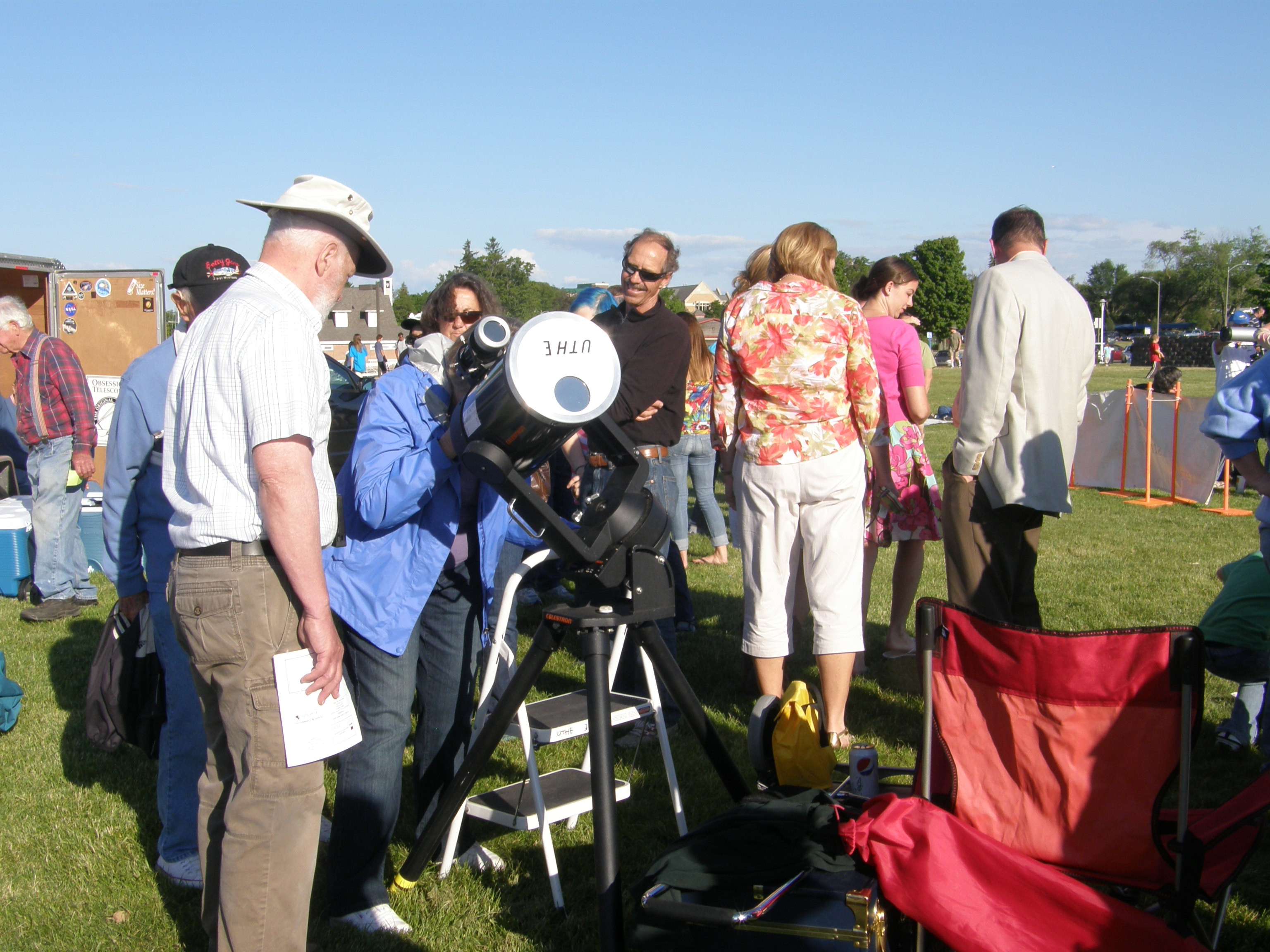
Member Ron Uthe brought his 8″ telescope to the event.
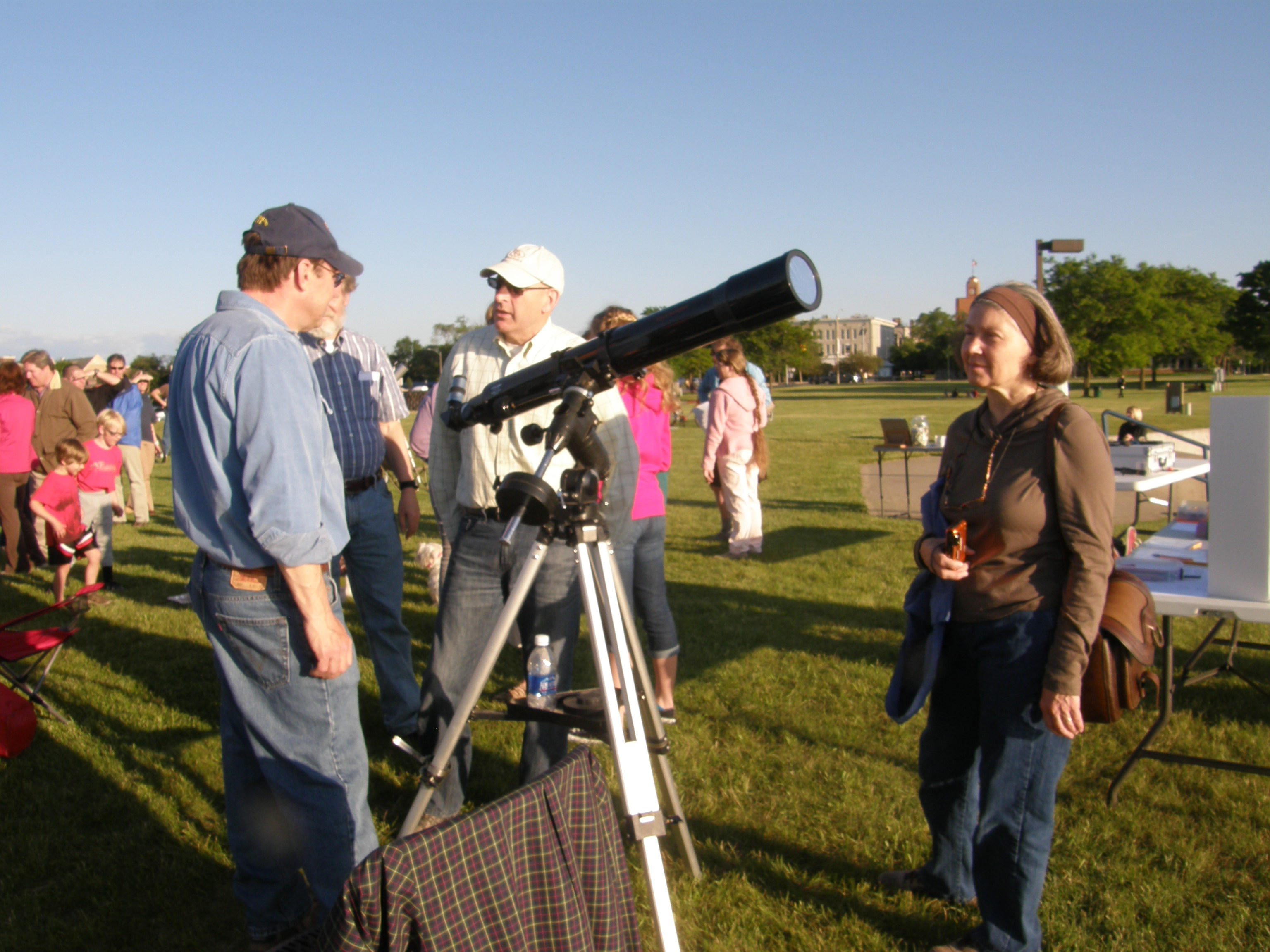
This is GTAS president Rich Kuschell’s 4″ refractor.

A little impromptu musical accompaniment.
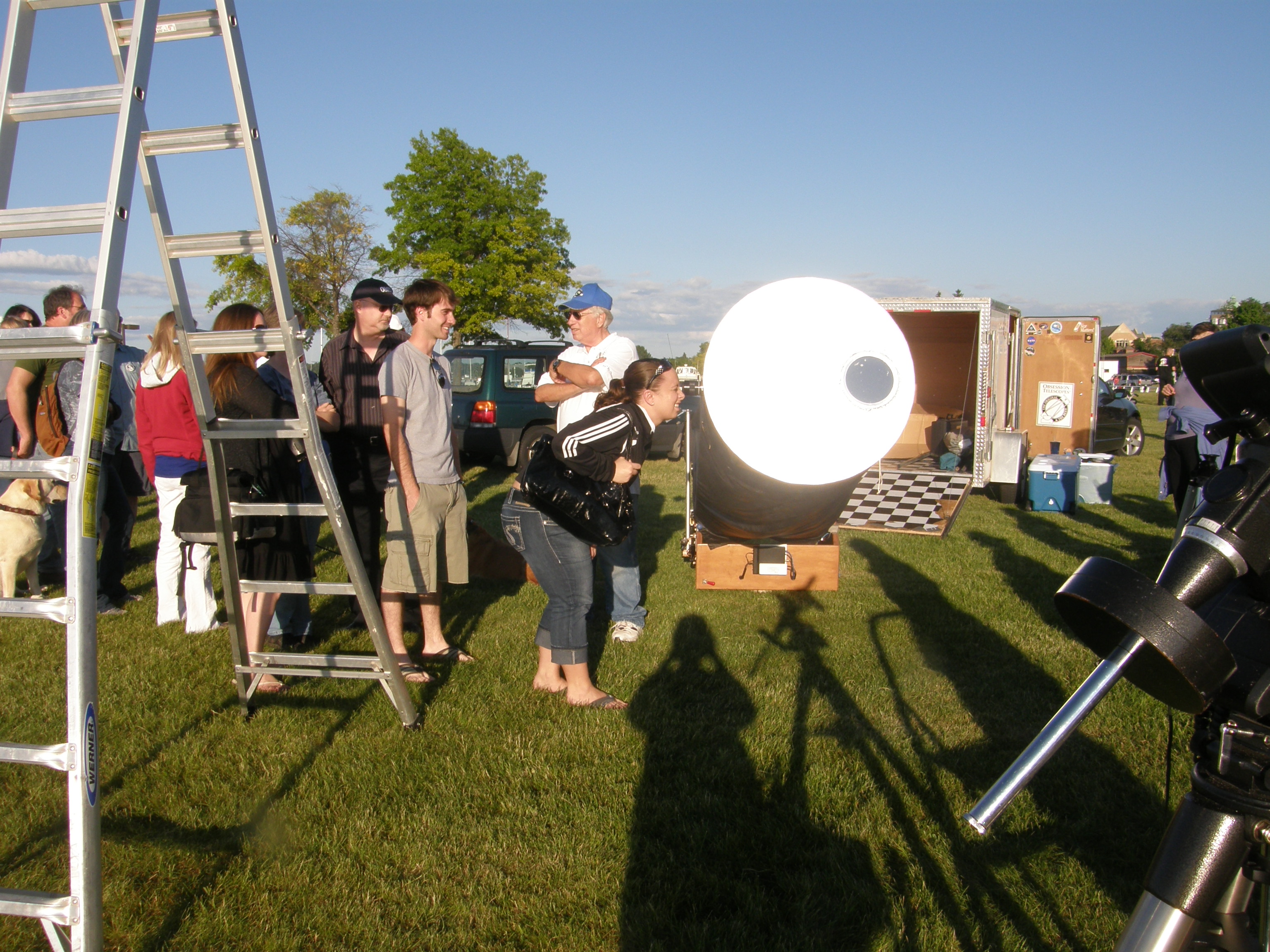
The sun’s getting low now. That’s me in the blue cap.
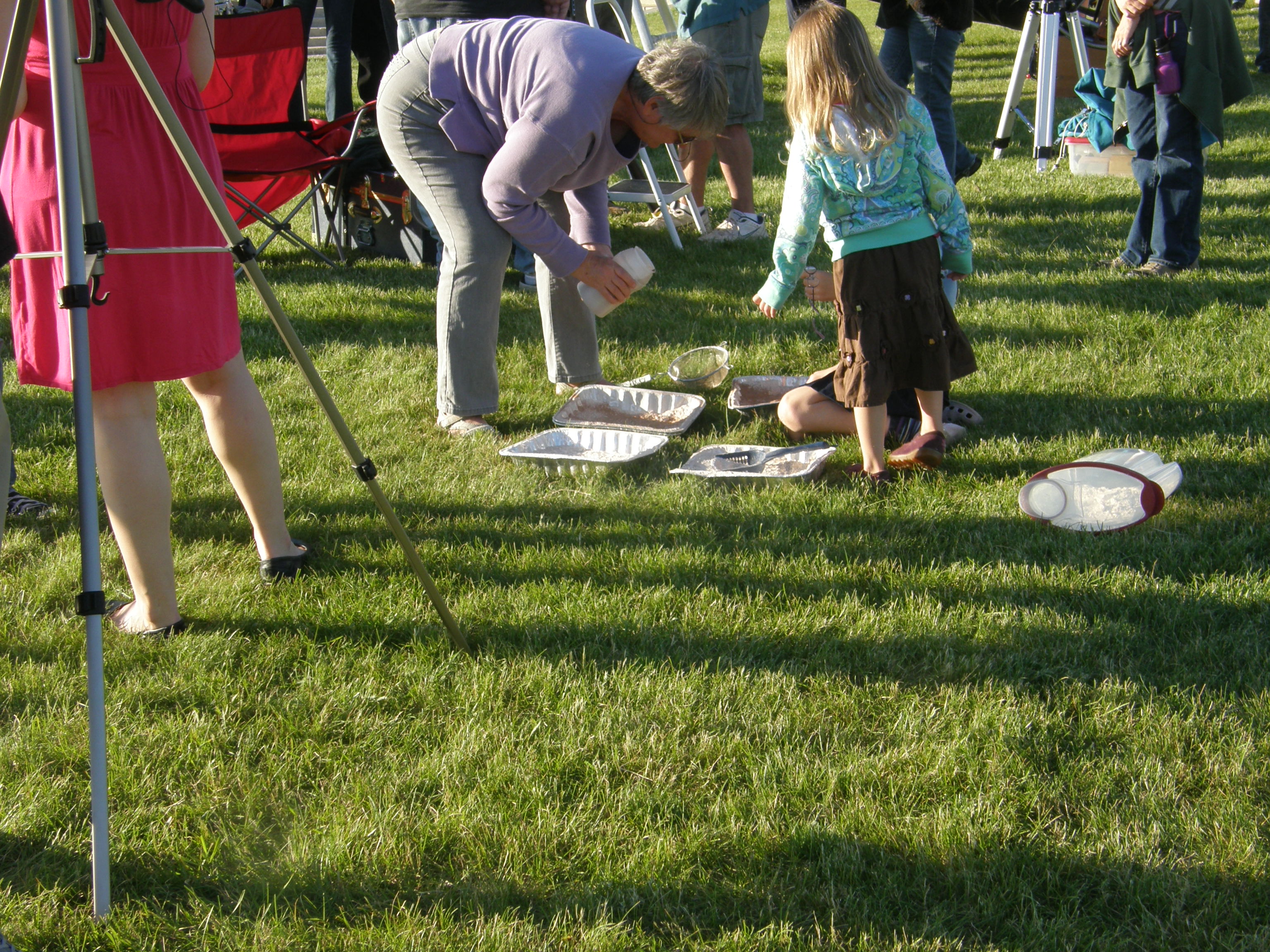
The small kids got a chance to create moon craters in pans of flour covered by chocolate drink powder.
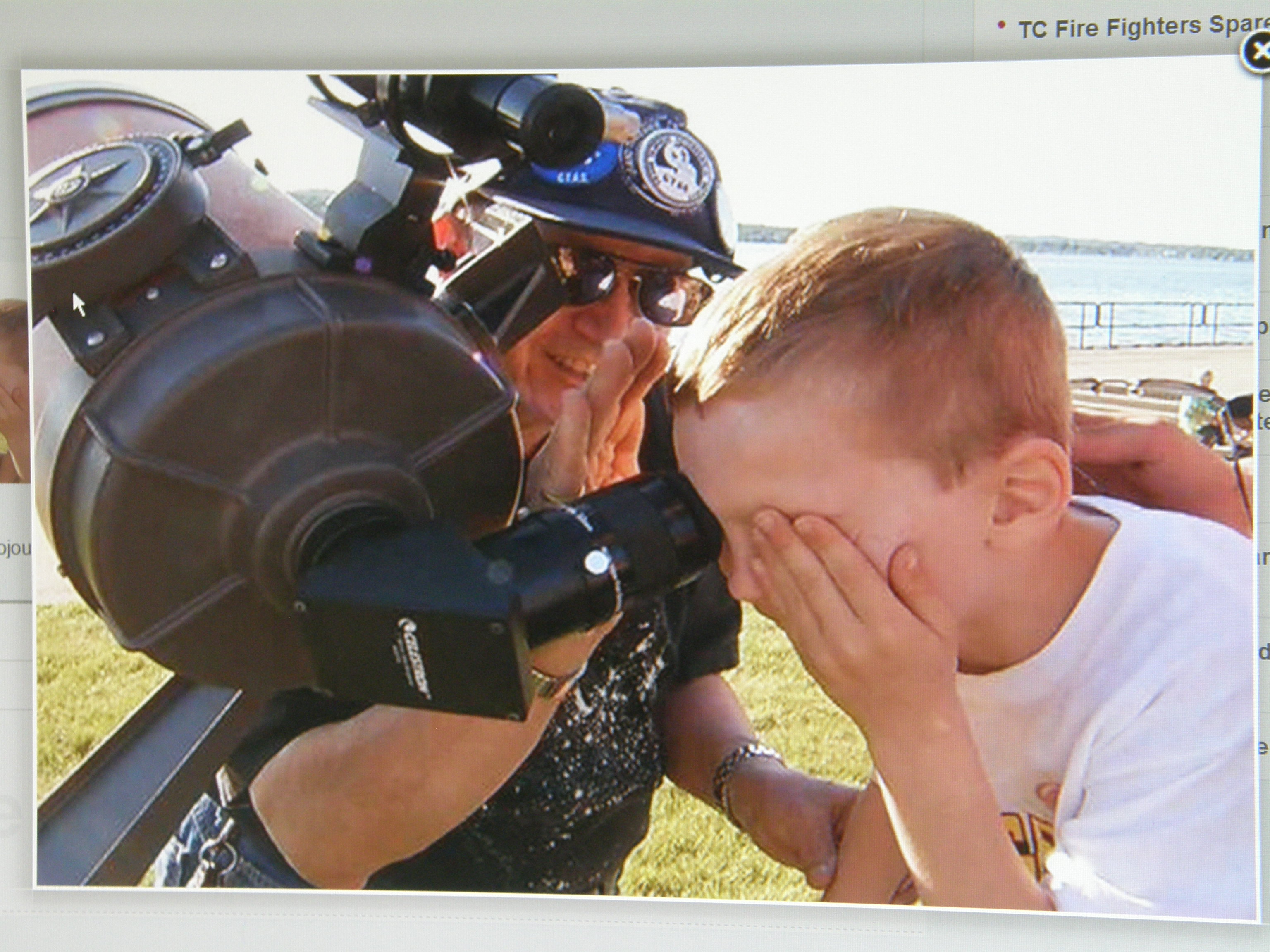
Gary Carlisle shielding the sun for a young man viewing through his 8″ telescope.
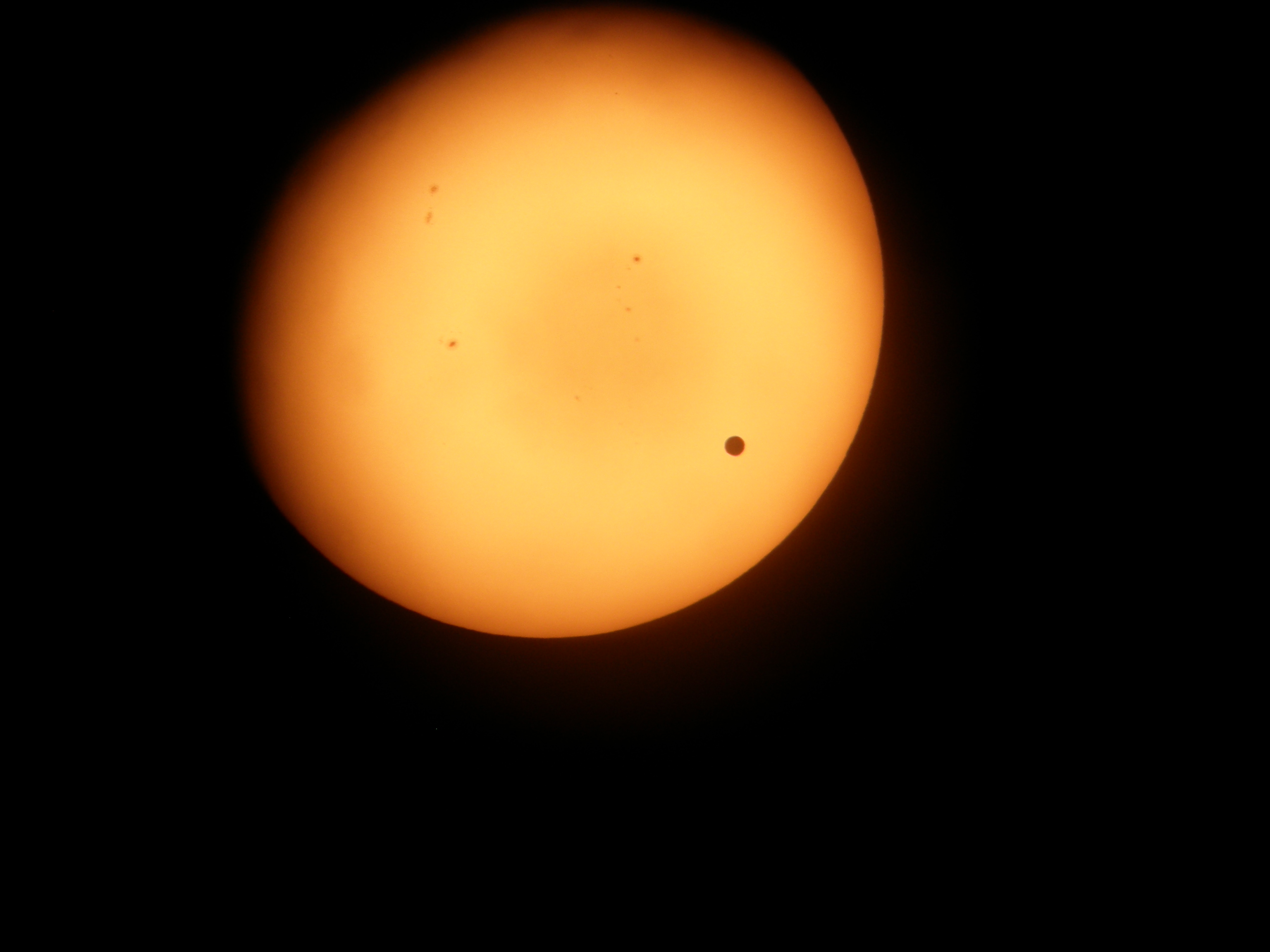
Gary’s photo of the transit.
06/05/2012 – Ephemeris – Transit of Venus is today!
Ephemeris for Tuesday, June 5th. Today the sun will be up for 15 hours and 25 minutes, setting at 9:24. The moon, 1 day past full, will rise at 10:46 this evening. Tomorrow the sun will rise at 5:58.
Early this evening we will see a rare event, the transit of the planet Venus across the sun. This will start at a few minutes after 6 p.m. When Venus will start crossing the sun from near the top. While the transit will last nearly 7 hours, we’ll see about 3 hours of it, clouds willing before the sun sets. The safety precautions are the same as viewing a solar eclipse, that is Do Not Look Directly At The Sun. Safe approved solar filters that fit in front of a telescope, projection of the sun’s image with a telescope or binoculars are the ways to view this event. The Grand Traverse Astronomical Society will be at the Open Space in Traverse City at 6 p.m. tonight for safe views of the event. The next transit of Venus will be in 2117.
Times are for the Traverse City/Interlochen area of Michigan. They may be different for your location.
Addendum
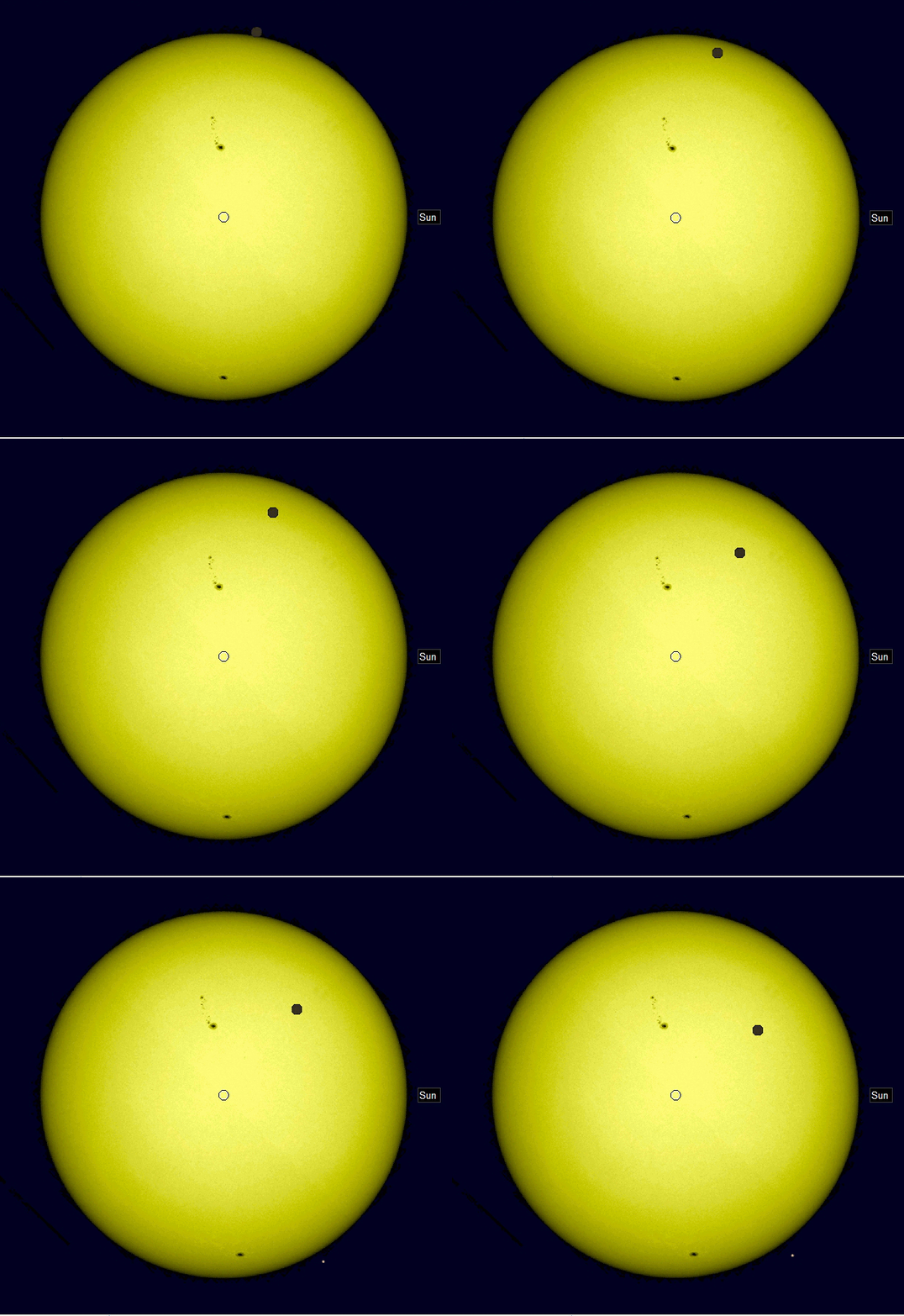
Animation of the Transit of Venus from Northern Michigan. Created using cartes du Ciel.
The Animation starts with Venus at contact 1, and every half hour until sunset. That’s why the transit ends abruptly.
For more information check out this NASA page.
How to observe the sun? The same techniques that are use to view a solar eclipse.
06/04/2012 – Ephemeris – Rare Transit of Venus is tomorrow
Ephemeris for Monday, June 4th. Today the sun will be up for 15 hours and 24 minutes, setting at 9:23. The moon, at full today, will rise at 9:51 this evening. Tomorrow the sun will rise at 5:58.
A partial eclipse of the moon is in progress this morning, but it started at moon set at 6 a.m. Tomorrow is a much rarer event, a transit of Venus across the face of the sun. This will start at a few minutes after 6 p.m. When Venus will start crossing the sun from near the top. While the transit will last nearly 7 hours, we’ll see about 3 hours of it, clouds willing. The safety precautions are the same as viewing a solar eclipse, that is Do Not Look Directly At The Sun. Safe approved solar filters that fit in front of a telescope, projection of the sun’s image with a telescope or binoculars are the ways to view this event. The Grand Traverse Astronomical Society will be at the Open Space in Traverse City at 6 p.m. Tomorrow for safe views of the event.
Times are for the Traverse City/Interlochen area of Michigan. They may be different for your location.
Addendum
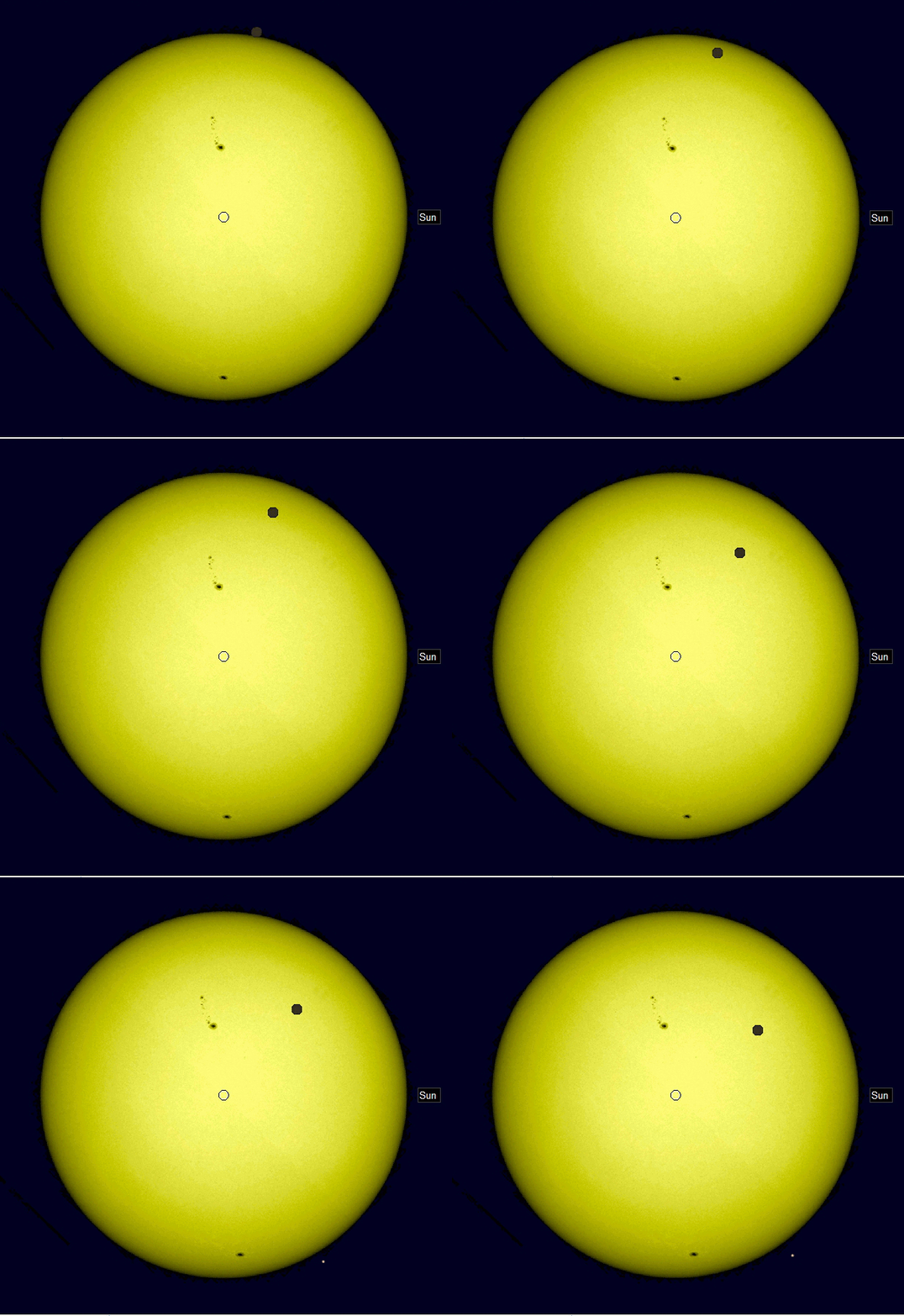
Transit of Venus as seen from the Grand Traverse Region. Created using Cartes du Ciel.
These plots are in 30 minute intervals starting around 6:10 p.m.
The sun is staying active – Check out the skies for the northern lights for the next few nights
Solar flares erupting from AR (Active Region) 1429, the big sunspot group now seen on the face of the sun, are sending clouds of charged particles toward the earth. Three flares in the last three days will provide an enhanced chance for auroral displays over the next few nights.
That’s both aurora borealis, northern lights and auroral australis, southern lights for or southern hemisphere friends.
Keep checking www.spaceweather.com for the latest information.
Also keep checking the western sky after sunset for Jupiter and Venus passing each other. These are the two brightest planets.
01/04/2012 – Ephemeris – The planets this week and the earth at perihelion
Wednesday, January 4th. The sun will rise at 8:19. It’ll be up for 8 hours and 56 minutes, setting at 5:15. The moon, 3 days past first quarter, will set at 5:03 tomorrow morning.
It’s the first Wednesday of 2012 and time again to take a look at the whereabouts of the bright planets. The planet Venus is brilliant in the southwestern sky after sunset setting at 8:07. Jupiter is the most prominent planet of the evening sky, once Venus sets. It’s located high in the south and is seen against the stars of the constellation Aries. It will pass due south at 7:41 p.m. It will set at 2:26 a.m.. Mars will rise at 10:52 p.m in the east northeast and is below the hind end of the constellation Leo the lion. It is 92.4 million miles away and closing. Saturn will rise at 2:07 a.m. just to the left of the bright star Spica in the east southeast. The sun is its closest to earth of the entire year today. Only 91.3 million miles away.
* Times, as always are for the Traverse City/Interlochen area of Michigan.
12/15/11 – Ephemeris – Comet Lovejoy will skim past the sun today
Thursday, December 15th. The sun will rise at 8:12. It’ll be up for 8 hours and 50 minutes, setting at 5:02. The moon, 2 days before last quarter, will rise at 10:39 this evening.
Today Comet Lovejoy will pass 100,000 miles above the surface of the sun. The sun is 865,000 miles in diameter, so that’s very close. Will the comet survive? Will it break into multiple pieces? Or will it evaporate in the sun’s intense heat? To get the latest news on the internet go to Spaceweather,com or space.com. For first hand information google SOHO NASA. Look for real time images. LASCO C3 and C2 are the views you want. These are near white light views with the sun’s face blocked out so the solar corona is visible. The C2 view is closer in than the C3 view. The comet will move from the lower left to upper right. And will go behind the occulting disk that hides the sun. The comet’s tail should be quite long.
* Times, as always are for the Traverse City/Interlochen area of Michigan.
Update 6:09 a.m.
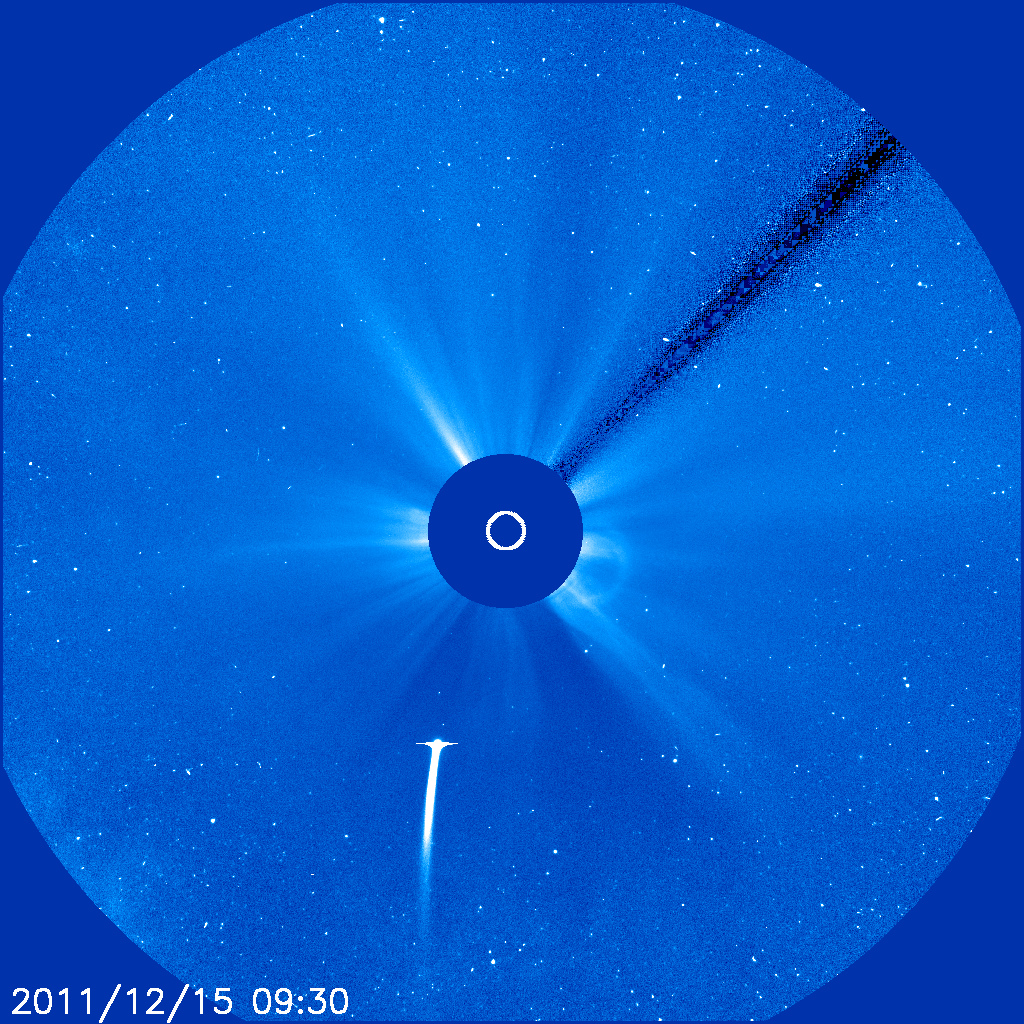
Comet Lovejoy at 9:30 UT or 2:23 a.m. EST. Courtesy of ESA, NASA, LASCO Team.
Click image to enlarge.
12/12/11 – Ephemeris – The Solar and Heliospheric Observatory (SOHO)
Monday, December 12th. The sun will rise at 8:09. It’ll be up for 8 hours and 52 minutes, setting at 5:02. The moon, 2 days past full, will rise at 7:15 this evening.
Most of this week will be on the topic of Comet Lovejoy which will pass a hundred thousand moles of the sun’s surface Thursday evening our time. It should be visible to the SOHO spacecraft orbiting the sun a million miles sunward of the earth starting Wednesday. Normally a spacecraft inside the earth’s orbit will orbit the sun in less time than the earth and move away from the earth. However SOHO is placed at a unique spot called L1, kind of a equilibrium point between the earth and sun SOHO means Solar and Heliospheric Observatory was launched in 1995 and has served as an early warning sentinel for solar storms approaching the earth pretty much ever since. It is with SOHO that we’ll see if Comet Lovejoy survives its plunge near the sun.
* Times, as always are for the Traverse City/Interlochen area of Michigan.
 Bob Moler's Ephemeris Blog