Archive
Ephemeris: 02/11/2025 – Newly discovered asteroid may have our number
This is Ephemeris for Tuesday, February 11th. Today the Sun will be up for 10 hours and 17 minutes, setting at 6:06, and it will rise tomorrow at 7:47. The Moon, 1 day before full, will set at 8:06 tomorrow morning.
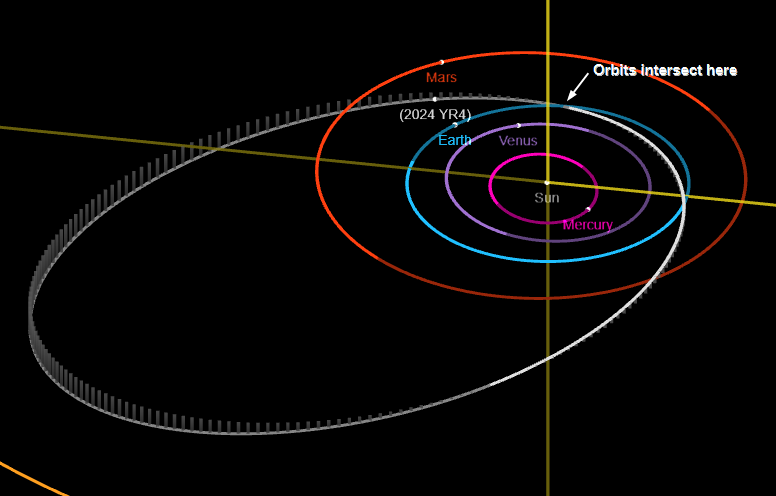
Late last year a tiny asteroid was found because it was close to the Earth and given the designation 2024 YR4. After observing it for a month it was discovered that it had a 1½ % chance of hitting the Earth when it came around again in 2032. Remember the fireball that exploded over Chelyabinsk Russia almost exactly 10 years ago? It exploded high in the air, and caused flying glass injuries to over a thousand people who saw the flash and rushed to the windows to see it when the atmospheric shock wave arrived. This object appears to be about 3 times the size of that object, nearly a football field in diameter, and thus could be 27 times the mass and volume. It’s four year orbit of the Sun will bring it back close to Earth in 2028 for us to get a better look at it and its orbit, and the last chance to alter its orbit.
The astronomical event times given are for the Traverse City/Interlochen area of Michigan (EST, UT – 5 hours). Times will be different for other locations.
Addendum
Ephemeris: 05/23/2024 – My observations of the Earth as a globe
This is Bob Moler with Ephemeris for Thursday, May 23rd. Today the Sun will be up for 15 hours and 7 minutes, setting at 9:13, and it will rise tomorrow at 6:05. The Moon, at full today, will rise at 9:58 this evening.
As far as I can remember back in time I’ve always thought that the Earth was a globe. To me that the Earth is flat is nonsensical. And I’ve looked to the sky as confirmation that the Earth was indeed a globe. During my first trip to a southern state I saw it for myself. From our vantage point here in Michigan the constellation of Scorpius the scorpion just scrapes the southern horizon at its highest. When traveling down to Kentucky it was higher in the sky, so that was my first proof that the Earth is round. I’ve since gone to Hawaii and even using the programs I wrote and use for the times for Ephemeris, based on the Earth as a globe, I was able to predict when and where to see the Southern Cross. It was right there as calculated by my program.
The astronomical event times given are for the Traverse City/Interlochen area of Michigan (EDT, UT–4 hours). They may be different for your location.
Addendum
06/09/2022 – Ephemeris – Looking at the gibbous Moon tonight
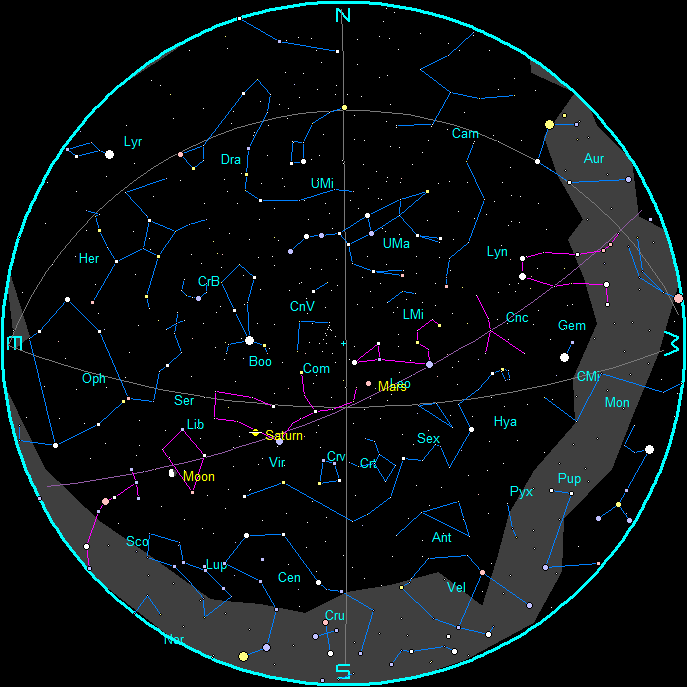
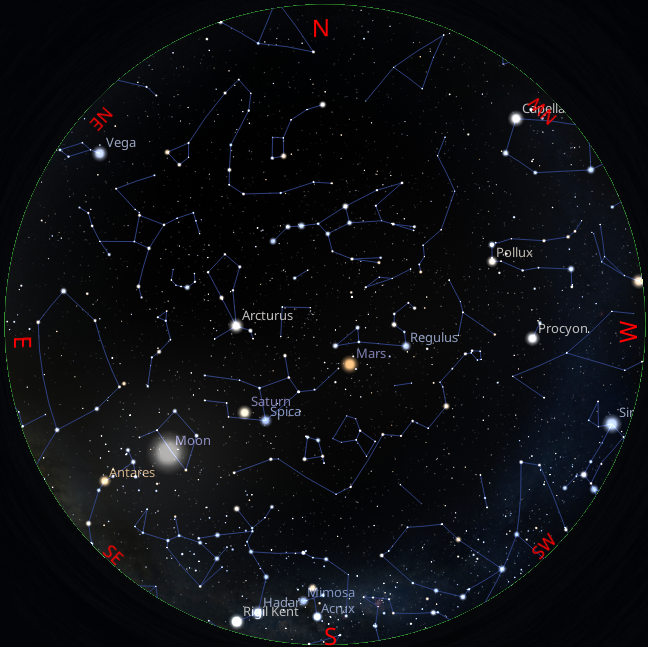
This is Bob Moler with Ephemeris for Thursday, June 9th. Today the Sun will be up for 15 hours and 29 minutes, setting at 9:27, and it will rise tomorrow at 5:57. The Moon, 2 days past first quarter, will set at 3:29 tomorrow morning.
By tonight, the gibbous moon will be quite bright. At the moon’s left edge, just coming into sunlight, will be what looks like a large half crater at the edge of the lunar sea called Mare Imbrium, the Sea of Showers. That feature is Sinus Iridium, or Bay of Rainbows. The arc of its mountainous edge is rainbow shaped, but it is as colorless as the rest of the Moon. The crater Copernicus sports few shadows and appears mostly as a bright spot surrounded by its ray system of ejecta craters that appear bright when the sun is high in their sky. At the south end of the Moon are the lunar highlands, bright, rugged and covered by large, mostly very old craters. Largest of these craters is Clavius, named for Christophorus Clavius who, working for Pope Gregory XIII, devised the Gregorian Calendar we use today.
The astronomical event times given are for the Traverse City/Interlochen area of Michigan (EDT, UT – 4 hours). They may be different for your location.
Addendum
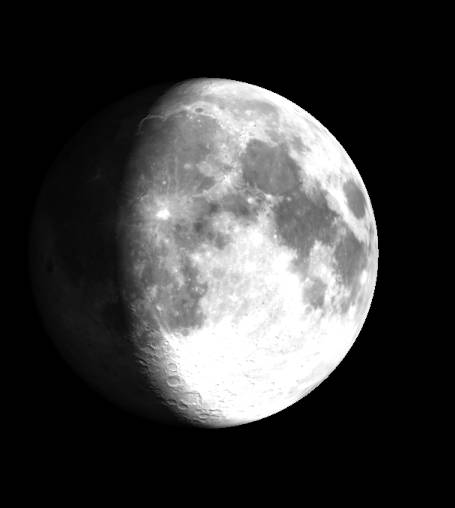
Binocular Moon as it might appear tonight, June 9, 2022. Below, we’ll look closer to the terminator area of the Moon. Created using Virtual Moon Atlas.
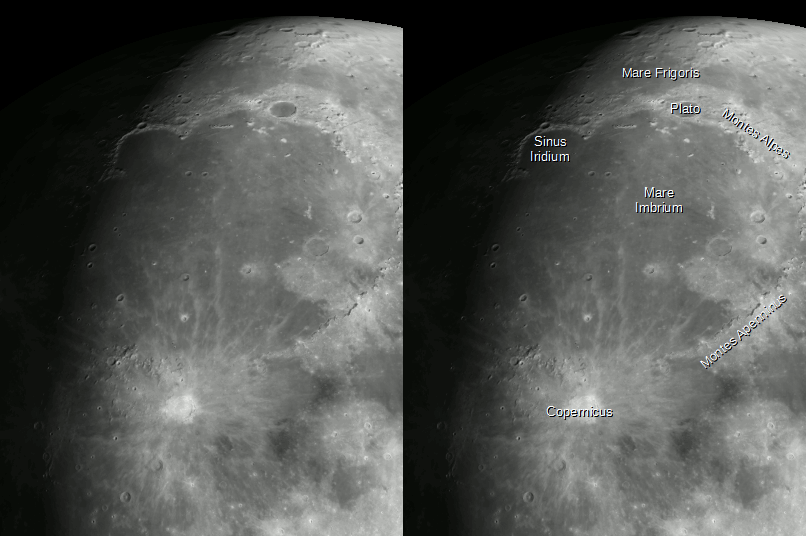
Northern gibbous Moon terminator area with labels for some prominent features. Created using Virtual Moon Atlas, LibreOffice and GIMP.
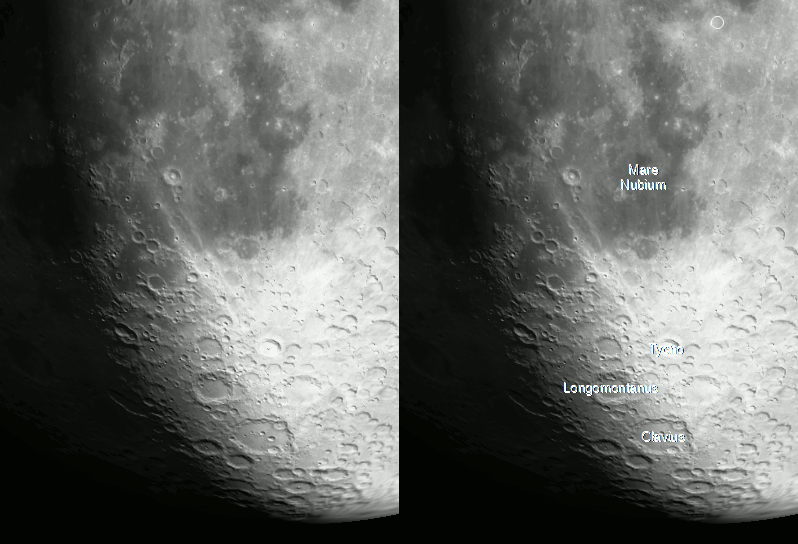
Southern gibbous Moon terminator area with labels for some prominent features. Created using Virtual Moon Atlas, LibreOffice and GIMP.
Translations
Mare Frigoris – Sea of Cold
Mare Imbrium – Sea of Showers
Mare Nubium – Sea of Clouds
Montes Alpes – Alps Mountains
Montes Appinenninus – Apennines Mountains
Sinus Iridium – Bay of Rainbows
09/23/2021 – Ephemeris – The Earth’s axial tilt gives us our seasons
This is Bob Moler with Ephemeris for Thursday, September 23rd. Today the Sun will be up for 12 hours and 6 minutes, setting at 7:37, and it will rise tomorrow at 7:32. The Moon, 3 days past full, will rise at 9:03 this evening.
The Earth has an axial tilt* of about 23 and a half degrees, which gives us our seasons. Because the Earth rotates on its axis, it has a slight equatorial bulge. Earth’s polar diameter is 7,900 miles (12,714 kilometers) while its equatorial diameter is 7,926 miles (12,756 kilometers), a difference of 26 miles (42 kilometers). The gravitational tug on that equatorial bulge by the Moon and Sun actually keeps the tilt stable, but does cause the Earth’s axis to precess like a top slowing down. It’s why Polaris will no longer be our North Pole star in centuries to come, just as it wasn’t in centuries past. It’s also why the constellations of the zodiac no longer align with the astrological signs of Ptolemy’s zodiac of the second century AD.
The astronomical event times given are for the Traverse City/Interlochen area of Michigan (EDT, UT-4 hours). They may be different for your location.
* Astronomers call axial tilt “obliquity” or “obliquity of the ecliptic”.
Addendum
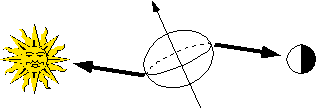
The Moon and Sun’s gravitational force act on the Earth’s equatorial bulge, attempting to cause the Earth to straighten up and fly right. Because the Earth is spinning, it acts like a gyroscope and the torque to straighten it up causes it to be applied 90 degrees away in the direction of the rotation causing the procession. Image credit: Open Course: Astronomy.
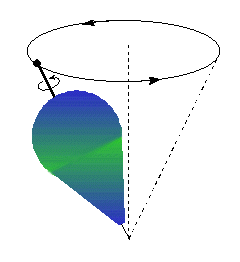
Precession of a spinning top: the spin axis traces the surface of a cone. The axis, in the case of the Earth, traces a circle of radius 23.5 degrees on the sky. Credit NASA.
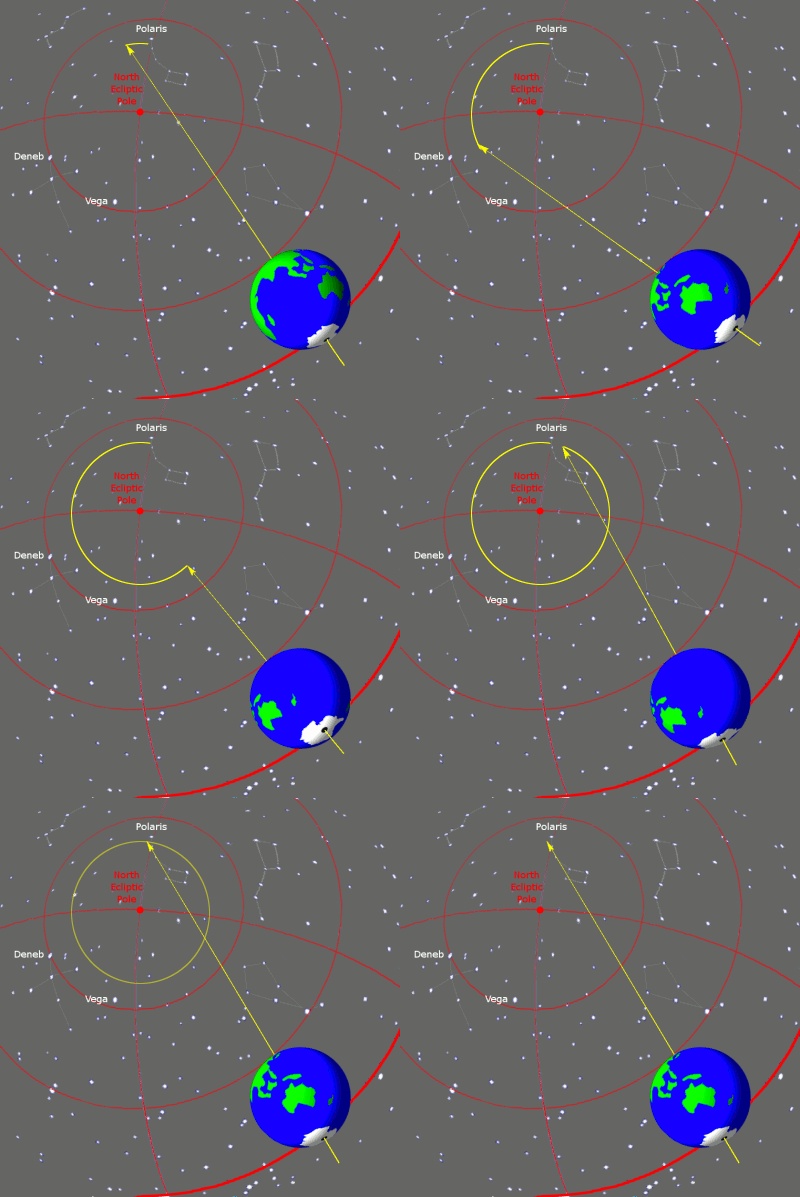
The 25,700-year cycle of precession traced on the sky as seen from near the Earth. The current North Pole star is Polaris (top). In about 8,000 years it will be the bright star Deneb (left), and in about 12,000 years, Vega (left center). The Earth’s rotation is not depicted to scale – in this span of time, it would actually rotate over 9 million times. Credit image: Tfr000, caption: Wikipedia.
09/13/2021 – Ephemeris – The Greeks knew the size and shape of the Earth and estimated the distance to the Moon a long time ago
This is Bob Moler with Ephemeris for Monday, September 13th. Today the Sun will be up for 12 hours and 37 minutes, setting at 7:56, and it will rise tomorrow at 7:20. The Moon, at first quarter today, will set at 11:57 this evening.
The Ancient Greeks used lunar eclipses to determine that Earth is a sphere, and worked on determining the distance to the Moon. From ancient times, the Greeks knew that an eclipse of the Moon was caused by the Earth’s shadow falling on the Moon. Since the Earth’s shadow was always circular, no matter where the Moon was in the sky during an eclipse, the Earth must be a sphere since that’s the only three-dimensional body that always casts a circular shadow. They also used the size of the Earth’s shadow to estimate the distance to the Moon. The lunar distance, on average, is 60.8 times the Earth’s radius away. The first estimates were about one third of that. Hipparchus in the 2nd century BC got much closer. It got even better from there.
The astronomical event times given are for the Traverse City/Interlochen area of Michigan (EDT, UT – 4 hr). They may be different for your location.
Addendum
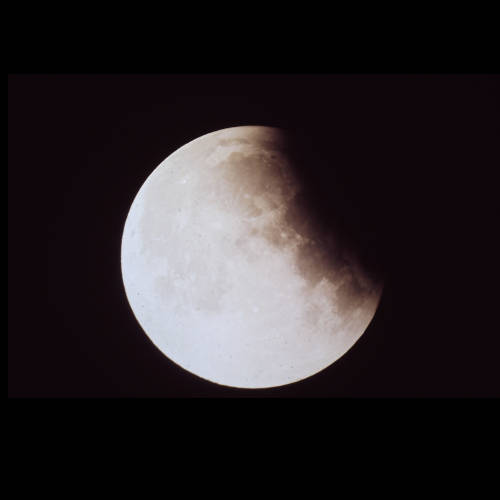
Partial Lunar Eclipse showing circular arc of the Earth’s shadow. Taken 04:15 UT August 17, 1970. Credit: the author.
The size of the Earth was unknown until Eratosthenes did in 240 BC. He came up with the circumference of the Earth to a fairly high degree. The Circumference is equal to the radius of a sphere or circle by 2πr.
07/03/2017 – Ephemeris – The Earth is farthest from the Sun today
Ephemeris for Monday, July 3rd. Today the Sun will be up for 15 hours and 28 minutes, setting at 9:30, and it will rise tomorrow at 6:03. The Moon, 3 days past first quarter, will set at 3:13 tomorrow morning.
At 8:59 tonight the Earth will pass a point in its orbit of the sun called aphelion, the farthest point from the sun of 94.5 million miles (152 million km). The whole Earth gets something like 6% less heat from the Sun than early January when the Sun is closest. So why is it summer now? The difference in distance from the sun pales as a cause of the seasons next to the tilt of the earth’s axis. Six months ago, because the sun was up for a shorter period each day, and didn’t rise very high in the sky, the sun gave us in northern Michigan something like 70% less heat than it does now. The real effect of aphelion coming in summer is that it makes summer the longest season at 94 days. This is because the farther the Earth is from the Sun, the slower it travels. Hey, it’s summer – take the hint and slow down and enjoy the season.
The times given are for the Traverse City/Interlochen area of Michigan. They may be different for your location.
08/28/2014 – Ephemeris – The evening Moon will stay low in the sky for the next couple of weeks.
Ephemeris for Thursday, August 28th. The sun will rise at 7:00. It’ll be up for 13 hours and 25 minutes, setting at 8:26. The moon, 3 days past new, will set at 9:40 this evening.
Since we’re within a month of the autumnal equinox, coming up on September 22nd, something funny is happening with the Moon rise and set times near both new and full moon. That is they aren’t changing very much. Here we are with the Moon three days old, and it still sets before the end of astronomical twilight. You may notice that for the next two weeks, that the Moon doesn’t get very high in the sky in the early evening. It’s path stays close to the horizon. Around first quarter next Tuesday the Moon will get to be just a little higher in the sky than the sun does on the first day of winter. The next full moon is the Harvest Moon, being the full moon closest to the first day of autumn. Then the day-to-day succession of rise times again will slow.
Times are for the Traverse City/Interlochen area of Michigan. They may be different for your location.
Addendum
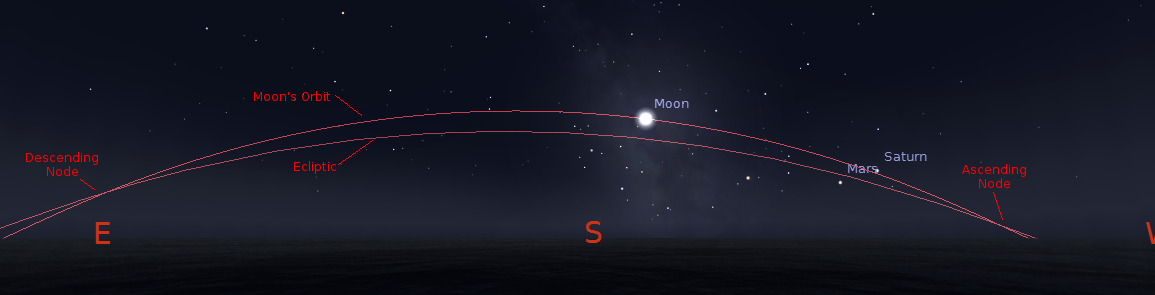
The Moon on September 3, 2014 a day after first quarter. It will rise higher after that if one stays up long enough. Created using Stellarium. Click on image to enlarge.
In the image above the Moon’s orbit is compared to the ecliptic, the plane of the Earth’s orbit to which it’s inclined by about 5º. Note the two points where these lines cross. The point where the Moon’s orbit crosses the ecliptic heading northward is called the ascending node. The crossing point heading southward is the descending node. The important thing about that is the when the moon passes a node while at new or full, an eclipse will occur, which they will do in October. There will be a total lunar eclipse on the morning of October 8th, then a partial solar eclipse on October 23rd as the sun is setting here in northern Michigan. I’ll have more information as the events gets closer.
07/10/2014 – Ephemeris – Why is the bright Moon so low in summer and so high in winter?
Ephemeris for Thursday, July 10th. Today the sun will be up for 15 hours and 20 minutes, setting at 9:28. The moon, 2 days before full, will set at 5:22 tomorrow morning. Tomorrow the sun will rise at 6:08.
If you watch the moon for the next few nights, you won’t have to strain your neck because the moon at its highest will be less than 30 degrees above the southern horizon for us in northern Michigan. That’s because the moon closely follows the path of the sun in the sky, called the ecliptic, with a deviation of only 5 degrees maximum. Tonight it’s a couple of degrees north of the ecliptic. Tonight it’s located about where the sun was back last November or will be next November. In winter you’d swear that the full moon at its greatest height was practically overhead. It’s another effect of the Earth’s axial tilt of 23 ½ degrees. Our moon is odd in it doesn’t orbit the Earth’s equator like most large moons do for their planets.
Times are for the Traverse City/Interlochen area of Michigan. They may be different for your location.
Addendum
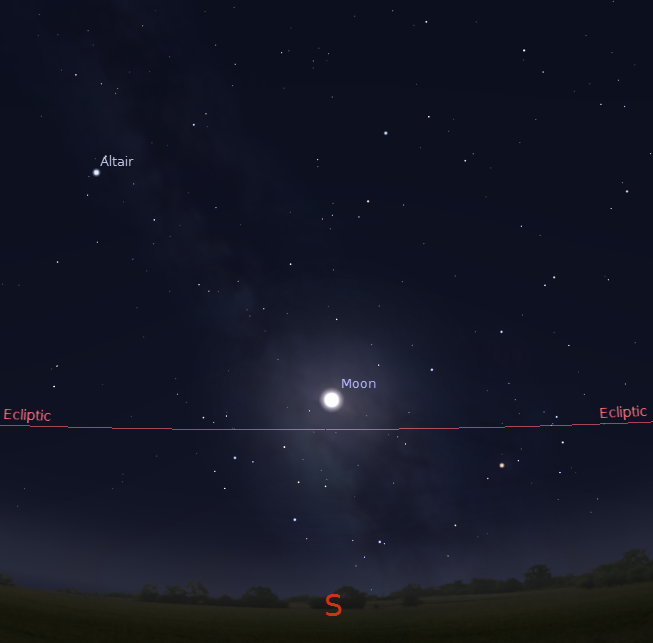
The full Moon on July, 12, 2014. Created using Stellarium.
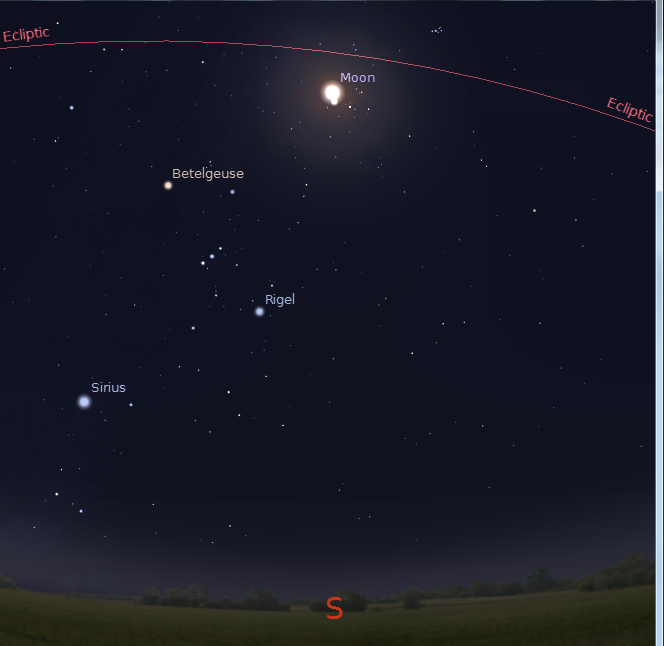
The full Moon on December 6, 2014. Created using Stellarium.
01/02/2014 – Ephemeris – Quadrantids and the Earth at Perihelion tomorrow night
Ephemeris for Thursday, January 2nd. The sun will rise at 8:19, the latest sunrise of the year. It’ll be up for 8 hours and 54 minutes, setting at 5:14. The moon, 1 day past new, will set at 7:16 this evening. | The Quadrantid meteor shower will be the best meteor shower of the year since the other showers will have to contend with the bright moon. The best time to see them will be between midnight and 6:30 in the morning Friday night through Saturday morning. They will seem to come from behind the Big Dipper’s handle. Weird though it seems. At 1 a.m. Saturday morning the Earth will be closest to the sun in it’s orbit. This is called perihelion. The earth at that instant will be 91.45 million miles away. On July 3rd it will be at its farthest, about 94 and a half million miles away. This slight distance variance doesn’t affect us much except to make winter shorter than summer by a few days. You probably won’t believe that either.
Times are for the Traverse City/Interlochen area of Michigan. They may be different for your location.
Addendum
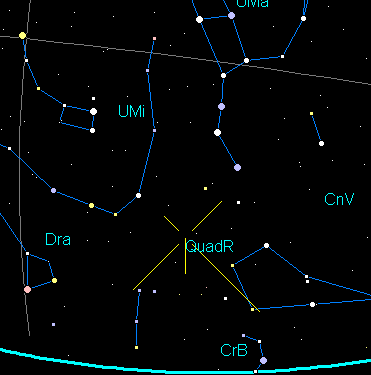
Quadrantid meteor shower radiant low in the noirtheast at 1:30 a.m.
The Bad Astronomer’s take on perihelion is here.
Also for this and the rest of the year here is David Dickinson’s 101 Astronomical Events for 2014 on Universe Today.
04/22/2013 – Ephemeris – Spaceship Earth
Ephemeris for Earth Day, Monday, April 22nd. The sun rises at 6:46. It’ll be up for 13 hours and 50 minutes, setting at 8:36. The moon, 3 days before full, will set at 5:17 tomorrow morning.
The earth is unique in the solar system. Actually every planet is unique, as we’ve found out with our spacecraft that have at least flown by every planet of the solar system, and we’re two years from flying by the dwarf planet Pluto and its so far discovered 5 moons. But the earth uniquely supports life as we know it. It is the only one. While it is imperative that we colonize the moon, Mars and asteroids and live off the land so no single disaster can wipe us out, we need to take care of the earth, to understand and get a grip on what we’re doing to earth’s climate. We must think of the earth as a spaceship with both renewable resources and limited ones. Our journey is long, the supplies will have to last.
Times are for the Traverse City/Interlochen area of Michigan. They may be different for your location.
Addendum

Our home. Credit NASA.
 Bob Moler's Ephemeris Blog