Archive
Ephemeris: 01/26/2026 – Artemis, not just flags and footprints
This is Ephemeris for Monday, January 26th. Today the Sun will be up for 9 hours and 35 minutes, setting at 5:43, and it will rise tomorrow at 8:07. The Moon, 1 day past first quarter, will set at 3:10 tomorrow morning.
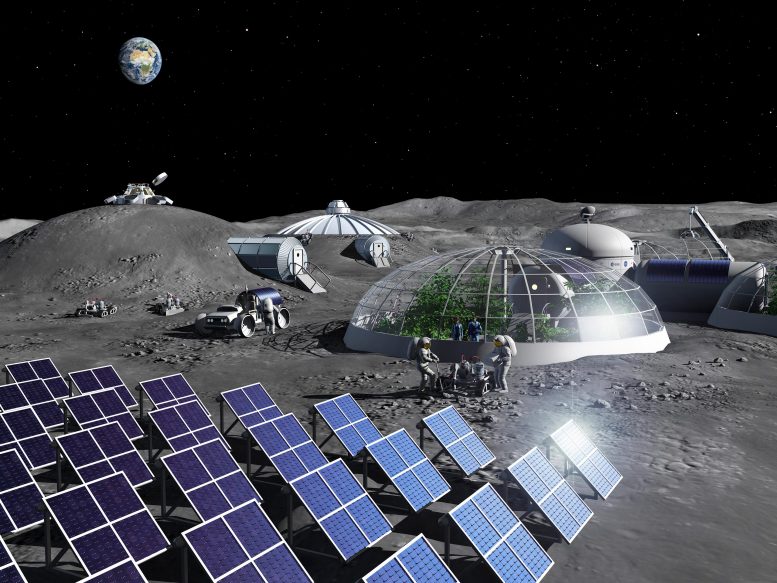
The current space race or I might say more properly, Moon race, is more than it was in the 1960s this race is not simply what is called a flag and footprints race get there first and go home. We already did that 57 years ago. But to set up permanent settlements on the moon to explore and extract the Moon’s resources like water. Water is not for export. Whatever water we find on the Moon would still be fairly scarce and probably rationed. There’s also an unknown amount of helium 3, which is a useful fuel for fusion reactors. Something we don’t have on the Earth, but would be the Holy Grail for clean energy production. We don’t know the Moon’s mineral potential, but whatever we find won’t have to be hauled up a quarter of a million miles from the Earth.
The astronomical event times given in this blog are for the Traverse City/Interlochen area of Michigan (Lat 44.7° N, Long 85.7° W; EST, UT – 5 hours) unless stated otherwise. Times will be different for other locations.
Addendum
Ephemeris: 10/06/2025 – Tonight’s full moon is the Harvest Moon!
This is Ephemeris for Monday, October 6th. Today the Sun will be up for 11 hours and 26 minutes, setting at 7:13, and it will rise tomorrow at 7:48. The Moon, at full today, will rise at 6:53 this evening.
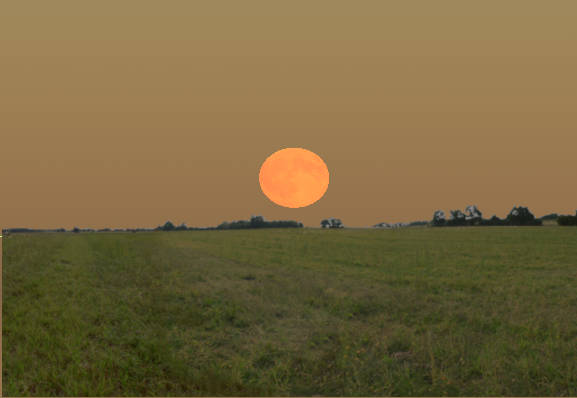
Today’s full moon is the nearest full moon to the autumnal equinox which makes it the Harvest Moon. Normally, October’s full moon is called the Hunter’s Moon, so it can be both at the same time. The indigenous peoples of our area, the Anishinaabe, call it the Falling Leaves Moon and indeed this month the leaves will fall from deciduous trees, after giving us a couple of weeks of spectacular color. The exact time that the moon will be full will be 11:48 PM this evening. Therefore, the Moon is going to rise very close to sunset. As a matter of fact, it will rise 20 minutes before sunset, so it should be a very spectacular rising of an orangish moon which, this time of year, will remind one of a pumpkin.
The astronomical event times given in this blog are for the Traverse City/Interlochen area of Michigan (Lat 44.7° N, Long 85.7° W; EDT, UT – 4 hours) unless stated otherwise. Times will be different for other locations.
Addendum
Ephemeris: 09/08/2025 – Previewing the Harvest Moon Effect
This is Ephemeris for Monday, September 8th. Today the Sun will be up for 12 hours and 52 minutes, setting at 8:05, and it will rise tomorrow at 7:14. The Moon, 1 day past full, will rise at 8:30 this evening.
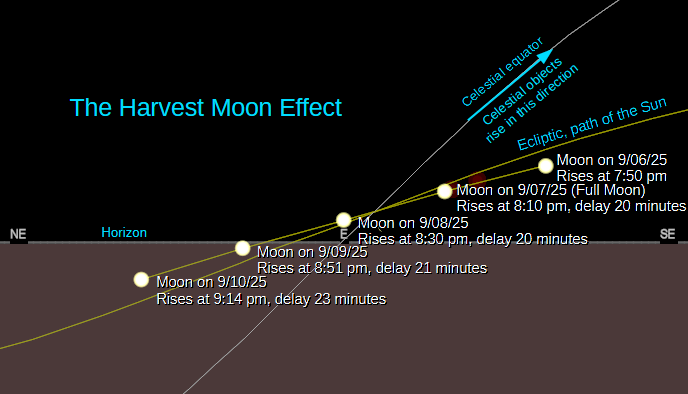
Last night’s full moon was not the Harvest Moon. We normally expect the Harvest Moon to come in September, but this year it does not because it is not the closest full moon to the autumnal equinox. The full moon of October 6th, this year, is the nearest full moon to the autumnal equinox. So it this month’s full moon is called the Corn Moon. But the effects of this full moon are the same as the Harvest Moon, in that the Moon rises only slightly later each evening for about a week or so. The Moon tonight will rise only 20 minutes later than it rose last night. The average day-to-day interval of moon rising is about 50 minutes. This earlier rising time had the effect of extending twilight which helped early farmers with an extra hour to gather in their crops.
The astronomical event times given in this blog are for the Traverse City/Interlochen area of Michigan (Lat 44.7° N, Long 85.7° W; EDT, UT – 4 hours) unless stated otherwise. Times will be different for other locations.
Addendum
Ephemeris: 08/29/2025 – Late August crescent Moon stays low in the western sky
This is Ephemeris for Friday, August 29th. Today the Sun will be up for 13 hours and 22 minutes, setting at 8:24, and it will rise tomorrow at 7:03. The Moon, 2 days before first quarter, will set at 10:48 this evening.
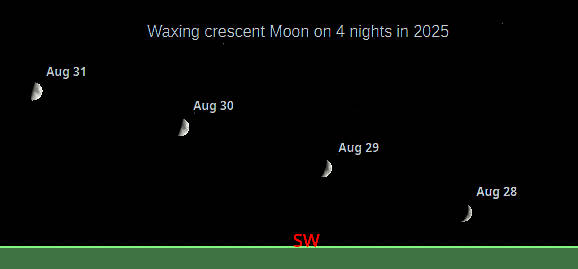
There’s an interesting feature that I’ve noticed about the Moon this time of year. When there’s a waxing crescent Moon in the evening, in late summer to early autumn, it’s seen pretty low in the southwestern sky after sunset. Tonight it’ll be two days before first quarter so it’ll be a fat crescent. However, when it’s seen after sunset, it will be very low in the southwestern sky. Contrast that for early risers, at this time of year the waning crescent Moon moves at a steep angle to the horizon, as do the planets now in the east. And of course the opposite is true for late winter and early spring moons. By the way, the Harvest Moon is in early October this year. The Harvest Moon is the nearest full moon to the autumnal equinox.
The astronomical event times given in this blog are for the Traverse City/Interlochen area of Michigan (Lat 44.7° N, Long 85.7° W; EDT, UT – 4 hours) unless stated otherwise. Times will be different for other locations.
Addendum
Ephemeris: 08/07/2025 – Does the Moon rotate?
This is Ephemeris for Thursday, August 7th. Today the Sun will be up for 14 hours and 23 minutes, setting at 9:00, and it will rise tomorrow at 6:37. The Moon, 2 days before full, will set at 5:26 tomorrow morning.
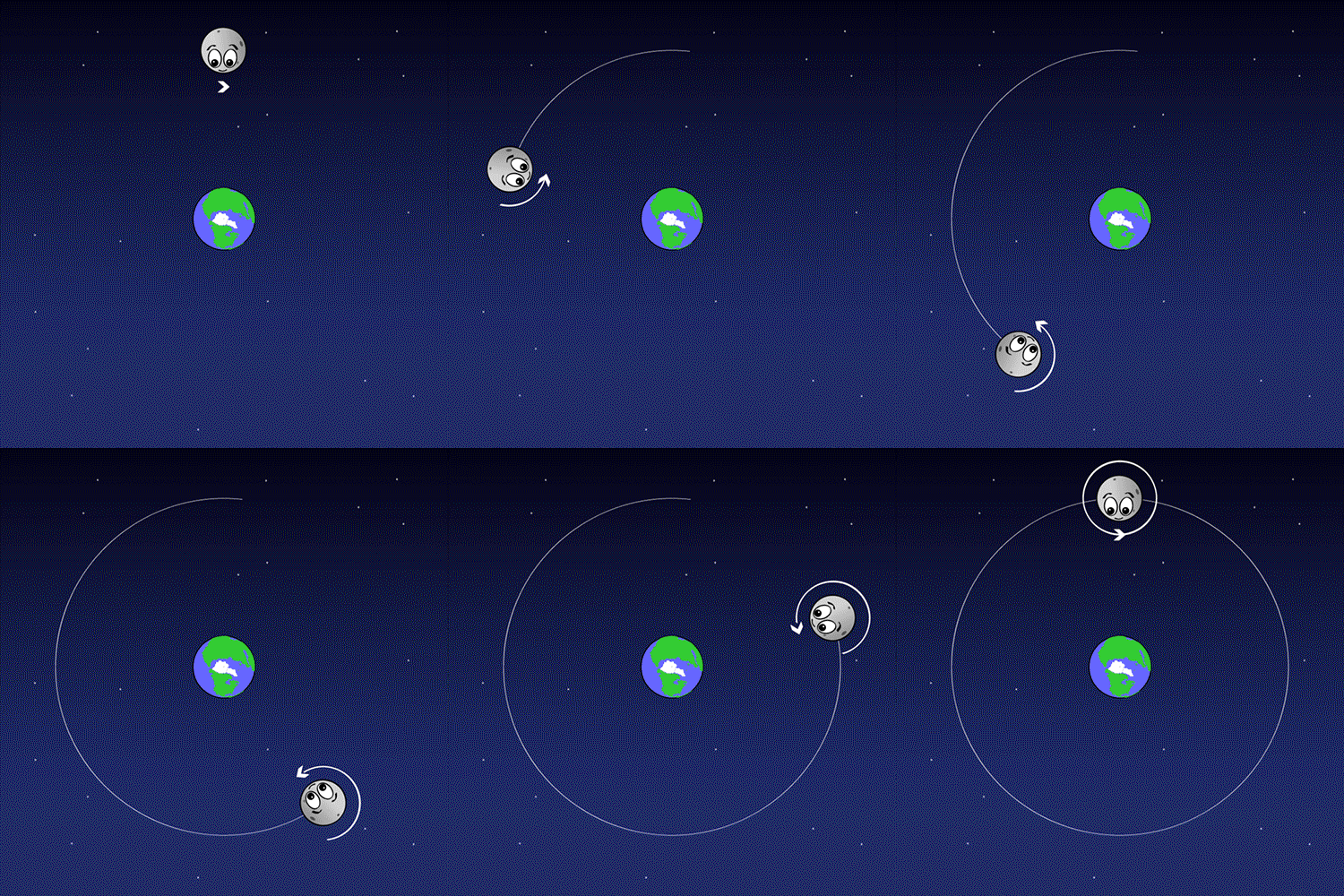
The moon exhibits the same face to the Earth throughout the month. That doesn’t mean the Moon doesn’t rotate. It means that the moon rotates in the same time it takes to orbit the Earth. This is called synchronous rotation. It is also known as tidal locking, caused by the difference in the gravitational attraction across the body of the Moon from the near side to the far side. The same thing happens with the Earth and is best seen by the ocean tides on the part of the Earth facing and away from the Moon. The reason the Earth is not tidally locked is that it is much more massive. But the Moon is slowing down the Earth’s rotation. But by doing that, it is moving further away, so it will never totally lock the Earth’s rotation with it.
The astronomical event times given in this blog are for the Traverse City/Interlochen area of Michigan (Lat 44.7° N, Long 85.7° W; EDT, UT – 4 hours) unless stated otherwise. Times will be different for other locations.
Addendum
Ephemeris: 08/05/2025 – Why space faring nations are fixated on the Moon’s South Pole
This is Ephemeris for Tuesday, August 5th. Today the Sun will be up for 14 hours and 28 minutes, setting at 9:02, and it will rise tomorrow at 6:35. The Moon, halfway from first quarter to full, will set at 3:06 tomorrow morning.
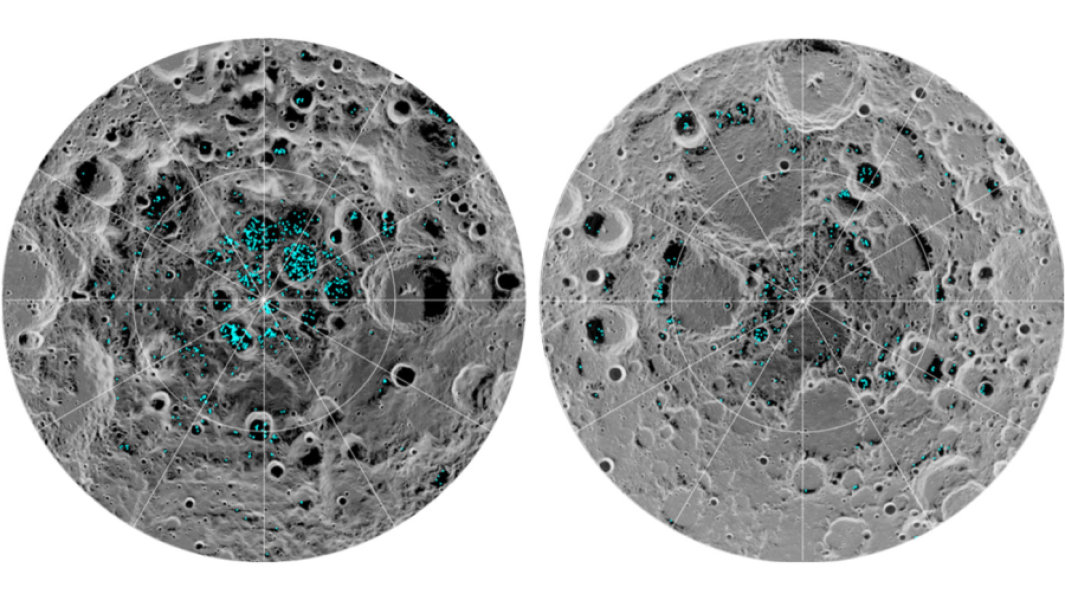
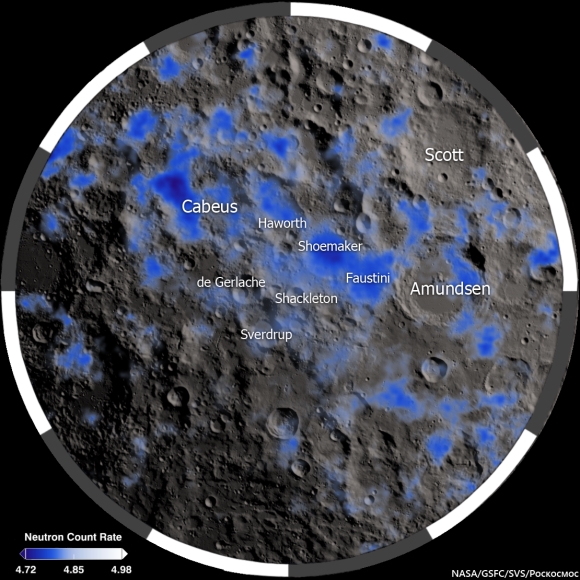
After more than 50 years since the Apollo landings on the Moon, space faring nations are beginning to be interested in one particular place on the Moon for further exploration. That is the lunar South Pole. The reason is the discovery of something more valuable than gold. That there may be water hidden in permanently shadowed craters there. The moon’s North Pole is not as rugged, so there’s probably not as much water there. Water can exist on the Moon but only in its frozen form, ice in permanently shadowed craters. The Moon’s axial tilt is only about 1 1/2° compared to the Earth’s 23 1/2°. The water molecule is the second most abundant in the universe after diatomic hydrogen, but normally cannot exist this close to the Sun.
The astronomical event times given in this blog are for the Traverse City/Interlochen area of Michigan (Lat 44.7° N, Long 85.7° W; EDT, UT – 4 hours) unless stated otherwise. Times will be different for other locations.
Addendum
Ephemeris: 07/07/2025 – Old and new explanations of the Moon’s appearance
This is Ephemeris for Monday, July 7th. Today the Sun will be up for 15 hours and 24 minutes, setting at 9:30, and it will rise tomorrow at 6:05. The Moon, 3 days before full, will set at 3:30 tomorrow morning.
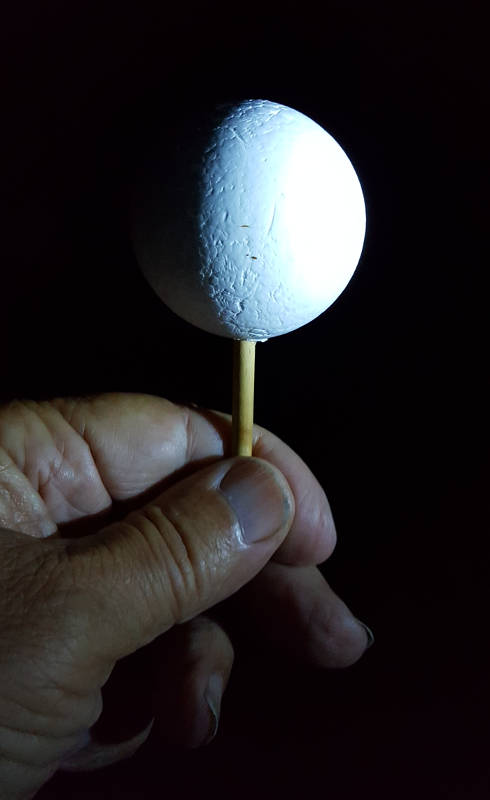
The Moon’s changing appearance over the month may seem to be mysterious at first glance. Maybe because one may think that the objects in the sky are somehow different from the familiar objects we see around us on the Earth. In ancient times, especially the Greeks thought that everything in the heavens was perfect and spotless. They explained the definite markings we see as the man-in-the-moon as a reflection of the Earth by a spotless Moon. The Moon’s phases are simply light and shadow on a ball in the sunlight. Sometime, when the Moon appears in the daytime, take a small ball, like a golf ball and hold it up to the Moon, while the ball is also in sunlight, and the small ball will exhibit the same phase as the Moon.
See 10/12/18
The astronomical event times given in this blog are for the Traverse City/Interlochen area of Michigan (Lat 44.7° N, Long 85.7° W; EDT, UT – 4 hours) unless stated otherwise. Times will be different for other locations.
Addendum
Ephemeris: 06/03/2025 – Looking at the Moon tonight
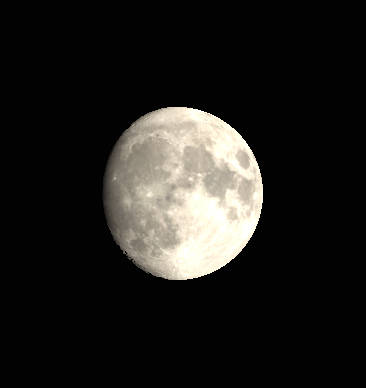
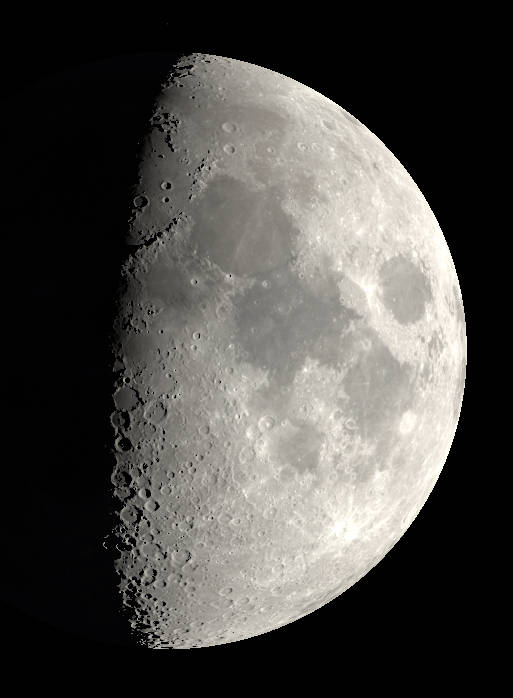
This is Bob Moler with Ephemeris for Tuesday, June 3rd. Today the Sun will be up for 15 hours and 23 minutes, setting at 9:23, and it will rise tomorrow at 5:58. The Moon, 1 day past first quarter, will set at 2:41 tomorrow morning.
For me, the best time to view the Moon with binoculars or a telescope is around first quarter and tonight’s Moon is just a day past first quarter. At this time we see the maximum amount of shadowing of the craters because the sunrise line which we call the terminator is cutting across, pretty much, the center of the Moon. Since the Moon is a pretty uniformly dark gray with light gray areas, shadows make all the difference in seeing detail. One thing to notice on tonight’s Moon is that the southern or bottom part of the Moon has a lot of craters and is bright gray. This is called the lunar highlands and is brighter than the darker areas to the north and on the western side of the Moon, which are covered by the maria or seas, plains of solidified lava flows.
The astronomical event times given in this blog are for the Traverse City/Interlochen area of Michigan (Lat 44.7° N, Long 85.7° W; EDT, UT – 4 hours) unless stated otherwise. Times will be different for other locations.
Addendum
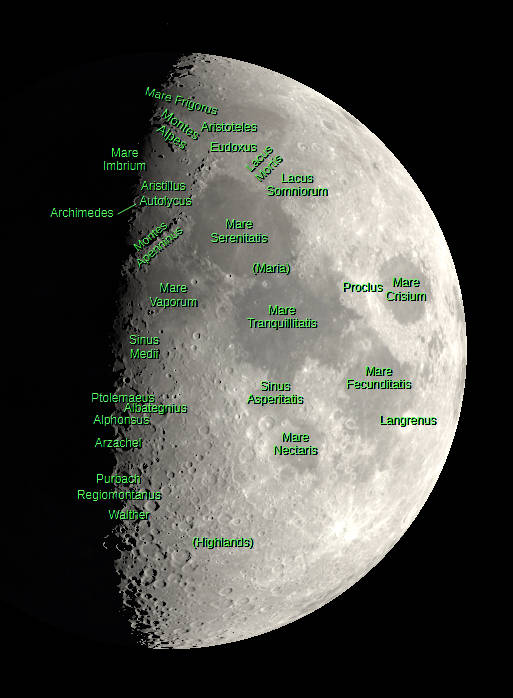
Translations of some lunar feature names according to Virtual Moon Atlas
Lacus Mortis – Lake of Death
Lacus Somniorum – Lake of Dreams
Mare Crisium – Sea of Crises
Mare Fecunditatis – Sea of Fruitfulness
Mare Frigoris – Sea of Cold
Mare Imbrium – Sea of Showers
Mare Nectaris – Sea of Nectar
Mare Serenitatis – Sea of Serenity
Mare Tranquillitatis – Sea of Tranquility
Mare Vaporum – Sea of Vapors
Montes Alpes – Alps Mountains
Montes Apenninus – Apennines Mountains
Sinus Asperitatis – Bay of Roughness
Sinus Medii – Central Bay
Note: Mare is pronounced Mar-e, and Maria is pronounced Mar-e-a.
These features, for the most part, were named by Giovanni Battista Riccioli in 1651, when he produced the first accurate map of the Moon. Craters are named for persons, real or otherwise. Features like Seas, Lakes and Bays were given fanciful names. Labels are centered on their feature where possible.
Ephemeris: 04/03/2025 – Blue Ghost’s two week long cold night
This is Ephemeris for Thursday, April 3rd. Today the Sun will be up for 12 hours and 53 minutes, setting at 8:13, and it will rise tomorrow at 7:17. The Moon, 1 day before first quarter, will set at 3:23 tomorrow morning.
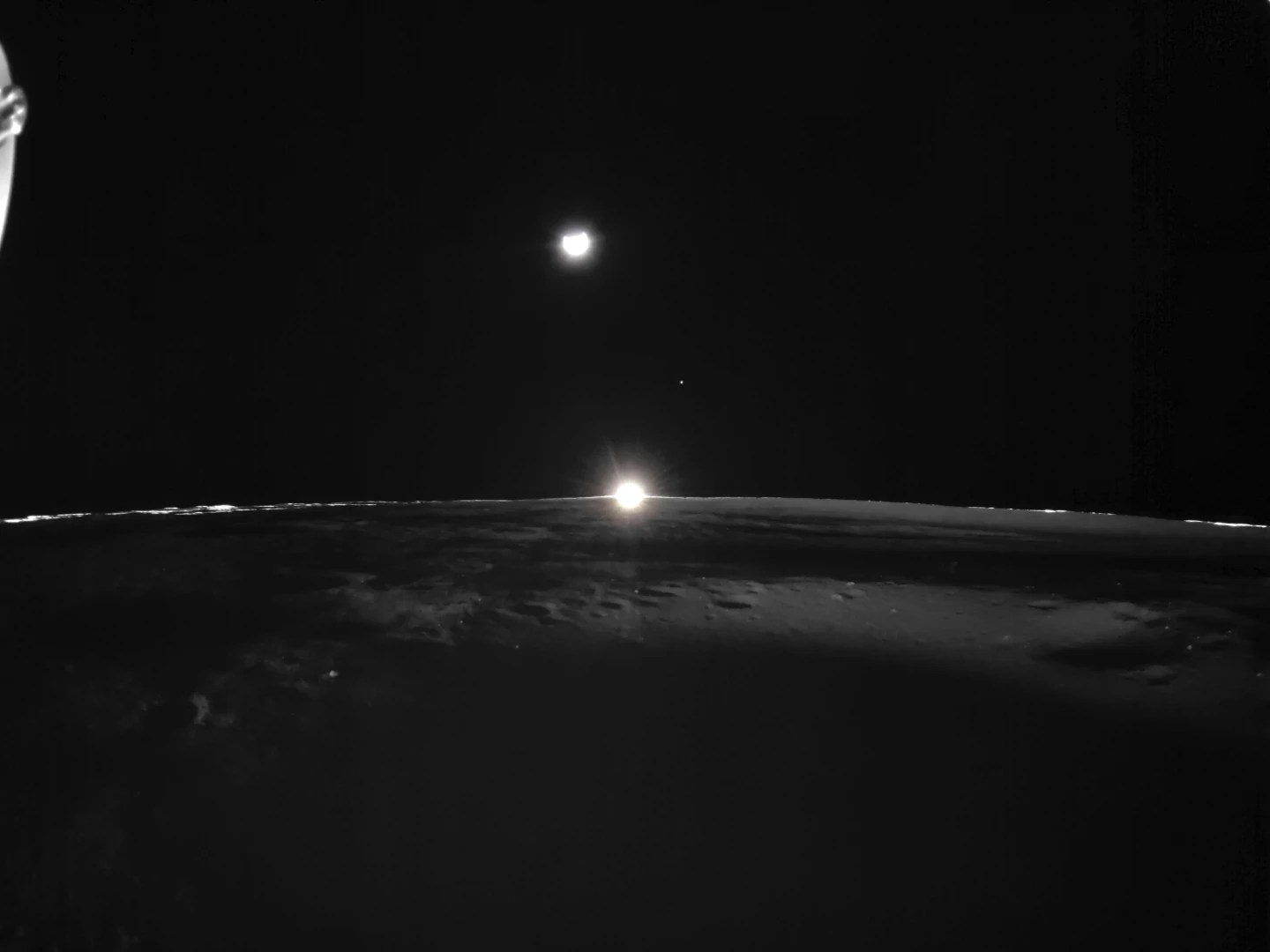
During the last lunar day the Blue Ghost Lander spend its time from little after sunrise until a little after sunset investigating the surface of the Moon at the lunar Sea of Crises or Mare Crisium. It wasn’t expected to survive the two-week-long night. It wasn’t expected to because it had no internal heating and at night the temperatures on the Moon can drop to down to minus 208° F, or a little bit more on the night side. During the day the temperature gets up to 250° which is pretty hot for some of the electronics. But what really kills a Lander is at night where they can’t recharge the batteries and the batteries drop in temperature to 200° below zero for two weeks. They generally do not survive.
The astronomical event times given are for the Traverse City/Interlochen area of Michigan (EDT, UT – 4 hours). Times will be different for other locations.
Addendum
Ephemeris: 03/10/2025 – Aristarchus, the brightest spot on the Moon, but not tonight
This is Ephemeris for Monday, March 10th. Today the Sun will be up for 11 hours and 39 minutes, setting at 7:42, and it will rise tomorrow at 8:01. The Moon, 4 days before full, will set at 7:11 tomorrow morning.
The moon tonight is bright. The sunrise line or terminator on the moon is crossing the large gray plain called Oceanus Procellarum, the largest of the moon’s seas. These seas were figments of the first telescopic observer’s imagination. They are really huge impact basins into which interior lava flowed. On the left edge of the Moon, just below center, this evening, at the terminator is a small shadow filled crater that might be visible in binoculars, but definitely telescopes. It’s called Aristarchus. It is a fairly new crater, probably less than a billion years old. As a rule the brighter the crater the newer it is. Aristarchus is the brightest spot on the Moon, when it is full. Visual astronomers have seen hazes and bright spots on rare occasions in and near Aristarchus.
The astronomical event times given are for the Traverse City/Interlochen area of Michigan (EST, UT – 5 hours). Times will be different for other locations.
Addendum
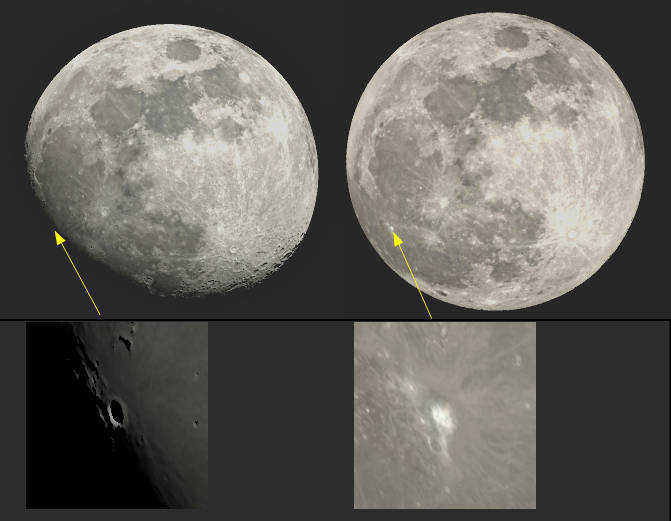
Aristarchus tonight, March 10, 2025, on the terminator (left), and Friday night, the 14th, before the total lunar eclipse starts. The enlargements show the telescopic view. Created using Stellarium, LibreOffice Draw and GIMP. The Moon doesn’t actually appear larger on the 14th. Apparently my field of view changed while getting the 14th’s image.
 Bob Moler's Ephemeris Blog