Archive
02/08/2022 – Ephemeris – The first quarter Moon tonight
This is Ephemeris for Tuesday, February 8th. Today the Sun will be up for 10 hours and 8 minutes, setting at 6:01, and it will rise tomorrow at 7:51. The Moon, at first quarter today, will set at 2:34 tomorrow morning.
The Moon tonight, will be about 12 hours past being exactly first quarter, so it will be showing to be just a bit gibbous, that is a bit more than 50% illuminated by the Sun from our vantage point. In binoculars, the gray lunar seas, which are actually frozen lava filled plains, dominate the upper right quarter of the Moon. At the bottom, or south end of the Moon are the lighter more cratered region of the Moon called the Lunar Highlands. It is near the terminator, the line between day and night on the Moon, where shadows are longest, where craters can be seen by the shadows of the rims. Farther away from the terminator, the Sun is higher in the Moon’s sky, so the shadows get shorter or disappear all together.
The astronomical event times given are for the Traverse City/Interlochen area of Michigan (EST, UT – 5 hours). They may be different for your location.
Addendum
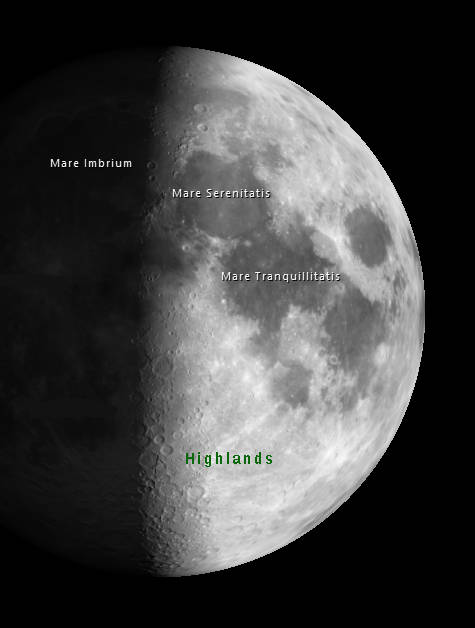
The is what the Moon might look like tonight, hours after first quarter. Just a bit of Mare Imbrium (Sea of Showers) is visible. Mare Serenitatis is the Sea of Serenity, Mare Tranquilitatis is the Sea of Tranquility. The green annotation is mine. BTW, Mare is pronounced Mar-e. It’s Latin, meaning sea. Created using Virtual Moon Atlas, a free app that can be downloaded from a link on the right, or listed under Free Astronomical Software.
02/07/2022 – Ephemeris – The Moon tonight
This is Ephemeris for Monday, February 7th. Today the Sun will be up for 10 hours and 5 minutes, setting at 6:00, and it will rise tomorrow at 7:53. The Moon, 1 day before first quarter, will set at 1:29 tomorrow morning.
Tonight, let’s take a look at the nearly first quarter Moon. The small, nearly circular gray spot is the sea of Crises. A diagonal chain of larger seas run from the terminator, the sunrise line, to below the Sea of Crises. They are, from the terminator, the seas of Serenity, Tranquility and Fertility. NASA is hoping to launch its uncrewed mission to the Moon, Artemis-1, next month with a large block of launch dates. The launch window begins on March 12th and ends on the 27th, with two blackout dates. Two lengths of missions are possible, a long 38 to 42 day mission is possible in the first part of the launch window, and a shorter 26 to 28 day mission is possible in the latter part of the window.
The astronomical event times given are for the Traverse City/Interlochen area of Michigan (EST, UT – 5 hours). They may be different for your location.
Addendum
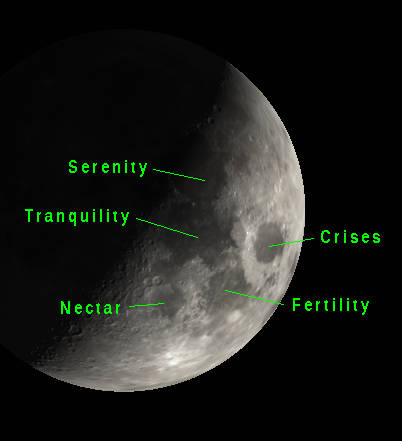
The Moon as it might appear tonight in binoculars or a small telescope at 7 pm tonight, February 7, 2022. I labeled the lunar seas with their English names, translated from the Latin. Also labeled is the Sea of Nectar, which wasn’t mentioned in the program. Moon image created using Stellarium.
01/13/2022 – Ephemeris – The Moon, first target for a new telescope
This is Ephemeris for Thursday, January 13th. Today the Sun will be up for 9 hours and 8 minutes, setting at 5:26, and it will rise tomorrow at 8:17. The Moon, halfway from first quarter to full, will set at 5:47 tomorrow morning.
The Moon is probably the first astronomical object owners of a new telescope look at. The first discovery is that it’s not that easy to find. Most telescopes produce an upside down or a mirror reversed image, so steering the telescope may take a bit of getting used to. The Moon is at its gibbous phase tonight, so it’s quite bright, and a lot of it doesn’t have much contrast except for the large dark gray areas, called seas. There’s no water in them, of course, but they are huge lava basins caused by large asteroid impacts in the early days of the Moon’s history. The best detail on the Moon is near the terminator, in the time before full moon, it is the sunrise line. There the shadows are longest, and the detail of craters are best seen.
The astronomical event times given are for the Traverse City/Interlochen area of Michigan (EST, UT – 5 hours). They may be different for your location.
Addendum
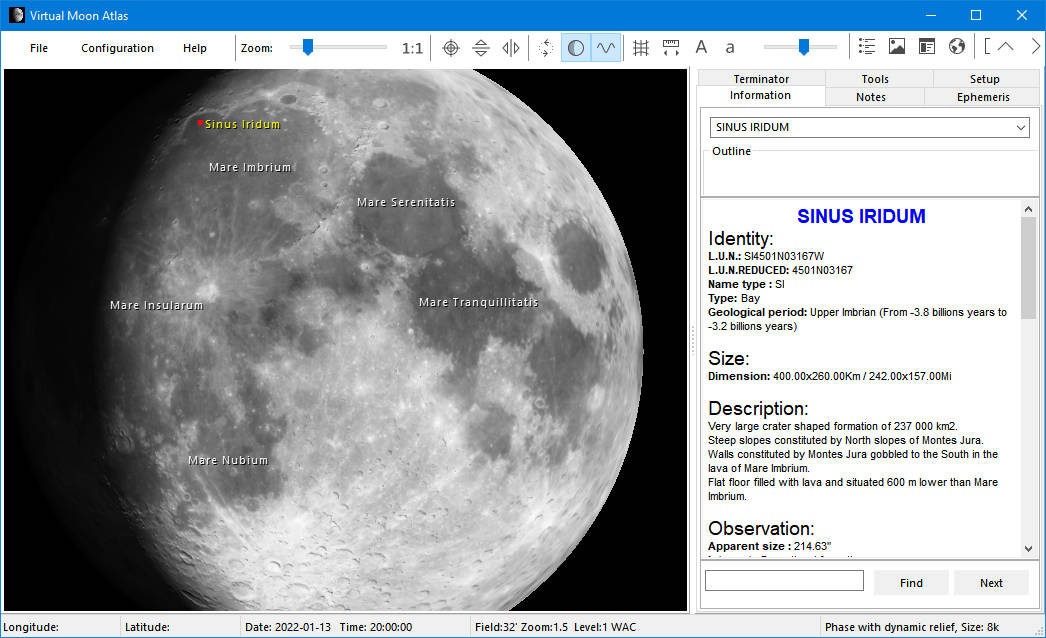
This is a great guide to the Moon called Virtual Moon Atlas for a computer, showing the Moon for any date and time. It’s a free app which runs natively on Windows, but also can run with emulators on Linux and macOS. I find it to be an amazing program. Check it out under Free Astronomical Software on the right of this page.
The other free app I use is Stellarium (See the right column). Zoom in enough, so the Moon fills the frame, and It will show labels to some of its features if clicked on.
12/17/2021 – Ephemeris – Artemis-1 mission may launch in less than 2 months
This is Ephemeris for Friday, December 17th. Today the Sun will be up for 8 hours and 48 minutes, setting at 5:03, and it will rise tomorrow at 8:15. The Moon, 1 day before full, will set at 7:56 tomorrow morning.
In a little less than two months, a fifteen-day launch window opens up to launch Artemis one, the first and hopefully only uncrewed Artemis mission to the Moon in the NASA’s program to land the next man and first woman on the Moon. The uncrewed Orion capsule and the ESA contributed Service Module will orbit the Moon in a very elongated distant orbit of the Moon, retreating out to 38,000 miles (61,000 kilometers) further than the Moon once or twice before heading within 60 miles of the Moon’s surface on its way back to the Earth. The upper stage, that sends Orion on its way to the Moon, will release some CubeSats as it follows Orion to the Moon, where it will whip around the Moon to orbit the Sun.
The astronomical event times given are for the Traverse City/Interlochen area of Michigan (EST, UT – 5 hours). They may be different for your location.
Addendum
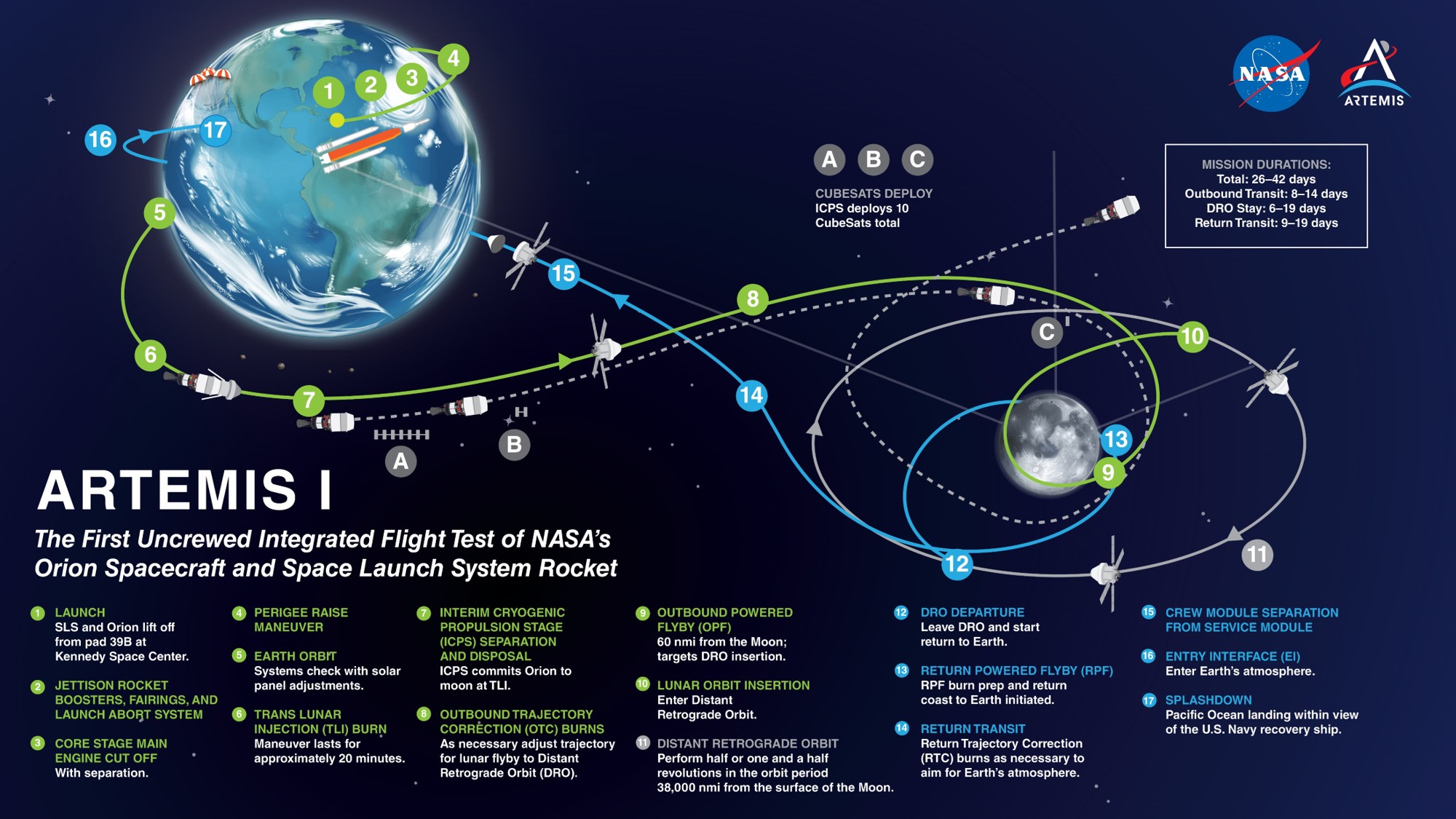
Artemis-1 orbital plan. Click on the image to enlarge it. Credit NASA.

The Earth and Moon to scale. Source Wikipedia.
12/16/2021 – Ephemeris – The brightest spot on the Moon
This is Ephemeris for Thursday, December 16th. Today the Sun will be up for 8 hours and 49 minutes, setting at 5:03, and it will rise tomorrow at 8:14. The Moon, 2 days before full, will set at 6:53 tomorrow morning.
The Moon tonight is bright. The sunrise line or terminator on the moon is crossing the large gray plain called Oceanus Procellarum, the largest of the moon’s seas. These seas were figments of the first telescopic observers imagination. They are really huge impact basins into which interior lava flowed. On the upper left edge of the moon near the terminator is a bright spot visible in binoculars. In a telescope, it is a crater called Aristarchus. It is a fairly new crater, probably less than a billion years old. As a rule the brighter the crater the newer it is. Aristarchus is the brightest spot on the moon. Over the years, visual astronomers have seen hazes and bright spots from time to time in and near Aristarchus. Their cause is still a mystery.
The astronomical event times given are for the Traverse City/Interlochen area of Michigan (EST, UT – 5 hours). They may be different for your location.
Addendum
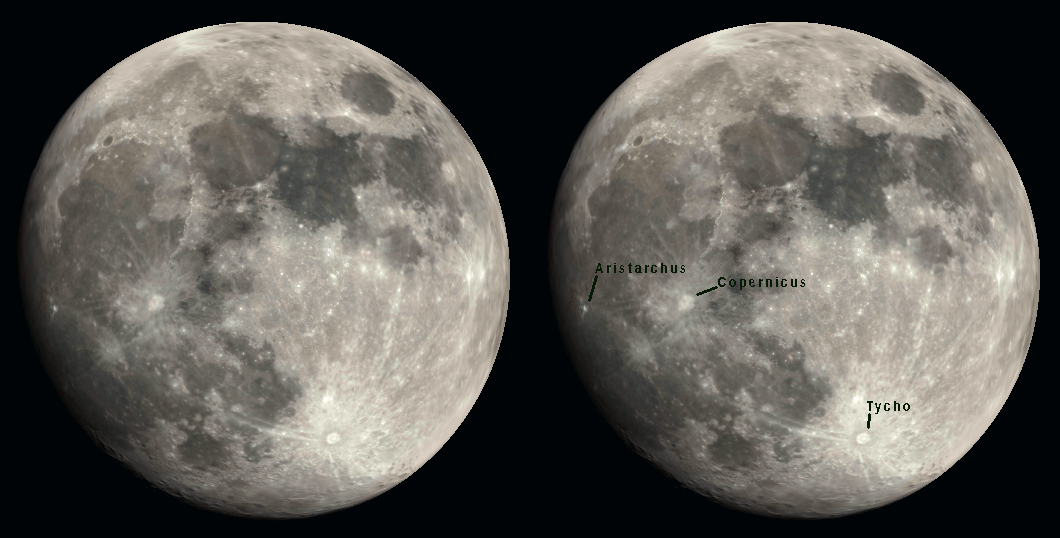
The brightest spots on the Moon as they might appear tonight, December 16, 2021. This is not a photograph. But created using Stellarium, presumably from lunar satellite photographs that simulate the phase and shadows.
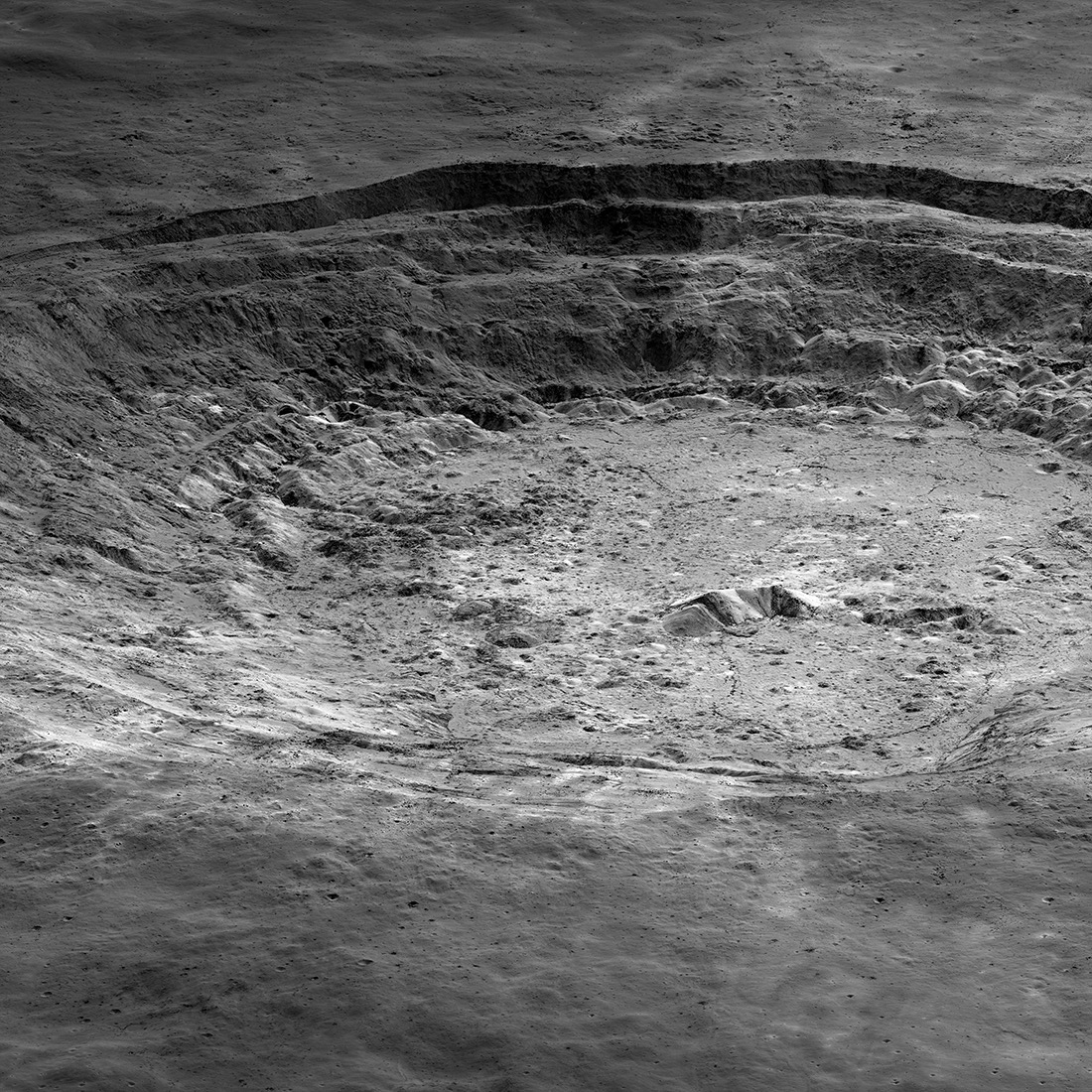
Oblique view of the crater Aristarchus from a lunar orbiting satellite. Credit: NASA/GSFC/Arizona State University.
12/14/2021 – Ephemeris – The Moon tonight will reveal more than you think
This is Ephemeris for Tuesday, December 14th. Today the Sun will be up for 8 hours and 49 minutes, setting at 5:02, and it will rise tomorrow at 8:13. The Moon, halfway from first quarter to full, will set at 4:45 tomorrow morning.
The gibbous Moon tonight is revealing a bit more of itself. In binoculars the dark oval spot visible on the Moon’s right side is the Sea of Crises or Mare Crisium a small dark lava plain. The Moon’s rotation is quite uniform, however its orbit isn’t circular, so the Moon’s face seems to rock a bit back and forth over the month. It’s an effect called libration. And one way to track that is to note how close the Sea of Crises is to the edge of the Moon. Right now that sea is as far from the Moon’s right edge or limb as it gets, and reveals two other seas in the edge: Mare Marginis, the Border Sea, and Mare Smythi, Smith’s Sea.
The astronomical event times given are for the Traverse City/Interlochen area of Michigan (EST, UT – 5 hours). They may be different for your location.
Addendum
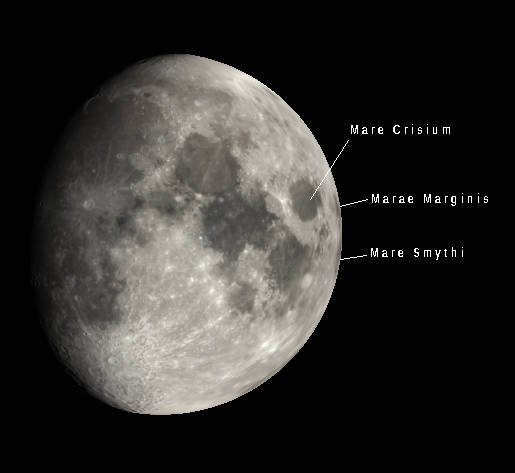
The Moon showing Maria Marginis and Smythi past Mare Crisium at 9 pm tonight, December 14, 2021. Created using Stellarium.
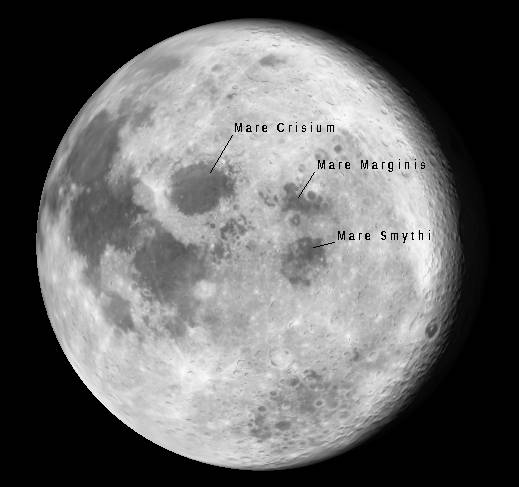
The Moon, seen as if flying over the border area of what we could see from the Earth. To the left is the Moon’s near side. To the right is the far side to the terminator or sunset line. Created using Virtual Moon Atlas.
Both the Stellarium and Virtual Moon Atlas apps are free. Links to them are elsewhere on this page.
11/18/2021 – Ephemeris – An almost total eclipse of the Moon will be visible early tomorrow morning
This is Ephemeris for Thursday, November 18th. Today the Sun will be up for 9 hours and 27 minutes, setting at 5:11, and it will rise tomorrow at 7:45. The Moon, 1 day before full, will set at 7:58 tomorrow morning.
Should our normal November clouds depart in the early morning hours tomorrow, we will be treated with a very deep partial eclipse of the Moon. At 4:03 am, the Moon will be 97% immersed into the Earth’s inner shadow, with lower left edge peeking out into sunlight. I haven’t heard of any massive volcanic eruptions in our Southern Hemisphere, so the light leaking and bent though the Earth’s atmosphere from all the simultaneous sunrises and sunsets during the eclipse won’t be too diminished and give us a coppery hue in the shadow. The shadow will touch the Moon at its top edge at 2:19 am. The maximum will occur at 4:03 am, and the last bit of the shadow will depart at the lower right edge of the Moon at 5:47 am.
The astronomical event times given are for the Traverse City/Interlochen area of Michigan (EST, UT – 5 hours). They may be different for your location.
Addendum
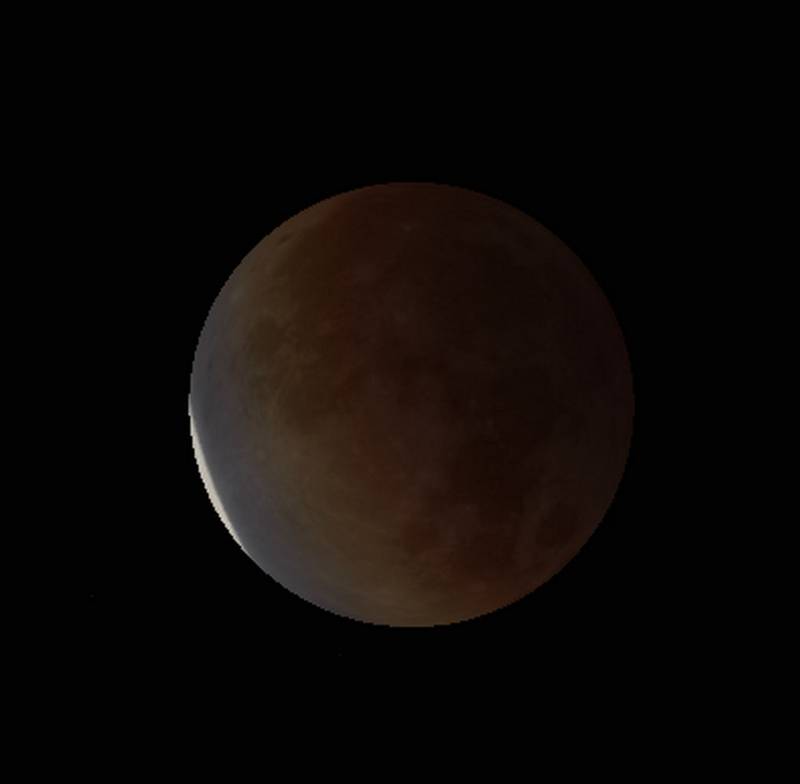
November 19, 2021, partial lunar eclipse maximum at 4:05 am EST. Orientation of the Moon and shadow could be different if not viewing from Northern Michigan. Created using Stellarium.
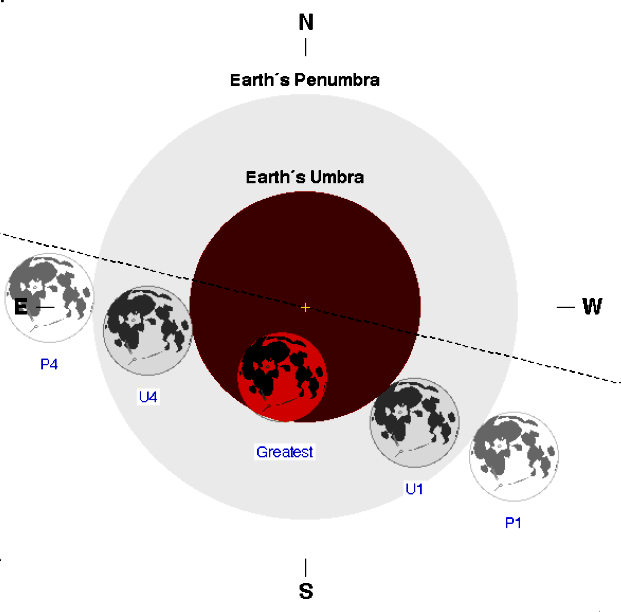
Lunar Eclipse Diagram for November 19, 2021. Effects of the eclipse on the Moon at P1 and P4 are not visible. U1 is the Moon at the beginning of the partial eclipse. U4 is the Moon at the end of the partial eclipse. A duskiness on the Moon’s face on the side closest to the umbral shadow will be visible just before and after the partial eclipse. Note that this diagram is not at the same orientation that an observer might experience. Created from a NASA PDF document on the NASA Eclipse Website. https://eclipse.gsfc.nasa.gov/eclipse.html.
11/16/2021 – Ephemeris – How China retrieved a sample from the Moon, and what Chang’e 5 is up to next
This is Ephemeris for Tuesday, November 16th. Today the Sun will be up for 9 hours and 31 minutes, setting at 5:13, and it will rise tomorrow at 7:42. The Moon, 3 days before full, will set at 5:49 tomorrow morning.
China’s Chang’e sample return mission of late last year was quite a feat. The spacecraft had an orbiter that orbited the Moon, and sent a lander with an ascent rocket. After the lander secured its samples, it put them in the ascent rocket, which launched back up to the orbiter. The samples were placed in a reentry capsule attached to the orbiter, which left the Moon’s orbit and headed back to the Earth. Near Earth, it ejected the reentry capsule and swung past Earth and headed out to the Earth-Sun Lagrangian point 1 between the Earth and Sun. There are already several satellites in halo orbits around L1, because it’s a great spot to be to study the Sun unobstructed by the Earth, and detect Coronal Mass Ejections (CMEs) about an hour before they reach Earth. NASA, NOAA and the European Space Agency all have satellites out there.
The astronomical event times given are for the Traverse City/Interlochen area of Michigan (EST, UT – 5 hours). They may be different for your location.
Addendum

Chang’e 5 Descent Capsule lands. It looks like a miniature Russian Soyuz Descent capsule. Credit Chinese Space Agency via Global Times.
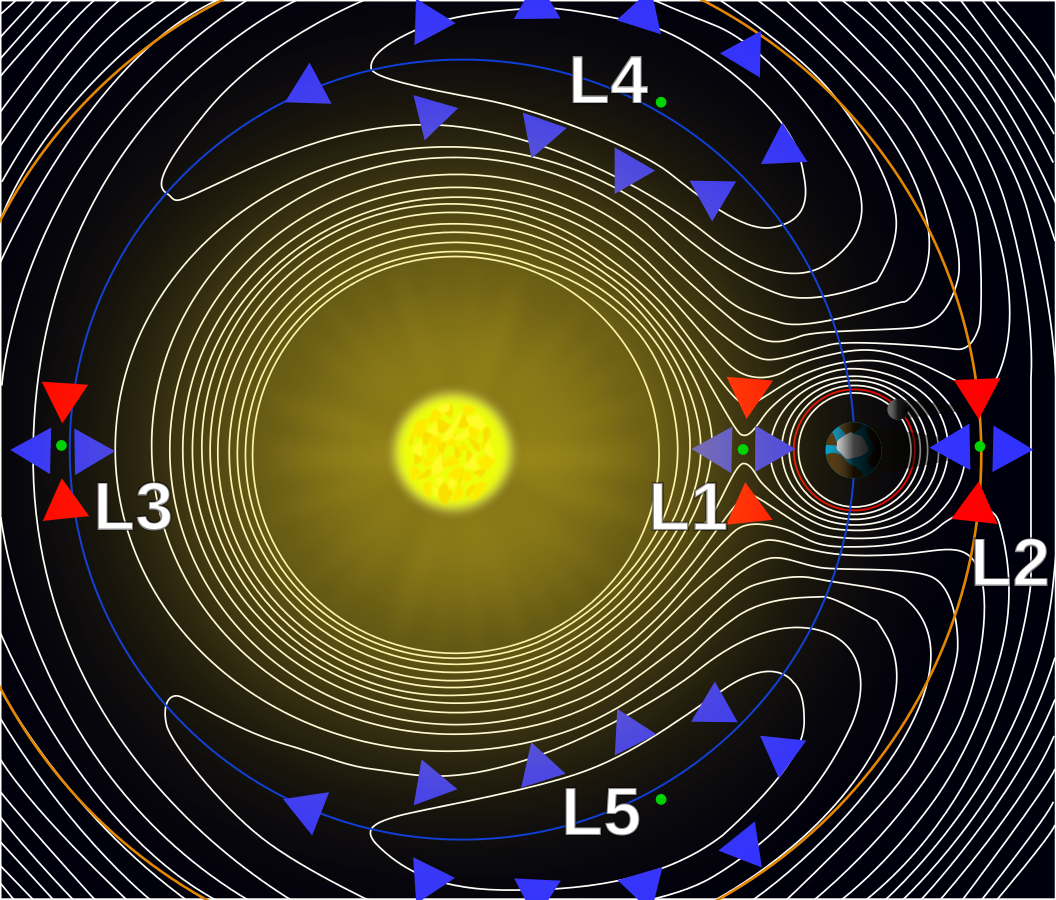
Earth-Sun Lagrangian Points. These are where a small body can stay. L1, 2 and 3 are unstable, so some little effort is needed to keep a spacecraft near there. L4 and L5 are stable. Source: Wikimedia Commons, Xander89. Click to enlarge.
1/15/2021 – Ephemeris – What the Chinese Chang’e 5 lunar mission found
This is Bob Moler with Ephemeris for Monday, November 15th. Today the Sun will be up for 9 hours and 34 minutes, setting at 5:14, and it will rise tomorrow at 7:41. The Moon, halfway from first quarter to full, will set at 4:45 tomorrow morning. | Late last year, the Chinese sent an uncrewed spacecraft to the Moon to collect samples of the surface material. That material is called regolith, and they drilled down at least a meter, which they returned to the Earth. An international team of geologists has been studying the material, and we have the first reports. Apparently the material they picked up was dated at 2 billion years, which is an intermediate age to the material picked up by the Apollo missions that dates either 3 billion years or older or 1 billion years. That helps fill gaps in the Moon’s history. Of course, all the material in the solar system is 4.5 billion years old. But the radioactive dating clock is reset when a rock is melted and solidifies.
The astronomical event times given are for the Traverse City/Interlochen area of Michigan (EST, UT – 5 hours). They may be different for your location.
Addendum
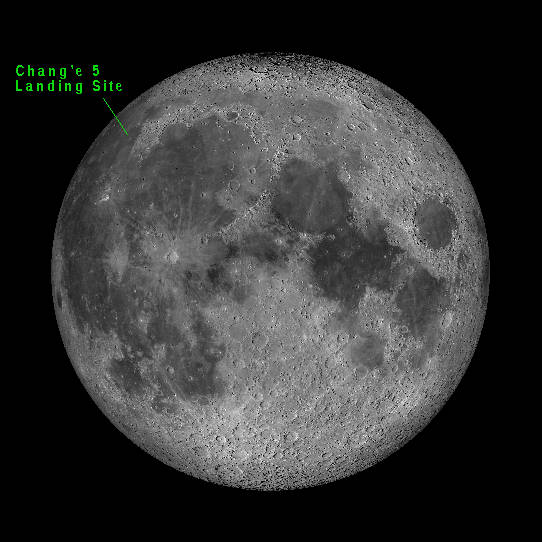
Chang’e 5 Landing-Site on full moon map. Created using Virtual Mon Atlas.
11/12/2021 – Ephemeris – The Moon appears to wobble slowly over the month
This is Ephemeris for Friday, November 12th. Today the Sun will be up for 9 hours and 41 minutes, setting at 5:17, and it will rise tomorrow at 7:37. The Moon, 1 day past first quarter, will set at 1:27 tomorrow morning.
When I look at the Moon, I check the position of one particular feature. A small, nearly circular gray area near the right or western edge of the Moon’s disk. It’s called the Sea of Crises, or in Latin, Mare Crisium. The reason I check it is that over the month its distance from the edge, or what astronomers call the limb, changes. That sea is about as far as it can get from the limb now. The reason for this wobbling back and forth, called libration, is that the Moon rotates at a constant rate due to angular momentum, but its revolution around the earth is an ellipse, so it doesn’t move with a uniform speed in its orbit. It moves faster at its closest to the Earth, called perigee, and is slowest at apogee, its farthest from the Earth.
The astronomical event times given are for the Traverse City/Interlochen area of Michigan (EST, UT – 5 hours). They may be different for your location.
Addendum.
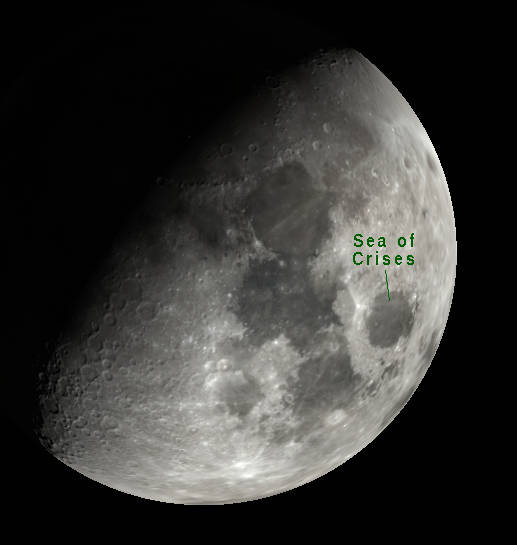
The Moon tonight (November 12, 2021) showing Mare Crisium (Sea of Crises) about as far from the limb (Moon’s edge) as it can get. Created using Stellarium.
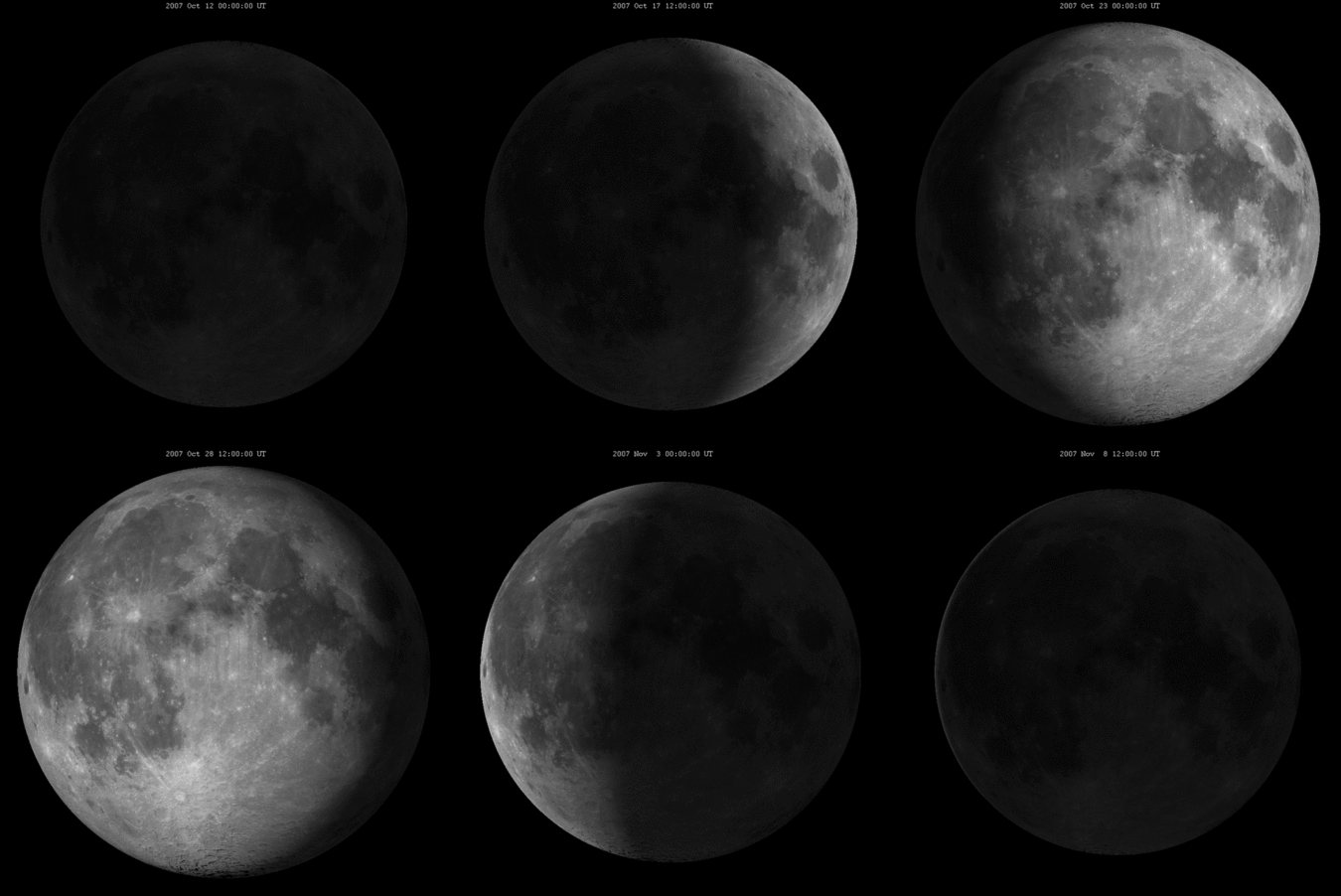
Simulation of the Moon’s phase and libration for October 2007 by Tomruen. Image is in the Public Domain.
 Bob Moler's Ephemeris Blog