Archive
04/08/2022 – Ephemeris – Landing a spacecraft at the Moon’s South Pole will be a tricky prospect
This is Ephemeris for Friday, April 8th. Today the Sun will be up for 13 hours and 8 minutes, setting at 8:19, and it will rise tomorrow at 7:09. The Moon, 1 day before first quarter, will set at 3:58 tomorrow morning.
The Artemis missions are to land near the South Pole of the Moon. Unlike the Earth’s 23 and a half degree axial tilt the Moon’s is only a degree and a half, so there is little month long variation of the Sun angle, though the Sun’s direction along the horizon revolves 360 degrees over 29 and a half days, the length of its orbit of the Earth. It should make for quite a challenge to land the human lander safely near the lunar South Pole. The lander has to choose a spot in sunlight to land that’s relatively smooth. The reason for the attraction of the lunar South Pole is the presence of water ice in permanently shadowed craters near and at the pole. The Moon’s North Pole isn’t as heavily cratered, with fewer permanently shadowed craters.
The astronomical event times given are for the Traverse City/Interlochen area of Michigan (EDT, UT – 4 hours). They may be different for your location.
Addendum
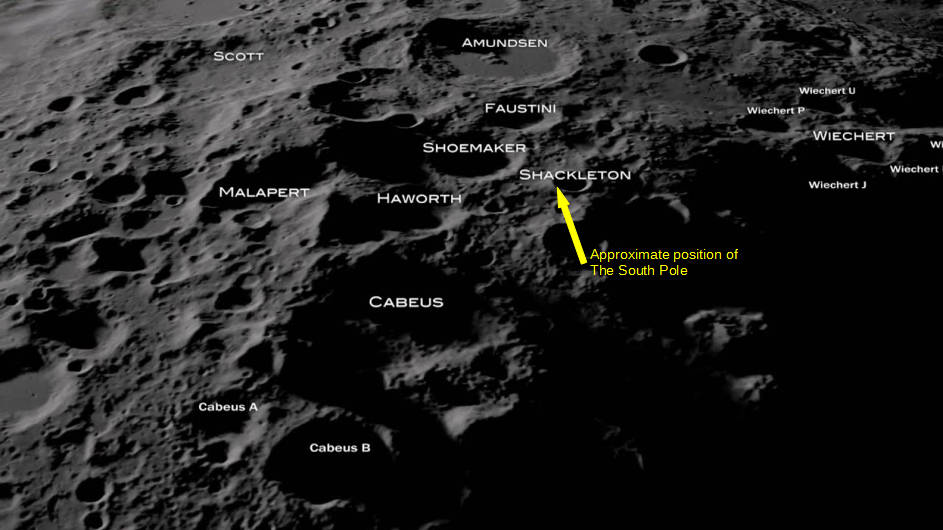
Lunar South Pole Flyover area with approximate South Pole marked based on Virtual Moon Atlas. Did you note a theme in some crater names? Click on the image to enlarge it. Credit: NASA/LRO.
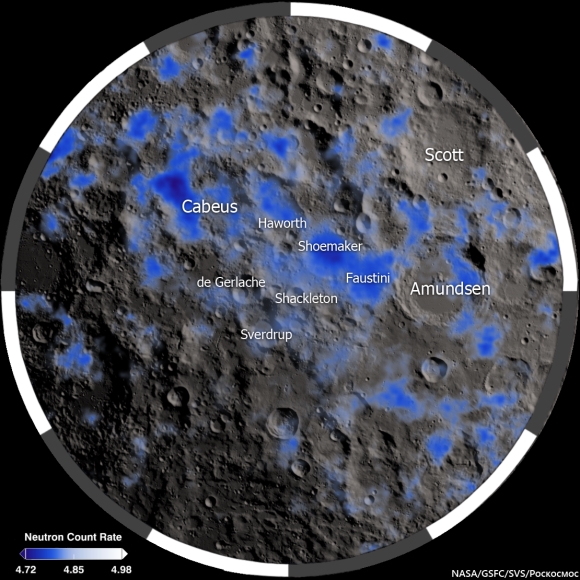
The South Pole of the Moon, where the presence of water ice is detected by the absorption of neutrons by the hydrogen atoms in the ice. Credit NASA/GSFC/SVS/Roscosmos.
03/11/2022 – Ephemeris – Looking at the northern part of the Moon and the crater Plato
This is Ephemeris for Friday, March 11th. Today the Sun will be up for 11 hours and 41 minutes, setting at 6:43, and it will rise tomorrow at 7:00. The Moon, 1 day past first quarter, will set at 4:18 tomorrow morning.
As the Moon moves around the Earth, now one day past first quarter, more of it is revealed in sunlight. The top or north part of the moon is of interest now. The second-largest lunar sea, Mare Imbrium, or Sea of Showers, is now half illuminated by the advancing terminator, the sunrise line. That can be seen with the naked eye. With binoculars, in the mountains north or above Imbrium can be found the flat floored crater or walled plain called Plato. This crater is situated in the lunar Alps. Mountains on the Moon are named after their earthly counterparts. Visible in telescopes now will be the Alpine Valley cutting through the Alps just to the right of Plato. Each night from new to full, more of the Moon’s features are revealed near the terminator.
The astronomical event times given are for the Traverse City/Interlochen area of Michigan (EST, UT – 5 hours). They may be different for your location.
Addendum
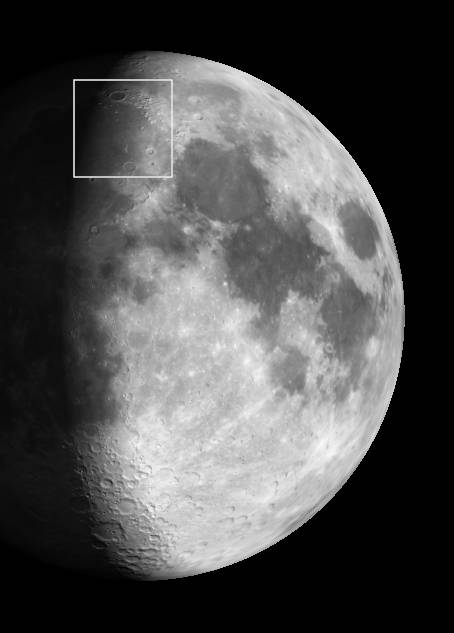
The Moon tonight, a day past first quarter, March 11, 2022, outlining the Mare Imbrium, crater Plato area, which is seen in detail below. Created using Virtual Lunar Atlas.
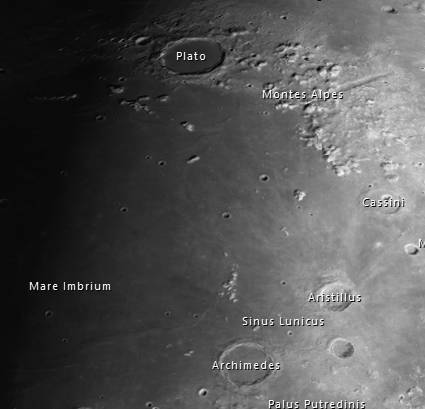
The Moon tonight, March 11, 2022, highlighting the crater Plato and lunar Alps. The Alpine Valley (Vallis Alpes), lies under the caption “Alpes” for the mountains. One of cool things to watch when the terminator is situated just right is to watch the shadows of the mountains retreat across Plato’s crater floor as the Sun rises. The shadows of the peaks appear very jagged as they retreat. Created using Virtual Lunar Atlas.
03/10/2022 – Ephemeris – Viewing the Moon at first quarter tonight
This is Ephemeris for Thursday, March 10th. Today the Sun will be up for 11 hours and 38 minutes, setting at 6:42, and it will rise tomorrow at 7:02. The Moon, at first quarter today, will set at 3:26 tomorrow morning.
By the time we spot the moon this evening, it will be over half a day from being exactly first quarter phase. Looking at the brighter part of the Moon in binoculars, which is at the bottom or south end. We are looking at the lunar highlands of mostly very old craters that extend back to the formation of the Moon, nearly 4.5 billion years ago, that weren’t obliterated by the asteroid strikes that created the darker maria or lunar seas half a billion years later. In small telescopes there is a vertical line of three large craters whose names, from largest to smallest and top down, are Ptolemaeus, Alphonsus, and Arzachel. Alphonsus is a curious crater. In 1958 a Soviet astronomer recorded a possible volcanic eruption or outgassing from the crater floor.
The astronomical event times given are for the Traverse City/Interlochen area of Michigan (EST, UT – 5 hours). They may be different for your location.
Addendum
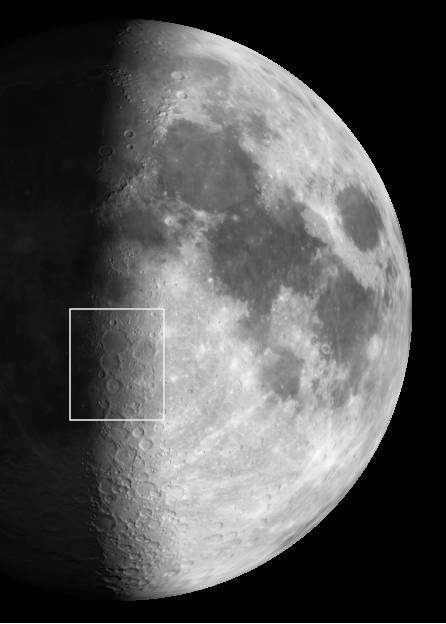
Lunar craters Ptolemaeus, Alphonsus and Arzachel outlined on the Moon’s disk, at first quarter, at 8 pm, March 10, 2022. Created using Virtual Moon Atlas.
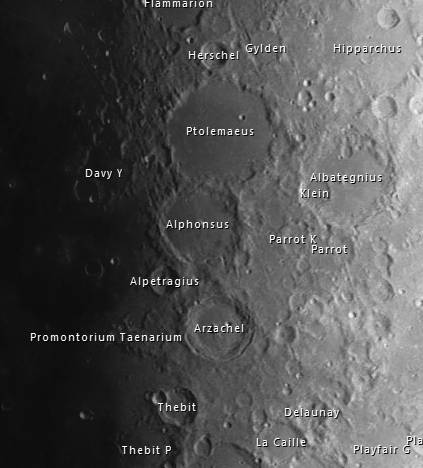
Closeup of lunar craters Ptolemaeus, Alphonsus and Arzachel, with other nearby craters, outlined above. Created using Virtual Moon Atlas.
02/15/2022 – Ephemeris – The Moon’s splashiest crater
This is Ephemeris for Tuesday, February 15th. Today the Sun will be up for 10 hours and 28 minutes, setting at 6:11, and it will rise tomorrow at 7:41. The Moon, 1 day before full, will set at 8:09 tomorrow morning.
The Moon at 8 pm tonight will be only 16 hours before being full. As down as I am about full moons due to the fact that they light up the sky and flood out the dimmer objects, I once in a while stop and view it. Being less than a day from full, we see it tonight from very nearly the direction of the Sun, so there will be few shadows to be had. The crater Tycho is near the bottom or south end of the moon and has long rays of tiny ejecta craters. The full moon is the best time to see these rays, which are easily visible in binoculars, through which Tycho itself looks like a bright dot. In telescopes, Tycho looks like a small, bright crater with a dark ring around it. The full moon is super bright. It’s daytime over there.
The astronomical event times given are for the Traverse City/Interlochen area of Michigan (EST, UT – 5 hours). They may be different for your location.
Addendum
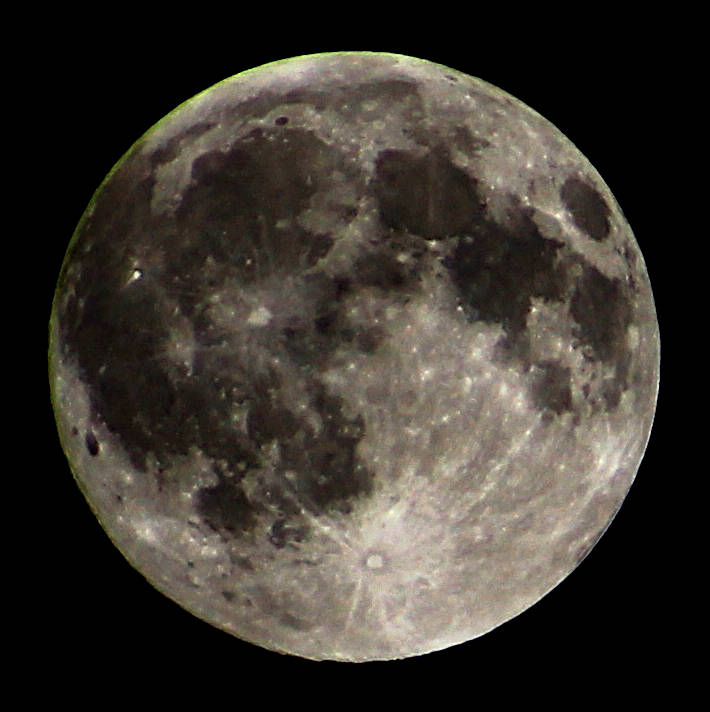
An image I took of the full moon in August 2016 and processed for maximum contrast to show the crater Tycho with its dark ring, near the bottom (south) of the Moon and its rays that stretch for hundreds of miles across the face of the Moon. The image is fairly low resolution, taken with a 300 mm telephoto lens. Click on the image to enlarge it a bit.
02/11/2022 – Ephemeris – The Sun Rises on the Moon’s Bay of Rainbows
This is Ephemeris for Friday, February 11th. Today the Sun will be up for 10 hours and 16 minutes, setting at 6:05, and it will rise tomorrow at 7:47. The Moon, 3 days past first quarter, will set at 5:34 tomorrow morning.
On the moon tonight, the gibbous phase and the terminator on the left side of the moon is revealing a large semicircular mountain range called the Jura Mountains that encloses a flat lava plain that looks like a bay in the margin of the Sea of Showers or Mare Imbrium. It is easily visible in binoculars this evening, when the sunrise line is crossing the bay. The Jura Mountains will appear as a hook out of the upper left edge of the moon. That’s about the coolest sight that’s visible on the moon that can be seen with binoculars. It’s especially striking if seen in a small telescope.
Also, related to the Moon: The Artemis-1 uncrewed mission to orbit the Moon has been pushed off at least one month or more, to this April or even May.
Addendum
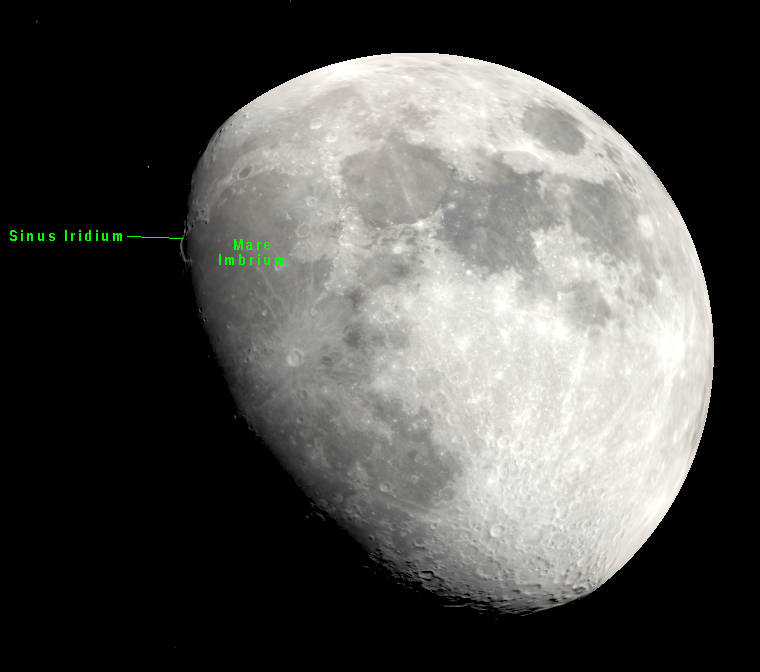
Sunrise at Sinus Iridium, full Moon disc with annotations. Click on the image to enlarge it. Moon image created using Stellarium.
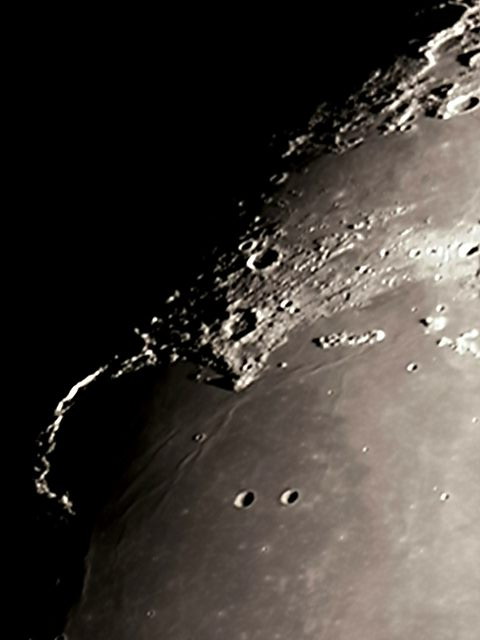
Sinus Iridium at sunrise. Photo by “Seb2003” on http://forums.futura-sciences.com/materiel-astronomique-photos-damateurs/5809-images-de-lune.html.
02/10/2022 – Ephemeris – The waxing gibbous Moon is revealing more seas and craters
This is Ephemeris for Thursday, February 10th. Today the Sun will be up for 10 hours and 14 minutes, setting at 6:04, and it will rise tomorrow at 7:48. The Moon, 2 days past first quarter, will set at 4:38 tomorrow morning.
The Moon tonight is a waxing gibbous phase. More gray lunar seas are appearing near the terminator, the sunrise line. From north to south these seas, most only partially in sunlight, are: At the far north, the Cold Sea, Sea of Showers, The sea where the famous crater Copernicus is, the Sea of Islands. The southernmost sea at the terminator is the Sea of Clouds. Some large and prominent craters can be seen with binoculars or a small telescope can be seen in the south, the striking and relatively fresh Tycho, with its Moon girdling ejecta rays, though the rays are best seen at full moon. And the huge crater Clavius, with an arc of 5 smaller craters, one on its wall and the others on its floor, in ever diminishing sizes.
The astronomical event times given are for the Traverse City/Interlochen area of Michigan (EST, UT – 5 hours). They may be different for your location.
Addendum
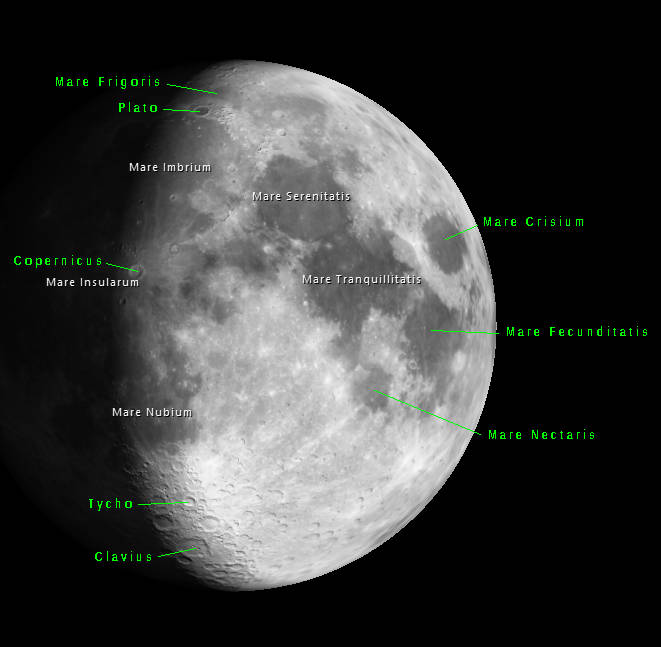
2 days past first quarter Moon as it would be seen in a small telescope or even binoculars, annotated. For this evening, February 10, 2022. Click on the image to enlarge it. Created using Virtual Moon Atlas. Annotations in white are from the app, mine are in green. Translations of the sea names are below.
Translations
Mare Crisium – Sea of Crises
Mare Fecunditatis – Sea of Fertility
Mare Frigoris – Sea of Cold
Mare Imbrium – Sea of Showers
Mare Insularum – Sea of Islands
Mare Nectaris – Sea of Nectar
Mare Nubium – Sea of Clouds
Mare Serenitatis – Sea of Serenity
Mare Tranquilitatis – Sea of Tranquility
A closer look
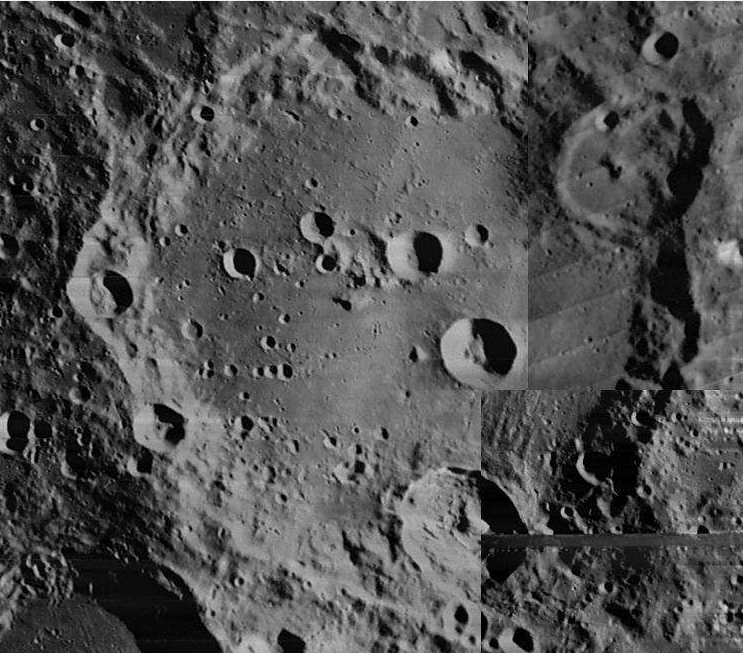
A montage of Clavius as photographed by one of the Lunar Orbiter spacecraft in the 1960s From Digital Lunar Orbital Photographic Atlas. Credit Jeff Gillis, Lunar and Planetary Institute.
02/08/2022 – Ephemeris – The first quarter Moon tonight
This is Ephemeris for Tuesday, February 8th. Today the Sun will be up for 10 hours and 8 minutes, setting at 6:01, and it will rise tomorrow at 7:51. The Moon, at first quarter today, will set at 2:34 tomorrow morning.
The Moon tonight, will be about 12 hours past being exactly first quarter, so it will be showing to be just a bit gibbous, that is a bit more than 50% illuminated by the Sun from our vantage point. In binoculars, the gray lunar seas, which are actually frozen lava filled plains, dominate the upper right quarter of the Moon. At the bottom, or south end of the Moon are the lighter more cratered region of the Moon called the Lunar Highlands. It is near the terminator, the line between day and night on the Moon, where shadows are longest, where craters can be seen by the shadows of the rims. Farther away from the terminator, the Sun is higher in the Moon’s sky, so the shadows get shorter or disappear all together.
The astronomical event times given are for the Traverse City/Interlochen area of Michigan (EST, UT – 5 hours). They may be different for your location.
Addendum
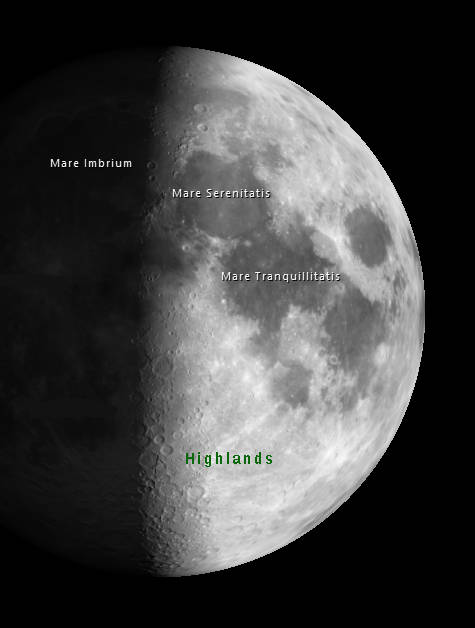
The is what the Moon might look like tonight, hours after first quarter. Just a bit of Mare Imbrium (Sea of Showers) is visible. Mare Serenitatis is the Sea of Serenity, Mare Tranquilitatis is the Sea of Tranquility. The green annotation is mine. BTW, Mare is pronounced Mar-e. It’s Latin, meaning sea. Created using Virtual Moon Atlas, a free app that can be downloaded from a link on the right, or listed under Free Astronomical Software.
02/07/2022 – Ephemeris – The Moon tonight
This is Ephemeris for Monday, February 7th. Today the Sun will be up for 10 hours and 5 minutes, setting at 6:00, and it will rise tomorrow at 7:53. The Moon, 1 day before first quarter, will set at 1:29 tomorrow morning.
Tonight, let’s take a look at the nearly first quarter Moon. The small, nearly circular gray spot is the sea of Crises. A diagonal chain of larger seas run from the terminator, the sunrise line, to below the Sea of Crises. They are, from the terminator, the seas of Serenity, Tranquility and Fertility. NASA is hoping to launch its uncrewed mission to the Moon, Artemis-1, next month with a large block of launch dates. The launch window begins on March 12th and ends on the 27th, with two blackout dates. Two lengths of missions are possible, a long 38 to 42 day mission is possible in the first part of the launch window, and a shorter 26 to 28 day mission is possible in the latter part of the window.
The astronomical event times given are for the Traverse City/Interlochen area of Michigan (EST, UT – 5 hours). They may be different for your location.
Addendum
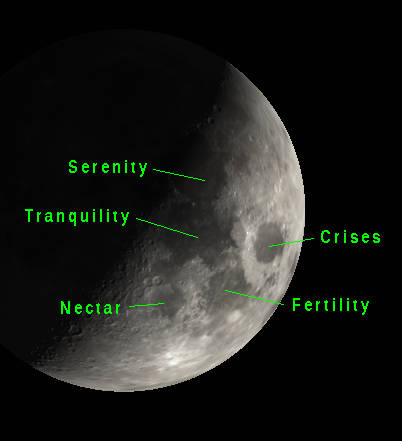
The Moon as it might appear tonight in binoculars or a small telescope at 7 pm tonight, February 7, 2022. I labeled the lunar seas with their English names, translated from the Latin. Also labeled is the Sea of Nectar, which wasn’t mentioned in the program. Moon image created using Stellarium.
01/13/2022 – Ephemeris – The Moon, first target for a new telescope
This is Ephemeris for Thursday, January 13th. Today the Sun will be up for 9 hours and 8 minutes, setting at 5:26, and it will rise tomorrow at 8:17. The Moon, halfway from first quarter to full, will set at 5:47 tomorrow morning.
The Moon is probably the first astronomical object owners of a new telescope look at. The first discovery is that it’s not that easy to find. Most telescopes produce an upside down or a mirror reversed image, so steering the telescope may take a bit of getting used to. The Moon is at its gibbous phase tonight, so it’s quite bright, and a lot of it doesn’t have much contrast except for the large dark gray areas, called seas. There’s no water in them, of course, but they are huge lava basins caused by large asteroid impacts in the early days of the Moon’s history. The best detail on the Moon is near the terminator, in the time before full moon, it is the sunrise line. There the shadows are longest, and the detail of craters are best seen.
The astronomical event times given are for the Traverse City/Interlochen area of Michigan (EST, UT – 5 hours). They may be different for your location.
Addendum
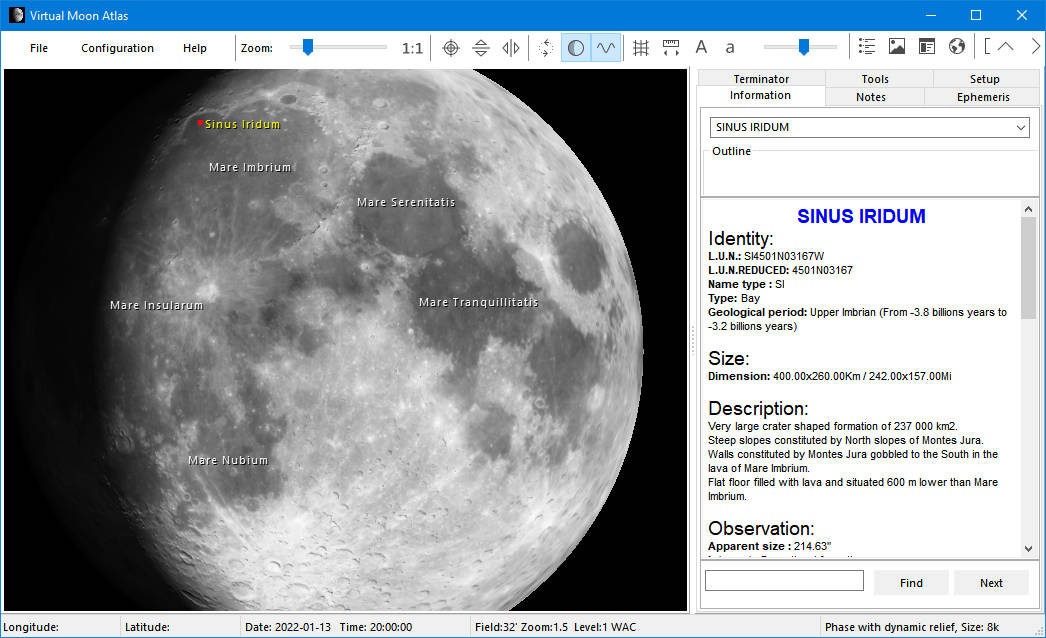
This is a great guide to the Moon called Virtual Moon Atlas for a computer, showing the Moon for any date and time. It’s a free app which runs natively on Windows, but also can run with emulators on Linux and macOS. I find it to be an amazing program. Check it out under Free Astronomical Software on the right of this page.
The other free app I use is Stellarium (See the right column). Zoom in enough, so the Moon fills the frame, and It will show labels to some of its features if clicked on.
12/17/2021 – Ephemeris – Artemis-1 mission may launch in less than 2 months
This is Ephemeris for Friday, December 17th. Today the Sun will be up for 8 hours and 48 minutes, setting at 5:03, and it will rise tomorrow at 8:15. The Moon, 1 day before full, will set at 7:56 tomorrow morning.
In a little less than two months, a fifteen-day launch window opens up to launch Artemis one, the first and hopefully only uncrewed Artemis mission to the Moon in the NASA’s program to land the next man and first woman on the Moon. The uncrewed Orion capsule and the ESA contributed Service Module will orbit the Moon in a very elongated distant orbit of the Moon, retreating out to 38,000 miles (61,000 kilometers) further than the Moon once or twice before heading within 60 miles of the Moon’s surface on its way back to the Earth. The upper stage, that sends Orion on its way to the Moon, will release some CubeSats as it follows Orion to the Moon, where it will whip around the Moon to orbit the Sun.
The astronomical event times given are for the Traverse City/Interlochen area of Michigan (EST, UT – 5 hours). They may be different for your location.
Addendum
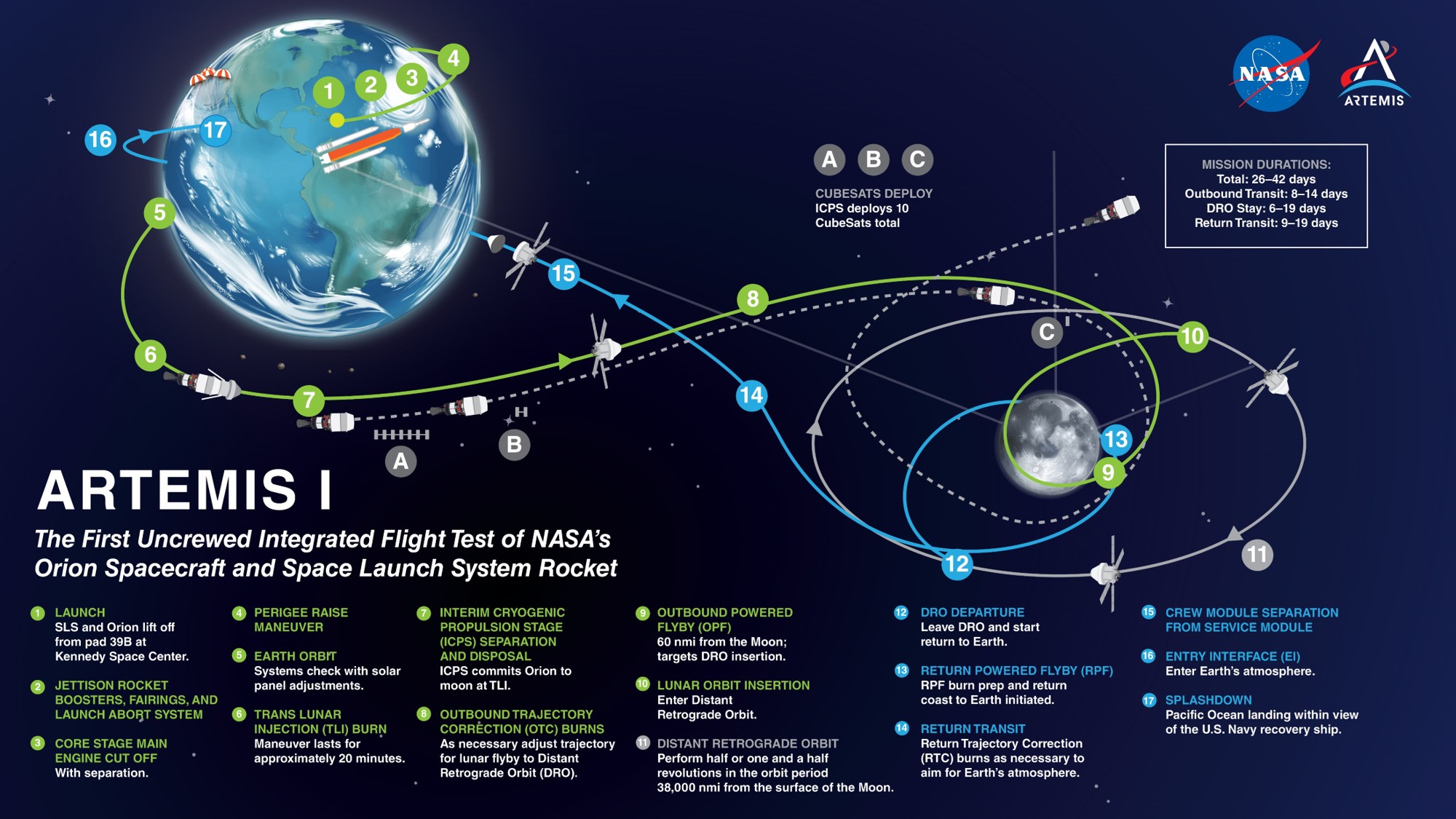
Artemis-1 orbital plan. Click on the image to enlarge it. Credit NASA.

The Earth and Moon to scale. Source Wikipedia.
 Bob Moler's Ephemeris Blog