Archive
Aldebaran Occultation November 26, 2015 from Northern Michigan
On the early morning of November 26th, that’s Thanksgiving morning here in the US, The Moon will pass in front of, or occult, the bright star Aldebaran in Taurus the bull. The event is called an occultation.
Three first magnitude stars can be occulted by the Moon, Aldebaran, Regulus in Leo the lion, Antares in Scorpius the Scorpion, and Spica in Virgo the virgin, since these stars lie within 5 1/2 degrees of the ecliptic, the plane of the Earth’s orbit. The Moon’s orbit is inclined to it by 5º 14′. Also because the Moon’s orbit precesses over a period 18.6 years they occur over the Earth in monthly series every 18.6 years. There are 43 monthly occultations that will occur in this series, which actually started in January. This is the best of them so far. We’ll have another on the evening of January 19th next year. Below is a chart of the event from the Astronomical Almanac Online which can be accessed here: http://asa.usno.navy.mil/.
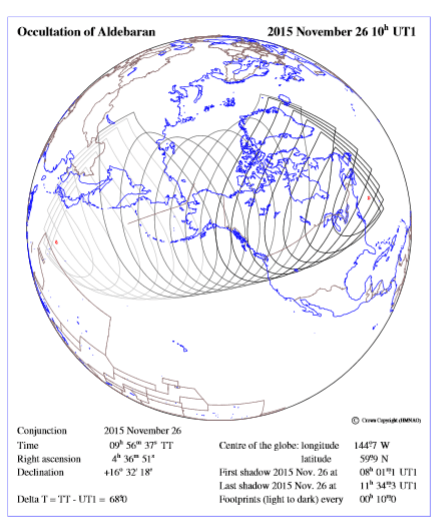
Map of the area where the occultation of Aldebaran is visible. Credit: Astronomical Almanac Online – U.S. Nautical Almanac Office, United States Naval Observatory (USNO), in the United States and Her Majesty’s Nautical Almanac Office (HMNAO), United Kingdom Hydrographic Office (UKHO), in the United Kingdom.
The occultation will be visible for locations within the nested grid of curved lines.
The two important events of the occultation is the star’s disappearance and reappearance. The times of these two events depend on your location, and are scientifically useful in determining the precise position of the Moon.
I’ve worked out the timings for my location about half way between Traverse City and Interlochen, so they should be within a couple of minutes of your observed time if you’re within 30 or so miles. Go out early, the earlier the better. The Moon will be especially bright, being only 12 hours after the instant the Moon will be full. Binoculars or a small telescope will be necessary to spot Aldebaran. The farther away Aldebaran is away from the Moon the easier it can be picked up. Note as a rule of thumb, the Moon moves its own diameter against the stars in about an hour.
For the Traverse City/Interlochen area I calculate the disappearance of Aldebaran at 5:38 a.m.
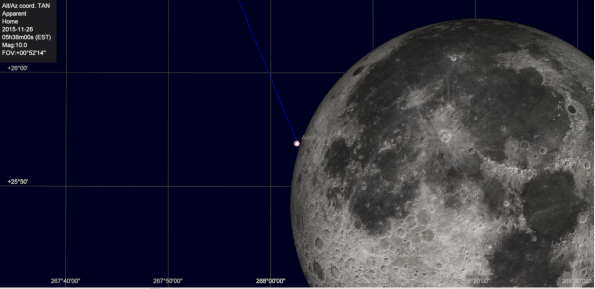
Aldebaran just prior to it’s disappearance behind the Moon from Interlochen/Traverse City. Created using Cartes du Ciel (Sky Charts).
For the Traverse City/Interlochen area I calculate the reappearance of Aldebaran at 6:29 a.m.
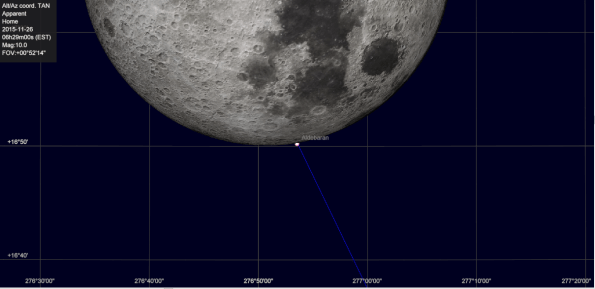
Aldebaran just after it’s reappearance from behind the Moon from Interlochen/Traverse City. Created using Cartes du Ciel (Sky Charts).
The Moon will be low in the western sky.
Timings for 3 locations in Michigan
This can be used to approximate the occultation time for other locations in Michigan.
City(s)                    Disappears  Reappears Location
Ironwood          5:33 a.m.   6:25 a.m. Northwestern corner of the
                                        Upper Peninsula (UP) of
                                        Michigan
Interlochen/      5:38 a.m.   6:29 a.m. Northwestern lower Michigan
   Traverse City
Monroe            5:45 a.m.   6:29 a.m. Southeastern corner of Michigan
Estimating timings for your location
I used Cartes du Ciel the free software that I have a link to on the right. Make sure that the program is set for topocentric positions under Setup/Solar System. And you have entered your position under Setup/Observatory. You can find your location in Google Earth.
You can also use Stellarium. Just make sure the Moon is normal sized.
In both programs you can lock the Moon or Aldebaran in the center of the screen Pick a time in advance of the occultation and using the set time window walk the star towards the Moon, mark the time. Then walk the star out from the Moon and record the reappearance time. That’s it.
This should work with other planetarium programs too.
11/19/2015 – Ephemeris – The no longer quite first quarter Moon tonight
Ephemeris for Thursday, November 19th. The Sun will rise at 7:44. It’ll be up for 9 hours and 26 minutes, setting at 5:11. The Moon, at first quarter today, will set at 1:06 tomorrow morning.
The Moon actually was at first quarter at 1:27 (6:47 UT) this morning. By this evening, when it’s out the terminator, the sunrise line, on the Moon will be curved giving the it a definite gibbous appearance. The upside down rabbit image in the Moon’s dark seas on the illuminated right half can be seen. In a telescope or even powerful binoculars at 9 p.m. the Terminator cuts the southern crater Tycho in half. The large crater Clavius south of it is just catching the morning Sun. To the north the sunrise line cuts the large Mare Imbrium or Sea of Showers in half. In the mountains on the north shore of Imbrium the large walled plain, really a crater, Plato can be seen. Pan near the terminator in the south and the Straight Wall might be spotted as a long shadow.
Times are for the Traverse City/Interlochen area of Michigan. They may be different for your location.
Addendum
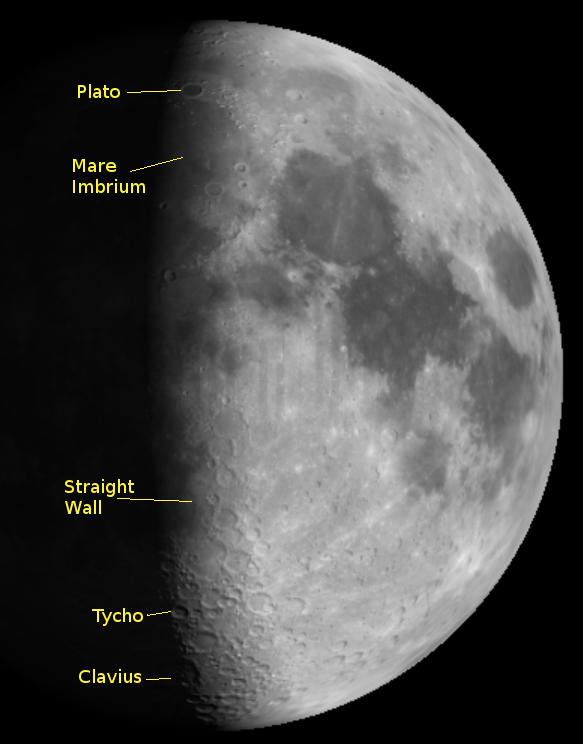
The Moon at 9 p.m. EST November 19, 2015. (2 hr UT November 20) Created using Virtual Moon Atlas.
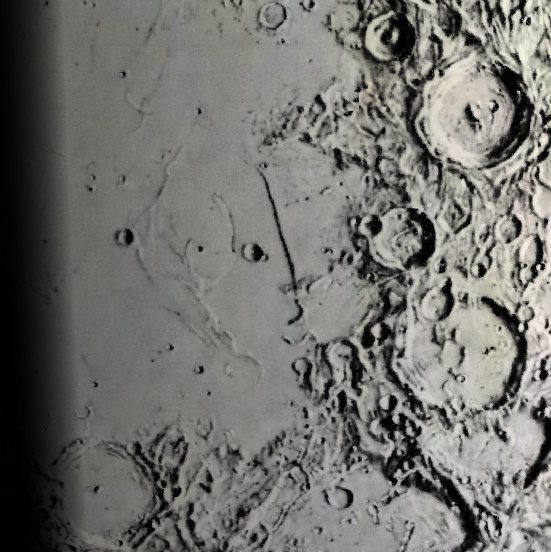
Closeup chart of the Straight Wall.
11/05/2015 – Ephemeris – The Moon will be among the morning planets in the next two days
Ephemeris for Thursday, November 5th. The Sun will rise at 7:25. It’ll be up for 10 hours and 0 minutes, setting at 5:26. The Moon, 2 days past last quarter, will rise at 2:23 tomorrow morning.
Over the next two mornings the Moon will pass, first, the planet Jupiter and then on Saturday Mars and Venus. These will be readily visible at 6 a.m. and less so at 7 a.m. when twilight is brighter. This month and next we will have two times the Moon will actually pass in front of another bright celestial object. Both will occur in the morning. These events are called occultations. The first will be an occultation of the bright star Aldebaran, the bright star in Taurus the bull, which I sometimes call the bull’s angry bloodshot eye. That will occur on the morning of November 26th. The next will be really spectacular. On December 7th the crescent Moon will occult the planet Venus. I’ll keep you updated on both these events.
Times are for the Traverse City/Interlochen area of Michigan. They may be different for your location.
Addendum
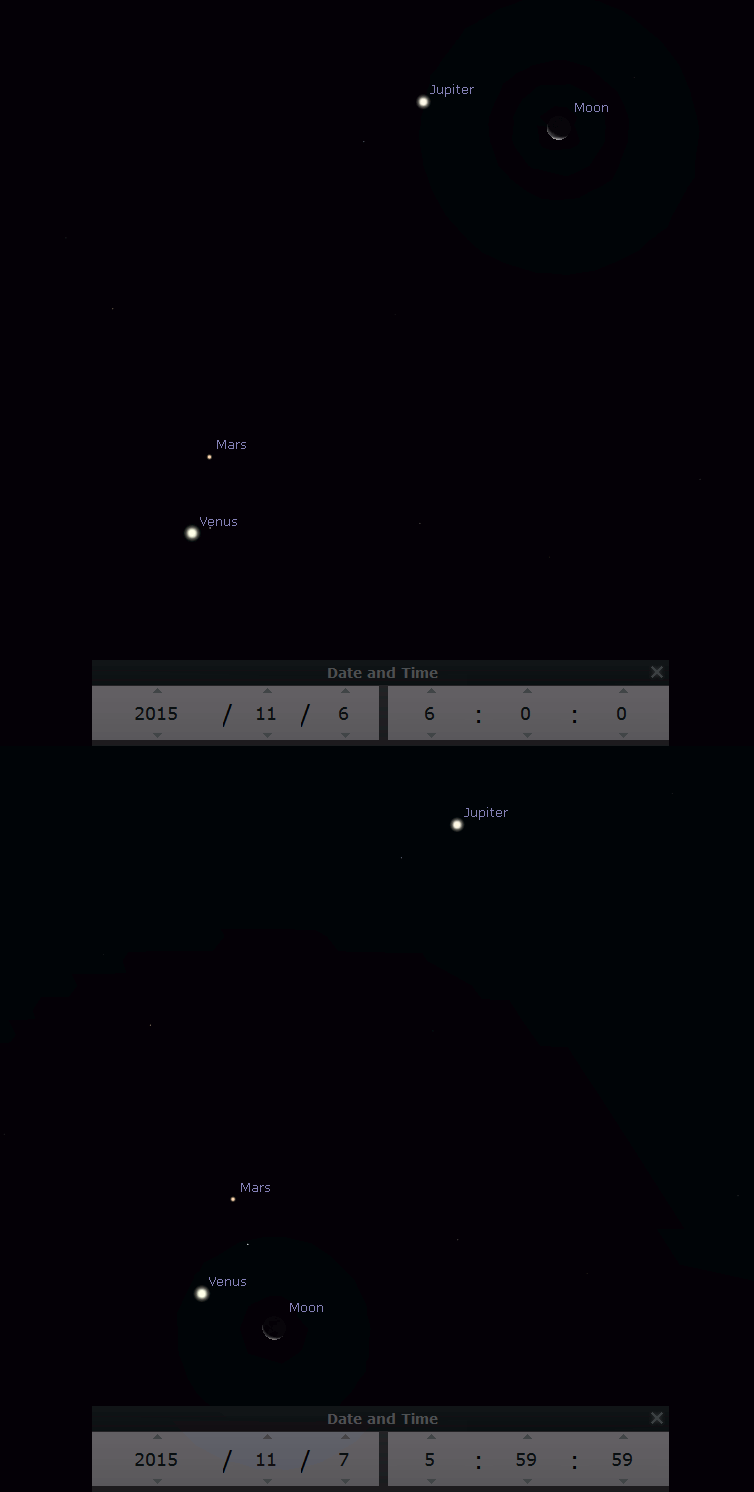
Animation of the Moon passing Jupiter tomorrow morning and Mars and Venus Saturday morning. Created using Stellarium and GIMP.
10/27/2015 – Ephemeris – Hunter’s Moon
Ephemeris for Tuesday, October 27th. The Sun will rise at 8:13. It’ll be up for 10 hours and 25 minutes, setting at 6:39. The Moon, at full today, will rise at 7:09 this evening.
Tonight’s full moon is known as the Hunter’s Moon because it is the full moon after the harvest moon. The minute the Moon will be full will be at 7:05 this morning, about an hour before it sets. This was the time Native Americans and Europeans went out to secure the meat for the winter. And it also coincides with the time of year of our hunting seasons. So in that regard it fits nicely. The names of the full moons throughout the year generally mesh with the activities or weather conditions of that month. For instance December’s full moon is the Cold Moon or the Long Nights Moon. December has the longest nights. This list is taken from farmersalmanac.com, the website of the Old Framers Almanac, from which I’ve been getting folklore tidbits for years.
Times are for the Traverse City/Interlochen area of Michigan. They may be different for your location.
Addendum
Other sources for full moon names:
- Wikipedia
- EarthSky
- MoonConnection
- Or just search for: full moon names
10/22/2015 – Ephemeris – My favorite lunar feature
Ephemeris for Thursday, October 22nd. The Sun will rise at 8:07. It’ll be up for 10 hours and 39 minutes, setting at 6:46. The Moon, 2 days past first quarter, will set at 3:10 tomorrow morning.
The Moon tonight is revealing my favorite feature, Sinus Iridium or Bay of Rainbows. Unfortunately features on the Moon are not that colorful. The Bay of Rainbows is surrounded on three sides by a semicircular mountain range called the Jura Mountains which is actually a broken down crater wall. The Bay is a bay in Mare Imbrium, the Sea of Showers. It is the nomenclature of land forms on planets and moons that still have Latin names in astronomy. That and constellations. Of course the Bay of Rainbows and the Sea of Showers aren’t real bodies of water. These were the product of the imaginations of astronomers looking through their primitive telescopes, at a completely alien landscape.
Times are for the Traverse City/Interlochen area of Michigan. They may be different for your location.
Addendum
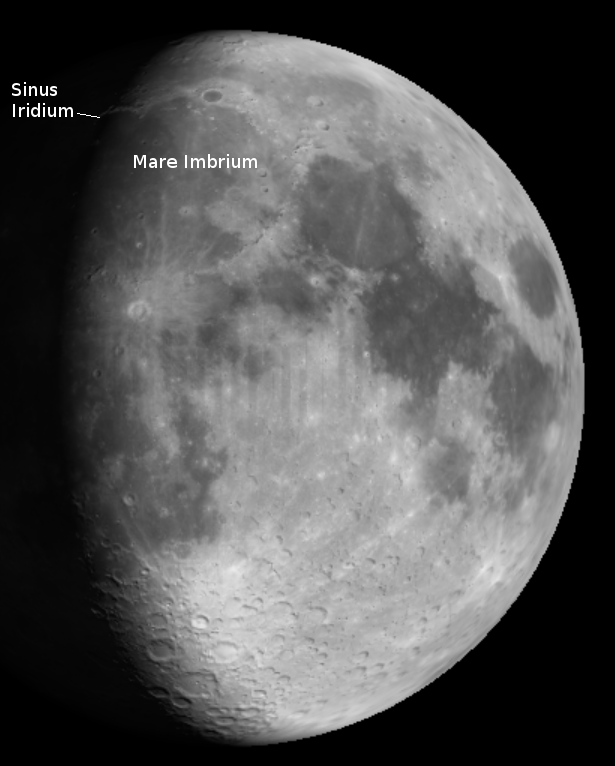
The Moon tonight with Sinus Iridium peeking out into the morning sunlight on the Moon, 9 p.m. October 2015. Created using Virtual Moon Atlas.
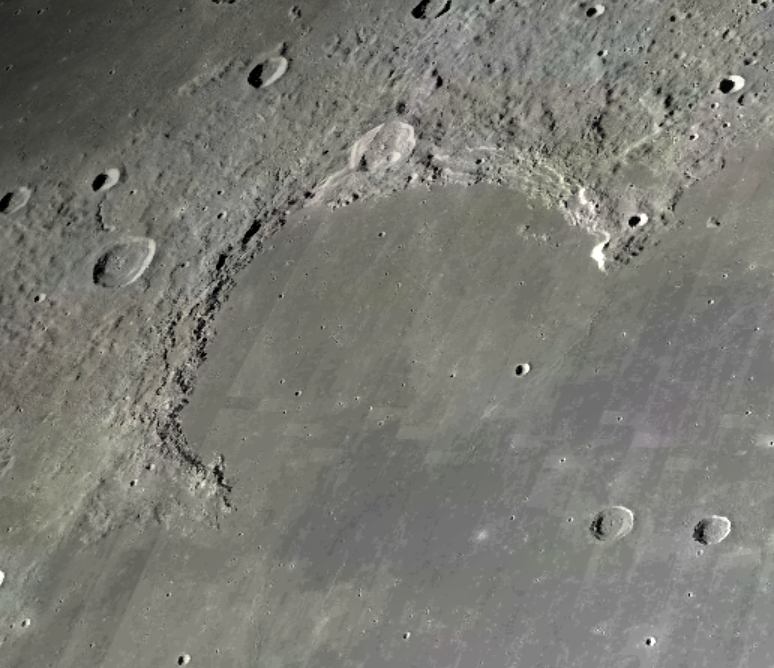
Sinus Iridium photographed by the Lunar Reconnaissance Orbiter as texture mapped on the globe of the Virtual Moon Atlas.
10/19/2015 – Ephemeris – Where did the Moon come from?
Ephemeris for Monday, October 19th. The Sun will rise at 8:03. It’ll be up for 10 hours and 48 minutes, setting at 6:51. The Moon, 1 day before first quarter, will set at 11:51 this evening.
Only two planets in the solar system have moons at least a quarter the size of the planet they orbit: The Earth and Pluto. The Moon is a bit more than a quarter the Earths diameter while Pluto’s moon Charon is half its size. Probably in the early days of the solar system, some four and a half billion years ago collisions were rather common. It is thought by many planetary scientists that a Mars sized protoplanet collided with the proto-earth with a glancing blow to rip off much of the Earth’s crust, thrust it into orbit where it coalesced into the Moon. It seems that Pluto’s Charon may have been formed much the same way. Some thing the varying axial tilts of the planets may have been caused the same way by smaller objects.
Times are for the Traverse City/Interlochen area of Michigan. They may be different for your location.
Addendum
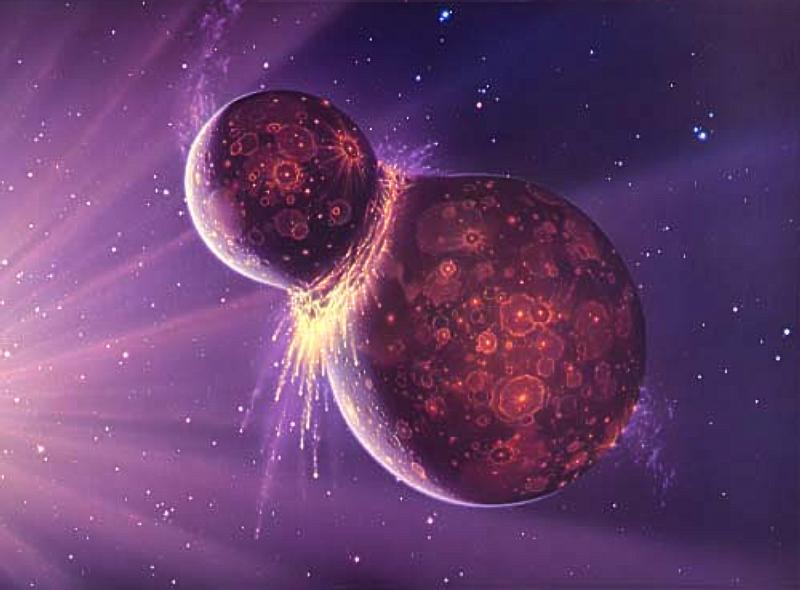
The hypothetical collision of a Mars sized body with the young Earth. Credit: Joe Tucciarone via NASA
Breaking News
Robert Farquhar the man behind the ISEE-3 spacecraft, the first to hang out at the Earth-Sun L1 point between the Earth and the Sun back in 1978 passed away yesterday. In 1982 he “stole” the spacecraft and through an amazing number of maneuvers using very little fuel managed to send it through the tail of Comet Gicobini-Zinner ahead of the fleet of spacecraft then aimed at Halley’s Comet. Last year when the then renamed spacecraft ICE approached the Earth, he hatched a plan to return the spacecraft to its L1 position. Unfortunately apparently there was not enough fuel pressure to complete the burns necessary for the task. I’ll have a program on Robert Farquhar next Monday.
10/09/2015 – Ephemeris – The Moon is seen with the morning planets this weekend
Ephemeris for Friday, October 9th. The Sun will rise at 7:50. It’ll be up for 11 hours and 18 minutes, setting at 7:09. The Moon, 3 days before new, will rise at 5:31 tomorrow morning.
This morning up to about 7:15 look to the east at the crescent Moon and the planets. The Moon is between Venus above and Jupiter just below and to the left. Mars will be a bit above and just left of the Moon. Mercury will be farther below the moon to the left and about 22 degrees below the Moon (that’s about twice the width of a fist held at arm’s length.) By Sunday morning the thin sliver of the Moor will be near Mercury with the tiny planet just above left of the Moon. Next Thursday the 15th, Mercury will climb to its greatest angular distance or elongation west of the Sun. It will be getting a bit brighter for a while because even though it’s moving away from us, its phase will be getting fuller. Remember it’s illuminated by the sun.
Times are for the Traverse City/Interlochen area of Michigan. They may be different for your location.
Addendum
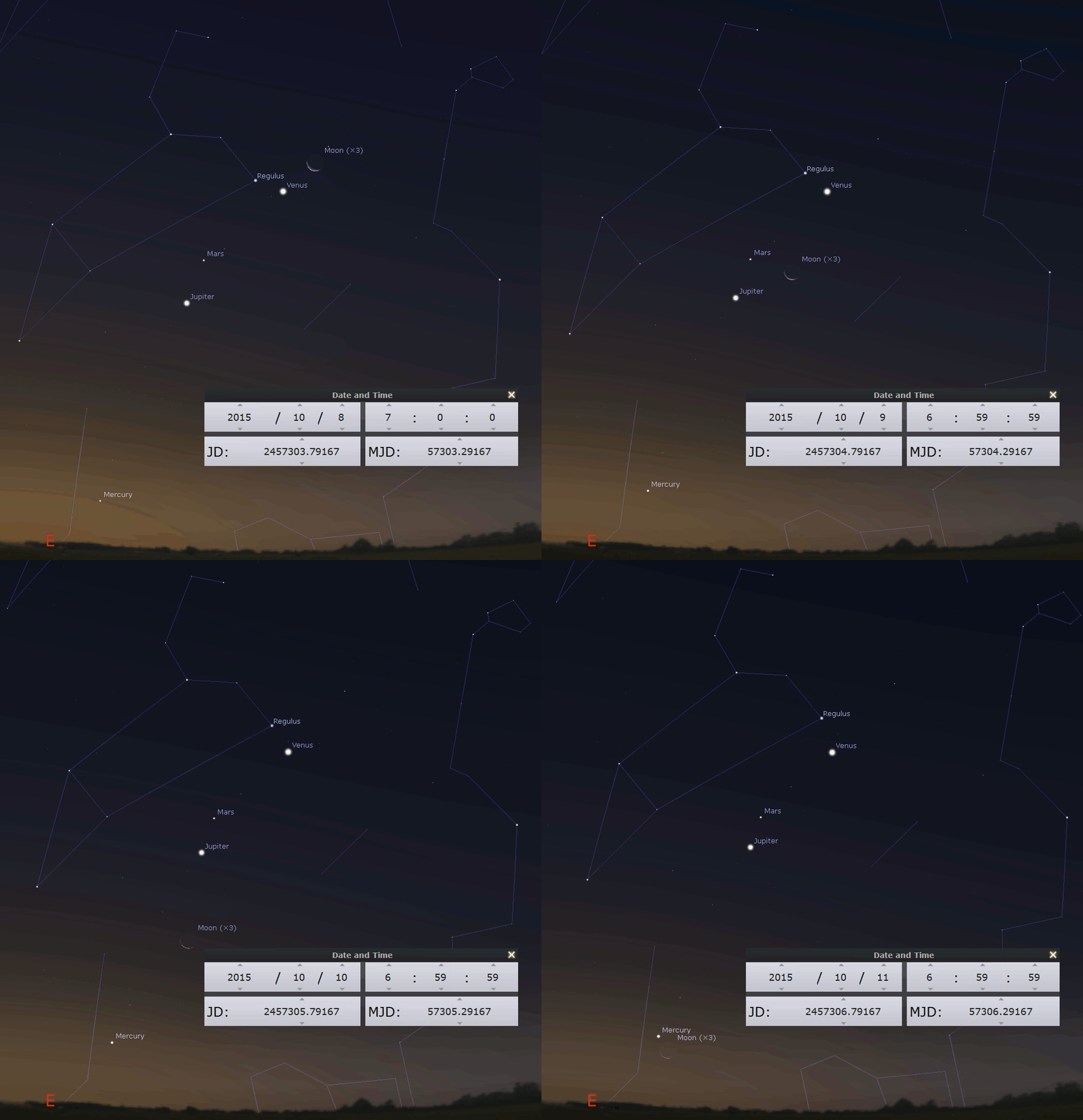
Morning planet animation for 7 a.m. October 8 to 11, 2015. Created using Stellarium and GIMP.
10/08/2015 – Ephemeris – The Draconid meteors will reach peak overnight tonight
Ephemeris for Thursday, October 8th. The Sun will rise at 7:49. It’ll be up for 11 hours and 21 minutes, setting at 7:10. The Moon, half way from last quarter to new, will rise at 4:33 tomorrow morning.
For this and the next few morning the Moon will pass the morning planets. This morning it’s Venus, tomorrow it will be near Mars and Jupiter, and Sunday morning it will be near Mercury.
This evening is the expected peak of the Draconid meteor shower. We can expect anything between zero and hundreds of meteors an hour. The calculated time of the peak number will be around 1:40 a.m. (5:40 UT, October 9). The point in space they will appear to come from is the head of the constellation Draco the dragon, a bit north of the bright star Vega, high in the west in the evening. Meteor experts don’t expect much from the shower this year, but the Draconids are capricious, you never know what to expect. However we do expect them to be slow-moving.
Times are for the Traverse City/Interlochen area of Michigan. They may be different for your location.
Addendum
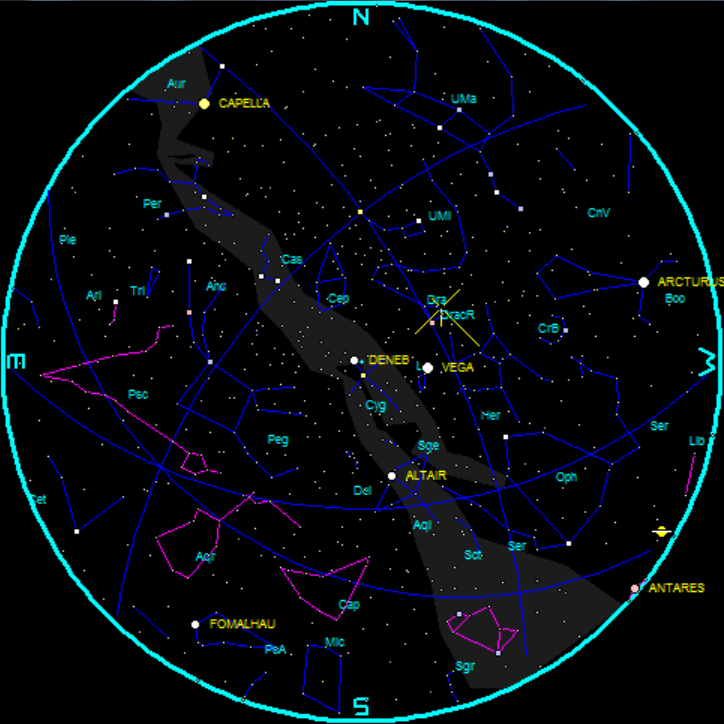
The entire sky dome including the Draconid Radiant (DraR) for 9 p.m. October 8, 2015 (1:00 UT 10/9). Created with my LookingUp program.
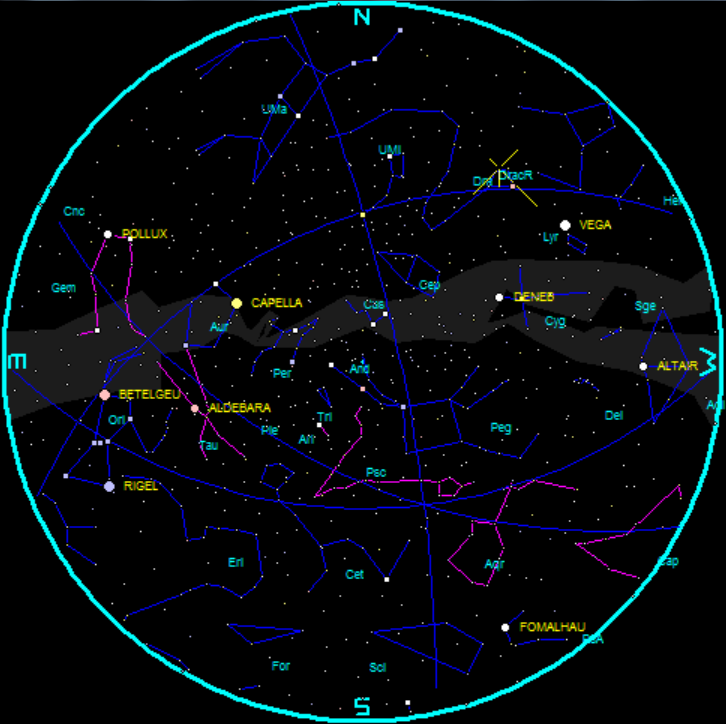
The entire sky dome including the Draconid Radiant (DraR) for 1:40 a.m. October 9, 2015 (05:40 UT). Created with my LookingUp program.
Morning planet animation for 7 a.m. October 8 to 11, 2015. Click on image to enlarge. Note the Moon’s size is tripled for visibility. Created using Stellarium 0.13 and GIMP.
09/28/2015 – Ephemeris – The Harvest Moon effect
Ephemeris for Monday, September 28th. The Sun will rise at 7:36. It’ll be up for 11 hours and 52 minutes, setting at 7:29. The Moon, 1 day past full, will rise at 8:00 this evening.
Yesterday’s full moon was the famous Harvest Moon, the nearest full moon to the autumnal equinox. This is a time of the full and waning gibbous moons in the next few days rising in twilight. In the old days before electric lights it helped farmers by effectively lengthening the hours of light to gather in the crops. The Moon on average rises 50 minutes later each night. The interval between tonight’s moon rise and tomorrow’s will be 38 minutes. The interval between Tuesday and Wednesday will be 42 minutes. This year’s harvest moon effect is spoiled a bit because the Moon was at perigee Sunday, the so-called supermoon, so it’s moving faster in its orbit than average. Like the Sun, the Moon always appears orange or red near the horizon.
Times are for the Traverse City/Interlochen area of Michigan. They may be different for your location.
Addendum
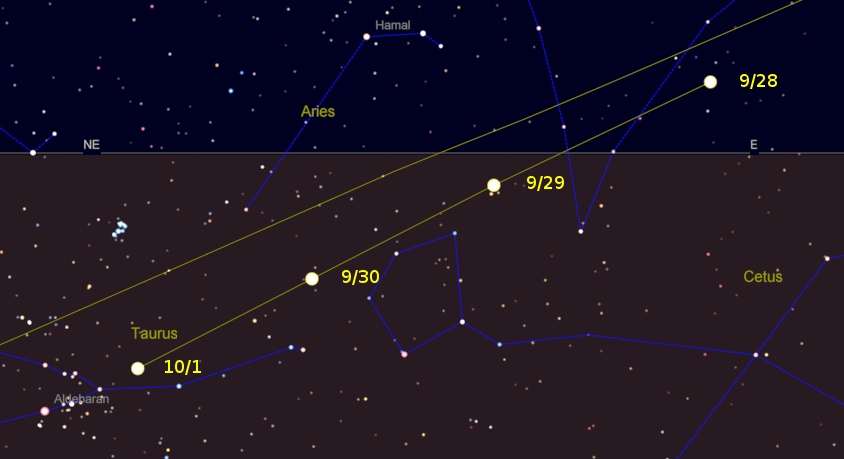
The positions of the Moon from September 28 to October 1, 2015. Note the path of the Moon. At Harvest Moon in northern Michigan time it makes less than a 45 degree angle with the horizon. For other latitudes it’s less than (90 – latitude). shorthand term for 90 – latitude is co-latitude. Created using Cartes du Ciel.
The closer to horizontal the Moon’s path is the shorter the difference in night-to-night rise times.
09/23/2015 – Ephemeris – One planet visible in the evening and three in the morning
Ephemeris for Wednesday, September 23rd. The Sun will rise at 7:30. It’ll be up for 12 hours and 7 minutes, setting at 7:38. The Moon, 2 days past first quarter, will set at 3:09 tomorrow morning.
Lets look at the planets for this first day of autumn. Saturn is alone in the evening sky spotted by 9 p.m. low in the southwestern sky near the bright star Antares to its left. Antares has a reddish hue, while Saturn is brighter and yellowish. Both these colors are enhanced by being low to the horizon. Saturn will set at 10:13 p.m. The rest of the planet action has moved to the morning sky. Venus, the morning star, will rise at 4:09 a.m. a bit north of east. Much dimmer Mars will rise at 4:44 a.m. in the east-northeast. Jupiter is beginning to be visible in the morning sky and will rise at 5:37 in the east-northeast. Mercury, though in the evening sky, sets too soon after the Sun to be visible.
Times are for the Traverse City/Interlochen area of Michigan. They may be different for your location.
Addendum
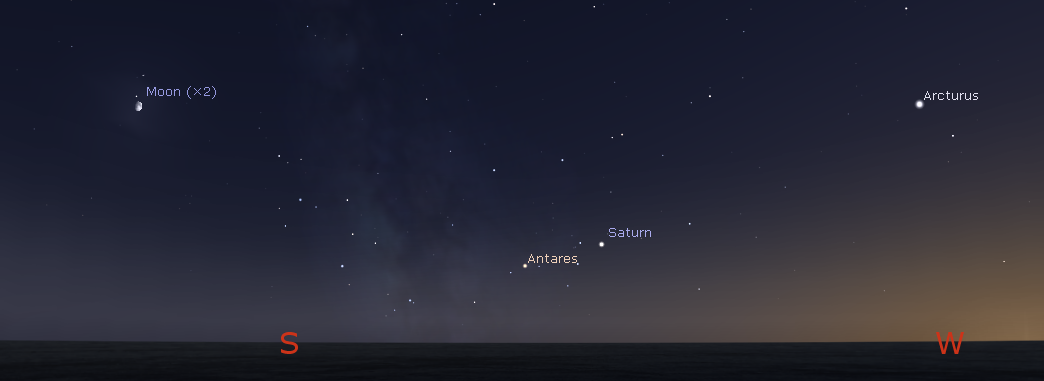
Saturn and the Moon with setting southern summer stars at 8:30 p.m. on September 23, 2015. The Moon is shown twice actual size. Created using Stellarium.
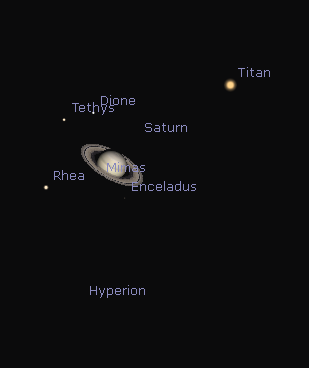
What Saturn and its moons might appear like in a telescope at 8:30 p.m., September 23, 2015. Small telescopes will show only the moon Titan. Created using Stellarium. The telescopic planet charts are all displayed at the same scale.
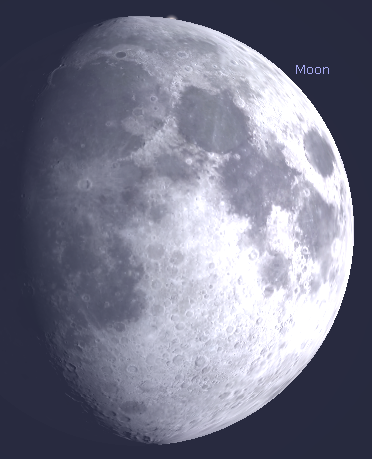
The Moon as it might be seen in binoculars at 8:30 p.m. September 23, 2015. Created using Stellarium.
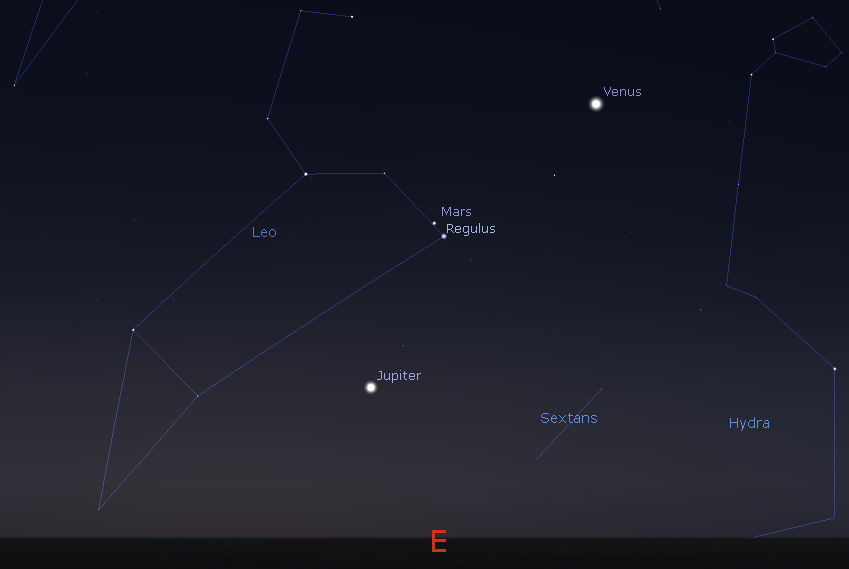
Venus, Mars and Jupiter with the constellation Leo at 6:30 a.m. September 24, 2015. Created using Stellarium.
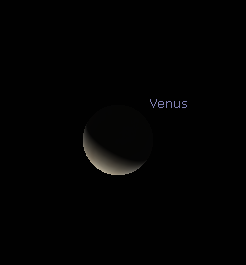
Venus in a telescope at 6:30 a.m. September 24, 2015. Created using Stellarium.
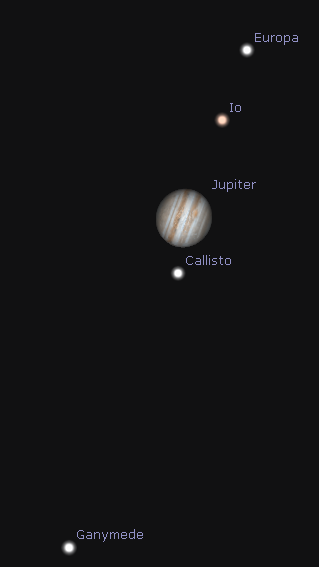
Jupiter and moons in a telescope at 6:30 a.m. September 24, 2015. Created using Stellarium.
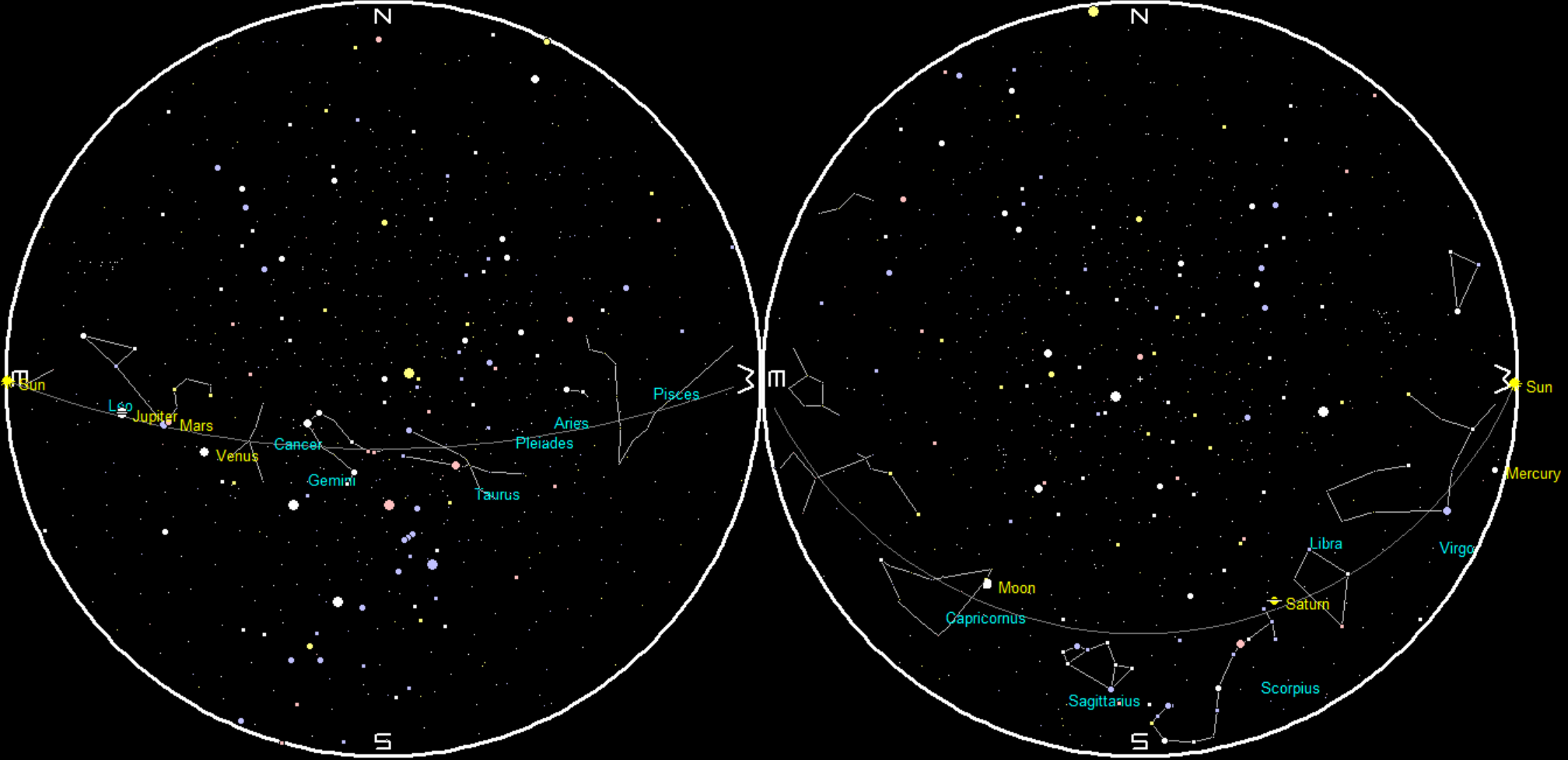
This is a chart showing the sunrise and sunset skies for September 23, 2015 showing the location of the planets and the Moon at that time. Created using my LookingUp program. Click on the image to enlarge.
 Bob Moler's Ephemeris Blog